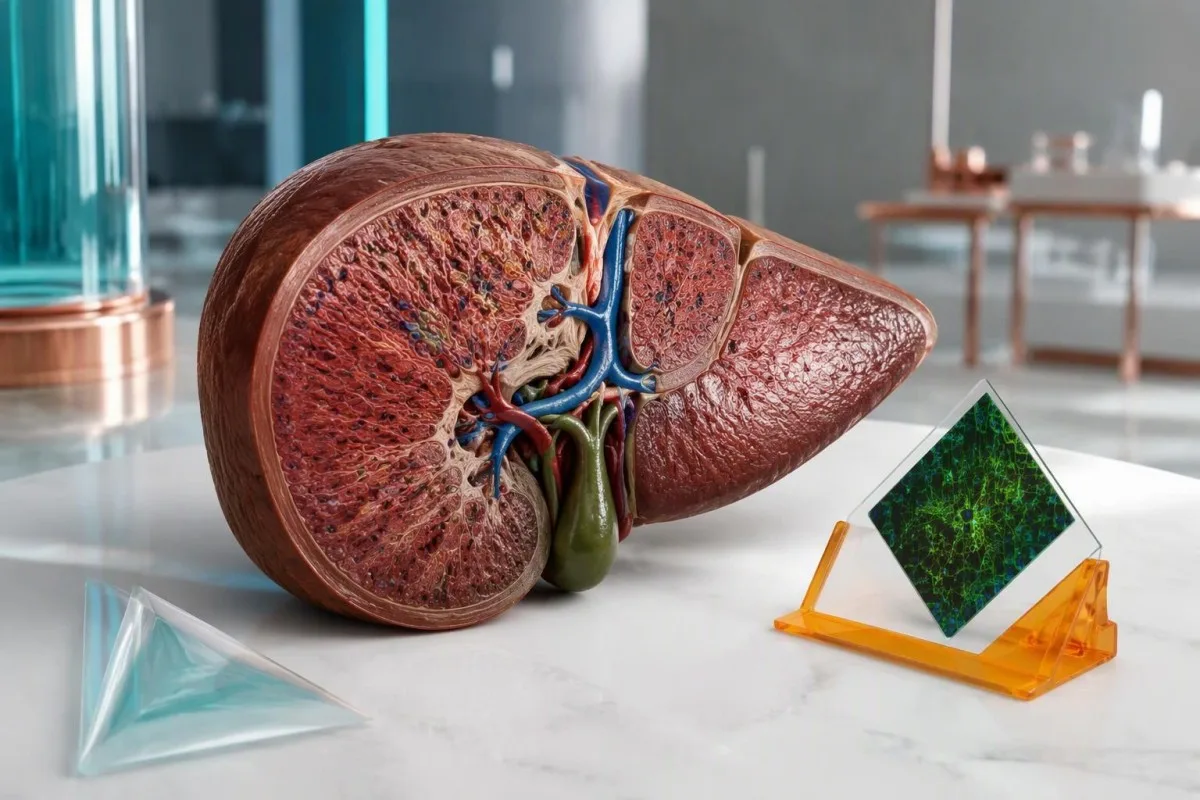
Положителният резултат за антитела е насока, а не диагноза. Важният въпрос е дали съответства на чернодробните ви ензими, нивото на IgG, историята на приеманите лекарства и находките в тъканта.


- Положителните антитела срещу гладката мускулатура сами по себе си не диагностицират автоимунен хепатит; титър на ASMA от 1:40 при възрастен носи само 1 точка към опростения диагностичен резултат.
- По-високите титри на ASMA засилват диагностичната подкрепа, но титрите 1:80 и 1:320 получават еднаквия максимален брой от 2 точки за антитела според опростените критерии.
- Антителата срещу F-актин разпознават по-специфична мишена на антителата, но положителният резултат все пак трябва да се разглежда в контекста на чернодробните показатели и клиничната картина; единиците на теста не могат да се преобразуват в титри на ASMA.
- Общият IgG над горната референтна граница на лабораторията подкрепя диагнозата автоимунен хепатит; ниво над 1.1 пъти тази граница носи 2 точки в опростения резултат.
- Нормален ALT прави случайно установения положителен резултат по-малко притеснителен, макар че нормалните ензими или IgG не изключват напълно автоимунен хепатит.
- Медикаментозна история трябва да включва лекарства по рецепта и хранителни добавки, започнати преди месеци или години, особено нитрофурантоин и миноциклин.
- Чернодробната биопсия обикновено помага за установяване на автоимунен хепатит и оценка на фиброзата; спешните решения за лечение не бива да чакат планови изследвания при тежко болен пациент.
- Спешна оценка е необходимо при жълтеница, съчетана със обърканост, значителна сънливост или повишаващ се INR; INR от поне 1,5 при енцефалопатия може да показва остра чернодробна недостатъчност.
Означават ли положителните антитела срещу гладката мускулатура автоимунен хепатит?
Положителните антитела срещу гладката мускулатура сами по себе си не диагностицират автоимунен хепатит. Резултат с нисък титър, например 1:40, може да е неспецифичен; клиницистите търсят съответстваща картина на повишен ALT или AST, повишен IgG, изключване на други чернодробни заболявания и обикновено подкрепящи находки в чернодробната тъкан.
ASMA, наричани още SMA, откриват антитела, реагиращи с компоненти на гладката мускулатура и сродни клетъчни структури; това не означава, че мускулите ви се разрушават. ASMA се свързват най-тясно с автоимунен хепатит тип 1, но могат да се появят и при други имунни реакции или чернодробни заболявания, поради което лабораторната дума „положителен“ не е диагноза.
Да разгледаме 2 показателни резултата: ASMA 1:40 при ALT 24 IU/L и нормален IgG спрямо ASMA 1:160 при ALT 286 IU/L и IgG над лабораторната граница. Вторият модел налага значително по-задълбочено изследване, макар че нито един от двата не установява причината без клинична оценка. Нашето обяснение на положително значение на резултата от антитела разграничава откриването на антитела от доказателствата за активно заболяване.
Кантести е един AI кръвен анализатор което може да помогне за съпоставяне на резултатите за ASMA с чернодробните ензими и IgG, вместо резултат 1:40 да се приема за диагноза. Като Томас Клайн, главен медицински директор, в тази статия се стремя открито да обясня тази логика, включително защо числата не могат да дадат категоричен отговор. Нашите организация и клиничен фокус предоставят контекст за тази образователна роля; диагнозата остава отговорност на клинициста.
Тълкуване на титъра на ASMA: какво означават 1:40 и 1:80?
Титрите на ASMA показват до каква степен може да се разреди пробата, като оцветяването от антителата остава откриваемо. При възрастни опростените критерии за автоимунен хепатит дават 1 точка за ANA или SMA поне 1:40 и 2 точки при поне 1:80; нито един от двата прага самостоятелно не диагностицира хепатит.
Титър от 1:160 означава, че оцветяването остава откриваемо и след по-голямо разреждане, отколкото при 1:40; това не означава 4 пъти повече чернодробно увреждане. В опростените критерии на Hennes et al. точките за антитела достигат максимум 2, така че 1:80 и 1:640 не носят допълнителни диагностични точки. Концентрацията на антителата, чувствителността на анализа и увреждането на тъканите са свързани несъвършено — и това разграничение помага да се избегне ненужна тревога.
Лабораторните методи влияят върху съпоставимостта на резултатите. Индиректната имунофлуоресценция върху тъканни субстрати, специфичните за антигена анализи, началните разреждания и правилата за отчитане се различават между лабораториите; промяната от 1:40 на 1:80 може да представлява една стъпка на разреждане, а не клинично значима промяна. Същата предпазливост важи и за тълкуването на ANA теста, особено когато едновременно се появят няколко слабо положителни антитела.
При децата е необходимо различно тълкуване: Титри на SMA до 1:20 могат да са значими при подходяща клинична картина при дете. Праговете за оценка при възрастни не бива да се прилагат механично към резултатите на дете без преценка от специалист, а скринингов тест по стандартите за възрастни с отрицателен резултат може да пропусне находки с по-нисък титър при деца. Попитайте лабораторията какъв субстрат и начално разреждане са използвани; тези подробности често са по-полезни от повторното изследване в друга лаборатория.
Изяснява ли диагнозата положителният резултат за антитела срещу F-актин?
An F-actin antibody positive result can strengthen suspicion of autoimmune hepatitis, but it is not a stand-alone confirmation. F-actin testing targets filamentous actin, one antigen recognized by some smooth muscle antibodies; its usefulness depends on the assay, strength of positivity, and accompanying liver abnormalities.
F-actin assays and ASMA titers are different measurements. Some commercial ELISA methods report less than 20 units as negative, 20–30 as weakly positive, and above 30 as positive, but other kits use different categories and units. A result of 25 units must therefore be read against that report's reference interval, not a cutoff copied from another laboratory or an online discussion.
A weak F-actin result with ASMA 1:40 and normal ALT may add little certainty; a clearly positive result alongside persistent enzyme elevation and increased IgG is more persuasive. F-actin antibodies can occur outside autoimmune hepatitis, including in other liver diseases, while some patients with autoimmune hepatitis lack detectable F-actin antibodies. This is a probability adjustment, not a yes-or-no confirmation switch.
Discordant tests deserve a method check before another diagnosis is added. ASMA may recognize targets other than F-actin, and antigen preparation can influence an ELISA result, so positive ASMA with negative F-actin is not automatically a laboratory error. Our guide to качествени и количествени резултати explains why 1:80, 25 units, and a simple positive flag cannot be converted into one interchangeable number.
Защо общият IgG е по-важен от още един положителен резултат за антитела?
Elevated total IgG supports autoimmune hepatitis because it reflects increased immunoglobulin production accompanying immune-mediated liver injury. The simplified criteria award 1 point above the laboratory upper limit and 2 points above 1.1 times that limit; normal IgG does not completely exclude the disease.
Adult IgG reference intervals commonly approximate 7–16 g/L, equivalent to 700–1,600 mg/dL, although laboratory and age-specific ranges take priority. If the upper limit is 16 g/L, an IgG of 17 g/L exceeds normal, while 18 g/L exceeds 1.1 times the limit of 17.6 g/L. Use the measured total IgG—not total protein—to make that comparison.
Globulin and the gamma gap cannot substitute for quantitative IgG. For example, total protein 84 g/L minus albumin 38 g/L produces a 46 g/L gap, but that gap contains proteins other than IgG and does not prove autoimmune hepatitis. Our gamma gap interpretation guide explains why an apparently useful shortcut can send the investigation down the wrong path.
Normal IgG should lower confidence in a classic presentation, not close the case when ALT is 500 IU/L or the patient is jaundiced. Acute presentations can lack the usual immunoglobulin pattern, and IgG can also rise with cirrhosis or other inflammatory conditions. Read IgG, IgA и IgM заедно when the protein abnormality is broader than isolated IgG elevation.
При какъв модел на чернодробните показатели положителният резултат за ASMA е по-притеснителен?
Persistent ALT and AST elevation makes positive ASMA more concerning, especially when IgG is also elevated. Autoimmune hepatitis usually produces a hepatocellular pattern—aminotransferases rising more prominently than alkaline phosphatase—but the enzyme magnitude alone cannot identify the cause or accurately measure liver function.
ALT reflects injury more than function. An ALT of 240 IU/L with an upper limit of 40 is 6 times the upper limit, but that ratio does not distinguish autoimmune hepatitis from viral hepatitis, drug injury, or several other causes. Bilirubin, INR, albumin, symptoms, and the direction of change tell a different part of the story; our обяснение на резултатите от ALT separates these roles.
The R-отношение compares ALT divided by its upper limit with ALP divided by its upper limit; a ratio at least 5 supports a hepatocellular injury pattern, particularly in drug-injury assessment. ALT 240/40 and ALP 120/120 give an R ratio of 6. This calculation classifies the pattern, not the diagnosis, and should use values obtained at the same time.
Disproportionate ALP elevation changes the differential diagnosis. If ALP is 3 times its upper limit while ALT is only mildly raised, clinicians consider biliary obstruction, primary biliary cholangitis, primary sclerosing cholangitis, or an overlap presentation rather than assuming isolated autoimmune hepatitis. Our guide to cholestatic liver-test patterns shows why GGT and imaging may become more useful than another ASMA measurement.
Доколко успокоителни са нормалните чернодробни ензими при положителен резултат за ASMA?
Positive ASMA with repeatedly normal liver enzymes is generally less concerning than ASMA with unexplained enzyme elevation. In a retrospective cohort reported by Healey et al. in 2016, only 1 of 202 people with SMA positivity and ALT below 55 IU/L subsequently received an autoimmune hepatitis diagnosis.
The observed proportion was approximately 0.5%, not zero. That study's ALT threshold of 55 IU/L was part of its design and should not become everyone's definition of normal, particularly when your laboratory uses a lower limit. The retrospective population also cannot provide an individualized probability for someone with jaundice, high IgG, prior abnormal tests, or established liver disease.
For an illustrative patient with ASMA 1:40, ALT 26 IU/L, normal bilirubin, and normal IgG, the next step is usually clinical review rather than immediate immunosuppression. A clinician may choose a repeat liver panel in roughly 6–12 weeks when a recent illness, medication exposure, or uncertain baseline needs clarification, but there is no universal ASMA-specific retesting interval. Review mild ALT elevation follow-up if the supposedly normal result is actually borderline.
Previous results can overturn a reassuring snapshot. An ALT of 30 IU/L today means something different after an unexplained value of 300 IU/L last month, especially if corticosteroids were started between samples. Bring at least 2 dated panels when possible; the important question is whether injury never occurred, resolved after a trigger disappeared, or was suppressed by treatment rather than truly excluded.
Могат ли лекарства да причинят положителен резултат за ASMA и хепатит, подобен на автоимунен?
Some medicines can cause liver injury with ASMA positivity, increased IgG, and tissue findings resembling autoimmune hepatitis. Nitrofurantoin and minocycline are classic examples; exposure may precede recognition by months or years, so a medication taken uneventfully for 2 years still belongs in the history.
The start date matters as much as the medicine name. Hydralazine, methyldopa, and some biologic medicines can also produce autoimmune-like liver injury, while herbal products may cause other injury patterns that coexist with incidental antibodies. Write down dose changes, intermittent courses, and supplements used during the preceding 12 months; include longer-standing drugs rather than limiting the list to something newly prescribed last week.
Drug-induced autoimmune-like hepatitis and idiopathic autoimmune hepatitis can look remarkably similar initially. Improvement after supervised withdrawal and the longer-term relapse pattern help distinguish them, but ALT may take weeks to fall and some patients still require corticosteroids. A fall from 400 to 200 IU/L is encouraging, not proof of the cause; persistent or recurrent injury needs reassessment rather than a premature label.
Кантести е един Платформа за интерпретация на биомаркери с AI that can help arrange laboratory trends beside medication dates, but it cannot determine causality from an ASMA titer of 1:80. Our AI технологичен гид за интерпретация describes the supporting workflow rather than a replacement for hepatology assessment. Do not stop an essential prescription on your own; suspected liver injury requires prompt prescriber advice, with emergency assessment when symptoms are severe.
Какво друго трябва да се изключи, преди състоянието да се определи като автоимунен хепатит?
Viral hepatitis, drug injury, metabolic liver disease, and selected inherited conditions must be considered before attributing liver injury to positive ASMA. The AASLD practice guidance emphasizes compatible findings and exclusion of competing explanations; antibody positivity does not protect a patient from having a second, more common condition.
Acute hepatitis E can resemble autoimmune hepatitis, including marked aminotransferase elevation, and testing depends on exposure, geography, immune status, and clinical presentation. Hepatitis B and C assessment is also part of a standard liver work-up, with hepatitis A or other viruses considered when appropriate. Our hepatitis E testing explanation clarifies why IgM, IgG, and PCR answer different questions rather than supplying 3 interchangeable confirmations.
MASLD can coexist with positive autoantibodies. An illustrative person with metabolic risk factors, liver fat on imaging, ALT 65 IU/L, ASMA 1:40, and normal IgG may have steatotic liver disease rather than autoimmune hepatitis, although coexisting disease remains possible. Our guide to metabolic liver disease testing explains how fibrosis assessment differs from identifying an immune cause.
In younger patients, unexplained hepatitis may require consideration of Wilson disease; iron overload and alpha-1 antitrypsin deficiency enter the differential according to age and presentation. An ALP elevation of 3 times normal also raises questions about biliary disease or overlap syndromes rather than simply increasing the apparent strength of ASMA. Kantesti AI should support a discussion of missing context, not automatically order every available test because 1 antibody is positive.
Кога е необходима чернодробна биопсия за изследване на положителен резултат за ASMA?
Liver biopsy is usually needed to establish autoimmune hepatitis when the clinical and laboratory findings suggest it. Tissue assessment can identify hepatitis, evaluate fibrosis, and reveal competing explanations; the AASLD guidance advises against diagnosing autoimmune hepatitis without biopsy, while urgent or unsafe situations require specialist judgment.
Interface hepatitis describes immune-cell activity at the boundary between portal areas and liver-cell plates; it supports autoimmune hepatitis but is not unique to it. Plasma-cell-rich inflammation can be helpful, yet its absence does not exclude the diagnosis, and drug injury can produce similar appearances. A tissue report must be interpreted alongside ASMA 1:80, IgG, viral testing, and the medication timeline—not treated as another isolated positive test.
Fibrosis tests cannot replace diagnostic histology. Liver stiffness may rise during active hepatitis, so a FibroScan value obtained while ALT is 500 IU/L can overstate fibrosis relative to a measurement after the injury settles. Our FibroScan result guide explains the distinction between stiffness and cause; a scan cannot show the cellular pattern needed to evaluate autoimmune hepatitis.
Biopsy timing and route depend on safety. A patient with impaired clotting, fluid accumulation, or severe acute illness may need a transjugular approach or a different immediate plan rather than routine percutaneous sampling. Likewise, a FIB-4 risk calculation can be distorted by acute AST elevation or platelets falling for another reason; none of these tools should delay urgent care when INR is rising toward or above 1.5.
Как клиницистите изчисляват комбинирания резултат за автоимунен хепатит?
The simplified autoimmune hepatitis score combines autoantibodies, IgG, liver histology, and exclusion of viral hepatitis. Hennes et al. developed an 8-point system in which at least 6 points supports probable and at least 7 supports definite autoimmune hepatitis; the score assists clinical judgment rather than replacing it.
Autoantibody points are capped at 2. ANA 1:160 plus ASMA 1:160 does not produce 4 points, and adding F-actin positivity is not a separate extra-point category. Anti-LKM1 at the qualifying threshold or positive anti-SLA can contribute within the same antibody category, but assay details matter. This prevents several related tests from being mistaken for several independent proofs of one diagnosis.
An illustrative adult with ASMA 1:80, IgG 1.2 times normal, typical histology, and excluded viral hepatitis reaches 8 points: 2 in each category. Another patient could mathematically reach 6 without histology, but that arithmetic does not justify bypassing the AASLD biopsy recommendation or ignoring medication-related injury. The original Hennes et al. criteria are a clinical framework, not a self-diagnosis calculator.
A low simplified score does not reliably dismiss every atypical presentation. Acute severe disease, normal IgG, or absent conventional antibodies can require a specialist assessment using additional evidence or a more detailed scoring system. Our стандарти за клинична методология explain why interpretation tools need explicit limitations; neither a 5-point estimate nor an 8-point estimate should independently decide whether someone starts immunosuppression.
Кои находки изискват спешна оценка, а не рутинно проследяване?
Urgency depends on symptoms and liver dysfunction, not the ASMA titer. New jaundice with confusion, unusual drowsiness, significant bleeding, or rapidly worsening illness needs emergency assessment; INR at least 1.5 with hepatic encephalopathy can indicate acute liver failure in someone without pre-existing cirrhosis.
A rising INR can be more concerning than a rising antibody titer. Interpretation must account for warfarin, vitamin K deficiency, and other causes, but an unexplained INR of 1.6 during acute hepatitis deserves prompt clinical attention rather than waiting for repeat ASMA. Our обяснение на резултата за INR distinguishes a clotting-time measurement from a diagnosis and explains why medication context changes its meaning.
ALT at least 5 times the upper limit warrants timely investigation, particularly with symptoms or increasing bilirubin, although there is no universal ASMA-specific ALT threshold that automatically means admission. A patient with ALT 220 IU/L, rising bilirubin, and poor intake may need faster assessment than someone with ALT 400 IU/L who has stable function and an established treatment plan. Numbers need a trajectory and a bedside assessment.
Conjugated bilirubin elevation points toward hepatobiliary dysfunction, but it does not distinguish autoimmune hepatitis from obstruction or another hepatitis. New yellow eyes or dark urine should prompt assessment, even if ASMA is only 1:40; our ръководство за модели на директен билирубин explains the competing mechanisms. Do not wait for an AI interpretation, a second antibody result, or an elective appointment if confusion or significant drowsiness develops.
Трябва ли положителният резултат за ASMA да се лекува със стероиди или азатиоприн?
Positive ASMA alone should not be treated with corticosteroids or azathioprine. Treatment targets confirmed or strongly supported active autoimmune hepatitis, not an antibody concentration; even a titer of 1:320 does not justify immunosuppression when the clinical evidence for liver disease is absent.
Confirmed autoimmune hepatitis is treatable, commonly with corticosteroid-based induction and a steroid-sparing medicine selected for the individual patient. Disease severity, cirrhosis, pregnancy considerations, infection risk, and medication tolerance affect the regimen, so a laboratory report cannot safely generate a dose. The initial aim is improvement and eventual normalization of ALT, AST, and IgG—not necessarily making an ASMA titer of 1:160 disappear.
Azathioprine requires safety assessment and monitoring. TPMT and, where appropriate, NUDT15 testing help identify susceptibility to severe thiopurine toxicity, but reassuring results do not remove the need for blood-count and liver-test monitoring. Our TPMT testing explanation describes these limits; early checks are often arranged within weeks, sometimes every 1–2 weeks during initiation or adjustment, according to the treating service's protocol.
Diet cannot erase positive smooth muscle antibodies or replace immunosuppression. Adequate protein and individualized calcium and vitamin D assessment may support patients receiving prolonged corticosteroids, whereas unregulated liver-detox supplements can complicate the investigation. Kantesti can help organize 2 or more dated panels for a treatment discussion, but treatment response, steroid tapering, and possible withdrawal must be managed by the clinician because relapse can occur despite previous normal results.
Какво трябва да направите, след като получите положителен резултат за ASMA?
After a positive ASMA result, obtain the exact titer or assay value and review it with liver enzymes, total IgG, symptoms, and medication history. A useful first appointment needs the original report and previous results; 2 dated panels often reveal more than repeating the antibody immediately.
Bring the report rather than only a screenshot of the positive flag. Confirm whether the result was ASMA by immunofluorescence, F-actin by ELISA, or both, and include the laboratory reference interval and units. Kantesti is an Инструмент за анализ на кръвни изследвания с AI that can help organize this information, but an extracted value such as 25 units should always be checked against the original document before it influences care.
I would prioritize 3 questions: Is there persistent hepatocellular injury, is IgG genuinely elevated, and has a plausible competing cause been addressed? That is the reasoning Thomas Klein uses here—not a claim that one threshold can diagnose an individual reader. Our Медицински консултативен съвет describes the clinical expertise behind our educational approach; a hepatologist must still decide whether additional serology, imaging, or tissue assessment is appropriate.
Share only the information needed for the task, and check consent before uploading a relative's results. Our практики за поверителност и обработване на данни describe the handling framework; laboratory identifiers and unrelated personal details deserve attention even when a result feels urgent. As of 20 октомври 2026 г., the practical message remains unchanged: use ASMA as 1 component of a liver assessment, not as a diagnosis or a reason to start treatment yourself.
Публикации на научни изследвания и доказателствата зад тази интерпретация
The clinical interpretation rests on autoimmune hepatitis guidance, diagnostic-criteria research, and outcome data—not on educational DOI registration alone. The 2008 Hennes criteria, 2019 AASLD guidance published in 2020, and Healey's 2016 cohort address different questions: diagnostic support, clinical management, and the significance of incidental SMA positivity.
The AASLD guidance supports a combined diagnostic assessment, including liver histology and exclusion of competing causes (Mack et al., 2020). Hennes et al. (2008) provide the 8-point simplified framework, while Healey et al. (2016) offer observational evidence about patients whose ALT was below 55 IU/L. These sources are not interchangeable: a retrospective follow-up study cannot replace a biopsy recommendation or determine an individual treatment plan.
Serum-protein education helps prevent misreading IgG-related clues. Нашите наръчник за интерпретация на серумни протеини explains albumin and globulin distinctions, including why albumin 38 g/L and a raised protein gap do not establish immune-mediated hepatitis. The related Zenodo publication is listed below as supporting educational material, not as primary evidence validating ASMA specificity, the 1:80 threshold, or autoimmune hepatitis treatment.
Coagulation education explains a different part of liver assessment: the significance of impaired protein synthesis and interpretation of clotting results. Our coagulation biomarker guide provides background, but an INR of 1.5 during acute hepatitis must be assessed using the patient's clinical situation rather than an aPTT reference range. The 2 Kantesti educational publications below use n.d. where publication dates were not supplied; discovery links are searches, not claims of verified hosting on ResearchGate or Academia.edu.
Често задавани въпроси
Какво означава положителен тест за антитела срещу гладката мускулатура?
0 A positive smooth muscle antibody test means antibodies reacting with smooth muscle-associated cellular targets were detected; it does not independently diagnose autoimmune hepatitis. In adults, ASMA at 1:40 contributes 1 point to the simplified diagnostic score, while at least 1:80 contributes 2 points. Clinicians interpret the finding alongside ALT, AST, total IgG, medications, exclusion testing, and usually liver biopsy. Repeatedly normal liver enzymes generally make incidental positivity less concerning.
0 Смущаващ ли е титър на ASMA 1:40?
Титърът на ASMA 1:40 е нисък титър при възрастни, който може да се наблюдава и без автоимунен хепатит. Той носи 1 точка по опростените критерии, но сам по себе си не представлява диагноза и не е показател за увреждане на черния дроб. Резултат 1:40 при ALT 25 IU/L и нормален IgG се интерпретира различно от същия титър при персистиращо повишение на ALT и жълтеница. При децата могат да бъдат клинично значими и по-ниски титри, включително 1:20, затова резултатите при деца трябва да се оценяват спрямо възрастта.
Потвърждава ли положителният тест за антитела срещу F-актин автоимунен хепатит?
Положителният резултат за антитела срещу F-актин сам по себе си не потвърждава автоимунен хепатит. Някои тестове определят стойности под 20 единици като отрицателни, а стойности 20–30 единици като слабо положителни, но тези гранични стойности зависят от използвания тестов комплект и с предимство е референтният интервал на лабораторията, извършила изследването. Резултатите за F-актин не могат да се преобразуват в титри на разреждане на ASMA, например 1:80. Повишените чернодробни ензими, повишеният IgG, изключването на други причини и обикновено хистологичното изследване на черния дроб определят дали резултатът има клинично значение.
Възможно ли е антителата срещу гладката мускулатура да са положителни при нормални чернодробни ензими?
0 Гладкомускулните антитела може да са положителни въпреки нормалните чернодробни ензими. В ретроспективна кохорта, публикувана от Healey и съавтори през 2016 г., 1 от 202 души с положителен резултат за SMA и ALT под 55 IU/L впоследствие са получили диагноза автоимунен хепатит, приблизително 0.5%. Този праг от проучването не е универсална горна граница на нормата за ALT, а предходни отклонения в изследванията, симптоми или високи нива на IgG може да променят оценката. Проследяването трябва да е индивидуализирано, вместо да се приема, че антитялото налага лечение или чести изследвания през целия живот.
Необходима ли ми е чернодробна биопсия, ако тестът ми за ASMA е положителен?
Изолиран положителен резултат от теста за ASMA не налага автоматично чернодробна биопсия. Биопсия обикновено е необходима, когато клинично се подозира автоимунен хепатит поради персистиращо чернодробно увреждане, повишен IgG или други подкрепящи находки; указанията на AASLD препоръчват да не се диагностицира автоимунен хепатит без биопсия. Титър 1:160 при нормални чернодробни изследвания сам по себе си не е основание за спешна биопсия. Тежко остро заболяване или INR поне 1,5 налага специалист да прецени спешността, безопасността и подходящия подход за изследване.
Могат ли положителните антитела срещу гладката мускулатура да изчезнат?
Резултатите за антитела срещу гладката мускулатура може да отслабнат или да станат отрицателни с времето, особено когато преходен имунен отговор или отключващ фактор, свързан с лекарство, отшуми. Промяната от 1:80 на 1:40 е само с 1 стъпка на разреждане и може също да отразява вариации в анализа, а не значимо клинично подобрение. При установен автоимунен хепатит ALT, AST и IgG по принцип са по-полезни маркери за отговор на лечението от повторните титри на ASMA. Само персистиращата позитивност за антитела не е основание за започване или увеличаване на имуносупресията.
Вземете анализ на кръвен тест с ИИ още днес
Присъединете се към над 2M+ потребители по целия свят, които се доверяват на Kantesti за моментален и точен анализ на лабораторни тестове. Качете резултатите от вашия кръвен тест и получете цялостно тълкуване на биомаркерите 15,000+ за секунди.
📚 Публикации от изследвания с препратки
Klein, T., Mitchell, S., & Weber, H. (2026). aPTT Нормален диапазон: D-димер, протеин C Ръководство за кръвосъсирване. Kantesti AI Medical Research.
Klein, T., Mitchell, S., & Weber, H. (2026). Ръководство за серумни протеини: Кръвен тест за глобулини, албумин и съотношение A/G. Kantesti AI Medical Research.
📖 Външни медицински източници
Mack CL et al. (2020). Diagnosis and Management of Autoimmune Hepatitis in Adults and Children: 2019 Practice Guidance and Guidelines From the American Association for the Study of Liver Diseases. Hepatology.
Hennes EM et al. (2008). Simplified criteria for the diagnosis of autoimmune hepatitis. Hepatology.
Healey R et al. (2016). Do anti-smooth muscle antibodies predict development of autoimmune hepatitis in patients with normal liver function? A retrospective cohort review.Ръководство за пациенти: Тълкуване на лабораторни изследвания 2026, актуализация. Леко абнормни стойности, прегледани от клиницист, са чести, но времето на...
⚕️ Медицинска декларация
Тази статия е само с образователна цел и не представлява медицински съвет. Винаги се консултирайте с квалифициран медицински специалист за решения относно диагностика и лечение.
Сигнали за доверие E-E-A-T
Опит
Медицински преглед, воден от лекар, на работните процеси за интерпретация на лабораторни резултати.
Експертиза
Фокус в лабораторната медицина върху това как се държат биомаркерите в клиничен контекст.
Авторитетност
Написано от д-р Томас Клайн, с преглед от д-р Сара Мичъл и проф. д-р Ханс Вебер.
Надеждност
Интерпретация, основана на доказателства, с ясни последващи стъпки за намаляване на тревогата.