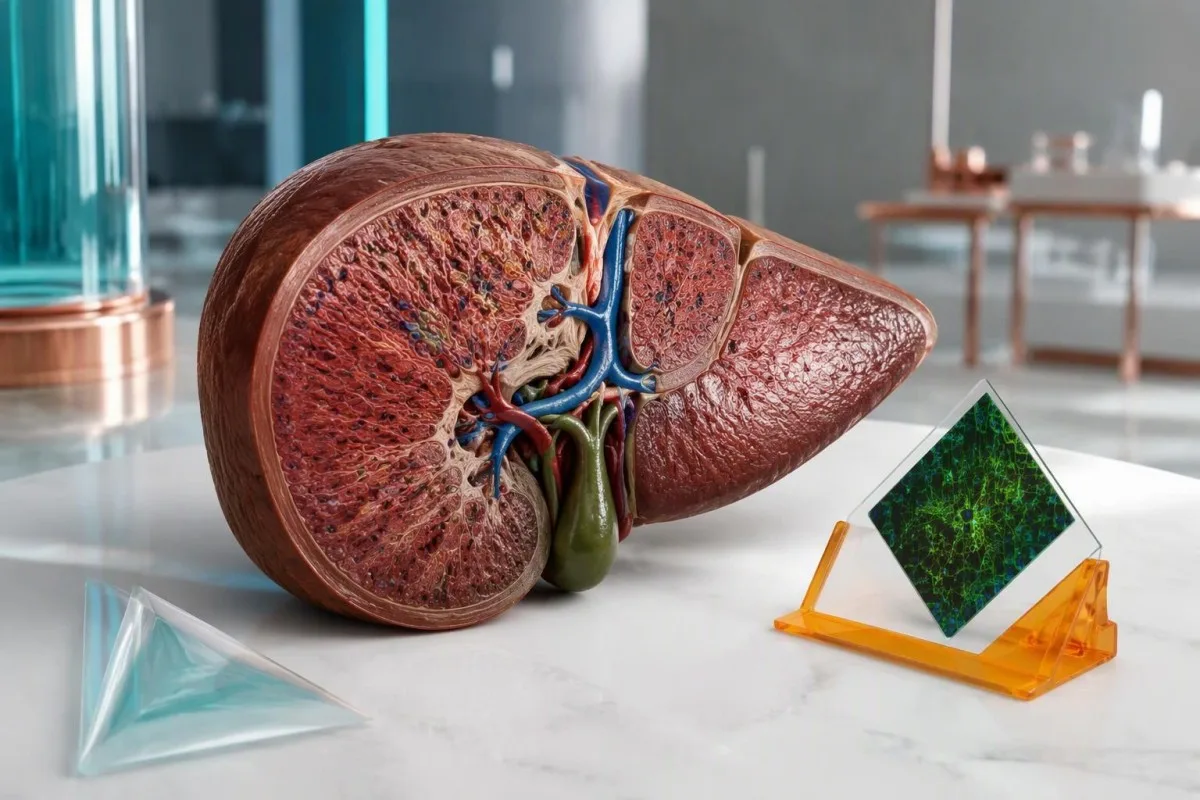
Pozitivan rezultat na antitela je smernica, a ne dijagnoza. Važno pitanje je da li se uklapa u vrednosti jetrenih enzima, nivo IgG-a, istoriju uzimanja lekova i nalaze tkiva.


- Pozitivna antitela na glatku muskulaturu sama po sebi ne dijagnostikuju autoimunski hepatitis; titar ASMA od 1:40 kod odraslih donosi samo 1 poen u pojednostavljenom dijagnostičkom skoru.
- Viši titri ASMA pružaju snažniju dijagnostičku potporu, ali titri od 1:80 i 1:320 donose isti maksimalni broj od 2 poena za antitela prema pojednostavljenim kriterijumima.
- Antitela na F-aktin prepoznaju specifičniji cilj antitela, ali pozitivan rezultat i dalje treba tumačiti u kontekstu nalaza jetrenih testova i kliničke slike; jedinice testa ne mogu se preračunati u titre ASMA.
- Ukupni IgG iznad gornje granice referentnog opsega laboratorije podržava dijagnozu autoimunskog hepatitisa; nivo iznad 1,1 puta te granice donosi 2 poena u pojednostavljenom skoru.
- Нормалан ALT čini slučajno otkrivenu pozitivnost manje zabrinjavajućom, mada normalne vrednosti enzima ili IgG-a ne isključuju uvek autoimunski hepatitis.
- историја лекова treba da obuhvati lekove na recept i suplemente uvedene pre nekoliko meseci ili godina, naročito nitrofurantoin i minociklin.
- Biopsija jetre obično pomaže u postavljanju dijagnoze autoimunog hepatitisa i proceni fibroze; odluke o hitnom lečenju ne treba odlagati zbog elektivnog testiranja kod teško obolelog pacijenta.
- Потребна је хитна процена je potrebno kod žutice praćene konfuzijom, izraženom pospanošću ili porastom INR-a; INR od najmanje 1,5 uz encefalopatiju može ukazivati na akutno zatajenje jetre.
Da li pozitivna antitela na glatku muskulaturu ukazuju na autoimunski hepatitis?
Pozitivna antitela na glatke mišiće sama po sebi ne dijagnostikuju autoimuni hepatitis. Rezultat niskog titra, kao što je 1:40, može biti nespecifičan; lekari traže odgovarajući obrazac povišenog ALT-a ili AST-a, povećanog IgG-a, isključivanje drugih bolesti jetre i obično potkrepljujuće nalaze u tkivu jetre.
ASMA, koji se naziva i SMA, otkriva antitela koja reaguju sa komponentama glatkih mišića i srodnim ćelijskim strukturama; to ne znači da se vaši mišići uništavaju. ASMA je najtešnje povezan sa autoimunim hepatitisom tipa 1, ali se može javiti i tokom drugih imunskih odgovora ili kod poremećaja jetre, zbog čega laboratorijska reč „pozitivno“ nije dijagnoza bolesti.
Razmotrite 2 ilustrativna rezultata: ASMA 1:40 uz ALT 24 IU/L i normalan IgG, nasuprot ASMA 1:160 uz ALT 286 IU/L i IgG iznad gornje granice laboratorije. Drugi obrazac zahteva znatno detaljniju obradu, iako nijedan ne utvrđuje uzrok bez kliničke procene. Naše objašnjenje pozitivan rezultat antitela značenje razdvaja otkrivanje antitela od dokaza aktivne bolesti.
Кантести је АИ анализатор крви koji može pomoći da se rezultati ASMA sagledaju zajedno sa jetrenim enzimima i IgG-om, umesto da se oznaka 1:40 tretira kao dijagnoza. Kao Thomas Klein, glavni medicinski direktor, u ovom članku nastojim otvoreno da objasnim to obrazloženje, uključujući i situacije u kojima se na osnovu brojeva ne može utvrditi odgovor. Naš organizacija i klinički fokus pruža kontekst za ovu edukativnu ulogu; dijagnoza ostaje odgovornost lekara.
Tumačenje titra ASMA: šta znače 1:40 i 1:80?
Titri ASMA opisuju koliko se uzorak može razblažiti, a da bojenje antitela ostane detektabilno. Kod odraslih, pojednostavljeni kriterijumi za autoimuni hepatitis dodeljuju 1 bod za ANA ili SMA od najmanje 1:40 i 2 boda za najmanje 1:80; nijedan prag samostalno ne dijagnostikuje hepatitis.
Titar od 1:160 znači da bojenje ostaje detektabilno i nakon većeg razblaženja nego pri 1:40; to ne znači 4 puta veće oštećenje jetre. U pojednostavljenim kriterijumima Hennes i saradnika, bodovi za antitela se zaustavljaju na 2, pa 1:80 i 1:640 ne donose dodatne dijagnostičke bodove. Koncentracija antitela, osetljivost testa i oštećenje tkiva samo su delimično povezani — a ta razlika sprečava nepotrebnu zabrinutost.
Laboratorijske metode utiču na uporedivost. Indirektna imunofluorescencija na tkivnim supstratima, testovi specifični za antigene, početna razblaženja i pravila izveštavanja razlikuju se među laboratorijama; promena sa 1:40 na 1:80 može predstavljati samo jedan korak razblaženja, a ne klinički značajnu promenu. Isti oprez važi i za tumačenje ANA testa, naročito kada se istovremeno pojavi nekoliko slabo pozitivnih antitela.
Kod dece je potrebno drugačije tumačenje: Titri SMA od samo 1:20 mogu biti relevantni u odgovarajućoj kliničkoj slici kod dece. Pragove za bodovanje kod odraslih ne treba primenjivati na nalaz deteta bez procene specijaliste, a skrining test prema kriterijumima za odrasle sa negativnim rezultatom može propustiti nalaze niskog titra kod dece. Pitajte laboratoriju koji su supstrat i početno razblaženje korišćeni; ti podaci su često korisniji od ponavljanja testa u drugoj laboratoriji.
Da li pozitivan rezultat na antitela na F-aktin pojašnjava dijagnozu?
An F-actin antibody positive result can strengthen suspicion of autoimmune hepatitis, but it is not a stand-alone confirmation. F-actin testing targets filamentous actin, one antigen recognized by some smooth muscle antibodies; its usefulness depends on the assay, strength of positivity, and accompanying liver abnormalities.
F-actin assays and ASMA titers are different measurements. Some commercial ELISA methods report less than 20 units as negative, 20–30 as weakly positive, and above 30 as positive, but other kits use different categories and units. A result of 25 units must therefore be read against that report's reference interval, not a cutoff copied from another laboratory or an online discussion.
A weak F-actin result with ASMA 1:40 and normal ALT may add little certainty; a clearly positive result alongside persistent enzyme elevation and increased IgG is more persuasive. F-actin antibodies can occur outside autoimmune hepatitis, including in other liver diseases, while some patients with autoimmune hepatitis lack detectable F-actin antibodies. This is a probability adjustment, not a yes-or-no confirmation switch.
Discordant tests deserve a method check before another diagnosis is added. ASMA may recognize targets other than F-actin, and antigen preparation can influence an ELISA result, so positive ASMA with negative F-actin is not automatically a laboratory error. Our guide to kvalitativni i kvantitativni rezultati explains why 1:80, 25 units, and a simple positive flag cannot be converted into one interchangeable number.
Zašto je ukupni IgG važniji od još jednog pozitivnog nalaza antitela?
Elevated total IgG supports autoimmune hepatitis because it reflects increased immunoglobulin production accompanying immune-mediated liver injury. The simplified criteria award 1 point above the laboratory upper limit and 2 points above 1.1 times that limit; normal IgG does not completely exclude the disease.
Adult IgG reference intervals commonly approximate 7–16 g/L, equivalent to 700–1,600 mg/dL, although laboratory and age-specific ranges take priority. If the upper limit is 16 g/L, an IgG of 17 g/L exceeds normal, while 18 g/L exceeds 1.1 times the limit of 17.6 g/L. Use the measured total IgG—not total protein—to make that comparison.
Globulin and the gamma gap cannot substitute for quantitative IgG. For example, total protein 84 g/L minus albumin 38 g/L produces a 46 g/L gap, but that gap contains proteins other than IgG and does not prove autoimmune hepatitis. Our gamma gap interpretation guide explains why an apparently useful shortcut can send the investigation down the wrong path.
Normal IgG should lower confidence in a classic presentation, not close the case when ALT is 500 IU/L or the patient is jaundiced. Acute presentations can lack the usual immunoglobulin pattern, and IgG can also rise with cirrhosis or other inflammatory conditions. Read IgG, IgA i IgM zajedno when the protein abnormality is broader than isolated IgG elevation.
Koji obrazac nalaza jetrenih testova čini pozitivnost na ASMA zabrinjavajućom?
Persistent ALT and AST elevation makes positive ASMA more concerning, especially when IgG is also elevated. Autoimmune hepatitis usually produces a hepatocellular pattern—aminotransferases rising more prominently than alkaline phosphatase—but the enzyme magnitude alone cannot identify the cause or accurately measure liver function.
ALT reflects injury more than function. An ALT of 240 IU/L with an upper limit of 40 is 6 times the upper limit, but that ratio does not distinguish autoimmune hepatitis from viral hepatitis, drug injury, or several other causes. Bilirubin, INR, albumin, symptoms, and the direction of change tell a different part of the story; our objašnjenje ALT rezultata separates these roles.
Тхе R однос compares ALT divided by its upper limit with ALP divided by its upper limit; a ratio at least 5 supports a hepatocellular injury pattern, particularly in drug-injury assessment. ALT 240/40 and ALP 120/120 give an R ratio of 6. This calculation classifies the pattern, not the diagnosis, and should use values obtained at the same time.
Disproportionate ALP elevation changes the differential diagnosis. If ALP is 3 times its upper limit while ALT is only mildly raised, clinicians consider biliary obstruction, primary biliary cholangitis, primary sclerosing cholangitis, or an overlap presentation rather than assuming isolated autoimmune hepatitis. Our guide to cholestatic liver-test patterns shows why GGT and imaging may become more useful than another ASMA measurement.
Koliko umiruju normalne vrednosti jetrenih enzima uz pozitivan ASMA?
Positive ASMA with repeatedly normal liver enzymes is generally less concerning than ASMA with unexplained enzyme elevation. In a retrospective cohort reported by Healey et al. in 2016, only 1 of 202 people with SMA positivity and ALT below 55 IU/L subsequently received an autoimmune hepatitis diagnosis.
The observed proportion was approximately 0.5%, not zero. That study's ALT threshold of 55 IU/L was part of its design and should not become everyone's definition of normal, particularly when your laboratory uses a lower limit. The retrospective population also cannot provide an individualized probability for someone with jaundice, high IgG, prior abnormal tests, or established liver disease.
For an illustrative patient with ASMA 1:40, ALT 26 IU/L, normal bilirubin, and normal IgG, the next step is usually clinical review rather than immediate immunosuppression. A clinician may choose a repeat liver panel in roughly 6–12 weeks when a recent illness, medication exposure, or uncertain baseline needs clarification, but there is no universal ASMA-specific retesting interval. Review mild ALT elevation follow-up if the supposedly normal result is actually borderline.
Previous results can overturn a reassuring snapshot. An ALT of 30 IU/L today means something different after an unexplained value of 300 IU/L last month, especially if corticosteroids were started between samples. Bring at least 2 dated panels when possible; the important question is whether injury never occurred, resolved after a trigger disappeared, or was suppressed by treatment rather than truly excluded.
Mogu li lekovi izazvati pozitivan ASMA i hepatitis nalik autoimunskom?
Some medicines can cause liver injury with ASMA positivity, increased IgG, and tissue findings resembling autoimmune hepatitis. Nitrofurantoin and minocycline are classic examples; exposure may precede recognition by months or years, so a medication taken uneventfully for 2 years still belongs in the history.
The start date matters as much as the medicine name. Hydralazine, methyldopa, and some biologic medicines can also produce autoimmune-like liver injury, while herbal products may cause other injury patterns that coexist with incidental antibodies. Write down dose changes, intermittent courses, and supplements used during the preceding 12 months; include longer-standing drugs rather than limiting the list to something newly prescribed last week.
Drug-induced autoimmune-like hepatitis and idiopathic autoimmune hepatitis can look remarkably similar initially. Improvement after supervised withdrawal and the longer-term relapse pattern help distinguish them, but ALT may take weeks to fall and some patients still require corticosteroids. A fall from 400 to 200 IU/L is encouraging, not proof of the cause; persistent or recurrent injury needs reassessment rather than a premature label.
Кантести је платформа за тумачење биомаркера помоћу AI that can help arrange laboratory trends beside medication dates, but it cannot determine causality from an ASMA titer of 1:80. Our водич за AI тумачење технологије describes the supporting workflow rather than a replacement for hepatology assessment. Do not stop an essential prescription on your own; suspected liver injury requires prompt prescriber advice, with emergency assessment when symptoms are severe.
Šta još treba isključiti pre postavljanja dijagnoze autoimunskog hepatitisa?
Viral hepatitis, drug injury, metabolic liver disease, and selected inherited conditions must be considered before attributing liver injury to positive ASMA. The AASLD practice guidance emphasizes compatible findings and exclusion of competing explanations; antibody positivity does not protect a patient from having a second, more common condition.
Acute hepatitis E can resemble autoimmune hepatitis, including marked aminotransferase elevation, and testing depends on exposure, geography, immune status, and clinical presentation. Hepatitis B and C assessment is also part of a standard liver work-up, with hepatitis A or other viruses considered when appropriate. Our hepatitis E testing explanation clarifies why IgM, IgG, and PCR answer different questions rather than supplying 3 interchangeable confirmations.
MASLD can coexist with positive autoantibodies. An illustrative person with metabolic risk factors, liver fat on imaging, ALT 65 IU/L, ASMA 1:40, and normal IgG may have steatotic liver disease rather than autoimmune hepatitis, although coexisting disease remains possible. Our guide to metabolic liver disease testing explains how fibrosis assessment differs from identifying an immune cause.
In younger patients, unexplained hepatitis may require consideration of Wilson disease; iron overload and alpha-1 antitrypsin deficiency enter the differential according to age and presentation. An ALP elevation of 3 times normal also raises questions about biliary disease or overlap syndromes rather than simply increasing the apparent strength of ASMA. Kantesti AI should support a discussion of missing context, not automatically order every available test because 1 antibody is positive.
Kada je potrebna biopsija jetre radi ispitivanja pozitivnog ASMA?
Liver biopsy is usually needed to establish autoimmune hepatitis when the clinical and laboratory findings suggest it. Tissue assessment can identify hepatitis, evaluate fibrosis, and reveal competing explanations; the AASLD guidance advises against diagnosing autoimmune hepatitis without biopsy, while urgent or unsafe situations require specialist judgment.
Interface hepatitis describes immune-cell activity at the boundary between portal areas and liver-cell plates; it supports autoimmune hepatitis but is not unique to it. Plasma-cell-rich inflammation can be helpful, yet its absence does not exclude the diagnosis, and drug injury can produce similar appearances. A tissue report must be interpreted alongside ASMA 1:80, IgG, viral testing, and the medication timeline—not treated as another isolated positive test.
Fibrosis tests cannot replace diagnostic histology. Liver stiffness may rise during active hepatitis, so a FibroScan value obtained while ALT is 500 IU/L can overstate fibrosis relative to a measurement after the injury settles. Our FibroScan result guide explains the distinction between stiffness and cause; a scan cannot show the cellular pattern needed to evaluate autoimmune hepatitis.
Biopsy timing and route depend on safety. A patient with impaired clotting, fluid accumulation, or severe acute illness may need a transjugular approach or a different immediate plan rather than routine percutaneous sampling. Likewise, a FIB-4 risk calculation can be distorted by acute AST elevation or platelets falling for another reason; none of these tools should delay urgent care when INR is rising toward or above 1.5.
Kako kliničari objedinjuju nalaze u skoru za autoimunski hepatitis?
The simplified autoimmune hepatitis score combines autoantibodies, IgG, liver histology, and exclusion of viral hepatitis. Hennes et al. developed an 8-point system in which at least 6 points supports probable and at least 7 supports definite autoimmune hepatitis; the score assists clinical judgment rather than replacing it.
Autoantibody points are capped at 2. ANA 1:160 plus ASMA 1:160 does not produce 4 points, and adding F-actin positivity is not a separate extra-point category. Anti-LKM1 at the qualifying threshold or positive anti-SLA can contribute within the same antibody category, but assay details matter. This prevents several related tests from being mistaken for several independent proofs of one diagnosis.
An illustrative adult with ASMA 1:80, IgG 1.2 times normal, typical histology, and excluded viral hepatitis reaches 8 points: 2 in each category. Another patient could mathematically reach 6 without histology, but that arithmetic does not justify bypassing the AASLD biopsy recommendation or ignoring medication-related injury. The original Hennes et al. criteria are a clinical framework, not a self-diagnosis calculator.
A low simplified score does not reliably dismiss every atypical presentation. Acute severe disease, normal IgG, or absent conventional antibodies can require a specialist assessment using additional evidence or a more detailed scoring system. Our standardi kliničke metodologije explain why interpretation tools need explicit limitations; neither a 5-point estimate nor an 8-point estimate should independently decide whether someone starts immunosuppression.
Koji nalazi zahtevaju hitnu procenu, a ne rutinsko praćenje?
Urgency depends on symptoms and liver dysfunction, not the ASMA titer. New jaundice with confusion, unusual drowsiness, significant bleeding, or rapidly worsening illness needs emergency assessment; INR at least 1.5 with hepatic encephalopathy can indicate acute liver failure in someone without pre-existing cirrhosis.
A rising INR can be more concerning than a rising antibody titer. Interpretation must account for warfarin, vitamin K deficiency, and other causes, but an unexplained INR of 1.6 during acute hepatitis deserves prompt clinical attention rather than waiting for repeat ASMA. Our objašnjenje rezultata INR-a distinguishes a clotting-time measurement from a diagnosis and explains why medication context changes its meaning.
ALT at least 5 times the upper limit warrants timely investigation, particularly with symptoms or increasing bilirubin, although there is no universal ASMA-specific ALT threshold that automatically means admission. A patient with ALT 220 IU/L, rising bilirubin, and poor intake may need faster assessment than someone with ALT 400 IU/L who has stable function and an established treatment plan. Numbers need a trajectory and a bedside assessment.
Conjugated bilirubin elevation points toward hepatobiliary dysfunction, but it does not distinguish autoimmune hepatitis from obstruction or another hepatitis. New yellow eyes or dark urine should prompt assessment, even if ASMA is only 1:40; our vodič za obrasce direktnog bilirubina explains the competing mechanisms. Do not wait for an AI interpretation, a second antibody result, or an elective appointment if confusion or significant drowsiness develops.
Da li pozitivan ASMA treba lečiti steroidima ili azatioprinom?
Positive ASMA alone should not be treated with corticosteroids or azathioprine. Treatment targets confirmed or strongly supported active autoimmune hepatitis, not an antibody concentration; even a titer of 1:320 does not justify immunosuppression when the clinical evidence for liver disease is absent.
Confirmed autoimmune hepatitis is treatable, commonly with corticosteroid-based induction and a steroid-sparing medicine selected for the individual patient. Disease severity, cirrhosis, pregnancy considerations, infection risk, and medication tolerance affect the regimen, so a laboratory report cannot safely generate a dose. The initial aim is improvement and eventual normalization of ALT, AST, and IgG—not necessarily making an ASMA titer of 1:160 disappear.
Azathioprine requires safety assessment and monitoring. TPMT and, where appropriate, NUDT15 testing help identify susceptibility to severe thiopurine toxicity, but reassuring results do not remove the need for blood-count and liver-test monitoring. Our TPMT testing explanation describes these limits; early checks are often arranged within weeks, sometimes every 1–2 weeks during initiation or adjustment, according to the treating service's protocol.
Diet cannot erase positive smooth muscle antibodies or replace immunosuppression. Adequate protein and individualized calcium and vitamin D assessment may support patients receiving prolonged corticosteroids, whereas unregulated liver-detox supplements can complicate the investigation. Kantesti can help organize 2 or more dated panels for a treatment discussion, but treatment response, steroid tapering, and possible withdrawal must be managed by the clinician because relapse can occur despite previous normal results.
Šta treba da uradite nakon što dobijete izveštaj o pozitivnom ASMA?
After a positive ASMA result, obtain the exact titer or assay value and review it with liver enzymes, total IgG, symptoms, and medication history. A useful first appointment needs the original report and previous results; 2 dated panels often reveal more than repeating the antibody immediately.
Bring the report rather than only a screenshot of the positive flag. Confirm whether the result was ASMA by immunofluorescence, F-actin by ELISA, or both, and include the laboratory reference interval and units. Kantesti is an Алат за анализу крвних тестова уз помоћ AI that can help organize this information, but an extracted value such as 25 units should always be checked against the original document before it influences care.
I would prioritize 3 questions: Is there persistent hepatocellular injury, is IgG genuinely elevated, and has a plausible competing cause been addressed? That is the reasoning Thomas Klein uses here—not a claim that one threshold can diagnose an individual reader. Our медицински саветодавни одбор describes the clinical expertise behind our educational approach; a hepatologist must still decide whether additional serology, imaging, or tissue assessment is appropriate.
Share only the information needed for the task, and check consent before uploading a relative's results. Our objašnjavaju kako se postupa sa otpremljenim izveštajima, ali odluke o akutnom riziku moraju ostati u nadležnosti tima koji leči pacijenta. describe the handling framework; laboratory identifiers and unrelated personal details deserve attention even when a result feels urgent. As of 20. oktobar 2026., the practical message remains unchanged: use ASMA as 1 component of a liver assessment, not as a diagnosis or a reason to start treatment yourself.
Publikacije i dokazi iza ove interpretacije
The clinical interpretation rests on autoimmune hepatitis guidance, diagnostic-criteria research, and outcome data—not on educational DOI registration alone. The 2008 Hennes criteria, 2019 AASLD guidance published in 2020, and Healey's 2016 cohort address different questions: diagnostic support, clinical management, and the significance of incidental SMA positivity.
The AASLD guidance supports a combined diagnostic assessment, including liver histology and exclusion of competing causes (Mack et al., 2020). Hennes et al. (2008) provide the 8-point simplified framework, while Healey et al. (2016) offer observational evidence about patients whose ALT was below 55 IU/L. These sources are not interchangeable: a retrospective follow-up study cannot replace a biopsy recommendation or determine an individual treatment plan.
Serum-protein education helps prevent misreading IgG-related clues. Наше vodič za tumačenje serumskih proteina explains albumin and globulin distinctions, including why albumin 38 g/L and a raised protein gap do not establish immune-mediated hepatitis. The related Zenodo publication is listed below as supporting educational material, not as primary evidence validating ASMA specificity, the 1:80 threshold, or autoimmune hepatitis treatment.
Coagulation education explains a different part of liver assessment: the significance of impaired protein synthesis and interpretation of clotting results. Our coagulation biomarker guide provides background, but an INR of 1.5 during acute hepatitis must be assessed using the patient's clinical situation rather than an aPTT reference range. The 2 Kantesti educational publications below use n.d. where publication dates were not supplied; discovery links are searches, not claims of verified hosting on ResearchGate or Academia.edu.
Често постављана питања
Šta znači pozitivan test na antitela na glatke mišiće?
Pozitivan test na antitela na glatku muskulaturu znači da su otkrivena antitela koja reaguju sa ćelijskim ciljevima povezanim sa glatkom muskulaturom; sam po sebi ne postavlja dijagnozu autoimunskog hepatitisa. Kod odraslih, ASMA u titru 1:40 donosi 1 poen prema pojednostavljenom dijagnostičkom skoru, dok titар od najmanje 1:80 donosi 2 poena. Kliničari tumače ovaj nalaz zajedno sa vrednostima ALT, AST i ukupnog IgG, primenjenim lekovima, testovima za isključivanje drugih uzroka i, obično, biopsijom jetre. Ako su jetreni enzimi ponavljano normalni, slučajno pozitivan nalaz obično je manje zabrinjavajući.
Da li je titar ASMA 1:40 zabrinjavajući?
Titar ASMA od 1:40 je nizak titar kod odraslih koji se može javiti i bez autoimunskog hepatitisa. U pojednostavljenim kriterijumima donosi 1 poen, ali nije dijagnoza niti mera oštećenja jetre. Rezultat od 1:40 uz ALT 25 IU/L i normalan IgG tumači se drugačije od istog titra uz trajno povišen ALT i žuticu. Kod dece mogu biti klinički značajni i niži titri, uključujući 1:20, pa je za pedijatrijske rezultate potrebna procena prilagođena uzrastu.
Da li pozitivan F-aktin antitelo potvrđuje autoimunski hepatitis?
Pozitivan rezultat testa na F-aktin antitela sam po sebi ne potvrđuje autoimunski hepatitis. Neki testovi vrednosti manje od 20 jedinica klasifikuju kao negativne, a vrednosti od 20 do 30 jedinica kao slabo pozitivne, ali ove granične vrednosti zavise od korišćenog kompleta, a prednost ima referentni interval laboratorije koja izdaje nalaz. Rezultati testa na F-aktin ne mogu se pretvoriti u titre razblaženja ASMA, kao što je 1:80. Povišeni jetreni enzimi, povećan IgG, isključivanje drugih uzroka i, obično, histološki nalaz jetre određuju da li rezultat ima klinički značaj.
Da li antitela na glatke mišiće mogu biti pozitivna uz normalne vrednosti enzima jetre?
Antitela na glatke mišiće mogu biti pozitivna uprkos normalnim vrednostima jetrenih enzima. U retrospektivnoj kohortnoj studiji koju su objavili Healey i saradnici 2016. godine, kod 1 od 202 osobe pozitivne na SMA, sa ALT ispod 55 IU/L, kasnije je dijagnostikovan autoimunski hepatitis, što iznosi približno 0,5%. Prag korišćen u toj studiji nije univerzalna granica za normalan ALT, a prethodni abnormalni nalazi, simptomi ili visok IgG mogu uticati na procenu. Praćenje treba prilagoditi pojedinačnom slučaju, umesto pretpostavljati da su zbog antitela potrebni lečenje ili doživotno često testiranje.
Da li mi je potrebna biopsija jetre ako je moj ASMA test pozitivan?
Izolovan pozitivan ASMA test ne zahteva automatski biopsiju jetre. Biopsija je obično potrebna kada se klinički sumnja na autoimunski hepatitis zbog trajnog oštećenja jetre, povišenog IgG ili drugih potkrepljujućih nalaza; smernice AASLD ne preporučuju dijagnostikovanje autoimunskog hepatitisa bez biopsije. Titar 1:160 uz normalne testove funkcije jetre sam po sebi nije indikacija za hitnu biopsiju. Teška akutna bolest ili INR od najmanje 1,5 zahtevaju procenu specijaliste o hitnosti, bezbednosti i odgovarajućem načinu testiranja.
Mogu li pozitivna antitela na glatke mišiće nestati?
Rezultati testova na antitela protiv glatkih mišića mogu vremenom postati slabije pozitivni ili negativni, naročito kada se povuče prolazni imunski odgovor ili okidač povezan s lekovima. Promena sa 1:80 na 1:40 predstavlja samo jedan korak razblaženja i može odražavati i varijaciju testa, a ne klinički značajno poboljšanje. Kod utvrđenog autoimunskog hepatitisa, ALT, AST i IgG su uglavnom korisniji pokazatelji odgovora na terapiju od ponovljenih titara ASMA. Sama trajna pozitivnost na antitela nije razlog za započinjanje ili povećavanje imunosupresije.
Укључите AI анализу крвне слике данас
Придружите се више од 2 милиона корисника широм света који верују Kantesti-у за тренутну и прецизну анализу лабораторијских тестова. Отпремите своје резултате крвне слике и добијте свеобухватно тумачење 15,000+ биомаркера за неколико секунди.
📚 Референциране научне публикације
Klajn, T., Mičel, S., i Veber, H. (2026). aPTT нормални опсег: Д-димер, протеин Ц, водич за згрушавање крви. Kantesti AI Medical Research.
Klajn, T., Mičel, S., i Veber, H. (2026). Водич за серумске протеине: Тест крви за глобулине, албумин и однос А/Г. Kantesti AI Medical Research.
📖 Спољне медицинске референце
Mack CL et al. (2020). Diagnosis and Management of Autoimmune Hepatitis in Adults and Children: 2019 Practice Guidance and Guidelines From the American Association for the Study of Liver Diseases. Hepatologija.
Hennes EM et al. (2008). Simplified criteria for the diagnosis of autoimmune hepatitis. Hepatologija.
Healey R et al. (2016). Do anti-smooth muscle antibodies predict development of autoimmune hepatitis in patients with normal liver function? A retrospective cohort review.Водич за пацијенте: тумачење лабораторијских налаза, ажурирање 2026. Лекарски прегледано Благо абнормални бројеви су чести, али време када...
⚕️ Медицинска одрицање одговорности
Овај чланак је само у образовне сврхе и не представља медицински савет. За одлуке о дијагнози и лечењу увек се консултујте са квалификованим здравственим радником.
Е-Е-А-Т сигнали поверења
Искуство
Клиничка ревизија процеса тумачења лабораторијских налаза коју води лекар.
Експертиза
Фокус на лабораторијску медицину: како се биомаркери понашају у клиничком контексту.
Ауторитативност
Написао др Томас Клајн, уз рецензију др Саре Мичел и проф. др Ханса Вебера.
Поузданост
Тумачење засновано на доказима, са јасним путевима праћења како би се смањила узнемиреност.