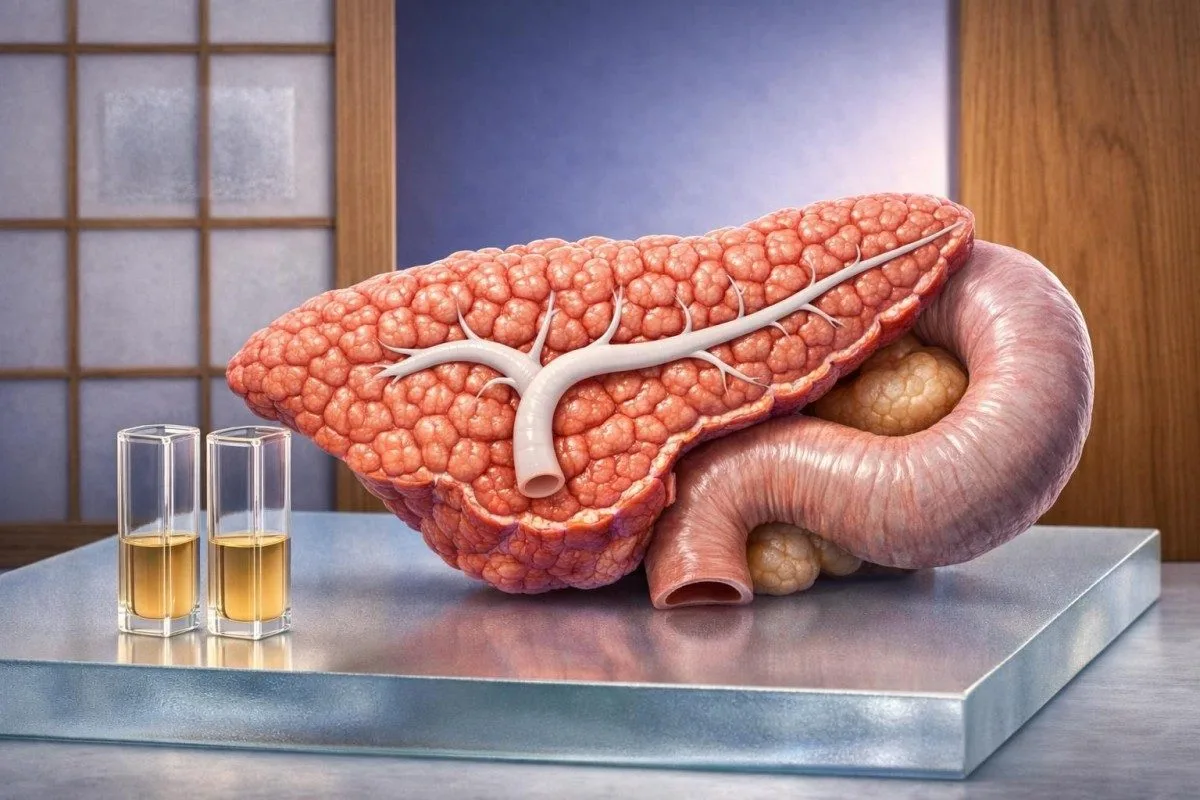
Lipase is usually the better pancreatic blood test for suspected pancreatitis because it is more specific and stays elevated longer than amylase. High results still happen without pancreatic disease — kidney impairment, gallbladder disease, bowel problems, diabetic ketoacidosis, and macroamylasemia are common reasons.


- Lipase is usually the better pancreatic blood test; a value at least 3 times the upper limit of normal plus typical pain supports acute pancreatitis.
- Amylase often rises within 6 to 24 hours but may return toward baseline in 3 to 5 days, so delayed testing can miss it.
- Lipase timing is usually 4 to 8 hours to rise, about 24 hours to peak, and 8 to 14 days to remain elevated.
- Normal ranges commonly run around 13 to 60 U/L for lipase and 30 to 110 U/L for amylase, but each lab sets its own interval.
- Mild elevations under 3x ULN are nonspecific and often reflect kidney dysfunction, gallbladder irritation, bowel disease, or critical illness rather than pancreatitis.
- Macroamylasemia can cause repeatedly high amylase with normal lipase and low urinary amylase, often in people who feel completely well.
- Triglycerides above 500 mg/dL raise concern for pancreatitis risk, and levels above 1,000 mg/dL can directly trigger it.
- CRP above 150 mg/L at 48 hours and a rising BUN are more useful for severity than the lipase number alone.
- Urgent evaluation is needed when high amylase or lipase comes with severe upper abdominal pain, repeated vomiting, fever, jaundice, low blood pressure, or confusion.
What a pancreatic blood test can actually tell you
Lipase is usually the more useful pancreatic blood test. In adults with sudden upper-abdominal pain, a lipase level at least 3 times the lab's upper limit of normal supports acute pancreatitis better than an amylase result, especially after the first 24 hours. High values still happen without pancreatic disease — kidney impairment, gallbladder disease, bowel problems, diabetic ketoacidosis, and macroamylasemia are common reasons.
A pancreatic enzyme result is a clue, not a verdict. On Kantesti AI, we see many uploads where a mildly high lipase turns out to be reduced kidney clearance, biliary irritation, or a timing issue rather than pancreatitis itself. If you have ever wondered why a highlighted result can mislead, our explainer on why normal ranges mislead covers the same point I make in clinic.
As Thomas Klein, MD, I usually ask two questions before I react to the number: where is the pain, and when did it start? In our analysis of more than 2 million uploaded panels from 127+ countries, the pattern most associated with true pancreatic inflammation is typical epigastric pain plus lipase ≥3x ULN, not an isolated enzyme bump. If you want to know who reviews that logic, read About our team.
Banks et al. defined acute pancreatitis by 2 of 3 criteria: characteristic pain, pancreatic enzymes ≥3 times the upper limit of normal, or imaging consistent with pancreatitis (Banks et al., 2013). That means a high enzyme with no pain does not automatically equal pancreatitis, and a normal enzyme very early on does not completely exclude it. Our symptom decoder is useful when the report arrives before the story is clear.
Amylase vs lipase: which test helps more for pancreatitis?
Lipase beats amylase for suspected acute pancreatitis in most adults because it is more pancreas-weighted and stays abnormal longer. Amylase can still help, but it rises and falls faster and is more easily confounded by salivary gland disease, vomiting, and macroamylasemia.
The ACG guideline favors lipase over amylase when pancreatitis is suspected (Tenner et al., 2013). In practical terms, lipase usually rises within 4 to 8 hours, peaks around 24 hours, and may remain elevated for 8 to 14 days. That long tail is why a patient who shows up 2 days after pain started can have a striking lipase with a nearly normal amylase.
Amylase is less specific because the body makes it in the pancreas and the salivary glands. A routine amylase blood test usually does not separate those sources, so parotid inflammation, heavy vomiting, or some intestinal disorders can push it up. If you want the broader map of how our models place these enzymes beside other biomarkers, the 15,000-biomarker guide lays it out.
Oddly enough, I still glance at amylase when the story is messy. A normal lipase with a modest amylase rise can point me toward salivary disease or macroamylasemia rather than the pancreas, while a very early blood draw can occasionally catch amylase first. That is nuance, though — not the usual rule.
When amylase still earns its place
Amylase still has niche value in very early presentations, suspected macroamylasemia, and hospitals where a lab only offers one pancreatic enzyme overnight. Most patients find that knowing the symptom timing matters more than memorizing which test is technically better.
When amylase and lipase rise after symptoms start
Timing changes the result more than most patients expect. Amylase typically rises within 6 to 24 hours and returns toward baseline in 3 to 5 days, whereas lipase often stays high for more than a week.
If you draw the lipase blood test too early — say 2 hours after pain starts — it can still be normal. In classic cases with persistent upper-abdominal pain, a repeat sample in about 6 to 12 hours can be more informative than jumping straight to a scan. I tell patients not to be falsely reassured by an ultra-early normal result.
Late presentation flips the problem. Someone who waits 48 to 72 hours before getting checked may have an amylase that has already drifted down, while lipase remains clearly abnormal. That is one reason delayed presentations fool people reading their own results online; our guide on how to read lab reports walks through that step by step.
There is another wrinkle here: hypertriglyceridemia can blunt measured amylase, and chronic pancreatitis can produce only small enzyme changes because the gland is already scarred. A not-very-high result never means much without the clock.
How high is high on amylase and lipase?
Most labs report lipase as normal somewhere around 13 to 60 U/L and amylase around 30 to 110 U/L, but the exact range varies by analyzer and country. For pancreatitis, the clinically useful threshold is usually 3 times the lab's upper limit of normal, not a single universal number.
A lipase of 95 U/L may be trivial in one lab and meaningful in another if the upper limit is 30 U/L. Some European laboratories use slightly lower cutoffs than large US systems, which is why raw numbers travel badly across portals and second opinions. Kantesti AI adjusts to the lab's own reference interval instead of pretending every lipase shares the same ceiling.
Mild elevations — usually less than 3x ULN — are nonspecific. Once the result is ≥3x ULN and the pain fits, pancreatitis moves much higher on the list; once it is 8x or 10x ULN, the diagnosis may feel more obvious, but severity still depends on organ function, hydration, oxygenation, and imaging. Our clinical validation page explains how our platform weighs that context.
This is one of those areas where context matters more than the number. I have admitted patients with lipase 220 U/L who looked quite ill, and I have discharged well-appearing patients with lipase 900 U/L after the rest of the workup pointed elsewhere.
Why a very high value does not equal a very severe case
Lipase reflects enzyme leakage into blood, not the exact amount of pancreatic tissue injury. A falling lipase can coexist with worsening dehydration or kidney injury, so we track the patient in front of us — not just the line on the graph.
Why lipase can be high even without pancreatic disease
High lipase without pancreatitis is common enough that we look for it every week. Kidney dysfunction, bowel obstruction or ischemia, gallbladder inflammation, diabetic ketoacidosis, sepsis, and some medications can all raise lipase.
Hameed et al. reviewed many non-pancreatic causes of substantial lipase elevation, including renal failure, hepatobiliary disease, intestinal disease, and critical illness (Hameed et al., 2015). In real practice, the quiet giveaway is often the company lipase keeps: a creatinine of 2.0 mg/dL, an eGFR below 45 mL/min/1.73 m², or cholestatic liver tests change the conversation fast. Our article on low GFR with normal creatinine helps if the kidney piece is confusing.
Reduced renal clearance can let lipase linger even when the pancreas is fine. I recently reviewed a panel from a 68-year-old with lipase 118 U/L, creatinine 1.9 mg/dL, no abdominal pain, and stable appetite; repeating the test after hydration and kidney follow-up told us more than an urgent CT would have. The pattern usually makes better sense once you check BUN/creatinine patterns.
DKA is a classic trap. I have seen lipase values in the 200 to 400 U/L range settle as glucose, ketones, and acidosis improve, with imaging never showing pancreatitis. Drug-related pancreatitis is real but rare, and an isolated enzyme bump after starting a new medication does not prove the drug is guilty.
Why amylase can be high when lipase is normal
A high amylase with a normal lipase usually points away from the pancreas. Salivary gland disease, vomiting, intestinal disorders, alcohol-related irritation, and macroamylasemia are the patterns I think about first.
Routine amylase blood test panels usually measure total amylase, not pancreatic and salivary isoenzymes separately. So a patient with parotid swelling or a week of retching can show amylase 150 to 250 U/L with a normal lipase and a perfectly normal pancreas. If the symptoms are more nausea, bloating, or bowel change than classic pancreatic pain, our digestive symptom guide is often the better starting point.
Macroamylasemia is one of the more under-taught causes. Amylase binds to larger proteins — often immunoglobulins — and becomes too bulky to clear through the kidneys, so serum amylase stays high while urinary amylase stays low; patients are often completely well. When I see amylase repeatedly above 2x ULN with no symptoms and normal lipase, I think of it early.
And sometimes the pancreas is only indirectly involved. A passing gallstone can irritate the pancreatic duct opening and nudge amylase up, but if ALT, ALP, GGT, or bilirubin are also off, the biliary tree may be the real headline. Start with our guide to elevated liver enzymes. If the transaminase pattern is still puzzling, the AST/ALT ratio guide adds another layer.
One extra clue doctors use
Persistent isolated hyperamylasemia with no pain is a reasonable moment to ask about urinary amylase or amylase isoenzymes rather than repeating CT scans. That small step can save a surprising amount of worry.
Symptoms that make a high amylase or lipase result matter more
Symptoms are what turn a high enzyme from an incidental lab result into a medical problem. Severe upper-abdominal pain, pain that reaches the back, repeated vomiting, fever, jaundice, or collapse matter more than whether the number says 180 or 380 U/L.
Classic pancreatitis pain is steady, upper central or left-sided, and often worse after eating. When that pattern appears with lipase ≥3x ULN, I take it seriously even before imaging; when the same number shows up in someone with no pain, I slow down. That is why a pancreatic blood test is best read beside the symptom story.
Gallstone pancreatitis leaves clues. An ALT above 150 U/L within the first 48 hours makes a biliary cause much more likely, and bilirubin or alkaline phosphatase elevation increases suspicion of obstruction. That behaves differently from alcohol-related disease, which more often brings dehydration, electrolyte drift, and a rougher overnight course.
Metabolic triggers can be subtle. Triglycerides above 500 mg/dL raise concern, and levels above 1,000 mg/dL can directly trigger pancreatitis. If that number is high, see our high triglycerides guide. Calcium above 10.5 mg/dL can also point to a cause worth chasing. If calcium is elevated too, review high calcium causes.
What if there is no pain at all?
An asymptomatic lipase 1 to 2x ULN is far more often a watch-and-recheck problem than an ambulance problem. In my experience, the most common mistake is jumping from one abnormal enzyme straight to cancer fear or chronic pancreatitis fear.
Other labs and scans that change the meaning of amylase and lipase
Other labs often matter more than amylase or lipase once pancreatitis is on the table. CBC, CMP, bilirubin, ALT/AST, creatinine, BUN, calcium, glucose, triglycerides, and CRP tell us about the cause and the strain the body is under.
I almost never interpret a pancreatic blood test in isolation. A CMP versus BMP matters because sodium, CO2, creatinine, bilirubin, albumin, and liver enzymes can reveal dehydration, biliary obstruction, or early organ stress that the lipase level itself cannot grade. Kantesti AI reads these panels together for exactly that reason.
A rising BUN in the first 24 hours worries clinicians because it can signal ongoing fluid loss and worse outcomes, and a hematocrit above 44% can hint at hemoconcentration. CRP above 150 mg/L at 48 hours is one of the more useful inflammatory markers for more severe disease, though I would never use CRP alone to predict the whole course. Our CRP interpretation article fills in the details.
Imaging has its place, but not every patient needs an immediate CT. Ultrasound is often the first scan if gallstones are suspected, while contrast CT becomes more useful when the diagnosis is unclear or the patient is not improving after 48 to 72 hours. If acidosis is part of the picture, the anion gap clues can explain why a lipase bump in DKA does not settle the diagnosis.
When a high pancreatic enzyme result needs urgent care
Go to urgent care or the ER now if a high amylase or lipase comes with severe pain, persistent vomiting, fever, jaundice, faintness, or shortness of breath. Pancreatitis can become dangerous quickly, especially when dehydration or infection is developing.
The red-flag combination is symptoms plus systemic strain. If you cannot keep fluids down for more than 6 to 8 hours, your heart rate is persistently above 100/min, or your blood pressure is low, the danger is not the lab alone — it is shock, electrolyte problems, and organ stress. This is where my advice gets very plain: do not wait for a portal to refresh again.
The enzyme height does not decide who needs admission. As Thomas Klein, MD, I worry more about an older adult with lipase 240 U/L, confusion, dry mucosa, and rising creatinine than a younger patient with lipase 800 U/L who is comfortable, hydrated, and improving. Our medical advisory board helped build that triage logic into the clinical framework behind Kantesti.
There are quieter danger signs too: new jaundice, pale stools, dark urine, or unexplained weight loss suggest you may be dealing with bile duct obstruction or another process rather than simple self-limited irritation. Those patients usually need same-week medical assessment even if the pain is modest.
When to repeat amylase or lipase and when not to
Repeat amylase or lipase testing helps when the first sample was drawn early, symptoms are changing, or the initial result was only mildly abnormal. Once pancreatitis is already diagnosed, repeating lipase every day usually adds little.
A practical rule I use: if symptoms started only a few hours ago and the first enzyme is normal, repeat in 6 to 12 hours. If the person feels well and the only issue is lipase 70 to 120 U/L, I often repeat the test in 1 to 2 weeks after hydration, medication review, and a quick look at kidney and liver markers.
Trends are powerful only when you compare like with like. A lipase of 68 U/L in one lab and 74 U/L in another may reflect different analyzers more than real biology. Kantesti AI handles that by normalizing the context in our compare lab trends workflow. Mild hemoconcentration can also distort companion markers. This piece on dehydration false highs is worth a read.
Patients often ask whether fasting changes the result. Fasting is not usually required for amylase or lipase, and it does not meaningfully hide pancreatitis; the bigger issue is timing relative to pain onset, not whether you had toast.
One mistake to avoid
Chasing the enzyme back to normal before discharge or before ending worry is rarely useful. I care much more that pain is settling, hydration is adequate, and kidney function is stable.
How Kantesti interprets a pancreatic blood test more safely
If you want a safer read on a pancreatic blood test, upload the full report — not just the highlighted number. Kantesti works best when it can analyze amylase, lipase, creatinine, liver tests, glucose, calcium, and symptoms together.
On our AI blood test analyzer, we interpret pancreatic enzyme results against the lab's own reference range, your age, the surrounding chemistry panel, and the timing you provide. That matters because a lipase of 140 U/L means something very different in a well person with chronic kidney disease than in a patient with new epigastric pain after a fatty meal. Kantesti's neural network was built to read the pattern, not just the red flag.
As of April 18, 2026, Kantesti lets you upload a PDF or photo and receive an explanation in about 60 seconds. If you want to try it, use the free lab demo. If you want to see how we securely parse reports, our blood test PDF upload guide shows the process. Patients also ask about privacy; our workflow is CE-marked and aligned with HIPAA, GDPR, and ISO 27001 standards.
One last thing. Our AI-powered blood test interpretation is built for interpretation, not emergency substitution, so any combination of severe pain, vomiting, jaundice, fever, or collapse still deserves urgent in-person care. Most patients find that once the whole panel is viewed together, the result becomes much less mysterious.
Frequently Asked Questions
Is lipase better than amylase for pancreatitis?
Yes — in most adults, lipase is the better test for suspected acute pancreatitis. Lipase usually rises within 4 to 8 hours, peaks around 24 hours, and can stay elevated for 8 to 14 days, while amylase often returns toward normal in 3 to 5 days. Clinicians usually treat a pancreatic enzyme result as supportive when it is at least 3 times the lab's upper limit of normal and the pain pattern is typical. A normal amylase does not rule out pancreatitis if the test was late, and a normal lipase does not fully rule it out if the sample was drawn very early.
Can lipase be high without pancreatitis?
Yes, a high lipase blood test does not automatically mean pancreatitis. Kidney dysfunction, gallbladder inflammation, bowel obstruction or ischemia, diabetic ketoacidosis, sepsis, and some medications can all raise lipase, and mild elevations under 3x ULN are especially nonspecific. In practice, the rest of the chemistry panel often explains the result better than the lipase number alone. That is why clinicians look at creatinine, liver tests, glucose, triglycerides, and symptoms together.
What lipase level is considered high?
Most adult labs list a normal lipase range somewhere near 13 to 60 U/L, but the exact cutoff varies by analyzer and country. A result is technically high if it exceeds the lab's upper limit, yet pancreatitis becomes much more convincing when lipase is 3 times the upper limit of normal or higher and the symptoms fit. A lipase of 90 U/L can be barely abnormal in one lab and clearly abnormal in another if the upper limit is lower. The multiple of the lab's own cutoff matters more than one universal number.
Why would amylase be high but lipase normal?
A high amylase blood test with a normal lipase often points to a non-pancreatic source. Salivary gland disease, repeated vomiting, intestinal disorders, alcohol-related irritation, and macroamylasemia are common reasons. In macroamylasemia, serum amylase stays high because it binds to large proteins and clears poorly through the kidneys, while urinary amylase is often low. When lipase is normal and there is no classic pancreatic pain, doctors usually widen the differential rather than assume pancreatitis.
Do I need to fast before an amylase or lipase blood test?
Usually no — fasting is not routinely required for an amylase lipase panel. A recent meal does not meaningfully hide acute pancreatitis, and the timing of the sample relative to symptom onset matters much more than whether you ate breakfast. The exception is when the clinician also wants fasting triglycerides, because triglycerides above 500 mg/dL and especially above 1,000 mg/dL can change the interpretation. If the order includes a broader metabolic workup, follow the instructions for that full panel.
Should amylase and lipase be repeated every day?
Usually not. Once acute pancreatitis is already diagnosed, repeating lipase or amylase every day rarely changes treatment because the enzyme level does not reliably track severity. Repeat testing makes sense when the first sample was drawn very early, when symptoms are changing, or when a mild isolated elevation needs follow-up after 1 to 2 weeks. In the hospital, clinicians care more about pain control, hydration, oxygenation, BUN, creatinine, and complications than whether lipase fell from 600 U/L to 300 U/L.
Can a normal lipase still happen in pancreatitis?
Yes, a normal lipase can still occur in pancreatitis, although it is less common than a false-normal amylase. The usual setting is a very early blood draw within the first few hours of pain, or a more complex case such as hypertriglyceridemia or chronic pancreatic scarring. If the pain is classic and persistent, clinicians often repeat the enzyme in 6 to 12 hours rather than dismiss the diagnosis immediately. Diagnosis still depends on the full picture: symptoms, enzyme pattern, and sometimes imaging.
Can lipase still be high after gallbladder removal?
Yes. Gallbladder removal lowers the chance of gallstone pancreatitis, but small stones or sludge can occasionally remain or form in the bile ducts, and non-biliary causes of high lipase are still possible. New severe pain, fever, or jaundice needs prompt medical assessment.
Can pregnancy change amylase or lipase results?
Pregnancy itself usually does not cause large amylase or lipase increases. Severe upper abdominal pain, repeated vomiting, fever, or jaundice during pregnancy needs same-day medical care, often starting with blood tests and a safe ultrasound.
Can medicines raise amylase or lipase levels?
Yes. Some medicines can irritate the pancreas or affect enzyme results, including certain diabetes medicines, diuretics, seizure medicines, immunosuppressants, and steroids. Do not stop a prescribed medicine on your own; contact your prescriber if high enzymes come with new abdominal pain or vomiting.
Get AI-Powered Blood Test Analysis Today
Join over 2 million users worldwide who trust Kantesti for instant, accurate lab test analysis. Upload your blood test results and receive comprehensive interpretation of 15,000+ biomarkers in seconds.
📚 Referenced Research Publications
Klein, T., Mitchell, S., & Weber, H. (2026). aPTT Normal Range: D-Dimer, Protein C Blood Clotting Guide. Kantesti AI Medical Research.
Klein, T., Mitchell, S., & Weber, H. (2026). Serum Proteins Guide: Globulins, Albumin & A/G Ratio Blood Test. Kantesti AI Medical Research.
📖 External Medical References
⚕️ Medical Disclaimer
This article is for educational purposes only and does not constitute medical advice. Always consult a qualified healthcare provider for diagnosis and treatment decisions.
E-E-A-T Trust Signals
Experience
Physician-led clinical review of lab interpretation workflows.
Expertise
Laboratory medicine focus on how biomarkers behave in clinical context.
Authoritativeness
Written by Dr. Thomas Klein with review by Dr. Sarah Mitchell and Prof. Dr. Hans Weber.
Trustworthiness
Evidence-based interpretation with clear follow-up pathways to reduce alarm.