An HIV RNA result measures how much virus is circulating, chiefly to confirm that treatment is working. The number matters, but its trend, assay limit, timing and treatment history matter more.



- Purpose: An HIV viral load test measures HIV RNA in copies/mL and is primarily used to monitor antiretroviral treatment, not to screen for routine infection.
- Undetectable: A result below the assay's lower limit, often 20, 40 or 50 copies/mL, does not mean HIV has left the body.
- U=U threshold: Sustained viral suppression below 200 copies/mL means there is no sexual transmission risk in the evidence base for U=U.
- Meaningful change: A shift of at least 0.5 log10, roughly threefold, is usually more clinically persuasive than a small numerical wobble.
- Early treatment: Most people taking effective daily ART reach below 200 copies/mL within 8 to 24 weeks.
- Monitoring schedule: HIV RNA is usually checked at baseline, 2 to 4 weeks after starting or changing ART, then every 4 to 8 weeks until suppressed.
- Blips: A single 50 to 199 copies/mL result after prior suppression is commonly a transient blip, but it deserves a repeat test rather than dismissal.
- Diagnosis: A fourth-generation antigen/antibody test and, when indicated, diagnostic NAT are used to establish HIV infection; a treatment-monitoring viral load alone is not enough.
What an HIV RNA result actually measures
HIV viral load results report the amount of HIV RNA in one millilitre of plasma, expressed as copies/mL; they are designed to track response to treatment rather than diagnose most new infections. An undetectable result usually means the assay found less than 20 to 50 copies/mL, while U=U uses the clinically validated threshold of less than 200 copies/mL. As of September 11, 2026, that distinction remains central to safe interpretation. In my clinical work, the first question is always whether the result is being compared with the right prior result.
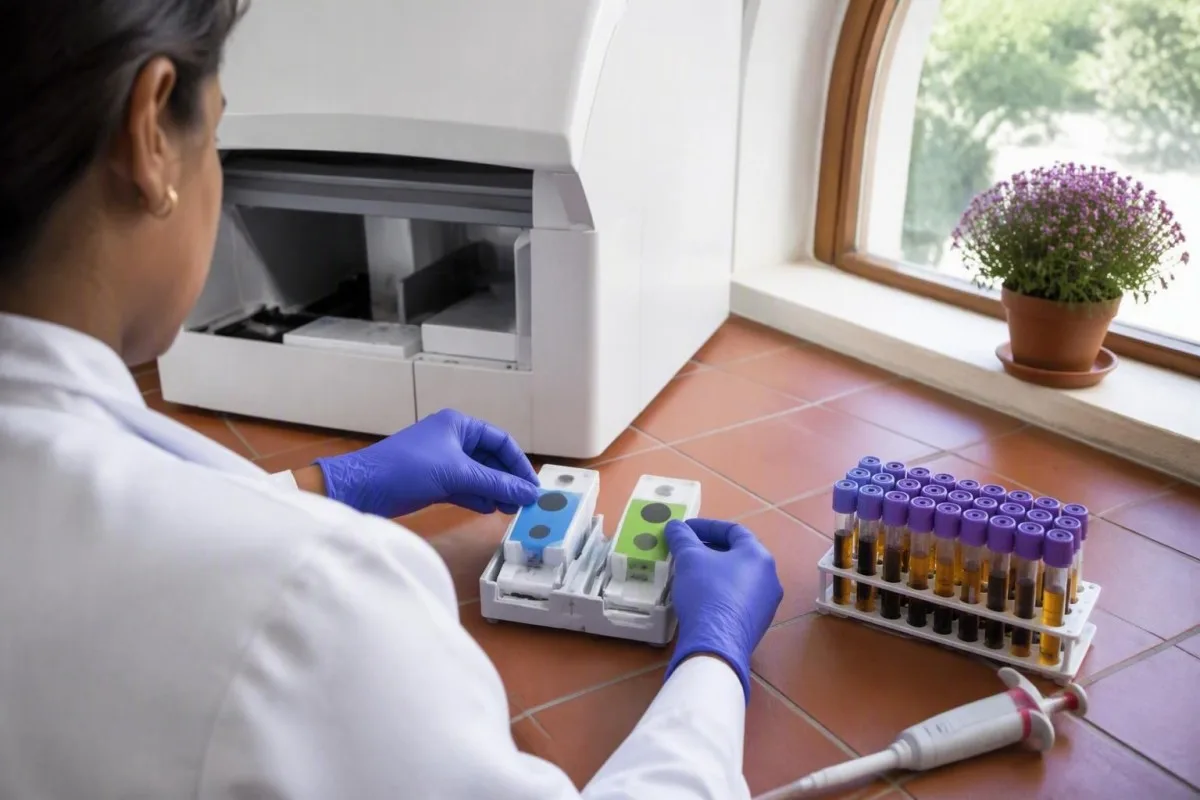
The test is also called an HIV RNA test, HIV-1 RNA quantitative PCR, or nucleic-acid amplification test. A result of 48,000 copies/mL means the laboratory detected approximately 48,000 HIV RNA copies in each mL of plasma; it does not measure the total amount of virus in the body.
Kantesti is an AI blood test analyzer that helps organise laboratory trends, but an HIV RNA result needs clinician-led interpretation alongside ART history, CD4 count and adherence details. Dr. Thomas Klein's practical rule is simple: never compare values without checking whether the laboratory used the same assay and lower reporting limit.
A viral-load value is not a measure of how ill someone looks or feels. People can feel entirely well at 100,000 copies/mL, while an intercurrent illness may produce a small rise in an otherwise stable person; our guide to qualitative and quantitative tests explains why those result types cannot be read interchangeably.
The unit on the report
Copies/mL is a concentration, not a percentage. Some reports also show log10 copies/mL because HIV RNA spans several orders of magnitude: 10,000 copies/mL equals 4.0 log10, and 100,000 copies/mL equals 5.0 log10. A tenfold change is 1.0 log10.
Why viral load monitoring is not the usual HIV diagnostic test
A quantitative viral-load assay can detect HIV RNA early, but it does not by itself establish a routine HIV diagnosis. Standard diagnosis generally starts with a laboratory fourth-generation HIV-1/2 antigen-antibody test, followed by the recommended supplemental test or diagnostic NAT when results are discordant.
A laboratory fourth-generation test usually detects HIV about 18 to 45 days after exposure, whereas a diagnostic nucleic-acid test can often detect infection around 10 to 33 days after exposure. The exact window depends on the specimen, the assay and whether PrEP or PEP has altered early immune or viral signals.
When acute HIV is suspected because of a recent high-risk exposure, fever, rash, sore throat or a negative or indeterminate antigen-antibody test, clinicians may request HIV RNA testing urgently. A detectable RNA result in this setting requires prompt confirmation and specialist assessment; it should not be interpreted alone from a portal screenshot.
PEP and PrEP deserve extra care because they can delay or blunt detectable markers in uncommon cases. For the practical testing intervals after post-exposure prophylaxis, see our review of HIV testing after PEP; do not stop prescribed prevention medication based on one home or laboratory result without the prescriber.
How to read HIV viral load copies per mL
HIV viral load copies below 200/mL indicate viral suppression for treatment and U=U purposes, while values of 200 copies/mL or more require closer trend review. There is no universal “normal range” because a person without HIV should have no detectable HIV RNA, whereas treated HIV is assessed against treatment targets.
Reports may state “target not detected,” “detected below quantification,” or give a number such as 32 copies/mL. Target not detected means no RNA signal was detected within that assay; “detected below quantification” means RNA was found but was too low for a reliable numerical estimate.
A baseline of 320,000 copies/mL may sound alarming, yet the early treatment trajectory is more informative than the starting point. Effective ART often lowers RNA by at least 1 log10, or tenfold, within the first 2 to 4 weeks, although initial response varies with regimen, absorption and adherence.
Immune recovery is assessed separately. A viral load of 24 copies/mL with a CD4 count of 180 cells/mm³ still calls for attention to opportunistic-infection prevention, which is why patients should also understand CD4 and CD8 testing.
Undetectable viral load and U=U are related but not identical
Undetectable means the HIV RNA is below a laboratory assay’s detection or quantification limit, whereas U=U is the evidence-based statement that sustained viral load below 200 copies/mL prevents sexual HIV transmission. A person can have a reported value of 80 copies/mL and still meet the U=U threshold.
The PARTNER studies observed zero genetically linked sexual HIV transmissions across more than 76,000 condomless sex acts when the partner living with HIV had viral load below 200 copies/mL (Rodger et al., 2019). That finding applies to sex, not to sharing injection equipment, pregnancy or chestfeeding, where prevention guidance uses different risk frameworks.
U=U requires ongoing treatment and sustained suppression, not a single low result. In practice, clinicians usually document at least one confirmatory suppressed result after starting ART and continue regular monitoring because a long interruption can allow rebound within weeks.
A rise from “target not detected” to 47 copies/mL does not cancel U=U or prove treatment failure. It is a classic example of why changes between blood tests should be assessed with analytic variation and the next value, not fear.
Which viral-load changes are clinically meaningful
A confirmed change of 0.5 log10 copies/mL, roughly a threefold change, is generally more meaningful than a small fluctuation between adjacent low results. For example, 50 to 150 copies/mL is a threefold increase but remains below the 200 copies/mL U=U threshold; its importance depends on repetition and clinical context.
At low concentrations, sampling noise and assay precision can create apparently large percentage changes. Moving from 22 to 48 copies/mL sounds like a 118% increase, but it is only 0.34 log10 and commonly falls within the zone where I would repeat rather than alter a successful regimen.
A viral blip is typically an isolated detectable result, often 50 to 199 copies/mL, followed by return to suppression without a treatment change. Persistent low-level viraemia is different: two or more detectable results can reflect missed doses, drug interactions, vomiting, malabsorption or emerging resistance.
Kantesti AI can place dates, units and prior values side by side, yet our medical validation approach is explicit that trend recognition cannot replace an HIV clinician's decision about ART or resistance testing.
Why a low detectable result can occur after suppression
Most isolated low HIV RNA results below 200 copies/mL are transient and do not mean ART has stopped working. They may reflect normal assay variation, short-lived release of viral RNA from reservoirs, a recent missed dose, vaccination, acute illness or a change in how the sample was handled.
I see this pattern often after a winter respiratory illness: a previously undetectable person receives a value of 74 copies/mL, feels well, reports no meaningful missed doses, and is undetectable again 4 weeks later. That is reassuring, but only the repeat result earns that reassurance.
A true rebound tends to have direction and momentum. A sequence of 38, then 280, then 1,900 copies/mL is more concerning than 28, then 71, then target not detected, and it should trigger a careful medication reconciliation including supplements and antacids.
Save the laboratory name, collection date, ART start date, missed-dose history and any new medicines with each result. A structured longitudinal lab record makes the clinical conversation much more productive.
How quickly viral load should fall after starting ART
Effective first-line ART usually reduces HIV RNA by at least 1 log10 within 2 to 4 weeks and reaches below 200 copies/mL within 8 to 24 weeks. A slower fall is not automatically drug resistance, but it merits an early review of dosing, interactions, absorption and baseline resistance.
A person starting at 100,000 copies/mL who reaches 8,000 copies/mL at week 2 has had just over a 1-log10 decline, which is broadly compatible with an active regimen. Someone starting at 100,000 and remaining at 70,000 copies/mL needs prompt evaluation; waiting months can lose useful time.
The International Antiviral Society-USA treatment recommendations emphasise rapid ART initiation and monitoring for virologic response, while accounting for individual barriers to access and adherence (Saag et al., 2020). The goal is durable suppression, not merely a better-looking number.
Do not double doses after a missed tablet unless the prescribing team has told you to do so. Medication schedules, kidney or liver function and co-prescribed drugs can all affect drug exposure; our article on medication safety trends explains why dated medication lists matter.
When HIV viral load testing is usually scheduled
HIV RNA is normally checked at diagnosis or before ART, 2 to 4 weeks after starting or changing treatment, then every 4 to 8 weeks until suppression is confirmed. Once stable, many adults are monitored every 3 to 6 months, with longer intervals appropriate for selected people with durable suppression and reliable follow-up.
A practical schedule is baseline, week 2 to 4, then every 4 to 8 weeks until below 200 copies/mL. After that, a clinician may test every 3 to 4 months; patients suppressed for more than 2 years with stable adherence may sometimes move to 6-monthly testing under local guidance.
Kantesti is an AI blood test interpretation platform that can surface the chronology of uploaded results, but it cannot tell whether a missed dose, a pharmacy gap or an interaction explains a rise. That explanation still comes from a direct clinical conversation.
Testing should be sooner after prolonged vomiting, suspected drug interaction, a treatment interruption, pregnancy, an injectable-ART scheduling problem or a result at or above 200 copies/mL. Understanding how to upload a lab report safely is useful, but urgent HIV care should never wait for an online interpretation.
Do fasting, timing or laboratory differences affect HIV RNA results?
Fasting is not required for an HIV RNA test, and time of day has no established clinically useful effect on routine viral-load interpretation. The larger technical issues are assay lower limit, specimen type, prompt plasma processing and whether the same laboratory method was used for serial testing.
Modern assays commonly quantify down to 20, 40 or 50 copies/mL, but a lab may report “<20,” “<40,” or target not detected using different rules. Those phrases should not be treated as a rank order of health; all can represent effective suppression when clinical context is stable.
A sample that is delayed, inadequately processed or collected in an unsuitable tube may be rejected or yield uncertainty. This is another reason an unexpected result should be repeated before changing an otherwise well-tolerated regimen, particularly below 200 copies/mL.
Eisinger and colleagues reviewed the evidence behind the prevention message and concluded that successful ART with sustained viral suppression prevents sexual HIV transmission (Eisinger et al., 2019). That certainty rests on sustained suppression, not on chasing the lowest possible assay number.
When a viral-load rise needs urgent clinical review
Persistent HIV RNA of 200 copies/mL or more after prior suppression warrants prompt clinician review, while 1,000 copies/mL or more makes virologic failure and resistance assessment particularly important. A single result is a signal to investigate, not a reason to stop ART without guidance.

Resistance genotyping works best while a person is still taking the failing regimen and when RNA is sufficiently detectable, commonly above 500 to 1,000 copies/mL depending on the laboratory. Below that level, a test may fail to amplify, but clinicians may still attempt it when the pattern is concerning.
The most common correctable cause of rebound is inconsistent drug exposure, not instant drug resistance. Ask specifically about missed doses, new multivitamins containing minerals, acid-suppressing medicines, tuberculosis treatment, anticonvulsants and non-prescribed products; a non-judgmental conversation gets better answers.
Severe illness with fever, confusion, breathlessness, neurological symptoms, inability to keep medicines down, or a known prolonged ART interruption deserves same-day medical advice. If a redraw is needed because the specimen was compromised, our repeat-test guide explains the broader laboratory logic.
Special circumstances: pregnancy, PrEP, PEP and injectable ART
Pregnancy, PrEP, PEP and long-acting injectable ART require more individualised HIV RNA testing than routine stable treatment. In pregnancy, clinicians monitor viral load more closely because suppression before delivery reduces perinatal transmission risk; with PrEP or PEP, RNA testing may be added when acute infection is plausible.

During pregnancy, many services test HIV RNA at the initial visit, 2 to 4 weeks after any ART change, at least every 3 months, and again near 36 weeks; local protocols vary. A value below 50 copies/mL near delivery is often a key obstetric planning target, which is stricter than the <200 U=U threshold.
Injectable cabotegravir-based treatment depends on injections being received on schedule. Delayed injections can create a pharmacologic “tail” with declining drug levels, so clinicians may use HIV RNA tests and oral bridging strategies rather than guessing from symptoms.
Dr. Thomas Klein advises patients using prevention or injectable treatment to bring exact dates—not estimates—to appointments. For a wider explanation of testing immune function alongside infection risks, see our immune-system blood test guide.
What to bring to an HIV viral-load review
The most useful HIV viral-load review includes the actual result, units, assay limit, collection date, ART regimen, missed-dose history and prior values. A number without those details can invite false reassurance or unnecessary alarm.
Ask four direct questions: What was my lower assay limit? Is this a blip or a sustained rise? When should I repeat the test? Do any of my medicines or supplements interact with ART? These questions are more productive than asking whether one number is “good” or “bad.”
Kantesti can help turn a PDF result history into a dated overview, including related liver, kidney and blood-count markers that may affect treatment safety. Kantesti is an AI-powered blood test analysis tool for interpreting laboratory information, not a diagnostic service or a substitute for HIV specialist care.
If you receive results before your clinician has contacted you, do not ration or stop ART while waiting. Our guidance on seeing results before doctor review offers a sensible way to prepare questions without self-adjusting treatment.
Common misunderstandings about HIV viral-load numbers
An undetectable viral load does not mean HIV is cured, and a detectable result does not automatically mean treatment has failed. HIV persists in long-lived cellular reservoirs despite successful ART, which is why treatment should continue even when repeated tests show target not detected.

“Undetectable” is an assay statement, not a promise of zero virus. The test measures free RNA in plasma, whereas HIV can remain integrated inside resting immune cells; stopping ART allows viraemia to return in most people, often within weeks.
“My viral load is 80, so I am infectious” is also misleading in the sexual-transmission context. Sustained values below 200 copies/mL meet the evidence-based U=U criterion, provided ART is continued; this does not remove the need for testing and care for other sexually transmitted infections.
For context on laboratory limits and why flagged results need interpretation rather than panic, read what out-of-range means. This is one of those areas where the pattern genuinely matters more than an isolated number.
Using digital tools without losing clinical context
Digital result tracking can make HIV care safer when it preserves exact dates, units, assay wording and privacy, but it cannot determine ART changes. HIV results are particularly sensitive health information, so access controls and consent deserve the same attention as clinical accuracy.
Keep the original report even if you use a summary tool; “target not detected” and “<20 copies/mL” may be rendered differently by the lab system. The useful record includes the specimen date, laboratory, collection setting and any medication change in the preceding 8 weeks.
Kantesti supports privacy-focused laboratory interpretation across multiple languages, yet our AI should be used to prepare for—not replace—a discussion with the prescribing HIV team. A physician-reviewed approach to methodology is outlined in our AI technology guide.
If you are worried about a result, contact your HIV clinic or prescriber rather than posting an identifiable laboratory report in a public forum. Kantesti's clinical work is overseen with input from the Medical Advisory Board, but urgent symptoms and treatment interruptions need real-time clinical care.
Frequently Asked Questions
What is a normal HIV viral load?
For a person without HIV, a properly performed diagnostic test should not detect HIV RNA. For a person taking effective HIV treatment, the clinical target is viral suppression below 200 copies/mL, and many modern assays report below 20 to 50 copies/mL or “target not detected.” HIV viral load does not have a conventional population normal range because it measures a virus rather than a normal body chemical. A result must be interpreted with treatment status, assay limit and previous values.
Is 20 copies/mL HIV viral load undetectable?
A result of 20 copies/mL is very low but is technically detectable if the laboratory has quantified it. It is still below the 200 copies/mL threshold used for sustained viral suppression and U=U in relation to sexual transmission, provided treatment is continued. Some assays report values below 20 as “target not detected,” while others may quantify low values differently. One 20 copies/mL result does not usually require a treatment change.
Can HIV viral load be used to diagnose HIV?
HIV RNA can be detected very early and is used in diagnostic evaluation when acute HIV is suspected, but a routine quantitative viral-load test alone should not be used as the sole basis for diagnosis. Standard laboratory diagnosis usually begins with a fourth-generation antigen-antibody assay and follows the recommended confirmatory algorithm. Diagnostic nucleic-acid testing can detect HIV roughly 10 to 33 days after exposure, compared with approximately 18 to 45 days for a laboratory fourth-generation test. A clinician should urgently review a positive RNA result, especially after PrEP or PEP.
What HIV viral load number means U=U?
A sustained HIV viral load below 200 copies/mL supports U=U: no sexual transmission of HIV has been observed in the evidence base when effective ART is maintained. The PARTNER studies reported zero linked sexual transmissions across more than 76,000 condomless sex acts with the HIV-positive partner below this threshold. U=U does not mean HIV is cured, and it does not address injection-equipment sharing, pregnancy or chestfeeding. Continue ART and scheduled viral-load monitoring.
What is an HIV viral-load blip?
An HIV viral-load blip is an isolated, small detectable result after prior suppression, commonly between 50 and 199 copies/mL, followed by return to suppression without changing treatment. Assay variation, brief missed doses, intercurrent illness and transient release of viral RNA can contribute. A confirmed rise of 0.5 log10 copies/mL, roughly threefold, carries more weight than a minor fluctuation at very low concentrations. Persistent results at or above 200 copies/mL need clinical review.
How often should HIV viral load be tested when treatment is working?
After starting or changing ART, HIV RNA is commonly checked 2 to 4 weeks later and every 4 to 8 weeks until suppression is established. Once viral load is below 200 copies/mL and treatment is stable, monitoring is often every 3 to 6 months. Some people with more than 2 years of durable suppression and reliable follow-up can be tested less often under local clinical guidance. Pregnancy, injectable ART, adherence concerns and medication changes call for more frequent testing.
Get AI-Powered Blood Test Analysis Today
Join over 2 million users worldwide who trust Kantesti for instant, accurate lab test analysis. Upload your blood test results and receive comprehensive interpretation of 15,000+ biomarkers in seconds.
📚 Referenced Research Publications
Klein, T., Mitchell, S., & Weber, H. (2026). Klein, T. (2026). aPTT Normal Range: D-Dimer, Protein C Blood Clotting Guide. Zenodo. https://doi.org/10.5281/zenodo.18262555. Kantesti AI Medical Research.
Klein, T., Mitchell, S., & Weber, H. (2026). Klein, T. (2026). Serum Proteins Guide: Globulins, Albumin & A/G Ratio Blood Test. Zenodo. https://doi.org/10.5281/zenodo.18316300. Kantesti AI Medical Research.
📖 External Medical References

⚕️ Medical Disclaimer
This article is for educational purposes only and does not constitute medical advice. Always consult a qualified healthcare provider for diagnosis and treatment decisions.
E-E-A-T Trust Signals
Experience
Physician-led clinical review of lab interpretation workflows.
Expertise
Laboratory medicine focus on how biomarkers behave in clinical context.
Authoritativeness
Written by Dr. Thomas Klein with review by Dr. Sarah Mitchell and Prof. Dr. Hans Weber.
Trustworthiness
Evidence-based interpretation with clear follow-up pathways to reduce alarm.