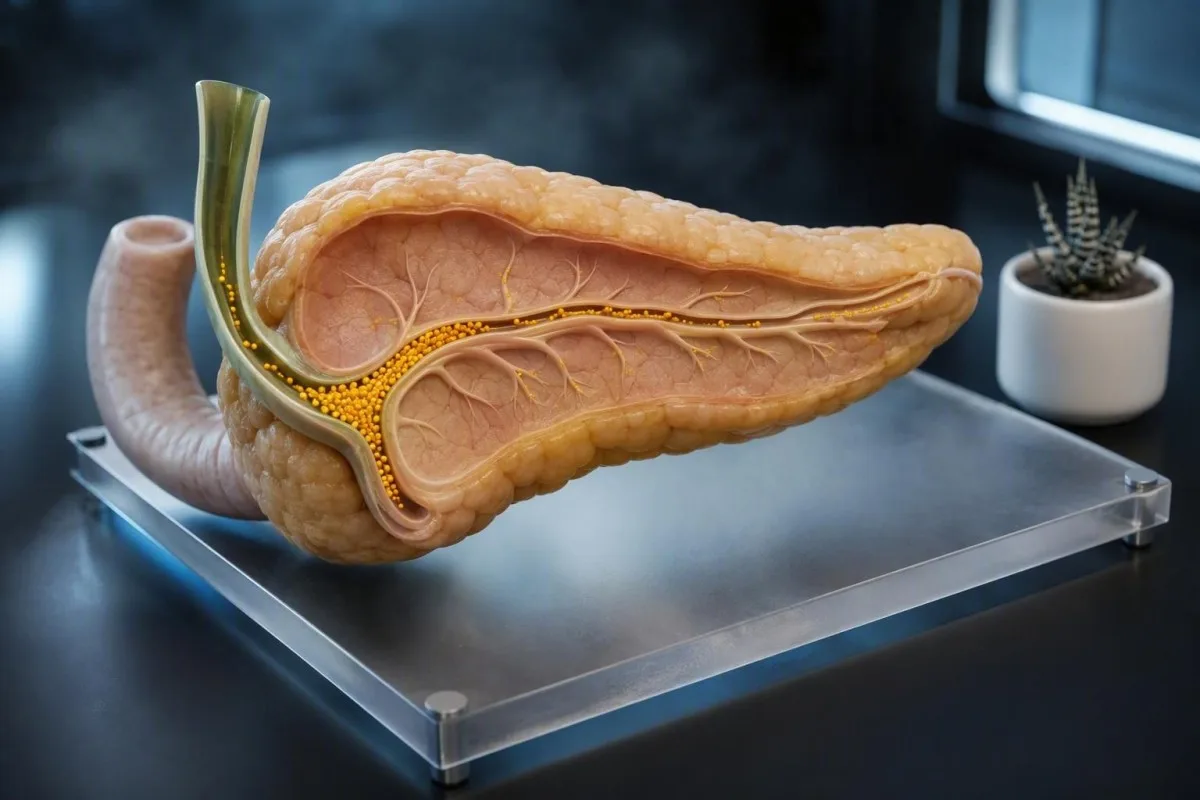
An amylase result matters most when it is paired with the right symptom pattern. This symptom-first guide separates an incidental flag from pain or illness that needs same-day assessment.


- Emergency pattern: Severe, persistent upper-abdominal pain with vomiting, fever, faintness, or yellow skin needs urgent assessment, whether amylase is 180 U/L or 1,800 U/L.
- Three-times rule: Amylase at least 3 times a laboratory's upper limit supports acute pancreatitis only when paired with typical pain or imaging findings.
- Typical adult range: Many laboratories use roughly 30-110 U/L for total serum amylase, but the printed range on your own report takes priority.
- Lipase context: Lipase is generally more pancreas-specific and can remain elevated for 8-14 days, while amylase may normalize within 3-5 days.
- Silent elevation: A mild isolated rise below 2 times the upper limit often reflects salivary release, kidney clearance, medicines, or macroamylase rather than pancreatic injury.
- Kidney clue: Reduced filtration, especially an eGFR below 60 mL/min/1.73 m², can raise amylase because the kidneys help remove it.
- Macroamylase clue: High amylase with normal lipase and no symptoms can be investigated with an amylase-creatinine clearance ratio; a result below 1% supports macroamylasaemia.
- Triglyceride caution: Very high triglycerides can trigger pancreatitis and may interfere with some enzyme assays, so a deceptively modest amylase never rules out illness.
Which High Amylase Symptoms Need Urgent Care?
High amylase symptoms need urgent care when severe upper-abdominal pain lasts more than 30 minutes, travels through to the back, or comes with repeated vomiting, fever, confusion, fainting, jaundice, or an inability to keep fluids down. The number alone does not decide urgency: a person with amylase 160 U/L and escalating pain can be sicker than someone with 600 U/L who feels entirely well. As Chief Medical Officer, Dr. Thomas Klein advises emergency assessment rather than waiting for a repeat test when those symptoms are present.
Acute pancreatitis is diagnosed when at least 2 of 3 features are present: typical abdominal pain, amylase or lipase at least 3 times the upper limit of normal, or characteristic imaging. This is the internationally used Revised Atlanta framework, not a diagnosis made from a single flagged result (Banks et al., 2013).
Call emergency services now for severe pain plus collapse, confusion, cold clammy skin, breathing difficulty, or very little urine. These can signal dehydration, low blood pressure, or a complication beyond the pancreas; do not drive yourself if you feel faint.
Kantesti is an AI blood test analyzer that reads amylase beside lipase, creatinine, bilirubin, glucose, calcium, and triglycerides, because this cluster is safer than treating one enzyme as a verdict. For the underlying differential, see our guide to high amylase causes.
Symptoms that can wait for a prompt appointment
A mild, intermittent ache, new nausea without severe pain, recurrent cheek swelling, or an unexpected amylase rise with no systemic illness usually merits a clinician call within a few days rather than an emergency visit. The exception is pregnancy, significant immune suppression, known gallstones, or a prior pancreatitis episode, where the threshold for same-day advice is lower.
How High Is High on an Amylase Blood Test?
Many adult laboratories report total serum amylase around 30-110 U/L, but the laboratory-specific upper limit is the only valid baseline for interpreting your result. A value over 3 times that upper limit is more concerning for acute pancreatitis in a person with compatible pain; a mild elevation alone is not proof of pancreatic disease.
A result of 145 U/L is only about 1.3 times high if your laboratory limit is 110 U/L, while 330 U/L is 3 times high. That distinction matters more than a red H flag, particularly because some European laboratories use upper limits near 100 U/L and others near 120 U/L.
Amylase commonly begins rising 2-12 hours after pancreatic injury, peaks within roughly 12-72 hours, and can return to range after 3-5 days. A late test may therefore be normal even after a genuine attack, which is one reason clinicians do not dismiss persistent pain based on one enzyme measurement.
Total amylase combines pancreatic and salivary isoenzymes. A normal or minimally changed lipase alongside high total amylase shifts the probability away from the pancreas, although it does not eliminate it; our explanation of the amylase-lipase ratio shows why the two tests sometimes disagree.
The Pancreatic Pattern: Pain, Vomiting and Timing
Pancreatic-type pain is usually severe and constant in the upper middle abdomen, often radiating to the back and accompanied by nausea or vomiting. It typically worsens after eating or lying flat and may ease slightly when sitting forward, although no single pain feature confirms pancreatitis.
Lipase is generally more specific for pancreatic injury than amylase and remains elevated longer, often 8-14 days compared with amylase's usual 3-5 days. Yadav, Agarwal, and Pitchumoni concluded that enzyme tests must be interpreted with the clinical picture, because neither can establish pancreatitis in isolation (Yadav et al., 2002).
In my 15 years of clinical practice, the detail patients often omit is whether pain was abrupt, whether it followed a heavy meal, and whether it reaches the back. Those three observations can alter triage more than a small numerical change, such as 128 to 156 U/L.
Pain on the right under the ribs, yellow eyes, dark urine, or pale stool raises concern for a gallstone-related blockage rather than uncomplicated indigestion. If lipase is also high, review our practical guide to high lipase warning signs while arranging clinician-led evaluation.
Why a normal enzyme does not erase severe pain
A normal amylase and lipase do not exclude every pancreatic, biliary, bowel, or ulcer-related condition, particularly if symptoms began days earlier. Persistent focal pain, fever, guarding, black stools, or worsening vomiting still deserves examination and may need imaging.
Red Flags That Override the Amylase Number
Severe pain, repeated vomiting, fever above 38°C, jaundice, confusion, fainting, or a rigid abdomen warrant same-day emergency assessment even if amylase is only mildly elevated. These signs identify physiological stress or obstruction, not merely an abnormal laboratory value.
A heart rate persistently above 120 beats per minute, inability to pass urine for 8-12 hours, or dizziness on standing can indicate substantial fluid loss. Pancreatitis can cause rapid third-space fluid shifts, but severe gastroenteritis, sepsis, bowel obstruction, and diabetic ketoacidosis can look similar at the start.
New yellow skin with upper-abdominal pain is particularly time-sensitive because a stone in the common bile duct can obstruct bile flow and trigger pancreatitis. Fever or shaking chills alongside jaundice raises concern for ascending cholangitis, which needs urgent hospital treatment rather than home monitoring.
People sometimes try to decide whether pain is "bad enough" from a lab portal. That is risky. A clinician needs to assess tenderness, hydration, pulse, blood pressure, and sometimes ECG findings; our overview of abdominal pain lab clues explains why a broad panel is often necessary.
What If Amylase Is High but You Feel Fine?
An isolated, mild amylase elevation without abdominal pain, vomiting, fever, or salivary swelling is often not dangerous, but it should be checked in context rather than ignored. Repeat testing, lipase, creatinine/eGFR, medicine review, and occasionally isoenzyme or macroamylase testing usually clarify the source.
A stable amylase of 130-170 U/L over months with normal lipase and normal examination is a different clinical problem from a sudden climb from 70 to 290 U/L. Trend, not just range status, helps separate a benign baseline from a new process; a useful primer is what out-of-range means.
Macroamylasaemia occurs when amylase binds to larger proteins, often immunoglobulins, and becomes too large for efficient renal filtration. It can produce persistent elevations, sometimes several-fold above the limit, in otherwise well people and does not itself require pancreatic treatment.
Kantesti is an AI blood test interpretation platform that compares an isolated amylase result with your previous values and the rest of the panel before flagging a follow-up pattern. That comparison cannot replace an examination, but it can prevent a minor incidental result being confused with an emergency.
When High Amylase Points to the Salivary Glands
Cheek or jaw swelling, pain that flares while eating, dry mouth, fever, or a tender area below the ear can point to salivary-gland release of amylase rather than pancreatic disease. Total amylase rises because salivary glands produce an amylase isoenzyme, and lipase often stays normal.
A blocked salivary duct often causes one-sided swelling that increases at mealtimes, when saliva production rises against the obstruction. Hydration, oral care, and sour foods may sometimes be advised by a clinician for a simple stone, but fever, spreading swelling, or trouble swallowing needs urgent review.
Vomiting and recurrent acid exposure can stimulate salivary gland enlargement and modestly raise amylase, a detail that is easy to miss in a laboratory-only assessment. Clinicians should ask sensitively about nausea, reflux, dental discomfort, eating patterns, and medications that dry the mouth.
If you also have greasy stools, unintentional weight loss, or long-standing upper-abdominal symptoms, the question changes toward pancreatic digestion rather than saliva. Our guide to stool elastase follow-up explains when a stool test contributes useful evidence.
Kidney Function and Macroamylase: Two Often Missed Causes
Reduced kidney filtration can raise serum amylase because the kidneys clear part of the enzyme, while macroamylase raises it because the enzyme-protein complex is too large to clear normally. An eGFR below 60 mL/min/1.73 m² makes kidney context especially relevant, although amylase is not a kidney-function test.
An amylase-creatinine clearance ratio below 1% supports macroamylasaemia; many laboratories consider about 1-4% a usual interval, though methods differ. It is a specialised calculation using paired urine and serum samples, so do not attempt to infer it from a standard blood panel.
Chronic kidney disease may also make lipase modestly high, which is why an enzyme result must be read with creatinine, eGFR, hydration status, and symptoms. For a clearer framework, review the chronic kidney stages rather than relying on creatinine alone.
Rapid kidney changes deserve a different response from stable chronic impairment. Vomiting, diarrhoea, new diuretics, or anti-inflammatory pain medicines can reduce filtration over days; the BUN-creatinine relationship can provide an additional hydration clue when interpreted by a clinician.
Other Abdominal Conditions That Can Raise Amylase
Gallbladder disease, bowel obstruction, peptic ulcer complications, reduced intestinal blood flow, and diabetic ketoacidosis can raise amylase without being primary pancreatitis. The accompanying symptom location, glucose, ketones, bilirubin, liver enzymes, and examination findings direct the next step.
Right-upper abdominal pain after fatty food with bilirubin, alkaline phosphatase, or GGT elevation suggests a biliary pathway. A stone may pass before an ultrasound is performed, leaving a short-lived enzyme signal and normal imaging later that day.
Diabetic ketoacidosis can elevate amylase or lipase even when imaging does not show pancreatitis. High glucose, thirst, rapid deep breathing, ketones, abdominal pain, and nausea require urgent assessment because treating dehydration and insulin deficiency comes first.
Pale stool, dark urine, itch, or yellow eyes should prompt a liver and bile-duct review, not an assumption that amylase identifies the cause. See pale stool clues for the practical symptom pattern that warrants prompt care.
Alcohol, Medicines and Triglycerides: Important Trigger Clues
Alcohol exposure, gallstones, very high triglycerides, and certain medicines are common high amylase causes when pancreatic symptoms are present. A trigger is not proven by timing alone, so clinicians should review the full history before attributing a painful episode to a supplement or prescription.
Triglycerides above 1,000 mg/dL or 11.3 mmol/L substantially increase pancreatitis risk, especially when diabetes is uncontrolled or there is a genetic lipid disorder. Extremely lipaemic laboratory samples may interfere with some enzyme assays, so a lower-than-expected amylase cannot safely reassure someone with classic pain.
Medicines that clinicians may review include azathioprine, valproate, didanosine, thiazide diuretics, and some immune or cancer treatments. Newer metabolic medicines can cause modest enzyme changes in some people; the evidence for predicting pancreatitis from an isolated enzyme rise is honestly mixed.
A fasting lipid profile and accurate supplement list are useful after recovery, not as a way to self-treat acute pain. Our guides to high triglyceride symptoms and supplements before blood tests can help you prepare for that conversation.
Which Tests Clarify an Elevated Amylase Result?
The most useful first tests for elevated amylase are lipase, a metabolic panel with creatinine/eGFR, liver tests, glucose, calcium, triglycerides, and a pregnancy test when relevant. The right combination identifies dehydration, biliary obstruction, metabolic triggers, or a non-pancreatic source far better than repeating total amylase alone.
Lipase at least 3 times the upper limit alongside typical pain carries more pancreatic weight than total amylase alone. Calcium above the laboratory range and triglycerides above 1,000 mg/dL are two metabolic findings clinicians specifically look for after an unexplained pancreatitis episode.
If persistent elevation remains unexplained, pancreatic and salivary isoamylase testing or polyethylene-glycol precipitation can identify the source or macroamylase. These are not routine emergency tests, and their best use is in a well person with a recurrent or stable unexplained result.
Kantesti AI interprets amylase by checking the result against adjacent biomarkers and laboratory units, then highlighting gaps to discuss with a clinician. Our blood biomarker guide explains why units, reference intervals, and collection date belong in any safe lab interpretation.
Why urine testing may enter the work-up
Urine amylase can help calculate amylase-creatinine clearance when macroamylase is suspected, but it does not replace blood lipase for acute pancreatic triage. A spot urine sample is only meaningful when paired correctly with a serum sample from the same clinical period.
When Ultrasound or CT Is Needed
Ultrasound is usually the first imaging test when gallstones or bile-duct dilation are suspected, while CT is reserved for uncertain diagnoses, severe illness, or concern about complications. Early CT is not routinely needed when typical pain and enzymes already establish uncomplicated acute pancreatitis.
An abdominal ultrasound is particularly useful when pain is right-sided or bilirubin, alkaline phosphatase, and GGT are raised. It detects many gallstones, but small stones in the common bile duct can be missed, so doctors may use MRCP or endoscopic ultrasound when suspicion remains high.
CT performed too early may underestimate the extent of pancreatic tissue change. NICE guidance on pancreatitis recommends imaging selectively, with timing driven by diagnostic uncertainty or clinical deterioration rather than a fixed amylase number (NICE, 2020).
A simultaneous cholestatic liver pattern changes the imaging question from "is the pancreas inflamed?" to "is bile flow obstructed?" Read our guide to cholestasis patterns for that laboratory cluster; our clinical validation approach explains how Kantesti handles findings that need human follow-up.
Repeat Testing: When It Helps and When It Delays Care
Repeat amylase helps when a person is stable and an unexpected mild elevation needs confirmation, but it should never delay urgent assessment for severe abdominal symptoms. For a stable incidental result, clinicians commonly repeat amylase with lipase and kidney function after addressing short-term factors such as dehydration or recent vomiting.
The interval for rechecking is clinical rather than universal: 24-48 hours may be used after an acute episode, while a stable asymptomatic result may be rechecked in several weeks. Serial amylase values do not reliably measure pancreatitis severity, so chasing daily normalization is rarely useful.
Specimen mix-ups, transcription errors, unit conversion mistakes, and result uploads missing their reference range can create apparent change. A rise from 95 to 140 U/L may be ordinary biological variation if different assays were used, while a jump from 90 to 600 U/L deserves immediate verification.
Kantesti is an AI-powered blood test analysis tool that can flag unusual shifts for review, including values that conflict with the surrounding panel. Our article on lab delta checks and the AI technology guide describe what pattern recognition can identify and where laboratory confirmation remains necessary.
How to Prepare for a Clinician Appointment
Bring the exact amylase value, reference interval, collection date, prior results, symptom timeline, medicine list, alcohol history, and any recent vomiting or abdominal illness to your appointment. These details often identify the likely source faster than ordering a large panel without a history.
Write down when pain began, its location, whether it radiates to the back, the last normal meal, bowel and urine changes, and measured temperature. Include over-the-counter products, weight-loss injections, herbal products, and doses; a missed supplement is surprisingly common in medication reconciliation.
Ask direct questions: Was lipase tested? Are liver tests or triglycerides abnormal? Could reduced eGFR explain part of this? Is there a reason to test for macroamylase or obtain an ultrasound? A good consultation should explain why each next test changes management.
Bring a concise, dated laboratory record rather than screenshots from several portals. Our doctor visit summary can help structure results and symptoms so the first 10 minutes of the visit are clinically useful.
Using AI Results Safely Without Missing Real Illness
AI interpretation can organize an elevated amylase result and identify connected abnormalities, but it cannot examine your abdomen, measure dehydration, or rule out an emergency. High amylase is dangerous only when the underlying cause is dangerous, and symptom severity remains the first triage signal.
As of August 3, 2026, no responsible interpretation system should label a person with pancreatitis from amylase alone. The Revised Atlanta criteria still require 2 of 3 elements—typical pain, enzymes at least 3 times the upper limit, or imaging—and that standard protects patients from both missed illness and overdiagnosis.
Dr. Thomas Klein's practical rule is simple: escalating pain wins over a reassuring-looking portal result, while a quiet, stable minor elevation deserves measured follow-up rather than panic. Kantesti AI can support this distinction by preserving trends and related markers, but diagnosis and treatment belong with the clinician who evaluates you.
Our medical content is reviewed with input from the Medical Advisory Board and built within the wider work of Kantesti as an organisation. If pain is severe, vomiting persists, or jaundice appears, skip digital interpretation and seek urgent in-person care.
Frequently Asked Questions
What symptoms happen with high amylase?
High amylase itself does not cause symptoms; the underlying condition does. Acute pancreatic inflammation commonly causes severe constant upper-abdominal pain, pain into the back, nausea, vomiting, and sometimes fever, while salivary causes can produce cheek or jaw swelling that worsens with meals. Severe pain, repeated vomiting, fever above 38°C, faintness, jaundice, or inability to drink needs same-day urgent assessment. A mild result such as 130 U/L without symptoms is often handled very differently from an amylase result above 3 times the laboratory upper limit with pain.
Is high amylase dangerous?
High amylase is not automatically dangerous because it is a marker, not a disease. A value at least 3 times the laboratory upper limit, usually around 330 U/L or higher where the upper limit is 110 U/L, is concerning when typical upper-abdominal pain or imaging findings are also present. Mild elevations can occur with salivary-gland conditions, reduced kidney clearance, medicines, vomiting, or macroamylase. The urgent risk comes from symptoms and the cause, especially pancreatitis, bile-duct obstruction, severe dehydration, or ketoacidosis.
Can stress cause high amylase?
Acute physiological stress can contribute to a small amylase rise, particularly when it involves vomiting, dehydration, metabolic illness, or salivary stimulation, but emotional stress alone is not a safe explanation for a significant result. Clinicians should not attribute amylase above 3 times the upper limit of normal to stress without checking for abdominal symptoms, lipase, kidney function, and other causes. If the result is mildly elevated and you feel well, a repeat test with lipase and creatinine may be reasonable. Severe pain or vomiting requires assessment regardless of a suspected stress trigger.
What level of amylase suggests pancreatitis?
An amylase level at least 3 times the laboratory upper limit supports acute pancreatitis when the person also has characteristic abdominal pain or compatible imaging. For a laboratory with an upper limit of 110 U/L, that threshold is about 330 U/L, but laboratories use different assays and ranges. Lower values do not exclude pancreatitis, particularly if testing occurs late after symptoms start or triglycerides are extremely high. Doctors use the revised diagnostic standard of 2 of 3 findings: typical pain, enzymes at least 3 times high, or imaging evidence.
Can kidney disease cause high amylase?
Yes, kidney disease can raise amylase because the kidneys remove part of the enzyme from circulation. Reduced filtration becomes a meaningful interpretation factor when eGFR is below 60 mL/min/1.73 m², although the degree of amylase elevation does not measure kidney disease severity. High amylase with normal lipase, no abdominal symptoms, and stable reduced eGFR often has a different implication from high amylase with sudden pain. A clinician may consider paired urine and serum testing for macroamylase if the elevation remains unexplained.
Should I repeat a high amylase test?
Repeat amylase testing is useful for a stable, unexpected mild elevation, especially when repeated with lipase, creatinine/eGFR, and liver tests. It is not appropriate to wait for a repeat test if you have severe abdominal pain, repeated vomiting, fever, jaundice, fainting, or poor urine output. Many clinicians repeat a stable incidental result after several weeks, whereas acute symptoms may require reassessment within 24-48 hours or immediate hospital testing. The best interval depends on symptoms, the original level, and whether a likely temporary trigger such as dehydration has resolved.
Get AI-Powered Blood Test Analysis Today
Join over 2 million users worldwide who trust Kantesti for instant, accurate lab test analysis. Upload your blood test results and receive comprehensive interpretation of 15,000+ biomarkers in seconds.
📚 Referenced Research Publications
Klein, T., Mitchell, S., & Weber, H. (2026). AI Blood Test Analyzer: 2.5M Tests Analyzed | Global Health Report 2026. Kantesti AI Medical Research.
Klein, T., Mitchell, S., & Weber, H. (2026). RDW Blood Test: Complete Guide to RDW-CV, MCV & MCHC. Kantesti AI Medical Research.
📖 External Medical References
National Institute for Health and Care Excellence (2020). Pancreatitis: NICE guideline NG104. NICE.
⚕️ Medical Disclaimer
This article is for educational purposes only and does not constitute medical advice. Always consult a qualified healthcare provider for diagnosis and treatment decisions.
E-E-A-T Trust Signals
Experience
Physician-led clinical review of lab interpretation workflows.
Expertise
Laboratory medicine focus on how biomarkers behave in clinical context.
Authoritativeness
Written by Dr. Thomas Klein with review by Dr. Sarah Mitchell and Prof. Dr. Hans Weber.
Trustworthiness
Evidence-based interpretation with clear follow-up pathways to reduce alarm.