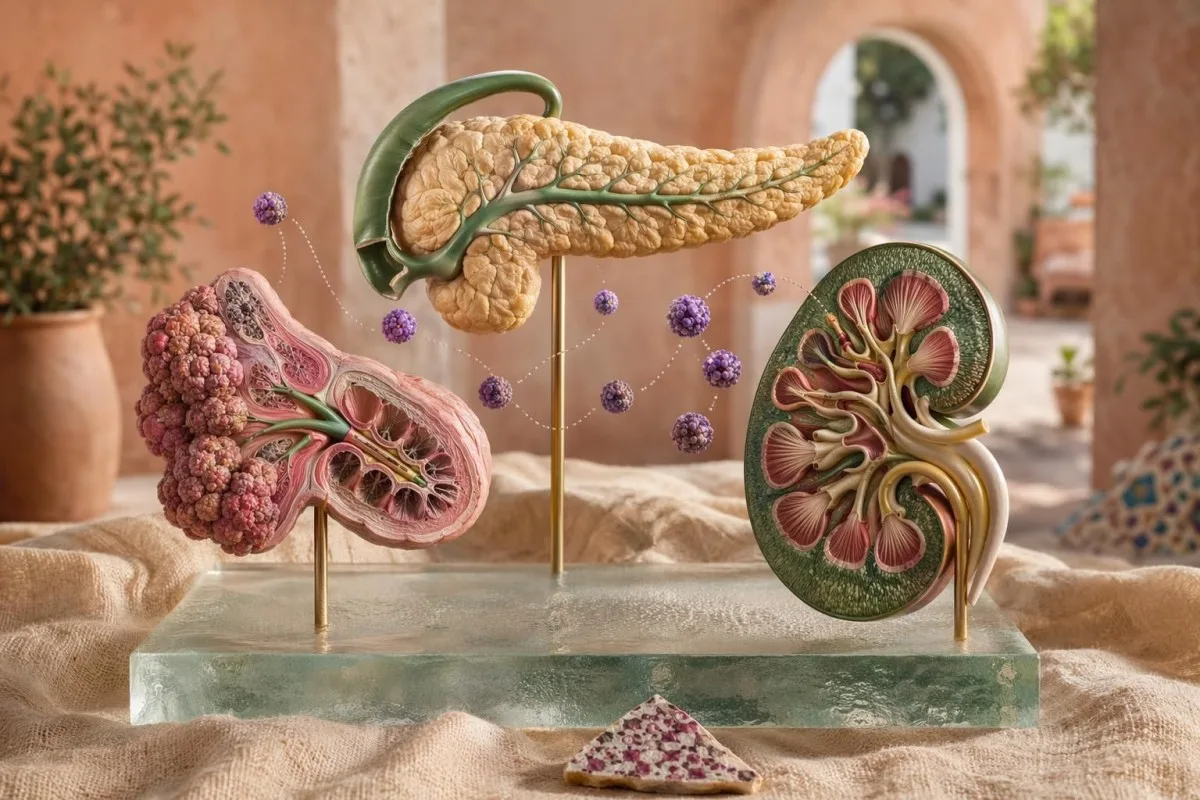
A raised amylase result does not always mean pancreatitis. The useful clue is the pattern: lipase, symptoms, kidney function, urine amylase, medicines and timing.


- High amylase causes include pancreatitis, salivary gland irritation, reduced kidney clearance, bowel inflammation, medicines and macroamylase.
- Amylase high lipase normal often points away from classic acute pancreatitis, especially when abdominal pain and imaging are absent.
- Pancreatitis concern rises when amylase or lipase is above 3 times the lab upper limit, often roughly above 300 U/L for amylase.
- Kidney clearance matters because eGFR below 60 mL/min/1.73 m² can keep amylase elevated even without pancreatic injury.
- Macroamylase causes high serum amylase with normal lipase, low urine amylase and an amylase-to-creatinine clearance ratio often below 1%.
- Salivary clues include jaw swelling, dry mouth, recent dental work, vomiting, mumps-like illness or Sjögren-type symptoms.
- High amylase symptoms that need same-day care include severe upper abdominal pain, persistent vomiting, fever, jaundice, fainting or confusion.
- Recheck timing is usually 24-72 hours for suspicious acute illness, or 1-3 weeks for a mild isolated result in a well patient.
What a high amylase result usually means first
High amylase causes include pancreatic inflammation, salivary gland disease, reduced kidney clearance, macroamylase, bowel irritation and medication effects. A normal lipase makes classic acute pancreatitis less likely, but not impossible. In my experience, the fastest safe split is this: severe upper abdominal pain plus enzyme levels above 3 times the upper limit is urgent; a well patient with isolated amylase usually needs pattern-checking, not panic.
As of June 28, 2026, most adult laboratories report serum amylase around 30-110 U/L, although I still see upper limits from 90 to 125 U/L across countries. Kantesti is an AI blood test analyzer that reads amylase alongside lipase, creatinine, eGFR, liver enzymes and symptoms rather than treating one red flag as a diagnosis; our biomarker guide explains why that context matters.
A single amylase of 145 U/L in a person eating normally and walking into clinic comfortably is a different problem from an amylase of 780 U/L with vomiting and a rigid upper abdomen. Thomas Klein, MD, here: the first case often ends up being salivary, kidney-related or macroamylase; the second case gets assessed for pancreatitis, gallstones and complications.
The hidden trap is timing. Amylase can rise within 6-12 hours after pancreatic irritation and often falls back toward baseline within 3-5 days, so a late blood test can look deceptively mild while the clinical story remains serious.
When is high amylase dangerous?
High amylase is dangerous when it is paired with severe symptoms, organ stress or levels above about 3 times the upper reference limit. If the lab upper limit is 100 U/L, a result above 300 U/L is the usual threshold that pushes clinicians to actively consider acute pancreatitis.
A result between 1 and 2 times the upper limit is common and often nonspecific. Some European labs use a lower amylase reference interval than UK or US labs, so a value of 118 U/L can be flagged in one system and normal in another.
Kantesti AI links enzyme height to pattern severity using clinically reviewed rules, and our clinical validation work treats amylase above 3 times the upper limit very differently from a borderline isolated result. That distinction prevents two bad outcomes: missing pancreatitis and over-medicalising a harmless macroamylase pattern.
Danger also depends on the company amylase keeps. Amylase of 260 U/L with bilirubin 65 µmol/L, ALP 280 U/L and right upper quadrant pain suggests a biliary-pancreatic pathway; amylase of 260 U/L with eGFR 38 mL/min/1.73 m² and no pain may simply reflect reduced clearance.
Pancreas clues that point toward acute pancreatitis
Acute pancreatitis is suspected when at least 2 of 3 findings are present: typical upper abdominal pain, pancreatic enzymes above 3 times the upper limit, or imaging evidence. This 2-of-3 framework comes from the revised Atlanta classification (Banks et al., 2013).
The pain pattern matters more than many patients expect. Classic pancreatic pain is deep upper abdominal pain that may travel to the back, often with vomiting and inability to tolerate food; our guide to high lipase danger covers the companion enzyme in more detail.
Amylase above 3 times the upper limit has reasonable sensitivity early, but lipase is usually more specific for pancreatic injury and stays high longer. Forsmark, Vege and Wilcox described this practical timing problem in the New England Journal of Medicine review on acute pancreatitis (Forsmark et al., 2016).
I worry sooner when high amylase comes with high bilirubin, high ALT above 150 U/L, pale stools, dark urine or fever, because gallstone pancreatitis can evolve quickly. A patient with ALT 212 U/L, amylase 640 U/L and a tender upper abdomen is not a wait-and-see situation.
Why amylase can be high when lipase is normal
Amylase high lipase normal usually means the amylase source may be non-pancreatic, the pancreatitis window has passed, or the result reflects clearance rather than new enzyme release. Normal lipase does not erase symptoms, but it strongly changes the probability map.
Lipase is more pancreas-weighted than amylase, while amylase comes from pancreatic and salivary isoenzymes. If you want the deeper lab disagreement, our amylase-lipase ratio article explains why the two enzymes can move in different directions.
Kantesti is an AI lab test interpretation service that treats normal lipase as a probability modifier, not a dismissal. A lipase of 28 U/L with amylase 210 U/L, eGFR 92 and jaw swelling reads very differently from lipase 28 U/L, amylase 210 U/L and 14 hours of severe epigastric pain.
Yadav, Agarwal and Pitchumoni argued in the American Journal of Gastroenterology that laboratory tests for acute pancreatitis must be interpreted against timing and clinical presentation, not in isolation (Yadav et al., 2002). That still matches what I see: the patient, not the enzyme, declares the emergency.
Salivary gland causes doctors often miss
Salivary gland amylase can raise total serum amylase even when the pancreas is quiet. Jaw swelling, pain while eating, dry mouth, recent vomiting, dental infection or mumps-like illness are the clues I actively ask about.
Roughly 50-70% of total serum amylase activity can come from salivary-type isoamylase, depending on the assay and the person. That is why a normal lipase with cheek tenderness makes me look above the neck, not straight to the pancreas.
A very common story is a patient who had dental work, then a mild amylase elevation two days later. For oral and jaw-related lab patterns, our article on tooth problem labs gives a useful checklist before anyone orders abdominal imaging.
Eating can briefly stimulate salivary secretion, but it should not usually push serum amylase very high. Persistent salivary-pattern amylase is more convincing when it appears with dry eyes, dry mouth, recurrent parotid swelling or inflammatory markers such as CRP above 10 mg/L.
Kidney clearance can make amylase look falsely alarming
Reduced kidney function can raise amylase because the kidneys help clear the enzyme from circulation. In practical terms, eGFR below 60 mL/min/1.73 m² can turn a modest amylase elevation into a clearance problem rather than a pancreas diagnosis.
When I see amylase 180-300 U/L with creatinine 150 µmol/L or eGFR 42, I slow the conversation down. Kidney-related elevation is usually mild to moderate, often under 3 times the upper limit, and it may persist for weeks if renal function is stable.
This is where a renal panel matters. Patients in the UK may see urea and electrolytes instead of BUN, so our U&E guide helps translate the kidney side of the report.
The amylase-to-creatinine clearance ratio is a niche but useful test when macroamylase or clearance confusion is suspected. For kidney math, the BUN/creatinine ratio guide is a good companion, especially when dehydration raises urea but eGFR is otherwise near baseline.
Macroamylase: the benign pattern that causes anxiety
Macroamylase is a large amylase-immunoglobulin complex that stays in the bloodstream because it is too bulky to pass easily into urine. The classic pattern is high serum amylase, normal lipase, low urine amylase and an amylase-to-creatinine clearance ratio below 1%.
Macroamylase is uncommon, but it is not rare enough to ignore; older studies and lab series often place it around 1% of unexplained hyperamylasaemia cases. The patient is usually well, and the amylase can sit at 150-600 U/L for months without matching symptoms.
Kantesti AI flags this possibility when serum amylase stays high across repeat tests but lipase, CRP, bilirubin and eGFR do not support pancreatic disease. Many patients first notice the pattern while trying to understand lab results before their appointment, which is exactly when reassurance plus a plan helps.
The practical test is not another random amylase alone. Ask your clinician whether urine amylase, amylase isoenzymes, polyethylene glycol precipitation or the amylase-to-creatinine clearance ratio is available locally.
Medicines, procedures and metabolic triggers
Medication-related high amylase can occur with drugs that irritate the pancreas, alter salivary flow or change kidney handling. The pattern is more concerning when symptoms start within days to weeks of a new medicine and enzymes rise above 3 times the upper limit.
Medicines linked to pancreatitis in case reports or clinical practice include azathioprine, valproate, didanosine, some diuretics, GLP-1 receptor agonists, tetracyclines and high-dose corticosteroids. The evidence strength varies a lot; I do not stop a useful drug on amylase alone unless the clinical picture fits.
Procedures matter too. ERCP can raise pancreatic enzymes, and after abdominal procedures a mild transient amylase rise may reflect handling, stress or local irritation rather than a new chronic disease.
The hidden metabolic triggers are triglycerides above 1,000 mg/dL, calcium clearly above the lab range and heavy recent alcohol exposure. If the timing lines up with a new prescription, our medication monitoring guide can help you prepare a clean timeline for your clinician.
Gut, gallbladder and other abdominal clues
Non-pancreatic abdominal illness can raise amylase because irritated bowel, biliary disease or nearby tissue stress can leak enzymes or stimulate inflammatory pathways. These cases usually reveal themselves through stool changes, fever, obstruction symptoms or abnormal liver tests.
Gallstones can trigger true pancreatitis, but they can also create a biliary picture before enzymes become dramatic. Pale stools, dark urine and bilirubin above 34 µmol/L make me think about bile flow, not just pancreatic cells.
Bowel obstruction, perforation, ischemia and severe gastroenteritis are less common high-amylase causes, yet they matter because the patient often looks sicker than the amylase number suggests. In those cases, lactate, white cell count, CRP and imaging can be more decisive than repeating amylase three times.
Triglyceride-driven pancreatitis is a special trap because very high triglycerides can interfere with some assays and muddy enzyme interpretation. Our guide to high triglyceride causes is worth reading if triglycerides are above 500 mg/dL, and urgent if they are near or above 1,000 mg/dL.
High amylase symptoms that should not wait
High amylase symptoms needing urgent care include severe upper abdominal pain, persistent vomiting, fever, fainting, jaundice, confusion or a fast heart rate. A lab number alone is rarely an emergency; a sick person with that lab can be.
Call emergency services or seek same-day assessment if pain is severe, constant, radiates to the back or comes with repeated vomiting. Dehydration can develop within 12-24 hours, and creatinine may rise before the patient realises how dry they are.
I also take fever, low blood pressure, confusion and oxygen saturation below 94% seriously because these suggest systemic illness, not just a pancreas lab. When infection or shock is on the table, our sepsis marker guide explains why lactate, CBC and CRP change the level of concern.
Thomas Klein, MD, clinical rule of thumb: if you cannot keep fluids down, cannot stand straight because of abdominal pain, or look grey and clammy, do not wait for a repeat blood test. That is an examination-and-imaging problem.
Which follow-up tests clarify the source?
Follow-up tests for high amylase usually include lipase, creatinine/eGFR, liver enzymes, bilirubin, CRP, full blood count and sometimes urine amylase or amylase isoenzymes. Imaging is chosen from the story, not ordered automatically for every mild elevation.
If pancreatitis is suspected, clinicians often check lipase, ALT, AST, ALP, GGT, bilirubin, calcium, triglycerides, urea, creatinine, electrolytes and CRP. A CRP above 150 mg/L at 48 hours can suggest more severe pancreatitis, although it is not a perfect early triage tool.
Ultrasound is often used when gallstones are possible, while CT is usually reserved for diagnostic uncertainty or suspected complications after the early phase. A CT scan in the first 24 hours can be falsely reassuring in some pancreatitis cases, so timing matters.
Before the appointment, I ask patients to write down pain timing, meals, alcohol, vomiting, new medicines and previous enzyme results. A structured doctor visit checklist prevents the common problem of remembering the amylase number but forgetting the event that caused it.
How pattern-based interpretation avoids false alarms
Pattern-based interpretation separates urgent high-amylase results from benign or chronic patterns by combining enzyme height, lipase, renal function, liver tests, inflammation markers and symptom timing. No responsible system should diagnose pancreatitis from amylase alone.
Kantesti is an AI-powered blood test analysis tool used by people in 127+ countries, and our medical team trains the system to recognise disagreement between amylase and lipase. The logic is simple clinically but hard to do manually at scale: one abnormal enzyme is a clue, not a conclusion.
Kantesti's neural network compares amylase with more than one context layer, including whether eGFR is below 60, whether bilirubin is high, whether CRP is above 10 mg/L and whether prior results show a stable personal baseline. The underlying approach is described in our AI technology guide.
This is not a replacement for urgent care. It is a sorting lens: high amylase with severe symptoms gets a red-flag message, while persistent isolated amylase with normal lipase and low urine amylase gets a macroamylase prompt to discuss with a clinician.
What to do before repeating amylase
Repeat amylase timing depends on risk: same day for severe symptoms, 24-72 hours for uncertain acute illness, and 1-3 weeks for a mild isolated result in a well person. Retesting too quickly can create noise without changing decisions.
Before a non-urgent repeat, avoid heavy alcohol, unusually intense exercise and unnecessary supplements for 48-72 hours if your clinician agrees. Do not stop prescribed medicines on your own; stopping azathioprine, valproate or a diabetes medicine abruptly can be riskier than the enzyme result.
Bring the previous report, reference range and units. Amylase reported in U/L cannot be compared casually across different assay methods, and a shift from 105 to 135 U/L may be pure laboratory variation if the upper limit changed from 125 to 100 U/L.
Trend is the calmest teacher. If your amylase has been 180, 176 and 190 U/L over six months with normal lipase, that is not behaving like acute pancreatitis; our trend analysis guide explains how to spot that kind of stable pattern.
Bottom line for patients and clinicians
High amylase is a clue, not a diagnosis. The safest interpretation separates pancreatic emergency patterns from salivary, kidney, medication and macroamylase patterns using symptoms, lipase, eGFR, liver tests and repeat behaviour.
At Kantesti AI, our clinical position is deliberately conservative: severe symptoms win over reassuring fragments, and stable isolated enzyme patterns deserve thoughtful follow-up rather than fear. Our doctors and advisors are listed on the Medical Advisory Board page for readers who want to know who reviews our medical logic.
Thomas Klein, MD: the most common avoidable mistake I see is assuming that every high amylase means pancreas damage. The second mistake is the opposite — ignoring severe abdominal pain because lipase happens to be normal at one point in time.
If you remember one number, remember 3 times the upper limit. If you remember one pattern, remember high amylase plus normal lipase plus low urine amylase plus no symptoms points strongly toward macroamylase or non-pancreatic causes, while pain, vomiting and jaundice need urgent medical assessment. You can read more about our organisation and governance on About Us.
Frequently Asked Questions
What are the most common high amylase causes?
The most common high amylase causes are acute pancreatitis, salivary gland irritation, reduced kidney clearance, macroamylase, medication effects and abdominal conditions such as gallbladder or bowel disease. A typical adult reference range is about 30-110 U/L, but laboratories vary. Values above 3 times the upper limit, often above about 300 U/L, are more concerning when symptoms fit pancreatitis.
Is high amylase dangerous if lipase is normal?
High amylase with normal lipase is often less dangerous than high levels of both enzymes, but symptoms decide urgency. Normal lipase makes classic acute pancreatitis less likely, especially if there is no severe upper abdominal pain or vomiting. A mild isolated amylase elevation under 2 times the upper limit often leads to repeat testing, kidney review and consideration of salivary or macroamylase causes.
What does amylase high lipase normal mean?
Amylase high lipase normal means the enzyme pattern may be coming from outside the pancreas, such as salivary glands, kidney clearance or macroamylase. It can also happen if the blood test was taken late after an episode, because amylase often falls within 3-5 days. If pain is severe or persistent, a normal lipase does not remove the need for clinical assessment.
What symptoms with high amylase need urgent care?
High amylase needs urgent care when it occurs with severe upper abdominal pain, repeated vomiting, fever, jaundice, fainting, confusion, fast heart rate or low blood pressure. These symptoms can signal pancreatitis, gallstone obstruction, dehydration or systemic illness. A result above 3 times the upper limit plus typical pain should be assessed promptly.
Can kidney problems raise amylase?
Yes, kidney problems can raise amylase because the kidneys help clear amylase from circulation. An eGFR below 60 mL/min/1.73 m² can cause mild to moderate amylase elevation without new pancreatic injury. In that pattern, creatinine, urea or BUN, urine findings and previous kidney results are often more useful than repeating amylase alone.
How is macroamylase diagnosed?
Macroamylase is suspected when serum amylase stays high while lipase, symptoms and imaging do not support pancreatitis. The classic clue is low urine amylase with an amylase-to-creatinine clearance ratio below 1%. Some laboratories confirm it with amylase isoenzymes or polyethylene glycol precipitation testing.
How soon should I repeat a high amylase test?
Repeat timing depends on the clinical picture. Severe symptoms need same-day care rather than a routine repeat, while uncertain acute illness is often rechecked within 24-72 hours. A well person with a mild isolated elevation may reasonably repeat amylase with lipase, creatinine/eGFR and liver tests in 1-3 weeks if their clinician agrees.
Should my family members be tested if I have macroamylase?
Usually not. Macroamylase is generally an individual laboratory finding rather than a condition needing family screening; once confirmed in a person without concerning symptoms, documenting it can prevent unnecessary repeat testing or emergency evaluations.
Get AI-Powered Blood Test Analysis Today
Join over 2 million users worldwide who trust Kantesti for instant, accurate lab test analysis. Upload your blood test results and receive comprehensive interpretation of 15,000+ biomarkers in seconds.
📚 Referenced Research Publications
Klein, T., Mitchell, S., & Weber, H. (2026). C3 C4 Complement Blood Test & ANA Titer Guide. Kantesti AI Medical Research.
Klein, T., Mitchell, S., & Weber, H. (2026). Nipah Virus Blood Test: Early Detection & Diagnosis Guide 2026. Kantesti AI Medical Research.
📖 External Medical References
Yadav D et al. (2002). A critical evaluation of laboratory tests in acute pancreatitis. American Journal of Gastroenterology.
⚕️ Medical Disclaimer
This article is for educational purposes only and does not constitute medical advice. Always consult a qualified healthcare provider for diagnosis and treatment decisions.
E-E-A-T Trust Signals
Experience
Physician-led clinical review of lab interpretation workflows.
Expertise
Laboratory medicine focus on how biomarkers behave in clinical context.
Authoritativeness
Written by Dr. Thomas Klein with review by Dr. Sarah Mitchell and Prof. Dr. Hans Weber.
Trustworthiness
Evidence-based interpretation with clear follow-up pathways to reduce alarm.