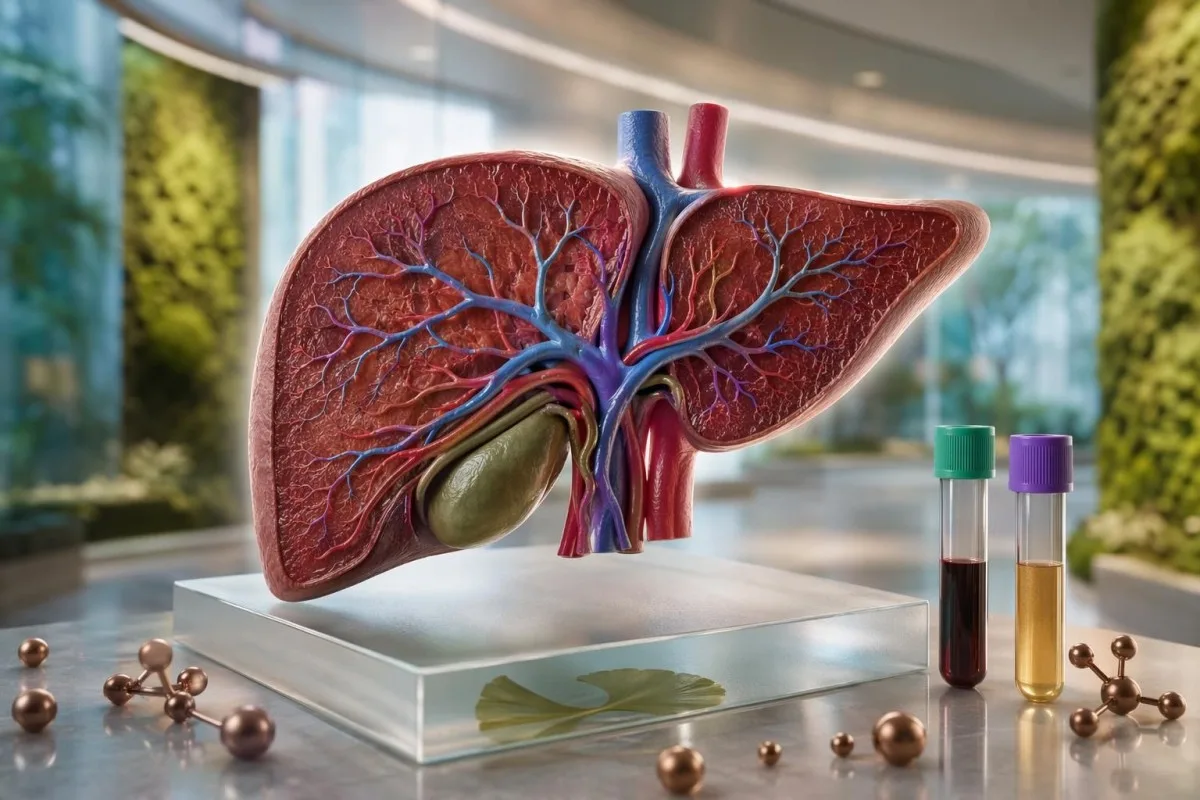
A low ceruloplasmin result is not a diagnosis by itself. The useful answer comes from the pattern: serum copper, 24-hour urine copper, liver enzymes, inflammation markers, symptoms, and sometimes genetics.


- Ceruloplasmin blood test is usually read with serum copper, 24-hour urine copper, ALT, AST, bilirubin, INR and CRP rather than alone.
- Low ceruloplasmin is commonly defined as below 20 mg/dL, but many labs use slightly different adult ranges such as 20-35 mg/dL.
- Wilson disease clue is low ceruloplasmin plus 24-hour urine copper above 100 µg/day in a symptomatic person, especially with liver or neurologic findings.
- Copper deficiency clue is low ceruloplasmin plus low serum copper and low urine copper, often with anemia, neutropenia, neuropathy, excess zinc or malabsorption.
- Inflammation effect matters because ceruloplasmin is an acute-phase protein and may rise during infection, pregnancy, estrogen therapy or inflammatory disease.
- Serum copper is often low in both Wilson disease and copper deficiency because most circulating copper is carried by ceruloplasmin.
- Urine copper separates many cases: Wilson disease tends to waste copper into urine, while nutritional copper deficiency usually does not.
- Urgent patterns include jaundice, high INR, Coombs-negative hemolysis, rapidly rising AST/ALT or confusion; these need same-day medical assessment.
How the ceruloplasmin blood test fits the copper pattern
Ceruloplasmin blood test results are useful only as a pattern: low ceruloplasmin plus low total serum copper can mean Wilson disease or copper deficiency, but high 24-hour urine copper, rising ALT/AST, neurologic signs, or Kayser-Fleischer rings push the interpretation toward Wilson disease. Low ceruloplasmin with low urine copper, anemia/neutropenia, high zinc intake, or malabsorption points more toward copper deficiency. Inflammation usually raises ceruloplasmin, so a normal-looking result during high CRP can still hide Wilson disease.
I’m Thomas Klein, MD, and when I review a low ceruloplasmin result, I never stop at the single number. A ceruloplasmin of 14 mg/dL with urine copper of 180 µg/day is a different clinical story from 14 mg/dL with urine copper of 8 µg/day, even though both reports may show the same red flag.
Kantesti is an AI blood test analyzer that reads ceruloplasmin in the same pattern-based way clinicians use: total copper, urine copper, liver enzymes, blood counts and inflammatory markers are weighted together rather than treated as separate islands. You can read more about the medical team behind Kantesti on our About Us page.
A practical rule I use is this: Wilson disease is a copper misplacement problem, while copper deficiency is a copper shortage problem. That is why Wilson disease can show tissue copper overload while total serum copper looks low, whereas copper deficiency usually shows low copper everywhere it is measured.
Ceruloplasmin test results explained: ranges and assay traps
Ceruloplasmin test results explained properly start with the lab method and reference range. Adult reference intervals often sit around 20-35 mg/dL, but some laboratories report 15-60 mg/dL depending on immunologic versus enzymatic measurement and local calibration.
A ceruloplasmin below 20 mg/dL is commonly considered low, and a value below 10 mg/dL is more suspicious for a major copper-handling disorder. Still, I have seen healthy ATP7B carriers, premature infants, and people with heavy protein loss sit below 20 mg/dL without having classic Wilson disease.
Most circulating copper travels attached to ceruloplasmin, so total serum copper often falls when ceruloplasmin falls. Our copper range guide explains why a low total copper result can be misleading unless urine copper and symptoms are reviewed at the same time.
Kantesti AI maps ceruloplasmin against more than 15,000 markers in our biomarker guide, which matters because the same 16 mg/dL result means something different in pregnancy, nephrotic syndrome, hepatitis, bariatric surgery or suspected Wilson disease.
Serum copper and urine copper tell different stories
Serum copper measures copper circulating in the blood, while 24-hour urine copper measures copper being lost through the kidneys. In untreated symptomatic Wilson disease, 24-hour urine copper is often above 100 µg/day, while nutritional copper deficiency usually produces low urine copper.
Normal adult serum copper is often about 70-140 µg/dL, though women taking estrogen-containing therapy may run higher. Low serum copper plus low ceruloplasmin does not separate Wilson disease from deficiency because both can reduce copper carried in circulation.
The 2022 AASLD guidance describes 24-hour urine copper as a core test in suspected Wilson disease, especially when interpreted with ceruloplasmin and clinical features (Schilsky et al., 2023). A 24-hour urine copper above 100 µg/day in a symptomatic patient is a strong Wilson clue, while 40-100 µg/day is a grey zone that needs repeat collection, genetics, eye exam or specialist review.
Collection quality is the boring part that prevents bad decisions. If a patient misses the first morning void, over-collects for 30 hours, or uses a contaminated container, urine copper can look falsely low or falsely high; urine interpretation also changes when kidney protein loss is present, as covered in our guide to protein loss in urine.
Low ceruloplasmin: Wilson disease or copper deficiency?
Low ceruloplasmin points toward Wilson disease when urine copper is high and liver, neurologic or eye findings fit. It points toward copper deficiency when serum copper and urine copper are both low, especially with anemia, neutropenia, sensory neuropathy, bariatric surgery, excess zinc or malabsorption.
Copper deficiency can look surprisingly neurologic: numb feet, balance trouble, fatigue and a low neutrophil count may appear before anyone thinks about copper. In clinic, the patient who worries me for deficiency is often taking 50 mg zinc daily or using zinc-containing denture adhesive, not someone with classic liver symptoms.
A typical copper deficiency pattern is serum copper below 70 µg/dL, ceruloplasmin below 20 mg/dL, urine copper below 20 µg/day, and a CBC showing anemia or neutropenia. Our article on high zinc clues explains why zinc can block copper absorption through intestinal metallothionein.
Wilson disease is different because copper accumulates in liver and brain tissue even when total serum copper looks low. In a 19-year-old with tremor, ALT 96 IU/L, ceruloplasmin 9 mg/dL and urine copper 220 µg/day, I would not reassure them with the phrase low copper; I would push for hepatology assessment.
What liver enzymes add to a Wilson disease blood test
Liver enzymes add risk context to a Wilson disease blood test because Wilson disease often injures hepatocytes before symptoms look obviously hepatic. ALT and AST may be mildly elevated for years, but acute liver failure can show jaundice, high INR, hemolysis and a disproportionally low alkaline phosphatase.
ALT above 40-50 IU/L or AST above 40-50 IU/L is not specific, but persistent elevation with low ceruloplasmin deserves a copper workup. For context on what a liver panel includes, our liver panel guide breaks down ALT, AST, ALP, bilirubin, albumin and GGT.
The acute Wilson pattern is one of the scarier lab clusters in medicine: bilirubin rises, INR prolongs, Coombs-negative hemolysis appears, and ALP can be unexpectedly low for the degree of jaundice. EASL’s Wilson disease guideline highlights that no single biochemical test is definitive, which is why clinical scoring and multiple tests are used together (EASL, 2012).
A subtle clue is AST higher than ALT in a young person with hemolysis, low ALP and rapidly worsening jaundice. Our separate guide to ALT result patterns is useful when the liver enzyme rise is mild and competing causes such as fatty liver, viral hepatitis or exercise are still plausible.
Inflammation can hide or distort ceruloplasmin results
Inflammation usually raises ceruloplasmin because it behaves as an acute-phase protein. A ceruloplasmin of 24 mg/dL may be less reassuring if CRP is 80 mg/L, the patient is pregnant, or estrogen therapy is increasing hepatic ceruloplasmin production.
This is where top-line reference ranges fail. If someone has suspected Wilson disease and active infection, autoimmune disease or marked tissue response, a normal ceruloplasmin may be inflated by inflammation and should be rechecked when CRP falls.
I often pair ceruloplasmin with CRP, ESR and fibrinogen when the story is messy. Our guide to CRP test differences explains why a standard CRP of 30 mg/L means acute inflammation, while hs-CRP is mainly used for low-grade cardiovascular risk.
Pregnancy is a classic false-normal situation because estrogen raises ceruloplasmin and serum copper. A pregnant patient with Wilson disease can have serum copper above the non-pregnant range, so urine copper, liver tests and specialist history matter more than the copper number alone.
False-low ceruloplasmin patterns doctors should check
False-low ceruloplasmin can occur with protein loss, severe liver synthetic failure, malnutrition, infancy, certain genetic carrier states and assay limitations. These patterns can mimic Wilson disease unless albumin, total protein, urine protein, INR and clinical context are reviewed.
Ceruloplasmin is a protein made by the liver, so low production or excess loss can lower the result. A patient with albumin 24 g/L, total protein 48 g/L and heavy urine protein has a very different differential diagnosis from a patient with normal albumin and neurologic tremor.
Nephrotic syndrome and protein-losing enteropathy can pull ceruloplasmin down along with other plasma proteins. For a deeper biochemical context, our serum proteins guide explains albumin, globulins and A/G ratio patterns that often travel with these cases.
Infants are another trap. Ceruloplasmin is physiologically low in early infancy, so adult cutoffs should not be applied to a 3-month-old; pediatric hepatology teams often rely on age-specific ranges, clinical signs, genetics and repeat testing.
Scoring systems and specialist tests when results conflict
When ceruloplasmin, copper and liver tests conflict, specialists often use the Leipzig scoring system, slit-lamp eye examination, ATP7B genetic testing and sometimes hepatic copper measurement. A score of 4 or more traditionally supports Wilson disease, but borderline scores need judgement.
Ferenci and colleagues proposed the widely used diagnostic scoring framework that combines ceruloplasmin, Kayser-Fleischer rings, neurologic signs, urinary copper, liver copper and ATP7B findings (Ferenci et al., 2003). The score helps because a single abnormal marker can mislead, but several partially abnormal findings may become convincing together.
Hepatic copper above 250 µg/g dry weight is a classic Wilson threshold, although sampling error and cholestatic liver disease can complicate it. A low hepatic copper result also does not absolutely exclude Wilson disease if the tissue sample misses copper-rich regions.
Kantesti is an AI blood test interpretation platform with clinical validation workflows described on our medical validation page, but suspected Wilson disease still belongs with a hepatologist, neurologist or metabolic specialist. Our AI can flag the pattern; it cannot replace a slit-lamp exam, genetics or urgent liver assessment.
Non-ceruloplasmin copper sounds useful, but be careful
Non-ceruloplasmin copper estimates the fraction of serum copper not bound to ceruloplasmin, but calculated values are often unreliable. The common formula uses total copper minus about 3.15 times ceruloplasmin in mg/dL, and small assay errors can produce impossible negative results.
In theory, Wilson disease should raise toxic non-ceruloplasmin copper. In practice, immunologic ceruloplasmin assays can measure apoceruloplasmin, total copper methods vary, and the resulting calculation may swing from negative to high without reflecting the patient’s true copper biology.
Some specialist centres measure exchangeable copper or relative exchangeable copper, and reported cutoffs around 18.5% for relative exchangeable copper have shown promising diagnostic performance in selected studies. These tests are not widely available, and clinicians disagree about how to use them outside expert centres.
Unit conversion is another source of chaos: serum copper may appear as µg/dL, µmol/L or µg/L, and ceruloplasmin may appear as mg/dL, g/L or mg/L. Our article on lab unit changes can prevent a false trend when a patient switches laboratories.
Blood counts and neurologic clues in copper deficiency
Copper deficiency often announces itself through the CBC and nervous system rather than the liver. Low copper can cause anemia, neutropenia, high RDW, gait imbalance, numbness and spinal-cord-like symptoms even when liver enzymes are normal.
A common pattern is hemoglobin below 12 g/dL in women or below 13 g/dL in men, neutrophils below 1.5 × 10⁹/L, low serum copper and low ceruloplasmin. Bone marrow findings can mimic myelodysplasia, which is why copper deficiency is worth checking before assuming a marrow disorder.
Bariatric surgery, long-term tube feeding, coeliac disease, inflammatory bowel disease and excess zinc are the usual culprits. The overlap with iron deficiency can confuse things, and our iron studies guide helps separate ferritin, transferrin saturation and inflammatory iron blockade.
Neurologic recovery is slower than blood-count recovery. In my experience, neutrophils may improve within weeks of copper replacement, while gait and numbness can take months and sometimes remain incomplete if deficiency has been prolonged.
When abnormal copper tests are not Wilson disease
Abnormal copper tests are not automatically Wilson disease because cholestasis, acute hepatitis, autoimmune liver disease, protein loss, supplements and collection error can all distort copper markers. The pattern should be matched against symptoms, age, medications and repeat results.
Cholestasis can raise serum and liver copper because bile is the main copper exit route. A person with high ALP, high GGT and obstructive symptoms may have secondary copper retention rather than ATP7B-related Wilson disease.
Viral hepatitis and autoimmune hepatitis can raise urinary copper during active liver injury. If hepatitis risk is present, our guide to hepatitis C lab clues explains which antibody and RNA tests separate past exposure from active infection.
The age story helps, but it is not perfect. Wilson disease often presents between ages 5 and 35, yet I have seen convincing adult presentations later than that; conversely, mild low ceruloplasmin in a 62-year-old on zinc is more often deficiency or protein loss.
How Kantesti flags copper patterns without overcalling disease
Kantesti flags copper patterns by comparing ceruloplasmin with serum copper, urine copper, liver enzymes, CBC changes, CRP, albumin, kidney markers and medications. The aim is triage: identify a pattern that deserves medical review, not label a patient with Wilson disease from one result.
Kantesti is an AI biomarker interpretation platform used by people across 127+ countries, and our copper logic is deliberately conservative because false alarms can be frightening. A ceruloplasmin of 18 mg/dL with normal ALT, low urine copper and recent zinc use is flagged differently from 18 mg/dL with urine copper 160 µg/day and bilirubin 55 µmol/L.
Our neural network also watches for contradictions. If serum copper is reported in µmol/L, urine copper in µg/day and ceruloplasmin in g/L, the system normalizes units before comparing trends; the methodology behind this workflow is outlined in our AI technology guide.
The most useful output is often the follow-up list: repeat ceruloplasmin when CRP is lower, confirm a full 24-hour urine collection, add CBC and zinc, or ask whether an eye exam and ATP7B testing are appropriate. That is more clinically honest than pretending one biomarker has all the answers.
Retesting preparation and sample quality details
Retesting is reasonable when ceruloplasmin is mildly low, the clinical story is weak, or the result conflicts with serum and urine copper. Use the same lab when possible, avoid new copper or zinc supplements unless prescribed, and confirm whether inflammation or pregnancy may change the result.
Ceruloplasmin itself does not usually require fasting. Serum copper is more vulnerable to contamination, so trace-element collection tubes and careful handling matter; a normal venipuncture workflow is fine, but the tube type and lab method should be appropriate.
For a 24-hour urine copper test, patients usually discard the first morning urine, collect every void for the next 24 hours, and include the final morning sample. Missed collections can make a Wilson-pattern result look falsely reassuring, while contaminated containers can push copper upward.
If the result is mildly abnormal, repeat testing after 2-8 weeks is often more useful than reacting overnight, unless there are red flags such as jaundice, confusion, high INR or rapidly rising enzymes. Our guide to repeating abnormal labs explains which abnormalities can wait and which need faster review.
What to ask your clinician after a low result
After a low ceruloplasmin result, ask whether the pattern fits Wilson disease, copper deficiency, protein loss, inflammation or a lab artifact. The next useful tests are usually serum copper, 24-hour urine copper, ALT, AST, bilirubin, INR, CBC, CRP, zinc, albumin and urinalysis.
I advise patients to bring the actual PDF, not just a screenshot. Reference ranges, units and assay notes matter, and the word low means different things across laboratories; our guide to second opinions is built around that exact problem.
A good question is: does my urine copper match the ceruloplasmin result? Another good one is: could CRP, pregnancy, estrogen therapy, protein loss, zinc or liver inflammation be distorting the result?
Thomas Klein, MD, reviewed this article with the same caution we use in Kantesti’s clinical governance process: copper disorders are rare, but missing Wilson disease can be serious. Our physicians and advisors are listed through the Medical Advisory Board, and any urgent liver-failure pattern should bypass AI interpretation and go straight to emergency care.
Frequently Asked Questions
What does a low ceruloplasmin blood test mean?
A low ceruloplasmin blood test usually means the level is below about 20 mg/dL, but the cause depends on the full copper pattern. Wilson disease is more likely when low ceruloplasmin is paired with 24-hour urine copper above 100 µg/day, liver enzyme abnormalities, neurologic symptoms or Kayser-Fleischer rings. Copper deficiency is more likely when serum copper and urine copper are both low, especially with anemia, neutropenia, excess zinc or malabsorption.
Can Wilson disease have normal ceruloplasmin?
Yes, Wilson disease can have a normal ceruloplasmin result, especially during inflammation, pregnancy, estrogen therapy or acute tissue response because ceruloplasmin is an acute-phase protein. A value around 20-35 mg/dL does not fully exclude Wilson disease if urine copper is high or liver and neurologic signs fit. Clinicians often add 24-hour urine copper, slit-lamp examination, ATP7B testing and sometimes hepatic copper measurement when suspicion remains.
What urine copper level suggests Wilson disease?
A 24-hour urine copper above 100 µg/day in an untreated symptomatic person strongly supports Wilson disease when the clinical pattern fits. Results between 40 and 100 µg/day are borderline and may occur in early Wilson disease, carrier states, hepatitis, cholestasis or collection error. Normal urine copper is often below 40-50 µg/day, and very low urine copper with low serum copper usually points more toward copper deficiency.
Why can serum copper be low in Wilson disease?
Serum copper can be low in Wilson disease because most circulating copper is bound to ceruloplasmin, and ceruloplasmin is often low. The problem in Wilson disease is not always low body copper; it is abnormal copper transport and tissue accumulation, especially in the liver and brain. This is why low serum copper must be interpreted with urine copper, liver enzymes, neurologic signs and sometimes genetic testing.
Can inflammation change ceruloplasmin results?
Inflammation can raise ceruloplasmin because it behaves as an acute-phase protein. A ceruloplasmin of 24 mg/dL may look normal, but if CRP is 60-100 mg/L, that value may be artificially elevated compared with the patient’s baseline. In suspected Wilson disease, clinicians often repeat testing after inflammation improves or rely more heavily on urine copper, clinical signs and specialist tests.
What tests should be ordered with ceruloplasmin?
Ceruloplasmin is usually most useful with serum copper, 24-hour urine copper, ALT, AST, alkaline phosphatase, bilirubin, INR, albumin, CBC, CRP, zinc and urinalysis. If Wilson disease remains possible, slit-lamp examination for Kayser-Fleischer rings and ATP7B genetic testing may be appropriate. If copper deficiency is suspected, checking zinc exposure, malabsorption history and anemia or neutropenia patterns is often more useful than repeating ceruloplasmin alone.
Could denture adhesive contribute to copper deficiency?
Some denture adhesives contain zinc, and prolonged heavy use can raise zinc exposure enough to interfere with copper absorption in susceptible people. Bring the product or ingredient list to your clinician; zinc and copper testing can help determine whether it is contributing.
Get AI-Powered Blood Test Analysis Today
Join over 2 million users worldwide who trust Kantesti for instant, accurate lab test analysis. Upload your blood test results and receive comprehensive interpretation of 15,000+ biomarkers in seconds.
📚 Referenced Research Publications
Klein, T., Mitchell, S., & Weber, H. (2026). Nipah Virus Blood Test: Early Detection & Diagnosis Guide 2026. Kantesti AI Medical Research.
Klein, T., Mitchell, S., & Weber, H. (2026). B Negative Blood Type, LDH Blood Test & Reticulocyte Count Guide. Kantesti AI Medical Research.
📖 External Medical References
⚕️ Medical Disclaimer
This article is for educational purposes only and does not constitute medical advice. Always consult a qualified healthcare provider for diagnosis and treatment decisions.
E-E-A-T Trust Signals
Experience
Physician-led clinical review of lab interpretation workflows.
Expertise
Laboratory medicine focus on how biomarkers behave in clinical context.
Authoritativeness
Written by Dr. Thomas Klein with review by Dr. Sarah Mitchell and Prof. Dr. Hans Weber.
Trustworthiness
Evidence-based interpretation with clear follow-up pathways to reduce alarm.