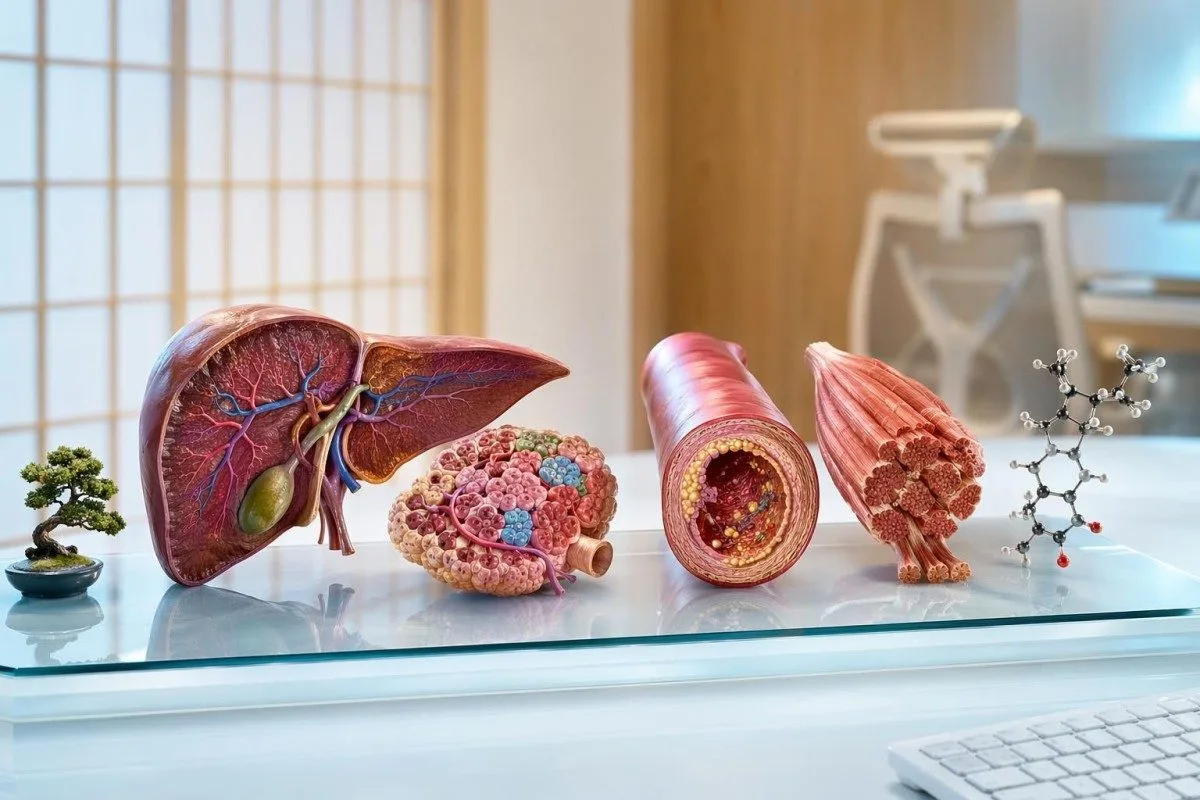
Desk work changes lab patterns long before symptoms appear. The useful panel is not bigger; it is more targeted to sitting, indoor life, stress, and metabolic drift.


- Fasting insulin above about 10-12 µIU/mL can suggest early insulin resistance even when fasting glucose is still 70-99 mg/dL.
- HbA1c of 5.7-6.4% is prediabetes range; 6.5% or higher needs repeat confirmation unless symptoms are clear.
- Triglycerides below 150 mg/dL are generally normal, while 200 mg/dL or higher makes ApoB or non-HDL cholesterol more useful.
- ApoB of 130 mg/dL or higher is a risk-enhancing cholesterol marker in the 2018 AHA/ACC guideline.
- ALT above 30 IU/L in men or 19 IU/L in women may be metabolically meaningful, even if the lab flag does not mark it high.
- 25-OH vitamin D below 20 ng/mL is deficiency; many indoor office workers sit between 15-25 ng/mL in winter.
- hs-CRP below 1 mg/L is low cardiovascular inflammation risk; above 3 mg/L should be interpreted only when you are well.
- eGFR below 60 mL/min/1.73 m² for 3 months meets chronic kidney disease criteria and should not be dismissed as dehydration.
- HOMA-IR above roughly 2.5 often points toward insulin resistance, but ethnicity, weight history, and lab method change the cutoff.
- Repeat testing after 8-12 weeks is usually better than reacting to one mildly abnormal office-worker panel.
What should a desk job blood test include?
A blood test for office workers should focus on metabolic drift from sitting: HbA1c, fasting glucose, fasting insulin or HOMA-IR, lipid panel with non-HDL or ApoB, ALT, AST, GGT, 25-OH vitamin D, hs-CRP, ferritin, CBC, creatinine/eGFR, and electrolytes. That is the practical desk-job checklist I use first; Kantesti AI can help interpret the pattern, not just the red flags.
As of May 4, 2026, the issue is not that every office worker needs a giant panel. The issue is that long sitting, indoor work, cafeteria eating, commuting stress, and late screens tend to move a small cluster of markers before a person feels unwell.
In our analysis of 2M+ blood test uploads, I often see the same quiet combination: fasting glucose 92 mg/dL, HbA1c 5.6%, triglycerides 178 mg/dL, ALT 42 IU/L, vitamin D 18 ng/mL, and hs-CRP 2.8 mg/L. None of those alone screams emergency; together they say, pause and act.
This is different from a generic annual panel. If you want the broader prevention view, our guide to early risk labs is useful, but the desk-worker version gives more weight to insulin, liver fat signals, ApoB, vitamin D, and inflammation.
I am Thomas Klein, MD, and in clinic I try to ask one question before ordering tests: what will change if this result is abnormal? For office workers, the answer is usually movement timing, meal composition, sleep repair, vitamin D replacement, and a targeted repeat test in 8-12 weeks.
Which labs catch insulin resistance before diabetes?
Fasting glucose, HbA1c, fasting insulin, and HOMA-IR catch desk-job insulin resistance earlier than glucose alone. A fasting glucose of 70-99 mg/dL is normal, but fasting insulin above about 10-12 µIU/mL can signal compensation years before HbA1c reaches 5.7%.
The American Diabetes Association defines prediabetes as fasting glucose 100-125 mg/dL, HbA1c 5.7-6.4%, or 2-hour oral glucose tolerance 140-199 mg/dL (American Diabetes Association Professional Practice Committee, 2024). Diabetes is diagnosed at fasting glucose 126 mg/dL or HbA1c 6.5% or higher, usually confirmed on a second day.
The office-worker blind spot is insulin. A 38-year-old project manager can have fasting glucose 88 mg/dL and fasting insulin 18 µIU/mL; the pancreas is working overtime, so the glucose still looks fine. If you want the calculation details, our HOMA-IR guide walks through glucose in mg/dL multiplied by insulin in µIU/mL, divided by 405.
A HOMA-IR below about 1.5 is commonly insulin-sensitive, while values above 2.5 often suggest insulin resistance. Clinicians disagree on the exact cutoff because South Asian, Middle Eastern, Black, and Pacific Islander populations may show risk at lower body mass index and sometimes different insulin thresholds.
I rarely panic over one fasting insulin result. I do pay attention when fasting insulin rises from 6 to 14 µIU/mL over two years while triglycerides climb and waist circumference increases by 5 cm; that is a pattern, not a lab curiosity.
How does sitting change cholesterol and triglycerides?
Sitting commonly raises triglycerides, lowers HDL, and increases particle-related risk even when LDL cholesterol looks acceptable. Triglycerides below 150 mg/dL are generally normal, 150-199 mg/dL are borderline high, and 200 mg/dL or higher should prompt a closer look at ApoB or non-HDL cholesterol.
The mechanism is not mysterious: skeletal muscle lipoprotein lipase activity drops during prolonged sitting, so triglyceride-rich particles clear more slowly after meals. I see this after conference seasons — someone’s LDL barely changes, but triglycerides jump from 108 to 196 mg/dL.
According to the 2018 AHA/ACC cholesterol guideline, ApoB can be used as a risk-enhancing factor, especially when triglycerides are 200 mg/dL or higher, and ApoB of 130 mg/dL or higher is a meaningful risk marker (Grundy et al., 2019). Our ApoB blood test explainer covers why a normal LDL can miss particle burden.
Non-HDL cholesterol equals total cholesterol minus HDL cholesterol, and it captures cholesterol carried by LDL, VLDL, IDL, and remnants. A non-HDL cholesterol below 130 mg/dL is a common goal for average-risk adults, but people with diabetes, kidney disease, or known vascular disease often need lower targets.
One misconception: a high HDL does not erase a high ApoB. I have reviewed panels with HDL 78 mg/dL, LDL 122 mg/dL, triglycerides 230 mg/dL, and ApoB 118 mg/dL; that pattern is not protected just because the HDL column looks pretty.
Which liver markers hint at desk-job fatty liver?
ALT, AST, GGT, triglycerides, platelets, and fasting insulin are the most useful blood clues for metabolic fatty liver in sedentary professionals. ALT above 30 IU/L in men or 19 IU/L in women can be metabolically meaningful, even when a local lab reports a higher upper limit.
A classic pattern is ALT higher than AST, mildly raised GGT, high triglycerides, and a waist measurement that has crept up. A 44-year-old accountant I reviewed had ALT 58 IU/L, AST 34 IU/L, GGT 72 IU/L, triglycerides 218 mg/dL, and fasting insulin 16 µIU/mL; ultrasound later showed hepatic steatosis.
GGT is noisy. It can rise with fatty liver, alcohol, some seizure medicines, cholestasis, and even recent heavy training, so I do not treat GGT 65 IU/L as a diagnosis. Our liver function test guide explains why ALT, AST, ALP, bilirubin, and GGT must be read together.
FIB-4 uses age, AST, ALT, and platelet count to estimate fibrosis risk. In adults under 65, FIB-4 below 1.3 is usually low risk, while above 2.67 deserves further liver assessment; over age 65, many clinicians use a higher low-risk cutoff around 2.0 to avoid false alarms.
The office-worker action is usually boring but powerful: 7-10% weight loss if overweight, 150 minutes weekly aerobic activity, resistance training twice weekly, and fewer liquid calories. I have seen ALT fall from 62 to 29 IU/L in 14 weeks when the patient simply walked 12 minutes after lunch and dinner.
Why do indoor workers need 25-OH vitamin D checked?
25-hydroxyvitamin D is the correct blood test for vitamin D status in office workers because indoor light does not trigger meaningful skin vitamin D production. A 25-OH vitamin D below 20 ng/mL is deficiency, 20-29 ng/mL is often called insufficiency, and 30-50 ng/mL is a common practical target.
The Endocrine Society’s 2011 guideline classified vitamin D deficiency as below 20 ng/mL and suggested that levels above 30 ng/mL are often needed to ensure sufficiency in at-risk patients (Holick et al., 2011). Some bone-health researchers are comfortable with 20 ng/mL, so this is one of those areas where context matters more than a single number.
Unit confusion causes mistakes. A vitamin D result of 50 nmol/L equals 20 ng/mL because 1 ng/mL equals 2.5 nmol/L; our vitamin D blood test guide explains why 25-OH vitamin D is usually better than the active 1,25-OH form for deficiency screening.
Most adults with low vitamin D are treated with 800-2,000 IU daily, though some need 4,000 IU daily for a limited period under clinical guidance. Recheck after 8-12 weeks; checking after 10 days only proves that the calendar moved.
I also look at calcium, phosphate, alkaline phosphatase, kidney function, and sometimes PTH if vitamin D is very low or symptoms suggest bone turnover. Vitamin D toxicity is uncommon but becomes more plausible when 25-OH vitamin D exceeds 100-150 ng/mL with high calcium.
Which inflammation markers are useful for sedentary professionals?
hs-CRP, ferritin, CBC differential, and sometimes ESR are the most practical inflammation markers for sedentary office workers. hs-CRP below 1 mg/L suggests low cardiovascular inflammation risk, 1-3 mg/L suggests average risk, and above 3 mg/L suggests higher risk only if you are not acutely ill.
A common error is testing hs-CRP during a cold, dental flare, vaccine week, or hard training block. If hs-CRP is above 10 mg/L, I usually repeat it in 2-3 weeks when the patient is well rather than calling it chronic inflammation.
Ferritin behaves like an iron-storage marker and an acute-phase reactant. Ferritin above 300 ng/mL in men or above 200 ng/mL in women can reflect iron overload, but in office workers it often travels with fatty liver, insulin resistance, or inflammation; our hs-CRP comparison explains why test type matters.
The neutrophil-to-lymphocyte ratio is not a screening diagnosis, but it sometimes adds texture. A ratio above 3 may reflect stress physiology, infection, smoking, poor sleep, or steroid use; a ratio of 2.9 on Monday after a 70-hour workweek is less interesting than 2.9 repeated three times with rising CRP.
The evidence here is honestly mixed for using inflammation labs to micromanage wellness plans. I find them most helpful when paired with symptoms, waist change, gum health, sleep duration, and metabolic markers rather than sold as a stand-alone inflammation score.
Can blood tests show office stress or burnout?
Blood tests can suggest stress-related physiology, but they do not diagnose burnout. Morning cortisol is typically about 5-25 µg/dL, or 140-690 nmol/L, and a random midday cortisol is usually too hard to interpret for ordinary office stress.
The desk-job pattern I trust more than cortisol alone is indirect: fasting glucose drifting upward, triglycerides rising, sodium and potassium normal, mild neutrophil predominance, and sleep under 6 hours most nights. That pattern does not prove burnout, but it tells me the body is paying for the schedule.
Cushing syndrome screening uses late-night salivary cortisol, 24-hour urinary free cortisol, or a 1 mg overnight dexamethasone suppression test; a routine morning cortisol is not the screening test. Our cortisol timing guide explains why an 8 a.m. result and a 4 p.m. result cannot be compared casually.
Low morning cortisol can be serious if paired with weight loss, low blood pressure, low sodium, high potassium, or skin darkening. In a tired software developer with normal electrolytes and a cortisol of 11 µg/dL, I usually look harder at sleep apnea, iron, B12, thyroid, alcohol, and workload.
Most patients want a burnout number. I get it. But the most useful lab strategy is to rule out mimics, identify metabolic consequences, and then track whether recovery changes glucose, triglycerides, hs-CRP, and blood pressure over 8-16 weeks.
What kidney and hydration clues matter at a desk job?
Creatinine, eGFR, cystatin C, BUN, sodium, potassium, CO2, and uric acid are the kidney-and-hydration markers I check in sedentary professionals. eGFR above 90 mL/min/1.73 m² is usually normal, while eGFR below 60 for 3 months meets chronic kidney disease criteria.
Creatinine is muscle-dependent. A muscular gym-goer may run creatinine 1.25 mg/dL with normal kidney function, while a low-muscle desk worker can have creatinine 0.62 mg/dL and still not have much kidney reserve; cystatin C can clarify that mismatch.
BUN is usually about 7-20 mg/dL, but it rises with dehydration, high protein intake, gastrointestinal fluid loss, and kidney dysfunction. A BUN/creatinine ratio above 20 often points toward low fluid volume or high protein intake, not automatically kidney damage.
Potassium is one marker I do not ignore. Potassium below 3.0 mmol/L or above 6.0 mmol/L can be urgent, especially with palpitations, weakness, kidney disease, or medications that affect the renin-angiotensin system.
If eGFR seems unexpectedly low, our cystatin C guide explains when a second filtration estimate is worth ordering. In my experience, this prevents both under-calling kidney disease and over-frightening healthy people with unusual muscle mass.
Can labs reveal low movement and muscle loss?
No blood test directly measures how much you move, but creatinine, HDL, triglycerides, insulin, vitamin D, CK, and sometimes albumin can hint at low muscle activity or low lean mass. Low creatinine below about 0.6 mg/dL in adults may reflect low muscle mass rather than excellent kidney function.
Creatinine is produced from muscle metabolism, so a very low creatinine can be a clue when paired with weakness, low protein intake, or rapid weight loss. I have seen older desk-based executives celebrate creatinine 0.55 mg/dL, when the real issue was shrinking muscle.
CK is different. A normal CK, often around 30-200 IU/L depending on the lab, does not prove good muscle health; a CK above 1,000 IU/L after intense exercise can be benign, while persistent unexplained elevation deserves review.
Albumin below 3.5 g/dL is not a desk-job marker by itself. But if albumin is low with low creatinine, low vitamin D, and fatigue, I start asking about protein intake, gastrointestinal symptoms, kidney protein loss, and chronic inflammation.
For people using creatine or strength training to rebuild, our creatine and labs article explains why creatinine can rise slightly without kidney injury. The trend matters more than one isolated number.
Which fatigue labs are often mistaken for desk-job burnout?
TSH, free T4, B12, ferritin, CBC, and vitamin D are the fatigue labs most often confused with office burnout. TSH is commonly interpreted against a reference interval near 0.4-4.0 mIU/L, while free T4 is usually about 0.8-1.8 ng/dL depending on the assay.
A TSH above 10 mIU/L is usually treated more consistently than a TSH of 4.8 mIU/L, where symptoms, free T4, thyroid antibodies, pregnancy plans, age, and repeat testing change the decision. Some European labs use slightly different TSH reference ranges, so unit and method matter.
Vitamin B12 below 200 pg/mL is commonly deficient, while 200-400 pg/mL can still be symptomatic in some people, especially if methylmalonic acid is high. For the brain-fog overlap, our brain fog labs guide is more useful than ordering every hormone under the sun.
Ferritin below 30 ng/mL often suggests low iron stores even when hemoglobin is normal. I have seen many menstruating office workers with hemoglobin 12.9 g/dL, ferritin 11 ng/mL, normal TSH, and crushing afternoon fatigue.
The practical trick is sequencing. If TSH, B12, ferritin, CBC, vitamin D, and glucose markers are normal, I stop pretending another rare lab will explain a 75-hour workweek and start discussing sleep, workload, mood, and movement honestly.
What is a practical office worker health screening panel?
A practical office worker health screening panel has two tiers: a core desk-job panel and add-ons based on risk. The core includes HbA1c, fasting glucose, fasting insulin, lipid panel, ALT, AST, GGT, 25-OH vitamin D, hs-CRP, CBC, ferritin, creatinine/eGFR, sodium, potassium, and CO2.
Tier two is where personalization earns its keep: ApoB if triglycerides are 150-200 mg/dL or higher, Lp(a) once in adulthood, cystatin C if creatinine is misleading, B12 if plant-forward diet or numbness, TSH if fatigue or weight change, and uric acid if gout risk or metabolic syndrome.
Kantesti’s neural network maps more than 15,000 biomarkers across units, age, sex, and reference-range formats, which is useful when a PDF mixes mg/dL, mmol/L, ng/mL, and IU/L. Our biomarkers guide gives a deeper marker-by-marker reference if your panel is unusually broad.
Do not order everything every month. For most low-risk office workers, baseline testing and a 3-month repeat after a change is more informative than weekly lab anxiety.
If a packaged panel looks impressive but skips fasting insulin, ApoB or non-HDL, GGT, and 25-OH vitamin D, it may miss the desk-job story. Our wellness panel review explains how to separate useful preventive labs from expensive noise.
When should sedentary lifestyle blood tests be repeated?
Sedentary lifestyle blood tests should usually be repeated 8-12 weeks after a meaningful lifestyle or medication change. Fasting 8-12 hours is best when measuring fasting insulin, HOMA-IR, and triglycerides, while many cholesterol checks remain useful without fasting.
Non-fasting lipids are acceptable in many settings, but triglycerides can jump after a meal and calculated LDL becomes less reliable when triglycerides exceed 400 mg/dL. If the clinical question is insulin resistance, I prefer a true morning fast with water only.
Hard exercise can raise AST, ALT, and CK for 24-72 hours, which can mimic liver or muscle injury. I once reviewed an AST of 89 IU/L in a weekend cyclist after a charity ride; repeat testing 5 days later showed AST 31 IU/L.
Supplements and timing matter. Biotin can distort some thyroid and hormone immunoassays, so many clinicians advise stopping high-dose biotin for 48-72 hours before testing; our fasting guide covers which results shift most.
A single borderline abnormal result should usually be repeated before it becomes part of your identity. The exception is a dangerous value, such as potassium above 6.0 mmol/L, triglycerides above 500 mg/dL, or glucose in the diabetes range with symptoms.
How Kantesti AI reads desk-job lab patterns
Kantesti AI reads desk-job lab patterns by combining biomarkers, units, reference ranges, demographics, and trends rather than treating each flag as a separate problem. Our platform can interpret an uploaded blood test PDF or photo in about 60 seconds and highlight patterns such as insulin resistance plus fatty liver risk.
For example, ALT 44 IU/L may look mild, but Kantesti AI weighs it differently if triglycerides are 210 mg/dL, fasting insulin is 17 µIU/mL, waist circumference is rising, and platelet count is normal. That is the same pattern-based reasoning I use clinically.
Our medical validation page describes the clinical standards behind our interpretation workflow, including safety checks for critical results. Kantesti’s neural network is not a diagnosis machine; it is a structured interpretation layer that helps people ask better questions and spot trends sooner.
The underlying engine is also benchmarked in our pre-registered validation work: Kantesti AI Engine benchmark. I still tell patients to bring concerning results to their clinician, because context such as symptoms, medications, pregnancy, acute infection, and family history can completely change the meaning.
This is where technology is helpful and humility is non-negotiable. Thomas Klein, MD, signs off clinically on the principle that an AI interpretation should make the next medical conversation safer, clearer, and faster — not replace it.
What should office workers do with abnormal results?
Office workers should act on abnormal results by separating urgent values, repeatable borderline findings, and lifestyle-responsive patterns. HbA1c 6.5% or higher, fasting glucose 126 mg/dL or higher, triglycerides 500 mg/dL or higher, eGFR below 60, or ALT above 3 times the upper limit deserves timely medical review.
Borderline metabolic patterns usually deserve a 12-week experiment rather than panic. I often recommend 10-minute walks after two meals daily, resistance training twice weekly, 25-35 g fibre daily, 1.2-1.6 g/kg/day protein if appropriate, and sleep timing repair before repeating insulin, triglycerides, ALT, and hs-CRP.
Severe or discordant results should not be optimized privately. Potassium above 6.0 mmol/L, sodium below 125 mmol/L, unexplained anemia, platelet count below 50,000/µL, bilirubin with jaundice, or glucose above 250 mg/dL with symptoms needs clinical contact, not just a better spreadsheet.
The most overlooked next step is trend storage. Our lab trend guide explains why a result moving from 20th to 80th percentile inside the reference range can matter more than a tiny red flag that never repeats.
If you are unsure whether a result is urgent, use medical care rather than waiting for another app notification. Warm advice, plain and simple: if the number is extreme or you feel unwell, get a human clinician involved.
Research notes, responsible use, and free interpretation
The research links below support lab-literacy work, but they are not a substitute for clinician-led diagnosis. As of May 4, 2026, Kantesti LTD is a UK company building AI-powered blood test interpretation with medical oversight, privacy safeguards, and a clear boundary between education and treatment.
Kantesti LTD, UK Company No. 17090423, describes our clinical mission on About Kantesti. Our doctors and advisors are listed through the Medical Advisory Board, because author visibility matters in medical content and, frankly, it should.
Formal Kantesti research citation: Kantesti Research Group. (2026). B Negative Blood Type, LDH Blood Test & Reticulocyte Count Guide. Figshare. https://doi.org/10.6084/m9.figshare.31333819. ResearchGate: publication search. Academia.edu: publication search.
Formal Kantesti research citation: Kantesti Research Group. (2026). Diarrhea After Fasting, Black Specks in Stool & GI Guide 2026. Figshare. https://doi.org/10.6084/m9.figshare.31438111. ResearchGate: publication search. Academia.edu: publication search.
If you already have results, you can upload them to try free analysis. Kantesti supports PDF and photo upload, family health-risk context, nutrition suggestions, trend analysis, and multilingual interpretation; the best use is to bring a clearer question to your clinician.
Frequently Asked Questions
What blood test should office workers get?
Office workers should usually prioritize HbA1c, fasting glucose, fasting insulin or HOMA-IR, lipid panel with non-HDL cholesterol or ApoB, ALT, AST, GGT, 25-OH vitamin D, hs-CRP, ferritin, CBC, creatinine/eGFR, and electrolytes. This combination targets sedentary risks such as insulin resistance, triglyceride shifts, fatty liver signals, low vitamin D, and low-grade inflammation. The exact panel should change with age, medication use, family history, pregnancy, symptoms, and prior results.
Can a blood test show if sitting too much is harming me?
A blood test cannot measure sitting time directly, but it can show patterns commonly associated with sedentary physiology. Fasting insulin above about 10-12 µIU/mL, triglycerides above 150 mg/dL, HDL below 40 mg/dL in men or 50 mg/dL in women, ALT above about 30 IU/L in men or 19 IU/L in women, and vitamin D below 20 ng/mL can all fit the desk-job risk pattern. These results are most useful when compared with your own previous values.
Is fasting required for a desk job blood test?
Fasting for 8-12 hours is preferred if the panel includes fasting insulin, HOMA-IR, fasting glucose, or triglycerides. Non-fasting cholesterol testing is acceptable in many guidelines, but triglycerides can rise after meals and calculated LDL becomes unreliable when triglycerides exceed 400 mg/dL. Water is fine during the fast, and most people should avoid unusually hard exercise for 48-72 hours before liver enzymes or CK are checked.
How often should office workers repeat abnormal blood tests?
Most borderline metabolic abnormalities should be repeated after 8-12 weeks of a real intervention, such as walking after meals, resistance training, improved sleep timing, or dietary fibre changes. Urgent values should not wait, including potassium above 6.0 mmol/L, triglycerides above 500 mg/dL, fasting glucose 126 mg/dL or higher on repeat, or eGFR below 60 mL/min/1.73 m². Mild one-off abnormalities often normalize when illness, dehydration, supplements, or recent exercise are removed.
Why is fasting insulin useful if my glucose is normal?
Fasting insulin can rise before fasting glucose becomes abnormal because the pancreas compensates for early insulin resistance. A person can have glucose of 88 mg/dL and insulin of 18 µIU/mL, which keeps glucose normal but suggests the body is using extra insulin to do it. HOMA-IR above roughly 2.5 often supports insulin resistance, although cutoffs differ by population and laboratory method.
What vitamin D level is common in indoor office workers?
Indoor office workers commonly show 25-OH vitamin D in the 15-25 ng/mL range, especially during winter or with limited midday sun exposure. A level below 20 ng/mL is usually classified as deficiency, while 20-29 ng/mL is often called insufficiency. Many clinicians aim for 30-50 ng/mL, then recheck after 8-12 weeks of supplementation.
Can Kantesti AI diagnose diabetes or fatty liver from my blood test?
Kantesti AI can interpret patterns that suggest diabetes risk, insulin resistance, or fatty liver signals, but it does not replace a clinician’s diagnosis. Diabetes usually requires HbA1c 6.5% or higher, fasting glucose 126 mg/dL or higher, or other accepted criteria confirmed appropriately. Fatty liver often needs clinical context and sometimes imaging, especially when ALT, GGT, triglycerides, fasting insulin, and waist measurements point in the same direction.
Can a standing desk improve my blood test results without exercise?
A standing desk can reduce total sitting and may improve comfort, but it usually will not reliably lower HbA1c, triglycerides, or liver fat by itself. Pair it with regular walking breaks, 150 minutes of weekly moderate activity, and strength training twice weekly.
Can normal blood tests still miss health problems from desk work?
Yes. Blood tests can look normal while poor sleep, low fitness, neck or back strain, anxiety, or early sleep apnea are driving symptoms. If fatigue, breathlessness, chest discomfort, or daytime sleepiness persists for more than 2-4 weeks, book a clinician review.
Get AI-Powered Blood Test Analysis Today
Join over 2 million users worldwide who trust Kantesti for instant, accurate lab test analysis. Upload your blood test results and receive comprehensive interpretation of 15,000+ biomarkers in seconds.
📚 Referenced Research Publications
Klein, T., Mitchell, S., & Weber, H. (2026). B Negative Blood Type, LDH Blood Test & Reticulocyte Count Guide. Kantesti AI Medical Research.
Klein, T., Mitchell, S., & Weber, H. (2026). Diarrhea After Fasting, Black Specks in Stool & GI Guide 2026. Kantesti AI Medical Research.
📖 External Medical References
American Diabetes Association Professional Practice Committee (2024). 2. Diagnosis and Classification of Diabetes: Standards of Care in Diabetes—2024. Diabetes Care.
⚕️ Medical Disclaimer
This article is for educational purposes only and does not constitute medical advice. Always consult a qualified healthcare provider for diagnosis and treatment decisions.
E-E-A-T Trust Signals
Experience
Physician-led clinical review of lab interpretation workflows.
Expertise
Laboratory medicine focus on how biomarkers behave in clinical context.
Authoritativeness
Written by Dr. Thomas Klein with review by Dr. Sarah Mitchell and Prof. Dr. Hans Weber.
Trustworthiness
Evidence-based interpretation with clear follow-up pathways to reduce alarm.