AI can explain an existing laboratory report quickly, but speed is not proof of diagnostic accuracy. Understand what automated interpretation can tell you—and what still needs a clinician.

Key takeaways
- AI interpretation explains laboratory results already measured by a laboratory; our usual processing time is about 60 seconds, not the turnaround time for collecting and testing a sample.
- Accuracy has at least 3 separate components: correct data extraction, clinically sound interpretation, and appropriate follow-up. A score for one component does not establish the others.
- HbA1c of 6.5% or higher meets an ADA diabetes diagnostic criterion, but confirmation is generally needed without unequivocal hyperglycemia.
- Kidney assessment requires time and context: an eGFR below 60 mL/min/1.73 m² must usually persist for at least 3 months to establish chronic kidney disease.
- Iron stores can be depleted before anemia appears; ferritin below 15 ng/mL strongly supports iron deficiency in otherwise healthy adults.
- Urgent results should not wait for an AI explanation: potassium of 6.5 mmol/L or higher generally requires immediate medical assessment.
- Privacy requires checking at least 3 things before uploading: consent, identifying information, and the service's retention and deletion terms.
- Trend analysis becomes more useful when at least 2 reports include their dates, units, laboratories, and relevant medication changes.
Reinventing Healthcare with Speed and Precision
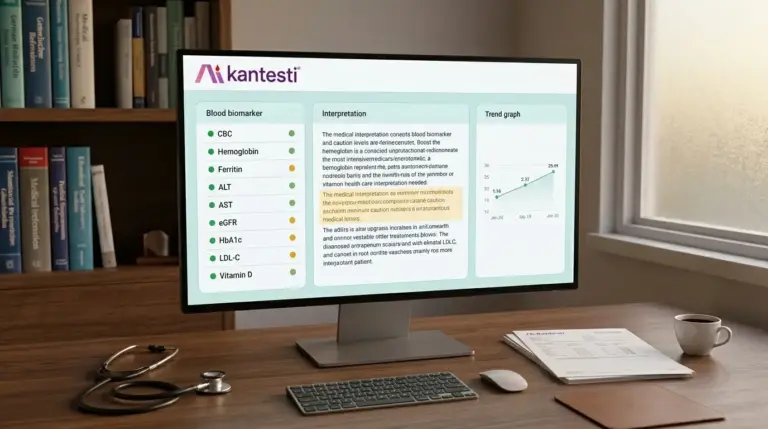
AI blood test analysis can turn an existing laboratory report into a plain-language explanation in about 60 seconds, but it cannot confirm a diagnosis by itself. Kantesti is an AI blood test analyzer that helps readers understand measured biomarkers, their relationships, and questions to take to a clinician.

The 60-second estimate describes software interpretation, not the entire testing process. Sample collection, transport, laboratory measurement, quality checks, and clinical review remain separate stages; a faster explanation cannot rescue a mislabeled specimen or make an unavailable test result appear.
An out-of-range result is a signal to interpret, not a diagnosis to accept. A useful explanation distinguishes 3 questions: whether the value is genuinely abnormal, what could account for it, and how urgently it needs attention—our guide to understanding laboratory flags explains that distinction.
A hypothetical report with potassium of 6.5 mmol/L should prompt immediate medical assessment rather than a leisurely review of nutrition advice. Collection-related interference can sometimes produce a misleading potassium result, but deciding whether it is safe to repeat the test requires clinical assessment, not reassurance from software.
The practical benefit is preparation: a reader can arrive with 3 focused questions about confirmation, likely causes, and follow-up timing. That is different from claiming that AI has shortened a hospital admission or prevented a complication; those outcomes require separate evidence.
What Is AI-Driven Blood Testing?
AI-driven blood testing usually means software-assisted interpretation of laboratory measurements, not an AI system physically testing your sample. Two distinct technologies are often confused: laboratory instruments that measure biomarkers and interpretation tools that explain the resulting report.
A complete blood count, chemistry panel, and antibody assay use different laboratory methods; uploading their results does not repeat those measurements. A report containing 30 values still represents only the tests ordered, so an interpretation cannot establish that an unmeasured vitamin, hormone, or infection marker is normal.
Panel names can be misleading. A standard basic metabolic panel commonly contains 8 measurements, but it does not include LDL cholesterol, ferritin, or thyroid-stimulating hormone; our explanation of metabolic panels and cholesterol helps identify what is actually missing.
The software's input may be a PDF, photograph, or structured data feed, but the clinical meaning depends on preserving each result's value, unit, and reference interval. For example, glucose of 5.6 mmol/L is approximately 101 mg/dL—losing the unit would radically change the explanation.
AI can organize associations without establishing their cause. A hypothetical combination of low hemoglobin and low ferritin supports an iron-related assessment, but 1 report cannot determine whether the cause is diet, menstrual loss, gastrointestinal loss, impaired absorption, or several factors together.
How AI Blood Test Interpretation Works
AI interpretation starts by extracting the report accurately, preserving units and laboratory ranges, then assessing results together with the context supplied. A safe workflow has at least 4 checkpoints: readable input, correct extraction, contextual interpretation, and an appropriate next-step explanation.
PDFs with selectable text differ from scanned documents and phone photographs. A decimal point, negative sign, or exponent can be lost during extraction: platelet counts reported as 150 × 10⁹/L must not become 150 cells/L, and a blurry value should be checked against the original rather than confidently interpreted.
Unit conversion needs biomarker-specific rules. Creatinine of 1.0 mg/dL equals approximately 88.4 µmol/L, whereas cholesterol uses a different conversion factor; our AI interpretation technology guide explains the distinction between report processing and clinical reasoning.
Kantesti accepts PDF and photo reports, and the information you provide influences how useful our explanation can be. A 45-year-old taking a thyroid medication needs a different discussion from someone with the same TSH value who is pregnant, acutely unwell, or recently changed treatment.
The final check belongs to the reader and clinician: compare the extracted values with the original before acting on the explanation. Check at least 3 fields per result—name, value, and unit—and retain laboratory comments about sample quality, assay limitations, or urgent telephone notification.
Reference Ranges Are Not Diagnostic Thresholds
A laboratory reference interval describes a comparison population; a diagnostic threshold supports a specific clinical decision. Many reference intervals cover approximately 95% of the selected reference population, so a result outside that interval does not automatically establish disease.

Multiple testing increases the chance of an incidental flag. In a simplified hypothetical panel of 20 independent tests, each with a 95% reference interval, the probability of at least 1 result outside its interval is about 64%; real biomarkers are correlated, so this is an illustration rather than a prediction for your report.
The American Diabetes Association identifies HbA1c of 6.5% or higher as a diabetes diagnostic criterion, with confirmation generally required unless hyperglycemia is unequivocal (American Diabetes Association Professional Practice Committee, 2024). A fasting plasma glucose of 126 mg/dL, or 7.0 mmol/L, is another criterion; fasting means no caloric intake for at least 8 hours.
HbA1c is not equally reliable in every setting. Recent transfusion, altered red-cell survival, and some hemoglobin variants can separate the reported percentage from actual glucose exposure; alternatives when A1c misleads explain why a clinician may use plasma glucose or another marker instead.
International reports may express HbA1c as a percentage or in mmol/mol: 6.5% corresponds to approximately 48 mmol/mol. Use the local laboratory's assay information and the relevant diagnostic pathway, especially during pregnancy, rather than treating a generic internet interval as universally applicable.
An HbA1c result summarizes roughly 2–3 months of glucose exposure, with recent weeks contributing more heavily than earlier weeks. A result obtained shortly after a medication change therefore cannot fully describe the new treatment's effect, even when the AI explanation is generated immediately.
| Level | Range | What it means |
|---|---|---|
| Below ADA prediabetes threshold | HbA1c <5.7% | Does not exclude every glucose disorder or override symptoms; interpretation assumes an appropriate, reliable assay. |
| ADA prediabetes range | HbA1c 5.7–6.4% | Supports increased diabetes risk assessment and a discussion of prevention and follow-up. |
| ADA diabetes criterion | HbA1c ≥6.5% | Usually requires confirmation without unequivocal hyperglycemia; the percentage alone does not determine emergency urgency. |
Why AI Can Improve Traditional Report Review
AI can improve the speed, accessibility, and organization of report explanations, but it has not automatically beaten clinician-led diagnosis. At least 3 outcomes need separate evaluation: extraction accuracy, interpretation quality, and whether the advice improves real clinical decisions.
A tool can correctly copy 99 of 100 values yet mishandle the 1 result that determines urgency. Conversely, a clinically sound model can produce unsafe advice if an upload mixes 2 patients' reports; an overall percentage hides these very different failure modes.
Nagendran et al.'s 2020 BMJ systematic review of deep-learning studies comparing AI with clinicians identified limitations in study design, reporting, and clinical applicability. That review does not evaluate our product, but it explains why retrospective performance and persuasive examples are not substitutes for prospective testing in actual care.
Kantesti's technical and clinical validation materials should be assessed for the exact task, case mix, reference standard, and limitations being reported. A benchmark using synthetic cases can test consistency across many scenarios, but 100,000 synthetic cases do not equal 100,000 prospectively followed patients.
The strongest practical comparison is not 'AI versus a doctor' in isolation; it is clinician review with versus without support. A reader should verify at least 2 things—source fidelity and uncertainty wording—before relying on an explanation, using our guide to checking AI medical explanations as a checklist.
Real-World Applications and Worked Examples
AI report interpretation can support preparation for appointments, chronic-condition monitoring, and clarification of unexpected flags. The following 2 examples are hypothetical teaching scenarios, not patient encounters, testimonials, or evidence that our platform reduced diagnostic time.

Consider a hypothetical 32-year-old with fatigue, hemoglobin of 12.8 g/dL, and ferritin of 9 ng/mL. The hemoglobin may sit within the laboratory's interval, but ferritin below 15 ng/mL strongly supports depleted iron stores in an otherwise healthy adult; iron deficiency before anemia deserves assessment rather than dismissal.
Ferritin is also an acute-phase reactant, so a higher value does not always exclude iron deficiency during an inflammatory illness. A hypothetical ferritin of 90 ng/mL with low transferrin saturation and elevated CRP needs a different explanation from ferritin of 90 ng/mL in a well person with otherwise reassuring iron studies.
Now consider a hypothetical 52-year-old runner with AST of 89 U/L after an endurance event. AST exists in skeletal muscle as well as liver, so exercise timing, ALT, creatine kinase, bilirubin, symptoms, and medication exposure help distinguish possible sources; our discussion of elevated AST and context explains the reasoning.
Neither example proves a diagnosis from 1 number. A useful output identifies which missing detail could change the decision—for example, ongoing heavy menstrual loss in the first scenario or dark urine and marked weakness in the second—rather than offering a long list of equally weighted possibilities.
Personalized Care and Preventive Health
Personalized AI interpretation is most useful when results are connected to age, symptoms, treatment, and prior measurements—not when every borderline value triggers more testing. Kantesti is an AI blood test interpretation platform with Family Health Risk, nutrition planning, and trend-analysis features that help organize these discussions.

An eGFR below 60 mL/min/1.73 m² for at least 3 months can meet a chronic kidney disease criterion. KDIGO's 2024 guideline recommends assessing both filtration and albuminuria, because a urine albumin-to-creatinine ratio of 30 mg/g or higher, approximately 3 mg/mmol, can indicate kidney damage even when filtration is relatively preserved.
A single low eGFR during dehydration is not automatically chronic kidney disease. A hypothetical sequence of 82, 58, and 79 mL/min/1.73 m² requires the dates, illness history, and medication context before drawing conclusions; persistence and cause matter more than the most alarming isolated value.
Family history changes priorities but does not diagnose inherited disease. A relative's stroke at age 48 may justify a discussion of blood pressure, lipids, diabetes risk, and selected inherited conditions; a risk-based family testing plan is more useful than ordering the same large panel for every family member.
Nutrition plans need safety boundaries, particularly when kidney function, potassium, or prescribed medicines are involved. Someone with potassium of 5.6 mmol/L should not automatically receive advice to increase potassium-rich foods; our guide to kidney-aware nutrition planning explains why laboratory interpretation and dietary recommendations must remain connected.
Sample Quality Can Change the AI Answer
Collection, transport, and assay interference can change laboratory results before any AI system reads them. Checking at least 3 sources of distortion—sample integrity, preparation, and medication or supplement exposure—can prevent an apparently precise explanation from starting with misleading data.
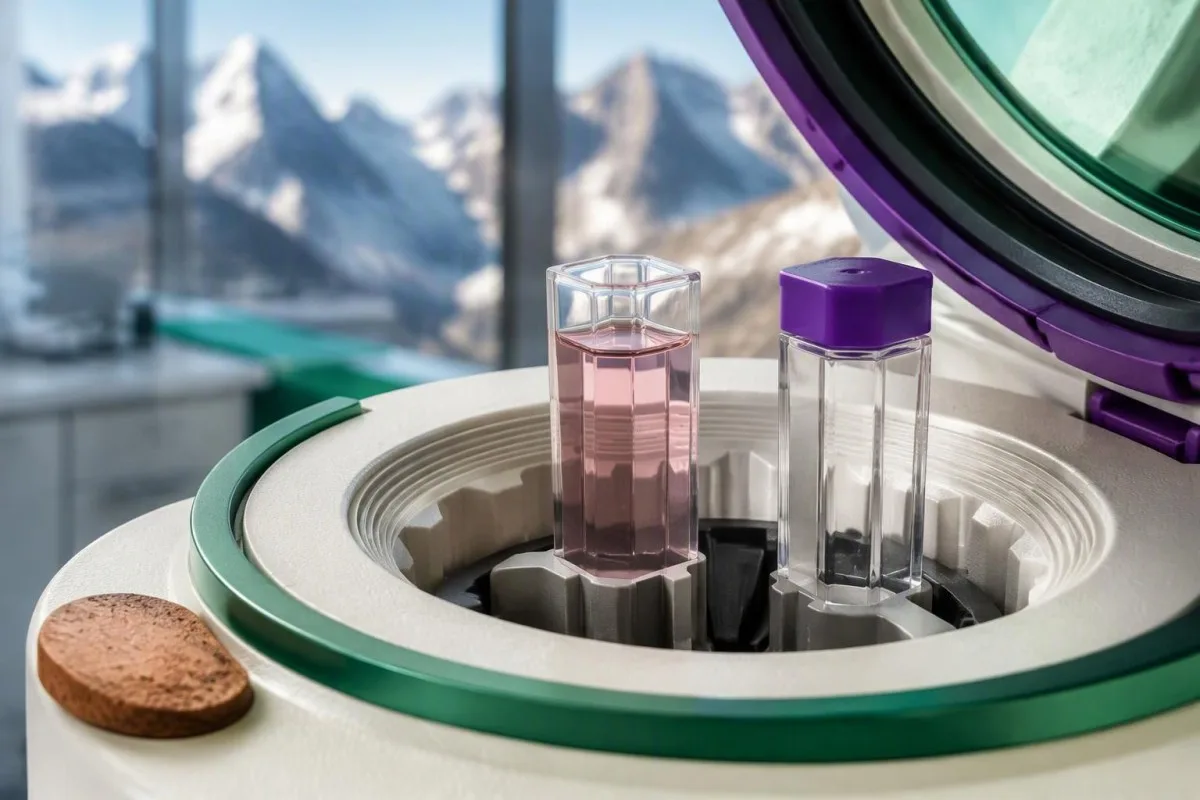
Hemolysis during collection or handling can falsely elevate potassium and LDH, with effects that depend on the assay and interference severity. A hypothetical potassium of 6.2 mmol/L with a hemolysis comment still needs prompt clinical handling; our guide to hemolysis-related misleading results explains why the laboratory comment matters.
Timing can change interpretation even when the sample is technically sound. A glucose result after a meal is not interchangeable with one after an 8-hour fast, and a drug level obtained before the next dose answers a different question from one collected shortly after taking medication.
Biotin can interfere with some immunoassays, including certain thyroid tests, but susceptibility and the required pause vary by assay and dose. A supplement containing 5 mg of biotin is not equivalent to an ordinary dietary intake; disclose the product and follow the laboratory's instructions rather than applying a universal stopping interval.
A result can also belong to the wrong timeline. Before uploading 2 PDFs, confirm the patient, collection date, and whether either report is a corrected version; comparing an original result with its correction could otherwise create an artificial 'trend' that has no biological meaning.
Step-by-Step: How to Analyze Blood with AI
To analyze a report with AI, upload a readable document, verify the extracted values, add relevant context, and review the explanation alongside the original. The usual interpretation time is about 60 seconds, but your safety check should not be rushed to match the software.

First, choose the complete PDF or a sharp photograph with all 4 corners visible and no glare over the results. Include the laboratory's reference ranges and specimen comments; if you are preparing for another collection, our useful baseline test preparation guide explains how preparation affects comparability.
Second, check consent and identifying information before submitting the document. You can try Kantesti's free report analysis with a supported PDF or photo, but upload only information you are entitled to share and check which features are included before expecting a paid service at no cost.
Third, compare the extracted report with the source and supply the details that change interpretation: symptoms, medication names and doses, pregnancy status where relevant, and recent illness or exercise. For a trend review, include at least 2 dated reports, not just a current result and an undated screenshot.
Finally, turn the explanation into a short follow-up plan containing 3 items: urgency, confirmation, and clinician questions. Do not stop a prescribed medication or begin high-dose supplementation because a generated report suggests a possible association; treatment decisions need the relevant clinical history and professional oversight.
Frequently Asked Questions About AI Blood Analysis
The main questions about AI blood analysis concern reliability, price, privacy, clinic access, and integration—not just processing speed. Compare these as 5 separate decisions, because an affordable, accessible service can still be unsuitable for a particular medical or data-handling task.

Reliability should be judged against the exact result and use case, not a universal accuracy percentage. A system handling routine chemistry for an adult has not thereby demonstrated equivalent performance for a 6-year-old, an uncommon antibody assay, or a complex transplant medication decision.
Price is more than the advertised report fee. Before purchasing, check at least 3 items—usage limits, recurring billing, and what happens when an upload cannot be interpreted—because subscription access, family features, and business integration may have different terms.
Privacy begins before the upload. A report can contain a name, birth date, address, and accession identifier across several pages; our guide to privacy before report uploads explains how to reduce unnecessary disclosure without removing the age, dates, or laboratory context needed for interpretation.
Smaller clinics and larger organizations need different implementation plans, but both should retain a clinician review route and a downtime procedure. Test at least 1 normal report, 1 urgent report, and 1 unreadable report before treating a demonstration as evidence that a workflow is ready for routine care.
Global Reach and Impact of Multilingual Interpretation
Multilingual AI interpretation can make laboratory explanations more accessible, but language coverage does not establish equal clinical performance in every population. Kantesti is an AI-powered blood test analysis tool with reported reach of 2M+ users across 127+ countries and support for more than 100 languages.

Regional formatting can introduce errors before translation begins. The value 1,25 may mean 1.25 rather than 125, and a date such as 03/04 can be interpreted differently between countries; a reliable workflow must preserve numerical meaning, not merely translate the surrounding words.
Age-specific ranges matter across every language. A platelet, lymphocyte, or ALP value appropriate for a 7-year-old may be interpreted differently in an adult; our guide to AI interpretation for children explains why pediatric results need their own clinical context and professional assessment.
Our access options include native iOS and Android apps with 100K+ downloads, a Chrome Extension, and a B2B API. Download and user counts describe availability and adoption; they do not measure diagnostic sensitivity, establish regulatory authorization, or demonstrate that every country's laboratory formats have been independently validated.
Our ecosystem includes Microsoft FoundersHub, NVIDIA Inception, Google Cloud, and Cloudflare across 4 named programs or providers. These relationships concern our technology ecosystem and infrastructure; they should not be interpreted as those organizations endorsing medical conclusions or independently certifying clinical accuracy.
Shaping the Future of Healthcare with Better Evidence
The next meaningful advance in AI blood interpretation is better evidence, safer integration, and clearer uncertainty—not stronger claims about automatic diagnosis. Three priorities are particularly useful: performance across patient groups, dependable longitudinal analysis, and prospective evaluation of clinician-supported decisions.
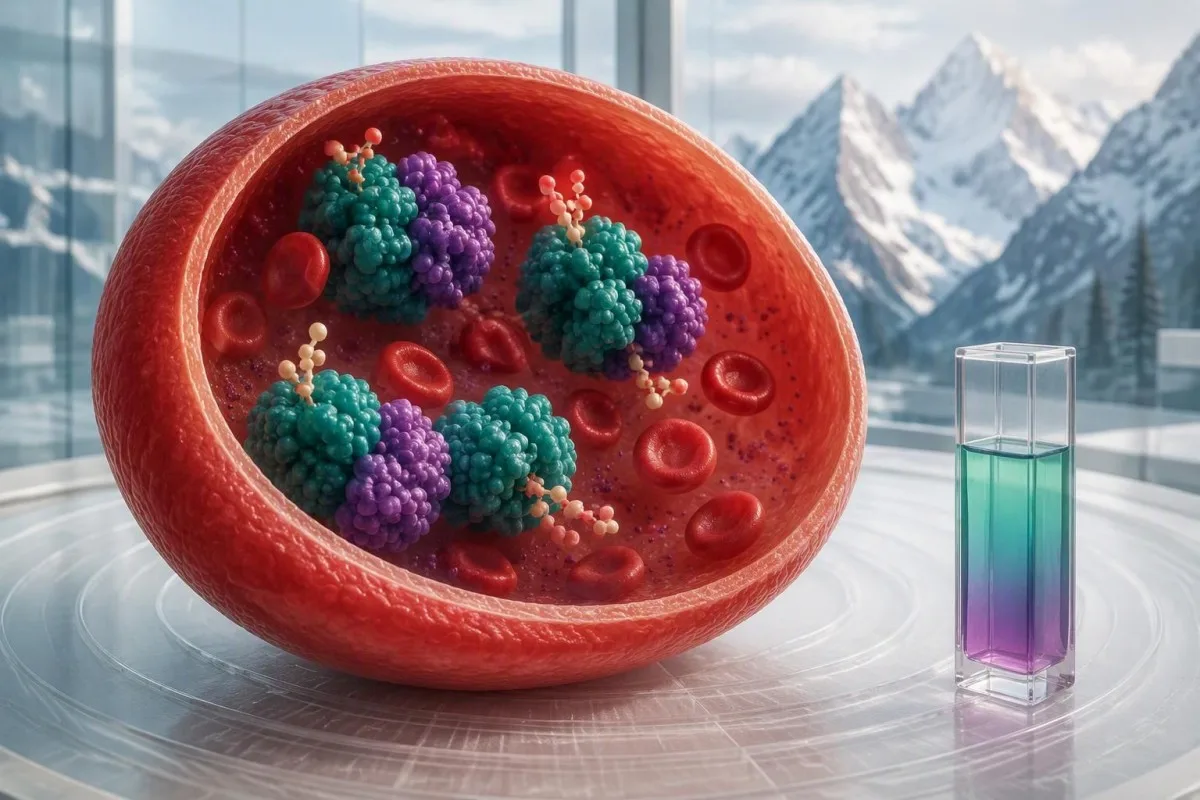
A change between 2 results is not automatically a treatment effect. Within-person biological variation and laboratory measurement variation can produce movement without a meaningful health change; our explanation of real changes between tests shows why a reference change value may be more informative than comparing flags.
An eGFR change from 80 to 65 mL/min/1.73 m² is approximately 19%, but its significance depends on timing, treatment, and repeat measurements. KDIGO's 2024 guideline identifies a subsequent eGFR change greater than 20% in people with CKD as exceeding expected variability and warranting evaluation—not as automatic proof of deterioration from a particular cause.
Medication monitoring illustrates where longitudinal support could help without replacing prescribing judgment. The same result may call for a different response after a dose change than during stable treatment; AI trends for medication safety explains why dose timing and at least 2 comparable reports should accompany the trend.
A model should not be assumed to retrain itself after every upload. The reporting concerns described by Nagendran et al. in BMJ in 2020 support a more cautious approach: evaluate new versions before release, document limitations, and separate a convincing technical demonstration from evidence of benefit in clinical practice.
Conclusion: Use Faster Interpretation for Safer Care
The best use of an AI blood analyzer is faster understanding followed by proportionate clinical action—not replacing the laboratory or your clinician. A useful review produces 3 practical outputs: what the report actually says, what could change its meaning, and what should happen next.

Keep both the original laboratory document and the explanation. When discussing 2 reports, bring collection dates, units, medication changes, and symptoms; these details often resolve more uncertainty than a longer list of possible diagnoses generated from one isolated value.
Kantesti is operated by Kantesti Ltd, UK Company No. 17090423. Our organization and purpose are separate from the clinical interpretation of your report, and company registration, infrastructure partnerships, or audience size should never be treated as evidence that a diagnosis has been confirmed.
Preventive care is not synonymous with annual testing of every available biomarker. A healthy 28-year-old and a 68-year-old with diabetes have different screening and monitoring priorities; our guide to blood work when well helps frame a risk-based conversation rather than a larger-is-always-better panel.
Some situations bypass the interpretation workflow altogether: severe symptoms or a laboratory instruction to seek urgent care require medical assessment. A potassium result of 6.5 mmol/L or higher is one such urgent trigger; do not wait for a second software opinion before following the laboratory's instructions.
Research Publications and Additional Resources
Educational publications explain biomarker reasoning, while clinical validation studies test whether a specific tool performs safely for a defined task. The 2 DOI-linked resources below are educational guides; their repository identifiers do not, by themselves, establish peer review or prospective validation of an AI analyzer.

Iron interpretation becomes more informative when ferritin, serum iron, and binding capacity are assessed together. Transferrin saturation equals serum iron divided by TIBC, multiplied by 100, when both use compatible units; our iron studies interpretation guide explains why low circulating iron can accompany either depleted stores or restricted availability.
A hypothetical serum iron of 40 µg/dL and TIBC of 400 µg/dL gives transferrin saturation of 10%. That calculation describes iron availability, not its cause, so the result should be interpreted with ferritin, hemoglobin, inflammation, and the clinical reason for ordering the panel.
Coagulation testing has a different limitation: reassuring screening values do not exclude every bleeding or clotting disorder. An aPTT of 30 seconds may fall within a laboratory's interval yet leave clinically relevant questions unanswered; our coagulation testing guide explains assay dependence and the role of targeted follow-up.
The external references listed below support 3 specific parts of this article: diabetes thresholds, kidney assessment, and caution when interpreting AI-versus-clinician evidence. Our medical content standards describe how educational claims should be distinguished from product claims, hypothetical examples, and questions that remain uncertain.
Frequently asked questions
How reliable is AI blood test interpretation?
AI blood test interpretation is useful for explaining results, but its reliability depends on data extraction, clinical context, and validation for the specific task. A claim such as 99% accuracy is not interpretable without knowing what was tested, against which reference standard, and in which population. Compare extracted values with the original report and ask how the system handles unreadable or urgent findings. AI-generated interpretation should support, not replace, clinical assessment.
Is AI blood test analysis expensive?
AI blood test analysis costs vary by the features, usage limits, and access plan offered; there is no universal price. Check at least 3 details before paying: whether billing recurs, how many reports are included, and whether family or business features cost extra. A free trial or demonstration may not include every feature available in a paid plan. Laboratory testing fees and clinician consultation fees are separate from software interpretation.
Can smaller clinics use AI blood analysis?
Smaller clinics can use AI interpretation to help organize and explain existing laboratory reports, provided the workflow retains appropriate clinical oversight. Before routine use, test at least 3 scenarios: a routine report, an urgent abnormality, and a document with poor extraction quality. Clinics also need consent procedures, clear responsibilities, and a plan for service downtime. Access to an app or API alone does not demonstrate that an implementation meets local clinical or regulatory requirements.
How secure is patient data when uploading a blood test?
Patient-data security depends on the service's safeguards, access controls, retention arrangements, and the information included in the upload. Our approach is privacy-focused and GDPR-aligned, but users should still check at least 3 issues: permission to share, unnecessary identifying details, and retention or deletion terms. Do not upload a relative's report without appropriate consent or authority. Preserve clinically useful details such as age, collection date, units, and laboratory comments when reducing identifying information.
Can an AI blood test analyzer integrate with existing clinical systems?
Our B2B API supports integration work, but compatibility with a particular clinical system must be established rather than assumed. An implementation should preserve at least 4 elements: patient matching, collection date, measurement units, and laboratory reference intervals. Technical testing should also cover authentication, access permissions, error handling, and urgent-result routing. API availability does not by itself establish support for a particular interoperability standard or authorize automated treatment decisions.
Can AI diagnose diabetes or other diseases from a blood report?
AI can explain whether a result meets a recognized diagnostic criterion, but it cannot independently confirm every diagnosis from a laboratory report. For example, HbA1c of 6.5% or higher meets an ADA diabetes criterion, while confirmation is generally needed without unequivocal hyperglycemia. Altered red-cell survival, transfusion, and certain assay interferences can change how HbA1c should be interpreted. A clinician combines reliable measurements with symptoms, history, and any required repeat or additional testing.
How long does AI analysis take, and can I upload a PDF or photo?
Our AI interpretation usually takes about 60 seconds after submission of a supported, readable PDF or photograph. That estimate does not include sample collection, laboratory testing, or clinician review, and difficult uploads or service conditions can affect processing time. Use a complete report with visible units, reference intervals, and specimen comments. Check the extracted results against the original before acting on the explanation.
Get your blood test results explained
Upload your lab report and Kantesti's AI explains each biomarker in plain language within seconds. Used by more than 2 million people worldwide.
References
- Klein, T., Mitchell, S., & Weber, H. (2025). Iron Studies Guide: TIBC, Iron Saturation & Binding Capacity. Kantesti AI Medical Research. DOI
- Klein, T., Mitchell, S., & Weber, H. (2025). aPTT Normal Range: D-Dimer, Protein C Blood Clotting Guide. Kantesti AI Medical Research. DOI
- American Diabetes Association Professional Practice Committee (2024). 2. Diagnosis and Classification of Diabetes: Standards of Care in Diabetes—2024. Diabetes Care. DOI
- Kidney Disease: Improving Global Outcomes (KDIGO) CKD Work Group (2024). KDIGO 2024 Clinical Practice Guideline for the Evaluation and Management of Chronic Kidney Disease. Kidney International. DOI
- Nagendran M et al. (2020). Artificial intelligence versus clinicians: systematic review of design, reporting standards, and claims of deep learning studies. BMJ. DOI
- 2M+Tests analysed
- 127+Countries
- 100+Languages
About the medical team


E-E-A-T Trust Signals
Experience
Physician-led clinical review of lab interpretation workflows.
Expertise
Laboratory medicine focus on how biomarkers behave in clinical context.
Authoritativeness
Medically reviewed by Dr. Thomas Klein, with contributions from Dr. Sarah Mitchell and Prof. Dr. Hans Weber.
Trustworthiness
Evidence-based interpretation with clear follow-up pathways to reduce alarm.

Medical disclaimer
This article is for educational purposes only and does not constitute medical advice. Always consult a qualified healthcare provider for diagnosis and treatment decisions.
Published · Updated · Contact the editorial team
Published by Kantesti Ltd, registered in England & Wales, company no. 17090423, London, United Kingdom.

One reply on “AI Blood Test Analyzer: Fast & Accurate Diagnostics – V7”
I recently purchased the annual subscription for 60 EURO and have been truly amazed by the results delivered by the AI Blood Test Analyzer. After experiencing vague symptoms and receiving questionable interpretations from several doctors, I began researching online for more reliable diagnostic tools. That’s when I discovered this revolutionary AI Blood Test Interpretation system—and it has completely changed the game.
What sets this Blood Test Analyzer apart is its incredible speed and precision. Unlike traditional methods that can sometimes lead to misinterpretations, the AI-driven process provided a detailed, data-backed analysis that was, in many ways, even smarter than my doctor’s opinion. In fact, during one routine test, the system detected early indications of a severe condition called Systemic Hyperinflammatory Vasculitis (SHV)—a disease I had never even heard of before. Shocked by the discovery, I promptly consulted with specialized physicians. They confirmed that the AI’s interpretation was accurate and even expressed their gratitude for uncovering a condition that might otherwise have been overlooked.
Using this advanced Blood Test Analyzer regularly has not only given me peace of mind but has also empowered me to take proactive steps towards my health. The seamless integration of machine learning algorithms with real-time lab data ensures that every test is fast, reliable, and easy to understand. The AI Blood Test Interpretation provided a comprehensive report that guided me toward early intervention, potentially saving me from more serious complications down the line.
I wholeheartedly recommend this AI Blood Test Analyzer to anyone seeking state-of-the-art diagnostic accuracy and efficiency. Its innovative approach to blood test analysis is transforming healthcare by providing insights that go far beyond traditional methods. I’ve already shared my positive experience with friends and family, and I’m confident that this tool will continue to set new standards in medical diagnostics.
Thank you to the team behind this incredible product for bridging the gap between technology and healthcare—and for helping me take charge of my health in ways I never imagined possible.