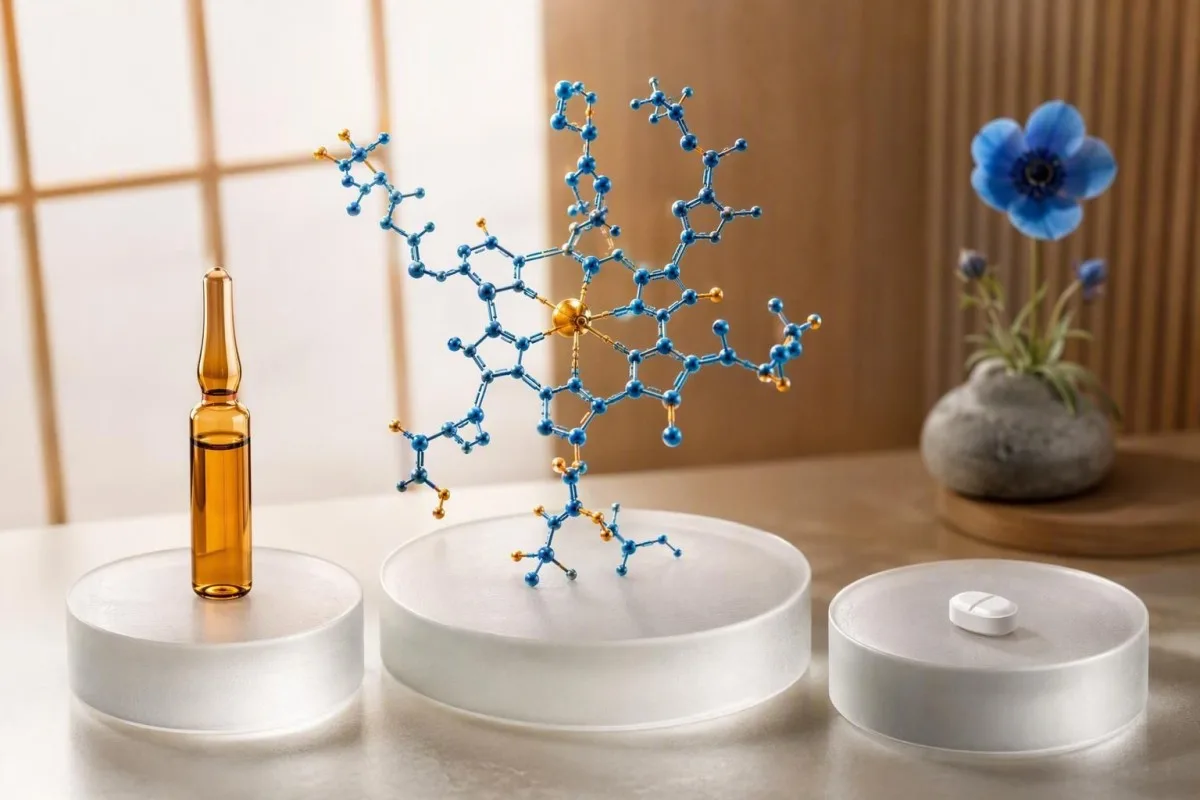
Inspuitings produseer 'n onmiddellike serumpiek, maar hoë-dosis orale B12 korrigeer tekort dikwels net so effektief oor weke. Die deurslaggewende faktor is gewoonlik die oorsaak en erns van tekort – nie slegs voorkeur nie.


- Vinnigste serumstyging: 'n 1 000 mikrogram intramuskulêre B12-inspuiting verhoog sirkulerende B12 binne ure, terwyl tablette stadiger oor dae styg.
- Vergelykbare vervanging: Orale siaanokobalamien 1 000-2 000 mikrogram daagliks kan soortgelyke korttermyn bloed- en simptoomuitkomste as intramuskulêre terapie vir baie volwassenes bereik.
- Inspuitingsindikasie: Ernstige neurologiese simptome, ernstige anemie, onvermoë om tablette te neem, of onbetroubare absorpsie regverdig gewoonlik klinikus-geleide inspuitings.
- Grenslyn resultaat: Serum B12 onder 180 pg/mL (133 pmol/L) word algemeen as 'n tekort beskou; 180-350 pg/mL benodig dikwels MMA of homosisteïen bevestiging.
- Passiewe absorpsie: Ongeveer 1% van 'n groot orale B12-dosis word deur passiewe diffusie opgeneem, daarom werk 'n 1 000 mikrogram tablet ten spyte van verswakte intrinsieke faktor.
- Her-toets-tydsberekening: 'n CBC en kliniese reaksie is gewoonlik nuttiger met 4-8 weke as 'n B12-vlak wat onmiddellik na behandeling getrek word.
- Veiligheidspunt: Moenie onverklaarbare gevoelloosheid met slegs foliensuur behandel nie; folaat kan bloedarmoede verbeter terwyl B12-verwante senuwee-besering voortduur.
- Oorsaak maak saak: Metformien, protonpomp-remmers, veganistiese diëte, coeliakie, maagsere en pernisieuse bloedarmoede vereis verskillende opvolgplanne.
Watter opsie verhoog vitamien B12-vlakke vinniger?
B12-inspuitings verhoog die gemete serumvlak vinniger as tablette, dikwels binne ure, omdat dit die ingewande omseil. Vir die meeste stabiele volwassenes met bevestigde tekort, kan 'n 1 000-2 000 mikrogram orale dosis daagliks egter liggaamswinkels aanvul en bloedtelling oor weke verbeter teen 'n klinies soortgelyke tempo.
'n Inspuiting skep 'n skerp vroeë piek omdat hidroksokobalamien of sianokobalamien direk in die spier en dan in die bloedstroom toegedien word. Daardie laboratoriumpiek is nie dieselfde as herstelde weefselwinkels of herstelde senuwee-funksie nie; in my praktyk word simptoomherstel in weke tot maande gemeet, nie die volgende oggend nie.
Die praktiese vergelyking is dikwels ure teenoor dae vir serumkonsentrasie, maar ongeveer 4-8 weke vir 'n betekenisvolle hematologiese reaksie met 'n voldoende roete. Retikulocyte styg algemeen met dag 3-5, hemoglobien begin verbeter na ongeveer 1-2 weke, en makrositose kan tot 8 weke neem om te stabiliseer.
Kantesti is 'n KI-bloedtoetsontleder wat B12 langs MCV, hemoglobien, folaat, kreatinien en vorige resultate plaas eerder as om 'n B12-spits na behandeling te behandel as bewys dat die onderliggende probleem opgelos is. Lesers kan ook hul resultaat vergelyk met ons B12-referensiereeks gids.
Wat “vinniger” eintlik beteken
'n Hoë resultaat na 'n inspuiting bevestig onlangse blootstelling, nie noodwendig voldoende sellulêre aflewering nie. Metielmaloniese suur, neurologiese bevindinge en die CBC-tendens is meer insiggewend wanneer die oorspronklike diagnose onseker was.
Hoe orale B12-absorpsie werk wanneer intrinsieke faktor laag is
Hoë-dosis orale B12 kan werk selfs wanneer intrinsieke-faktor absorpsie benadeel is omdat 'n klein fraksie deur passiewe diffusie binnekom. Ongeveer 1% van 'n 1 000 mikrogram dosis kan passief geabsorbeer word, wat ongeveer 10 mikrogram lewer – ver bo die gemiddelde daaglikse behoefte van 2,4 mikrogram vir volwassenes.
Normale voedsel-gebonde B12 moet deur maagsuur vrygestel word, aan intrinsieke faktor bind, en in die terminale ileum opgeneem word. Hierdie meer-stap stelsel verduidelik waarom langtermyn-suuronderdrukking, outo-immuun gastritis, ileale siekte en bariatriese prosedures tekort kan veroorsaak; dit verduidelik ook waarom 'n standaard multivitamine dikwels te klein 'n dosis vir behandeling is.
Orale B12-absorpsie is dosis-afhanklik maar nie lineêr nie. Die intrinsieke-faktor pad versadig by ongeveer 1,5-2 mikrogram per ete, terwyl passiewe diffusie slegs met milligram-reeks tablette klinies nuttig word. 'n 50 mikrogram aanvulling is redelike voorkoming vir sommige mense, maar dit is nie gelykstaande aan 1 000 mikrogram vir gevestigde tekort nie.
Vir pasiënte wat omeprazol, pantoprazol of 'n ander PPI gebruik, kyk ek na die breër patroon—dieet, ouderdom, bloedarmoede en duur van gebruik—eerder as om aan te neem dat die middel die hele storie is. Ons oorsig van langtermyn PPI laboratorium monitering verduidelik waarom magnesium en yster ook belangrik kan wees.
Wat kliniese proewe toon oor tablette teenoor inspuitings
Gerandomiseerde bewyse dui daarop dat orale B12 teen 1 000-2 000 mikrogram daagliks net so effektief as intramuskulêre B12 kan wees vir baie mense met 'n tekort. Die bewysbasis is nie enorm nie, en dit bevat minder pasiënte met ernstige neurologiese siektes as wat klinici sou wou hê.
Die Cochrane-oorsig deur Wang en kollegas het bevind dat hoë-doel orale B12 soortgelyke B12-bloedvlakreaksies as intramuskulêre behandeling opgelewer het in die klein gerandomiseerde proewe wat beskikbaar is (Wang et al., 2018). Een studie het 2 000 mikrogram mondelings elke dag gebruik; “n ander het 1 000 mikrogram mondelings gebruik na ”n aanvanklike skedule, so "orale terapie" beteken nie 'n lae-doel supermark produk nie.
Die vroeëre proef deur Kuzminski et al. het groter serum B12-konsentrasies met 2 000 mikrogram orale sianokobalamien gerapporteer as met 'n 1 000 mikrogram inspuitingsregime, tog was kliniese uitkomste die vraag wat saak gemaak het (Kuzminski et al., 1998). Die bewyse is eerlik gemeng oor die ideale protokol omdat proewe verskillende inspuitingsintervalle en opvolgperiodes gebruik het.
'n Tablet werk slegs as dit geneem word. Gemiste daaglikse dosisse kan 'n inspuiting wat elke 2-3 maande toegedien word, meer betroubaar maak in die werklike lewe, veral vir brose volwassenes of mense met komplekse medikasieskedules. Ons bloedtoets tydlyn gids kan help om 'n ware verandering in behandeling te onderskei van 'n swak-tydig her-toetsing.
Wanneer B12-inspuitings medies noodsaaklik is
B12-inspuitings is gewoonlik medies noodsaaklik wanneer 'n tekort ernstig is, neurologiese simptome teenwoordig is, orale inname onmoontlik is, of absorpsie en nakoming nie vertrou kan word nie. Hulle is nie outomaties verpligtend bloot omdat pernisieuse anemie vermoed word nie, mits hoë-doel orale behandeling en opvolging uitvoerbaar is.
Dringende kliniese assessering is gepas vir nuwe gangonstabiliteit, progressiewe gevoelloosheid, swakheid, verwarring, visuele verandering, merkbare anemie, of swangerskap met beduidende tekort. Neurologiese B12-besering kan gedeeltelik onomkeerbaar word; in daardie omstandighede, sal ek nie parenterale terapie vertraag terwyl ek oor gerief debatteer nie.
NICE-riglyn NG239 adviseer intramuskulêre behandeling wanneer wanabsorpsie vermoed of bevestig word en beveel lewenslange intramuskulêre vervanging vir outo-immuun gastritis in baie gevalle aan (NICE, 2024). Die praktyk wissel internasionaal: sommige klinici gebruik orale 1-2 mg daagliks by betroubare pasiënte met pernisieuse anemie, terwyl ander inspuitings verkies omdat die gevolge van 'n insinking hoër is.
'n Hemoglobien onder 80 g/L, simptomatiese kortasemigheid, tagikardie, of moontlike rugmurgbetrokkenheid regverdig onmiddellike mediese oorsig eerder as selfbehandeling. Om te verstaan hoe anemiepatrone op roetine-toetse verskyn, sien wat 'n volledige bloedtelling insluit.
B12-tekortbehandeling dosisse wat klinici eintlik gebruik
Algemene orale behandelingsdosisse is 1 000-2 000 mikrogram daagliks, terwyl algemene intramuskulêre regimes 1 000 mikrogram per dosis met 'n aanvanklike laai-fase gebruik. Die produk, nasionale riglyn en oorsaak van tekort bepaal die presiese skedule.
In Britse praktyk word hidroksokobalamien 1 000 mikrogram intramuskulêr dikwels drie keer per week vir 2 weke gegee wanneer daar geen neurologiese betrokkenheid is nie, dan elke 2-3 maande vir onderhoud; protokolle verskil volgens plaaslike diens. Met neurologiese kenmerke word aanvanklike dosisse dikwels elke tweede dag gegee totdat daar geen verdere verbetering is nie, dan volg onderhoud spesialisadvies.
'n Tipiese orale plan is sianokobalamien 1 000 mikrogram daagliks vir 8-12 weke, gevolg deur 1 000 mikrogram daagliks of 'n laer onderhoudskedule as dieet die enigste oorsaak was. Sublinguale produkte is nie bewys om geslukte tablette te oortref nie; sodra dit opgelos is, word meeste tog ingesluk.
Moenie 'n laai-regime uit sosiale media advies improviseer nie. Die gemetileerde B12 teenoor sianokobalamien vergelyking verduidelik waarom die dosis en konsekwentheid oor die algemeen meer saak maak as bemarkingsbewerings oor die B12-vorm.
Hoe om 'n lae of grenslyn B12-resultaat te interpreteer
Serum B12 onder 180 pg/mL (133 pmol/L) ondersteun gewoonlik tekort, terwyl waardes van ongeveer 180-350 pg/mL 'n onbepaalde sone is waarin MMA of homosisteïen sellulêre tekort kan verduidelik. Individuele laboratoriumintervalle verskil, en 'n normale serumwaarde sluit nie tekort na onlangse aanvulling volledig uit nie.
Metielmalonsuur styg wanneer B12-afhanklike metabolisme belemmer word, maar verminderde nierfunksie kan MMA onafhanklik verhoog. Homosisteïen kan styg met B12-tekort, folaattekort, vitamien B6-tekort, hipotireose en nierverswakking, dus moet geen van die bevestigingstoetse in isolasie gelees word nie.
Makrositose is ondersteunend maar nie vereis nie. 'n Gemiddelde korpuskulêre volume bo 100 fL verhoog die vermoede vir B12- of folaattekort, alkoholblootstelling, lewersiekte, hipotireose, murgversteurings of medikasie-effekte; ongeveer 'n kwart van simptomatiese B12-tekort pasiënte mag 'n normale MCV hê.
Kantesti AI interpreteer B12 resultate deur die patroon van MCV, RDW, hemoglobien, folaat en historiese waardes na te gaan, insluitend leidrade dat 'n folaat aanvulling makrositose kan maskeer. Ons artikel oor hoë MCV opvolg dek die algemene alternatiewe.
Pernisieuse anemie verander die langtermynplan, nie altyd die roete nie
Pernisieuse anemie is outo-immuun verlies van intrinsieke-faktor funksie, en dit vereis lewenslange B12 vervanging na diagnose. Inspuitings bied betroubare aflewering, maar hoë-dosis orale terapie kan steeds voldoende status handhaaf in geselekteerde, noukeurig gemoniteerde volwassenes.
Die toetse wat die meeste gebruik word, is intrinsieke-faktor-teenliggame en pariëtale-sel-teenliggame, tesame met B12, CBC en soms gastrien. 'n Positiewe intrinsieke-faktor-teenliggaam is hoogs spesifiek maar nie baie sensitief nie, dus sluit 'n negatiewe resultaat die toestand nie uit nie; dit is een van daardie areas waar konteks meer saak maak as 'n enkele teenliggaam.
Pernisieuse anemie is meer as 'n absorpsieprobleem. Outo-immuun gastritis kan saamval met ystertekort voordat B12-tekort duidelik word, en langdurige siekte hou risiko's vir maagmonitering in wat met die behandelende geneesheer bespreek moet word. Ons gids vir pernisieuse anemie toetsing detailleer die diagnostiese volgorde.
Kantesti is 'n AI bloedtoets interpretasie platform gebruik regoor 127+ lande, maar 'n KI interpretasie kan nie outo-immuun gastritis diagnoseer of 'n lewenslange inspuitingsinterval kies nie. 'n Geneesheer moet simptome, teenliggame, endoskopiese geskiedenis en die laboratoriumpatroon verbind.
Hoekom neurologiese simptome vinniger kliniese aksie benodig
Tinteling, verlies van vibrasiesensasie, onstabiele loop, kognitiewe verandering of swakheid met lae B12 moet dringende persoonlike assessering en gewoonlik inspuitbare behandeling veroorsaak. Senuweeherstel is minder voorspelbaar as bloedarmoede herstel en mag onvolledig bly na maande van tekort.
Die dorsale kolomme en perifere senuwees is kwesbaar vir B12-tekort, wat 'n patroon produseer wat geneeshere subakuut gekombineerde degenerasie noem in gevorderde gevalle. 'n Normale hemoglobien beskerm nie teen dit nie; ek het pasiënte gesien wie se verdoofde voete en abnormale vibrasiesensasie enige ooglopende bloedarmoede voorgegaan het.
Verbetering begin dikwels binne 1 week van effektiewe terapie, maar sensoriese simptome kan 3-12 maande neem en mag nie heeltemal oplos nie. Die veiligste benadering is om basislyn funksie aan te teken—loopafstand, val, handvaardigheid, vibrasiesensasie—omdat 'n stygende serum B12 alleen nie 'n hersteltelling is nie.
Neuropatie het ook baie nabootsings, insluitend diabetes, alkohol-verwante senuwee besering, skildklier siekte, oormatige vitamien B6 en sommige medisyne. Pasiënte met tinteling kan ons vitamien B6 senuwee-simptoom gids gebruik om beter vrae voor te berei, maar progressiewe swakheid benodig mediese sorg nou.
Wanneer tablette gewoonlik genoeg is vir voedings-B12-tekort
tablette is gewoonlik genoeg wanneer lae B12 voortspruit uit onvoldoende inname en die ingewande aanvullings kan absorbeer. Veganiste, mense wat baie min dierlike voedsel eet, en volwassenes met tydelike dieet beperking reageer dikwels goed op orale siaanokobalamien 1 000 mikrogram daagliks.
Vitamien B12 word natuurlik in diere-afgeleide voedsel en verrykte voedsel gekonsentreer, dus benodig 'n streng vegan dieet 'n betroubare verrykte-voedsel of aanvullingstrategie. Plantvoedsel wat as natuurlike B12-bronne bemark word, is inconsistent; seewier en gefermenteerde voedsel kan onaktiewe analoë bevat wat nie betroubare behandeling is nie.
Dieettekort behoort steeds 'n kort geskiedenis te regverdig. 'n 23-jarige veganis met B12 van 142 pg/mL, normale MMA na behandeling en geen derm simptome verskil van 'n 68-jarige met dieselfde resultaat, gewigsverlies en ystertekort. Ouderdom, medikasie en gastroïntestinale simptome verander die opvolg.
Vir voedselbeplanning, ons wateroplosbare vitamien gids skei voorkomingsdosisse van tekortbehandeling. Moenie aanvaar dat voeding alleen neurologiese simptome vinnig genoeg sal regstel nie.
Medisyne en dermtoestande wat die B12-behandelingkeuse verander
Metformin, suuronderdrukkende medikasie, coeliakie, Crohn se siekte wat die ileum affekteer, pankreasinsuffisiëntie en maagsirurgie kan almal B12 beskikbaarheid verminder. 'n Tabletproef kan in sommige gevalle redelik wees, maar inspuitings word dikwels gekies wanneer absorpsie onseker is of simptome betekenisvol is.
Metformin-geassosieerde B12-tekort is algemeen genoeg dat reguleerders aanraai om vlakke te kontroleer by pasiënte met neuropatie, anemie of ander risikofaktore, veral by hoër dosisse of met lang duur. Die meganisme behels waarskynlik kalsium-afhanklike opname van die B12-intrinsieke faktor kompleks in die ileum, nie bloot swak dieet nie.
Na slukderm-gastrectomie of maagomleiding, moet behandelingsbesluite die bariatriese span se protokol volg omdat yster, folaat, tiamien, vitamien D en koper saam beïnvloed kan word. Diarree, lae albumin, onverklaarbare gewigsverlies of vetterige stoelgange moet ondersoek aanmoedig eerder as eindelose aanvullingsveranderinge.
Lae koper kan ook anemie en neurologiese simptome veroorsaak wat B12-tekort naboots, veral na bariatriese chirurgie of oormatige sink. Ons lae koper kliniese leidrade verduidelik waarom slegs B12 kontroleer die ware verduideliking kan mis.
Hoe gou om weer te toets na B12-behandeling
'n CBC en simptoom oorsig by ongeveer 4-8 weke is oor die algemeen nuttiger as om serum B12 onmiddellik na 'n inspuiting of tablet kursus te herhaal. 'n Baie hoë B12 resultaat kort na behandeling weerspieël hoofsaaklik die dosis wat geneem is.
'n Retikulosit respons rondom dag 3-5 bied 'n vroeë leidraad dat beenmurgproduksie herstel, terwyl hemoglobien oor die volgende weke behoort te styg as B12-tekort 'n sleutel drywer was. Gebrek aan verbetering moet die differensiaal heropen: ystertekort, voortdurende bloedverlies, folaattekort, inflammasie, niersiekte of 'n verkeerde diagnose.
Vir 'n ongekompliseerde dieettekort, kontroleer ek dikwels weer CBC en B12 by 8-12 weke, en bevestig dan 'n volhoubare instandhoudingsplan. Vir neurologiese siekte, outo-immuun gastritis, swangerskap, nierverswakking of veelvuldige tekorte, moet opvolg geïndividualiseer word en begin gewoonlik vroeër.
Kantesti se KI-aangedrewe bloedtoets-analisehulpmiddel kan opeenvolgende B12, MCV, RDW en hemoglobien resultate vergelyk eerder as om elke trek as 'n ontkoppelde gebeurtenis te vertoon. Die sy-aan-sy laboratoriumvergelykingsgids toon wat om tussen toetse aan te teken.
Hoekom 'n hoë B12-resultaat na behandeling nie altyd gerusstellend is nie
'n Hoë B12 vlak na 'n inspuiting of hoë-dosis tablet weerspieël gewoonlik aanvulling en bewys nie dat simptome 'n ander oorsaak het nie. Omgekeerd, onverklaarbare aanhoudende B12 verhoging sonder aanvullings verdien kliniese oorsig, veral wanneer lewer, nier of bloedtelling abnormaliteite saam bestaan.
Serum B12 kan 'n laboratorium boonste limiet van ongeveer 900-1,000 pg/mL oorskry na behandeling, afhangende van die toets en tydsberekening. Dit word verwag en is gewoonlik nie toksies nie; B12 het geen vasgestelde verdraagbare boonste inname vlak by gesonde volwassenes nie omdat oormaat grotendeels uitgeskei word, hoewel aknee-agtige uitbarstings by 'n klein minderheid voorkom.
Die vraag wat ek vra is eenvoudig: is die monster getrek na 'n aanvulling, inspuiting, multivitamine, energiedrankie of verrykte produk? Indien nie, kan verhoogde B12 lewersiekte, verminderde renale klaring, inflammasie of sekere hematologiese toestande vergesel, en dit benodig konteks eerder as alarm.
Ons hoë vitamien B12 gids verduidelik die onderskeid tussen verwagte aanvullingsverwante verhoging en 'n onverklaarbare laboratorium leidraad.
Algemene B12-behandelingsfoute wat herstel vertraag
Die mees gevolgryke fout is om slegs foliensuur te neem wanneer B12-tekort nie uitgesluit is nie. Foliensuur kan anemie normaliseer terwyl B12-verwante senuwee-besering kan voortduur, veral wanneer dosisse die normale voedingsbereik oorskry.
Moenie simptome alleen gebruik om tussen inspuitings en tablette te besluit nie. Moegheid, breinmis en lae bui is werklik, maar nie-spesifiek; slaapverlies, tiroïed siekte, yster tekort, depressie, diabetes en medikasie effekte kan soortgelyke klagtes veroorsaak. 'n B12-resultaat naby 250 pg/mL regverdig bevestiging meer dikwels as 'n outomatiese inspuiting.
Nog 'n fout is om 'n toets uit te stel totdat aanvullings moontlik begin is. Selfs 50-500 mikrogram daagliks kan serum B12 genoeg verskuif om diagnose te bemoeilik, hoewel dringende neurologiese simptome altyd eers behandel moet word. Die hoë folate en verborge B12-kwessie is veral relevant vir mense wat prenatale of energietablette neem.
Vanaf 27 Augustus 2026, my raad as Dr. Thomas Klein is om die minste belastende roete te kies wat medies betroubaar is, en dan herstel te verifieer met simptome en tendense. Inspuiting behandeling is uitstekende medisyne wanneer aangedui; dit is nie inherent sterker medisyne vir elke lae resultaat nie.
'n Praktiese besluitraamwerk vir B12-inspuitings of tablette
Kies inspuitings wanneer risiko hoog is of mondelinge betroubaarheid laag is; kies hoë-dosis tablette wanneer tekort lig-tot-matig is, inname die hoofkwessie is en opvolg betroubaar is. Die beste roete is die een wat tekort regstel sonder om ondersoek van die oorsaak uit te stel.
tablette pas die beste wanneer B12 laag is van die dieet, daar geen neurologiese tekens is nie, sluk veilig is en die persoon 1,000-2,000 mikrogram daagliks konsekwent kan neem. Inspuitings pas die beste met neurologiese bevindings, ernstige simptomatiese anemie, braking, groot wanabsorpsie, postoperatiewe anatomie of onsekere nakoming.
Bring vier dinge na die afspraak: die oorspronklike B12-resultaat met eenhede, 'n CBC, elke aanvulling en medisyne dosis, en 'n simptoom-tydlyn. Dr. Thomas Klein se kliniese reël is dat die oorsaak benoem moet word voordat onderhoud onbepaald gemaak word wanneer dit veilig gedoen kan word.
Kantesti AI is ’n KI-labtoets-interpretasiediens ontwerp om laboratoriumkonteks vir pasiënte en klinici te organiseer, terwyl finale diagnose en voorskrifte kliniese besluite bly. Ons Mediese Adviesraad en kliniese valideringsbenadering beskryf die mediese toesig agter daardie grens.
Gereelde vrae
Werk B12-inspuitings vinniger as tablette?
B12-inspuitings verhoog serum B12 vinniger as tablette omdat 'n 1 000 mikrogram binnespierse dosis dermabsorpsie omseil en sirkulerende vlakke binne enkele ure kan verhoog. Hoë-dosis mondelinge B12, gewoonlik 1 000-2 000 mikrogram daagliks, kan steeds tekorte effektief regstel oor 'n paar weke by baie volwassenes. Die betekenisvolle eindpunte is die verbetering van simptome, retikulosiette teen dag 3-5 en CBC-herstel teen ongeveer 4-8 weke, nie net die onmiddellike serumpiek nie. Inspuitings word verkies wanneer neurologiese simptome, ernstige anemie of onbetroubare absorpsie teenwoordig is.
Kan orale B12 werk as ek pernisieuse anemie het?
Orale B12 in hoë dosisse kan by sommige mense met pernisieuse anemie werk omdat ongeveer % van 'n groot dosis passief deur diffusie sonder intrinsieke faktor geabsorbeer word. 'n Daaglikse orale dosis van 1 000-2 000 mikrogram kan dus 10-20 mikrogram geabsorbeerde B12 verskaf, wat die volwasse daaglikse behoefte van 2,4 mikrogram oorskry. NICE-riglyne ondersteun algemeen lewenslange intramuskulêre vervanging vir outo-immuun gastritis, veral waar betroubaarheid onseker is. Die roete moet ooreengekom word met die klinikus wat die diagnose bestuur en gemonitor word met simptome en 'n CBC.
Hoeveel B12-tablette is gelyk aan een inspuiting?
Daar is geen presiese tablet-na-inspuiting-omskakeling nie, want inspuitings lewer byna volledige sistemiese beskikbaarheid, terwyl orale absorpsie dosisafhanklik en gedeeltelik versadigbaar is. 'n 1 000 mikrogram inspuiting en 1 000-2 000 mikrogram oraal daagliks is albei algemene behandeling dosisse, maar hulle is nie farmakologies uitruilbaar op 'n dosis-vir-dosis basis nie. Ongeveer 1% van 'n 1 000 mikrogram orale dosis kan deur passiewe diffusie intree, terwyl bykomende absorpsie deur intrinsieke faktor plaasvind wanneer daardie pad werk. Behandeling reaksie en die oorsaak van tekort moet enige oorskakeling rig.
Hoe lank neem dit vir B12-inspuitings om moegheid te verbeter?
B12-inspuitings mag energie binne dae tot 'n paar weke verbeter wanneer 'n tekort die ware oorsaak van moegheid is, maar die tydlyn wissel wyd. Retikulosietteling neem dikwels toe teen dag 3-5, hemoglobien begin algemeen styg na 1-2 weke, en volle regstelling van makrositose kan tot 8 weke duur. Gevoelloosheid, balansprobleme en kognitiewe simptome duur dikwels 3-12 maande en kan onvolledig wees indien die tekort lank aanhoudend was. Aanhoudende moegheid na 'n normaliserende CBC moet lei tot ondersoek vir ystertekort, tiroïedsiekte, slaapprobleme en ander oorsake.
Moet ek B12-tablette neem voor 'n bloedtoets?
Indien toetse beplan word om onverklaarbare B12-tekort te diagnoseer en jy klinies stabiel is, vermy om aanvullings te begin totdat die monster versamel is, want selfs 50-500 mikrogram daagliks kan serum B12 verander. Daar is geen universele afspoelinterval nie, aangesien laboratoriums en dosisse verskil, so vra die klinikus of laboratorium vir hul voorbereidingsadvies. Moenie behandeling vertraag om 'n perfekte basislyn te verkry as jy neurologiese simptome, ernstige anemie, swangerskap-verwante bekommernis of beduidende kliniese agteruitgang het nie. Dokumenteer die dosis en begindatum sodat die resultaat korrek geïnterpreteer kan word.
Is 'n B12-vlak van 200 pg/mL laag genoeg vir inspuitings?
'n B12-vlak van 200 pg/mL is grenslaag en bepaal op sigself nie of inspuitings nodig is nie. Baie laboratoriums beskou waardes onder 180 pg/mL as duidelik tekort, terwyl waardes van ongeveer 180-350 pg/mL moontlik metielmalonzuur, homosisteïen, CBC-bevindinge en simptoomhersiening benodig. Inspuitings is redelik teen 200 pg/mL wanneer neurologiese simptome, anemie, wanabsorpsie, swangerskap of onvermoë om orale terapie te neem teenwoordig is. 'n Stabiele persoon met dieetrisiko en geen neurologiese bevindinge kan goed reageer op 1 000-2 000 mikrogram orale B12 daagliks met beplande opvolging.
Kry vandag KI-aangedrewe bloedtoets-analise
Sluit aan by meer as 2 miljoen gebruikers wêreldwyd wat Kantesti vertrou vir onmiddellike, akkurate laboratoriumtoetsanalise. Laai jou bloedtoetsresultate op en ontvang omvattende interpretasie van 15,000+-biomerkers binne sekondes.
📚 Verwysde navorsingspublikasies
Klein, T., Mitchell, S., & Weber, H. (2026). Kantesti LTD. (2026). ’n Vooraf-geregistreerde, Rubriek-gebaseerde Outomatiese Tegniese Benchmark van die Kantesti Bloedtoets-Interpretasie-enjin op 100,000 Sintetiese Toetsgevalle. Figshare.. Kantesti KI Mediese Navorsing.
Klein, T., Mitchell, S., & Weber, H. (2026). Kantesti LTD. (2026). Kliniese Valideringsraamwerk v2.0 (Mediese Valideringsbladsy). Zenodo.. Kantesti KI Mediese Navorsing.
📖 Eksterne mediese verwysings
NICE (2024). Vitamien B12-tekort by meer as 16-jariges: diagnose en bestuur. NICE-riglyn NG239.
⚕️ Mediese Vrywaring
Hierdie artikel is slegs vir opvoedkundige doeleindes en vorm nie mediese advies nie. Raadpleeg altyd ’n gekwalifiseerde gesondheidsorgverskaffer vir besluite oor diagnose en behandeling.
E-E-A-T Vertrouenseine
Ervaring
Kliniese oorsig gelei deur ’n geneesheer van laboratorium-interpretasie-werksvloei.
Kundigheid
Laboratoriumgeneeskunde fokus op hoe biomerkers in ’n kliniese konteks optree.
Gesagsvermoë
Geskryf deur dr. Thomas Klein met hersiening deur dr. Sarah Mitchell en prof. dr. Hans Weber.
Betroubaarheid
Bewysgebaseerde interpretasie met duidelike opvolgpaaie om alarm te verminder.