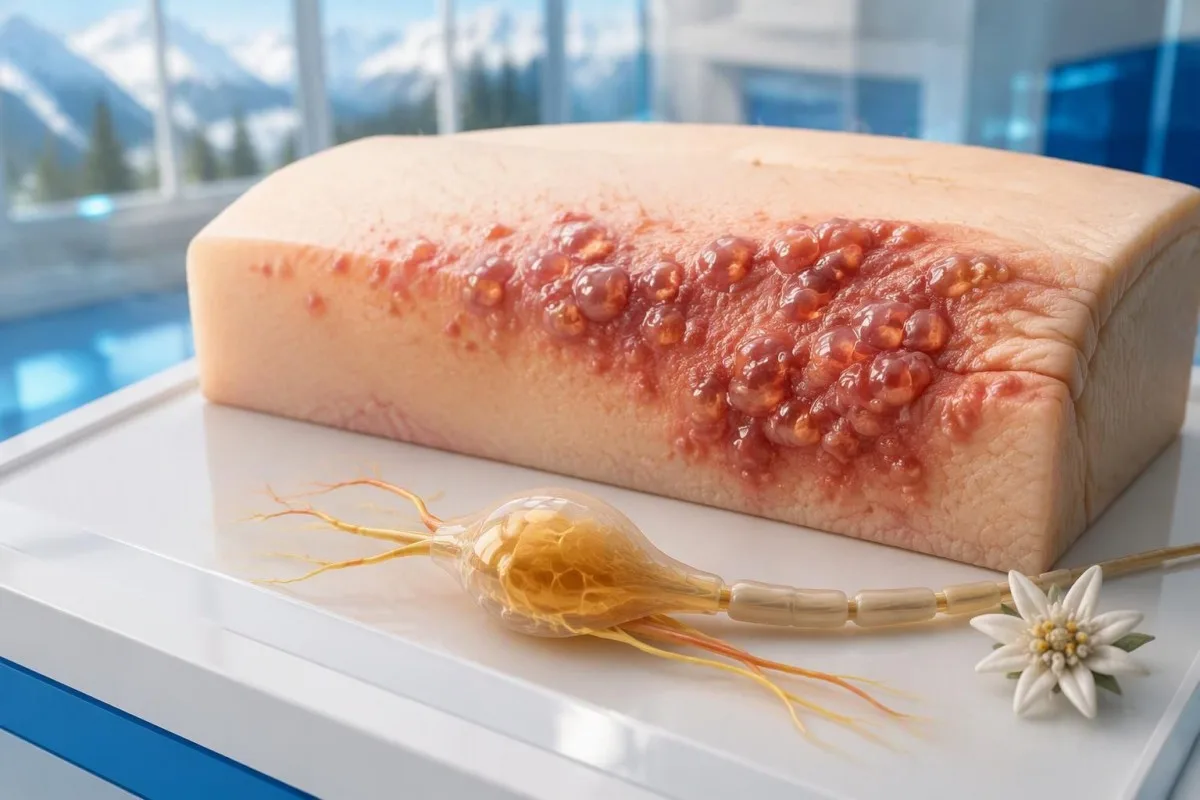
A painful patch of skin can appear normal for several days. The useful clues are its location, sensitivity, and evolution—not pain alone.


- Early shingles symptoms can include burning, tingling, itching, or unusual touch sensitivity on 1 side, often 2–3 days before a rash; these symptoms do not establish the diagnosis.
- Skin sensitivity may make clothing painful even when the skin looks normal, but nerve compression and other neuropathies can produce the same sensation.
- Rash appearance usually progresses from grouped bumps to fluid-filled blisters; affected sites commonly crust within 7–10 days.
- Lesion PCR tests material from a blister, its cellular base, or a scab for varicella-zoster virus; it is especially useful when the eruption is atypical.
- Antibody results cannot reliably confirm a current shingles episode: a positive VZV IgG usually reflects previous exposure or vaccination.
- Behandelingstydsberekening is generally measured from rash onset, with assessment ideally within 72 hours; later treatment can still help selected patients.
- Eye warning signs include eye pain, redness, light sensitivity, or altered vision; obtain urgent assessment without waiting for a rash or PCR result.
- Prescription dosing depends on kidney function: a common adult valaciclovir regimen is 1,000 mg three times daily for 7 days only when clinically appropriate.
- Persistent pain lasting at least 90 days after rash onset is commonly classified as postherpetic neuralgia and needs a separate management plan.
Which shingles symptoms can start before a rash?
Early shingles symptoms can include one-sided burning, tingling, itching, and painful skin sensitivity, often 2–3 days before a rash. These symptoms alone cannot confirm shingles; an atypical eruption may need lesion PCR, and eye pain or vision changes require urgent assessment without waiting for visible blisters.
The most useful early clue is a new, localized skin sensation rather than a general feeling of being unwell. A person might describe a hot patch under a shirt, intermittent electrical stings, or itching that stays within 1 strip instead of spreading randomly across the body.
Headache, fatigue, or a mild fever can accompany the local symptoms, but none distinguishes shingles from another illness. During the first 48 hours, the skin may look entirely ordinary; absence of redness therefore does not settle the question, while the absence of a rash also limits diagnostic certainty.
My approach as Thomas Klein, MD, is to separate suspicion from confirmation: a 58-year-old with a newly sensitive patch over the right ribs deserves a different assessment from someone with months of tingling in both feet. That is an illustrative comparison, not a diagnostic shortcut or a reported patient encounter.
Kantesti is an AI blood test analyzer that can help explain accompanying laboratory results, but it cannot confirm shingles from burning skin or a routine panel. As of October 12, 2026, this distinction remains central: recognize the pattern, arrange appropriate assessment, and do not let a normal test delay care.
Why does clothing hurt when the skin looks normal?
Allodynia means pain caused by a normally harmless stimulus, such as light clothing brushing the skin. It can occur with shingles pain before rash because irritated sensory nerves alter touch processing; noticing it on 1 side raises suspicion but does not identify the cause.
Light touch and firm pressure do not always produce the same response. A bedsheet may feel abrasive while deeper pressure is less troublesome, suggesting a superficial sensory problem rather than a straightforward muscle strain; this comparison is useful history, not a validated 2-part home diagnostic test.
Tingling in both feet over 3 months points toward a different investigation from burning across one flank over 2 days. Vitamin B12 deficiency is one possible cause of persistent neuropathy, including cases without anemia; our explanation of grensgevalle B12-resultate addresses why the neurological history matters.
Tingling around the mouth and in both hands, particularly with cramps, can reflect an electrolyte problem rather than a shingles prodrome. If symptoms follow that 2-sided pattern, our guide to lae kalsium waarskuwingstekens explains when blood testing and urgent evaluation are more relevant.
Repeatedly scratching or testing a sensitive patch can create redness that obscures the original picture. Record when it started, whether it stays on 1 side, and whether movement changes it; a photograph of any new visible change is more useful than repeatedly provoking the sensation.
What causes shingles pain before rash appears?
Shingles results from reactivation of varicella-zoster virus, which remains dormant in sensory nerve ganglia after chickenpox. Nerve irritation can precede the skin eruption by several days; the virus is not newly acquired from another person each time someone develops a 1-sided shingles episode.
The delay between nerve symptoms and blisters is biologically plausible: the nerve and its connected skin do not become visibly affected at exactly the same moment. Dworkin et al. describe a prodrome commonly lasting 2–3 days in their Clinical Infectious Diseases management recommendations, while recognizing substantial variation between patients.
Age increases shingles risk partly because virus-specific cellular immune control becomes less effective over time. A person aged 70 and a person aged 30 can both develop shingles, but age, immune-suppressing medicines, and the severity of symptoms change how quickly a clinician considers treatment and possible complications.
A total lymphocyte count measures circulating cells, not the strength of every virus-specific immune response. Kantesti AI can help contextualize that count, but a result within the laboratory interval does not exclude shingles or prove intact antiviral immunity; see our discussion of lymphocyte counts and context.
A recent stressful week is not proof that stress caused an episode. When reviewing a new 1-sided symptom, I would give greater weight to its distribution, evolving skin findings, medication history, and neurological examination than to a presumed trigger that cannot be established in an individual case.
Where do early shingles symptoms usually occur?
Early shingles symptoms often follow a dermatome, an area of skin supplied by a sensory nerve root, usually on one side of the trunk or face. The midline is a useful landmark, but 1 small spot beyond it does not automatically rule shingles out.
A trunk eruption may form a partial belt from the back toward the abdomen without wrapping around both sides. The painful area can initially feel broader than the later visible blisters, so drawing an exact 1-centimeter boundary is less helpful than establishing whether the symptoms remain predominantly unilateral.
Pain near a nerve root can also arise from spinal degeneration, a disc problem, or nerve entrapment. Movement-related pain, a recent lifting injury, persistent weakness, or symptoms extending into a limb may shift the assessment; our guide to onverklaarbare pyn toetsing explains why normal inflammatory markers do not resolve every nerve problem.
Shingles can involve adjacent dermatomes, particularly when immune function is impaired. Symptoms or blisters in 2 neighboring bands are different from scattered affected sites across several distant regions; widespread changes should prompt urgent assessment rather than being treated as an ordinary localized episode.
Facial distribution needs extra care because the trigeminal nerve has 3 major branches. Forehead and upper-eyelid involvement suggests the ophthalmic branch; cheek or jaw symptoms involve different territories, although patients should not try to determine eye safety from a diagram instead of an examination.
What does shingles look like once the rash develops?
A typical shingles rash consists of grouped bumps that become fluid-filled blisters on a predominantly one-sided band of skin. New blisters often develop over 3–5 days, affected sites commonly crust in 7–10 days, and skin healing usually takes about 2–4 weeks.
The color of the surrounding skin varies with skin tone and lighting. On darker skin, redness may appear purple-brown or be less conspicuous, so a cluster of raised spots, local tenderness, and the 1-sided distribution may be more informative than a bright-red appearance in a reference photograph.
Not every affected site develops at the same time. A photograph taken on day 2 can therefore look different from one taken on day 5 without implying a new illness; however, expanding warmth, thick discharge, rapidly increasing swelling, or renewed fever requires assessment for an additional skin problem.
Nighttime itch with burrows between the fingers or several household members itching favors a different explanation. Our guide to scabies rash patterns helps distinguish that distribution from a single painful band, although neither condition should be diagnosed from 1 photograph alone.
A rash is not required for every cause of itch, and a blood panel is not the first answer to every blistering eruption. The discussion of itching and test limits explains when generalized symptoms warrant laboratory investigation instead of assuming that 1 local skin change explains everything.
Which conditions can mimic early shingles symptoms?
Nerve compression, muscle or rib pain, contact dermatitis, and herpes simplex can mimic aspects of shingles. Chest or abdominal pain also has potentially urgent causes; the presence of burning skin on 1 side must never be used to dismiss a heart, lung, or abdominal emergency.
Radiculopathy can produce burning, tingling, or shooting pain without a rash, while contact dermatitis may cause itch followed by changes matching an adhesive, detergent, or garment. Symptoms beginning within 24 hours of a new local exposure support considering dermatitis, but exposure history alone does not establish that diagnosis.
Herpes simplex can produce grouped blisters and occasionally resemble a small shingles eruption. Repeated episodes in the same small area, especially 2 or more similar recurrences, should make a clinician reconsider the label; requesting both HSV and VZV PCR may clarify the cause when the appearance is uncertain.
Chest pressure, breathlessness, fainting, or pain spreading to the arm or jaw needs emergency assessment even if the skin also tingles. Pain that changes with breathing or position has other possibilities, including the patterns described in our pericarditis chest pain guide; there is no 72-hour observation rule for concerning chest symptoms.
Severe abdominal pain, persistent vomiting, or worsening focal tenderness needs a separate assessment rather than waiting 2–3 days for a possible rash. Our explanation of normale toetse in blindedermontsteking makes the same safety point: a reassuring white-cell count cannot exclude every serious cause of pain.
When does lesion PCR help confirm atypical shingles?
VZV PCR from an affected skin site is the preferred laboratory method for confirming an uncertain shingles eruption. It is particularly useful for an unusual distribution, very few blisters, recurrent similar eruptions, or immunocompromised patients; 1 well-collected specimen may be enough, depending on the laboratory protocol.
Blister fluid, cells collected from the base of a blister, and scabs are suitable materials for PCR. The CDC's Laboratory Testing for Varicella-Zoster Virus guidance identifies PCR as the most helpful confirmation test and emphasizes appropriate skin specimens; a dry swab lightly brushed over intact skin is not equivalent to 1 properly collected sample.
An atypical rash does not have to be dramatic to justify testing. A 3-spot cluster beside the waistline could be shingles, herpes simplex, or another skin problem; the clinician's question should guide whether the laboratory tests for VZV alone or both viruses, rather than ordering an undirected screening panel.
A negative PCR reduces the likelihood of shingles only in the context of the specimen and clinical findings. If collection missed the affected cellular material, the result may be misleading; there is no single sensitivity percentage that applies equally to every specimen type, stage, and assay across all 3 settings.
Kantesti is an AI blood test interpretation platform, not a replacement for collecting and testing an affected skin site. Our kliniese geldigheidsraamwerk is relevant to interpreting laboratory information, but neither a routine panel nor an algorithmic interpretation establishes VZV as the cause of 1 unexplained rash.
Can shingles occur without any visible rash?
Varicella-zoster reactivation without a rash is possible and is called zoster sine herpete, but unexplained pain alone does not confirm it. Before any affected skin site appears, ordinary lesion PCR is unavailable; persistent 1-sided symptoms require examination and consideration of alternative neurological or structural causes.
A positive VZV IgG usually indicates previous infection or vaccination, not proof of current shingles. One positive antibody result can remain present for years; our guide to positiewe antistoftoets betekenis explains the difference between immune memory, current infection, and tests that need additional confirmation.
VZV IgM has limitations and cannot reliably settle an otherwise uncertain rash-free case. A negative IgM does not exclude reactivation, while a positive result can be difficult to interpret; ordering 2 antibody classes instead of 1 does not remove those biological and assay limitations.
Blood or saliva PCR is not a dependable routine substitute for affected-site PCR in uncomplicated localized shingles. Neurological complications may require specialist-directed cerebrospinal fluid testing or other investigations, but a lumbar puncture is not the usual next step for 2 days of isolated burning skin without neurological findings.
Empirical treatment before the rash is a clinician-specific decision, not a standard rule for everyone with tingling. If the history strongly suggests VZV and the potential consequences are high, treatment may be considered while other causes are assessed; the evidence is less secure than for a characteristic eruption presenting within 72 hours.
Which eye, face, or ear symptoms need urgent care?
Eye pain, redness, light sensitivity, or altered vision with suspected shingles requires urgent same-day assessment. Sudden vision loss is an emergency; a new 1-sided forehead or upper-eyelid rash also needs prompt treatment assessment, even when the eye initially seems comfortable.
Affected sites on the tip, side, or root of the nose can indicate nasociliary nerve involvement and increased risk of eye complications. Opstelten and Zaal's BMJ review explains the significance of this sign; absence of nasal changes does not establish that the eye is safe, and 1 apparently reassuring feature cannot replace examination.
A red, painful eye has causes other than shingles, including uveitis and glaucoma-related emergencies. Our guide to uveitis and HLA-B27 illustrates why a known blood-test result does not determine the cause of a new eye symptom; urgent assessment comes before interpreting 1 antibody or genetic marker.
Ear discomfort with blisters near the ear, new facial weakness, hearing changes, or vertigo raises concern for Ramsay Hunt syndrome or another neurological problem. Seek same-day care; facial droop accompanied by arm weakness, speech difficulty, or other stroke symptoms requires emergency services rather than waiting 24 hours for a routine appointment.
Do not put leftover steroid drops into an affected eye or wait for blisters to appear before seeking help for altered vision. Eye specialists may prescribe specific treatments after examination, but using 1 old prescription without knowing the current diagnosis can worsen certain eye conditions or delay the correct treatment.
Who needs a lower threshold for prompt assessment?
People with impaired immunity, older adults, and anyone with widespread, severe, or neurological symptoms need a lower threshold for assessment. Risk is not determined by age alone: a 35-year-old taking transplant medicines may need more urgent evaluation than an otherwise well 55-year-old with a small localized eruption.
Transplant medicines, chemotherapy, some biologic therapies, and substantial corticosteroid exposure can alter both presentation and treatment needs. A person taking tacrolimus should mention it immediately; our guide to tacrolimus monitoring and safety explains why medication timing, kidney function, and 1 isolated concentration are different clinical questions.
Shingles can occur in otherwise healthy people, so 1 episode does not automatically imply a hidden immune disorder or cancer. Recurrent, unusually extensive, or unusually severe episodes may justify targeted assessment; our discussion of frequent infection investigations emphasizes selecting tests from the history rather than ordering every immune marker.
Pregnancy changes the discussion of exposure, medications, and alternative diagnoses, even though maternal shingles is generally less concerning for the fetus than primary chickenpox. A pregnant person with 1 new blistering eruption should contact their maternity or medical team promptly, particularly when previous chickenpox immunity is uncertain.
Confusion, severe headache with neck stiffness, new limb weakness, inability to pass urine, or widespread blisters requires urgent assessment rather than home observation. Kantesti can help organize existing laboratory information for the clinician, but 1 uploaded report must not become a detour when symptoms suggest a neurological or disseminated complication.
How quickly should shingles treatment be assessed?
Antiviral treatment is generally most useful when started within 72 hours of rash onset, not 72 hours from the first tingling sensation. Later treatment may still be appropriate when new blisters are appearing, the eye is involved, symptoms are severe, or the patient is immunocompromised.
The 72-hour threshold largely reflects the entry window used in antiviral trials and the period of active viral replication; it is not a switch after which treatment becomes pointless. Dworkin et al. recommend considering treatment beyond that window in selected cases, although the evidence becomes less direct than for early uncomplicated disease.
A common regimen for an adult with suitable kidney function is valaciclovir 1,000 mg three times daily for 7 days. Aciclovir 800 mg five times daily for 7 days is another option; these are prescription examples, not instructions to start leftover medication, and local recommendations may differ.
Kidney impairment can require substantial dose adjustment because these medicines are cleared through the kidneys. Our nierefunksie interpretasiegids explains why hydration, creatinine, and the broader clinical picture matter; the same 1,000 mg dose is not appropriate for every patient.
I, Thomas Klein, MD, would not tell someone with suspected eye involvement to wait for laboratory confirmation before seeking treatment assessment. Antivirals can shorten the acute course but do not reliably prevent every case of persistent pain; a person presenting on day 5 still needs an individualized decision rather than an automatic refusal.
How should pain be managed during and after shingles?
Shingles pain may need both ordinary pain relief and treatment directed at nerve pain, depending on severity and patient factors. Pain lasting at least 90 days after rash onset is commonly classified as postherpetic neuralgia; continuing pain does not, by itself, mean the virus remains contagious.
Loose clothing, a cool clean compress, and avoiding adhesive directly over affected sites may make ordinary activities easier. Record sleep disruption and a simple 0–10 pain score for discussion with the clinician; pain that prevents drinking, eating, or basic self-care needs reassessment rather than being accepted as inevitable.
Paracetamol or another suitable analgesic may help, but liver disease, kidney disease, pregnancy, anticoagulants, and other medicines affect the choice. A 75-year-old taking several prescriptions needs a medication review rather than simply adding the largest over-the-counter dose; pain relief should not obscure worsening neurological or eye symptoms.
Gabapentin and pregabalin are sometimes used for neuropathic pain, but they are not antivirals and their doses depend on kidney function. Our guide to lae eGFR-waarskuwingstekens provides useful context; new confusion or marked sedation after starting 1 of these medicines warrants prompt advice.
Persistent pain needs a different conversation from an acute eruption, especially once 90 days have passed. Topical options, selected oral medicines, and specialist pain care may be considered; do not apply medicated patches to blistered skin, and do not assume a second antiviral course is automatically the answer to healed-skin pain.
When is shingles contagious, and can vaccination help?
A person with shingles can transmit VZV to someone without immunity, causing chickenpox rather than directly causing shingles. Localized shingles is considered contagious while blisters are present and until every affected site is dry and crusted, commonly around 7–10 days after rash onset.
Covering the eruption, washing hands, and avoiding contact with vulnerable nonimmune people reduces exposure risk. Until all affected sites have crusted, take particular care around newborns, pregnant people without chickenpox immunity, and people with impaired immunity; counting 7 days is less reliable than checking whether every site has actually dried.
Localized shingles is not usually considered contagious during the pain-only prodrome, but symptoms cannot establish that an eruption is truly shingles. If 1 new blister appears, update the precautions and arrange assessment; widespread VZV disease requires different infection-control decisions, particularly in hospitals and other clinical settings.
VZV IgG can help answer selected questions about previous immunity, but it does not diagnose an active shingles episode or measure the severity of current pain. Our explanation of varicella immunity test results separates that purpose from affected-site PCR; an exposed high-risk person should not delay medical advice while waiting for 1 antibody result.
Recombinant shingles vaccination uses 2 doses and reduces future risk; it does not treat an episode already underway. US recommendations include adults aged 50 or older and certain immunocompromised adults aged 19 or older, while UK eligibility differs; ask about local eligibility and timing after recovery rather than assuming one schedule applies internationally.
What can blood tests—and our platform—actually tell you?
Routine blood tests do not confirm or exclude localized shingles. Creatinine can inform antiviral dosing, and selected tests may investigate alternative causes of tingling or impaired immunity, but 1 normal CBC, CRP, or metabolic panel cannot replace examination or VZV PCR from an atypical eruption.
Kantesti is an AI-powered blood test analysis tool that helps explain uploaded laboratory reports and trends, not a lesion-testing service. Our KI-tegnologiegids describes that workflow; interpreting 1 creatinine result may support a clinician's medication review, but it cannot determine whether burning skin is caused by VZV.
White-cell counts and CRP reflect different aspects of the body's response and may be normal in localized shingles. The practical sequence is symptom assessment first, targeted testing second, and treatment when indicated; there is no need to wait approximately 60 seconds for an automated interpretation before seeking urgent care for altered vision.
The clinical perspective attributed here to Thomas Klein, MD, Chief Medical Officer, is educational rather than an individual consultation. Kantesti's mediese adviesraad provides information about our clinical team; a publication date such as October 12, 2026, should not be mistaken for evidence that a named physician has completed review of a particular patient's findings.
Two separate educational publications appear in the research section below: our hematologie-merkergids en ons spysverteringsimptoomgids. Neither investigates shingles, and neither supports the VZV diagnostic or treatment statements here; those statements are attributed to the 3 directly relevant medical references listed separately.
Gereelde vrae
Wat is die eerste tekens van gordelroos voordat die uitslag verskyn?
Die eerste tekens van gordelroos kan gelokaliseerde branderigheid, tinteling, jeuk of pynlike sensitiwiteit vir ligte aanraking insluit, gewoonlik aan die een kant van die liggaam. Hierdie simptome gaan die uitslag gewoonlik met ongeveer 2–3 dae vooraf, hoewel die tydsverloop wissel. Senuweekompressie, spierpyn en ander toestande kan soortgelyke simptome veroorsaak, dus bevestig pyn alleen nie gordelroos nie. Kry spoedige beoordeling vir aanhoudende simptome en dringende mediese sorg vir oogpyn, veranderde sig, nuwe swakheid of erge borspyn.
Hoe lank kan gordelpyn voorkom voordat ’n uitslag verskyn?
Pyn weens gordelroos begin gewoonlik ongeveer 2–3 dae voor die uitslag, maar sommige pasiënte het ’n korter of langer prodroom. Die tydsberekening is nie ’n diagnostiese afsnypunt nie, en ’n week se onverklaarde pyn moet nie outomaties as gordelroos bestempel word nie. Indien ’n uitslag verskyn, neem foto’s van die veranderinge en reël dadelik ’n beoordeling, want die gewone antivirale venster van 72 uur word vanaf die begin van die uitslag gemeet. Aanhoudende pyn sonder ’n uitslag vereis dat ander oorsake oorweeg word.
Hoe lyk gordelroos aan die begin?
Vroeë gordelroos lyk dikwels soos ’n klein groepie verhewe kolle aan die een kant van die liggaam wat in vloeistofgevulde blase ontwikkel. Nuwe blase verskyn gewoonlik oor 3–5 dae, en die aangetaste plekke vorm gewoonlik binne 7–10 dae korsies. Rooiheid kan minder sigbaar wees of persbruin lyk op donkerder vel. ’n Ongewone uitslag kan VZV-PCR vereis, omdat voorkoms alleen nie elke geval betroubaar van herpes simplex of ’n ander veltoestand kan onderskei nie.
Kan ’n bloedtoets gordelroos bevestig voordat die uitslag verskyn?
’n Roetinebloedtoets kan gordelroos nie betroubaar bevestig voordat ’n uitslag verskyn nie. ’n Positiewe VZV IgG weerspieël gewoonlik vorige blootstelling aan waterpokkies of inenting, en 1 positiewe teenliggaamuitslag bevestig nie huidige reaktivering nie. VZV IgM het ook diagnostiese beperkings en kan gordelroos nie betroubaar uitsluit wanneer die uitslag negatief is nie. Wanneer ’n atipiese uitslag teenwoordig is, is PCR van geskikte materiaal wat van ’n aangetaste velplek versamel is, oor die algemeen die voorkeurbevestigingstoets.
Wanneer moet ’n ongewone gordelroosuitslag met PCR getoets word?
VZV-PCR is nuttig wanneer ’n vermoedelike gordelroosuitslag ’n ongewone verspreiding het, baie min aangetaste plekke, herhaalde soortgelyke episodes, of ’n onsekere voorkoms by ’n immuunonderdrukte pasiënt. Geskikte monsters sluit in blaasvloeistof, selle van die basis van die blaas, of ’n skurf, wat volgens die laboratorium se instruksies versamel word. Een behoorlik versamelde monster kan voldoende wees, en HSV-toetsing kan bygevoeg word wanneer herpes simplex ’n realistiese alternatief is. Dringende assessering vir behandeling moet nie wag vir PCR wanneer oogbetrokkenheid of ernstige komplikasies vermoed word nie.
Is it too late to treat shingles after 72 hours?
It is not automatically too late to treat shingles after 72 hours from rash onset. Clinicians may still prescribe antivirals when new blisters are developing, symptoms are severe, the eye is involved, or immunity is impaired. A common adult valaciclovir regimen is 1,000 mg three times daily for 7 days when kidney function and other patient factors permit. The dose and decision require a prescriber; leftover medication is not an appropriate substitute for assessment.
Which shingles symptoms near the eye are an emergency?
Eye pain, redness, light sensitivity, or altered vision with suspected shingles requires urgent same-day assessment, and sudden vision loss is an emergency. A one-sided forehead or upper-eyelid eruption also needs prompt treatment assessment even if the eye initially feels comfortable. Affected sites on the nose increase concern, but their absence does not rule out eye complications. Do not wait 72 hours, wait for PCR, or use leftover steroid eye drops before seeking appropriate care.
Kry vandag KI-aangedrewe bloedtoets-analise
Sluit aan by meer as 2 miljoen gebruikers wêreldwyd wat Kantesti vertrou vir onmiddellike, akkurate laboratoriumtoetsanalise. Laai jou bloedtoetsresultate op en ontvang omvattende interpretasie van 15,000+-biomerkers binne sekondes.
📚 Verwysde navorsingspublikasies
Klein, T., Mitchell, S., & Weber, H. (2026). B Negatiewe Bloedgroep, LDH-bloedtoets en retikulosiettelling-gids. Kantesti KI Mediese Navorsing.
Klein, T., Mitchell, S., & Weber, H. (2026). Diarree na vas, swart spikkels in stoelgang en GI-gids 2026. Kantesti KI Mediese Navorsing.
📖 Eksterne mediese verwysings
Centers for Disease Control and Prevention (n.d.). Laboratory Testing for Varicella-Zoster Virus (VZV). CDC clinical guidance.
Opstelten W, Zaal MJ (2005). Managing ophthalmic herpes zoster in primary care. BMJ.
⚕️ Mediese Vrywaring
Hierdie artikel is slegs vir opvoedkundige doeleindes en vorm nie mediese advies nie. Raadpleeg altyd ’n gekwalifiseerde gesondheidsorgverskaffer vir besluite oor diagnose en behandeling.
E-E-A-T Vertrouenseine
Ervaring
Kliniese oorsig gelei deur ’n geneesheer van laboratorium-interpretasie-werksvloei.
Kundigheid
Laboratoriumgeneeskunde fokus op hoe biomerkers in ’n kliniese konteks optree.
Gesagsvermoë
Geskryf deur dr. Thomas Klein met hersiening deur dr. Sarah Mitchell en prof. dr. Hans Weber.
Betroubaarheid
Bewysgebaseerde interpretasie met duidelike opvolgpaaie om alarm te verminder.