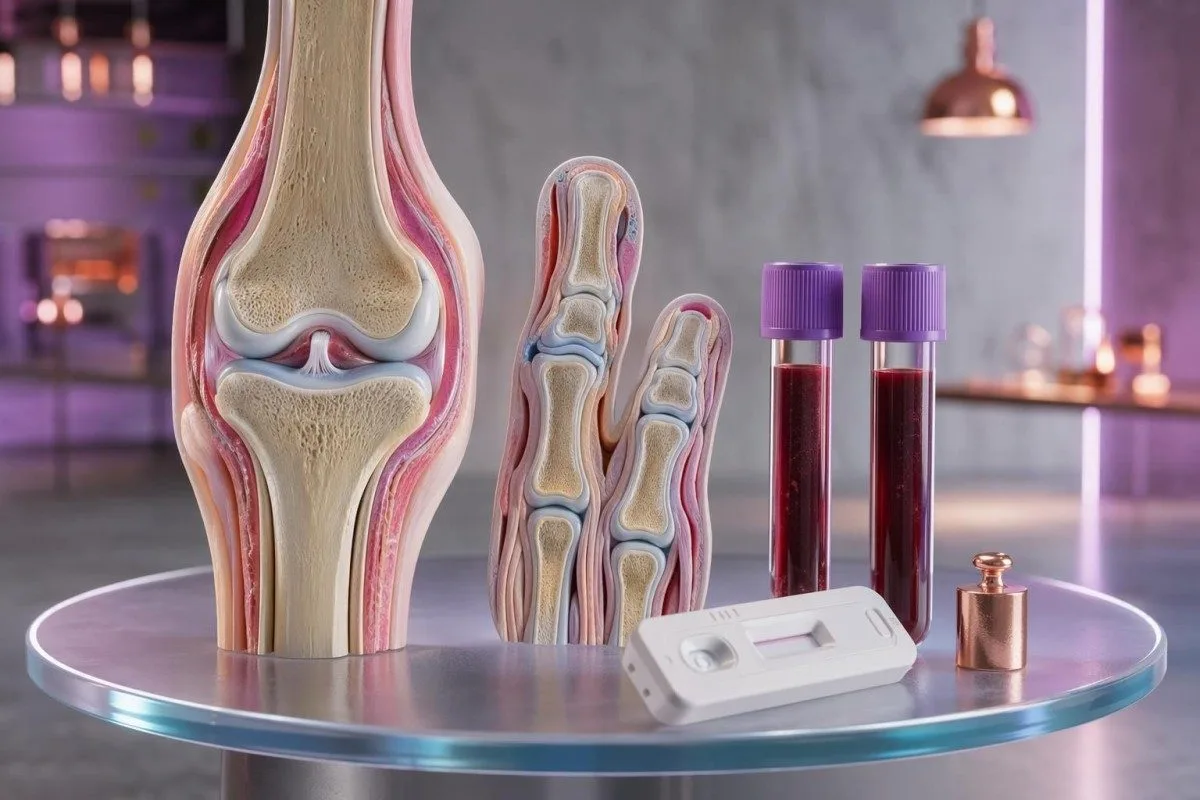
Joint pain becomes easier to understand when symptoms, exam findings and blood results are read as a pattern. Blood work can point toward inflammation, autoimmunity, infection or gout, but it rarely gives the whole answer alone.


- Blood test for joint pain usually starts with CBC, ESR, CRP, kidney/liver chemistry and targeted tests such as RF, anti-CCP, ANA or uric acid depending on symptoms.
- CRP is often reported as normal below 5 mg/L or 10 mg/L, and values above 100 mg/L raise concern for serious infection, vasculitis or major tissue inflammation.
- ESR rises slowly and is strongly affected by age, sex, anemia and pregnancy; an ESR above 100 mm/hour deserves prompt clinical review.
- Anti-CCP antibody has high specificity for rheumatoid arthritis, commonly around 95% in clinical studies, but a negative result does not exclude early disease.
- ANA testing is useful when joint pain comes with rashes, mouth ulcers, kidney findings, Raynaud symptoms or low blood counts, not as a broad screening test for every ache.
- Uric acid above 6.8 mg/dL favors urate crystal formation, yet uric acid can be normal during an acute gout flare.
- Infection clues include fever, a hot swollen single joint, high neutrophils, very high CRP and sometimes procalcitonin above 0.5 ng/mL, but joint fluid testing may be urgent.
- Normal blood tests do not rule out osteoarthritis, tendon pain, hypermobility or fibromyalgia; pain pattern and examination often matter more than the lab flags.
Which blood tests help doctors sort joint pain causes?
A blood test for joint pain usually includes CBC, ESR, CRP, kidney and liver chemistry, then selected autoimmune or gout tests based on the pattern of pain. Blood work can separate inflammatory arthritis, autoimmune disease, infection and metabolic clues, but it cannot prove most diagnoses without the history, exam, imaging or sometimes joint fluid. As of May 7, 2026, that is still the honest answer I give patients. I am Thomas Klein, MD, and when we review results through Kantesti AI, our first task is not naming a disease; it is deciding which pattern deserves fast medical attention.
The fastest clinical split is inflammatory versus non-inflammatory pain. Morning stiffness lasting more than 45-60 minutes, swelling in small hand joints, night pain or improvement with movement pushes me toward inflammation, while pain that worsens after use and settles with rest often behaves mechanically.
A basic first pass often includes CBC with differential, CRP, ESR, creatinine/eGFR, ALT/AST, albumin and sometimes urinalysis. If you want a broader overview of how inflammation labs compare, our guide to inflammation blood tests explains why CRP and ESR answer different questions.
One trap: a normal CRP does not make swollen joints imaginary. In early rheumatoid arthritis, palindromic rheumatism, psoriatic arthritis or treated autoimmune disease, inflammatory markers can sit in the reference range while the joint exam is clearly abnormal.
The first clinical question is not the test name
I ask patients where the pain started, whether one joint or many joints are involved, and whether the joint is visibly swollen. A single hot knee in a 70-year-old with fever is a very different problem from symmetrical finger stiffness in a 34-year-old new parent.
Start with the pain pattern before ordering a large panel
The symptom pattern decides which joint pain blood tests are useful. Ordering every antibody at once increases false positives, especially when the pain pattern looks like tendon strain, osteoarthritis or overuse.
Inflammatory arthritis commonly causes warmth, swelling and prolonged morning stiffness. Mechanical joint pain tends to peak after activity, often has stiffness under 30 minutes, and may affect weight-bearing joints such as knees, hips or the base of the thumb.
A 52-year-old marathon runner with knee pain after hill training may need an exam and possibly imaging before antibodies. A 29-year-old with three months of swollen knuckles and 90 minutes of morning stiffness deserves ESR, CRP, RF and anti-CCP much earlier; a routine standard blood test would miss part of that story.
The practical threshold I use is persistence. Joint swelling lasting more than 6 weeks, especially in more than one joint, earns a targeted inflammatory arthritis workup even if the first CBC and chemistry panel look boring.
How CRP and ESR act as inflammation markers for joint pain
CRP and ESR are the main inflammation markers for joint pain, but they measure different biology. CRP changes within hours, while ESR moves more slowly and is heavily influenced by age, anemia, pregnancy and kidney disease.
A standard CRP normal range is often below 5 mg/L or below 10 mg/L, depending on the laboratory method. CRP above 10 mg/L usually means active inflammation somewhere, and CRP above 100 mg/L raises concern for serious infection, vasculitis, crystal arthritis or major tissue injury.
ESR is commonly considered roughly normal below 15 mm/hour in younger men and below 20 mm/hour in younger women, but many clinicians use age-adjusted estimates in older adults. Our CRP range guide and ESR range guide show why one flagged result can be harmless while a trend can be revealing.
The thing is, CRP may be low in lupus even when symptoms are active, unless infection or serositis is present. I have seen patients with painful swollen joints and CRP under 3 mg/L whose ultrasound still showed synovitis, so I do not let a single quiet marker overrule the joint exam.
RF and anti-CCP: rheumatoid arthritis clues, not verdicts
RF and anti-CCP are the main blood tests for arthritis pain when rheumatoid arthritis is suspected. Anti-CCP is more specific, while rheumatoid factor is more prone to false positives.
Anti-CCP antibody is commonly about 95% specific for rheumatoid arthritis in many clinical settings, though sensitivity is lower, often around 60-70% in early disease. The 2010 ACR/EULAR criteria give weight to antibody level, number of involved joints, symptom duration and acute-phase reactants rather than antibody positivity alone (Aletaha et al., 2010).
Rheumatoid factor can be positive in rheumatoid arthritis, but also in hepatitis C, Sjögren disease, chronic lung disease and some older adults without inflammatory arthritis. If you are staring at a borderline RF result, our rheumatoid factor guide explains why a value just above the cutoff is not the same as a diagnosis.
When anti-CCP results are strongly positive and the hands or feet are symmetrically swollen, I move faster. Kantesti's neural network flags this pattern differently from an isolated weak RF in someone with knee osteoarthritis because the pre-test probability is not remotely the same.
When ANA and lupus blood tests fit the joint pain story
ANA testing fits joint pain when there are systemic autoimmune clues such as rash, mouth ulcers, Raynaud symptoms, kidney abnormalities, chest pain with breathing, low blood counts or unusual fatigue. ANA is a poor screening test for ordinary aches.
An ANA titer of 1:80 or higher is the entry criterion in the 2019 EULAR/ACR lupus classification system, but classification criteria are not the same as bedside diagnosis (Aringer et al., 2019). Low-positive ANA results are common, especially in women, older adults and people with thyroid autoimmunity.
If ANA is positive and the story fits, doctors may add anti-dsDNA, anti-Sm, C3, C4, urinalysis and urine protein-to-creatinine ratio. Low C3 or C4 with joint pain and abnormal urine is more concerning than ANA alone; our ANA titer guide and lupus blood test guide go deeper into those combinations.
Here is a pattern I do not ignore: joint pain, platelets under 150 x 10^9/L, urine protein and low complement. That cluster can reflect immune-complex disease, and it deserves clinician review even if CRP is only mildly raised.
A negative ANA changes the odds
A negative ANA makes classic lupus less likely, but it does not explain every symptom. Doctors still consider thyroid disease, viral arthritis, inflammatory bowel disease, psoriasis-related arthritis, vasculitis and medication reactions when the clinical picture points elsewhere.
Blood tests for infection when one joint is hot or swollen
A hot, swollen single joint with fever is treated as possible infection until proven otherwise. Blood tests can support the suspicion, but joint fluid testing often decides the diagnosis.
CBC may show neutrophils above 7.5 x 10^9/L, CRP may rise above 100 mg/L, and procalcitonin above 0.5 ng/mL can support bacterial infection in the right context. None of these blood tests safely rules out septic arthritis by itself.
Doctors often order blood cultures if fever, rigors or systemic illness are present. Our guide to infection markers explains why CRP, procalcitonin and CBC can disagree during the first 24 hours of illness.
Geography and timing matter. Lyme testing is most useful when exposure risk and symptoms fit; testing too early can be falsely negative, which is why our Lyme timing guide focuses on when antibodies become detectable rather than simply listing tests.
Uric acid, gout and why a normal result can mislead
Uric acid helps assess gout risk, but it does not confirm or exclude gout during a flare. The most definitive test is finding crystals in joint fluid under polarized microscopy.
Monosodium urate crystals form more readily when serum urate is above about 6.8 mg/dL, the physiologic saturation point. During an acute gout flare, uric acid can fall into the normal range, so a normal result in the emergency clinic should not end the conversation.
The 2020 American College of Rheumatology gout guideline recommends a treat-to-target urate strategy below 6 mg/dL for patients receiving urate-lowering therapy (FitzGerald et al., 2020). Our uric acid range guide covers why risk rises gradually rather than at one magical cutoff.
Kidney function changes the plan. An eGFR below 60 mL/min/1.73 m² affects medication choices, flare treatment and allopurinol titration, so I want creatinine and eGFR beside the uric acid result, not in a separate mental folder.
Pseudogout looks similar
Calcium pyrophosphate crystal arthritis can mimic gout and infection, especially in older adults with sudden knee or wrist swelling. Serum uric acid does not diagnose pseudogout, and calcium, magnesium, phosphate, alkaline phosphatase, ferritin and thyroid tests may be considered when attacks are recurrent.
Thyroid, vitamin and iron clues that can mimic joint pain
Thyroid disease, vitamin D deficiency, B12 deficiency and iron problems can cause muscle aches, bone pain, stiffness or nerve symptoms that feel like joint pain. These tests do not replace arthritis testing, but they prevent tunnel vision.
A typical adult TSH reference interval is roughly 0.4-4.0 mIU/L, though pregnancy, age and local lab methods change interpretation. Hypothyroidism can cause diffuse aches, carpal tunnel symptoms and stiffness that patients often describe as joint pain; see our thyroid disease labs for the TSH-free T4 pattern.
25-hydroxyvitamin D below 20 ng/mL is generally considered deficient, and deficiency can cause bone pain or proximal muscle weakness. The vitamin D blood test matters more than the active 1,25-OH form for routine deficiency screening.
B12 deficiency can cause burning feet, balance trouble and hand tingling that masquerade as hand joint pain. If the neurologic story is strong, a B12 of 250-350 pg/mL may still need methylmalonic acid or homocysteine follow-up, depending on the lab and clinical picture.
Iron deficiency has a musculoskeletal voice
Low ferritin can worsen restless legs, fatigue and exercise intolerance, which can amplify pain perception. I have seen ferritin under 20 ng/mL make a patient feel globally sore even though their joints were not inflamed on exam.
Kidney and liver tests make arthritis treatment safer
Kidney and liver blood tests do not diagnose joint pain, but they strongly shape safe treatment. Creatinine, eGFR, ALT, AST, albumin and sometimes hepatitis tests can change which anti-inflammatory or disease-modifying drug is appropriate.
An eGFR below 60 mL/min/1.73 m² for 3 months suggests chronic kidney disease and makes NSAID use riskier. Our renal function panel explains why creatinine can look normal in a smaller or older adult even when filtration is reduced.
ALT and AST elevations above 2-3 times the upper reference limit usually deserve review before starting methotrexate, leflunomide or frequent acetaminophen. If liver enzymes are abnormal, our medication monitoring guide gives practical timing for repeat labs.
Kantesti AI interprets joint pain blood tests by checking safety patterns alongside diagnosis clues. A high CRP plus creatinine rise, low albumin and anemia is a different risk profile from isolated hand stiffness with normal chemistry.
Baseline labs are not bureaucracy
Before steroids, NSAIDs or immune-modifying treatment, baseline CBC, creatinine and liver enzymes create a safety anchor. Without that anchor, a later abnormal ALT of 89 IU/L is hard to interpret: new drug effect, old fatty liver, alcohol pattern or muscle contribution.
Seronegative arthritis and HLA-B27: useful only in context
Seronegative inflammatory arthritis can cause joint pain with negative RF and anti-CCP. HLA-B27 can support the diagnosis when symptoms fit, but it is not a stand-alone arthritis test.
HLA-B27 is found in roughly 6-8% of many Northern European populations, with wide variation globally, so a positive result can occur in healthy people. In ankylosing spondylitis and related conditions, positivity is much more common, but ethnicity and phenotype change the probability.
The symptom clue is inflammatory back pain: onset before age 45, improvement with exercise, night pain and stiffness that eases after getting up. If gut symptoms, psoriasis, uveitis or tendon insertion pain are present, doctors may look beyond a narrow autoimmune panel toward spondyloarthritis.
Celiac disease can rarely present with arthralgia or low nutrient markers, and it is missed when clinicians only chase RF and ANA. Our celiac blood test guide explains why total IgA should sit beside tTG-IgA for screening accuracy.
Seronegative does not mean non-inflammatory
A patient can have swollen joints, high CRP and negative RF, anti-CCP and ANA. That is not a failed workup; it narrows the next step toward imaging, pattern recognition and sometimes rheumatology examination.
What normal blood tests mean when joints still hurt
Normal joint pain blood tests make systemic inflammation less likely, but they do not rule out real pain. Osteoarthritis, tendon disorders, bursitis, hypermobility, nerve pain and fibromyalgia often have normal CBC, ESR and CRP.
Osteoarthritis usually has normal CRP and ESR unless another inflammatory process is present. Pain at the base of the thumb, knees or hips that worsens with use and improves with rest often needs mechanical assessment more than antibody testing.
Fibromyalgia does not raise RF, ANA, ESR or CRP by definition, though patients may have unrelated abnormal results. This is where blood test normal range thinking matters: one minor flag can distract from the actual pain mechanism.
Hypermobility is another under-discussed cause. A flexible 24-year-old with shoulder, wrist and knee pain after activity may have perfect blood work, yet still need physiotherapy, strength training and joint protection strategies.
Do not let normal labs delay care
If a joint is visibly swollen, losing range of motion, waking you at night or getting progressively worse over 4-6 weeks, normal blood tests should not be the end point. Examination and imaging may show what chemistry cannot.
Timing, fasting and repeat testing change interpretation
Most blood tests for arthritis pain do not require fasting, but timing can change interpretation. CRP can move within 6-12 hours, ESR may lag for days, and antibodies usually change slowly over months or years.
If symptoms flare and settle quickly, testing during the flare can capture CRP, ESR, CBC or uric acid patterns that are invisible two weeks later. That said, uric acid can drop during an acute gout attack, which is one reason repeat testing after recovery is often useful.
Small changes are not always meaningful. A CRP shift from 4 to 7 mg/L may reflect lab variation, minor infection or exercise, while a jump from 4 to 64 mg/L during a swollen-joint flare is much harder to dismiss; our lab variability guide covers this in plain terms.
Kantesti compares uploaded results against prior values, units and reference intervals, which helps when one lab reports CRP in mg/L and another reports hs-CRP for cardiovascular risk. If a result seems out of character, our repeat abnormal labs guide explains when repeating is safer than reacting.
Biotin and supplements can interfere
High-dose biotin, often 5-10 mg daily in hair and nail products, can interfere with some immunoassays. If thyroid or antibody results do not match the clinical picture, tell the clinician and laboratory about supplements before repeating.
When joint pain blood tests should trigger urgent care
Urgent care is needed for joint pain with fever, a hot swollen single joint, inability to bear weight, new weakness, chest pain, severe rash or rapidly worsening swelling. Blood tests should not delay emergency assessment in these situations.
A single hot joint can lose cartilage quickly if infection is present, and waiting days for outpatient labs can be unsafe. If fever is above 38°C, CRP is very high, or the person cannot move the joint, clinicians often prioritize same-day assessment and joint fluid evaluation.
Rheumatology referral is usually appropriate for joint swelling lasting more than 6 weeks, positive anti-CCP with compatible symptoms, suspected lupus with kidney findings, or recurrent unexplained inflammatory flares. If you are preparing for a first visit, our guide on new doctor labs helps organize the basics without overwhelming the appointment.
Virtual care can review trends, medication safety labs and next-test choices, but it cannot feel warmth, detect an effusion or aspirate a joint. Our telehealth blood review explains where remote interpretation helps and where hands-on examination wins.
How Kantesti helps read joint pain blood results safely
Kantesti helps interpret joint pain blood results by linking biomarkers to symptom patterns, trends and safety flags, not by pretending a blood panel diagnoses everything. Our AI can read a blood test PDF or photo in about 60 seconds, but medical decisions still belong with the patient and clinician.
Our AI-powered blood test interpretation platform supports over 75 languages and analyzes a wide biomarker library, which matters because joint pain workups often mix CRP, ESR, CBC, antibodies, kidney function and medication monitoring. Kantesti LTD describes its governance and company background on About Us, and our medical oversight is listed through the Medical Advisory Board.
For clinical standards, we publish our validation approach through Medical Validation and the broader AI lab workflow. A related pre-registered benchmark is available as Clinical Validation of the Kantesti AI Engine on 100,000 anonymised cases across 127 countries at https://doi.org/10.6084/m9.figshare.32095435.
Formal Kantesti research records include: Kantesti LTD. (2026). Clinical Validation Framework v2.0. Zenodo. https://doi.org/10.5281/zenodo.17993721. Kantesti LTD. (2026). AI Blood Test Analyzer: 2.5M Tests Analyzed | Global Health Report 2026. Zenodo. https://doi.org/10.5281/zenodo.18175532.
If you already have results, upload them to our free blood test analysis and bring the interpretation to your clinician. Thomas Klein, MD reviews these tools with one rule in mind: the safest answer is often a ranked differential and a next-step plan, not a dramatic label.
What our AI should and should not do
Kantesti AI can flag a high CRP, positive anti-CCP, low complement or rising creatinine in context. It should not tell a person with a feverish hot knee to stay home because an online report looked reassuring.
Frequently Asked Questions
What blood tests should I ask for if I have joint pain?
The usual first blood tests for joint pain are CBC with differential, ESR, CRP, creatinine/eGFR, liver enzymes and sometimes urinalysis. If symptoms suggest inflammatory arthritis, doctors may add RF, anti-CCP, ANA and selected follow-up antibodies. If gout is possible, serum uric acid is often checked, although a level below 6.8 mg/dL during a flare does not exclude gout. The exact list should follow the pain pattern, especially whether swelling, fever or morning stiffness over 45-60 minutes is present.
Can a blood test diagnose arthritis?
A blood test alone usually cannot diagnose arthritis, because many arthritis diagnoses require symptom pattern, examination, imaging or joint fluid analysis. Anti-CCP is highly specific for rheumatoid arthritis, often around 95%, but it still needs matching symptoms such as persistent small-joint swelling. CRP and ESR show inflammation but do not name the cause. A normal blood panel also does not rule out osteoarthritis, tendon pain, hypermobility or fibromyalgia.
Which inflammation markers are used for joint pain?
The main inflammation markers for joint pain are CRP and ESR. CRP is often normal below 5-10 mg/L and can rise within hours, while ESR changes more slowly and is affected by age, anemia, pregnancy and kidney disease. CRP above 100 mg/L is a red flag when paired with fever, severe pain or a hot swollen joint. Doctors often interpret both markers together rather than choosing one winner.
Does high uric acid always mean gout?
High uric acid does not always mean gout, because many people with uric acid above 6.8 mg/dL never develop crystal arthritis. Gout is more likely when sudden severe pain, redness and swelling affect the big toe, midfoot, ankle, knee or wrist. During an acute flare, uric acid can be normal, so the timing of the test matters. The most definitive test is identification of urate crystals in joint fluid.
What does it mean if ANA is positive with joint pain?
A positive ANA with joint pain can be meaningful when systemic autoimmune features are present, such as rash, mouth ulcers, Raynaud symptoms, low blood counts or abnormal urine protein. An ANA titer of 1:80 or higher is used as an entry criterion in the 2019 EULAR/ACR lupus classification system, but low-positive ANA results are common in people without lupus. Doctors often add anti-dsDNA, anti-Sm, C3, C4 and urinalysis when the symptom pattern fits. ANA alone should not be used to label ordinary joint aches as autoimmune disease.
What if all my joint pain blood tests are normal?
Normal joint pain blood tests lower the chance of major systemic inflammation, but they do not make the pain unreal. Osteoarthritis, tendon injury, bursitis, nerve pain, hypermobility and fibromyalgia often have normal CBC, ESR and CRP. If swelling, loss of motion or night pain persists for more than 4-6 weeks, examination and imaging may be more useful than repeating the same panel. A normal lab result should be interpreted beside the body part, timing and physical findings.
When is joint pain an emergency even before blood results return?
Joint pain is urgent when one joint is hot and swollen, fever is above 38°C, weight-bearing is impossible, severe redness spreads, or the person feels systemically unwell. These features can indicate septic arthritis, crystal arthritis or another acute inflammatory process that may need same-day evaluation. CRP, ESR and CBC help risk-stratify, but they should not delay joint fluid testing when infection is suspected. New neurologic weakness or chest pain with joint symptoms also warrants urgent medical care.
Get AI-Powered Blood Test Analysis Today
Join over 2 million users worldwide who trust Kantesti for instant, accurate lab test analysis. Upload your blood test results and receive comprehensive interpretation of 15,000+ biomarkers in seconds.
📚 Referenced Research Publications
Klein, T., Mitchell, S., & Weber, H. (2026). Kantesti LTD. (2026). Clinical Validation Framework v2.0 (Medical Validation Page). Zenodo. https://doi.org/10.5281/zenodo.17993721. ResearchGate: https://www.researchgate.net/. Academia.edu: https://www.academia.edu/.. Kantesti AI Medical Research.
Klein, T., Mitchell, S., & Weber, H. (2026). Kantesti LTD. (2026). AI Blood Test Analyzer: 2.5M Tests Analyzed | Global Health Report 2026. Zenodo. https://doi.org/10.5281/zenodo.18175532. ResearchGate: https://www.researchgate.net/. Academia.edu: https://www.academia.edu/.. Kantesti AI Medical Research.
📖 External Medical References
⚕️ Medical Disclaimer
This article is for educational purposes only and does not constitute medical advice. Always consult a qualified healthcare provider for diagnosis and treatment decisions.
E-E-A-T Trust Signals
Experience
Physician-led clinical review of lab interpretation workflows.
Expertise
Laboratory medicine focus on how biomarkers behave in clinical context.
Authoritativeness
Written by Dr. Thomas Klein with review by Dr. Sarah Mitchell and Prof. Dr. Hans Weber.
Trustworthiness
Evidence-based interpretation with clear follow-up pathways to reduce alarm.