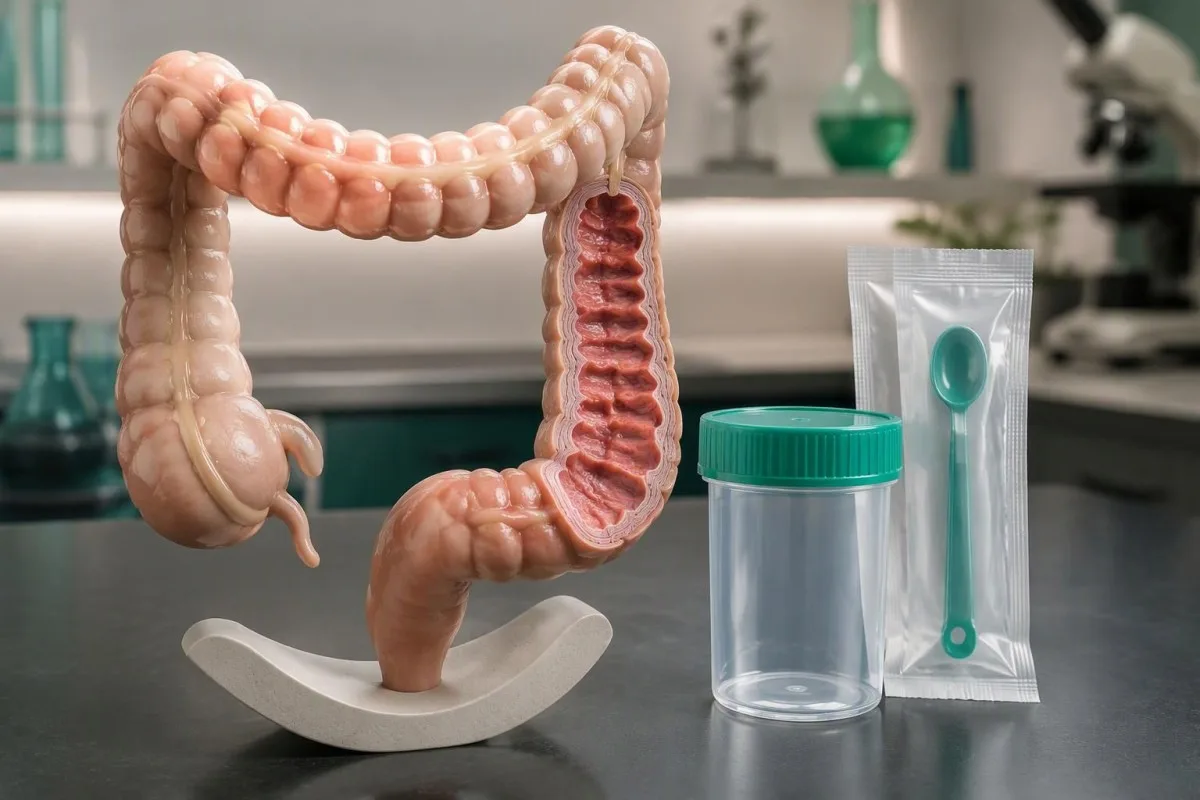
Për shumicën e njerëzve, një test i mikrobiomës së zorrëve nuk ia vlen të blihet për të diagnostikuar IBS-in ose për të zgjedhur suplemente. Ai përshkruan ADN-në mikrobiale në një mostër fekale, por nuk mund të krijojë një rezultatin universal të shëndetit të zorrëve ose të parashikojë me besueshmëri se cilat trajtime do të ndihmojnë.


- Vlera klinike varet nga nëse një rezultat ndryshon kujdesin; profilizimi mikrobial te konsumatorët nuk ka një prag diagnostikues të pranuar universalisht për IBS.
- Shumëllojshmëri relative mat një pjesë të sekuencave të klasifikuara: 10% nuk do të thotë 10% të të gjitha baktereve të gjalla në të gjithë traktin tuaj tretës.
- Metoda renditëse ndryshojnë: profilizimi 16S synon një gjen shenjues bakterial, ndërsa renditja shotgun kampinjonon ADN-në më gjerësisht.
- Rezultatet e shumëllojshmërisë varen nga llogaritja dhe procesi laboratorik; një rezultat prej 70/100 nuk është një matje e standardizuar mjekësore.
- Diagnoza IBS përdor zakonisht dhimbje barku e përsëritur mesatarisht të paktën 1 ditë në javë gjatë 3 muajve të fundit, së bashku me kritere të tjera klinike.
- Kalprotektina fekale nën 50 µg/g konsiderohet zakonisht i ulët te të rriturit, por vargjet laboratorike dhe simptomat paralajmëruese ende kanë rëndësi.
- Elastaza fekale nën 100 µg/g mbështet pamjaftueshmërinë e pankreasit ekzokrin kur matet në një mostër të përshtatshme; mostrat ujore mund të japin rezultate falsisht të ulëta.
- Përzgjedhja e shtojcave nuk mund të ndjekë me besueshmëri vetëm një renditje bakteriale; simptomat, diagnozat e vërtetuara, efektet e medikamenteve dhe mungesat e treguara janë pika më të mira për t'u nisur.
Kur ia vlen të paguash për një test të mikrobiomës së zorrëve?
A test i mikrobiomës së zorrëve mund të ia vlejë të paguhet si kuriozitet ose ushtrim kërkimor, por zakonisht jo si mjet diagnostikues ose për përzgjedhjen e trajtimit. Që nga 5 tetori 2026, dallimi i mbrojtshëm është midis përshkrimit të 1 mostrës së jashtëqitjes dhe demonstrojnë se veprimi mbi raportin e saj përmirëson shëndetin.
Raportet e sekuencimit të konsumatorëve nuk diagnostikojnë me besueshmëri IBS, nuk identifikojnë shkakun e fryrjes, ose nuk zgjedhin një probiotik të personalizuar. Deklarata e konsensusit ndërkombëtar mbi testin e mikrobiomës përshkruan pengesa të konsiderueshme për aplikimin rutinë klinik, duke përfshirë standardizimin dhe dobishmërinë klinike të demonstruar (Porcari et al., 2025); zbulimi i dallimeve midis grupeve nuk është e njëjta gjë me diagnostikimin e 1 individi.
Kantesti është një analizues i testit të gjakut AI, jo një shërbim sekuencimi i jashtëqitjes. Unë jam Thomas Klein, Drejtor Mjekësor Kryesor, dhe rekomandimi im është të ndajmë 3 pyetje: çfarë u mat, sa i riprodhueshëm është, dhe a do të ndryshonte përgjigjja kujdesin? Tonë sfondin e kompanisë shpjegon fokusin tonë në testin e gjakut.
Një kit hipotetik prej 180 £ mund të bëhet një blerje shumë më e madhe nëse raporti rekomandon shtojca mujore prej 60 £ dhe testime të përsëritura çdo 3 muaj. Këto shifra ilustrojnë një problem buxhetimi, jo një vlerësim të çmimit të tregut: kostoja kuptimplote përfshin gjithçka që raporti fillestar ju bind të blini.
Një i rritur asimptomatik që pëlqen biologjinë mund të pranojë me arsye këtë pasiguri. Dikush me 6 javë diarre të vazhdueshme ka nevojë për një bisedë tjetër: vlerësim mjekësor, teste të synuara dhe një plan që nuk varet nga përmirësimi i një rezultati të pronësuar të mirëqenies.
Çfarë mat në fakt një test mikrobial fekal?
A test i mikrobiomës së jashtëqitjes zakonisht mat ADN-në mikrobiale të rikuperuar nga një mostër e vogël jashtëqitjeje. Dy qasjet kryesore—sekuencimi i gjeneve të ARN-së ribosomale 16S dhe sekuencimi metagenomik me goditje—ndryshojnë në atë që ato mund të identifikojnë, por asnjëra nuk mat drejtpërdrejt çdo organizëm të gjallë ose aktivitetin e tij në të gjithë zorrën.
Sekuencimi 16S synon një gjene markues të përdorur për të klasifikuar bakteret dhe, me metoda të përshtatshme, arkeologjitë. Rajone të ndryshme të ndryshueshme dhe primere rikuperojnë organizma të ndryshëm; një identifikim në nivel gjini nuk vërteton se cila specie ose shtam është e pranishme, dhe pretendimet për trajtim specifik për shtamin nuk mund të vijojnë automatikisht nga 1 emër gjini.
Sekuencimi me goditje kampëzon ADN-në më gjerësisht dhe mund të identifikojë gjene mikrobiale, ndonjëherë me rezolucion më të mirë të specieve. Megjithatë, gjetja e 1 gjeneve të lidhur me një shteg metabolik nuk tregon se shtegu është aktiv, se produkti i tij arrin indet tuaja, ose se ndryshimi i tij do të përmirësojë simptomat.
Jashtëqitja përfaqëson materialin që del nga koloni, jo një inventar të plotë të zorrës së hollë ose organizmave të ngjitur në mukozën intestinale. Prandaj, një mostër e mbledhur në 1 mëngjes mund të jetë teknikisht informative duke humbur vendndodhjen anatomike relevante për pyetjen klinike—veçanërisht kur dikush po pyet për simptoma të zorrës së hollë.
Një raport mund të kombinojë organizma të zbuluar, proporcione të vlerësuara dhe funksione të parashikuara siç do të ishin matje ekuivalente. Ato nuk janë. Udhëzuesi ynë për rezultatet kualitative dhe kuantitative shpjegon pse identifikimi i diçkaje dhe matja e sasisë së saj, përgjigjen 2 pyetjeve të ndryshme.
Çfarë kuptojnë në të vërtetë përqindjet e shumëllojshmërisë bakteriale?
Shumëllojshmëri relative është proporcioni i një organizmi në sekuencat e përfshira në llogaritjen e një laboratori, jo një numër absolut i baktereve të gjalla. Nëse 20 nga 100 lexime të klasifikuara i përkasin një grupi, sasia e tij e raportuar është 20%; emëruesi përcakton se çfarë do të thotë ajo përqindje.
Një përqindje mund të bjerë pa u ulur vetë organizmi. Në një shembull të thjeshtëzuar, 20 lexime të caktuara nga 100 lexime totale japin 20%, ndërsa 20 nga 200 japin 10%; rezultati i dytë mund të pasqyrojë zgjerimin e grupeve të tjera në vend të varfërimit të së parës.
Absolute microbial load requires additional measurement, such as calibrated quantitative PCR, flow cytometry or a validated spike-in approach. Even then, stool water content and the reporting denominator matter: copies per gram of wet stool and copies per gram of dry stool are 2 different quantities.
A report stating that an organism is absent usually means it was not detected above that workflow’s threshold. If an organism has a true read fraction of 0.01% and only 1,000 relevant reads are sampled, missing it is unsurprising; non-detection should not trigger a diagnosis of bacterial deficiency.
The same reasoning applies when percentages distract from absolute blood-cell counts, as explained in our count versus percentage guide. For microbiome reports, ask 2 practical questions: what entered the denominator, and were unclassified reads excluded?
A do të thotë një rezultat më i lartë i shumëllojshmërisë së mikrobiomës shëndet më të mirë?
A higher microbiome diversity score does not automatically mean better digestive health. Diversity summarizes features such as richness and evenness; it does not identify whether organisms are helpful, harmful or clinically relevant, and a proprietary 0–100 score has no universal medical interpretation.
Richness counts detected categories, while evenness describes how balanced their proportions are. A sample with 100 detected species dominated by 1 species may have high richness but low evenness; sequencing depth and the taxonomic level chosen can change both calculations.
The Shannon index combines richness and evenness. Using natural logarithms, 2 equally abundant categories produce approximately 0.69 and 4 produce approximately 1.39; these are mathematical examples, not healthy-gut thresholds, and values calculated at genus level should not be compared directly with species-level values.
Bowel transit complicates the interpretation because stool consistency is associated with microbiome composition. Recording stool form for 7 days can reveal whether a score is being compared across very different bowel states; the Tabela e feçeve Bristol provides a practical vocabulary.
A reference cohort also shapes the result: a percentile against 500 self-selected customers is not equivalent to a percentile against a carefully characterized population. Ask whether the comparator matches your age, geography, medications and bowel habits before treating an 18th-percentile result as a problem.
Pse dy ofrues të mikrobiomës mund të japin rezultate të ndryshme?
Two providers can give different results from the same stool because their collection, DNA extraction, sequencing and computational workflows differ. At least 4 layers can change a report before clinical interpretation begins; disagreement does not necessarily mean that either laboratory mixed up the specimen.
DNA extraction is a major source of variation because bacterial cell walls differ in how easily they break open. Costea and colleagues demonstrated why fecal sample processing needs standardization (Costea et al., 2017); insufficient mechanical disruption can under-represent some organisms even when 2 laboratories sequence equal amounts of extracted DNA.
Transport introduces another variable: an unstabilized sample spending 48 hours at room temperature is not equivalent to a sample immediately placed in a validated preservative. The correct handling conditions are kit-specific; refrigeration is not automatically appropriate when a collection system was designed and validated for ambient shipping.
Reference databases and software versions can reassign the same sequence. One provider may report a species while another reports only its genus, and 2 health scores may use different proprietary weighting systems; apparently conflicting recommendations can arise from the scoring rules rather than the underlying biology.
A specimen problem can undermine interpretation even when the instrument works correctly, a principle illustrated by our për ndërhyrjet në mostra. If comparing results, document collection time, preservative, recent medicines and the pipeline version—not just the final percentage.
Si duhet ta gjykoni saktësinë e testit të mikrobiomës së zorrëve?
Gut microbiome test accuracy has 3 separate meanings: analytical validity, clinical validity and clinical utility. A laboratory may accurately detect microbial DNA without accurately diagnosing a condition or proving that its recommended treatment improves outcomes; a single percentage labelled accuracy cannot resolve those distinctions.
Analytical validity asks whether the workflow measures what it claims to measure. Useful evidence includes known-composition microbial controls, extraction blanks, contamination controls, detection limits and duplicate precision; processing 1 sample twice is helpful, but it does not test every source of variation from home collection onward.
Clinical validity asks whether a result distinguishes people with and without a defined condition in relevant populations. An algorithm evaluated in 200 people already known to have severe disease may perform differently in 200 primary-care patients with overlapping symptoms; spectrum and selection bias matter.
Clinical utility asks whether using the report improves a patient outcome compared with appropriate usual care. Porcari et al. (2025) distinguish research promise from readiness for routine application; a prettier report or a change in 1 bacterial percentage is not itself evidence of less pain or better nutrition.
Tonë të standardeve klinike concerns blood-result interpretation and should not be read as validation of consumer stool sequencing. For any health report, the accuracy assessment checklist helps separate technical performance from claims that require patient-outcome studies.
A mundet një raport i mikrobiomës të diagnostikojë IBS ose të shpjegojë fryrjen?
A consumer microbiome report cannot diagnose irritable bowel syndrome, and no bacterial abundance cutoff reliably establishes IBS in routine practice. Commonly used Rome IV criteria include abdominal pain averaging at least 1 day weekly in the previous 3 months, with symptom onset at least 6 months earlier.
Rome IV also requires pain associated with at least 2 of 3 features: defecation, changed stool frequency, or changed stool form. These criteria support a positive clinical diagnosis, but warning signs and alternative explanations still require assessment; painless bloating alone does not meet the IBS pain criterion.
The ACG guideline supports a positive diagnostic strategy rather than endless exclusion testing, with celiac testing and inflammatory-marker assessment in appropriate patients with diarrhea symptoms (Lacy et al., 2021). A microbiome score is not one of those diagnostic criteria, even if a report associates 1 organism with IBS.
Consider a hypothetical 34-year-old with bloating, loose stools and low iron stores: celiac disease deserves consideration before a recommendation to remove gluten. Testing commonly includes tissue transglutaminase IgA and total IgA, because low IgA can mislead an IgA-based result.
Kantesti AI should not turn an unvalidated stool score into an IBS diagnosis or a claim of small-intestinal bacterial overgrowth. Anyone already avoiding gluten should discuss testing preparation rather than improvise a challenge; our udhëzuesi i përgatitjes për testet celiake explains why duration and intake affect interpretation.
Cilat teste klinike fekale japin përgjigje pyetjeve më të dobishme?
Clinical stool diagnostics investigate defined problems, such as intestinal inflammation, pancreatic enzyme output, pathogens or occult bleeding. They are different from microbiome profiling; fecal calprotectin, for example, is commonly reported in µg/g with assay-specific interpretation, whereas a bacterial diversity score has no comparable universal diagnostic threshold.
Kalprotektina fekale reflects intestinal neutrophil activity, not microbiome diversity. Many adult laboratories use below 50 µg/g as a low result, but infection, NSAID exposure and other conditions can raise it; our calprotectin and lactoferrin comparison explains their overlapping clinical roles.
An intermediate calprotectin result often needs context and sometimes a repeat after about 2–6 weeks, depending on the local pathway. Persistent symptoms or alarm features may justify earlier investigation, so our borderline calprotectin guide should not be used to postpone assessment.
Elastaza në feçe estimates pancreatic exocrine output: above 200 µg/g is generally reassuring, 100–200 µg/g is indeterminate, and below 100 µg/g supports insufficiency in an appropriate specimen. The stool elastase interpretation guide explains why dilution and pretest probability matter.
A provider may bundle 1 clinically established assay with several exploratory scores in the same package. That does not validate the entire package: judge each component separately, and remember that normal calprotectin does not exclude every bowel disorder or replace colorectal-cancer evaluation when indicated.
A mundet renditja e konsumatorëve të përjashtojë me besueshmëri një infeksion të zorrëve?
Consumer microbiome sequencing cannot reliably rule out a gut infection unless the specific pathogen claim has been clinically validated. Targeted stool PCR, antigen assays, toxin testing and culture answer different questions; 3 or more new unformed stools in 24 hours may prompt assessment for C. difficile in the right clinical setting.
C. difficile testing needs symptoms and risk context because detecting a toxin gene can identify colonization as well as illness. Recent antibiotics, healthcare exposure and laxative use influence the decision; 1 positive molecular result does not automatically establish toxin-mediated disease or justify treatment.
Travel-associated diarrhea may require targeted testing for Giardia or other pathogens based on exposure and symptom duration. A report that simply lists an organism among hundreds lacks the same clinical meaning as a validated diagnostic assay, and 1 negative consumer profile cannot safely exclude it.
H. pylori stool antigen testing is an example of a directed assay with established uses. Proton pump inhibitors generally need to be withheld for 2 weeks and antibiotics or bismuth for 4 weeks before testing when clinically safe; prescribed medicines should not be stopped without advice.
Acid-suppressing medicines can also affect symptoms, microbiome composition and other laboratory results. Our PPI and gastrin guide illustrates why medication history belongs in the interpretation rather than being reduced to 1 report note about an altered bacterial community.
Cilat simptoma duhet të kenë përparësi ndaj testimit të mikrobiomës?
Visible blood, black tarry stool, unexplained weight loss, anemia, persistent nighttime diarrhea or severe abdominal pain should take priority over a consumer microbiome test. A reassuring bacterial score provides no safety clearance; heavy bleeding, fainting, severe dehydration or rapidly worsening pain warrants urgent assessment.
A normal microbiome report cannot exclude colorectal cancer, inflammatory bowel disease or a clinically significant source of bleeding. Even 1 episode of black tarry stool needs assessment when gastrointestinal bleeding is plausible; our stool bleeding urgency guide distinguishes color changes from concerning patterns.
A positive FIT detects human hemoglobin in stool and requires follow-up through the relevant diagnostic pathway; repeating a microbiome kit does not answer why it is positive. The positive FIT next steps explain why a screening or symptomatic result cannot be dismissed by an unrelated score.
Risk depends on age, family history and symptom trajectory, not just a single duration cutoff. A hypothetical 62-year-old with 8 weeks of new bowel-habit change and weight loss needs prompt clinical review even if a consumer report rates diversity as excellent.
Severe diarrhea can cause kidney and electrolyte complications before its cause is known. Fewer trips to urinate, dizziness on standing or inability to keep fluids down for several hours should shift attention toward hydration and medical assessment—not toward whether 1 bacterial genus appears unusually abundant.
A mundin rezultatet e mikrobiomës të zgjedhin probiotikë ose suplemente të personalizuara?
A microbiome report alone cannot reliably select a personalized probiotic, prebiotic or vitamin regimen. A low bacterial percentage is not a diagnosed deficiency, and benefits depend on the indication, exact formulation and sometimes strain; 1 genus name does not establish which supplement will help.
The ACG guideline suggests against probiotics for global IBS symptoms because the evidence is very uncertain, while supporting soluble fiber (Lacy et al., 2021). That recommendation does not prove that every probiotic is ineffective; it means that confidence in routinely recommending 1 product for IBS remains limited.
A cautious soluble-fiber trial may start with about 3–5 g of psyllium daily and increase gradually according to tolerance and product instructions. Take it with adequate fluid—often at least 250 mL per dose—and seek advice for swallowing difficulty or obstruction risk; adding several fermentable products at once makes symptom attribution harder.
Vitamin or mineral needs require dietary and clinical assessment, not a microbial vitamin-production prediction. In the United States, the adult zinc upper intake level is 40 mg/day from all sources; sustained excess can cause copper deficiency, as our high zinc safety guide .
Kantesti is an AI blood test interpretation platform that helps place measured blood results in context; microbial genes cannot establish serum B12, iron stores or magnesium status. Our evidence-based food choices can support dietary variety, but 1 restrictive plan is not appropriate for every digestive condition.
Si ndikojnë mbledhja, testimi i përsëritur dhe privatësia te vlera?
Collection quality, repeat-test consistency and data handling affect whether a microbiome purchase is useful. Follow the specific kit instructions, keep a record of relevant exposures, and avoid treating a change between 2 samples as proof of improvement when collection conditions or analytical methods also changed.
Recent antibiotics, bowel preparation, acute diarrhea and major dietary changes can alter the sample’s context. There is no universal evidence-based waiting interval—such as exactly 4 weeks—that makes every microbiome test representative again; document dates and discuss the question rather than stopping a necessary treatment to improve a score.
Repeated samples are easier to interpret when provider, kit, handling and bowel state remain comparable. Keeping a 7-day record of symptoms, stool form, diet changes and medicines may be more useful than purchasing a repeat immediately; our udhëzuesi ynë për simptomat tretëse explains common contextual clues.
Privacy questions should cover both the physical specimen and the digital data. Ask 4 things before paying: how long each is retained, whether secondary research use is optional, whether third-party sharing occurs, and whether deletion covers raw sequencing files as well as the account.
Shotgun sequencing can capture human DNA alongside microbial DNA, so human-read filtering and retention policies deserve scrutiny. A GDPR-aligned statement alone does not answer every processing question; request the actual consent terms, hosting arrangements and cross-border safeguards before sending 1 specimen that may generate extensive data.
Çfarë duhet të bëni nëse tashmë keni një raport të mikrobiomës?
If you already have a microbiome report, separate established clinical assays from exploratory scores and prioritize symptoms over bacterial rankings. Write down 3 items before making changes: the problem you want to improve, the evidence for the proposed intervention, and the outcome that would justify continuing it.
The first step is to inventory the report rather than accept its overall traffic-light rating. A package containing calprotectin in µg/g, bacterial relative abundance in percent and a wellness score out of 100 contains 3 different types of information; each needs its own interpretation and evidence.
Choose 1 measurable outcome for a reasonable trial: weekly pain days, stool frequency, urgency episodes or the ability to tolerate a food. A hypothetical 4-week intervention that improves symptoms without changing a diversity score may still be useful; the reverse pattern does not establish patient benefit.
Kantesti is an AI-powered blood test analysis tool, not a substitute for a digestive diagnosis. Our shpjegim i teknologjisë AI describes how blood-result interpretation works; ferritin, a CBC or electrolytes may answer specific clinical questions, but there is no validated blood panel that reveals your ideal bacterial balance.
My practical recommendation, as Thomas Klein, is to bring the original report and a 7-day symptom record to the clinician rather than a shopping list of recommended supplements. Do not add antibiotics, antifungals or restrictive diets solely because 1 organism was flagged; agree on what would trigger reassessment or specialist referral.
Publikime kërkimore dhe kufijtë e interpretimit të AI
Research on AI blood-result interpretation does not validate consumer microbiome diagnosis or personalized supplement selection. The 2 company-supplied Figshare records below concern blood-test workflows; neither title establishes that stool-sequencing recommendations improve digestive symptoms, detect IBS or identify an individual’s optimal probiotic.
Kantesti’s supplied technical benchmark is described as evaluating 100,000 synthetic test cases. Synthetic-case performance can examine defined technical behavior, but it is not equivalent to diagnostic accuracy in consecutive real patients; independent reproduction, representative clinical data and patient outcomes require separate evaluation.
The supplied hantavirus report describes engineering validation and deployment across 50,000 interpreted blood-test reports. Deployment volume does not by itself establish sensitivity, specificity or outcome benefit, and a triage workflow for 1 infectious condition cannot be generalized to microbiome profiling without new evidence.
The formal citations below use n.d. because publication dates were not supplied; their linked records should be checked for authorship, version and review status. ResearchGate and Academia.edu links are DOI search routes, not claims that 2 verified copies exist there, and repository availability should not be mistaken for journal peer review.
Clinical accountability remains separate from publication count or sample volume. Our bordi këshillimor mjekësor page describes medical governance; the decision standard remains whether a particular test answers the patient’s question, with limitations explained before purchase rather than after 1 unexpected result.
Pyetje të Shpeshta
A ia vlejnë testet e mikrobiomës së zorrëve?
Testet e mikrobiomës së zorrëve zakonisht nuk ia vlejnë për t’u blerë për diagnostikimin e sindromës së zorrës së irrituar (IBS) ose për të zgjedhur suplemente të personalizuara. Ato mund të përshkruajnë ADN-në mikrobike në 1 mostër feçesh, por rezultatet e testeve për konsumatorë përgjithësisht nuk kanë pragje diagnostikuese të përcaktuara dhe nuk është provuar se ndihmojnë në përzgjedhjen e trajtimit. Para se të blini, merrni parasysh koston e plotë të kompletit, testeve të përsëritura dhe produkteve të rekomanduara. Simptomat e vazhdueshme trajtohen më mirë përmes vlerësimit klinik dhe testeve të synuara që i përgjigjen një pyetjeje të përcaktuar.
Sa i saktë është një test i mikrobiomës së zorrëve?
Saktësia e testit të mikrobiomës së zorrëve varet nga 3 pyetje të veçanta: nëse laboratori mat saktë DNA-në mikrobike, nëse rezultati parashikon një gjendje klinike dhe nëse veprimi mbi të përmirëson rezultatet. Mbledhja, nxjerrja e ADN-së, thellësia e sekuencimit dhe bazat e të dhënave referuese mund të ndryshojnë bollëkun e raportuar. Një rezultat teknikisht i riprodhueshëm nuk ofron automatikisht një diagnozë të besueshme. Kërkoni vërtetimin e pretendimit specifik në vend që të pranoni një përqindje të vetme të përgjithshme të saktësisë.
A mundet një test i mikrobiomës së jashtëqitjes të diagnostikojë IBS?
Një test i mikrobiomës së zorrëve nga konsumatori nuk mund të diagnostikojë IBS duke përdorur një kufi të caktuar bakterial. Kriteret e zakonshme Rome IV përfshijnë dhimbje abdominale e përsëritur mesatarisht të paktën 1 ditë në javë në 3 muajt e mëparshëm, fillimin e simptomave të paktën 6 muaj më parë, dhe ndryshime të lidhura të zorrëve. Mjekët gjithashtu vlerësojnë shenjat paralajmëruese dhe konsiderojnë teste të synuara, duke përfshirë testin për celiaki tek pacientët e përshtatshëm me diarre. Profilimi i mikrobiomës nuk e zëvendëson atë vlerësim.
Çfarë është një rezultat normal i diversitetit të mikrobiomës?
Nuk ka një rezultat universal të zakonshëm të diversitetit mikrobik për një pacient individual. Një rezultat pronësor 70/100 është kuptimplotë vetëm brenda llogaritjes së ofruesit dhe popullatës së referencës, jo si një diagnozë e standardizuar. Pasuria, barazia, thellësia e sekuencimit dhe niveli taksonomik ndikojnë në matjet e diversitetit. Diversiteti më i lartë nuk është automatikisht më i mirë, dhe një rezultat i ulët vetëm nuk justifikon suplementet ose medikamentet.
A është një test mikrobik i njëjtë me testin e jashtëqitjes nga mjeku im?
Profilimi i mikrobiomës është i ndryshëm nga testimi klinik i jashtëqitjes për një gjendje të përcaktuar. Kalprotektina fekale zakonisht përdor nën 50 µg/g si rezultat i ulët te të rriturit, ndërsa elastaza fekale nën 100 µg/g mbështet pamjaftueshmërinë e pankreasit ekzokrin në një mostër të përshtatshme. Analizat e patogjenëve të synuar dhe FIT hetojnë pyetje të tjera specifike. Një paketë komerciale mund të përfshijë si analiza të etabluara ashtu edhe rezultate eksploruese, kështu që çdo komponent duhet të vlerësohet veçmas.
A mund të më tregojnë rezultatet e mikrobiomës sime se cilin probiotik duhet të marr?
Rezultatet e mikrobiomës nuk mund të identifikojnë në mënyrë të besueshme probiotikun më të mundshëm për të ndihmuar një individ. Zbulimi i një proporcion të ulët të një gjinie bakteriale nuk përcakton mungesë ose tregon se gëlltitja e një organizmi të lidhur do të përmirësojë simptomat. Dëshmitë për probiotikët varen nga indikacioni, formulimi dhe ndonjëherë nga saktësisht shtami. Për IBS, udhëzimi i ACG të vitit 2021 sugjeron kundër probiotikëve për simptoma globale, sepse provat mbështetëse janë shumë të pasigurta.
Merrni sot analizë të analizave të gjakut me AI
Bashkohuni me mbi 2 milionë përdorues në mbarë botën që i besojnë Kantesti për analizë të menjëhershme dhe të saktë të analizave laboratorike. Ngarkoni rezultatet e analizave të gjakut dhe merrni interpretim gjithëpërfshirës të biomarkerëve të 15,000+ brenda sekondash.
📚 Publikime kërkimore të cituara
Klein, T., Mitchell, S., & Weber, H. (2026). Mbështetje vendimmarrëse klinike e asistuar nga AI multilinguale për tregimin e hershëm të Hantavirusit: Dizajn, Validim Inxhinierik dhe Vendosje Reale në më shumë se 50,000 Raporte të Analizave të Gjakut të Interpretuara. Kantesti Kërkim Mjekësor me AI.
Klein, T., Mitchell, S., & Weber, H. (2026). Një Benchmark Teknik i Parregjistruar, i Bazuar në Rubrika, i Motorit të Interpretimit të Analizës së Gjakut Kantesti mbi 100,000 Raste Testi Sintetike. Kantesti Kërkim Mjekësor me AI.
📖 Referenca të jashtme mjekësore
Porcari S et al. (2025). International consensus statement on microbiome testing in clinical practice. The Lancet Gastroenterology & Hepatology.
Costea PI et al. (2017). Towards standards in human fecal sample processing. Nature Biotechnology.
⚕️ Mohim përgjegjësie mjekësore
Ky artikull është vetëm për qëllime edukative dhe nuk përbën këshilla mjekësore. Gjithmonë konsultohuni me një ofrues të kualifikuar të kujdesit shëndetësor për vendimet e diagnozës dhe trajtimit.
Sinjalet e Besimit E-E-A-T
Përvoja
Rishikim klinik i udhëhequr nga mjeku i flukseve të punës për interpretimin e analizave.
Ekspertizë
Fokus i mjekësisë laboratorike mbi mënyrën se si sillen biomarkerët në kontekstin klinik.
Autoritariteti
Shkruar nga Dr. Thomas Klein me rishikim nga Dr. Sarah Mitchell dhe Prof. Dr. Hans Weber.
Besueshmëria
Interpretim i bazuar në prova, me rrugë të qarta për ndjekje për të reduktuar alarmin.