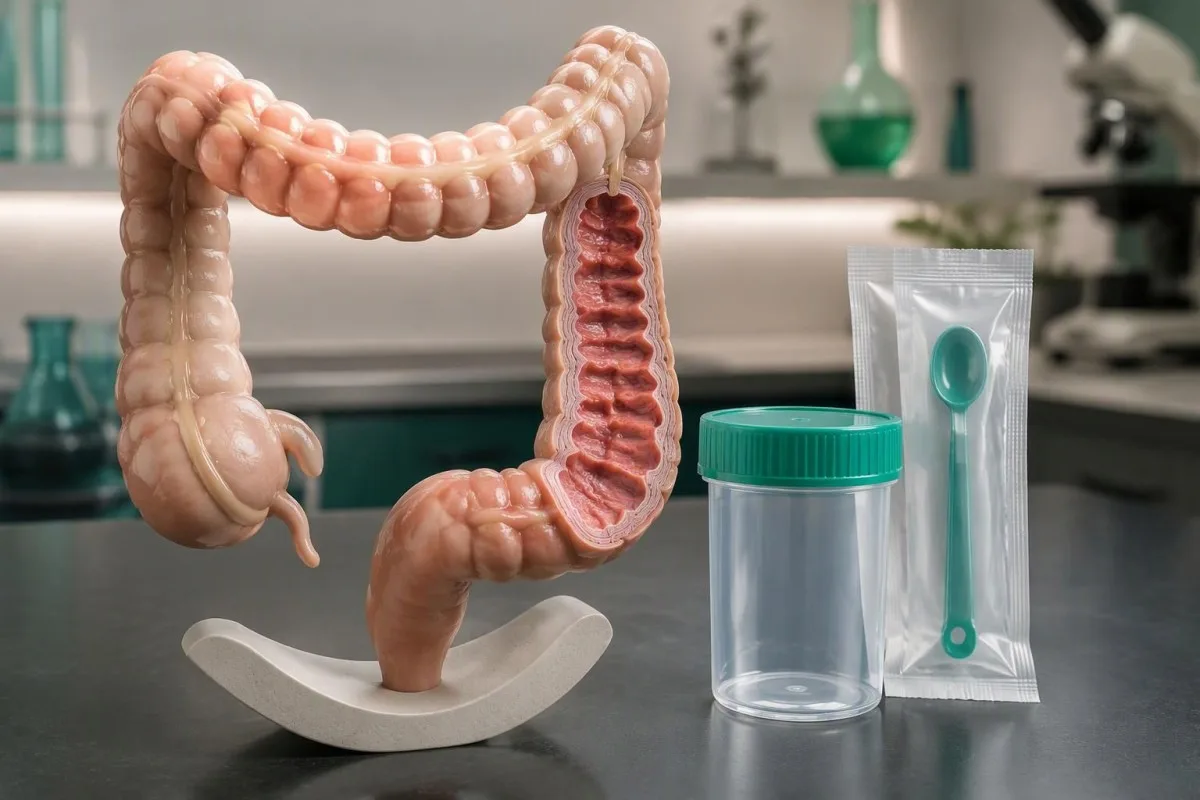
Kanggo wong akeh, tes mikrobioma usus ora pantes dituku kanggo diagnosa IBS utawa milih suplemen. Iki nggambarake DNA mikroba ing siji sampel tinja, nanging ora bisa nggawe skor usus sehat universal utawa kanthi andal prédhiksi perawatan endi sing bakal mbantu.


- Nilai klinis gumantung apa asil ngganti perawatan; profil mikrobioma konsumen ora duwe ambang diagnostik sing ditampa sacara universal kanggo IBS.
- Kelimpahan relatif ngukur bagéan saka urutan sing diklasifikasikake: 10% ora ateges 10% saka kabeh bakteri urip ing saluran pencernaan.
- Metode sekuensing beda: profil 16S nargetake gen penanda bakteri, nalika sekuensing shotgun njupuk DNA kanthi luwih akeh.
- Skor keragaman gumantung saka perhitungan lan alur kerja laboratorium; skor 70/100 dudu pangukuran medis standar.
- Diagnosis IBS biasane nggunakake rasa nyeri weteng rekuren rata-rata paling ora 1 dina saben minggu sajrone 3 wulan kepungkur, bebarengan karo kriteria klinis liyane.
- Fecal calprotectin ingisor saka 50 µg/g umume dianggep kurang ing wong diwasa, nanging kisaran laboratorium lan gejala peringatan isih penting.
- Elastase bangku ingisor saka 100 µg/g ndhukung insuffisiensi eksokrin pankreas nalika diukur ing spesimen sing cocog; sampel banyu bisa ngasilake asil sing salah kurang.
- Pilihan suplemen ora bisa dipercaya ngandelake peringkat bakteri mung; gejala, diagnosis sing wis mapan, efek obat lan kekurangan sing ditampilake minangka titik wiwitan sing luwih apik.
Kapan tes mikrobioma usus pantes dibayar?
A tes mikrobioma usus bisa uga migunani kanggo rasa penasaran utawa latihan riset, nanging biasane ora minangka alat diagnostik utawa alat pemilihan perawatan. Wiwit tanggal 5 Oktober 2026, bedane sing bisa dibenerake yaiku antarane njlèntrèhaké 1 sampel tin lan nuduhake yen tumindak marang laporane nambah kesehatan.
Laporan urutan konsumen ora bisa dipercaya diagnostik IBS, nemtokake sababe kembung, utawa milih probiotik sing dipersonalisasi. Pernyataan konsensus internasional babagan pengujian mikrobioma nggambarake alangan sing akeh kanggo aplikasi klinis rutin, kalebu standardisasi lan bukti kegunaan klinis (Porcari et al., 2025); ndeteksi beda antarane klompok ora padha karo diagnostik individu 1.
Kantesti minangka penganalisis tes getih AI, dudu layanan urutan tin. Aku Thomas Klein, Chief Medical Officer, lan rekomendasi yaiku misahake 3 pitakonan: apa sing diukur, sepira bisa dibaleni, lan apa jawaban bakal ngganti perawatan? Kita latar mburi perusahaan nerangake fokus tes getih kita.
Kit hipotetis £180 bisa dadi tuku sing luwih gedhe yen laporan kasebut nyaranake suplemen £60 saben wulan lan tes ulang saben 3 wulan. Tokoh-tokoh kasebut nggambarake masalah anggaran, dudu perkiraan rega pasar: biaya sing bermakna kalebu kabeh sing diyakini dening laporan awal kanggo dituku.
Wong diwasa tanpa gejala sing seneng biologi bisa uga nampa yen ora pasti. Wong sing ngalami diare terus-terusan 6 minggu mbutuhake obrolan sing beda: penilaian medis, tes target, lan rencana sing ora gumantung saka perbaikan skor kesehatan proprietary.
Apa sing diukur dening tes mikrobioma tinja?
A tes mikrobioma tin biasane ngukur DNA mikroba sing dijupuk saka sampel tin cilik. 2 pendekatan utama—urutan gen RNA ribosomal 16S lan urutan metagenomik shotgun—bedane ing apa sing bisa diidentifikasi, nanging ora ana sing langsung ngukur saben organisme urip utawa aktivitasé ing usus.
Urutan 16S nargetake gen penanda sing digunakake kanggo ngelasaké bakteri lan, kanthi metode sing cocog, archaea. Wilayah variabel lan primer sing beda ngasilake organisme sing beda; identifikasi ing tingkat genus ora netepake spesies utawa galur sing ana, lan klaim perawatan khusus galur ora bisa ditindakake kanthi otomatis saka jeneng genus 1.
Urutan shotgun sampel DNA luwih akeh lan bisa ngidentifikasi gen mikroba, kadhangkala kanthi resolusi spesies sing luwih apik. Nanging, nemokake 1 gen sing ana hubungane karo jalur metabolisme ora nuduhake yen jalur kasebut aktif, yen produké tekan jaringan sampeyan, utawa yen ngowahi iku bakal nambah gejala.
Tin minangka materi sing metu saka usus gedhe, dudu inventaris lengkap usus cilik utawa organisme sing nempel ing lendir usus. Mulane, sampel sing diklumpukake ing siji esuk bisa uga informatif sacara teknis nalika ora ana lokasi anatomi sing relevan karo pitakonan klinis—terutama nalika ana sing takon babagan gejala usus cilik.
Laporan kasebut bisa nggabungake organisme sing dideteksi, perkiraan proporsi, lan fungsi sing diprediksi kaya-kaya padha ukurane. Dheweke ora. Pandhuan kita kanggo asil kualitatif lan kuantitatif nerangake kenapa ngidentifikasi sesuatu lan ngukur jumlahé mangsuli 2 pitakonan sing beda.
Apa persentase kelimpahan bakteri pancen tegese?
Kelimpahan relatif minangka proporsi organisme saka urutan sing kalebu ing perhitungan laboratorium, dudu jumlah total bakteri urip. Yen 20 saka 100 maca sing diklasifikasikake kalebu ing siji klompok, kelimpahan sing dilapurake yaiku 20%; penyebut nemtokake apa tegese persentase kasebut.
Persentase bisa mudhun tanpa organisme kasebut dhewe mudhun. Ing conto sing disederhanakake, 20 maca sing ditetepake ing antarane 100 total maca menehi 20%, dene 20 ing antarane 200 menehi 10%; asil kapindho bisa nggambarake ekspansi klompok liyane tinimbang penurunan klompok pisanan.
Absolute microbial load requires additional measurement, such as calibrated quantitative PCR, flow cytometry or a validated spike-in approach. Even then, stool water content and the reporting denominator matter: copies per gram of wet stool and copies per gram of dry stool are 2 different quantities.
A report stating that an organism is absent usually means it was not detected above that workflow’s threshold. If an organism has a true read fraction of 0.01% and only 1,000 relevant reads are sampled, missing it is unsurprising; non-detection should not trigger a diagnosis of bacterial deficiency.
The same reasoning applies when percentages distract from absolute blood-cell counts, as explained in our count versus percentage guide. For microbiome reports, ask 2 practical questions: what entered the denominator, and were unclassified reads excluded?
Apa skor keragaman mikrobioma sing luwih dhuwur tegese kesehatan sing luwih apik?
A higher microbiome diversity score does not automatically mean better digestive health. Diversity summarizes features such as richness and evenness; it does not identify whether organisms are helpful, harmful or clinically relevant, and a proprietary 0–100 score has no universal medical interpretation.
Richness counts detected categories, while evenness describes how balanced their proportions are. A sample with 100 detected species dominated by 1 species may have high richness but low evenness; sequencing depth and the taxonomic level chosen can change both calculations.
The Shannon index combines richness and evenness. Using natural logarithms, 2 equally abundant categories produce approximately 0.69 and 4 produce approximately 1.39; these are mathematical examples, not healthy-gut thresholds, and values calculated at genus level should not be compared directly with species-level values.
Bowel transit complicates the interpretation because stool consistency is associated with microbiome composition. Recording stool form for 7 days can reveal whether a score is being compared across very different bowel states; the Bagan feses Bristol provides a practical vocabulary.
A reference cohort also shapes the result: a percentile against 500 self-selected customers is not equivalent to a percentile against a carefully characterized population. Ask whether the comparator matches your age, geography, medications and bowel habits before treating an 18th-percentile result as a problem.
Kenapa rong panyedhiya mikrobioma bisa menehi asil sing beda?
Two providers can give different results from the same stool because their collection, DNA extraction, sequencing and computational workflows differ. At least 4 layers can change a report before clinical interpretation begins; disagreement does not necessarily mean that either laboratory mixed up the specimen.
DNA extraction is a major source of variation because bacterial cell walls differ in how easily they break open. Costea and colleagues demonstrated why fecal sample processing needs standardization (Costea et al., 2017); insufficient mechanical disruption can under-represent some organisms even when 2 laboratories sequence equal amounts of extracted DNA.
Transport introduces another variable: an unstabilized sample spending 48 hours at room temperature is not equivalent to a sample immediately placed in a validated preservative. The correct handling conditions are kit-specific; refrigeration is not automatically appropriate when a collection system was designed and validated for ambient shipping.
Reference databases and software versions can reassign the same sequence. One provider may report a species while another reports only its genus, and 2 health scores may use different proprietary weighting systems; apparently conflicting recommendations can arise from the scoring rules rather than the underlying biology.
A specimen problem can undermine interpretation even when the instrument works correctly, a principle illustrated by our pandhuan gangguan sampel. If comparing results, document collection time, preservative, recent medicines and the pipeline version—not just the final percentage.
Carane ngadili akurasi tes mikrobioma usus?
Gut microbiome test accuracy has 3 separate meanings: analytical validity, clinical validity and clinical utility. A laboratory may accurately detect microbial DNA without accurately diagnosing a condition or proving that its recommended treatment improves outcomes; a single percentage labelled accuracy cannot resolve those distinctions.
Analytical validity asks whether the workflow measures what it claims to measure. Useful evidence includes known-composition microbial controls, extraction blanks, contamination controls, detection limits and duplicate precision; processing 1 sample twice is helpful, but it does not test every source of variation from home collection onward.
Clinical validity asks whether a result distinguishes people with and without a defined condition in relevant populations. An algorithm evaluated in 200 people already known to have severe disease may perform differently in 200 primary-care patients with overlapping symptoms; spectrum and selection bias matter.
Clinical utility asks whether using the report improves a patient outcome compared with appropriate usual care. Porcari et al. (2025) distinguish research promise from readiness for routine application; a prettier report or a change in 1 bacterial percentage is not itself evidence of less pain or better nutrition.
kita kaca standar klinis concerns blood-result interpretation and should not be read as validation of consumer stool sequencing. For any health report, the accuracy assessment checklist helps separate technical performance from claims that require patient-outcome studies.
Apa laporan mikrobioma bisa diagnosa IBS utawa nerangake kembung?
A consumer microbiome report cannot diagnose irritable bowel syndrome, and no bacterial abundance cutoff reliably establishes IBS in routine practice. Commonly used Rome IV criteria include abdominal pain averaging at least 1 day weekly in the previous 3 months, with symptom onset at least 6 months earlier.
Rome IV also requires pain associated with at least 2 of 3 features: defecation, changed stool frequency, or changed stool form. These criteria support a positive clinical diagnosis, but warning signs and alternative explanations still require assessment; painless bloating alone does not meet the IBS pain criterion.
The ACG guideline supports a positive diagnostic strategy rather than endless exclusion testing, with celiac testing and inflammatory-marker assessment in appropriate patients with diarrhea symptoms (Lacy et al., 2021). A microbiome score is not one of those diagnostic criteria, even if a report associates 1 organism with IBS.
Consider a hypothetical 34-year-old with bloating, loose stools and low iron stores: celiac disease deserves consideration before a recommendation to remove gluten. Testing commonly includes tissue transglutaminase IgA and total IgA, because low IgA can mislead an IgA-based result.
Kantesti AI should not turn an unvalidated stool score into an IBS diagnosis or a claim of small-intestinal bacterial overgrowth. Anyone already avoiding gluten should discuss testing preparation rather than improvise a challenge; our pandhuan persiapan tes celiac explains why duration and intake affect interpretation.
Tes tinja klinis endi sing mangsuli pitakon sing luwih migunani?
Clinical stool diagnostics investigate defined problems, such as intestinal inflammation, pancreatic enzyme output, pathogens or occult bleeding. They are different from microbiome profiling; fecal calprotectin, for example, is commonly reported in µg/g with assay-specific interpretation, whereas a bacterial diversity score has no comparable universal diagnostic threshold.
Fecal calprotectin reflects intestinal neutrophil activity, not microbiome diversity. Many adult laboratories use below 50 µg/g as a low result, but infection, NSAID exposure and other conditions can raise it; our calprotectin and lactoferrin comparison explains their overlapping clinical roles.
An intermediate calprotectin result often needs context and sometimes a repeat after about 2–6 weeks, depending on the local pathway. Persistent symptoms or alarm features may justify earlier investigation, so our borderline calprotectin guide should not be used to postpone assessment.
Elastase feses estimates pancreatic exocrine output: above 200 µg/g is generally reassuring, 100–200 µg/g is indeterminate, and below 100 µg/g supports insufficiency in an appropriate specimen. The stool elastase interpretation guide explains why dilution and pretest probability matter.
A provider may bundle 1 clinically established assay with several exploratory scores in the same package. That does not validate the entire package: judge each component separately, and remember that normal calprotectin does not exclude every bowel disorder or replace colorectal-cancer evaluation when indicated.
Apa sekuensing konsumen bisa kanthi andal ngilangi infeksi usus?
Consumer microbiome sequencing cannot reliably rule out a gut infection unless the specific pathogen claim has been clinically validated. Targeted stool PCR, antigen assays, toxin testing and culture answer different questions; 3 or more new unformed stools in 24 hours may prompt assessment for C. difficile in the right clinical setting.
C. difficile testing needs symptoms and risk context because detecting a toxin gene can identify colonization as well as illness. Recent antibiotics, healthcare exposure and laxative use influence the decision; 1 positive molecular result does not automatically establish toxin-mediated disease or justify treatment.
Travel-associated diarrhea may require targeted testing for Giardia or other pathogens based on exposure and symptom duration. A report that simply lists an organism among hundreds lacks the same clinical meaning as a validated diagnostic assay, and 1 negative consumer profile cannot safely exclude it.
H. pylori stool antigen testing is an example of a directed assay with established uses. Proton pump inhibitors generally need to be withheld for 2 weeks and antibiotics or bismuth for 4 weeks before testing when clinically safe; prescribed medicines should not be stopped without advice.
Acid-suppressing medicines can also affect symptoms, microbiome composition and other laboratory results. Our PPI and gastrin guide illustrates why medication history belongs in the interpretation rather than being reduced to 1 report note about an altered bacterial community.
Gejala apa sing kudu prioritas tinimbang tes mikrobioma?
Visible blood, black tarry stool, unexplained weight loss, anemia, persistent nighttime diarrhea or severe abdominal pain should take priority over a consumer microbiome test. A reassuring bacterial score provides no safety clearance; heavy bleeding, fainting, severe dehydration or rapidly worsening pain warrants urgent assessment.
A normal microbiome report cannot exclude colorectal cancer, inflammatory bowel disease or a clinically significant source of bleeding. Even 1 episode of black tarry stool needs assessment when gastrointestinal bleeding is plausible; our stool bleeding urgency guide distinguishes color changes from concerning patterns.
A positive FIT detects human hemoglobin in stool and requires follow-up through the relevant diagnostic pathway; repeating a microbiome kit does not answer why it is positive. The positive FIT next steps explain why a screening or symptomatic result cannot be dismissed by an unrelated score.
Risk depends on age, family history and symptom trajectory, not just a single duration cutoff. A hypothetical 62-year-old with 8 weeks of new bowel-habit change and weight loss needs prompt clinical review even if a consumer report rates diversity as excellent.
Severe diarrhea can cause kidney and electrolyte complications before its cause is known. Fewer trips to urinate, dizziness on standing or inability to keep fluids down for several hours should shift attention toward hydration and medical assessment—not toward whether 1 bacterial genus appears unusually abundant.
Apa asil mikrobioma bisa milih probiotik utawa suplemen pribadi?
A microbiome report alone cannot reliably select a personalized probiotic, prebiotic or vitamin regimen. A low bacterial percentage is not a diagnosed deficiency, and benefits depend on the indication, exact formulation and sometimes strain; 1 genus name does not establish which supplement will help.
The ACG guideline suggests against probiotics for global IBS symptoms because the evidence is very uncertain, while supporting soluble fiber (Lacy et al., 2021). That recommendation does not prove that every probiotic is ineffective; it means that confidence in routinely recommending 1 product for IBS remains limited.
A cautious soluble-fiber trial may start with about 3–5 g of psyllium daily and increase gradually according to tolerance and product instructions. Take it with adequate fluid—often at least 250 mL per dose—and seek advice for swallowing difficulty or obstruction risk; adding several fermentable products at once makes symptom attribution harder.
Vitamin or mineral needs require dietary and clinical assessment, not a microbial vitamin-production prediction. In the United States, the adult zinc upper intake level is 40 mg/day from all sources; sustained excess can cause copper deficiency, as our high zinc safety guide nerangake.
Kantesti is an AI blood test interpretation platform that helps place measured blood results in context; microbial genes cannot establish serum B12, iron stores or magnesium status. Our evidence-based food choices can support dietary variety, but 1 restrictive plan is not appropriate for every digestive condition.
Carane ngumpulake, tes ulang lan privasi mengaruhi nilai?
Collection quality, repeat-test consistency and data handling affect whether a microbiome purchase is useful. Follow the specific kit instructions, keep a record of relevant exposures, and avoid treating a change between 2 samples as proof of improvement when collection conditions or analytical methods also changed.
Recent antibiotics, bowel preparation, acute diarrhea and major dietary changes can alter the sample’s context. There is no universal evidence-based waiting interval—such as exactly 4 weeks—that makes every microbiome test representative again; document dates and discuss the question rather than stopping a necessary treatment to improve a score.
Repeated samples are easier to interpret when provider, kit, handling and bowel state remain comparable. Keeping a 7-day record of symptoms, stool form, diet changes and medicines may be more useful than purchasing a repeat immediately; our pituduh gejala pencernaan explains common contextual clues.
Privacy questions should cover both the physical specimen and the digital data. Ask 4 things before paying: how long each is retained, whether secondary research use is optional, whether third-party sharing occurs, and whether deletion covers raw sequencing files as well as the account.
Shotgun sequencing can capture human DNA alongside microbial DNA, so human-read filtering and retention policies deserve scrutiny. A GDPR-aligned statement alone does not answer every processing question; request the actual consent terms, hosting arrangements and cross-border safeguards before sending 1 specimen that may generate extensive data.
Apa sing kudu ditindakake yen sampeyan wis duwe laporan mikrobioma?
If you already have a microbiome report, separate established clinical assays from exploratory scores and prioritize symptoms over bacterial rankings. Write down 3 items before making changes: the problem you want to improve, the evidence for the proposed intervention, and the outcome that would justify continuing it.
The first step is to inventory the report rather than accept its overall traffic-light rating. A package containing calprotectin in µg/g, bacterial relative abundance in percent and a wellness score out of 100 contains 3 different types of information; each needs its own interpretation and evidence.
Choose 1 measurable outcome for a reasonable trial: weekly pain days, stool frequency, urgency episodes or the ability to tolerate a food. A hypothetical 4-week intervention that improves symptoms without changing a diversity score may still be useful; the reverse pattern does not establish patient benefit.
Kantesti is an AI-powered blood test analysis tool, not a substitute for a digestive diagnosis. Our katrangan teknologi AI describes how blood-result interpretation works; ferritin, a CBC or electrolytes may answer specific clinical questions, but there is no validated blood panel that reveals your ideal bacterial balance.
My practical recommendation, as Thomas Klein, is to bring the original report and a 7-day symptom record to the clinician rather than a shopping list of recommended supplements. Do not add antibiotics, antifungals or restrictive diets solely because 1 organism was flagged; agree on what would trigger reassessment or specialist referral.
Publikasi riset lan watesan interpretasi AI
Research on AI blood-result interpretation does not validate consumer microbiome diagnosis or personalized supplement selection. The 2 company-supplied Figshare records below concern blood-test workflows; neither title establishes that stool-sequencing recommendations improve digestive symptoms, detect IBS or identify an individual’s optimal probiotic.
Kantesti’s supplied technical benchmark is described as evaluating 100,000 synthetic test cases. Synthetic-case performance can examine defined technical behavior, but it is not equivalent to diagnostic accuracy in consecutive real patients; independent reproduction, representative clinical data and patient outcomes require separate evaluation.
The supplied hantavirus report describes engineering validation and deployment across 50,000 interpreted blood-test reports. Deployment volume does not by itself establish sensitivity, specificity or outcome benefit, and a triage workflow for 1 infectious condition cannot be generalized to microbiome profiling without new evidence.
The formal citations below use n.d. because publication dates were not supplied; their linked records should be checked for authorship, version and review status. ResearchGate and Academia.edu links are DOI search routes, not claims that 2 verified copies exist there, and repository availability should not be mistaken for journal peer review.
Clinical accountability remains separate from publication count or sample volume. Our dewan penasehat medis page describes medical governance; the decision standard remains whether a particular test answers the patient’s question, with limitations explained before purchase rather than after 1 unexpected result.
Pitakonan sing Sering Ditakoni
Apa tes mikrobioma usus kuwi pantes ditindakake?
Tes mikrobioma usus biasane ora patut dituku kanggo diagnosa IBS utawa milih suplemen sing dipersonalisasi. Tes kasebut bisa njlentrehake DNA mikroba ing 1 sampel tinja, nanging skor kanggo konsumen umume ora duwe ambang diagnostik sing wis mapan lan kegunaan sing kabukten kanggo milih perawatan. Sadurunge tuku, pikirna biaya lengkap kit, tes ulang, lan produk sing disaranake. Gejala sing terus-terusan luwih becik ditangani liwat asesmen klinis lan tes sing ditargetake kanggo mangsuli pitakon tartamtu.
Sepira akuratese tes mikrobioma usus?
Akurasi tes mikrobioma usus gumantung saka 3 pitakonan kapisah: apa laboratorium ngukur DNA mikrob kanthi bener, apa asil kasebut prédhiksi kondisi klinis, lan apa tumindak adhedhasar iku nambah asil. Koleksi, ekstraksi DNA, ambane urutan lan database referensi bisa ngowahi kalimpahan sing dilaporake. Asil sing bisa ditindakake kanthi teknis ora kanthi otomatis menehi diagnosis sing bisa dipercaya. Takon validasi klaim tartamtu tinimbang nampa persentase akurasi sakabehe.
Apa tes mikrobioma tinja bisa kanggo ngerteni IBS?
Tes mikrobioma feses konsumen ora bisa ngidini IBS nggunakake watesan bakteri sing wis ditetepake. Kriteria Rome IV sing umum digunakake kalebu nyeri weteng bola-bali rata-rata paling ora 1 dina saben minggu ing 3 wulan sadurunge, wiwitane gejala paling ora 6 wulan sadurunge, lan owah-owahan usus sing ana gandhengane. Dokter uga nyemak tandha-tandha bebaya lan nimbang tes sing dituju, kalebu tes celiac ing pasien sing cocog kanthi diare. Profiling mikrobioma ora ngganti penilaian kasebut.
Skor keragaman mikrobioma sing normal iku pira?
Ora ana skor keragaman mikrobioma normal universal kanggo pasien individu. Skor kepemilikan 70/100 mung migunani ing njero pitungan panyedhiya lan populasi referensi, ora minangka diagnosis standar. Kékaayaan, kasamakan, jerone urutan, lan tingkat taksonomi mengaruhi pangukuran keragaman. Keragaman sing luwih dhuwur ora mesthi luwih apik, lan skor sing sithik dhewe ora mbenerake suplemen utawa obat.
Apa tes mikrobioma padha karo tes feses saka dhokterku?
Profiling mikrobioma beda karo tes tinja klinis kanggo kondisi sing ditemtokake. Kalprotektin feses umumé nggunakake ing ngisor 50 µg/g minangka asil diwasa sing cendhèk, nalika elastase feses ing ngisor 100 µg/g ndhukung insufficiency eksokrin pankreas ing spesimen sing cocog. Uji patogen sing ditargetake lan FIT nyelidiki pitakonan spesifik liyane. Paket komersial bisa kalebu uji sing wis ditetepake lan skor eksplorasi, mula saben komponen kudu dipepiti kanthi kapisah.
Apa asil mikrobioma bisa nuduhake probiotik apa sing kudu dijupuk?
Asil Microbiome ora bisa kanthi dipercaya nemtokake probiotik sing paling mungkin mbantu wong. Ngerteni proporsi genus bakteri sing sithik ora nyatakake kekurangan utawa nuduhake yen ngulu organisme sing ana gandhengane bakal nambah gejala. Bukti probiotik gumantung ing indikasi, formulasi lan kadang-kadang galur tartamtu. Kanggo IBS, pedoman ACG 2021 nyaranake supaya ora nggunakake probiotik kanggo gejala global amarga bukti pendukung banget ora mesthi.
Entuk Analisis Tes Getih Berbasis AI Dina Iki
Gabung karo luwih saka 2 yuta pangguna ing saindenging jagad sing percaya Kantesti kanggo analisis tes lab sing instan lan akurat. Unggah asil tes getihmu lan tampa interpretasi lengkap saka 15,000+ biomarker sajrone sawetara detik.
📚 Publikasi Riset sing Dirujuk
Klein, T., Mitchell, S., & Weber, H. (2026). Dhukungan Keputusan Klinis Berbantuan AI Multibasa Kanggo Triase Hantavirus Dini: Desain, Validasi Rekayasa, lan Penerapan Dunia Nyata Ing 50.000 Laporan Tes Darah sing Ditafsirake. Riset Medis AI Kantesti.
Klein, T., Mitchell, S., & Weber, H. (2026). Mesin Tolok Ukur Téknis Otomatis Adhedhasar Rubrik Pra-Dhaptar saka Mesin Interpretasi Tes Getih Kantesti ing 100.000 Kasus Tes Sintetis. Riset Medis AI Kantesti.
📖 Referensi Medis Eksternal
Porcari S et al. (2025). International consensus statement on microbiome testing in clinical practice. The Lancet Gastroenterology & Hepatology.
Costea PI et al. (2017). Towards standards in human fecal sample processing. Nature Biotechnology.
⚕️ Penafian Medis
Artikel iki mung kanggo tujuan edukasi lan ora dadi saran medis. Tansah konsultasi karo panyedhiya layanan kesehatan sing mumpuni kanggo keputusan diagnosis lan perawatan.
Sinyal Kepercayaan E-E-A-T
Pengalaman
Tinjauan klinis sing dipimpin dokter babagan alur kerja interpretasi lab.
Keahlian
Fokus kedokteran laboratorium babagan carane biomarker tumindak ing konteks klinis.
Kewibawaan
Ditulis dening Dr. Thomas Klein kanthi ditinjau dening Dr. Sarah Mitchell lan Prof. Dr. Hans Weber.
Kapercayan
Interpretasi adhedhasar bukti kanthi tindak lanjut sing cetha kanggo nyuda rasa kaget.