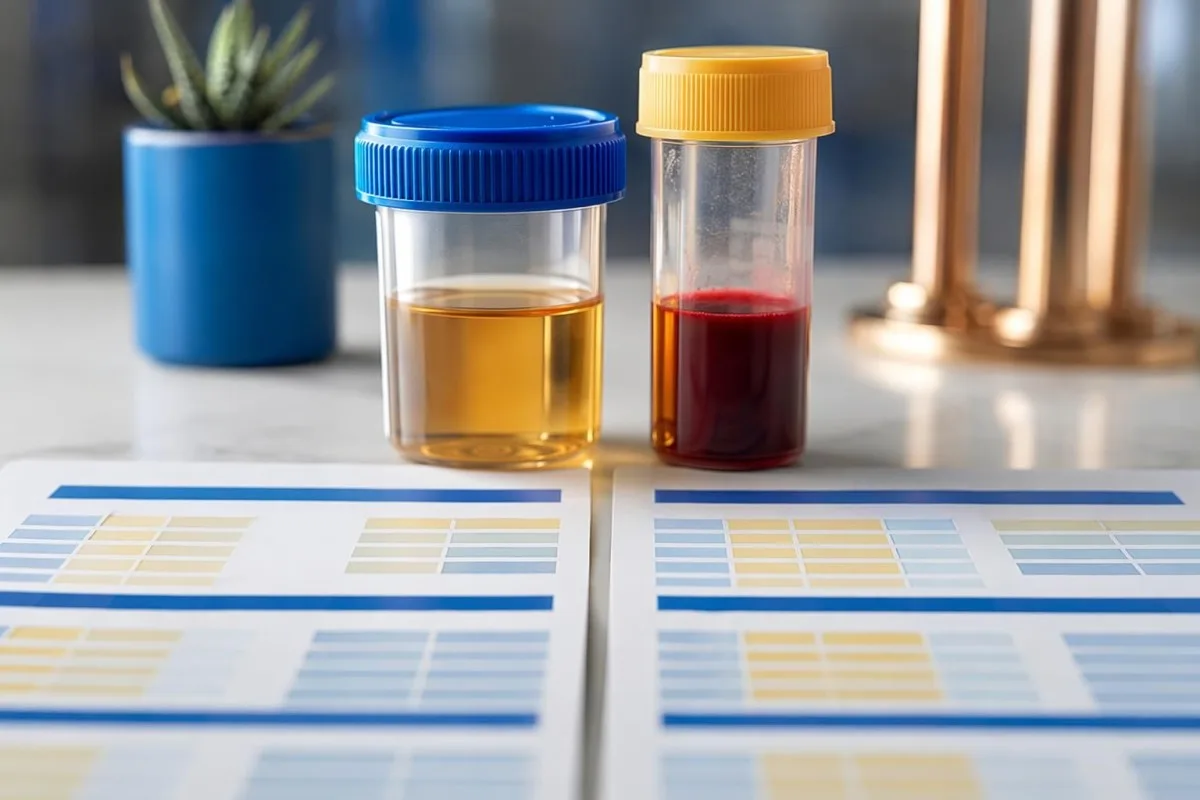
A side by side blood test comparison is safest when you match units, fasting status, lab method, medication timing, and your own baseline before judging a rise or drop. As of June 1, 2026, I still see more harm from overreacting to tiny lab shifts than from calmly repeating the right test.


- Side by side blood test comparison should start with units, date, fasting status, lab name, and medication timing before interpreting any change.
- Normal biological variation means a 5% sodium shift can matter, while a 25% ALT shift may still be temporary after exercise or illness.
- Triglycerides commonly rise about 20-30 mg/dL after ordinary meals, so fasting and non-fasting lipid reports should not be compared as identical conditions.
- Creatinine changes above roughly 15-20% deserve attention, especially when eGFR also falls or urine albumin-creatinine ratio rises.
- HbA1c changes of 0.3 percentage points may be meaningful, but anemia, transfusion, kidney disease, and hemoglobin variants can distort the result.
- TSH can shift 20-50% with time of day, missed levothyroxine doses, biotin, acute illness, and pregnancy trimester.
- Medication timing matters: levothyroxine retesting usually needs 6-8 weeks, statin lipid checks often need 4-12 weeks, and iron labs can be distorted for days after supplements.
- Urgent changes include potassium above 6.0 mmol/L, sodium below 125 mmol/L, hemoglobin near 7 g/dL, or rapidly rising creatinine with symptoms.
- Recurring blood test analysis works best when the next test repeats the same lab, same collection time, and same pre-test routine.
How to compare lab visits without overreacting
A side by side blood test only becomes medically useful after you confirm that both reports are comparable. Compare the same biomarker, same unit, similar fasting state, same lab method if possible, and the same medication schedule; then ask whether the change is larger than expected day-to-day biology.
Kantesti is an AI blood test interpretation platform that places repeat reports in a single timeline rather than treating one red flag as a diagnosis. In our clinical review workflow, the first pass is deliberately boring: report date, collection time, unit, fasting state, lab name, and whether the patient was ill within the previous 14 days. For a deeper patient view of genuine trends, see our guide to real lab trends.
As Thomas Klein, MD, I tell patients that a result moving from 4.2 to 4.5 mmol/L potassium is usually not a story by itself. A result moving from 4.2 to 6.2 mmol/L, especially with kidney disease, ACE inhibitor use, or palpitations, is a very different conversation.
The phrase blood test difference between visits can sound dramatic, but many differences are arithmetic rather than medical. A creatinine of 1.0 mg/dL and 88 µmol/L are essentially the same value because 1.0 mg/dL creatinine equals about 88.4 µmol/L.
The practical trick is to separate three questions: did the number truly change, did the body change, and does the change fit the symptoms? Most mistakes happen when people answer the third question from one isolated number.
Check units, dates, and assay methods before meaning
Unit changes can make stable results look abnormal when nothing biological changed. Before interpreting a multiple blood test comparison, convert units and confirm that both labs measured the same analyte with the same type of method.
Cholesterol, LDL-C, and HDL-C convert from mg/dL to mmol/L by multiplying by 0.02586; triglycerides convert by multiplying by 0.01129. Hemoglobin in g/dL becomes g/L by multiplying by 10, so 13.5 g/dL equals 135 g/L. Our unit conversion guide goes through the common traps patients send us.
Assay method matters most for hormones, vitamin D, troponin, D-dimer, and some autoimmune antibodies. I have seen a patient panic over a 25-OH vitamin D drop from 34 ng/mL to 78 nmol/L, when 78 nmol/L is about 31 ng/mL; clinically, that is a small difference, not a collapse.
Reference ranges are not interchangeable between labs. A TSH upper limit may be 4.0 mIU/L in one lab and 4.5 mIU/L in another; free testosterone ranges can differ even more because immunoassay and mass spectrometry methods do not behave the same.
Look for specimen notes too. Hemolysis, lipemia, delayed processing, or a sample collected in the wrong tube can shift potassium, AST, LDH, glucose, and coagulation tests enough to create a false pattern.
Use biological variation to decide what changed
Biological variation is the normal within-person fluctuation that occurs even when health is stable. A change is more convincing when it exceeds the expected combined variation from your body and the laboratory instrument.
The classic Fraser and Harris model describes the reference change value, often estimated as 2.77 × √(analytical variation² + biological variation²), to decide whether two results are truly different (Fraser and Harris, 1989). In plain English: some markers are naturally steady, and others bounce around.
Sodium is tightly regulated, so a move from 140 to 132 mmol/L is much more meaningful than a triglyceride move from 145 to 175 mg/dL after lunch. For deeper context on expected swings, our variation guide explains why one-size reference ranges miss personal baselines.
Approximate real-change thresholds I use clinically are 4-5% for sodium, 10-15% for creatinine, 20-30% for ALT, 30-50% for ferritin, and 40-60% for triglycerides or TSH. These are not diagnosis cutoffs; they are signal-versus-noise cutoffs.
The evidence here is honestly mixed for newer wellness markers such as omega-3 index, IGF-1, and advanced lipid particles. They may be useful, but repeat testing should be standardized tightly because small shifts can reflect pre-analytical handling rather than physiology.
Fasting status changes more than glucose
Fasting and non-fasting reports should not be treated as identical lab visits. Meals can shift triglycerides, glucose, insulin, bilirubin, phosphate, and sometimes kidney markers enough to confuse a side-by-side review.
Nordestgaard et al. reported that routine lipid profiles can often be measured without fasting, but non-fasting triglycerides still rise by about 0.3 mmol/L, or roughly 26 mg/dL, after ordinary food intake (Nordestgaard et al., 2016). That is fine for cardiovascular screening; it is less fine if you are judging whether a diet lowered triglycerides by 20 mg/dL.
Fasting glucose of 100-125 mg/dL suggests impaired fasting glucose, while 126 mg/dL or higher on repeat testing supports diabetes diagnosis. A random glucose above 200 mg/dL with classic symptoms is a different diagnostic setting, not something to average casually with last year's fasting value.
Bilirubin may rise during fasting, especially in people with Gilbert syndrome; I often see total bilirubin move from 1.1 to 1.8 mg/dL while ALT and AST remain normal. Our guide to fasting status changes explains why that pattern is usually less worrying than bilirubin plus high ALP or GGT.
Renal panels also shift with recent protein intake and hydration. BUN can rise after a high-protein meal or dehydration, so BUN/creatinine ratio should be compared with fluid intake, not just kidney fear.
Lab-to-lab differences can mimic disease
Different laboratories can report different values from the same person on the same week. The problem is usually calibration, assay design, local reference populations, or reporting conventions rather than a sudden disease process.
Kantesti is an AI-powered blood test analysis tool that checks whether a result moved because the unit, reference interval, or lab source changed. This is especially useful for recurring blood test analysis across countries, where ferritin, vitamin D, thyroid, and kidney reporting formats vary widely.
Some European labs use a lower ALT upper reference limit than older US-style reports, often around 35 IU/L for men and 25 IU/L for women. A value of 42 IU/L may be flagged in one place and ignored in another, even though the liver did not change between airports.
The same issue affects eGFR. A creatinine-based eGFR of 58 mL/min/1.73 m² in a 72-year-old is not interpreted like the same eGFR in a 28-year-old endurance athlete; age, muscle mass, cystatin C, and urine albumin decide the risk.
Reference ranges describe populations, not your personal set point. Our article on why normal ranges mislead is worth reading before you chase every value one point outside the printed interval.
Medication timing is part of the result
Medication and supplement timing can change a lab result as much as the disease being monitored. A valid comparison records dose, missed doses, start date, last dose time, and whether the blood was collected before or after the medication peak.
Levothyroxine dose changes usually need 6-8 weeks before TSH reaches a new steady state. Testing at 2 weeks can show a misleading in-between result, while free T4 may shift sooner than TSH.
Biotin at 5-10 mg/day can interfere with some thyroid, troponin, and hormone immunoassays; many clinicians ask patients to stop it for 48-72 hours before testing, depending on dose and assay. I have seen a low TSH and high free T4 vanish after a patient stopped a hair supplement for three days.
Iron supplements can transiently raise serum iron and transferrin saturation, while ferritin moves more slowly over weeks. For medication-by-medication timing details, our drug timeline guide is more useful than trying to remember every half-life.
Statin response is usually assessed after 4-12 weeks, and LDL-C often falls 30-50% depending on intensity and adherence. If the second lipid panel was drawn after missed doses, a holiday, or a different fasting state, the comparison loses power.
Exercise, illness, and hydration leave fingerprints
Recent exercise, viral illness, vaccination, heat exposure, and dehydration can create temporary lab patterns that look alarming in isolation. These patterns are usually recognizable when multiple markers move together.
A 52-year-old marathon runner with AST 89 IU/L and ALT 42 IU/L might not have liver injury at all if CK is 2,800 IU/L and symptoms are muscle soreness. AST lives in muscle as well as liver, so high AST with normal bilirubin and high CK points away from bile duct trouble.
Dehydration concentrates albumin, hematocrit, total protein, calcium, and sometimes BUN. A hemoglobin rise from 14.2 to 15.7 g/dL after a hot day may reflect plasma volume loss rather than new red cell production.
Inflammatory markers lag behind symptoms. CRP can peak 24-72 hours after infection begins, and mild elevations below 10 mg/L are common after viral illness or hard training. Our guide to post-exercise lab shifts walks through CK, AST, WBC, and ferritin patterns.
Timing matters after vaccination too. A small WBC, CRP, or platelet shift within 1-7 days is usually less concerning than a persistent abnormality at 3-4 weeks, especially if fever, bruising, chest pain, or shortness of breath is absent.
Slow trends often matter more than red flags
Slow movement across three or more lab visits is often more clinically meaningful than one borderline flag. Recurring blood test analysis works best when it recognizes slope, persistence, and marker clusters rather than isolated abnormal values.
In our analysis of 2M+ user-uploaded reports, we consistently see risk hiding in values that are still technically normal. A fasting glucose rising from 86 to 94 to 101 mg/dL over three years deserves a different conversation than a single 101 mg/dL after poor sleep.
Kidney risk is similar. KDIGO 2024 notes that an eGFR change greater than 20% on subsequent testing exceeds expected variability and warrants evaluation, especially when urine albumin-creatinine ratio also worsens (KDIGO, 2024).
Ferritin is another slow-trend marker. A drop from 78 to 42 to 18 ng/mL over 18 months can explain restless legs, hair shedding, or fatigue before hemoglobin falls below 12 g/dL in women or 13 g/dL in men.
For a deeper framework, our guide to slow lab trends explains why three points make a trend and two points make a question. That distinction prevents both complacency and unnecessary worry.
Which changes need prompt medical care
Some lab changes should not be handled as routine trend review. Severe electrolyte abnormalities, falling hemoglobin, rising creatinine with symptoms, very high glucose, positive troponin, or clotting test changes on anticoagulants need timely clinical assessment.
Potassium above 6.0 mmol/L or below 2.8 mmol/L can be dangerous, particularly with weakness, palpitations, kidney disease, or heart medications. A repeat may be needed to exclude hemolysis, but symptoms should not wait for a spreadsheet.
Sodium below 125 mmol/L or above 155 mmol/L can cause confusion, seizures, falls, or severe thirst depending on speed of change. The same number can be tolerated when chronic but dangerous when acute, which is why timing and symptoms matter.
Hemoglobin near 7 g/dL, platelets below 20 × 10⁹/L, neutrophils below 0.5 × 10⁹/L, or WBC above 50 × 10⁹/L usually needs direct clinician review. Our critical values guide lists situations where an urgent call beats home interpretation.
Creatinine rising 30% after starting an ACE inhibitor may be monitored in some cases, but creatinine doubling from baseline is not a small trend. If decreased urine, swelling, breathlessness, chest pain, black stools, or fainting appears with abnormal labs, treat the person first and the comparison second.
How to compare CBC, CMP, lipids, and thyroid
Common panels should be compared by pattern, not by scanning for red letters. CBC, CMP, lipid panel, thyroid tests, iron studies, and inflammatory markers each have their own rules for meaningful change.
For CBCs, absolute counts usually matter more than percentages. Neutrophils at 75% may look high, but an absolute neutrophil count of 4.8 × 10⁹/L is often normal if total WBC is normal.
For CMPs, clusters matter: ALT plus AST suggests hepatocellular stress, ALP plus GGT suggests cholestatic or biliary pattern, and high calcium plus low albumin may need corrected calcium or ionized calcium. Our guide to abnormal clusters shows why grouped results are safer than single-value interpretation.
For lipids, LDL-C, non-HDL-C, ApoB, triglycerides, and fasting state all tell slightly different stories. According to the 2018 AHA/ACC cholesterol guideline, ApoB can be useful when triglycerides are 200 mg/dL or higher because LDL-C may undercount particle-related risk (Grundy et al., 2019).
For thyroid, compare TSH with free T4 and timing. TSH can rise overnight and fall later in the day; a 2.8 to 4.1 mIU/L shift may be timing, while TSH 12 mIU/L with low free T4 is a clearer hypothyroid pattern.
Your baseline changes with age, pregnancy, and training
A good comparison uses the right baseline for the person, not just the printed reference interval. Age, pregnancy, puberty, menopause, endurance training, muscle mass, and chronic medication use can all change the expected range.
Children are not small adults in lab interpretation. Alkaline phosphatase can be much higher during growth, lymphocyte counts are higher in younger children, and ferritin interpretation depends on age, inflammation, and diet.
Pregnancy lowers creatinine because kidney filtration rises, so a creatinine of 0.9 mg/dL can be less reassuring in late pregnancy than in a non-pregnant adult. TSH trimester targets are also lower early in pregnancy, which is why a report flagged normal may still need obstetric context.
Athletes often have higher CK, lower creatinine for body size if endurance-trained, and transient AST elevations after hard sessions. Older adults may have deceptively normal creatinine despite low muscle mass; cystatin C can help when eGFR looks too reassuring.
If you are comparing a parent, child, or athlete, use age-specific interpretation rather than generic cutoffs. Our age-specific ranges are a useful starting point for families tracking several reports together.
How Kantesti AI handles recurring reports
Kantesti AI compares repeat reports by standardizing units, checking reference intervals, detecting likely lab artifacts, and ranking changes by clinical context. It does not turn one abnormal value into a diagnosis; it looks for patterns that deserve follow-up.
Kantesti is an AI biomarker interpretation platform used by 2M+ people across 127+ countries, so the engine sees reports in many units, languages, and lab formats. Our system can read a PDF or photo in about 60 seconds, but speed is not the clinical goal; context is.
The platform checks whether a creatinine change is unit conversion, dehydration, medication timing, or possible kidney decline before giving a plain-language explanation. Readers who want the engineering detail can review our AI technology guide.
Our medical validation process also tests for hyperdiagnosis traps, where an answer sounds confident but overcalls a normal variant. The underlying benchmark design is described in the clinical validation benchmark.
I still want patients to use clinicians. AI can organize, flag, and explain; it cannot examine your abdomen, hear a new murmur, assess dehydration at the bedside, or decide whether your chest pain is safe.
Turn the comparison into a useful doctor message
A useful doctor message is short, dated, and specific. Send the changed biomarkers, the size of change, symptoms, medication changes, fasting status, and the question you need answered.
A good message sounds like this: My creatinine rose from 0.92 to 1.18 mg/dL over 4 months, eGFR fell from 82 to 63, I started lisinopril 10 mg six weeks ago, and I have no swelling or reduced urine. That gives a clinician enough signal to decide whether to repeat, check urine ACR, or adjust medication.
A weaker message is: My kidney labs are bad, what does this mean? I say that kindly; anxiety makes all of us vague. Numbers, dates, and symptoms lower the chance of back-and-forth delays.
Thomas Klein, MD and our clinical reviewers use this same structure when we audit difficult interpretations: what changed, how much, under what conditions, and what else changed with it. Our medical advisory board reviews the standards behind how we frame risk without frightening people unnecessarily.
Attach both reports if you can. Screenshots cropped to one red value often hide the clue, such as a high albumin suggesting dehydration or a high CK explaining AST.
Standardize the next retest before judging progress
The next retest should repeat the conditions that matter for the biomarker you are tracking. Same laboratory, same time of day, same fasting window, similar exercise load, and recorded medication timing make the next comparison far more reliable.
For lipids, use the same fasting decision each time if you are judging lifestyle response. For thyroid, test at a similar morning time and avoid biotin for 48-72 hours if your clinician agrees. For testosterone, draw before 10 a.m. when possible because morning levels are often substantially higher.
For kidney markers, arrive normally hydrated and avoid unusually heavy protein intake or intense exercise in the previous 24-48 hours. For ferritin and CRP, avoid testing during acute illness unless the illness is the reason for testing.
For HbA1c, do not retest too quickly. Because red cell lifespan averages about 120 days, a repeat at 8-12 weeks is more informative than one at 10 days unless there is a question about accuracy or a major therapy change.
Kantesti follows documented clinical standards for explaining uncertainty, repeat testing, and escalation. Bottom line: a side-by-side comparison is not about winning against last month's number; it is about finding the changes large enough, persistent enough, and coherent enough to deserve action.
Frequently Asked Questions
What is the best way to compare two blood test reports?
The best way to compare two blood test reports is to first match the biomarker name, unit, lab method, fasting status, collection time, and medication timing. Then calculate the percent change rather than reacting only to whether the value is red or black. A creatinine rise from 0.9 to 1.1 mg/dL is about 22%, which may deserve more attention than a tiny out-of-range ALT shift after exercise. If the change is large, persistent, or paired with symptoms, send both reports to your clinician.
How much blood test variation is normal between visits?
Normal blood test variation depends on the marker: sodium may vary only about 4-5%, while triglycerides, TSH, ferritin, and liver enzymes can vary 25-60% depending on fasting, illness, exercise, and assay method. A small shift inside the reference range is often biological noise. A change that exceeds the expected reference change value, repeats on a second test, or appears with related marker changes is more likely to be real. Symptoms and medication timing should always be reviewed before deciding what the change means.
Why did my blood test look worse at a different lab?
A blood test can look worse at a different lab because units, reference intervals, instruments, antibody assays, and calibration standards differ. For example, creatinine reported in mg/dL and µmol/L can look completely different unless you know that 1.0 mg/dL equals about 88.4 µmol/L. Thyroid hormones, vitamin D, ferritin, and testosterone are especially vulnerable to method differences. If possible, repeat trend-sensitive tests at the same lab.
Can non-fasting labs be compared with fasting labs?
Non-fasting labs can be compared with fasting labs only for some markers, and the fasting status must be written down. Triglycerides commonly rise around 20-30 mg/dL after meals, while glucose, insulin, bilirubin, phosphate, and BUN may also shift. LDL-C and total cholesterol are often still useful for risk screening, but lifestyle progress should be judged under similar conditions. If your result changed just enough to worry you, repeat it with the same fasting window.
Which blood test changes are urgent?
Urgent blood test changes include potassium above 6.0 mmol/L, potassium below 2.8 mmol/L, sodium below 125 mmol/L, sodium above 155 mmol/L, hemoglobin near 7 g/dL, or a positive troponin with chest symptoms. Very high glucose, rapidly rising creatinine, severe platelet abnormalities, or clotting test changes on blood thinners also need prompt clinical advice. A repeat test may be needed to exclude a lab artifact, but symptoms such as chest pain, fainting, confusion, weakness, or shortness of breath should not wait. In those cases, seek urgent medical care.
How often should I repeat abnormal blood work?
Repeat timing depends on the marker and severity. Mild isolated abnormalities are often repeated in 1-4 weeks under standardized conditions, while medication monitoring may need set intervals such as 6-8 weeks for TSH after levothyroxine changes or 4-12 weeks for lipids after statin changes. HbA1c usually needs about 8-12 weeks to reflect a meaningful treatment change. Critical values or abnormal results with symptoms should be discussed the same day rather than scheduled casually.
Can AI compare multiple blood tests safely?
AI can safely support multiple blood test comparison when it standardizes units, checks fasting and medication context, flags likely artifacts, and explains uncertainty rather than diagnosing from one value. Kantesti AI is designed to organize repeat reports, identify patterns, and help patients ask better questions in about 60 seconds. It should not replace a clinician when results are critical, symptoms are severe, or diagnosis requires examination. The safest use is AI plus medical review, not AI instead of care.
Could donating blood explain a change in my hemoglobin or HbA1c?
A recent whole-blood donation can temporarily lower hemoglobin and make HbA1c appear lower than your actual glucose control would suggest. Tell your clinician when you donated; glucose measurements can help clarify an unexpected HbA1c change while your blood cells recover.
Can my menstrual cycle affect how I compare blood test results?
Yes. Estradiol, progesterone, luteinizing hormone, and follicle-stimulating hormone naturally vary across the menstrual cycle, so record the cycle day and collection time. Heavy menstrual bleeding can also contribute to lower hemoglobin and iron stores over time.
What should I do if my old lab report is missing the reference range?
You can still compare the actual number and unit, but interpretation is less precise without the lab’s own range and method. Ask the lab or clinic for the full report, especially for thyroid, hormones, vitamins, and specialized tests.
Get AI-Powered Blood Test Analysis Today
Join over 2 million users worldwide who trust Kantesti for instant, accurate lab test analysis. Upload your blood test results and receive comprehensive interpretation of 15,000+ biomarkers in seconds.
📚 Referenced Research Publications
Klein, T., Mitchell, S., & Weber, H. (2026). Clinical Validation Framework v2.0 (Medical Validation Page). Kantesti AI Medical Research.
Klein, T., Mitchell, S., & Weber, H. (2026). AI Blood Test Analyzer: 2.5M Tests Analyzed | Global Health Report 2026. Kantesti AI Medical Research.
📖 External Medical References
Fraser CG and Harris EK (1989). Generation and application of data on biological variation in clinical chemistry. Critical Reviews in Clinical Laboratory Sciences.
KDIGO Work Group (2024). KDIGO 2024 Clinical Practice Guideline for the Evaluation and Management of Chronic Kidney Disease. Kidney International.
⚕️ Medical Disclaimer
This article is for educational purposes only and does not constitute medical advice. Always consult a qualified healthcare provider for diagnosis and treatment decisions.
E-E-A-T Trust Signals
Experience
Physician-led clinical review of lab interpretation workflows.
Expertise
Laboratory medicine focus on how biomarkers behave in clinical context.
Authoritativeness
Written by Dr. Thomas Klein with review by Dr. Sarah Mitchell and Prof. Dr. Hans Weber.
Trustworthiness
Evidence-based interpretation with clear follow-up pathways to reduce alarm.