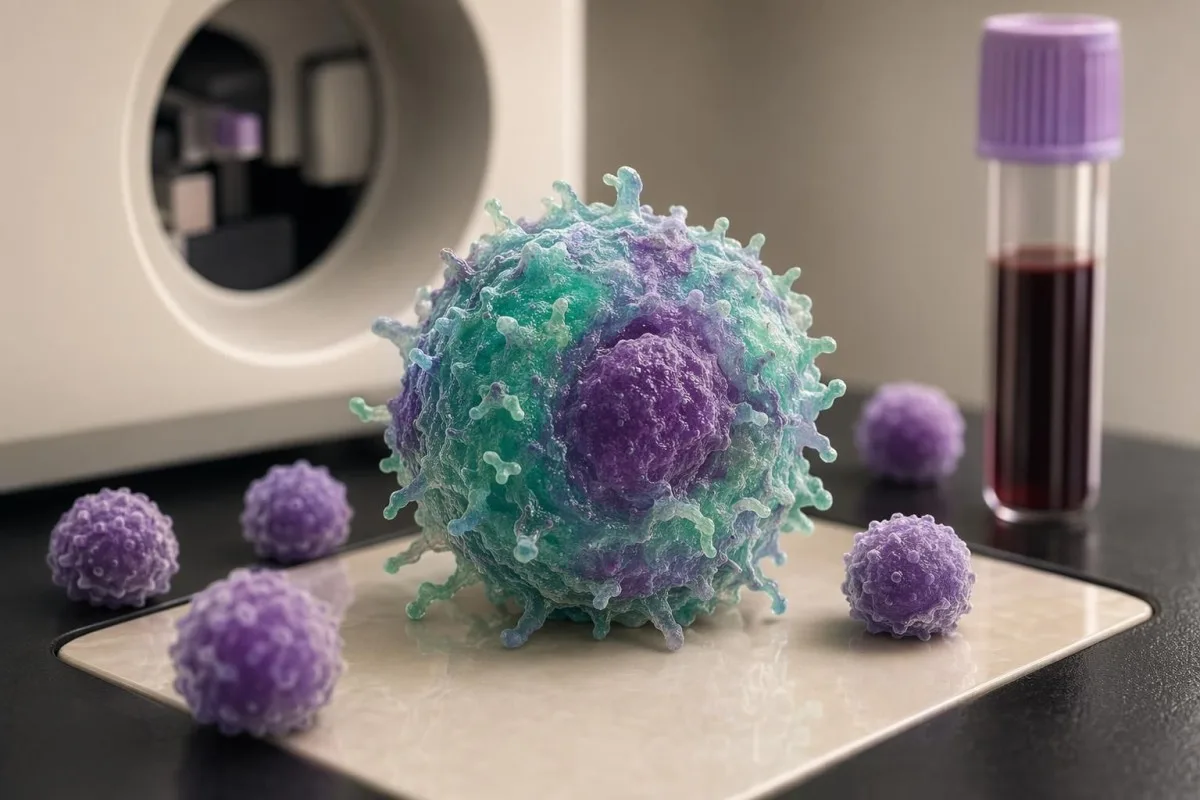
A portal flag saying reactive or atypical lymphocytes usually points to immune activation, not cancer. The useful question is whether the absolute count, symptoms, smear pattern and trend fit a short-lived viral illness.


- Reactive lymphocytes are activated immune cells seen on a CBC differential; they are most often triggered by viral illness rather than a blood cancer.
- Atypical lymphocytes describe appearance under the microscope, while high lymphocytes means the absolute lymphocyte count is above the adult cutoff of about 4.0 x 10^9/L.
- Adult lymphocytes usually run about 1.0-4.0 x 10^9/L, but children can normally have higher counts, especially under age 6.
- Viral clues include sore throat, fever, enlarged nodes, mild ALT/AST elevation and reactive lymphocytes above 10% on a manual differential.
- EBV mono often produces atypical lymphocytes of 10% or more, but Monospot testing can be falsely negative in the first week.
- Repeat CBC timing is commonly 2-6 weeks after symptoms improve if the patient is well and no red flags are present.
- Smear review matters when the analyzer flags blasts, cells look monotonous, cytopenias appear, or lymphocytosis persists beyond 3 months.
- Urgent review is warranted for drenching night sweats, weight loss over 10% in 6 months, rapidly enlarging nodes, severe abdominal pain or platelets below 100 x 10^9/L.
What a reactive lymphocyte flag means on a CBC
Reactive lymphocytes on a CBC usually mean your immune system has recently been stimulated, most often by a viral infection such as EBV, CMV, influenza or COVID. It is different from simply having high lymphocytes because the flag describes how the cells look, not just how many are present.
I’m Thomas Klein, MD, and when I review this result in clinic, I first check the absolute lymphocyte count, symptoms and timing. An adult absolute lymphocyte count of 1.0-4.0 x 10^9/L is commonly considered normal, while a reactive flag can appear even when the count is still within range.
Kantesti is an AI blood test interpretation platform that reads lymphocytes on CBC alongside neutrophils, platelets, hemoglobin, liver enzymes and trend history; our About Kantesti page explains the clinical team behind that workflow. A portal word like atypical sounds alarming, but in hematology it often means activated or virus-stimulated rather than malignant.
A CBC differential tells you which white cell types are present, and a manual differential adds information about cell appearance. If you are still learning the panel, our guide to CBC components explains why lymphocytes, neutrophils and platelets should be read together.
Reactive lymphocytes versus high lymphocytes
High lymphocytes means the number is above the reference range; reactive lymphocytes means some lymphocytes look activated. A patient can have reactive cells with a normal count, or high lymphocytes without many reactive forms.
The adult cutoff for lymphocytosis is usually an absolute lymphocyte count above 4.0 x 10^9/L, although some laboratories use 4.8 x 10^9/L. In children, a lymphocyte count of 7.0-9.0 x 10^9/L can be age-appropriate, especially in toddlers.
Reactive lymphocytes are usually larger than resting lymphocytes and may have deeper blue cytoplasm, irregular edges and less condensed chromatin. That morphology is why a manual smear can clarify a portal flag that an automated analyzer only hints at.
Percentages can mislead. A lymphocyte percentage of 48% may look high, but if the total WBC is 4.5 x 10^9/L, the absolute lymphocyte count is only about 2.2 x 10^9/L; our absolute count guide walks through that arithmetic.
How labs decide a lymphocyte looks atypical
A lab flags atypical lymphocytes either because an automated analyzer detects unusual cell patterns or because a trained reviewer sees activated cells on a smear. Manual review is more descriptive, but it is not performed on every CBC.
Modern hematology analyzers use light scatter, impedance and fluorescence-like signals to group cells. If the cluster does not fit the usual lymphocyte region, the instrument may trigger a manual review or print a phrase such as variant lymphocytes present.
A smear reviewer may count 100 white cells and report 8% reactive lymphocytes, or the lab may simply state present. Some European labs report reactive lymphocytes separately only when they exceed 5%, while other laboratories suppress the number and leave a comment.
The distinction between automated and manual wording matters because analyzer flags are sensitive but not perfectly specific. If your report mentions manual differential, our manual differential guide explains why a human-reviewed slide can change the next step.
Viral infections that most often cause reactive lymphocytes
The most common infectious causes of reactive lymphocytes are EBV, CMV, acute HIV, viral hepatitis, adenovirus, influenza, COVID and several travel-related viruses. The CBC pattern becomes more useful when paired with symptoms and liver enzymes.
Hurt and Tammaro’s American Journal of Medicine review on mononucleosis-like illness highlights why EBV is only one piece of the differential; CMV, acute HIV and toxoplasmosis can look similar in the first 7-14 days (Hurt & Tammaro, 2007). In practice, sore throat plus posterior neck nodes points me toward EBV, while prolonged fever with fewer throat findings makes CMV more plausible.
Influenza and COVID can also produce reactive lymphocytes, although COVID more often causes low lymphocytes early in moderate or severe disease. A mild ALT rise to 50-150 IU/L alongside reactive lymphocytes is common in EBV and CMV, and that pattern is more informative than either result alone.
If bacterial infection is the concern, the CBC often leans neutrophil-heavy rather than lymphocyte-heavy, though pertussis is a famous exception. For broader context on CBC, CRP and procalcitonin patterns, see our infection marker guide.
EBV mononucleosis and the classic CBC pattern
EBV mononucleosis classically causes fever, sore throat, enlarged lymph nodes and atypical lymphocytes of 10% or more. The CBC may show total lymphocytes above 4.0 x 10^9/L, mild thrombocytopenia and mild liver enzyme elevation.
In Balfour et al.’s university-student cohort, primary EBV infection severity tracked with viral and immune factors rather than one CBC value alone (Balfour et al., 2013). That matches my clinical experience: a 19-year-old with 18% atypical lymphocytes and ALT 112 IU/L often looks sicker than the CBC number suggests.
The heterophile antibody test, often called Monospot, can be falsely negative during the first week and in young children. EBV serology is more precise: VCA IgM suggests recent infection, VCA IgG persists, and EBNA usually appears later, often after 6-8 weeks.
Reactive lymphocytes after EBV can linger after the sore throat improves. I usually tell patients to avoid contact sports for at least 3-4 weeks if the spleen is enlarged or tender, and our high lymphocyte causes guide covers why the count may stay high during recovery.
CMV, acute HIV, COVID and hepatitis clues
CMV, acute HIV, COVID and viral hepatitis can all produce reactive or atypical lymphocytes, but their symptom patterns differ. CMV often gives prolonged fever and fatigue, acute HIV may follow exposure by 2-4 weeks, and hepatitis tends to push ALT higher.
CMV mononucleosis is often heterophile-negative and can last 2-6 weeks, especially in adults over 30. ALT and AST may rise 2-5 times the upper limit of normal, which means a CBC flag plus liver panel is more useful than a CBC alone.
Acute HIV can cause fever, rash, mouth ulcers, sore throat and reactive lymphocytes before standard antibody-only tests turn positive. A fourth-generation HIV antigen-antibody test is usually positive earlier than older antibody tests, and HIV RNA is used when exposure was very recent; our STD blood testing guide explains timing windows.
COVID adds a twist: severe cases often show lymphopenia below 1.0 x 10^9/L, while mild or recovering cases may show reactive forms. Viral hepatitis is different again, because ALT can exceed 500 IU/L, and that degree of liver enzyme elevation should not be dismissed as just a CBC curiosity.
Non-viral causes doctors keep on the list
Reactive lymphocytes are most often viral, but non-viral causes include pertussis, toxoplasmosis, drug hypersensitivity, autoimmune disease and recent vaccination. The clue is usually the timeline: medicine started 1-6 weeks earlier, travel, animal exposure or a new rash.
Drug reactions deserve respect. Anticonvulsants, sulfonamides, allopurinol and some antibiotics can trigger fever, rash, eosinophilia and atypical lymphocytes, sometimes with liver injury above 3 times the upper limit of normal.
Vaccination can shift immune markers for a few days, and most mild CBC changes settle within 1-3 weeks. A small reactive lymphocyte comment after an otherwise well-tolerated vaccine is usually less concerning than the same comment with fever over 38.5°C, rash and ALT 300 IU/L.
The practical question is whether the CBC fits the story. If your test was done soon after a vaccine or immune trigger, our guide to post-vaccination labs explains which markers commonly move and which changes deserve a call.
Why age and pregnancy change the interpretation
Age changes lymphocyte interpretation because children normally carry higher lymphocyte counts than adults. Pregnancy often lowers the lymphocyte percentage because neutrophils rise, so a reactive lymphocyte comment may stand out even when the absolute count is modest.
A 2-year-old with an absolute lymphocyte count of 7.5 x 10^9/L may be normal, while the same count in a 72-year-old deserves a different conversation. Pediatric reference intervals shift quickly during infancy, early childhood and adolescence.
In pregnancy, total WBC commonly rises to 6-16 x 10^9/L, mostly from neutrophils. A lymphocyte percentage can look low even if the absolute lymphocyte count is acceptable, and that is why percentages alone are a poor guide.
Older adults are the group where persistent lymphocytosis needs the most discipline. If lymphocytes remain above 5.0 x 10^9/L for more than 3 months without an infection story, I start thinking about flow cytometry; for age-specific ranges, see our WBC age guide.
When to repeat a CBC after reactive lymphocytes
A repeat CBC is often reasonable 2-6 weeks after symptoms improve if reactive lymphocytes appear during a likely viral illness. Repeating too early can create noise, because activated lymphocytes often outlast fever by 1-3 weeks.
For a healthy adult with sore throat, fatigue, reactive lymphocytes and no alarming exam findings, I commonly repeat the CBC in about 4 weeks. If the absolute lymphocyte count is falling and platelets and hemoglobin are stable, that trend is reassuring.
Kantesti is an AI-powered blood test analysis tool used by 2M+ people across 127 countries, and our trend view is designed to compare today’s CBC with earlier values rather than treating one flag as a diagnosis. A jump from 2.1 to 4.4 x 10^9/L after fever means something different from a steady 6.2 x 10^9/L for 9 months.
Repeat sooner if the patient is getting worse, not better. Our repeat lab guide gives a practical framework for deciding whether a result needs a 48-hour check, a 2-week check or routine follow-up.
When a smear review changes the next step
Smear review matters when the analyzer flag is unclear, lymphocytosis is persistent, or other CBC lines are abnormal. A trained reviewer can distinguish reactive, varied lymphocytes from monotonous cells or blasts that require urgent workup.
Barbara Bain’s New England Journal of Medicine review remains a good reminder that the blood film can reveal clues an automated count misses, including blasts, smudge cells, platelet clumping and abnormal lymphoid forms (Bain, 2005). A smear is not old-fashioned; it is targeted microscopy.
I ask for smear review when the absolute lymphocyte count is above 5.0 x 10^9/L without a clear viral story, when it persists beyond 3 months, or when hemoglobin falls below about 100 g/L or platelets below 100 x 10^9/L. Those thresholds are not magic, but they catch the patterns I do not like to ignore.
If the smear suggests a clonal lymphocyte population, flow cytometry is the usual next test. Our CBC smear pathway explains how clinicians move from CBC to smear to flow without jumping straight to worst-case thinking.
Red flags that should not wait for a routine recheck
Reactive lymphocytes need faster medical review when they come with severe symptoms, cytopenias, rapidly enlarging lymph nodes or signs of spleen trouble. The CBC flag is less important than the whole pattern of illness.
Call promptly for fever above 38°C lasting more than 7 days, drenching night sweats, unexplained weight loss over 10% in 6 months, or a hard supraclavicular node. I have seen patients wait on these symptoms because the portal said probable reactive change, and that is not the right bet.
Same-day care is wise for severe left upper abdominal pain after mono-like illness, fainting, shortness of breath, new confusion or widespread bruising. Platelets below 50 x 10^9/L, neutrophils below 0.5 x 10^9/L or hemoglobin below 80 g/L are not watch-and-wait numbers.
Dr. Thomas Klein’s practical rule is simple: if the patient looks unwell, the CBC is only one vote. For symptom clusters such as night sweats, fever and weight loss, our night sweat workup covers the additional labs clinicians often order.
How Kantesti AI reads lymphocytes in context
Kantesti AI interprets lymphocytes by combining absolute count, percentage, analyzer comments, trend direction, age, symptoms and companion biomarkers. That context matters because reactive lymphocytes alone are a clue, not a diagnosis.
Kantesti's neural network is trained to treat a reactive lymphocyte comment differently when ALT is 140 IU/L, platelets are 130 x 10^9/L and the patient reports sore throat. The same comment with persistent ALC 8.0 x 10^9/L, anemia and no viral symptoms is routed as a follow-up trigger.
Our AI workflow weighs unit systems, age ranges and longitudinal change because a CBC from London, São Paulo and Dubai may present lymphocytes in different formats. Kantesti supports 75+ languages, but the medical logic still depends on absolute numbers.
The biomarker library behind Kantesti AI covers 15,000+ markers, which lets the system connect lymphocytes with CRP, ferritin, ALT, LDH, platelets and B12 when those values are present. That is not a diagnosis engine; it is a structured interpretation layer for a clinician-patient conversation.
Why portal wording can sound scarier than it is
Portal wording often sounds frightening because labs use technical morphology terms without bedside context. The word atypical does not automatically mean cancer; it often means the lymphocytes look activated compared with resting cells.
Some portals release results before a clinician has added comments, so patients may see atypical lymphocytes at 7 a.m. and spend the morning imagining leukemia. In my experience, most of these flags after cold, flu or mono symptoms settle on repeat testing.
A portal may also show a high lymphocyte percentage with a normal absolute lymphocyte count. That is usually relative lymphocytosis, often because neutrophils are temporarily lower after a virus, and it does not carry the same meaning as an adult ALC above 5.0 x 10^9/L.
If you see results before review, write down 3 facts: the absolute lymphocyte count, whether reactive or atypical cells were quantified, and any abnormal hemoglobin or platelet result. Our guide to portal lab results explains how to prepare better questions rather than panic-refreshing the app.
Research notes, limits and the safest next step
As of July 5, 2026, reactive lymphocytes remain a morphology clue rather than a standalone diagnosis. The safest next step is to match the CBC to symptoms, repeat timing, smear findings and targeted viral testing when clinically appropriate.
Our AI biomarker interpretation platform at Kantesti is designed for pattern recognition, but physician oversight remains central for YMYL medical decisions. The evidence is strongest for classic EBV patterns and smear review triggers; it is weaker for predicting outcomes from a small percentage of reactive cells in isolation.
Kantesti’s clinical validation methods describe how we benchmark interpretation logic and keep medical review separate from marketing claims. For readers who want deeper hematology background, our hematology marker notes cover adjacent CBC patterns such as reticulocytes, LDH and cell-line recovery.
Bottom line: if you feel well and the reactive lymphocyte flag followed a viral illness, a repeat CBC in 2-6 weeks is often enough. If the count is persistent, the cells are monotonous, or red-flag symptoms appear, ask for clinician review, smear evaluation and possibly flow cytometry rather than relying on a portal label.
Frequently Asked Questions
Are reactive lymphocytes on a CBC dangerous?
Reactive lymphocytes on a CBC are usually not dangerous when they occur during or shortly after a viral illness and the rest of the CBC is stable. In adults, an absolute lymphocyte count under about 4.0 x 10^9/L with a small reactive comment is often monitored rather than urgently investigated. The result deserves faster review if lymphocytes remain above 5.0 x 10^9/L for more than 3 months, or if anemia, low platelets, weight loss, night sweats or enlarging lymph nodes are present.
What is the difference between reactive and atypical lymphocytes?
Reactive lymphocytes and atypical lymphocytes often refer to the same general finding: lymphocytes that look activated under the microscope. High lymphocytes means the absolute number is elevated, usually above 4.0 x 10^9/L in adults, while atypical or reactive describes cell appearance. A person can have atypical lymphocytes with a normal absolute count, especially during recovery from a viral infection.
Which infections cause reactive lymphocytes most often?
EBV mononucleosis is the classic cause of reactive lymphocytes, often with atypical cells above 10% on a manual differential. CMV, acute HIV, influenza, COVID, adenovirus and viral hepatitis can also cause reactive or atypical lymphocytes. The best next test depends on symptoms: sore throat and posterior neck nodes suggest EBV testing, recent sexual exposure may require fourth-generation HIV testing, and jaundice or ALT above 500 IU/L points toward hepatitis evaluation.
How long do reactive lymphocytes stay after a virus?
Reactive lymphocytes can persist for 1-3 weeks after fever and sore throat improve, and sometimes longer after EBV or CMV. A repeat CBC is commonly done about 2-6 weeks after symptoms settle if the patient is otherwise well. A falling absolute lymphocyte count and stable hemoglobin and platelets are reassuring signs during recovery.
When should a smear review be done for lymphocytes?
A smear review is reasonable when the analyzer flags blasts or abnormal cells, when adult lymphocytes are above 5.0 x 10^9/L without a clear infection, or when lymphocytosis persists beyond 3 months. It is also important if hemoglobin falls below about 100 g/L or platelets fall below 100 x 10^9/L. Smear review helps distinguish varied reactive lymphocytes from more uniform cells that may require flow cytometry.
Can reactive lymphocytes mean leukemia or lymphoma?
Reactive lymphocytes usually mean immune activation, not leukemia or lymphoma, especially when they follow a viral illness. Concern rises when lymphocytosis is persistent, cells look monotonous on smear, lymph nodes are hard or enlarging, or CBC lines such as hemoglobin and platelets are low. In an older adult, an unexplained absolute lymphocyte count above 5.0 x 10^9/L for more than 3 months often leads clinicians to consider flow cytometry.
Should I repeat my CBC if my portal says atypical lymphocytes?
Most people should discuss the result with their clinician and repeat the CBC in about 2-6 weeks if the flag appeared during a likely viral illness and symptoms are improving. Repeating the test in 24-48 hours is usually unnecessary unless the patient is getting worse or other CBC values are concerning. Same-day review is more appropriate if there is severe abdominal pain, fainting, bruising, shortness of breath, platelets below 50 x 10^9/L or neutrophils below 0.5 x 10^9/L.
Can a recent vaccine cause reactive lymphocytes on a CBC?
Immune stimulation after vaccination can temporarily affect white blood cells, but a reactive-lymphocyte flag alone cannot reliably be attributed to a vaccine. Share the vaccination date with your clinician, who can consider your symptoms, absolute count, and whether the finding resolves over several weeks.
Get AI-Powered Blood Test Analysis Today
Join over 2 million users worldwide who trust Kantesti for instant, accurate lab test analysis. Upload your blood test results and receive comprehensive interpretation of 15,000+ biomarkers in seconds.
📚 Referenced Research Publications
Klein, T., Mitchell, S., & Weber, H. (2026). Kantesti Research Group. (2026). Iron Studies Guide: TIBC, Iron Saturation & Binding Capacity. Zenodo. https://doi.org/10.5281/zenodo.18248745. Kantesti AI Medical Research.
Klein, T., Mitchell, S., & Weber, H. (2026). Kantesti Research Group. (2026). aPTT Normal Range: D-Dimer, Protein C Blood Clotting Guide. Zenodo. https://doi.org/10.5281/zenodo.18262555. Kantesti AI Medical Research.
📖 External Medical References
⚕️ Medical Disclaimer
This article is for educational purposes only and does not constitute medical advice. Always consult a qualified healthcare provider for diagnosis and treatment decisions.
E-E-A-T Trust Signals
Experience
Physician-led clinical review of lab interpretation workflows.
Expertise
Laboratory medicine focus on how biomarkers behave in clinical context.
Authoritativeness
Written by Dr. Thomas Klein with review by Dr. Sarah Mitchell and Prof. Dr. Hans Weber.
Trustworthiness
Evidence-based interpretation with clear follow-up pathways to reduce alarm.