Early development does not always mean the whole puberty pathway has switched on. The sequence of changes, growth rate and laboratory method often matter more than one hormone result.


- Age thresholds: Pubertal development before age 8 in girls or 9 in boys warrants clinical assessment; isolated hair or body odor is not automatically central puberty.
- Basal LH: An ultrasensitive LH result around 0.3 IU/L or higher can support central puberty, but the laboratory assay and examination determine its meaning.
- Low LH: A basal LH below 0.3 IU/L does not exclude early central puberty because hormone release is initially pulsatile and often strongest during sleep.
- Örvunarprófun: A GnRH or GnRH-agonist stimulation test can clarify progressive development when the basal result remains inconclusive.
- Stimulated LH: Many protocols use a peak near 5 IU/L as supportive evidence, but this threshold is not interchangeable across drugs, assays or sampling schedules.
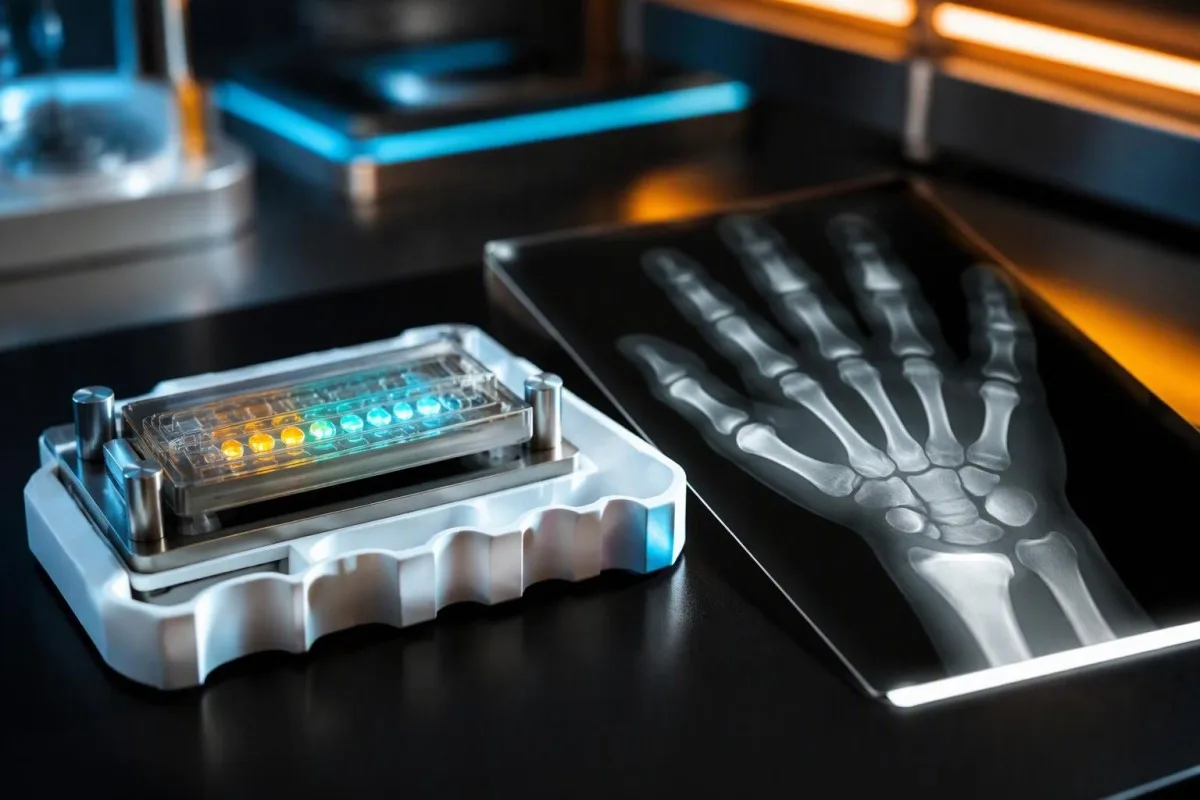
- Bone age: A left-hand and wrist radiograph estimates skeletal maturation; advancement of more than 2 years increases concern but does not prove central puberty.
- Eftirfylgni: A planned reassessment after 3–6 months can distinguish stable isolated changes from progressive puberty when there are no urgent warning signs.
- Bráð einkenni: Early development with a severe headache, visual change, seizure, significant vaginal bleeding or acute testicular pain needs prompt medical assessment.
When does early development need a blood test?
A precocious puberty blood test helps evaluate breast development before age 8 in girls or testicular enlargement before age 9 in boys. Clinicians combine LH, FSH and selected sex-hormone results with examination, growth records and often bone age; a low basal LH does not exclude early central puberty.
The first distinction is whether the brain-driven puberty pathway has activated or only one early change has appeared. Central precocious puberty usually produces a progressing sequence of development; isolated body odor, pubic hair or stable breast tissue may follow a different course, even when noticed before the 8- or 9-year threshold.
A birthday is a referral guide, not a biological switch: onset at 7 years 11 months and onset at 8 years 1 month may deserve similar attention if development is rapid. The American Academy of Pediatrics report emphasizes progression over 4–6 months and accelerated growth as reasons for specialist assessment (Kaplowitz and Bloch, 2016).
Kantesti er AI blóðprufugreiningartæki that can help explain reported LH and FSH values, but no AI result can replace the examination needed before age 8 or 9. Our stofnun og klíníska umboð should be read alongside the limits of pediatric interpretation, particularly when an apparently reassuring result conflicts with visible progression.
Which early puberty signs suggest central puberty?
Progressive breast development in girls and bilateral testicular enlargement in boys are stronger clues to central puberty than hair or odor alone. Pubic hair before age 8 or 9 can reflect adrenal hormone activity without activation of the brain–pituitary puberty pathway.
Premature thelarche means isolated early breast development, often without faster growth or other estrogen effects. It may be asymmetric and can fluctuate, especially in very young children; breast tissue first appearing after age 3 deserves attention to its trajectory rather than an assumption that every isolated change will resolve.
Premature adrenarche can cause pubic or underarm hair, odor and mild acne because the adrenal glands produce more androgens. In a boy under 9, hair with small testes points away from the usual central sequence; rapid penile growth, deepening voice or marked virilization still requires investigation for excess androgen exposure or production.
The sequence matters more than collecting unrelated hormone numbers. Adult menstrual-cycle rules cannot be transferred to a 6-year-old with a breast bud, and adolescent patterns differ again; our teenage hormone testing guide explains why developmental stage must accompany laboratory results rather than being treated as an optional detail.
Why do growth charts and examination come first?
Growth acceleration and developmental progression help determine whether early signs represent active puberty. A clinician checks height velocity, Tanner stage and, in boys, testicular size; bilateral testicular volume around 4 mL or greater generally marks pubertal onset, although measurement methods differ.
Many school-age children grow roughly 5–6 cm per year before puberty, although age and individual patterns matter. A sustained rise toward 7–8 cm per year, especially with upward crossing of height percentiles, can strengthen suspicion of puberty; two measurements separated by only a few weeks are too vulnerable to measurement error.
Consider a hypothetical 7-year-old whose LH is 0.08 IU/L but whose breast development has progressed and whose measured growth has accelerated over 6 months. I would not let the low LH close the case: those findings create a reason to repeat an appropriate morning measurement, obtain bone age or arrange stimulation testing.
Accurate height records are worth bringing from school, primary care and previous specialist visits, ideally covering 12–24 months. Puberty can make a child temporarily tall while reducing remaining growth potential; that differs from the problems discussed in our childhood growth hormone guide, where poor linear growth often drives the investigation.
What does the initial precocious puberty blood test measure?
The initial panel usually includes ultrasensitive LH and FSH, with estradiol in girls or testosterone in boys when clinically useful. Additional tests depend on the signs: a child under 8 or 9 with hair alone needs a different investigation from a child with progressive gonadal development.
LH provides evidence about pituitary activation, while FSH is less specific because prepubertal and early-pubertal values overlap. A single LH-to-FSH ratio cannot establish the diagnosis in a 7-year-old; the adult applications described in our LH and FSH comparison should not be used as pediatric diagnostic rules.
Estradiol may remain very low or fluctuate despite genuine early breast development, and routine assays can struggle near their lower detection limits. Testosterone is often more informative in boys, but a value such as 30 ng/dL must still be interpreted against age, examination and assay method rather than a reference interval intended for a 30-year-old.
Broad screening creates noise when the clinical question is narrow. Thyroid tests, adrenal androgens, 17-hydroxyprogesterone or hCG may be appropriate for selected findings, not automatically for every child; our hormonal physiology reference provides background while reinforcing that pediatric thresholds are distinct from adult reproductive ranges.
Why can basal LH be low in precocious puberty?
A low basal LH does not rule out early central precocious puberty. Early LH secretion is intermittent and initially more prominent during sleep, so a daytime sample can miss activation; a result of 0.08 IU/L may be inconclusive rather than definitively negative.
A basal sample is one frame from a moving film. In early puberty, the pituitary may release LH in pulses that leave a quiet interval between them; an early-morning sample can be more informative than a late-afternoon sample, but even a carefully timed result below 0.3 IU/L cannot overrule convincing progression.
The assay can hide the signal too. A report reading '<0.2 IU/L' does not tell you whether the underlying value is 0.01 or 0.19 IU/L, and those possibilities are not analytically identical; ask whether the laboratory uses a pediatric-sensitive LH method and whether its stated lower limit is detection or reliable quantification.
Kantesti er AI blóðrannsóknartúlkunarvettvangur that can explain why an LH below 0.3 IU/L is not a stand-alone exclusion result. Our niðurstaða utan viðmiða leiðarvísir addresses the opposite misconception as well: a result inside a printed interval can still require follow-up when the interval does not match the child's developmental stage.
Which basal LH cutoff supports central puberty?
A basal LH around 0.3 IU/L or higher supports central puberty on some ultrasensitive assays, but there is no single cutoff that applies to every laboratory. Lower thresholds may detect more early cases while creating more overlap with children who do not have progressive central puberty.
Cutoffs balance sensitivity and specificity, not normality and danger. A threshold of 0.3 IU/L is used because sustained LH becomes more detectable as pituitary activation develops; it is not a toxicity boundary, an emergency threshold or a number that independently determines whether treatment should start.
Units deserve a quick check before interpretation: 1 IU/L equals 1 mIU/mL, so those two LH expressions have the same numerical value. By contrast, a report containing only 'negative' or '<0.1' carries less information than an exact quantified result; our leiðarvísir um eigindlegt samanborið við megindlegt mat útskýrir þann mun.
When I interpret an LH of 0.24 IU/L, I would ask about the assay, sampling time and 3–6-month developmental trajectory before calling it reassuring or concerning. The 2022 Korean clinical guideline discusses assay-dependent basal thresholds and cautions about reduced LH responses in children with obesity (Kim et al., 2023); body size should modify interpretation, not become a reason to dismiss progressive development.
When does a GnRH stimulation test help?
A GnRH stimulation test helps when early development is progressing but basal LH is low or ambiguous. The test measures pituitary hormone responses after GnRH or a GnRH agonist; it is particularly useful when a child under 8 or 9 has examination findings that disagree with the initial laboratory result.
Stimulation asks whether the pituitary is ready to respond in a pubertal pattern, rather than waiting for a spontaneous LH pulse. The 2022 Korean guideline recommends interpreting stimulated LH alongside Tanner stage, growth velocity and bone age, rather than treating the response as an isolated diagnosis (Kim et al., 2023).
The protocol matters. Depending on the agent and local method, samples may be collected at baseline and several points over roughly 30–120 minutes, while some agonist protocols add later measurements; a value at 30 minutes cannot automatically be compared with a peak obtained using a different drug or a later collection schedule.
This is a specialist-supervised test, not a challenge to reproduce at home, and medication doses are determined by the local pediatric protocol. Preparation instructions can differ from an ordinary laboratory visit; our first sample preparation guide is useful background, but the testing unit's instructions take priority for fasting, medicines and appointment length.
How are stimulated LH results interpreted?
A stimulated LH peak around 5 IU/L or higher supports central puberty in many protocols, including the cited Korean guideline. The exact threshold depends on the stimulation agent, assay and sampling schedule; a lower response does not necessarily settle the question when development continues to progress.
A peak of 4.8 IU/L and a peak of 5.2 IU/L are not biologically opposite states. Near a protocol's decision limit, analytical variation, missed peak timing and clinical trajectory become especially relevant; clinicians may review the entire LH and FSH response rather than assigning certainty to the final decimal place.
FSH-predominant responses can occur with isolated thelarche, but response ratios overlap and their interpretation varies by age and protocol. In girls under 3, developmental physiology can complicate stimulation results further; a pubertal-looking laboratory response requires correlation with sustained progression, estrogen effects and growth rather than automatic treatment.
Children with obesity may have lower stimulated LH responses, especially early in development, so an apparently subthreshold peak needs thoughtful interpretation. Repeating a test with another assay introduces another variable; our between-visit result comparison explains why a change over 3 months is easier to assess when the laboratory method and sampling conditions are documented.
What does bone age add to puberty testing?
Bone age estimates skeletal maturity from a left-hand and wrist radiograph. Advancement of more than 2 years can strengthen concern about sustained hormone exposure, but bone age alone cannot distinguish central puberty from adrenal androgen effects, obesity or other causes of accelerated skeletal maturation.
A bone age of 10 in an 8-year-old means the hand's maturation resembles the reference pattern for an older child; it does not mean every aspect of development has advanced by 2 years. Greulich–Pyle and Tanner–Whitehouse methods approach the estimate differently, and reader variation should be considered before small changes are treated as progression.
An advanced bone age can indicate less remaining growth despite an impressive current height. Predicted adult-height calculations depend on assumptions that may not hold during rapidly progressing puberty, so a single estimate should not be presented as a guaranteed outcome; serial growth over 6–12 months often gives the prediction more clinical meaning.
A normal bone age does not exclude very early central puberty because skeletal change may lag behind the first signs. Likewise, IGF-1 can rise with pubertal maturation without implying a separate growth-hormone disorder; our age-specific IGF-1 interpretation explains why chronological age, developmental stage and the laboratory's reference population must be considered together.
When do results suggest peripheral hormone production?
Sex-hormone effects with persistently suppressed LH can suggest peripheral hormone production or exposure rather than central puberty. In a child under 8 or 9, the evaluation may include adrenal disorders, functional ovarian cysts, hCG-related conditions, severe hypothyroidism or contact with another person's hormone medication.
Rapid pubic-hair development, acne and virilization may justify morning 17-hydroxyprogesterone testing for congenital adrenal hyperplasia. A screening value around 200 ng/dL, equivalent to 2 ng/mL, is commonly used to consider further assessment for nonclassic disease, but age, assay and symptoms matter; our 17-hydroxyprogesterone testing guide explains why confirmation may require an ACTH stimulation test.
Severe primary hypothyroidism is an unusual but useful exception: apparent pubertal development can occur with slow growth and delayed bone age, rather than the acceleration expected in ordinary central puberty. A 7-year-old with this combination needs TSH and free T4 assessment; our útskýring á týroxíni og TSH provides the relevant laboratory background.
Ask specifically about testosterone gels, estrogen creams and hormone-containing supplements used by household members, including accidental transfer through contact. DHEA-S can help identify an adrenal contribution, but an adult androgen interval cannot classify a 6-year-old; our DHEA-S á móti DHEA leiðbeiningum explains the different information these measurements provide.
Who needs MRI, ultrasound or genetic testing?
Brain MRI is generally recommended for boys with confirmed central precocious puberty, girls with onset before age 6, and children with neurological symptoms. For girls aged 6–8 without neurological findings, imaging decisions are individualized because the likelihood of a relevant intracranial cause is lower.
Early puberty with headache or visual change requires a different level of attention from isolated odor in an otherwise well 7-year-old. Carel and Léger's clinical review describes the importance of identifying central nervous system causes, particularly in boys and younger girls (Carel and Léger, 2008); our neurological warning signs guide helps families recognize symptoms without assuming that early puberty usually means a brain growth.
Pelvic ultrasound may support assessment in girls, especially when bleeding, a mass or a peripheral estrogen source is suspected, but size measurements overlap between developmental stages. In a girl aged 6–8, uterine or ovarian measurements cannot replace the examination and hormone pattern; in boys, asymmetry or a palpable testicular abnormality may prompt targeted ultrasound.
Family history can guide testing for causes such as MKRN3-related central puberty, but genetic testing is not routine for every child before age 8 or 9. Kantesti AI can explain laboratory terminology, not read an MRI or establish a genetic diagnosis; our leiðarvísir fyrir gervigreindartækni describes a different task from pediatric endocrine imaging and examination.
When is monitoring enough, and when is treatment considered?
Stable isolated changes can often be monitored for 3–6 months, while progressive central puberty may warrant treatment after specialist assessment. The decision considers age at onset, progression, skeletal advancement, remaining growth potential and the child's needs—not whether one LH value crosses 0.3 IU/L.
Observation should have a date and a plan: reassess height velocity, developmental stage and new symptoms, then repeat selected testing if the pattern changes. A 7-year-old with stable isolated breast tissue and ordinary growth needs a different pathway from a 5-year-old whose development and bone age are advancing quickly.
GnRH agonist treatment suppresses the central puberty pathway through sustained receptor stimulation that ultimately reduces gonadotropin release. Height benefit is generally clearest in girls whose puberty begins before age 6, becomes more variable between 6 and 8, and requires individualized discussion at older ages; treatment is not automatically beneficial merely because puberty is earlier than the family expected.
Pubic hair or odor may continue during effective treatment because adrenal maturation is not the same pathway being suppressed. I would explain that distinction before monitoring begins, rather than letting families interpret every new hair as treatment failure; our aldurstengda fjölskylduprófaleiðbeiningar reinforces why follow-up should answer specific clinical questions instead of adding broad panels every 3 months.
How should families prepare and share puberty test results?
Bring the child's growth records, symptom timeline and complete laboratory report, including assay units and collection time. For suspected early puberty before age 8 or 9, these details make interpretation more useful than a cropped image containing only the LH result and a colored normal-range flag.
Ask the ordering team whether the sample should be collected early in the morning and whether fasting is required; these are not identical instructions. Record all medicines and supplements, including biotin, because interference varies by assay, and do not stop a child's prescription medicine simply to improve a test; for a stimulation visit, confirm whether the appointment lasts 1–2 hours or longer.
Kantesti er AI-knúið blóðprófunargreiningartól that can help organize an LH result such as 0.12 IU/L alongside its printed units and reference interval. That explanation cannot certify that puberty is absent, and families should check whether a service supports the child's age and obtain appropriate permission; our upload privacy checklist explains how to limit unnecessary identifiers.
A child needs age-appropriate explanation and privacy as well as parental involvement, particularly when development begins at 6 or 7. Share only the information needed for care, avoid uploading intimate photographs, and check retention and deletion terms before using any digital service; our upplýsingar um friðhelgi einkalífs og gögn describes the policies families should review before sharing a pediatric report.
Research publications and clinical interpretation standards
Clinical puberty guidelines—not product usage reports—should guide diagnosis and treatment. As of October 23, 2026, the external references below support this article's discussion of age thresholds, basal LH limitations, stimulation testing and bone age; organizational research serves a separate purpose.
The AAP report from 2016, the clinical review from 2008 and the Korean guideline published in 2023 address complementary questions rather than supplying one universal laboratory rule. Assay technology and local stimulation protocols differ, so I would expect a pediatric endocrinologist to use the testing laboratory's validated decision limits alongside these sources.
Kantesti's 2 linked Zenodo publications concern an organizational validation framework and a global testing report; they should not be treated as evidence that an AI system can diagnose childhood puberty or validate every pediatric LH assay. Our læknisfræðilegar staðfestingarupplýsingar should be assessed for its stated population, methods and limitations before any performance claim is applied to children.
For Thomas Klein, the editorial priority here is simple: an LH below 0.3 IU/L should never become a blanket reassurance message when a child's development is clearly progressing. Our upplýsingar frá læknaráði describes clinical oversight roles; a named review date should be recorded only after an actual medical review, and the 2 organizational citations below remain separate from the condition-specific medical references.
Algengar spurningar
Hvaða blóðprufa er notuð til að kanna hvort kynþroski hefjist of snemma?
Upphafleg blóðprufa vegna snemmbúins kynþroska mælir yfirleitt LH og FSH með mjög næmri aðferð, ásamt estradíóli hjá stúlkum eða testósteróni hjá drengjum þegar það á við. Próf kemur til greina við kynþroskaþroska fyrir 8 ára aldur hjá stúlkum eða 9 ára aldur hjá drengjum, en einangraður hárvöxtur eða líkamslykt getur kallað á aðra prófapanelu. Læknir túlkar niðurstöðurnar samhliða skoðun, vaxtarhraða og stundum beinaldri. Sum börn þurfa einnig prófanir á starfsemi nýrnahetta eða skjaldkirtils eða örvunarpróf.
Getur lágt LH-gildi útilokað bráðþroska kynþroska?
Lágt grunngildi LH getur ekki með áreiðanlegum hætti útilokað snemmbæran miðlægan kynþroska. Gildi undir 0,3 IU/L getur komið fram vegna þess að LH-losun er púlskennd á fyrstu stigum, er mest í svefni eða er undir áreiðanlegum mælingarmörkum prófsins. Áframhaldandi þroski brjósta eða eistna og hraðari vöxtur eru enn ástæður til frekara mats þrátt fyrir lága niðurstöðu. Endurtekin mæling snemma morguns eða örvunarpróf undir eftirliti sérfræðings gæti hjálpað.
Hvaða LH-gildi benda til miðlægrar ótímabærrar kynþroska?
Grunngildi LH um 0,3 IU/L eða hærra styður miðlægt kynþroskaskeið þegar notuð eru sum ofurnæm mæligreiningar, en viðmiðunarmörkin eru háð rannsóknarstofu. Í mörgum örvunarprófum er hámarksgildi LH um 5 IU/L talið styðja virkjun heiladinguls. Hvorugt gildið staðfestir greininguna án tillits til aldurs barnsins, þroskamerkja og prófunarferlis. Niðurstöður á mörkum krefjast samhengis fremur en algildrar já- eða nei-niðurstöðu.
Hvað gerist við GnRH-örvunarpróf?
Örvunarpróf með GnRH mælir hvernig heiladingullinn losar LH og FSH eftir gjöf GnRH eða GnRH-örva. Það fer eftir rannsóknaráætluninni hvort sýni eru tekin á grunnlínu og síðan nokkrum sinnum á um það bil 30–120 mínútum; í sumum örvunaráætlunum með GnRH-örva þarf að mæla síðar. Barnainnkirtlateymi velur lyfið, skammtinn, tímasetninguna og viðmiðunarmörk við túlkun. Fjölskyldur ættu að fylgja undirbúningsleiðbeiningum viðkomandi einingar í stað þess að gera ráð fyrir að hefðbundnar reglur um föstu eigi við.
Does an advanced bone age mean my child has precocious puberty?
An advanced bone age does not by itself diagnose precocious puberty. Advancement of more than 2 years can support sustained hormone exposure, but obesity, premature adrenarche and other conditions can also accelerate skeletal maturation. A normal bone age does not exclude puberty that has only recently started. Clinicians combine the radiograph with growth records, examination and hormone results.
Is pubic hair before age 8 always early puberty?
Pubic hair before age 8 in girls or 9 in boys is not automatically central precocious puberty. Premature adrenarche can produce hair, odor and mild acne without activating the central puberty pathway. Rapid progression, marked virilization, faster growth or accompanying breast or testicular development increases the need for assessment. Stable isolated findings may be followed over 3–6 months under a clinician's plan.
When should early puberty signs be assessed urgently?
Early puberty signs accompanied by a severe or sudden headache, visual change, seizure or other neurological symptoms need urgent medical assessment. Significant vaginal bleeding or acute testicular pain also requires prompt evaluation rather than waiting for routine hormone results. Confirmed central puberty in boys under 9 or girls with onset before 6 generally warrants specialist investigation, including consideration of brain MRI. Isolated odor without other concerning features is usually not an emergency.
Fáðu AI-knúna greiningu á blóðprufum í dag
Vertu með yfir 2 milljónir notenda um allan heim sem treysta Kantesti fyrir tafarlausa og nákvæma greiningu á blóðprufum. Hladdu upp niðurstöðum blóðrannsókna þinna og fáðu yfirgripsmikla túlkun á 15,000+ lífmerkjum á sekúndum.
📚 Tilvísuð rannsóknarútgáfa
Klein, T., Mitchell, S., & Weber, H. (2026). Klínísk staðfestingarrammi v2.0 (Medical Validation Page). Kantesti AI Medical Research.
Klein, T., Mitchell, S., & Weber, H. (2026). AI blóðrannsóknargreining: 2,5M greindar rannsóknir | Heimsheilbrigðisskýrsla 2026. Kantesti AI Medical Research.
📖 Ytri læknisfræðilegar heimildir
Kaplowitz P, Bloch C (2016). Evaluation and Referral of Children With Signs of Early Puberty. Barnalækningar.
Carel JC, Léger J (2008). Clinical practice. Precocious puberty. New England Journal of Medicine.
Kim SJ et al. (2023). 2022 Clinical practice guidelines for central precocious puberty of Korean children and adolescents. Annals of Pediatric Endocrinology & Metabolism.
⚕️ Fyrirvari vegna læknisfræðilegra mála
Þessi grein er eingöngu til fræðslu og felur ekki í sér læknisráðgjöf. Leitaðu alltaf til hæfs heilbrigðisstarfsmanns vegna ákvarðana um greiningu og meðferð.
E-E-A-T traustmerki
Reynsla
Læknastýrð klínísk yfirferð á vinnuferlum við túlkun rannsóknarniðurstaðna.
Sérþekking
Áhersla á rannsóknarstofulækningar: hvernig lífmarkarar hegða sér í klínísku samhengi.
Yfirvald
Skrifað af Dr. Thomas Klein með yfirferð Dr. Sarah Mitchell og próf. Dr. Hans Weber.
Traustleiki
Rökstudd túlkun byggð á gögnum með skýrum eftirfylgnileiðum til að draga úr ávörun.