Wczesny rozwój niy dycki ôznaczo, iże cołko ścieżka pokwitanio je włōnczōno. Sekwyncyjo zmian, wartkość wzrostu i metoda laboratoryjŏnŏ majōm czynsto wiynksze znaczenie niż jedyn wynik hormōnu.


- Progi wieku: Rozwój pokwitaniowy przed 8. rokiym życia u dziołch abo 9. rokiym u chŏpcōw wymogo ocyny klinicznej; same włosy abo zapach ciała niy ôznaczajōm automatycznie pokwitanio centralnego.
- Podstawowe LH: Wynik ultrasensytywnego LH około 0,3 IU/L abo wyższy może przemŏwiać za pokwitaniym centralnym, ale ô jego znaczeniu decydujōm test laboratoryjny i badanie.
- Niskie LH: Podstawowe LH poniżyj 0,3 IU/L niy wykluczo wczesnego pokwitanio centralnego, bo wydzielanie hormōnu je na poczōntku pulsacyjne i czynsto nojwiynksze podczŏs spania.
- Testy stymulacyjne: Test stymulacyjny GnRH abo agonistōm GnRH może wyjaśnić postympujōncy rozwój, kej wynik podstawowy dalij niy je rozstrzygajōncy.
- Stymulowane LH: W wielu protokołach szczyt blisko 5 IU/L uznŏwŏ sie za dowōd wspierajōncy, ale tego progu niy idzie stosować zamiennie dlo rōżnych lekōw, testōw abo harmonogramōw pobierania prōbek.
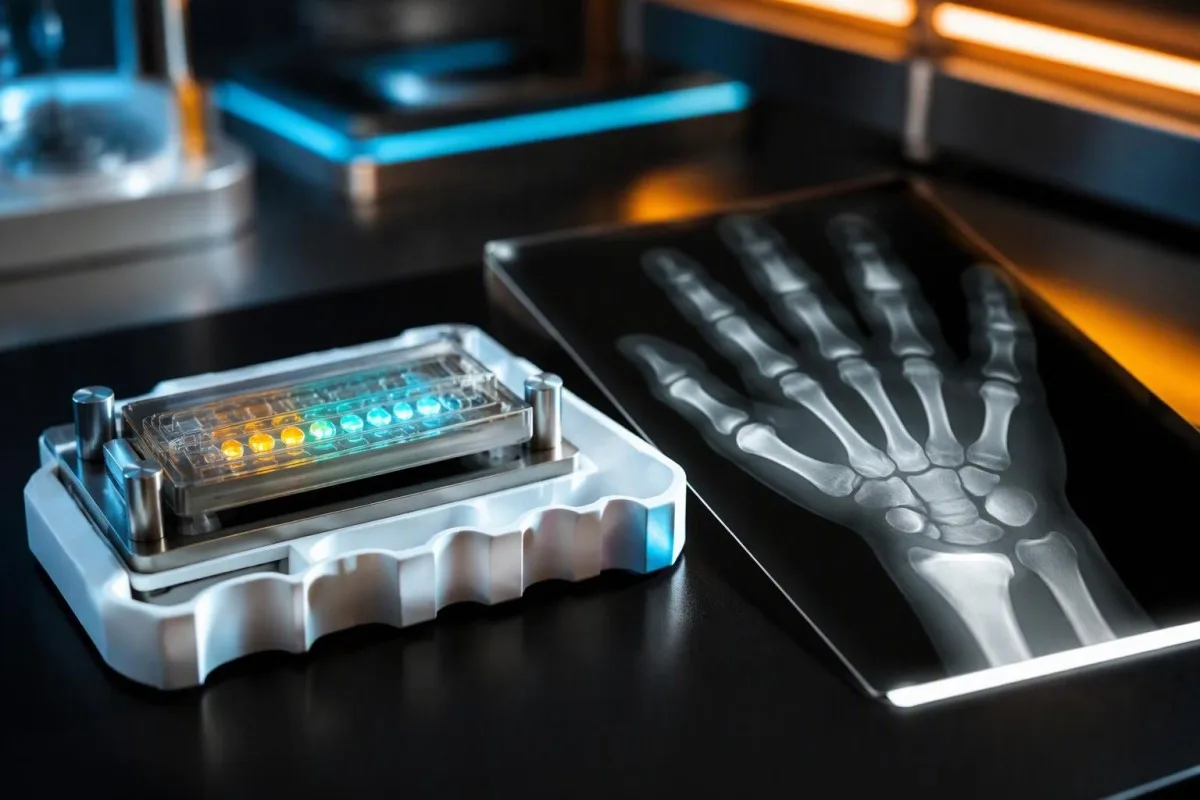
- Wiek kostny: Zdjęcie rentgenowskie lewej rynki i nadgarstka ôszacowuje dojrzewanie szkieletu; przyspieszenie ô wiyncyj jak 2 lata zwiynkszo ôbawã, ale niy dowodzi pokwitanio ôśrodkowego.
- Kontrola po czasie: Zaplanowano ponowno ôcena po 3–6 miesiōncach może ôdrōżnić stabilne, ôdosobnione zmiany ôd postympujōncego pokwitanio, kej niy ma pilnych ôstrzegawczych znakōw.
- Pilne objawy: Wczesny rozwōj ze silnym bōlem gowy, zmianōm widzynio, napadym, znaczōncym krwawieniym z pochwy abo ostrym bōlym jōder wymogo szybkij ôceny lekarskij.
Kedy wczesny rozwój wymago badania krwi?
A badanie krwi w kierōnku przedwczesnego pokwitanio pōmoże ôcenić rozwōj piersi przed 8. rokiym życia u dziołchōw abo powiynkszynie jōder przed 9. rokiym życia u synkōw. Lekorze łōnczōm wyniki LH, FSH i wybranych hormōnōw płciowych z badaniym, zapisami wzrostu i czynsto wiekiym kostnym; niski bazowy LH niy wykluczo wczesnego pokwitanio ôśrodkowego.
Pierwszo roztōmność je, eli aktywowoła sie ścieżka pokwitanio sterowano przez mōzg, abo pojawiła sie ino jedna wczesno zmiana. Pokwitanie ôśrodkowe przed czasym zwykle przebiego jako postympujōnco sekwyncyjo rozwoju; ôdosobniony zapach ciała, włosy łonowe abo stabilno tkanka piersi mogōm mieć inkszy przebieg, nawet kej zauważōno je przed granicōm 8 abo 9 rokōw.
Urodziny sōm wskazōwkōm do skierowanio, a niy biologicznym przełōncznikiym: poczōntek we wieku 7 lat i 11 miesiyncy i poczōntek we wieku 8 lot i 1 miesiōnca mogōm wymagać podobnyj uwagi, jeźli rozwōj przebiego wartko. Raport American Academy of Pediatrics podkreślo postympowanie w ciōngu 4–6 miesiyncy i przyspieszōny wzrost jako powody do ôceny u specjalisty (Kaplowitz and Bloch, 2016).
Kantesti je Analizatōr podszukowań krwi sztucznyj inteligyncyje co może pōmōc wyjaśnić podane wartości LH i FSH, ale żodyn wynik AI niy zastōmpi badanio, kere je potrzebne przed 8. abo 9. rokiym życia. Nasz organizacyjo i kliniczna remit trza czytać społym z ôgraniczyniami interpretacyje u dzieci, ôsobliwie kej pozornie uspokajajōncy wynik sprzeciwio sie widocznymu postympowi.
Kere ôznaki wczesnego pokwitanio sugerujōm pokwitanie centralne?
Postympujōncy rozwōj piersi u dziołchōw i ôbustronne powiynkszynie jōder u synkōw sōm mocniejszymi wskazōwkami na pokwitanie ôśrodkowe niż same włosy abo zapach. Włosy łonowe przed 8. abo 9. rokiym życia mogōm ôznaczać aktywność hormōnōw nadnerczowych bez aktywacyje ścieżki pokwitanio mōzg–przysadka.
Przedwczesne thelarche znaczy ôdosobniony wczesny rozwōj piersi, czynsto bez szybszego wzrostu abo inkszych efektōw estrogynōw. Może być asymetryczny i może sie zmieniać, ôsobliwie u bardzo małych dzieci; tkanka piersi, co pojawio sie piyrszy roz po 3. rokiym życia, wymogo ôceny jej przebiegu, a niy założynio, że kożdo ôdosobniono zmiana ustōmpi.
Przedwczesna adrenarche może powodować włosy łonowe abo pod pachōm, zapach i łagodny trōndzik, bo nadnercza produkujōm wiyncyj androgenōw. U synka przed 9. rokiym życia włosy przy małych jōdrach wskazujōm ôd zwykłyj sekwyncyje ôśrodkowyj; wartki wzrost prōcia, pogrubiynie głosu abo wyraźna wirylizacyjo dalij wymogo badania pod kōntym nadmiaru ekspozycyje abo produkcyje androgenōw.
Sekwyncyjo mo wiynksze znaczenie niż zbiyranie niypowiōnzanych ze sobōm wartości hormōnōw. Zasady dorosłego cyklu miesiōnczkowego niy mogōm być przenoszōne na 6-letnie dziecko z zawiōnzkym piersi, a wzorce u nastolatkōw znowu sie rōżniōm; nasz przewodnik po badaniach hormōnōw u nastolatkōw wyjaśnio, czamu etap rozwoju musi towarzyszyć wynikom laboratoryjnym, a niy być traktowany jako ôpcjonalny szczegōł.
Czamu wykresy wzrostu i badanie som piyrsze?
Przyspieszenie wzrostu i postympowanie rozwoju help determine whether early signs represent active puberty. A clinician checks height velocity, Tanner stage and, in boys, testicular size; bilateral testicular volume around 4 mL or greater generally marks pubertal onset, although measurement methods differ.
Many school-age children grow roughly 5–6 cm per year before puberty, although age and individual patterns matter. A sustained rise toward 7–8 cm per year, especially with upward crossing of height percentiles, can strengthen suspicion of puberty; two measurements separated by only a few weeks are too vulnerable to measurement error.
Consider a hypothetical 7-year-old whose LH is 0.08 IU/L but whose breast development has progressed and whose measured growth has accelerated over 6 months. I would not let the low LH close the case: those findings create a reason to repeat an appropriate morning measurement, obtain bone age or arrange stimulation testing.
Accurate height records are worth bringing from school, primary care and previous specialist visits, ideally covering 12–24 months. Puberty can make a child temporarily tall while reducing remaining growth potential; that differs from the problems discussed in our childhood growth hormone guide, where poor linear growth often drives the investigation.
Co mierzi piyrsze badanie krwi przi przedwczesnym pokwitaniu?
The initial panel usually includes ultrasensitive LH and FSH, with estradiol in girls or testosterone in boys when clinically useful. Additional tests depend on the signs: a child under 8 or 9 with hair alone needs a different investigation from a child with progressive gonadal development.
LH provides evidence about pituitary activation, while FSH is less specific because prepubertal and early-pubertal values overlap. A single LH-to-FSH ratio cannot establish the diagnosis in a 7-year-old; the adult applications described in our LH and FSH comparison should not be used as pediatric diagnostic rules.
Estradiol may remain very low or fluctuate despite genuine early breast development, and routine assays can struggle near their lower detection limits. Testosterone is often more informative in boys, but a value such as 30 ng/dL must still be interpreted against age, examination and assay method rather than a reference interval intended for a 30-year-old.
Broad screening creates noise when the clinical question is narrow. Thyroid tests, adrenal androgens, 17-hydroxyprogesterone or hCG may be appropriate for selected findings, not automatically for every child; our hormonal physiology reference provides background while reinforcing that pediatric thresholds are distinct from adult reproductive ranges.
Czamu podstawowe LH może być niskie przi przedwczesnym pokwitaniu?
A low basal LH does not rule out early central precocious puberty. Early LH secretion is intermittent and initially more prominent during sleep, so a daytime sample can miss activation; a result of 0.08 IU/L may be inconclusive rather than definitively negative.
A basal sample is one frame from a moving film. In early puberty, the pituitary may release LH in pulses that leave a quiet interval between them; an early-morning sample can be more informative than a late-afternoon sample, but even a carefully timed result below 0.3 IU/L cannot overrule convincing progression.
The assay can hide the signal too. A report reading '<0.2 IU/L' does not tell you whether the underlying value is 0.01 or 0.19 IU/L, and those possibilities are not analytically identical; ask whether the laboratory uses a pediatric-sensitive LH method and whether its stated lower limit is detection or reliable quantification.
Kantesti je platforma do interpretacji wyników badań krwi AI that can explain why an LH below 0.3 IU/L is not a stand-alone exclusion result. Our przewodnik po wyniku poza zakresem addresses the opposite misconception as well: a result inside a printed interval can still require follow-up when the interval does not match the child's developmental stage.
Kery próg podstawowego LH przemŏ za pokwitaniym centralnym?
A basal LH around 0.3 IU/L or higher supports central puberty on some ultrasensitive assays, but there is no single cutoff that applies to every laboratory. Lower thresholds may detect more early cases while creating more overlap with children who do not have progressive central puberty.
Cutoffs balance sensitivity and specificity, not normality and danger. A threshold of 0.3 IU/L is used because sustained LH becomes more detectable as pituitary activation develops; it is not a toxicity boundary, an emergency threshold or a number that independently determines whether treatment should start.
Units deserve a quick check before interpretation: 1 IU/L equals 1 mIU/mL, so those two LH expressions have the same numerical value. By contrast, a report containing only 'negative' or '<0.1' carries less information than an exact quantified result; our przewodnik po badaniach jakościowych i ilościowych wyjaśnia tę różnicę.
When I interpret an LH of 0.24 IU/L, I would ask about the assay, sampling time and 3–6-month developmental trajectory before calling it reassuring or concerning. The 2022 Korean clinical guideline discusses assay-dependent basal thresholds and cautions about reduced LH responses in children with obesity (Kim et al., 2023); body size should modify interpretation, not become a reason to dismiss progressive development.
Kedy pōmogo test stymulacyjny GnRH?
A GnRH stimulation test helps when early development is progressing but basal LH is low or ambiguous. The test measures pituitary hormone responses after GnRH or a GnRH agonist; it is particularly useful when a child under 8 or 9 has examination findings that disagree with the initial laboratory result.
Stimulation asks whether the pituitary is ready to respond in a pubertal pattern, rather than waiting for a spontaneous LH pulse. The 2022 Korean guideline recommends interpreting stimulated LH alongside Tanner stage, growth velocity and bone age, rather than treating the response as an isolated diagnosis (Kim et al., 2023).
The protocol matters. Depending on the agent and local method, samples may be collected at baseline and several points over roughly 30–120 minutes, while some agonist protocols add later measurements; a value at 30 minutes cannot automatically be compared with a peak obtained using a different drug or a later collection schedule.
This is a specialist-supervised test, not a challenge to reproduce at home, and medication doses are determined by the local pediatric protocol. Preparation instructions can differ from an ordinary laboratory visit; our first sample preparation guide is useful background, but the testing unit's instructions take priority for fasting, medicines and appointment length.
Jak sie interpretuje wyniki stymulowanego LH?
A stimulated LH peak around 5 IU/L or higher supports central puberty in many protocols, including the cited Korean guideline. The exact threshold depends on the stimulation agent, assay and sampling schedule; a lower response does not necessarily settle the question when development continues to progress.
A peak of 4.8 IU/L and a peak of 5.2 IU/L are not biologically opposite states. Near a protocol's decision limit, analytical variation, missed peak timing and clinical trajectory become especially relevant; clinicians may review the entire LH and FSH response rather than assigning certainty to the final decimal place.
FSH-predominant responses can occur with isolated thelarche, but response ratios overlap and their interpretation varies by age and protocol. In girls under 3, developmental physiology can complicate stimulation results further; a pubertal-looking laboratory response requires correlation with sustained progression, estrogen effects and growth rather than automatic treatment.
Children with obesity may have lower stimulated LH responses, especially early in development, so an apparently subthreshold peak needs thoughtful interpretation. Repeating a test with another assay introduces another variable; our between-visit result comparison explains why a change over 3 months is easier to assess when the laboratory method and sampling conditions are documented.
Co do testów pokwitanio dodowo wiek kostny?
Bone age estimates skeletal maturity from a left-hand and wrist radiograph. Advancement of more than 2 years can strengthen concern about sustained hormone exposure, but bone age alone cannot distinguish central puberty from adrenal androgen effects, obesity or other causes of accelerated skeletal maturation.
A bone age of 10 in an 8-year-old means the hand's maturation resembles the reference pattern for an older child; it does not mean every aspect of development has advanced by 2 years. Greulich–Pyle and Tanner–Whitehouse methods approach the estimate differently, and reader variation should be considered before small changes are treated as progression.
An advanced bone age can indicate less remaining growth despite an impressive current height. Predicted adult-height calculations depend on assumptions that may not hold during rapidly progressing puberty, so a single estimate should not be presented as a guaranteed outcome; serial growth over 6–12 months often gives the prediction more clinical meaning.
A normal bone age does not exclude very early central puberty because skeletal change may lag behind the first signs. Likewise, IGF-1 can rise with pubertal maturation without implying a separate growth-hormone disorder; our age-specific IGF-1 interpretation explains why chronological age, developmental stage and the laboratory's reference population must be considered together.
Kedy wyniki sugerujōm obwodowõ produkcyjõ hormōnōw?
Sex-hormone effects with persistently suppressed LH can suggest peripheral hormone production or exposure rather than central puberty. In a child under 8 or 9, the evaluation may include adrenal disorders, functional ovarian cysts, hCG-related conditions, severe hypothyroidism or contact with another person's hormone medication.
Rapid pubic-hair development, acne and virilization may justify morning 17-hydroxyprogesterone testing for congenital adrenal hyperplasia. A screening value around 200 ng/dL, equivalent to 2 ng/mL, is commonly used to consider further assessment for nonclassic disease, but age, assay and symptoms matter; our 17-hydroxyprogesterone testing guide explains why confirmation may require an ACTH stimulation test.
Severe primary hypothyroidism is an unusual but useful exception: apparent pubertal development can occur with slow growth and delayed bone age, rather than the acceleration expected in ordinary central puberty. A 7-year-old with this combination needs TSH and free T4 assessment; our wyjaśniynie tyroksyny i TSH provides the relevant laboratory background.
Ask specifically about testosterone gels, estrogen creams and hormone-containing supplements used by household members, including accidental transfer through contact. DHEA-S can help identify an adrenal contribution, but an adult androgen interval cannot classify a 6-year-old; our DHEA-S czy DHEA poradnik explains the different information these measurements provide.
Kto potrzebuje MRI, ultrasonografije abo testōw genetycznych?
Brain MRI is generally recommended for boys with confirmed central precocious puberty, girls with onset before age 6, and children with neurological symptoms. For girls aged 6–8 without neurological findings, imaging decisions are individualized because the likelihood of a relevant intracranial cause is lower.
Early puberty with headache or visual change requires a different level of attention from isolated odor in an otherwise well 7-year-old. Carel and Léger's clinical review describes the importance of identifying central nervous system causes, particularly in boys and younger girls (Carel and Léger, 2008); our neurological warning signs guide helps families recognize symptoms without assuming that early puberty usually means a brain growth.
Pelvic ultrasound may support assessment in girls, especially when bleeding, a mass or a peripheral estrogen source is suspected, but size measurements overlap between developmental stages. In a girl aged 6–8, uterine or ovarian measurements cannot replace the examination and hormone pattern; in boys, asymmetry or a palpable testicular abnormality may prompt targeted ultrasound.
Family history can guide testing for causes such as MKRN3-related central puberty, but genetic testing is not routine for every child before age 8 or 9. Kantesti AI can explain laboratory terminology, not read an MRI or establish a genetic diagnosis; our przewodnik po technologii AI describes a different task from pediatric endocrine imaging and examination.
Kedy styknie monitorowanie, a kedy rozważo sie leczenie?
Stable isolated changes can often be monitored for 3–6 months, while progressive central puberty may warrant treatment after specialist assessment. The decision considers age at onset, progression, skeletal advancement, remaining growth potential and the child's needs—not whether one LH value crosses 0.3 IU/L.
Observation should have a date and a plan: reassess height velocity, developmental stage and new symptoms, then repeat selected testing if the pattern changes. A 7-year-old with stable isolated breast tissue and ordinary growth needs a different pathway from a 5-year-old whose development and bone age are advancing quickly.
GnRH agonist treatment suppresses the central puberty pathway through sustained receptor stimulation that ultimately reduces gonadotropin release. Height benefit is generally clearest in girls whose puberty begins before age 6, becomes more variable between 6 and 8, and requires individualized discussion at older ages; treatment is not automatically beneficial merely because puberty is earlier than the family expected.
Pubic hair or odor may continue during effective treatment because adrenal maturation is not the same pathway being suppressed. I would explain that distinction before monitoring begins, rather than letting families interpret every new hair as treatment failure; our wodle wieku przewodnika po rodzinnych testach reinforces why follow-up should answer specific clinical questions instead of adding broad panels every 3 months.
Jak rodziny majōm sie przigotować i przekazywać wyniki testōw pokwitanio?
Bring the child's growth records, symptom timeline and complete laboratory report, including assay units and collection time. For suspected early puberty before age 8 or 9, these details make interpretation more useful than a cropped image containing only the LH result and a colored normal-range flag.
Ask the ordering team whether the sample should be collected early in the morning and whether fasting is required; these are not identical instructions. Record all medicines and supplements, including biotin, because interference varies by assay, and do not stop a child's prescription medicine simply to improve a test; for a stimulation visit, confirm whether the appointment lasts 1–2 hours or longer.
Kantesti je Narzędzie do analizy badań krwi oparte na AI that can help organize an LH result such as 0.12 IU/L alongside its printed units and reference interval. That explanation cannot certify that puberty is absent, and families should check whether a service supports the child's age and obtain appropriate permission; our upload privacy checklist explains how to limit unnecessary identifiers.
A child needs age-appropriate explanation and privacy as well as parental involvement, particularly when development begins at 6 or 7. Share only the information needed for care, avoid uploading intimate photographs, and check retention and deletion terms before using any digital service; our informacyje ô prywatności i danych describes the policies families should review before sharing a pediatric report.
Publikacyje badawcze i standardy klinicznej interpretacyje
Clinical puberty guidelines—not product usage reports—should guide diagnosis and treatment. As of October 23, 2026, the external references below support this article's discussion of age thresholds, basal LH limitations, stimulation testing and bone age; organizational research serves a separate purpose.
The AAP report from 2016, the clinical review from 2008 and the Korean guideline published in 2023 address complementary questions rather than supplying one universal laboratory rule. Assay technology and local stimulation protocols differ, so I would expect a pediatric endocrinologist to use the testing laboratory's validated decision limits alongside these sources.
Kantesti's 2 linked Zenodo publications concern an organizational validation framework and a global testing report; they should not be treated as evidence that an AI system can diagnose childhood puberty or validate every pediatric LH assay. Our informacje o walidacji medycznej should be assessed for its stated population, methods and limitations before any performance claim is applied to children.
For Thomas Klein, the editorial priority here is simple: an LH below 0.3 IU/L should never become a blanket reassurance message when a child's development is clearly progressing. Our informacyje ô lekarskij radzie doradczyj describes clinical oversight roles; a named review date should be recorded only after an actual medical review, and the 2 organizational citations below remain separate from the condition-specific medical references.
Czynsto zadawane pytania
Jaki badaniy krwi sprawdzo przedočasne dojrzewanie płciowe?
Piyrszy test krwi przi przedwczesnym dojrzewaniu zazwiczaj mierzi ultra-czułe LH i FSH, a u dziołchów, kej je to stosowne, estradiol abo u chłopców testosteron. Badanie bierze sie pod uwaga przi rozwoju płciowym przed ôsmym rokiem życia u dziołchów abo dziewiōntym u chłopców, ale samowłosienie abo zapach mogōm wymagać inkszego panelu badań. Lekorz interpretuje wyniki społem z badaniem, tempym wzrostu i czasym z wiekiem kostnym. Wybrane dzieci potrzebujōm tyż badań nadnerczy, tarczycy abo testōw stymulacyjnych.
Może niski poziōm LH wykluczyć przedwczesne dojrzewanie płciowe?
Niski bazalny poziōm LH niy może pewnie wykluczyć wczesne centralne przedwczesne dojrzewanie. Wartość pod 0.3 IU/L może wystąpić, bo wczesne uwalnianie LH przebiygo pulsacyjnie, je nojwiynksze we śnie abo je pod granicōm wiarygodnego pomiaru ôznaczanio. Postympujōncy rozwōj piersi abo jōder i szybszy wzrost dalij sōm powodami do dalszego badanio, mimo niskigo wyniku. Powtōrzyniy badanio rano abo test stymulacyjny pod nadzorym specjalisty mogōm pōmōc.
Jaki poziōm LH wskazuje na przedwczesne dojrzewanie centralne?
Bazalny LH ôkoło 0,3 IU/L abo wyższy wspiyro pokwitanie centralne we niykerych ultraszybkich testach, ale próg zależy ôd laboratorium. W wielu protokołach stymulacyjnych szczytowy LH ôkoło 5 IU/L je dowodem wspiyrajōncym aktywacyjo przysadki. Żodna z tych wartości niy stanowi rozpoznanio bez uwzględniynio wieku dziecka, ôbjawōw rozwojowych i protokołu badanio. Graniczne wyniki trza ôcyniać w kontekście, a niy wedle uniwersalnyj etykiety „dodatni” abo „ujemny”.
Co sie dzieje podwiela testu stymulacyjnego GnRH?
Test stymulacyje GnRH mierzi, jak przysadka wydzielo LH i FSH po ôtrzimaniu GnRH abo agonisty GnRH. Zależnie ôd protokołu, próbki laboratoryjne mogōm być ôdbiyrane na poczōntku i pora razy w ciōngu ôkoło 30–120 minut, a niykere protokoły z agonistōm mogōm wymagać pōźniyjszych pomiarōw. Zespōł endokrynologii dziecyncej ôbierŏ lek, dŏwka, czas i próg interpretacyje. Rodziny powinny postympować podug instrukcyji przygotowanio ôd swojigo ôddziału, a niy zakłŏdać, że obowiązujōm zwyczajne zasady ô poście.
Czy zaawansowany wiek kostny znaczy, iże moje dziecko mo przedwczesne dojrzewanie płciowe?
0 Zaawansowany wiek kostny niy oznaczo sam w sobie przedwczesnego dojrzewanio. Przyspieszenie o wiyncyj niż 2 lata może wspiyrać rozpoznanie długotrwałego działania hormonów, ale ôtyłość, przedwczesna adrenarche i inksze schorzenia tyż mogōm przyspieszać dojrzewanie szkieletu. Prawidłowy wiek kostny niy wykluczo dojrzewanio, kere dopiyro niedowno sie zaczło. Lekorze łōnczōm obraz radiologiczny z danymi ô wzroście, badaniym i wynikami hormonalnymi.
Czy owłosienie łonowe przed 8 rokym życia dycki ôznaczo przedwczesne dojrzewanie płciowe?
Włosy łonowe przed 8. rokiym życia u dziołch abo 9. rokiym u chŏpcōw niy ôznaczajōm autōmatycznie centralnego przedwczesnego pokwatanio. Przedwczesne adrenarche może wywołać włosy, zapach i lekki trōndzik bez aktywowanio centralnej ścieżki pokwatanio. Szybki postymp, wyraźna wirylizacja, szybszy wzrost abo towarzyszōncy rozwōj piersi abo jōder zwiynkszajōm potrzebã ôceny. Stabilne, ôdosobnione ôbjawy mogōm być ôbserwowane przez 3–6 miesiyncy wedle planu klinicysty.
Kedy trza pilnie ôcenić wczesne ôznaki pokwitanio?
Wczesne znaki pubertetu, kere towarzyszą srogij abo nagłej bolesce głowy, zmianie widzynio, napadzie abo inkszym neurologicznym symptomom, potrzebujōm pilnego medycznego ôsōndzynio. Znaczne krwawiyńie z pochwy abo ôstry bōl jōder tyż wymogajōm szybkigo ôsōndzynio, zamiast czekanio na rutynowe wyniki hormonōw. Potwierdzōny centralny pubertet u chōpcōw pod 9 rokōw abo u dziołchōw z poczōntkym przed 6 rokym na ôgōł wymogo specjalistycznego badanio, w tym rozważynio MRI mōzgu. Sam ôdōr bez inkszych niepokojōncych cech na ôgōł niy je nagłōm sprawōm.
Zdobōdź analizō krwi z AI dzisiaj
Dołącz do wiyncyj niż 2 milionōw użytkownikōw na całym świecie, co ufajōm Kantesti za natychmiastowō i dokładnō analizō badań labolatoryjnych. Wgraj swoje wyniki badańo krwi i dostōń kompleksowō interpretacyjo biomarkerōw 15,000+ w sekundach.
📚 Publikacyje badawcze z referencjami
Klein, T., Mitchell, S., & Weber, H. (2026). Ramy klinicznej walidacji v2.0 (strona walidacji medycznej). Kantesti AI Medycynne Badań.
Klein, T., Mitchell, S., & Weber, H. (2026). AI analiza krwi: 2.5M testōw przeanalizowanych | Globalny raport zdrowio 2026. Kantesti AI Medycynne Badań.
📖 Zewnętrzne medyczne referencyje
Kaplowitz P, Bloch C (2016). Evaluation and Referral of Children With Signs of Early Puberty. Pediatrics.
Carel JC, Léger J (2008). Clinical practice. Precocious puberty. New England Journal of Medicine.
Kim SJ et al. (2023). 2022 Clinical practice guidelines for central precocious puberty of Korean children and adolescents. Annals of Pediatric Endocrinology & Metabolism.
⚕️ Uchylynie ôd ôdpowiedzialności medycznyj
Ten artykuł je wyłōncznie do celōw edukacyjnych i nie stanowi porady medyczno. Zawsze skonsultuj się z wykwalifikowanym pracownikiem ochrony zdrowio w sprawie decyzji o diagnozie i leczeniu.
Sygnały zaufanio E-E-A-T
Doświadczynie
Kliniczny przeglōnd prowadzōny przez lekarza w ramach procydur interpretacyje wynikōw laboratorijnych.
Ekspertyza
Skupiyńce na medycynie laboratorijnej: jak biomarkery zachowujōm sie w klinicznym kontekście.
Autorytetność
Napisane przez dr. Thomasa Kleina z przeglōndym przez dr. Sarah Mitchell i prof. dr. Hansa Webera.
Godność
Interpretacyja na bazie dowodōw z jasnymi ścieżkami dalszego postępowania, coby zredukujōć alarm.