Ankstyvas vystymasis ne visada reiškia, kad prasidėjo visas brendimo procesas. Pokyčių seka, augimo tempas ir laboratorinio tyrimo metodas dažnai yra svarbesni už vieną hormono tyrimo rezultatą.


- Amžiaus ribos: Mergaičių brendimo požymiai iki 8 metų arba berniukų iki 9 metų yra pagrindas klinikiniam įvertinimui; vien pavieniai plaukuotumo ar kūno kvapo požymiai savaime nereiškia centrinio brendimo.
- Bazinis LH: Itin jautriu metodu nustatytas LH kiekis, lygus maždaug 0,3 IU/L arba didesnis, gali patvirtinti centrinį brendimą, tačiau jo reikšmė priklauso nuo laboratorinio tyrimo metodo ir apžiūros rezultatų.
- Mažas LH: Mažesnis nei 0,3 IU/L bazinis LH neatmeta ankstyvo centrinio brendimo, nes iš pradžių hormonas išsiskiria pulsuojamai ir dažnai didžiausiais kiekiais miegant.
- Stimuliacijos testavimas: GnRH arba GnRH agonisto stimuliacijos mėginys gali padėti išsiaiškinti situaciją, kai vystymasis progresuoja, bet bazinio tyrimo rezultatas lieka neaiškus.
- Stimuliuotas LH: Daugelyje protokolų didžiausia maždaug 5 IU/L reikšmė laikoma patvirtinančiu įrodymu, tačiau šios ribos negalima vienodai taikyti skirtingiems vaistams, tyrimo metodams ar mėginių ėmimo grafikams.
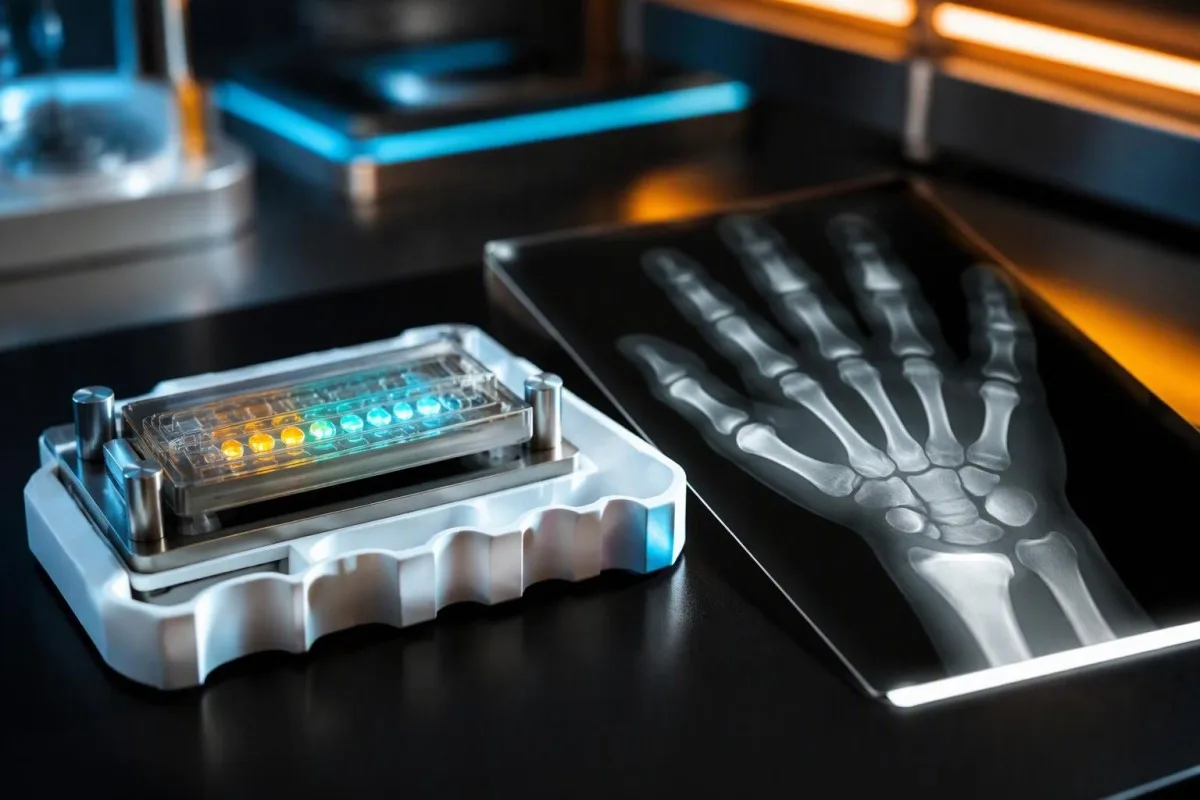
- Kaulų amžius: Kairės plaštakos ir riešo rentgenograma padeda įvertinti skeleto brandą; daugiau nei 2 metų pažengusi branda kelia didesnį susirūpinimą, tačiau neįrodo centrinio brendimo.
- Tolesni veiksmai: Jei nėra skubių pavojaus požymių, po 3–6 mėnesių numatytas pakartotinis vertinimas gali padėti atskirti stabilius pavienius pokyčius nuo progresuojančio brendimo.
- Skubūs simptomai: Ankstyvas vystymasis kartu su stipriu galvos skausmu, regėjimo pokyčiais, traukuliais, gausiu kraujavimu iš makšties ar ūmiu sėklidžių skausmu reikalauja skubaus medicininio įvertinimo.
Kada dėl ankstyvo vystymosi reikia atlikti kraujo tyrimą?
A ankstyvo brendimo kraujo tyrimas padeda įvertinti mergaičių krūtų vystymąsi iki 8 metų arba berniukų sėklidžių padidėjimą iki 9 metų. Gydytojai LH, FSH ir pasirinktų lytinių hormonų tyrimų rezultatus vertina kartu su apžiūra, augimo duomenimis ir dažnai kaulų amžiumi; mažas bazinis LH kiekis neatmeta ankstyvo centrinio brendimo.
Pirmiausia reikia nustatyti, ar suaktyvėjo smegenų valdomas brendimo kelias, ar pasireiškė tik vienas ankstyvas pokytis. Centrinis ankstyvas brendimas paprastai pasireiškia progresuojančia raidos požymių seka; pavienis kūno kvapas, gaktos plaukai ar nepakitęs krūties audinys gali vystytis kitaip, net jei tai pastebėta iki 8 ar 9 metų ribos.
Gimtadienis yra siuntimo pas specialistą orientyras, o ne biologinis jungiklis: jei raida sparčiai progresuoja, 7 metų ir 11 mėnesių bei 8 metų ir 1 mėnesio vaikams gali reikėti panašaus dėmesio. Amerikos pediatrų akademijos ataskaitoje nurodoma, kad progresavimas per 4–6 mėnesius ir pagreitėjęs augimas yra priežastys specialisto įvertinimui (Kaplowitz and Bloch, 2016).
Kantesti yra AI kraujo tyrimo analizatorius tai gali padėti paaiškinti pateiktus LH ir FSH rodiklius, tačiau jokio DI pateikto rezultato negalima laikyti apžiūros, būtinos iki 8 ar 9 metų, pakaitalu. Mūsų organizacija ir klinikiniai įgaliojimai reikėtų skaityti kartu su vaikų tyrimų rezultatų interpretavimo ribotumais, ypač kai, nepaisant iš pažiūros nuraminančio rezultato, matyti progresavimas.
Kokie ankstyvo brendimo požymiai rodo centrinį brendimą?
Progresuojantis mergaičių krūtų vystymasis ir abipusis berniukų sėklidžių padidėjimas yra svaresni centrinio brendimo požymiai nei vien plaukai ar kvapas. Gaktos plaukai iki 8 ar 9 metų gali rodyti antinksčių hormonų aktyvumą be smegenų–hipofizės brendimo kelio suaktyvėjimo.
Priešlaikinė telarchė reiškia izoliuotą ankstyvą krūtų vystymąsi, dažnai be spartesnio augimo ar kitų estrogenų poveikio požymių. Jis gali būti asimetriškas ir svyruoti, ypač labai mažiems vaikams; jei krūtų audinys pirmą kartą atsiranda po 3 metų, svarbu stebėti jo raidą, o ne manyti, kad kiekvienas pavienis pokytis išnyks.
Priešlaikinė adrenarchė gali lemti gaktos ar pažastų plaukų atsiradimą, kūno kvapą ir lengvą aknę, nes antinksčiai gamina daugiau androgenų. Jaunesniam nei 9 metų berniukui plaukai ir mažos sėklidės rodo, kad raida neatitinka įprastos centrinio brendimo sekos; greitas varpos augimas, žemėjantis balsas ar ryški virilizacija vis tiek reikalauja ištirti, ar nėra perteklinio androgenų poveikio arba gamybos.
Svarbesnė yra požymių seka, o ne nesusijusių hormonų rodiklių rinkimas. Suaugusiųjų menstruacinio ciklo taisyklių negalima taikyti 6 metų vaikui, kuriam formuojasi krūties užuomazga, o paauglių dėsningumai vėl skiriasi; mūsų paauglių hormonų tyrimų vadove paaiškinama, kodėl laboratorinių tyrimų rezultatus būtina vertinti atsižvelgiant į raidos stadiją, o ne laikyti ją nebūtina detale.
Kodėl pirmiausia vertinamos augimo kreivės ir atliekama apžiūra?
Augimo spartėjimas ir raidos progresavimas help determine whether early signs represent active puberty. A clinician checks height velocity, Tanner stage and, in boys, testicular size; bilateral testicular volume around 4 mL or greater generally marks pubertal onset, although measurement methods differ.
Many school-age children grow roughly 5–6 cm per year before puberty, although age and individual patterns matter. A sustained rise toward 7–8 cm per year, especially with upward crossing of height percentiles, can strengthen suspicion of puberty; two measurements separated by only a few weeks are too vulnerable to measurement error.
Consider a hypothetical 7-year-old whose LH is 0.08 IU/L but whose breast development has progressed and whose measured growth has accelerated over 6 months. I would not let the low LH close the case: those findings create a reason to repeat an appropriate morning measurement, obtain bone age or arrange stimulation testing.
Accurate height records are worth bringing from school, primary care and previous specialist visits, ideally covering 12–24 months. Puberty can make a child temporarily tall while reducing remaining growth potential; that differs from the problems discussed in our childhood growth hormone guide, where poor linear growth often drives the investigation.
Ką nustato pradinis ankstyvo brendimo kraujo tyrimas?
The initial panel usually includes ultrasensitive LH and FSH, with estradiol in girls or testosterone in boys when clinically useful. Additional tests depend on the signs: a child under 8 or 9 with hair alone needs a different investigation from a child with progressive gonadal development.
LH provides evidence about pituitary activation, while FSH is less specific because prepubertal and early-pubertal values overlap. A single LH-to-FSH ratio cannot establish the diagnosis in a 7-year-old; the adult applications described in our LH and FSH comparison should not be used as pediatric diagnostic rules.
Estradiol may remain very low or fluctuate despite genuine early breast development, and routine assays can struggle near their lower detection limits. Testosterone is often more informative in boys, but a value such as 30 ng/dL must still be interpreted against age, examination and assay method rather than a reference interval intended for a 30-year-old.
Broad screening creates noise when the clinical question is narrow. Thyroid tests, adrenal androgens, 17-hydroxyprogesterone or hCG may be appropriate for selected findings, not automatically for every child; our hormonal physiology reference provides background while reinforcing that pediatric thresholds are distinct from adult reproductive ranges.
Kodėl bazinis LH gali būti mažas esant ankstyvam brendimui?
A low basal LH does not rule out early central precocious puberty. Early LH secretion is intermittent and initially more prominent during sleep, so a daytime sample can miss activation; a result of 0.08 IU/L may be inconclusive rather than definitively negative.
A basal sample is one frame from a moving film. In early puberty, the pituitary may release LH in pulses that leave a quiet interval between them; an early-morning sample can be more informative than a late-afternoon sample, but even a carefully timed result below 0.3 IU/L cannot overrule convincing progression.
The assay can hide the signal too. A report reading '<0.2 IU/L' does not tell you whether the underlying value is 0.01 or 0.19 IU/L, and those possibilities are not analytically identical; ask whether the laboratory uses a pediatric-sensitive LH method and whether its stated lower limit is detection or reliable quantification.
Kantesti yra AI kraujo tyrimo rezultatų interpretavimo platforma that can explain why an LH below 0.3 IU/L is not a stand-alone exclusion result. Our už ribų esantis rezultatas addresses the opposite misconception as well: a result inside a printed interval can still require follow-up when the interval does not match the child's developmental stage.
Kokia bazinio LH riba patvirtina centrinį brendimą?
A basal LH around 0.3 IU/L or higher supports central puberty on some ultrasensitive assays, but there is no single cutoff that applies to every laboratory. Lower thresholds may detect more early cases while creating more overlap with children who do not have progressive central puberty.
Cutoffs balance sensitivity and specificity, not normality and danger. A threshold of 0.3 IU/L is used because sustained LH becomes more detectable as pituitary activation develops; it is not a toxicity boundary, an emergency threshold or a number that independently determines whether treatment should start.
Units deserve a quick check before interpretation: 1 IU/L equals 1 mIU/mL, so those two LH expressions have the same numerical value. By contrast, a report containing only 'negative' or '<0.1' carries less information than an exact quantified result; our kokybinis prieš kiekybinį vadovas paaiškina šį skirtumą.
When I interpret an LH of 0.24 IU/L, I would ask about the assay, sampling time and 3–6-month developmental trajectory before calling it reassuring or concerning. The 2022 Korean clinical guideline discusses assay-dependent basal thresholds and cautions about reduced LH responses in children with obesity (Kim et al., 2023); body size should modify interpretation, not become a reason to dismiss progressive development.
Kada padeda GnRH stimuliacijos mėginys?
A GnRH stimulation test helps when early development is progressing but basal LH is low or ambiguous. The test measures pituitary hormone responses after GnRH or a GnRH agonist; it is particularly useful when a child under 8 or 9 has examination findings that disagree with the initial laboratory result.
Stimulation asks whether the pituitary is ready to respond in a pubertal pattern, rather than waiting for a spontaneous LH pulse. The 2022 Korean guideline recommends interpreting stimulated LH alongside Tanner stage, growth velocity and bone age, rather than treating the response as an isolated diagnosis (Kim et al., 2023).
The protocol matters. Depending on the agent and local method, samples may be collected at baseline and several points over roughly 30–120 minutes, while some agonist protocols add later measurements; a value at 30 minutes cannot automatically be compared with a peak obtained using a different drug or a later collection schedule.
This is a specialist-supervised test, not a challenge to reproduce at home, and medication doses are determined by the local pediatric protocol. Preparation instructions can differ from an ordinary laboratory visit; our first sample preparation guide is useful background, but the testing unit's instructions take priority for fasting, medicines and appointment length.
Kaip interpretuojami stimuliuoto LH rezultatai?
A stimulated LH peak around 5 IU/L or higher supports central puberty in many protocols, including the cited Korean guideline. The exact threshold depends on the stimulation agent, assay and sampling schedule; a lower response does not necessarily settle the question when development continues to progress.
A peak of 4.8 IU/L and a peak of 5.2 IU/L are not biologically opposite states. Near a protocol's decision limit, analytical variation, missed peak timing and clinical trajectory become especially relevant; clinicians may review the entire LH and FSH response rather than assigning certainty to the final decimal place.
FSH-predominant responses can occur with isolated thelarche, but response ratios overlap and their interpretation varies by age and protocol. In girls under 3, developmental physiology can complicate stimulation results further; a pubertal-looking laboratory response requires correlation with sustained progression, estrogen effects and growth rather than automatic treatment.
Children with obesity may have lower stimulated LH responses, especially early in development, so an apparently subthreshold peak needs thoughtful interpretation. Repeating a test with another assay introduces another variable; our between-visit result comparison explains why a change over 3 months is easier to assess when the laboratory method and sampling conditions are documented.
Kuo kaulų amžiaus nustatymas papildo brendimo tyrimus?
Bone age estimates skeletal maturity from a left-hand and wrist radiograph. Advancement of more than 2 years can strengthen concern about sustained hormone exposure, but bone age alone cannot distinguish central puberty from adrenal androgen effects, obesity or other causes of accelerated skeletal maturation.
A bone age of 10 in an 8-year-old means the hand's maturation resembles the reference pattern for an older child; it does not mean every aspect of development has advanced by 2 years. Greulich–Pyle and Tanner–Whitehouse methods approach the estimate differently, and reader variation should be considered before small changes are treated as progression.
An advanced bone age can indicate less remaining growth despite an impressive current height. Predicted adult-height calculations depend on assumptions that may not hold during rapidly progressing puberty, so a single estimate should not be presented as a guaranteed outcome; serial growth over 6–12 months often gives the prediction more clinical meaning.
A normal bone age does not exclude very early central puberty because skeletal change may lag behind the first signs. Likewise, IGF-1 can rise with pubertal maturation without implying a separate growth-hormone disorder; our age-specific IGF-1 interpretation explains why chronological age, developmental stage and the laboratory's reference population must be considered together.
Kada rezultatai rodo periferinę hormonų gamybą?
Sex-hormone effects with persistently suppressed LH can suggest peripheral hormone production or exposure rather than central puberty. In a child under 8 or 9, the evaluation may include adrenal disorders, functional ovarian cysts, hCG-related conditions, severe hypothyroidism or contact with another person's hormone medication.
Rapid pubic-hair development, acne and virilization may justify morning 17-hydroxyprogesterone testing for congenital adrenal hyperplasia. A screening value around 200 ng/dL, equivalent to 2 ng/mL, is commonly used to consider further assessment for nonclassic disease, but age, assay and symptoms matter; our 17-hydroxyprogesterone testing guide explains why confirmation may require an ACTH stimulation test.
Severe primary hypothyroidism is an unusual but useful exception: apparent pubertal development can occur with slow growth and delayed bone age, rather than the acceleration expected in ordinary central puberty. A 7-year-old with this combination needs TSH and free T4 assessment; our tiroksino ir TSH paaiškinime provides the relevant laboratory background.
Ask specifically about testosterone gels, estrogen creams and hormone-containing supplements used by household members, including accidental transfer through contact. DHEA-S can help identify an adrenal contribution, but an adult androgen interval cannot classify a 6-year-old; our DHEA-S prieš DHEA vadovas explains the different information these measurements provide.
Kam reikia MRT, ultragarso arba genetinių tyrimų?
Brain MRI is generally recommended for boys with confirmed central precocious puberty, girls with onset before age 6, and children with neurological symptoms. For girls aged 6–8 without neurological findings, imaging decisions are individualized because the likelihood of a relevant intracranial cause is lower.
Early puberty with headache or visual change requires a different level of attention from isolated odor in an otherwise well 7-year-old. Carel and Léger's clinical review describes the importance of identifying central nervous system causes, particularly in boys and younger girls (Carel and Léger, 2008); our neurological warning signs guide helps families recognize symptoms without assuming that early puberty usually means a brain growth.
Pelvic ultrasound may support assessment in girls, especially when bleeding, a mass or a peripheral estrogen source is suspected, but size measurements overlap between developmental stages. In a girl aged 6–8, uterine or ovarian measurements cannot replace the examination and hormone pattern; in boys, asymmetry or a palpable testicular abnormality may prompt targeted ultrasound.
Family history can guide testing for causes such as MKRN3-related central puberty, but genetic testing is not routine for every child before age 8 or 9. Kantesti AI can explain laboratory terminology, not read an MRI or establish a genetic diagnosis; our AI technologijų gidas describes a different task from pediatric endocrine imaging and examination.
Kada pakanka stebėjimo, o kada svarstomas gydymas?
Stable isolated changes can often be monitored for 3–6 months, while progressive central puberty may warrant treatment after specialist assessment. The decision considers age at onset, progression, skeletal advancement, remaining growth potential and the child's needs—not whether one LH value crosses 0.3 IU/L.
Observation should have a date and a plan: reassess height velocity, developmental stage and new symptoms, then repeat selected testing if the pattern changes. A 7-year-old with stable isolated breast tissue and ordinary growth needs a different pathway from a 5-year-old whose development and bone age are advancing quickly.
GnRH agonist treatment suppresses the central puberty pathway through sustained receptor stimulation that ultimately reduces gonadotropin release. Height benefit is generally clearest in girls whose puberty begins before age 6, becomes more variable between 6 and 8, and requires individualized discussion at older ages; treatment is not automatically beneficial merely because puberty is earlier than the family expected.
Pubic hair or odor may continue during effective treatment because adrenal maturation is not the same pathway being suppressed. I would explain that distinction before monitoring begins, rather than letting families interpret every new hair as treatment failure; our šeimai skirtu tyrimų pagal amžių vadovu reinforces why follow-up should answer specific clinical questions instead of adding broad panels every 3 months.
Kaip šeimos turėtų pasiruošti brendimo tyrimams ir pasidalyti jų rezultatais?
Bring the child's growth records, symptom timeline and complete laboratory report, including assay units and collection time. For suspected early puberty before age 8 or 9, these details make interpretation more useful than a cropped image containing only the LH result and a colored normal-range flag.
Ask the ordering team whether the sample should be collected early in the morning and whether fasting is required; these are not identical instructions. Record all medicines and supplements, including biotin, because interference varies by assay, and do not stop a child's prescription medicine simply to improve a test; for a stimulation visit, confirm whether the appointment lasts 1–2 hours or longer.
Kantesti yra AI pagrindu veikiantis kraujo tyrimų analizės įrankis that can help organize an LH result such as 0.12 IU/L alongside its printed units and reference interval. That explanation cannot certify that puberty is absent, and families should check whether a service supports the child's age and obtain appropriate permission; our upload privacy checklist explains how to limit unnecessary identifiers.
A child needs age-appropriate explanation and privacy as well as parental involvement, particularly when development begins at 6 or 7. Share only the information needed for care, avoid uploading intimate photographs, and check retention and deletion terms before using any digital service; our informacija apie privatumą ir duomenis describes the policies families should review before sharing a pediatric report.
Mokslinės publikacijos ir klinikinio interpretavimo standartai
Clinical puberty guidelines—not product usage reports—should guide diagnosis and treatment. As of October 23, 2026, the external references below support this article's discussion of age thresholds, basal LH limitations, stimulation testing and bone age; organizational research serves a separate purpose.
The AAP report from 2016, the clinical review from 2008 and the Korean guideline published in 2023 address complementary questions rather than supplying one universal laboratory rule. Assay technology and local stimulation protocols differ, so I would expect a pediatric endocrinologist to use the testing laboratory's validated decision limits alongside these sources.
Kantesti's 2 linked Zenodo publications concern an organizational validation framework and a global testing report; they should not be treated as evidence that an AI system can diagnose childhood puberty or validate every pediatric LH assay. Our medicininio patvirtinimo informaciją should be assessed for its stated population, methods and limitations before any performance claim is applied to children.
For Thomas Klein, the editorial priority here is simple: an LH below 0.3 IU/L should never become a blanket reassurance message when a child's development is clearly progressing. Our medicininės konsultacinės tarybos informacija describes clinical oversight roles; a named review date should be recorded only after an actual medical review, and the 2 organizational citations below remain separate from the condition-specific medical references.
Dažnai užduodami klausimai
Koks kraujo tyrimas atliekamas siekiant nustatyti ankstyvą brendimą?
Atliekant pradinį kraujo tyrimą dėl ankstyvo lytinio brendimo paprastai nustatomas itin jautrus LH ir FSH, o mergaitėms, kai reikia, – estradiolis, berniukams – testosteronas. Tyrimai atliekami, kai lytinis brendimas prasideda mergaitėms iki 8 metų, berniukams – iki 9 metų, tačiau vien dėl plaukų augimo ar kūno kvapo gali prireikti kitokio tyrimų rinkinio. Gydytojas rezultatus vertina kartu su apžiūros duomenimis, augimo greičiu, o kartais ir kaulų amžiumi. Kai kuriems vaikams taip pat reikia antinksčių, skydliaukės ar stimuliacijos tyrimų.
Ar mažas LH kiekis gali paneigti ankstyvą lytinį brendimą?
Maža bazinė LH koncentracija negali patikimai atmesti ankstyvo centrinio priešlaikinio brendimo. Mažesnė nei 0,3 IU/L vertė gali būti nustatyta dėl to, kad ankstyvoje stadijoje LH išsiskiria pulsuojančiai, o ryškiausiai – miegant, arba jo koncentracija nesiekia patikimos tyrimo metodo matavimo ribos. Nepaisant mažo rezultato, progresuojantis krūtų ar sėklidžių vystymasis ir spartesnis augimas išlieka priežastys atlikti papildomą vertinimą. Pakartotinis tyrimas anksti ryte arba specialisto prižiūrimas stimuliacijos mėginys gali būti naudingas.
Koks LH kiekis rodo centrinį priešlaikinį lytinį brendimą?
Bazinis LH, siekiantis apie 0,3 IU/L ar daugiau, kai kuriuose itin jautriuose tyrimuose patvirtina centrinį brendimą, tačiau ribinė vertė priklauso nuo laboratorijos. Daugelyje stimuliacijos protokolų didžiausia LH vertė, siekianti apie 5 IU/L, laikoma hipofizės aktyvumo patvirtinimu. Nė viena iš šių verčių nepatvirtina diagnozės, jei neatsižvelgiama į vaiko amžių, raidos požymius ir tyrimo protokolą. Ribinius rezultatus reikia vertinti atsižvelgiant į aplinkybes, o ne universaliai priskirti teigiamiems ar neigiamiems.
Kas vyksta atliekant GnRH stimuliacijos mėginį?
GnRH stimuliacijos testu matuojama, kaip hipofizė išskiria LH ir FSH, gavusi GnRH arba GnRH agonisto. Atsižvelgiant į protokolą, laboratoriniai mėginiai gali būti imami prieš tyrimą ir kelis kartus maždaug per 30–120 minučių, o kai kuriuose agonisto protokoluose matavimus reikia atlikti vėliau. Vaikų endokrinologų komanda parenka vaistą, dozę, laiką ir interpretavimo ribinę vertę. Šeimos turėtų laikytis tos įstaigos pasiruošimo instrukcijų ir nemanyti, kad taikomos įprastos nevalgymo taisyklės.
Ar pažengęs kaulų amžius reiškia, kad mano vaikui prasideda ankstyvas brendimas?
Pažengęs kaulinis amžius savaime neleidžia diagnozuoti ankstyvo lytinio brendimo. Daugiau nei 2 metų pažengimas gali patvirtinti ilgalaikį hormonų poveikį, tačiau nutukimas, priešlaikinė adrenarchė ir kitos būklės taip pat gali paspartinti skeleto brendimą. Normalus kaulinis amžius neatmeta tik neseniai prasidėjusio brendimo. Gydytojai vertina rentgenogramą kartu su augimo duomenimis, apžiūros rezultatais ir hormonų tyrimų rezultatais.
0 Ar gaktos plaukai iki 8 metų visada reiškia ankstyvą brendimą?
Gaktos plaukai iki 8 metų mergaitėms arba 9 metų berniukams nebūtinai reiškia centrinį ankstyvą brendimą. Priešlaikinė adrenarchė gali lemti plaukų atsiradimą, kūno kvapą ir lengvą aknę, neaktyvindama centrinio brendimo kelio. Greita raida, ryški virilizacija, spartesnis augimas arba kartu pasireiškiantis krūtų ar sėklidžių vystymasis didina poreikį atlikti ištyrimą. Esant stabiliems izoliuotiems požymiams, gydytojui numačius, juos galima stebėti 3–6 mėnesius.
Kada ankstyvo lytinio brendimo požymius reikia skubiai įvertinti?
Ankstyvieji brendimo požymiai, kuriuos lydi stiprus ar staigus galvos skausmas, regėjimo pokyčiai, traukuliai ar kiti neurologiniai simptomai, reikalauja skubaus medicininio įvertinimo. Dėl gausaus kraujavimo iš makšties ar ūmaus sėklidės skausmo taip pat būtina nedelsiant kreiptis į gydytoją, nelaukiant planinių hormonų tyrimų rezultatų. Patvirtintas centrinis brendimas berniukams iki 9 metų arba mergaitėms, kurioms jis prasidėjo iki 6 metų, paprastai reikalauja specialisto ištyrimo, įskaitant smegenų MRT svarstymą. Pavienis kvapas, kai nėra kitų nerimą keliančių požymių, paprastai nėra skubi būklė.
Gaukite AI pagrįstą kraujo tyrimo analizę jau šiandien
Prisijunkite prie daugiau nei 2 milijonų naudotojų visame pasaulyje, kurie pasitiki Kantesti dėl momentinės, tikslios laboratorinių tyrimų analizės. Įkelkite savo kraujo tyrimo rezultatus ir per kelias sekundes gaukite išsamią 15,000+ biomarkerių interpretaciją.
📚 Nuorodomis pagrįsti moksliniai leidiniai
Klein, T., Mitchell, S., & Weber, H. (2026). Klinikinio patvirtinimo sistema v2.0 (Medicininio patvirtinimo puslapis). Kantesti AI Medical Research.
Klein, T., Mitchell, S., & Weber, H. (2026). AI kraujo tyrimo analizatorius: išanalizuota 2,5 mln. tyrimų | Pasaulinė sveikatos ataskaita 2026. Kantesti AI Medical Research.
📖 Išorinės medicininės nuorodos
Kaplowitz P, Bloch C (2016). Evaluation and Referral of Children With Signs of Early Puberty.
Carel JC, Léger J (2008). Clinical practice. Precocious puberty. Naujasis Anglijos žurnalas.
Kim SJ et al. (2023). 2022 Clinical practice guidelines for central precocious puberty of Korean children and adolescents. Annals of Pediatric Endocrinology & Metabolism.
⚕️ Medicininis atsakomybės apribojimas
Šis straipsnis skirtas tik mokymo tikslais ir nesudaro medicininės konsultacijos. Visada kreipkitės į kvalifikuotą sveikatos priežiūros specialistą dėl diagnozės ir gydymo sprendimų.
E-E-A-T patikimumo signalai
Patirtis
Gydytojo vadovaujama klinikinė laboratorinių tyrimų interpretavimo darbo eigų peržiūra.
Ekspertizė
Laboratorinės medicinos dėmesys tam, kaip biomarkeriai elgiasi klinikiniame kontekste.
Autoritetas
Parašyta dr. Thomas Klein, peržiūrėjo dr. Sarah Mitchell ir prof. dr. Hans Weber.
Patikimumas
Įrodymais pagrįsta interpretacija su aiškiais tolesnių veiksmų keliais, siekiant sumažinti nerimą.