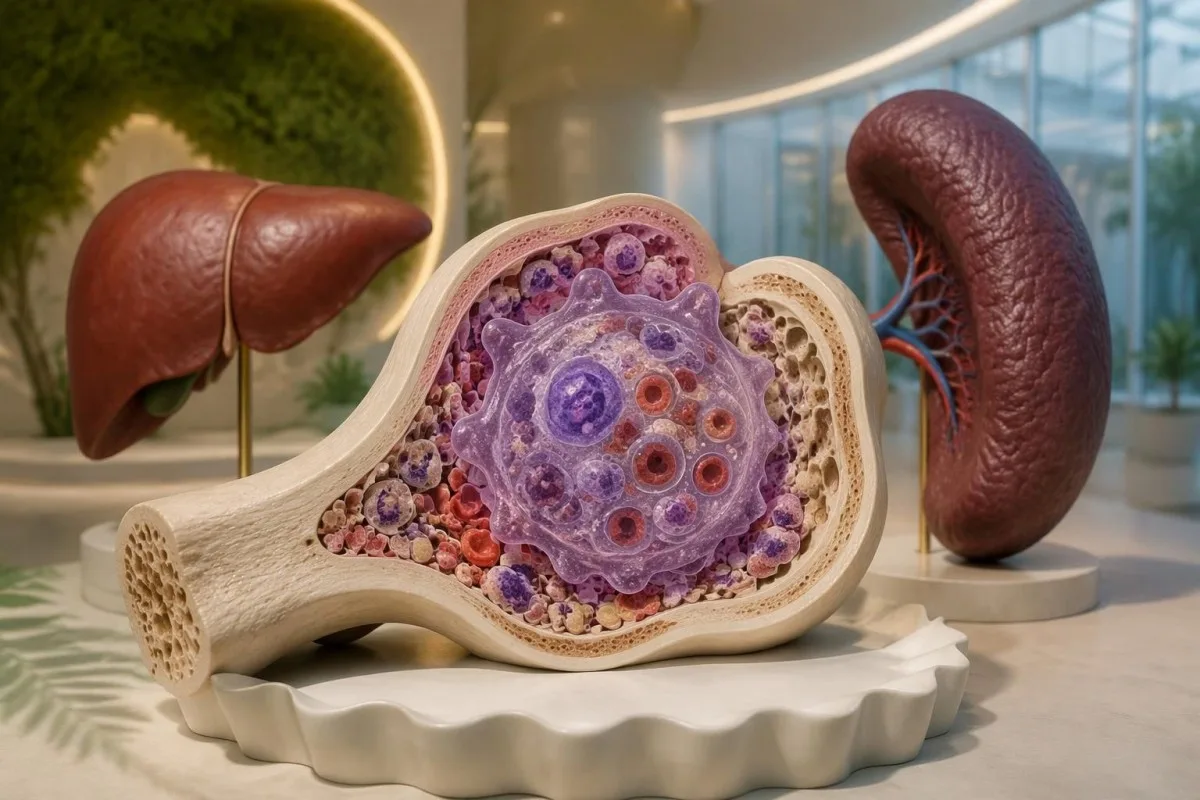
A magas HScore fokozza a felnőttkori szekunder HLH gyanúját; nem erősíti meg a diagnózist. A tartós láz, a csökkenő vérsejtszámok és a romló szervműködés sürgős kivizsgálást tesznek szükségessé akkor is, ha a pontszám alacsony vagy hiányos.

Főbb tanulságok
- A magas HScore jelentése felnőtteknél a szekunder HLH nagyobb valószínűségét jelenti, nem pedig az állapot bizonyítékát; a pontszám 9 klinikai és laboratóriumi változót kombinál.
- A 169-es küszöbérték az eredeti vizsgálatban körülbelül 93% érzékenységet és 86% specificitást mutatott, de ezek az értékek nem jellemzik minden kórházi populációt.
- Valószínűségi becslések az eredeti modellben 90 alatti pontszámok esetén 1% alatti, 250 feletti pontszámok esetén pedig 99% feletti értéknek feleltek meg — ezek azonban nem garantált, személyre szabott valószínűségek.
- Önmagában a ferritinszint nem alkalmas a HLH diagnosztizálására; az 500 ng/mL teljesíti a HLH-2004 egyik kritériumát, míg a HScore 2,000 ng/mL-nél kezd ferritinpontokat adni.
- Eltérő kritériumok számítanak: a HScore citopéniára vonatkozó küszöbértékei: hemoglobin ≤9,2 g/dL, vérlemezkeszám ≤110 × 10^9/L, összfehérvérsejtszám pedig ≤5,0 × 10^9/L.
- A HLH-2004 diagnózisa kompatibilis molekuláris diagnózison vagy a 8 kritérium közül 5 teljesülésén alapul, a klinikai lefolyással és a szakorvosi megítéléssel együtt értelmezve.
- A hiányzó vizsgálatok nem negatív eredmények; a csontvelő vizsgálatának elmaradása 35 lehetséges HScore-pontot hagyhat tisztázatlanul.
- Sürgős felmérés tartós láz és csökkenő vérsejtszám vagy szervi működészavar esetén szükséges; zavartság, súlyos nehézlégzés, összeesés vagy jelentős vérzés sürgősségi ellátást igényel.
A magas HScore azt jelenti, hogy HLH-je van?
Nem. A a magas HScore a másodlagos hemofagocitás limfohisztiocitózis, vagy HLH, nagyobb valószínűségét jelzi, de önmagában nem erősíti meg a diagnózist. A gyakran alkalmazott 169-es küszöb további kivizsgálást indokol; a tartós láz, a csökkenő vérsejtszám és a romló szervműködés sürgős szakorvosi vizsgálatot tesz szükségessé, függetlenül attól, hogy elérte-e ezt a küszöböt.
A másodlagos HLH az immunrendszer kontrollálatlan aktiválódásával járó, potenciálisan életveszélyes szindróma, nem pedig egyetlen kóros laboratóriumi eredmény vagy egy konkrét fertőzés. A 9 változóból álló pontszámot reaktív hemofagocitás szindróma miatt vizsgált felnőttek számára fejlesztették ki, ezért ha egy egészséges ember véletlenül észlelt ferritinszint-emelkedésére alkalmazzák, az megváltoztatja azt a környezetet, amelyben a becslést használják.
Egy lázas, kórházban kezelt felnőtt 180-as pontszáma mást jelent, mint egy egymással nem összefüggő járóbeteg-eredményekből összeállított online eredmény. Az orvosok először azt mérlegelik, hogy a megfigyelések ugyanahhoz a megbetegedési epizódhoz tartoznak-e, magyarázza-e őket egy alternatív diagnózis, illetve romlik-e az illető állapota – mert egy matematikailag helyes összpontszám is választ adhat rossz klinikai kérdésre.
Kantesti egy AI vérvizsgálati analizátor amely segít megmagyarázni az olyan leleteket, mint a 2000 ng/mL feletti ferritinszint más laboreredmények mellett; nem állapíthat meg HLH-diagnózist, és nem helyettesíti a sürgősségi vizsgálatot. A mi vállalati hátteret ismerteti a magyarázatok hátterében álló szervezetet, a feltételezett HLH-val kapcsolatos döntéseket pedig a kezelőorvosi csapat hozza meg.
Hogyan kell értelmezni a HScore küszöbértékeit és százalékait?
Egy A 169-es vagy annál magasabb HScore gyakran alkalmazott szűrési küszöb, nem pedig a HLH meglétét és hiányát elválasztó diagnosztikai határ. Fardet és munkatársai (2014) ennél a határértéknél körülbelül 93% érzékenységről és 86% fajlagosságról számoltak be; a kalkulátor által megjelenített valószínűség a mögöttes modelltől különálló eredmény.
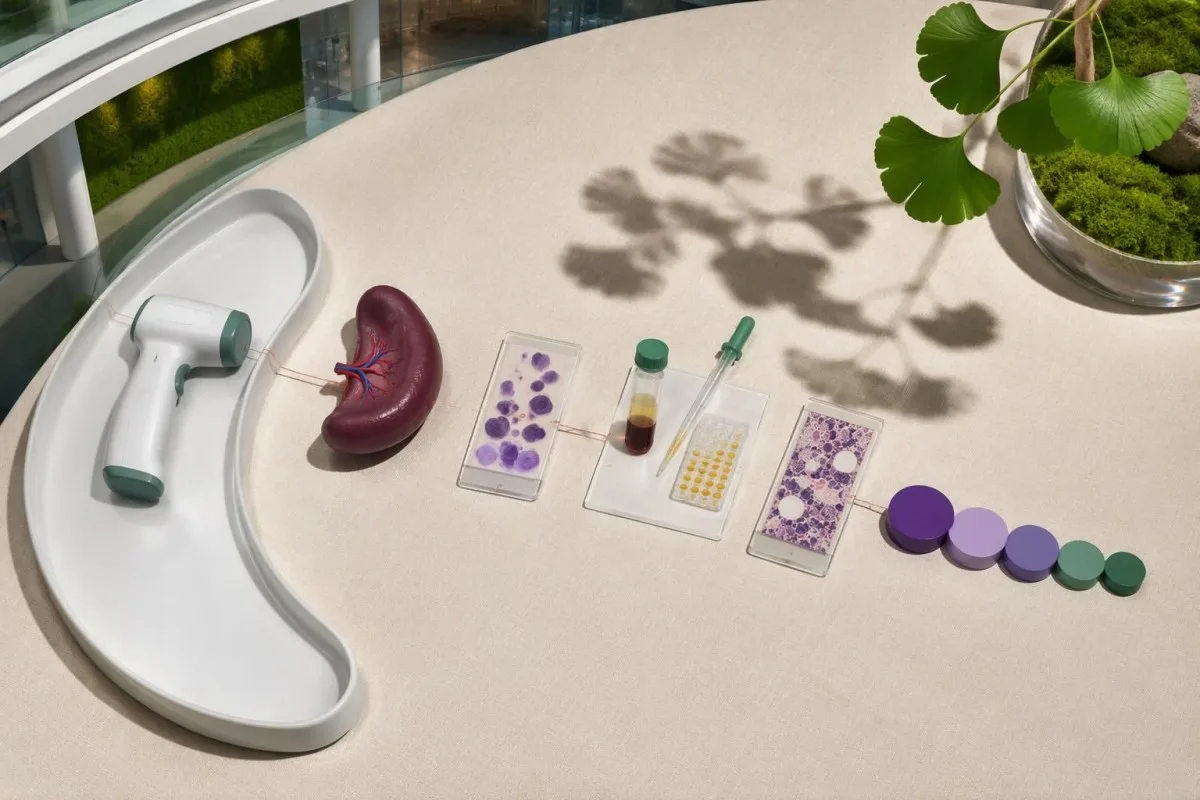
A 93% érzékenység azt jelenti, hogy az eredeti vizsgálati körülmények között az érintett betegek körülbelül 7%-a a küszöbérték alatt maradhat. A 86%-os fajlagosság azt jelenti, hogy az érintettek közé nem tartozó betegek körülbelül 14%-a elérheti vagy meghaladhatja ezt az értéket; egyik szám sem jelenti azt, hogy a pozitív eredményt elérő személynél 93% a HLH valószínűsége.
Egy egyértelműen hipotetikus bayesi példa megmutatja, miért fontos a beutalt betegek köre: 5%-os vizsgálat előtti valószínűség, 93%-os érzékenység és 86%-os fajlagosság mellett a pozitív küszöbérték körülbelül 26%-os pozitív prediktív értéket eredményez. 50%-os vizsgálat előtti valószínűségnél ugyanez a számítás körülbelül 87%-ot ad; ezek a példák nem helyettesítik a HScore-kalkulátor modelljét vagy a más populációban validált becsléseket.
Az eredeti fejlesztési vizsgálatban 312, feltételezett reaktív hemofagocitás szindróma miatt vizsgált beteg vett részt, nem pedig egy általános szűrési populáció. A kalkulátor százalékos értéke ezért a modell bemeneti adatoktól és fejlesztési környezetétől függő becslését írja le; a következő magyarázatunk: a számszerű és a kategóriákba sorolt eredményekről segít megkülönböztetni a valószínűséget a pozitív vagy negatív diagnózistól.
| Szint | Tartomány | Mit jelent |
|---|---|---|
| Low model estimate | HScore <90 | Less than 1% estimated probability in the original model; not an absolute exclusion rule. |
| Below common screening threshold | HScore 90–168 | Below the commonly used 169 cutoff; early disease, missing inputs, or treatment can limit reassurance. |
| At or above screening threshold | HScore 169–250 | Increasing concern for HLH; probability varies substantially within this interval. |
| Very high model estimate | HScore >250 | Greater than 99% estimated probability in the original model; urgent clinical assessment is appropriate, but the score is not independent confirmation. |
Melyik kilenc leletet használja a HScore-kalkulátor?
Egy HScore calculator combines immunosuppression, temperature, organ enlargement, cytopenias, ferritin, triglycerides, fibrinogen, AST, and bone-marrow hemophagocytosis. The maximum total is 337 points; several inputs require examination, imaging, medication history, or tissue findings and cannot be recovered from a routine blood report alone.
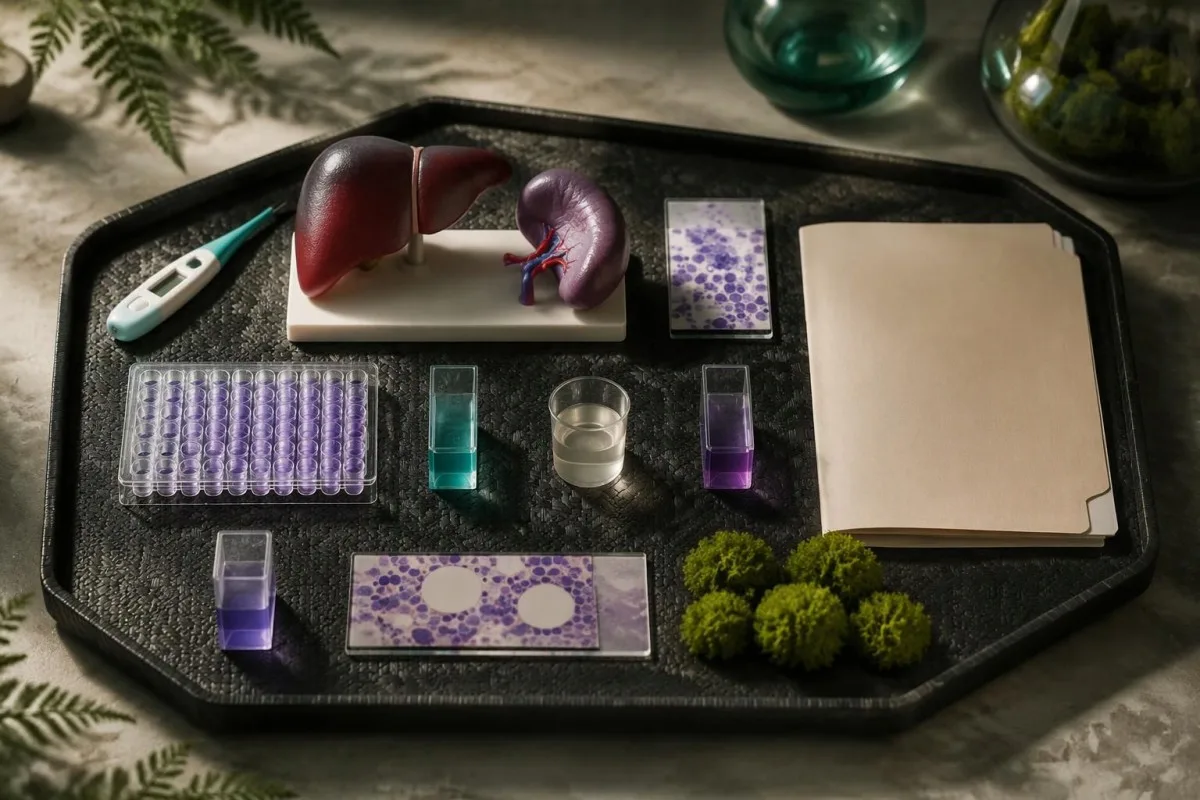
HScore cytopenia thresholds are hemoglobin ≤9.2 g/dL, platelets ≤110 × 10^9/L, and total white cells ≤5.0 × 10^9/L. Zero or 1 qualifying lineage earns no cytopenia points; 2 earn 24 and 3 earn 34, so an isolated platelet reduction is not scored like a simultaneous reduction across all three lineages.
A white-cell count of 4.8 × 10^9/L can qualify for the HScore even when it falls within a laboratory's reference interval. These are model thresholds, not universal definitions of an abnormal CBC; our hemoglobin and hematocrit explanation also explains why hemoglobin—not hematocrit or red-cell count—is the anemia input.
Fibrinogen ≤2.5 g/L contributes 30 points, whereas AST ≥30 IU/L contributes 19; neither finding is specific to HLH. Kantesti's vérbiomarker referenciaútmutató supports understanding the measurements, but the original score definitions must take precedence over a laboratory's high or low flags when a clinician calculates the HScore.
| Szint | Tartomány | Mit jelent |
|---|---|---|
| Known immunosuppression | Absent: 0; present: 18 points | Use the original definition, including HIV or long-term immunosuppressive therapy; do not infer it from feeling run down. |
| Temperature | <38.4°C: 0; 38.4–39.4°C: 33; >39.4°C: 49 points | Document the temperature and its timing relative to fever-reducing medicines. |
| Organ enlargement | Neither: 0; liver or spleen: 23; both: 38 points | Requires documented hepatomegaly or splenomegaly, not abdominal discomfort alone. |
| Qualifying cytopenic lineages | 0–1: 0; 2: 24; 3: 34 points | Use hemoglobin ≤9.2 g/dL, platelets ≤110 × 10^9/L, and total white cells ≤5.0 × 10^9/L. |
| Ferritin | <2,000: 0; 2,000–6,000: 35; >6,000 ng/mL: 50 points | Ferritin points are capped; increasingly extreme values above 6,000 do not add further points. |
| Trigliceridek | <1.5: 0; 1.5–4.0: 44; >4.0 mmol/L: 64 points | Equivalent boundaries are approximately 133 and 354 mg/dL. |
| Fibrinogén | >2.5: 0; ≤2.5 g/L: 30 points | 2.5 g/L equals 250 mg/dL. |
| AST | <30: 0; ≥30 IU/L: 19 points | Use AST, not ALT; muscle injury and sample hemolysis can affect interpretation. |
| Bone-marrow hemophagocytosis | Absent: 0; present: 35 points | Not assessed is unresolved information, even if a calculator defaults it to zero. |
Mi teheti félrevezetővé a HScore-kalkulátor eredményét?
Missing information, incorrect units, and measurements from different illness stages can make an HScore misleading. A calculator that assigns zero to an unexamined marrow leaves 35 potential points unresolved; the total may be a useful provisional estimate, but it is not equivalent to a fully documented assessment.
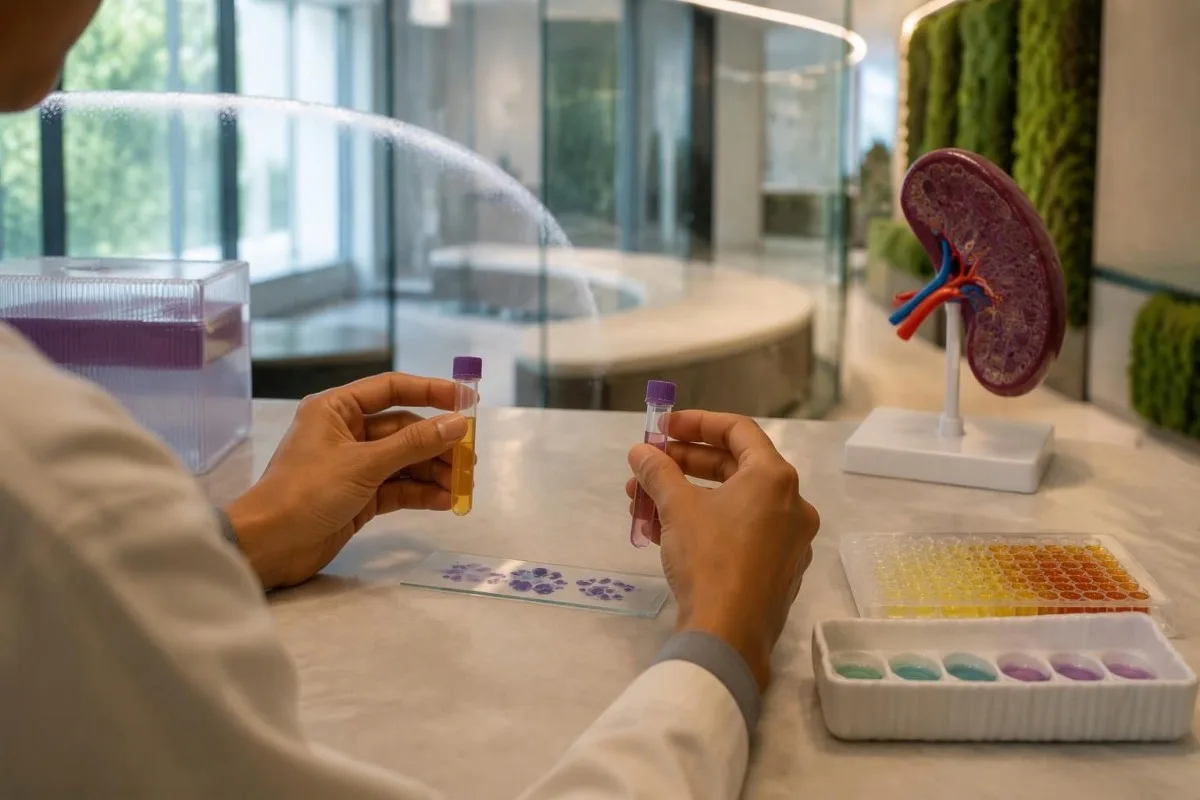
Ferritin in ng/mL and µg/L has the same numerical value, but fibrinogen in mg/dL and g/L does not: 250 mg/dL equals 2.5 g/L. Triglycerides require another conversion, with mmol/L multiplied by approximately 88.6 to obtain mg/dL; entering 250 mg/dL as 250 mmol/L can force a falsely high triglyceride category.
A platelet count of 85 × 10^9/L may be genuine, but platelet clumping can create a falsely low automated result. Laboratory comments and the cell review matter before that value is counted as a qualifying lineage; our explanation of EDTA-related platelet clumping describes how an alternative collection method may clarify the count.
AST ≥30 IU/L earns points even when the increase is small, so a compromised sample can alter the total without adding evidence of immune overactivation. A Magas hemolízis index can help explain an unreliable AST result; suspected HLH still requires prompt assessment while clinicians resolve specimen problems, rather than waiting for a perfect dataset.
Miben különbözik a HScore a HLH-2004 diagnosztikai kritériumaitól?
HScore is a weighted adult probability model; HLH-2004 is a diagnostic framework with 8 criteria. HLH-2004 permits diagnosis through a compatible molecular diagnosis or fulfillment of 5 of 8 criteria, but adult specialists also consider the trajectory and may act before all criteria are documented (Henter et al., 2007; La Rosée et al., 2019).
The first 3 HLH-2004 findings are fever, splenomegaly, and cytopenias affecting at least 2 lineages: hemoglobin <9 g/dL, platelets <100 × 10^9/L, or neutrophils <1.0 × 10^9/L in the usual non-neonatal thresholds. Unlike the HScore, HLH-2004 uses neutrophils rather than total white cells and does not award extra points for liver enlargement.
Another criterion is fasting triglycerides ≥3.0 mmol/L, approximately 265 mg/dL, and/or fibrinogen ≤1.5 g/L. The remaining 4 criteria are hemophagocytosis in marrow, spleen, or lymph nodes; low or absent natural-killer-cell activity; ferritin ≥500 ng/mL; and soluble CD25, also called soluble IL-2 receptor, ≥2,400 U/mL using an appropriate assay.
A fibrinogen result of 2.0 g/L earns 30 HScore points but does not meet the HLH-2004 fibrinogen threshold, illustrating why the two systems cannot be interchanged. HLH-2004 arose from pediatric treatment guidance; our discussion of children's interpretation safety explains why adult models should not be transferred casually to children, including those with possible inherited immune disorders.
A nagyon magas ferritinszint HLH-t jelent?
Very high ferritin increases concern for serious illness but does not identify HLH by itself. Ferritin ≥500 ng/mL meets one HLH-2004 criterion, while the HScore awards ferritin points only from 2,000 ng/mL; even values above 10,000 ng/mL can occur in adults with other illnesses.
Ferritin is both an iron-storage marker and an acute-phase reactant, so infection, liver injury, inflammatory disease, and some malignancies can raise it without HLH. Adult recommendations caution against treating a single ferritin threshold as diagnostic; La Rosée et al. (2019) emphasize the overall clinical picture, particularly when extreme elevations coexist with cytopenias and organ dysfunction.
Consider a hypothetical well adult with ferritin 650 ng/mL after a recent illness and no fever, falling counts, or organ dysfunction: that result is not equivalent to ferritin 6,500 ng/mL during rapid clinical deterioration. Our exercise-related ferritin discussion concerns stable outpatient interpretation, not a reason to attribute an acutely unwell person's extreme ferritin to training.
The HScore ferritin contribution is capped at 50 points above 6,000 ng/mL, so a rise from 8,000 to 25,000 may convey deterioration that the total score does not capture. Transferrin saturation and the broader vasvizsgálatok értelmezése help investigate iron loading, but iron overload assessment and urgent HLH assessment answer different questions and can require different timelines.
Milyen leletek kombinációi teszik aggasztóbbá a HLH-t?
Persistent fever plus falling blood counts, rising ferritin, and worsening liver or coagulation results is more concerning for HLH than any isolated abnormality. Fibrinogen falling toward 2.5 g/L can be especially informative during a strong inflammatory response, because inflammation often raises fibrinogen rather than lowering it.
A hypothetical platelet decline from 210 to 95 × 10^9/L over 48 hours deserves attention even before all 3 lineages cross HScore thresholds. The rate of change may signal evolving consumption, marrow suppression, or immune disease; the reason clinicians examine DIC-re jellemző laboratóriumi mintázatokról szóló tárgyalásunk is that disseminated intravascular coagulation can coexist with HLH or result from another critical illness.
A high CRP does not exclude HLH, and a white-cell count of 4.5 × 10^9/L does not establish it. Cytopenias can reflect medicines, infection, marrow disease, or baseline variation, so clinicians use the differential count, smear, previous results, and the WBC-versus-CRP relationship to ask whether several abnormalities share one evolving explanation.
Kantesti egy AI vérvizsgálat-értelmező platform that can help organize patterns across 2 or more reports, but an apparent trend must be checked against sampling dates, treatment, and laboratory methods. A falling fibrinogen with rising ferritin is a reason to contact the clinical team promptly—not proof that the platform, or the patient reading the report, has identified HLH.
Mikor teszi szükségessé a feltételezett HLH a sürgős szakorvosi vizsgálatot?
Suspected HLH requires urgent hospital-based assessment when fever accompanies falling counts or organ dysfunction; do not wait for an HScore of 169. Confusion, seizures, severe breathlessness, collapse, significant bleeding, or rapidly worsening jaundice require emergency care because HLH, sepsis, and other dangerous conditions can present similarly.

Fever with an absolute neutrophil count below 0.5 × 10^9/L is an emergency pattern, whether or not HLH is the eventual diagnosis. A person receiving chemotherapy or immunosuppressive treatment should follow their urgent-care instructions immediately; fever-reducing medicines may lower the measured temperature without making the underlying illness safe to monitor at home.
New breathlessness during a febrile illness can reflect lung involvement, anemia, fluid problems, or infection rather than the HScore itself. Our légszomj tesztelési útmutató explains why oxygenation and clinical examination matter alongside laboratory values; a reassuring ferritin or a score below 169 should never override severe respiratory symptoms.
A high HScore with persistent fever and deteriorating results merits same-day discussion with the treating team, commonly involving hematology and other relevant specialists. Bring available reports, but do not delay seeking care to retrieve all 9 inputs or wait for a marrow appointment; in the UK, call 999 for life-threatening symptoms, or use the local emergency number elsewhere.
Kizárhatja az alacsony HScore a korai vagy kezelt HLH-t?
A low HScore cannot reliably exclude HLH when the illness is early, key inputs are missing, or treatment has changed the findings. The original 169 threshold had approximately 93% sensitivity, not 100%; clinical deterioration can justify reassessment even when a first calculation falls below that cutoff.
Glucocorticoids and fever-reducing treatment can suppress some score inputs, while transfusion can raise hemoglobin and plasma products can alter coagulation measurements. A temperature of 37.8°C after treatment is not interchangeable with an untreated peak of 39.6°C; clinicians need the treatment timeline to interpret the score rather than assuming the lower total demonstrates recovery.
An unexamined marrow, unknown organ size, and absent triglyceride measurement leave 3 different areas of uncertainty. Recalculation should use clinically appropriate observations from the same assessment window, not a patchwork of worst-ever values selected from unrelated admissions; our gyógyszerbiztonsági trend útmutatónk explains why treatment dates belong beside laboratory trends.
Az Kantesti klinikai validációs információi concerns interpretation standards and limitations; it should not be read as validation of an HScore cutoff for every setting. The original 169 operating point cannot automatically be assumed to retain the same accuracy in intensive care, rheumatology-associated macrophage activation syndrome, or patients already receiving immune-directed treatment.
Mi válthat ki szekunder HLH-t felnőtteknél?
Infections, malignancies, and autoimmune or autoinflammatory disease are major trigger groups for secondary HLH in adults. An HScore of 200 does not tell clinicians which trigger is present; identifying the cause matters because controlling immune activation and treating the underlying disease often need to happen together.
Epstein–Barr virus is a recognized HLH trigger, but positive EBV IgG often reflects past exposure rather than the cause of an acute syndrome. A hypothetical adult with ferritin 12,000 ng/mL and positive VCA IgG still needs an appropriately selected infection workup; our EBV antitest minta útmutató explains why antibody history is not the same as active viral disease.
Certain treatable infections can cause fever, cytopenias, and liver-test abnormalities that resemble or trigger HLH, making exposure history medically useful. For example, a platelet count of 70 × 10^9/L after tick exposure changes the questions clinicians ask; our discussion of ehrlichiosis testing timing shows why early PCR and later antibodies may provide different information.
Macrophage activation syndrome, often associated with rheumatic disease, overlaps with secondary HLH but may need disease-specific assessment rather than rigid dependence on HScore 169. Lymphoma and other hematologic malignancies also warrant investigation when appropriate; adult presentation does not exclude inherited susceptibility, particularly when there are recurrent episodes, a suggestive family history, or unusual immune-function findings.
Hogyan néznek ki a hipotetikusan magas és hiányos HScores-értékek?
Worked examples show how the total is assembled, not how to diagnose yourself. A hypothetical adult with documented fever, spleen enlargement, 3 qualifying cytopenias, high ferritin, elevated triglycerides, low fibrinogen, and elevated AST can accumulate 264 points before marrow findings are known.
Suppose a hypothetical 52-year-old adult has no known immunosuppression, temperature 39.6°C, splenomegaly without hepatomegaly, hemoglobin 8.7 g/dL, platelets 80 × 10^9/L, and white cells 3.2 × 10^9/L. Those inputs contribute 0 + 49 + 23 + 34 = 106 points; the clinical pattern already deserves urgent attention before the remaining measurements are added.
Add ferritin 8,500 ng/mL, triglycerides 3.1 mmol/L, fibrinogen 1.8 g/L, and AST 120 IU/L: their contributions are 50 + 44 + 30 + 19 = 143, producing a subtotal of 249, not 264. If both liver and spleen were enlarged instead, the organ contribution would rise by 15 points to produce 264; unexamined marrow leaves a further 35 points unresolved in either example.
For contrast, ferritin 4,200 ng/mL and AST 45 IU/L contribute only 54 points between them; they do not establish a complete low HScore when the other 7 inputs are unknown. Kantesti uses these hypothetical calculations to show why missingness and exact definitions matter; our blood-test timeline explanation helps organize the observations before a clinician interprets the total.
Mi történik, miután a klinikusok HLH-ra gyanakodnak?
Clinicians investigate HLH and its trigger in parallel, usually repeating blood counts, ferritin, liver tests, triglycerides, and coagulation measurements while considering marrow examination and specialist immune tests. Soluble CD25 ≥2,400 U/mL is one HLH-2004 criterion, but assay units and delayed turnaround can complicate interpretation.
Hemophagocytosis is neither necessary nor sufficient for HLH diagnosis: it may be absent early and can occur in other severe illnesses. A positive marrow result contributes 35 HScore points, but marrow examination may be just as valuable for detecting a malignancy, infection, or alternative explanation for cytopenias; our MDS diagnostic limits guide illustrates why a CBC cannot replace tissue-based investigation.
Specialist tests can include soluble IL-2 receptor, natural-killer-cell function, selected genetic studies, and targeted microbiological testing, depending on the presentation. A laboratory reporting soluble CD25 in pg/mL cannot be compared directly with the original 2,400 U/mL threshold without assay-specific interpretation; asking which method and reference system were used can prevent a misleading criterion count.
Treatment may begin before 5 HLH-2004 criteria are documented when the clinical team judges the syndrome sufficiently likely and organ dysfunction is progressing. La Rosée et al. (2019) describe individualized adult management that may involve glucocorticoids, selected cytokine-directed treatment, or etoposide-containing regimens; an HScore alone does not determine a drug, dose, or safe treatment pathway.
Hogyan készülhet fel biztonságosan a HScore-ról szóló megbeszélésre?
Kantesti egy Mesterséges intelligencia-alapú vérvizsgálat-elemző eszköz for understanding laboratory reports, not a service that confirms HLH or manages emergency deterioration. Before discussing an HScore near or above 169, gather the original reports, their dates and units, recent treatments, and any documented liver or spleen findings.
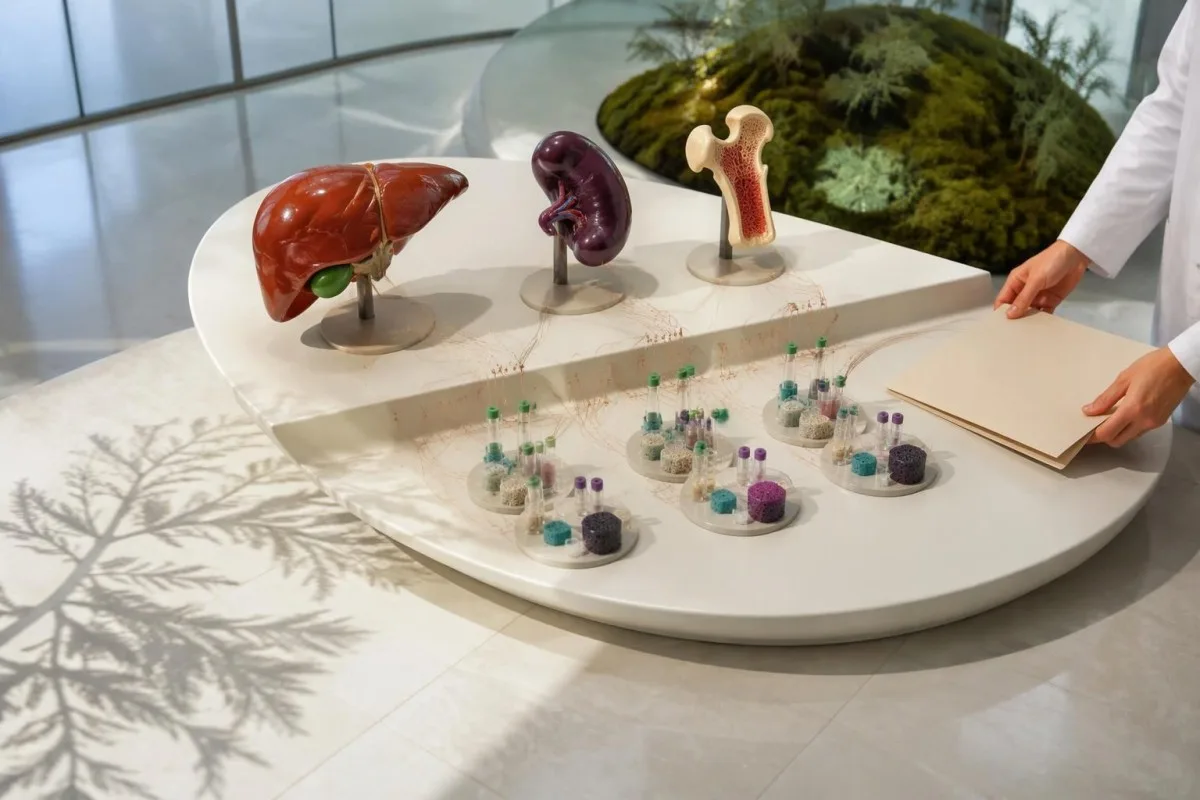
A useful appointment summary separates measured, documented, and unknown information across all 9 HScore inputs. Record the highest relevant temperature with its timing, whether imaging documented organ enlargement, and whether marrow was examined; write 'not assessed' rather than 'negative' when a test or examination has not happened.
Ask 3 focused questions: Is this pattern concerning for HLH or another urgent condition, which missing investigations could change the assessment, and what symptoms should trigger immediate return? If you are clinically stable with ferritin 700 ng/mL and no systemic warning signs, ask about ordinary iron, liver, and inflammatory causes rather than assuming an HLH workup is automatically required.
Diet, supplements, and iron avoidance do not treat suspected HLH, even when ferritin exceeds 6,000 ng/mL. Our felelős MI-re vonatkozó kötelezettségvállalásaink explain the boundary between educational interpretation and medical decision-making; the practical next step for a high, unexplained score is clinician contact, not repeated online calculations intended to obtain a more reassuring number.
Kutatási publikációk és a HScore értelmezésének bizonyítékai
The main evidence for HScore interpretation comes from its 2014 development study and adult HLH recommendations, not general laboratory guides. Fardet et al. established the model and its 169 operating threshold; Henter et al. (2007) described HLH-2004, and La Rosée et al. (2019) addressed the challenges of applying diagnostic and treatment frameworks to adults.

The 3 clinical references below answer different questions: how the score was developed, what the HLH-2004 criteria require, and how adult management differs from a purely pediatric protocol. None makes a calculator a standalone diagnostic test, and none establishes one universally reliable threshold for every patient group, treatment stage, or hospital setting.
Kantesti LTD, UK Company No. 17090423, also publishes educational laboratory guides; the 2 Zenodo records listed below concern kidney function and urinalysis, not HScore validation. Our vesefunkciós arányokról szóló útmutató can help readers understand accompanying renal measurements when a multisystem illness affects hydration or organ function, without identifying the cause of that illness.
Urinalysis is not one of the 9 HScore inputs, although urine findings may contribute to a broader assessment of organ involvement or alternative diagnoses. The vizeletvizsgálati (urinalysis) értelmezési útmutató is supplementary reading; our orvosi tartalmi szabványok explain why educational publications, diagnostic studies, and clinical guidelines should be distinguished rather than presented as equivalent evidence.
Gyakran feltett kérdések
Megerősíti a magas HScore az HLH-t?
A magas HScore növeli a szekunder HLH becsült valószínűségét felnőtteknél, de önmagában nem erősíti meg a diagnózist. Az eredeti vizsgálatban a gyakran alkalmazott 169-es küszöbérték hozzávetőleg 93% érzékenységgel és 86% fajlagossággal járt. A klinikusoknak értékelniük kell a betegség lefolyását, az alternatív diagnózisokat, a hiányzó adatokat és az alátámasztó vizsgálati eredményeket. A csökkenő vérsejtszámokkal vagy szervi működészavarral társuló tartós láz sürgős kivizsgálást igényel, nem pedig egy újabb kalkulátoreredményre való várakozást.
Milyen HScore-érték számít magasnak?
A 169-es vagy magasabb HScore-t gyakran küszöbértékként használják a felnőttkori másodlagos HLH további kivizsgálásának alátámasztására. Az eredeti modellben a 250 feletti pontszámokhoz 99%-nál nagyobb becsült valószínűség társult, de ez a százalékos érték nem garantál személyre szabott valószínűséget minden klinikai helyzetben. A 169 alatti HScore-értékek korai, nem teljes körűen kivizsgált vagy már kezelt HLH esetén is előfordulhatnak. A megfelelő teendő a klinikai mintázattól és attól függ, hogy romlik-e az érintett állapota.
Jelenthet-e a 10 000 feletti ferritinszint a HLH-től eltérő dolgot?
A 10 000 ng/ml feletti ferritinszint HLH nélküli felnőtteknél is előfordulhat, például súlyos fertőzés, májkárosodás, rosszindulatú daganat vagy más gyulladásos betegség esetén. Az ≥500 ng/ml ferritinszint csupán egy HLH-2004-kritériumnak felel meg, a HScore pedig 50 pontban maximálja a ferritinértéket, ha az meghaladja a 6000 ng/ml-t. A rendkívül magas ferritinszint aggasztóbb, ha tartós lázzal, csökkenő vérsejtszámokkal, alacsony fibrinogénszinttel vagy szervi működészavarral társul. Klinikai kivizsgálást kell indokolnia, nem pedig a HLH vagy a vastúlterhelés automatikus diagnózisát.
Kiszámítható-e az HScore csontvelővizsgálat nélkül?
A csontvelővizsgálat előtt előzetes HScore-számítás végezhető, de a meg nem vizsgált csontvelő státusza ismeretlen, nem pedig negatív. A csontvelői hemofagocitózis 35 pontot ér, ezért a bizonytalanság úgy írható le, mint lehetséges 35 pontos hozzáadás, ha az összes többi adat dokumentált. A hemofagocitózis hiánya a vizsgált mintában nem zárja ki a HLH-t, jelenléte pedig önmagában nem erősíti meg a HLH-t. A sürgős kivizsgálást nem szabad pusztán e tétel pótlása miatt késleltetni.
Mi a különbség a HScore és a HLH-2004 kritériumrendszer között?
A HScore egy 9 bemeneti változót használó, súlyozott valószínűségi modell, míg a HLH-2004 kompatibilis molekuláris diagnózist vagy a 8 diagnosztikai kritériumból 5 teljesülését követeli meg. A laboratóriumi küszöbértékeik különböznek: a HScore a fibrinogénszint ≤2,5 g/L értékénél ad pontot, míg a HLH-2004 fibrinogénküszöbe ≤1,5 g/L. A HLH-2004 a természetes ölősejtek aktivitását és az oldható CD25-öt is figyelembe veszi, amelyek nem szerepelnek a HScore-ban. A felnőtteket kezelő szakorvosok ezeket a keretrendszereket klinikai megítélésükkel együtt alkalmazzák, nem pedig felcserélhető tesztekként kezelik őket.
Kizárhatja az alacsony HScore a HLH-t?
Az alacsony HScore nem zárhatja ki biztonságosan a HLH-t, ha fontos leletek hiányoznak, a kezelés megváltoztatta az eredményeket, vagy a szindróma még kialakulóban van. Az eredeti, 169-es küszöbérték érzékenysége hozzávetőleg 93% volt, nem pedig 100%, és más populációkban eltérő lehet a teljesítménye. Az eredeti modellben a 90 alatti pontszám 1%-nál kisebb becsült valószínűséget jelentett, nem pedig abszolút kizárási szabályt. Az újonnan jelentkező zavartság, súlyos légszomj, összeesés, jelentős vérzés vagy a szervműködés romlása felül kell hogy írja az alacsony pontszám nyújtotta megnyugtatást.
Érthető magyarázatot kaphat a vérvizsgálat eredményekről
Töltse fel laborleletét, és az Kantesti AI másodpercek alatt közérthetően elmagyarázza az egyes biomarkereket. Világszerte több mint 2 millió ember használja.
Referenciák
- Klein, T., Mitchell, S., & Weber, H. (2026). BUN/Creatinintartalom magyarázata: vesefunkciós teszt útmutató. Kantesti AI orvosi kutatás. DOI
- Klein, T., Mitchell, S., & Weber, H. (2026). Urobilinogén vizeletteszt: teljes vizeletanalízis útmutató 2026. Kantesti AI orvosi kutatás. DOI
- Fardet L et al. (2014). Development and validation of the HScore, a score for the diagnosis of reactive hemophagocytic syndrome. Arthritis & Rheumatology. DOI PubMed
- Henter JI et al. (2007). HLH-2004: Diagnostic and therapeutic guidelines for hemophagocytic lymphohistiocytosis. Pediatric Blood & Cancer. DOI PubMed
- La Rosée P et al. (2019). Recommendations for the management of hemophagocytic lymphohistiocytosis in adults. Blood. DOI PubMed
- 2 hónapos kortólElemzett vizsgálatok
- 127+Országok
- 100+Nyelvek
Az orvosi csapatról


E-E-A-T bizalmi jelzések
Tapasztalat
Orvosok által vezetett klinikai áttekintés a laboratóriumi értelmezési munkafolyamatokról.
Szakértelem
Laboratóriumi medicina fókusz: hogyan viselkednek a biomarkerek klinikai környezetben.
Tekintélyesség
Orvosi lektor: Dr. Thomas Klein, közreműködött Dr. Sarah Mitchell és Prof. Dr. Hans Weber.
Megbízhatóság
Bizonyítékokon alapuló értelmezés, világos követési útvonalakkal a riadalom csökkentésére.






Orvosi nyilatkozat
A cikk kizárólag oktatási célokat szolgál, és nem minősül orvosi tanácsadásnak. A diagnózisra és a kezelési döntésekre vonatkozóan mindig konzultáljon szakképzett egészségügyi szolgáltatóval.
Közzétéve · Kapcsolat a szerkesztőséggel
Kiadó: Kantesti Ltd, bejegyezve Angliában és Walesben, cégjegyzékszám:. 17090423, London, Egyesült Királyság.
