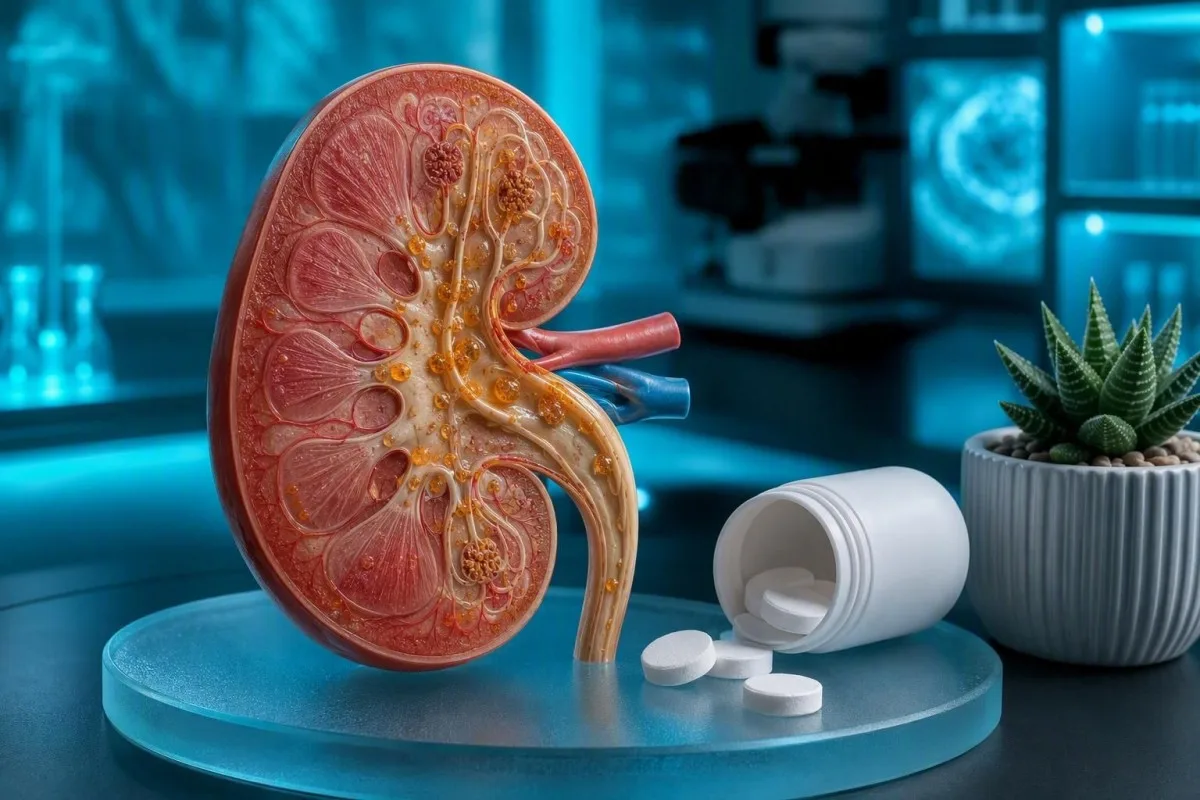
Calcium carbonate can relieve heartburn, but repeated doses can raise calcium, alkalinise the blood, and abruptly strain the kidneys. The risk is highest when vomiting, dehydration, vitamin D, or reduced kidney function enter the picture.


- High calcium usually means total calcium above about 2.60 mmol/L (10.4 mg/dL), but albumin and ionised calcium determine whether the result is real.
- Calcium carbonate is 40% elemental calcium: a 1,000 mg tablet contains about 400 mg of actual calcium.
- Milk-alkali syndrome is the combination of hypercalcaemia, metabolic alkalosis, and acute kidney injury after absorbable alkali and calcium intake.
- Urgent threshold: calcium at or above 3.0 mmol/L (12 mg/dL) needs same-day clinical assessment, especially with symptoms or worsening creatinine.
- Emergency symptoms include confusion, fainting, severe weakness, palpitations, repeated vomiting, very little urine, or inability to keep fluids down.
- Dehydration loop matters: high calcium causes thirst and urination, then volume loss reduces kidney calcium clearance and pushes calcium higher.
- Do not self-treat a high calcium result by drinking extreme volumes of water or taking more supplements; stop non-prescribed calcium carbonate and seek individual advice.
- Useful lab cluster includes adjusted or ionised calcium, creatinine/eGFR, bicarbonate or total CO2, phosphate, magnesium, potassium, and parathyroid hormone.
What does high calcium mean after taking antacids?
What does high calcium mean after antacids? It can mean calcium carbonate intake is contributing to hypercalcaemia, particularly when the result appears alongside a high bicarbonate level and a rising creatinine. A single borderline result is not a diagnosis, but calcium of 3.0 mmol/L (12 mg/dL) or higher deserves same-day assessment.
High calcium from antacids is often called calcium-alkali syndrome, previously milk-alkali syndrome. The modern pattern is less about milk and more about calcium carbonate chewables, osteoporosis supplements, fortified products, or several of these together. In my clinical work, the overlooked clue is often a patient saying, “They’re only antacids,” while taking 8 to 12 tablets on bad reflux days.
Total calcium is normally about 2.15 to 2.55 mmol/L (8.6 to 10.2 mg/dL) in many adult laboratories, although the range and adjustment method differ. Calcium bound to albumin can make total calcium look high during dehydration; ionised calcium, normally roughly 1.15 to 1.30 mmol/L, is the biologically active fraction. Our calcium guide for children explains why age-specific ranges cannot be borrowed for adults.
As of August 30, 2026, I would treat a calcium result as a clinical pattern, not a score to optimise. Kantesti is an AI blood test analyzer that places calcium beside kidney function, albumin, CO2, and previous results, because that combination is more informative than an isolated H flag. Dr. Thomas Klein’s practical rule: bring every antacid, supplement, and multivitamin packet to the assessment.
Calcium carbonate dose math patients commonly miss
Calcium carbonate can cause high calcium because it contains 40% elemental calcium and also delivers absorbable alkali. A label showing 1,000 mg calcium carbonate does not mean 1,000 mg of calcium; it supplies about 400 mg elemental calcium.
This distinction changes the arithmetic. Five 1,000 mg calcium carbonate tablets provide about 2,000 mg elemental calcium, before dietary calcium, a multivitamin, or a bone-health product is counted. Some antacid labels recommend no more than 7,500 mg calcium carbonate in 24 hours, but that label maximum is not a personal safety guarantee for someone with chronic kidney disease, dehydration, or vitamin D treatment.
Milk-alkali syndrome has occurred at lower intakes than the older textbook descriptions of more than 4 g elemental calcium daily. Felsenfeld and Levine described the syndrome as a self-reinforcing disturbance of calcium homeostasis rather than a simple dose threshold (Felsenfeld and Levine, 2006). Older age, thiazide diuretics, reduced eGFR, and poor fluid intake shrink the margin for error.
Count calcium from all sources for one ordinary week, not only the worst day. That includes chewables, liquid antacids, prenatal products, calcium/vitamin D combinations, and fortified shakes. If the label language is confusing, our blood test biomarker guide can help frame the relevant lab names, but a pharmacist is the fastest person to check the actual product formulation.
Why chewable tablets create a false sense of safety
Chewables are easy to repeat because relief is immediate while calcium accumulation is silent. A patient may take two after lunch, two at bedtime, and several overnight without perceiving this as “medication use.” Write down tablet strength, number taken, and timing; that record is clinically more useful than estimating from memory.
Milk-alkali syndrome symptoms and the three-lab pattern
Milk-alkali syndrome symptoms arise from the triad of high calcium, metabolic alkalosis, and kidney impairment. The classic laboratory pattern is elevated calcium, elevated bicarbonate or total CO2, and creatinine above the person’s baseline after substantial calcium and alkali exposure.
Symptoms can be annoyingly nonspecific: constipation, nausea, reduced appetite, fatigue, thirst, frequent urination, foggy thinking, or muscle weakness. That is why I ask specifically about antacids when a patient has “gastroenteritis” symptoms plus a bicarbonate of 30 mmol/L or higher. Vomiting can also raise bicarbonate, so the medication history matters.
The physiology is circular. Calcium can narrow kidney blood vessels and reduce sodium reabsorption, causing salt and water loss; volume contraction then increases bicarbonate retention and decreases calcium excretion. Medarov’s Mayo Clinic review remains useful here: calcium-alkali syndrome can progress rapidly when intake continues despite nausea and reduced fluids (Medarov, 2009).
Kantesti is an AI blood test interpretation platform that highlights this cluster when calcium, CO2, creatinine, and eGFR move together across a panel. It does not diagnose milk-alkali syndrome, because primary hyperparathyroidism and malignancy can also cause hypercalcaemia, but it can make the medication question harder to miss. Compare the renal change with our guide to temporary eGFR decline after dehydration.
Why dehydration makes calcium carbonate toxicity escalate
Dehydration can turn modest antacid overuse into clinically significant hypercalcaemia because the kidneys need circulating volume to excrete calcium. Dark urine, dizziness on standing, dry mouth, and a falling urine volume are warning patterns, not just inconveniences.
High calcium reduces the kidney’s ability to concentrate urine, so a person may initially pass unusually large amounts of urine and become thirsty. Later, vomiting, poor intake, or an older person avoiding fluids because of nocturia can produce a strikingly different picture: very little urine and rising creatinine. The shift from polyuria to oliguria is particularly concerning.
A raised urea-to-creatinine ratio may support volume depletion, but it is not a reliable standalone diagnosis. Creatinine can rise within 24 to 48 hours of a significant fluid insult, while eGFR is less reliable during a rapidly changing acute illness. Our BUN and creatinine ratio guide covers why both values need context.
Do not try to “flush out calcium” with extreme water intake if you have heart failure, advanced kidney disease, or are vomiting. Small frequent sips may be reasonable while arranging care if you can swallow and have no fluid restriction, but intravenous fluid decisions belong to a clinician. The dark urine warning guide is useful when urine colour is one of the first changes you notice.
Kidney effects of high calcium from antacids
High calcium can cause acute kidney injury by reducing renal blood flow, promoting water loss, and depositing calcium in kidney tissue when exposure persists. A creatinine rise from baseline plus calcium above 2.60 mmol/L is more concerning than either abnormality alone.
The kidney panel should include creatinine, eGFR, urea or BUN, sodium, potassium, chloride, bicarbonate/CO2, magnesium, phosphate, and urinalysis when indicated. Low phosphate can accompany calcium-alkali syndrome because calcium binds phosphate in the gut, though the pattern is not universal. A normal potassium does not rule out serious kidney stress.
KDIGO defines acute kidney injury partly as a creatinine increase of 0.3 mg/dL (26.5 µmol/L) within 48 hours or 1.5 times baseline within 7 days (KDIGO, 2012). That threshold was designed for early detection, not reassurance; someone with low muscle mass may have clinically important injury despite a creatinine that still looks “normal.”
I have seen patients focus on a mildly high calcium while overlooking a creatinine that doubled from 55 to 110 µmol/L. That change should prompt action even if the laboratory reference range is broad. For kidney-protective supplement choices after recovery, see supplements and chronic kidney disease.
When a calcium result needs urgent care today
Seek urgent same-day assessment for calcium at or above 3.0 mmol/L (12 mg/dL), any rapidly rising calcium, or a high result with vomiting, confusion, weakness, palpitations, or reduced urine. Call emergency services rather than driving yourself if there is collapse, severe drowsiness, chest pain, or new disorientation.
Severity is not determined by calcium alone. A level of 2.75 mmol/L may be manageable with prompt outpatient review in a well person with stable kidney function, while 2.65 mmol/L with repeated vomiting, eGFR 25 mL/min/1.73 m², or a new rhythm symptom can require hospital treatment. Symptoms and trajectory decide the urgency.
Emergency clinicians commonly repeat calcium, check ionised calcium, obtain electrolytes and creatinine, review an ECG, and give IV isotonic fluid if appropriate. Hypercalcaemia can shorten the QT interval and provoke rhythm disturbance, although an ECG can be normal even when the calcium problem is real. Do not take more calcium carbonate to settle nausea or indigestion while waiting.
Kantesti AI flags calcium plus renal and electrolyte abnormalities as a follow-up trigger rather than telling users that one value establishes a cause. For a broader triage framework, read our urgent electrolyte patterns guide.
Red flags beyond the calcium number
Confusion, marked weakness, inability to retain fluids, fainting, palpitations, and a clear fall in urine output are red flags even before a calcium result is available. In older adults, new constipation plus slowed thinking may be the first visible presentation rather than dramatic thirst.
Neurological symptoms can range from irritability and poor concentration to lethargy and coma at higher levels. The rate of increase often matters more than a single threshold: calcium rising from 2.40 to 3.05 mmol/L in two days is a different clinical event from a stable value of 2.70 over years. Family members are often better at noticing a change in thinking than the affected person.
Constipation is common but easy to dismiss, particularly in people already using antacids for dyspepsia. When constipation occurs with thirst, nausea, weakness, and excessive calcium carbonate use, I consider hypercalcaemia before recommending another magnesium- or calcium-containing remedy. The related constipation lab clues can help prepare for a clinician visit.
New flank pain, fever, or visible blood in urine needs separate evaluation; stones and urinary obstruction can coexist with high calcium but should not be assumed to be the same problem. Keep the medication packets and take a photograph of labels before leaving home. It saves time in urgent care.
Corrected calcium versus ionised calcium: which result matters?
Ionised calcium is the most physiologically direct measurement, while albumin-adjusted calcium is an estimate that can mislead during acute illness. A total calcium result should never be interpreted without its albumin, sampling context, and laboratory reference interval.
Many UK laboratories use an adjustment similar to: adjusted calcium = measured calcium + 0.02 × (40 − albumin in g/L). This equation is assay- and laboratory-specific, and it becomes less dependable in critical illness, severe acid-base disturbance, paraproteinaemia, or after major fluid shifts. Use the adjustment printed by your own lab when one is provided.
Alkalosis increases calcium binding to albumin and can lower ionised calcium even if total calcium is high. That sounds contradictory, but it explains why tingling or cramping can occasionally coexist with an abnormal total calcium pattern; it is one reason clinicians may recheck ionised calcium rather than rely on arithmetic. Acid-base status changes the biology, not merely the report.
A difficult sample can also distort results. Prolonged tourniquet use and marked dehydration can concentrate proteins, while laboratory methods vary. Before assuming a dangerous trend, compare the timing with our blood test difference guide and ask whether the sample should be repeated urgently under clinical supervision.
How clinicians distinguish antacid-related calcium from other causes
Antacid-related hypercalcaemia becomes more likely when calcium elevation follows calcium carbonate exposure with high bicarbonate and suppressed parathyroid hormone, but it is never the only possible cause. Primary hyperparathyroidism and malignancy remain common adult explanations for persistent high calcium.
Parathyroid hormone (PTH) should normally fall when calcium is high. A PTH that is high or inappropriately normal alongside confirmed hypercalcaemia points toward PTH-dependent causes, especially primary hyperparathyroidism. A low PTH shifts the investigation toward calcium intake, vitamin D-related causes, malignancy, granulomatous disease, thyroid disease, and certain medicines.
Calcium carbonate may be a contributor rather than the full explanation. I have cared for patients whose antacid use amplified an underlying mild hyperparathyroidism, producing a sharper presentation during a vomiting illness. Stopping the tablets can improve the number, yet the diagnosis still needs completion if calcium remains elevated after recovery.
Ask about thiazide diuretics, lithium, vitamin A derivatives, vitamin D doses, and immobilisation. Thiazides reduce urinary calcium excretion; lithium can shift PTH regulation. Our article on high vitamin D warning signs explains why checking 25-hydroxyvitamin D is often sensible, but not every high calcium result is vitamin D toxicity.
Medicines and health conditions that raise the risk
Reduced kidney function, thiazide diuretics, vitamin D therapy, pregnancy, older age, and volume depletion increase the risk of high calcium from antacids. People with eGFR below 60 mL/min/1.73 m² have less reserve for calcium and alkali loads.
Thiazides, commonly prescribed for blood pressure, decrease urinary calcium excretion. Angiotensin-converting enzyme inhibitors, ARBs, and NSAIDs do not directly raise calcium in the same way, but during dehydration they can worsen the kidney perfusion problem. Do not stop a prescribed medicine abruptly; contact the prescriber or urgent service for tailored advice.
Pregnancy deserves extra care because nausea can drive antacid use, while dehydration can develop quickly. Calcium needs in pregnancy are real, but separate prenatal calcium products, antacids, and fortified drinks can overlap. The same-day pregnancy lab red flags are a safer guide than guessing from a general adult threshold.
People with a history of kidney stones, sarcoidosis, prior hypercalcaemia, or bariatric surgery should not use prolonged calcium carbonate courses without medical review. The evidence is honestly mixed on exactly who will develop calcium-alkali syndrome at a given dose; susceptibility matters at least as much as the packet count.
What to do now if you suspect high calcium from antacids
Stop non-prescribed calcium carbonate and calcium-containing supplements, record what you took, and arrange prompt clinical advice if your calcium is high or you have symptoms. Do not restart a product simply because heartburn returns; reflux treatment can be changed safely after review.
Write down the brand, strength, number of tablets or spoonfuls, timing, vitamin D dose, and any calcium-fortified drinks consumed during the previous 7 days. Include over-the-counter products that seem unrelated, such as laxatives or indigestion remedies. This simple exposure history is often more diagnostic than a vague statement of “occasional use.”
If you feel well and have only a slight elevation, a clinician may repeat calcium, albumin, creatinine, CO2, and PTH after medication review and normal hydration. If you have symptoms or calcium of 3.0 mmol/L or more, do not wait for a routine repeat appointment. The basic metabolic panel guide explains the tests likely to be repeated.
Kantesti is an AI-powered blood test analysis tool used to organise lab results into a clinician-ready timeline, including whether calcium and creatinine changed together. It cannot replace examination, ECG review, or urgent treatment; use it to preserve the dates, values, and product history that make the consultation more efficient.
Do not compensate with another supplement
Avoid starting magnesium, phosphate, potassium, or high-dose vitamin D based on internet advice while hypercalcaemia is unresolved. These products can be useful in specific deficiencies, yet kidney injury changes how safely they are handled. A clinician can target treatment after repeat testing.
What urgent care and hospital treatment may involve
Hospital care for symptomatic or severe antacid-related hypercalcaemia usually begins with stopping the calcium source, careful IV isotonic fluid replacement, and frequent electrolyte and kidney monitoring. The treatment is aimed at restoring renal calcium excretion while avoiding fluid overload.
The first several hours matter because calcium can fall as circulation improves and the kidney begins excreting calcium again. Clinicians monitor urine output, creatinine, sodium, potassium, magnesium, phosphate, bicarbonate, and repeat calcium. A loop diuretic is not routine “calcium treatment”; it may be used only after adequate volume replacement in selected patients with fluid overload risk.
Bisphosphonates, calcitonin, glucocorticoids, or dialysis are reserved for particular causes or refractory severe hypercalcaemia. In calcium-alkali syndrome, antiresorptive drugs are often unnecessary and can overshoot into hypocalcaemia once the calcium source is stopped. This is one reason identifying the cause before reflex treatment is clinically valuable.
Most patients improve when the exposure and dehydration are corrected, but recovery is not a reason to skip follow-up. Calcium, creatinine, and bicarbonate should return toward baseline; persistent abnormalities require a wider endocrine or renal work-up. Read about changing labs after hospital discharge before comparing early post-discharge panels.
Preventing repeat high calcium from antacid use
The safest prevention strategy is to treat frequent heartburn as a reason for review rather than escalating calcium carbonate tablets. Needing antacids on most days for more than 2 weeks should trigger a pharmacist or clinician conversation about the cause of reflux and alternative treatment.
Start with the pattern: late meals, large fatty meals, caffeine, smoking, alcohol, NSAID use, weight change, pregnancy, and alarm symptoms all matter. Frequent dyspepsia can be reflux, gastritis, H. pylori, medication irritation, ulcer disease, or occasionally something more serious. Antacids mask acidity; they do not explain why symptoms keep recurring.
If a clinician recommends calcium for bone health, use the prescribed elemental dose and avoid doubling it through antacids. Calcium is usually absorbed best in divided doses of 500 to 600 mg elemental calcium or less at a time, but the precise plan depends on diet, fracture risk, kidney function, and whether calcium citrate would be preferable. Do not swap formulations without checking the indication.
In my experience, a medication list updated at each lab draw prevents repeat episodes better than generic warnings. Our long-term PPI monitoring guide discusses a different acid-suppression pathway and its monitoring trade-offs; it is not a recommendation to start or stop a PPI independently.
How to review calcium and kidney results over time
A meaningful calcium review compares the current result with prior calcium, albumin, creatinine, eGFR, CO2, and medication exposure on the same timeline. One result can be distorted by dehydration, but a reproducible upward drift is a clinical signal even if each value is only mildly raised.
Look for direction and pace. Calcium of 2.58, 2.62, and 2.77 mmol/L over several months suggests a different problem from a lone 2.77 during a diarrhoeal illness; both still need review, but the question changes. A repeat should generally use the same laboratory method where feasible, because reference intervals and albumin adjustment differ.
Kantesti AI can compare prior reports and surface changes in calcium, albumin, and kidney markers for discussion with your clinician. Our longitudinal blood test analysis guide explains why your own baseline may carry more meaning than a population range. We handle results as private health data, but the final interpretation remains clinical.
Dr. Thomas Klein recommends saving the original PDF, not merely a screenshot of flagged values. The draw date, units, reference interval, fasting status, recent illness, and supplement exposure all affect what a trend actually means. A change that looks alarming on a graph may be a known post-illness shift—or the first clue to a real disorder.
Questions to ask your clinician after a high calcium result
Ask whether your calcium was albumin-adjusted or ionised, whether kidney function changed from baseline, and whether PTH is appropriately suppressed. These three questions separate a potentially temporary antacid-related pattern from the need for a broader hypercalcaemia work-up.
Useful questions include: “Could my antacid dose provide this much elemental calcium?”, “Is my CO2 or bicarbonate high?”, “Do I need a repeat calcium and creatinine today?”, and “Which prescribed medicines should I continue while unwell?” Ask for units; mg/dL and mmol/L are not interchangeable without conversion. For calcium, 1 mmol/L is approximately 4 mg/dL.
Also ask how soon to retest after stopping the suspected source and whether persistent elevation needs PTH, 25-hydroxyvitamin D, phosphate, magnesium, urinary calcium, or imaging. The answer varies with severity and symptoms. There is no sensible one-size-fits-all “recheck in a month” rule when kidney function is changing.
Kantesti’s medical content is reviewed with clinical oversight; our Medical Advisory Board helps set the safety boundaries for results that warrant clinician assessment. For methodology and limits of automated interpretation, see our clinical validation information.
Research notes and the limits of self-interpretation
Published evidence supports calcium carbonate exposure as a reversible cause of hypercalcaemia, alkalosis, and kidney injury, but no app or article can establish the cause in an individual. Persistent high calcium always needs clinical evaluation after the suspected medication is stopped.
Felsenfeld and Levine (2006) detailed the calcium-alkali syndrome feedback loop, while Medarov (2009) showed how modern over-the-counter calcium products changed the syndrome’s epidemiology. These papers support a practical point: the combination of high calcium, alkalosis, and kidney impairment is more specific than any symptom by itself. They do not justify self-diagnosis.
Kantesti has analysed more than 2 million reports across 127 countries, yet prevalence in our user population cannot be used as a clinical risk estimate because uploaded tests are self-selected. Kantesti is an AI lab test interpretation service designed to make laboratory language clearer, not to replace urgent assessment. Our AI medical report safety guide explains the source checks patients should make before acting.
For technical context, review the Kantesti AI technology guide. Research references below describe our reporting work and are separate from the external clinical evidence used in this article.
Kantesti research publications
Klein T. (2026). AI Blood Test Analyzer: 2.5M Tests Analyzed | Global Health Report 2026. Zenodo. https://doi.org/10.5281/zenodo.18175532. ResearchGate record: https://www.researchgate.net/search.Search.html?query=AI%20Blood%20Test%20Analyzer%202.5M%20Tests%20Analyzed. Academia.edu record: https://www.academia.edu/search?q=AI%20Blood%20Test%20Analyzer%202.5M%20Tests%20Analyzed
Klein T. (2026). RDW Blood Test: Complete Guide to RDW-CV, MCV & MCHC. Zenodo. https://doi.org/10.5281/zenodo.18202598. ResearchGate record: https://www.researchgate.net/search.Search.html?query=RDW%20Blood%20Test%20Complete%20Guide. Academia.edu record: https://www.academia.edu/search?q=RDW%20Blood%20Test%20Complete%20Guide
Frequently Asked Questions
Can calcium carbonate antacids cause high calcium?
Yes. Calcium carbonate antacids can cause hypercalcaemia because calcium carbonate is about 40% elemental calcium and also supplies absorbable alkali. Five 1,000 mg tablets provide about 2,000 mg elemental calcium, before calcium from food or supplements is added. Risk rises sharply with dehydration, reduced kidney function, thiazide diuretics, and vitamin D treatment. A calcium result above 2.60 mmol/L (10.4 mg/dL) should prompt a medication review, and 3.0 mmol/L (12 mg/dL) or more generally needs same-day assessment.
What are the symptoms of milk-alkali syndrome?
Milk-alkali syndrome symptoms commonly include nausea, constipation, thirst, frequent urination, fatigue, weakness, and difficulty concentrating. More severe cases can cause repeated vomiting, confusion, palpitations, fainting, very low urine output, and acute kidney injury. The laboratory triad is high calcium, high bicarbonate or total CO2, and impaired kidney function after calcium and alkali exposure. Symptoms plus calcium at or above 3.0 mmol/L (12 mg/dL) should be assessed urgently.
How much calcium carbonate is too much?
There is no single calcium carbonate dose that is safe for every person because risk depends on kidney function, hydration, vitamin D exposure, and other medicines. One gram of calcium carbonate contains approximately 400 mg elemental calcium, so repeated chewables can add up quickly. Cases of calcium-alkali syndrome have occurred below the older threshold of 4 g elemental calcium daily in susceptible people. Follow the product label, but seek medical advice if you need calcium carbonate on most days or are taking another calcium product.
Should I stop calcium supplements if my blood calcium is high?
Stop non-prescribed calcium supplements and calcium carbonate antacids while arranging medical advice for a high calcium result, unless a clinician has explicitly told you otherwise. Do not abruptly stop prescribed treatment for a complex condition without contacting the prescriber, especially in pregnancy, osteoporosis treatment, or advanced kidney disease. Bring the supplement label and record the elemental calcium dose in mg. A clinician may repeat calcium, albumin, creatinine, bicarbonate, and PTH before deciding whether calcium can be restarted.
Can dehydration cause a falsely high calcium result?
Dehydration can raise total calcium by concentrating albumin and other proteins, but it can also cause true hypercalcaemia by reducing kidney calcium excretion. An albumin-adjusted calcium or ionised calcium test helps distinguish these possibilities, although adjustment formulas are imperfect during acute illness. A creatinine rise of 26.5 µmol/L (0.3 mg/dL) within 48 hours meets one KDIGO criterion for acute kidney injury. Therefore, dehydration plus high calcium should be treated as a possible clinical problem, not dismissed as a laboratory artefact.
When should high calcium send me to the emergency department?
Go to emergency care for high calcium with confusion, fainting, severe weakness, palpitations, chest pain, repeated vomiting, inability to drink, or markedly reduced urine output. Calcium at or above 3.5 mmol/L (14 mg/dL) is generally severe and usually requires hospital treatment, while 3.0 mmol/L (12 mg/dL) or above warrants same-day assessment even without obvious symptoms. People with kidney disease, heart failure, pregnancy, or rapid changes from their baseline should use a lower threshold for urgent advice. Do not drive yourself if you feel drowsy, confused, or faint.
Get AI-Powered Blood Test Analysis Today
Join over 2 million users worldwide who trust Kantesti for instant, accurate lab test analysis. Upload your blood test results and receive comprehensive interpretation of 15,000+ biomarkers in seconds.
📚 Referenced Research Publications
Klein, T., Mitchell, S., & Weber, H. (2026). AI Blood Test Analyzer: 2.5M Tests Analyzed | Global Health Report 2026. Kantesti AI Medical Research.
Klein, T., Mitchell, S., & Weber, H. (2026). RDW Blood Test: Complete Guide to RDW-CV, MCV & MCHC. Kantesti AI Medical Research.
📖 External Medical References
⚕️ Medical Disclaimer
This article is for educational purposes only and does not constitute medical advice. Always consult a qualified healthcare provider for diagnosis and treatment decisions.
E-E-A-T Trust Signals
Experience
Physician-led clinical review of lab interpretation workflows.
Expertise
Laboratory medicine focus on how biomarkers behave in clinical context.
Authoritativeness
Written by Dr. Thomas Klein with review by Dr. Sarah Mitchell and Prof. Dr. Hans Weber.
Trustworthiness
Evidence-based interpretation with clear follow-up pathways to reduce alarm.