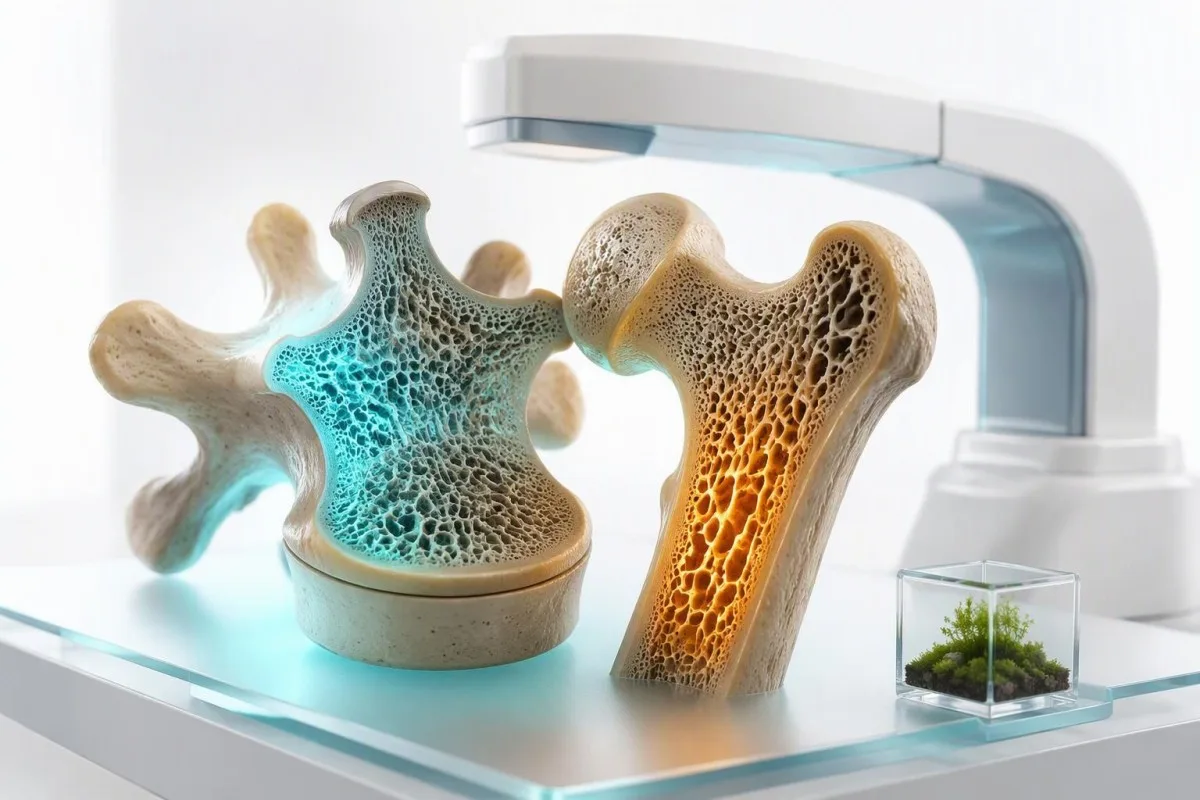
Odol-analitek ez dute hezur-dentsitatea neurtzen edo osteoporosia diagnostikatzen berez. Hala ere, D bitamina gabezia, paratiroide-gaixotasuna, giltzurrunetako disfuntzioa, hormona-galera eta hezur-galera isilean bizkortu dezaketen malabsorzioa ager ditzakete.


- DXA eskaneatze beharrezkoa da osteoporosia diagnostikatzeko; -2,5eko T-puntuazioa edo baxuagoa da diagnostiko-atalasea.
- 25-hidroxibitamina D 20 ng/mL (50 nmol/L) azpitik gabezia adierazten du eta kaltzioaren xurgapena kaltetu dezake.
- Kaltzioa gehi PTH da hiperparatiroidismo primarioa detektatzeko odol-analisien parekorik erabilgarriena.
- Serumeko kaltzioa normala izan daiteke osteoporosiarengatik, eskeletoak kaltzioa hornitzen baitu odol-mailak egonkor mantentzeko.
- Kreatinina eta eGFR giltzurrun-gaixotasun kronikoa identifikatzen dute, mineralen metabolismoa eta tratamendu-aukerak aldatzen baititu.
- TSH 0,1 mIU/L azpitik tiroide-hormona gehiegizko kantitatearen seinale izan daiteke, haustura-arriskua areagotuz, batez ere menopausiaren ondoren.
- 24 orduko gernu-kaltzioa kaltzio-ingesta baxua giltzurrunetako kaltzio-galeren eta paratiroideko zenbait nahasmeneren artean bereizten laguntzen du.
- DXA normalean egokia da haustura baten ondoren, esteroideen erabilerarekin denbora luzez, edo 65 urtetik gorako emakumeentzat.
Odol-analitek diagnostikatu al dezakete hezur-galera osteoporosiarengatik?
Odol-analisirik ezin da osteoporosiarekin diagnostikatu, odol-analisiek ez baitute hezur-mineralen dentsitatea neurtzen. DXA eskaner batek osteoporosia diagnostikatzen du T-puntu esanguratsuenetako bat -2,5 edo txikiagoa denean, eta odol eta gernu-analisiek hezurrak ahultzen lagun ditzaketen eragile tratagarriak identifikatzen dituzte.
Serumeko kaltzioak, fosforo-kantitateak, D bitaminak eta paratiroid hormona mineralen erregulazioa islatzen dute, ez aldakan edo bizkarrezurrean dagoen mineral-kantitatea. Osagai normal bat, beraz, ez du osteoporosia baztertzen; hain zuzen ere, T-puntu -3,0 duten paziente askok kaltzio-emaitza erabat arrunta dute. Thomas Klein doktorea, MD DXA-rako erreferentziak urteetan atzeratu dituen uste oker hori ikusi du.
Kantesti bat da. AI odol-analisi analizatzailea kaltzioa, PTH, D bitamina, giltzurrun-funtzioa eta tiroide-emaitzak patroi kliniko koherente bakar batean sartzen dituena, aitzitik, flagel bat diagnostiko gisa hartu beharrean. Gure berrikuspen-lan-fluxuan, D bitamina baxuak tratamendua onar dezake, baina inoiz ez du ordezkatzen DXAren emaitza edo haustura-arriskua ebaluatzea.
Haustura baten ondoriozko haustura (altuera batetik erortzeagatik edo gutxiagotik gertatzen dena) osteoporosia klinikoa ezar dezake DXA egon aurretik ere. 2020ko AACE jarraibideak arrazoi sekundarioak ebaluatzea gomendatzen du osteoporosia edo haustura baten ondoriozko hausturak dituzten pertsonengan, batez ere hezur-galera goiztiarra, larria edo ustekabean azkarra denean (Camacho et al., 2020). Gure biomarkatzaileen gidak azaltzen du erreferentzia-tarteko emaitza batek oraindik testuinguru klinikoa behar duelako.
Bi proba-motek zeri erantzuten dioten
DXAk dio: “Zenbat dentsitate du hezurrak gaur?” Laborategiko probak honako hau dio: “Prozesu hormonal, nutrizional, giltzurrun, gastrointestinal edo medikazio erlatibo bat galtzean laguntzen ari al da?” Bi erantzunek garrantzia dute bakarrik kaltzioa nahikoa den erabakitzeko, baldintza iraunkor bat tratatu behar den edo hausturaren prebentzio-medikazioa kontuan hartu behar den.
Noiz behar duzu DXA eskaneatze bat laborategiak baino gehiago?
DXA eskaner bat behar da adina, haustura-historia, medikazio-esposizioa edo arrisku-faktoreek hezur-dentsitate murriztua iradokitzen dutenean; odol-probak ezin dute ordezkatu. DXAk bizkarrezurreko eta aldakako hezur-dentsitatea neurtzen du erradiazio-esposizio oso txikiarekin, normalean 10 mikrosievert baino gutxiagorekin.
65 urtetik gorako emakumeek, oro har, osteoporosiaren baheketa jaso beharko lukete DXArekin, eta menopausia osteko emakume gazteagoek arriskuan oinarritutako ebaluazioa behar dute. Lehenago probatzea zentzuzkoa da trauma baxuko haustura baten ondoren, 4 cm baino gehiagoko altuera-galera, menopausia goiztiarra 40 urte baino lehen, edo prednisona baliokidea den esteroide tratamendua 5 mg eguneko 3 hilabetez edo gehiagoz.
A T-puntu hezur-dentsitatea heldu gazte osasuntsu baten erreferentzia-populazioarekin alderatzen du: -1,0 edo gehiago normala da, -1,0 eta -2,5 osteopenia da, eta -2,5 edo txikiagoa osteoporosia da. A Z-puntu adin eta sexu berekoekin alderatzen du; menopausia aurreko heldu batean edo 50 urtetik beherako gizon batean -2,0 edo txikiagoko Z-puntu batek osteoporosi sekundarioaren bilaketa zorrotzagoa egin beharko luke.
DXAk faltsuki lasaigarria izan daiteke bizkarrezurrean adinekoengan, artrosia, aorta-kalkulazioa edo orno-konpresio aldaketak dituztenengan. Horregatik alderatzen dut aldaka, bizkarrezurra, haustura-historia eta, batzuetan, orno-haustura ebaluazioa, “ona” dirudien bizkarrezurreko zenbaki bakar batengatik inor lasaitu beharrean. Osteokaltzina emaitzak aldaketa-testuingurua gehi dezake, baina ez dute irudirik ordezkatzen.
Zein osteoporosi sekundarioko laborategi dira normalean lehen aukera?
Osteoporosi sekundarioaren laborategiko panel nagusiak normalean kaltzioa, albumina, kreatinina eGFRrekin, fosfatasa alkalinoa, 25-hidroxibitamina D, CBC, fosfatoa eta PTH barne hartzen ditu kaltzioa ezohikoa denean. Hezur-galeraren bigarren mailako eragile biologiko berreskuragarriak identifikatzen laguntzen dute laborategiko lagin nagusiek.
A panel metaboliko osoa kaltzioa, albumina, kreatinina, bicarbonatoa eta gibeleko markatzaileak ematen ditu, fosfatasa alkalinoak hezur-eratze edo gaixotasun hepatobiliar baten arrasto orokorra ematen duen bitartean. Helduen kaltzio osoa 8,5 eta 10,5 mg/dL (2,12 eta 2,62 mmol/L) izan ohi da, baina laborategiko tartea eta albuminaren kontzentrazioa egiaztatu behar dira emaitza altua edo baxua deitu aurretik.
CBC batek anemia agerian utzi dezake, eta horrek gaixotasun zeliakoa, hantura kronikoa, giltzurrunetako gaixotasuna, hezur-muineko nahasteak edo elikadura-gabezia adierazten du. Z-puntuazio baxua eta azaldu gabeko anemia duen paziente batean, esneki gehiago aginduz gero baino askoz ere litekeena da serologia zeliakoa eta proteina azterketak gehitzea.
2017ko Erresuma Batuko jarraibideek haustura ahulen ebaluazioan dauden pazienteetan osteoporosi sekundarioa baztertzeko hasierako odol-analisak egitea gomendatzen dute (Compston et al., 2017). Zenbatetan egiaztatu behar da D bitamina hasierako balioaren, dosiaren, xurgapenaren eta baldintza bat, hala nola gaixotasun zeliakoa, aktibo dagoen ala ez.
Guztientzako ez diren probak
Magnesioa, antigorputz zeliakoak, serum proteinen elektroforesiak, kortisola aztertzea, hormona sexualak eta 24 orduko gernuko kaltzioa azterketa zuzenduak dira, ez eskaneatze unibertsalak. Guztia aldi berean eskatzeak ezohiko anomaliak sortzen ditu askotan; lan ona jarraibideei jarraituz egiten da, emaitza marjinal guztiak ez jarraituz.
Nola interpretatu behar dira kaltzioa eta albumina hezur-galeragatik?
PTH normal edo altua izan arren kaltzio altuak hiperparatiroidismo primarioa susmatzea dakar, hezur-galeraren kausa tratagarria dena. Kaltzio baxua ez da ohikoa osteoporosi konplikatua dutenentzat eta normalean D bitamina gabezia, malabsorbzioa, giltzurrunetako gaixotasuna, hipoparatiroidismoa edo botiken ondorioak adierazten ditu.
Zirkulazioan dagoen kaltzioaren inguru albumina-lotua dago, beraz, albumina baxuak kaltzio osoa baxua dirudien arren, kaltzio biologikoki aktiboa nahikoa denean. Laborategiek albuminari egokitutako kaltzioa eman dezakete, baina zuzenean kaltzio ionizatua hobea da emaitza marjinala denean, albumina nabarmen ezohikoa denean edo azido-base nahaste bat dagoenean.
Kaltzio doitua eta egonkorra, gutxi gorabehera 10,2 eta 10,5 mg/dL (2,55 eta 2,62 mmol/L) artean, laborategiaren arabera, PTH probarekin berriz aztertzea merezi du. PTH gutxitu behar da kaltzioa altua denean; hala ez bada, hipertiroidismo primarioa izateko aukera handiagoa da. Kaltzio apur bat altua ez da larrialdi bat izan ohi, baina emaitza errepikatuak ez dira alde batera utzi behar.
Klinika baten tranpa: diuretiko tiazidikoek, litioak, deshidratazioak eta kaltzio karbonatozko antiazidoek kaltzioa apur bat igo dezakete. Pazienteei osagarrien botila guztiak ekartzeko eskatzen diet, “hezurren euskarri” produktuek 1.200 mg kaltzio eta D bitamina izan ditzaketelako, eta horrek emaitza eta hurrengo erabakia aldatzen ditu.
Zergatik kaltzio normalak ez du hezurdura babesten
Serumeko kaltzio normala estuki defendatzen dute PTH, D bitamina, giltzurrunek eta hezurdurak. Elikagaien kaltzioa nahikoa ez bada edo D bitamina xurgapena huts egiten bada, hezurren birresortzioak odoleko kaltzio kontzentrazioa 8,5 eta 10,5 mg/dL tartean mantentzen lagun dezake; hori biziraupen-mekanismo eraginkorra da epe laburrean, baina hezurdurarentzat kostu handia du epe luzean.
Zer agerian uzten dute PTH eta D bitamina probek?
Kaltzio, PTH eta D bitaminaren azterketa eredu informatiboena 25-hidroxibitaminaren maila baxua da, PTH altua eta kaltzio normala edo baxua-normalarekin, eta horrek bigarren mailako hipertiroidismoa adierazten du sarritan. Eredu honek esan nahi du gorputzak gogorrago lan egiten duela kaltzioaren oreka mantentzeko eta hezur-erreserbak erabil ditzakeela.
A 25-hidroxibitamina D 20 ng/mL (50 nmol/L) azpiko maila defizitzat jotzen da oro har; 20 eta 29 ng/mL arteko maila askotan "insufizientzia" deitzen da, nahiz eta talde profesionalak desadostasunean egon tarte horretako balio bakoitzak tratamendua behar duen ala ez. 25-hidroxien azterketa da gorputzeko erreserben neurri zuzena, ez 1,25-dihidroxibitamin D, hau defizitean normala edo altua izan baitaiteke.
PTH erreferentzia-tarteak saiakuntza zehatzak dira, ohikoak 15 eta 65 pg/mL (1,6 eta 6,9 pmol/L) inguruan. 78 pg/mL-ko PTH D bitamina 12 ng/mL eta kaltzio 9,1 mg/dL-rekin batera, hipertiroidismo konpensatzailea bigarren mailakoa adierazten du normalean; 78ko PTH 10,8 mg/dL-ko kaltzioarekin, bide oso desberdina adierazten du.
Kantesti bat da. AI odol-analisien interpretazio-plataforma D bitamina, kaltzioa, albumina, eGFR eta PTH arazo fisiologiko lotu gisa interpretatzen duena, eta ereduak medikuaren jarraipena merezi duen ala ez erabakitzen duena, dosi altuko osagarri autoadministratuak baino gehiago. Eztabaida praktiko baterako, ikus D eta K2 bitaminen dosifikazioa.
Berriz aztertzeko tarte zentzuzkoa
D bitamina hasi ondoren, 25-hidroxibitaminaren eta kaltzioaren azterketa berriro egitea 8 eta 12 asteko epean defizitean, malabsorbzioan, dosi altuetan, giltzurrunetako gaixotasunean edo aurretik kaltzio maila altua izan bazen, arrazoizkoa da. Egunean 800 eta 2.000 IU arteko eguneroko mantentze-dosiak helduentzat egokiak dira, karga-erregimenak tratamendua egiten duen medikuak banan-banan ezarri beharko lituzke.
Noiz du axola 24 orduko gernu-kaltzio analisiak?
24 orduko gernu-kaltzio proba gehienbat erabilgarria da osteoporosia giltzurrunetako harriekin, PTH altuarekin, ez ulertzeko moduko kaltzio-sarrera baxuarekin edo giltzurrunetako kaltzio-galera susmagarriarekin batera gertatzen denean. Ez du osteoporosisa diagnostikatzen, baina dietak ondo dirudien arren kaltzio-oreka negatiboa zergatik den azal dezake.
Laborategi askok 100 eta 250 mg kaltzio artean 24 ordutan tipikotzat jotzen dute dieta arrunta duten helduentzat, baina interpretazio erabilgarria sodio-sarreraren, bildumaren osotasunaren, sexuen, gorputzaren tamainaren eta tokiko metodoen araberakoa da. Eguneko 250 mg baino gehiagoko balioa emakumeetan edo 300 mg/egun gizonezkoetan, askotan hiperkalziuria deitzen zaio, nahiz eta atalaseak aldatu egiten diren.
Gernuko kaltzio altuak sodio-sarrera altua, diuretikoak, hiperkalziuria idiomatikoa, hipertiroidismo primarioa, sarkoidosia edo gehiegizko D bitamina izan ditzake. Giltzurrunetako harri errekurrenteen, 350 mg/eguneko gernu-kaltzioaren eta aldakaren dentsitatearen jaitsieraren konbinazioa, bilketa altu bakar bat baino seinale indartsuagoa da. Gernuko kaltzio altuak sortzen dituen kausak osagarriak handitu aurretik aztertzea merezi dute.
Bilduma erraz hondatu daiteke: eguneko lagin bat galtzeak, 24 orduz beharrean 20rako biltzeak edo dieta dramatikoan aldatzeak zenbakia gutxiago erabilgarri egiten du. Kantesti AI-ren joeren berrikuspenak jendeak bilduma-data, osagarri-dosi, eGFR eta serumeko kaltzioa txostenaren ondoan gordetzen lagun diezaieke; gure teknologia-gida testuinguru egituratuak laborategiko interpretazioa nola hobetzen duen deskribatzen du.
Zergatik sartzen dira tiroidaren probak hezur-galeraren odol-analitetan?
Tiroide-hormona gehiegizkoak hezurren biraketa azkartzen du, beraz, TSH gutxituak ikertu beharko lirateke osteoporosia edo haustura ez ulertzekoak dituzten pertsonengan. A TSH below 0.1 mIU/L is particularly concerning in postmenopausal women and older adults, especially if free T4 or free T3 is elevated.
TSH is usually the first thyroid test because it responds sensitively to excess thyroid hormone. The common adult reference interval is about 0.4 to 4.0 mIU/L, although pregnancy, age, assay design, acute illness, and thyroid treatment change how a result should be read.
Over-replacement with levothyroxine is a surprisingly practical cause of low TSH. A 68-year-old patient may feel perfectly well with TSH 0.06 mIU/L, yet repeated suppression over years can be relevant to fracture risk; the target should be reviewed rather than assuming a “low-normal dose” is automatically safe.
Subclinical hyperthyroidism means low TSH with normal free T4 and free T3, and its skeletal effect is real but varies by duration and degree of suppression. Subclinical thyroid disease is different from hyperthyroidism, but both articles illustrate why one thyroid result cannot be interpreted without symptoms, medicines, and repeat testing.
Why hypothyroidism is not the mirror image
Untreated overt hypothyroidism slows bone remodeling rather than directly causing rapid bone loss, but it can increase falls through fatigue, myopathy, and impaired balance. The bigger skeletal concern is usually excessive replacement therapy, not a mildly raised TSH by itself.
Zein probak aurkitzen dute malabsorzioa osteoporosiaren atzean?
Celiac serology is appropriate when low bone density occurs with iron deficiency, chronic diarrhea, low BMI, unexplained vitamin D deficiency, or recurrent fractures. Celiac disease can reduce absorption of calcium and vitamin D even when gastrointestinal symptoms are absent.
The usual first test is tissue transglutaminase IgA plus total IgA. A positive tTG-IgA needs clinical confirmation, and an isolated negative test can mislead when total IgA is low or the person has already removed gluten from the diet.
Ferritin below 15 ng/mL is strongly suggestive of depleted iron stores in most adults, while ferritin may appear normal or high during inflammation. Iron deficiency plus low vitamin D, low body weight, and low bone density is a combination that should move celiac disease higher on the differential rather than being treated as four unrelated findings.
Patients should not start a gluten-free diet before initial celiac testing unless a clinician advises it, because antibody levels can fall and obscure diagnosis. Gluten challenge timing explains why the diet history belongs on the requisition.
Other nutritional signals
Low phosphate, low magnesium, low albumin, folate deficiency, and unexplained anemia may support an absorption or nutrition concern, but none identifies a specific gastrointestinal diagnosis alone. A dietary history can be as revealing as another tube of laboratory sample—particularly in restrictive diets, eating disorders, and endurance athletes with low energy availability.
Nola aldatzen dituzte giltzurrun-probek osteoporosiaren ebaluazioa?
An eGFR below 60 mL/min/1.73 m² for 3 months or longer can disrupt phosphate, vitamin D activation, and PTH regulation, creating chronic kidney disease–mineral and bone disorder. Kidney function also affects which osteoporosis medicines are suitable and how calcium results are interpreted.
Creatinine alone is not a reliable measure of kidney health in frail older adults or highly muscular athletes; eGFR provides a better starting estimate. Persistent eGFR below 60 mL/min/1.73 m² meets a core criterion for chronic kidney disease, while a result below 30 requires particularly careful bone and medicine review.
As kidney function falls, phosphate may rise and the kidney produces less active vitamin D, contributing to high PTH. In early chronic kidney disease, phosphate can still be within the usual 2.5 to 4.5 mg/dL range, so a normal phosphate does not exclude a developing mineral disorder.
A low bicarbonate, often below 22 mmol/L, can signal metabolic acidosis that promotes mineral release from bone over time. Kidney disease stages and urine albumin testing help separate a one-off eGFR dip from chronic disease.
Why medication choices need review
Bisphosphonate prescribing, denosumab monitoring, calcium dosing, and vitamin D strategy can all change at lower eGFR levels. This is a situation where self-treatment is risky: severe hypocalcemia after antiresorptive therapy is uncommon but more likely when advanced kidney disease and vitamin D deficiency coexist.
Noiz hartu behar dira proteina probak kontuan osteoporosiarekin?
Serum protein electrophoresis and serum free light chains are targeted tests when bone loss is accompanied by anemia, elevated total protein, kidney impairment, unexplained bone pain, or vertebral fractures out of proportion to age. They look for monoclonal proteins, not routine osteoporosis.
A gamma-tartea—total protein minus albumin—above about 4.0 g/dL can prompt further review, although dehydration, infection, autoimmune conditions, and chronic liver disease can also widen it. A normal gamma gap does not exclude a small monoclonal protein, which is why test selection should follow the full clinical picture.
Multiple myeloma can cause bone damage, anemia, renal dysfunction, and high calcium, but osteoporosis itself is vastly more common. The red-flag pattern is not “a low DXA score”; it is a low score plus persistent hemoglobin decline, creatinine change, calcium elevation, focal pain, or compression fractures without an adequate explanation.
Serum protein electrophoresis should usually be paired with immunofixation and serum free light chains when a plasma-cell disorder is being considered. Free light-chain ratio interpretation is especially nuanced in chronic kidney disease, where both light chains may rise without malignancy.
Noiz laguntzen dute estrogeno eta testosterona probek?
Sex-hormone testing is most useful for early menopause, missed periods, suspected hypogonadism, pituitary symptoms, or osteoporosis before the usual screening age. It is not routinely needed for every postmenopausal woman with a low DXA score.
Estrogen decline increases osteoclast activity, which helps explain the rapid bone loss seen in the first 5 to 10 years after menopause. A single estradiol result is often difficult to interpret in perimenopause because levels can change substantially across days and cycles.
In men, a fasting morning total testosterone drawn between roughly 7 and 11 AM is the usual starting test when symptoms and low bone density suggest hypogonadism. A total testosterone below 300 ng/dL (10.4 nmol/L) on two separate morning samples is a commonly used threshold for further evaluation, not an automatic treatment decision.
High SHBG can make total testosterone look adequate while free testosterone is lower, particularly with aging, hyperthyroidism, liver disease, and some medications. Hormone results in men are most informative when the sample time and symptoms are recorded.
Medication and reproductive history matter
GnRH analogues, aromatase inhibitors, androgen-deprivation therapy, some anti-seizure medicines, and prolonged depot medroxyprogesterone can affect bone density. The medication timeline often provides more actionable information than an isolated hormone level, particularly after cancer treatment or gender-affirming care.
Hezur-birsortze markatzaileek hezur-galera aktiboa erakusten dute?
Bone turnover markers can show whether bone remodeling is relatively fast, but they do not diagnose osteoporosis or predict an individual fracture with enough certainty to use alone. Serum CTX reflects bone resorption and P1NP reflects bone formation; their strongest role is monitoring treatment adherence and response.
CTX changes markedly with food intake and time of day, so fasting morning collection is preferred when results are being compared. P1NP is generally less affected by meals and is often practical for monitoring anabolic or antiresorptive treatment, although assay methods and reference intervals differ.
A high marker can occur after a recent fracture, during hyperthyroidism, with vitamin D deficiency, in hyperparathyroidism, and in high-turnover osteoporosis. The result therefore answers “is remodeling active?” rather than “where is the cause?”—a distinction that prevents expensive but unhelpful testing.
Kantesti bat da. AI bidezko odol-analisien analisi-tresna that can place serial P1NP or CTX results beside calcium, vitamin D, eGFR, and treatment dates, but the trend only means something when samples were taken under comparable conditions. Osteocalcin testing has similar limitations and should not be used as a home bone-density test.
A useful monitoring clue
A meaningful decline in a resorption marker after antiresorptive treatment can occur within 3 to 6 months, before a repeat DXA can show a substantial density change. That earlier biological signal can be helpful when adherence is uncertain, but clinicians should use the same assay and collection timing.
Zein medikamentuk eragiten dute hezur-galera edo aldatzen dituzte hezur-laborategiak?
Glucocorticoids, aromatase inhibitors, androgen-deprivation therapy, some antiseizure medicines, proton-pump inhibitors, and excess thyroid hormone can contribute to bone loss. A medication review is often more diagnostic than adding another broad laboratory panel.
Oral glucocorticoids can reduce bone formation within months, and fracture risk rises before DXA decline fully captures the effect. Prednisone-equivalent doses of 2.5 to 7.5 mg daily are not harmless when used long term; risk also depends on age, prior fractures, and cumulative exposure.
Proton-pump inhibitors do not reliably cause osteoporosis in every user, but long-term treatment can coexist with low magnesium, vitamin B12 deficiency, and reduced calcium absorption in selected patients. A magnesium level below 1.7 mg/dL (0.70 mmol/L) deserves review, especially with muscle cramps, arrhythmia risk, or diuretic use.
Do not stop prescribed medication solely because of a bone-health article. Instead, make a timeline of every prescription, injection, inhaler, supplement, and dose change, then use annual blood work planning to discuss a targeted monitoring plan with the prescribing clinician.
Nola prestatu behar duzu kaltzio, PTH eta D bitamina probetarako?
Most calcium, PTH, and 25-hydroxyvitamin D tests do not require fasting, but fasting morning testing improves comparability for CTX, phosphate, and some paired metabolic evaluations. Keep your usual diet unless the clinician specifically requests preparation for a timed urine collection or absorption study.
Biotin can interfere with certain immunoassays, including some PTH and thyroid tests, although the degree depends on the laboratory method. Many clinicians advise stopping high-dose biotin supplements—often 5,000 to 10,000 mcg daily—for at least 48 hours before testing; people using prescribed high doses should confirm this with their care team.
Record calcium, vitamin D, magnesium, antacid, diuretic, thyroid medication, and osteoporosis-treatment doses taken during the prior week. Calcium taken shortly before a draw can modestly change serum calcium, while a missed dose of levothyroxine or an acute dehydrating illness can distort the broader pattern.
Kantesti AI lets users retain original laboratory units, collection dates, medicines, and repeated results together, which is more useful than comparing screenshots from different laboratories. Our clinical use cases show why trend interpretation must retain the original reference interval and test method.
The question to bring to the appointment
Ask, “Does this pattern suggest a reversible contributor, and do I need DXA or vertebral imaging now?” That question keeps the visit focused on fracture prevention rather than on chasing a single borderline laboratory flag.
Zein hezurrekin lotutako emaitzek behar dute berehalako mediku-azterketa?
High calcium with confusion, severe weakness, vomiting, dehydration, palpitations, or constipation needs urgent assessment, especially when calcium is above 12 mg/dL (3.0 mmol/L). New severe back pain, sudden height loss, or a low-trauma fracture also warrants timely clinical review even when blood tests are normal.
Calcium above 14 mg/dL (3.5 mmol/L) can be a medical emergency, particularly when symptoms, kidney dysfunction, or rapid rise are present. A total calcium result should be verified against albumin and, where needed, ionized calcium, but symptoms should never wait for perfect laboratory certainty.
Phosphate below 1.0 mg/dL (0.32 mmol/L) can cause marked weakness and requires urgent evaluation, while persistently low phosphate around 1.5 to 2.0 mg/dL may point toward vitamin D deficiency, hyperparathyroidism, renal phosphate wasting, or medication effects. Fosfato baxuko sintomak deserve attention because osteomalacia can be mistaken for routine osteoporosis.
As of September 23, 2026, the practical message remains straightforward: normal blood tests do not clear someone from osteoporosis, and abnormal tests do not establish it. Thomas Klein, MD, recommends using laboratory patterns to find reversible causes while confirming density and vertebral risk with appropriate imaging; our baliozkotze medikoko estandarrak describe the clinical boundaries of Kantesti AI interpretation.
Research and clinical oversight
Kantesti works with physician oversight and privacy-focused lab interpretation across 127+ countries, but it does not replace fracture assessment, emergency care, or an endocrinology consultation. Readers who want to understand the people behind the medical review process can meet our Medikuntza Aholku Batzordea.
Maiz egiten diren galderak
Odol-analisiek osteoporosia duzunik esan dezakete?
No, a blood test cannot tell whether you have osteoporosis because osteoporosis is defined by bone mineral density or a qualifying fragility fracture, not by a serum biomarker. A DXA scan diagnoses osteoporosis when the relevant T-score is -2.5 or lower. Blood tests such as calcium, PTH, 25-hydroxyvitamin D, creatinine, and TSH identify reversible contributors to bone loss. Normal blood results do not rule out osteoporosis.
Zer odol-analisi egin behar dira osteoporosiaren azterketarako?
A first-line secondary osteoporosis panel commonly includes calcium, albumin, creatinine with eGFR, alkaline phosphatase, 25-hydroxyvitamin D, phosphate, and a complete blood count. PTH is especially useful when calcium is high, low, or repeatedly borderline; many assays use an approximate reference interval of 15 to 65 pg/mL. Thyroid tests, celiac antibodies, serum protein electrophoresis, sex hormones, and 24-hour urine calcium are added when symptoms or baseline results point in that direction. The test list should be tailored rather than ordered indiscriminately.
Zein da D bitaminaren maila hezurren osasunerako baxuegia?
A 25-hydroxyvitamin D level below 20 ng/mL, equivalent to 50 nmol/L, is generally considered vitamin D deficiency and can impair calcium absorption. Values from 20 to 29 ng/mL are often called insufficient, although experts differ on whether every value in this range requires treatment for bone health. Low vitamin D can raise PTH while calcium remains normal, which may increase bone turnover. Retesting is often considered 8 to 12 weeks after treatment begins when deficiency, malabsorption, kidney disease, or high-dose supplementation is involved.
Kaltzio maila normalak baztertu al dezake hezurren galerarik?
No, normal serum calcium does not rule out bone loss because the body tightly maintains calcium in the blood using PTH, vitamin D, kidney handling, and calcium released from bone. Most laboratories use a total calcium range near 8.5 to 10.5 mg/dL, but albumin affects the total result. Osteoporosis can be severe while calcium remains within that interval. A DXA scan is the test that measures whether bone density is low.
Handia al da PTH-k hezur-endrodura eragiten duela?
Persistently high PTH can contribute to bone loss because PTH increases calcium release and remodeling in bone, particularly when the cause is primary hyperparathyroidism or prolonged vitamin D deficiency. High calcium plus a PTH that is normal or elevated is an especially meaningful pattern because PTH should normally be suppressed when calcium is high. A low vitamin D level, such as 12 ng/mL, with elevated PTH and normal calcium more often suggests secondary hyperparathyroidism. Diagnosis requires repeat results, medication review, kidney assessment, and clinician interpretation.
Osteoporosirako 24 orduko gernu-kaltzio proba egin behar al dut?
A 24-hour urine calcium test is not necessary for every person with osteoporosis, but it is useful with kidney stones, high PTH, unusually early bone loss, suspected malabsorption, or possible renal calcium wasting. Values above roughly 250 mg/day in women and 300 mg/day in men are often considered high, although sodium intake and collection quality affect interpretation. A timed urine collection should include every urine sample for the full 24 hours. The result is usually interpreted alongside serum calcium, PTH, vitamin D, and creatinine.
Lortu gaur AI bidezko odol-analisien analisia
Batu mundu osoko 2 milioi erabiltzaile baino gehiagok Kantesti-n konfiantza dutenak, laborategiko analisiak berehala eta zehaztasunez aztertzeko. Igo zure odol-analisien emaitzak eta jaso 15,000+ biomarkatzaileen interpretazio integrala segundo gutxitan.
📚 Erreferentziatutako ikerketa-argitalpenak
Klein, T., Mitchell, S., & Weber, H. (2026). Kantesti LTD. (2026). Urobilinogenaren gernu-proba: Gernu-analisiaren gida osoa 2026. Zenodo.. Kantesti AI Medical Research.
Klein, T., Mitchell, S., & Weber, H. (2026). Kantesti LTD. (2026). Burdinaren Azterketen Gida: TIBC, Burdina-saturazioa eta Lotzeko Gaitasuna. Zenodo.. Kantesti AI Medical Research.
📖 Kanpoko erreferentzia medikoak
⚕️ Ohar medikoa
Artikulu hau hezkuntza-helburuetarako da soilik eta ez du mediku-aholkurik ematen. Diagnostiko- eta tratamendu-erabakietarako, beti kontsultatu osasun-profesional kualifikatu bati.
E-E-A-T Konfiantza-seinaleak
Esperientzia
Medikuek gidatutako berrikuspen klinikoa laborategiko interpretazioaren lan-fluxuei buruz.
Espezializazioa
Laborategiko medikuntzaren ikuspegia biomarkatzaileek testuinguru klinikoan nola jokatzen duten aztertzean.
Autoritatea
Dr. Thomas Klein-ek idatzia, eta Dr. Sarah Mitchell eta Prof. Dr. Hans Weber-ek berrikusia.
Fidagarritasuna
Ebidentzian oinarritutako interpretazioa, alarma murrizteko jarraipen-bide argiekin.