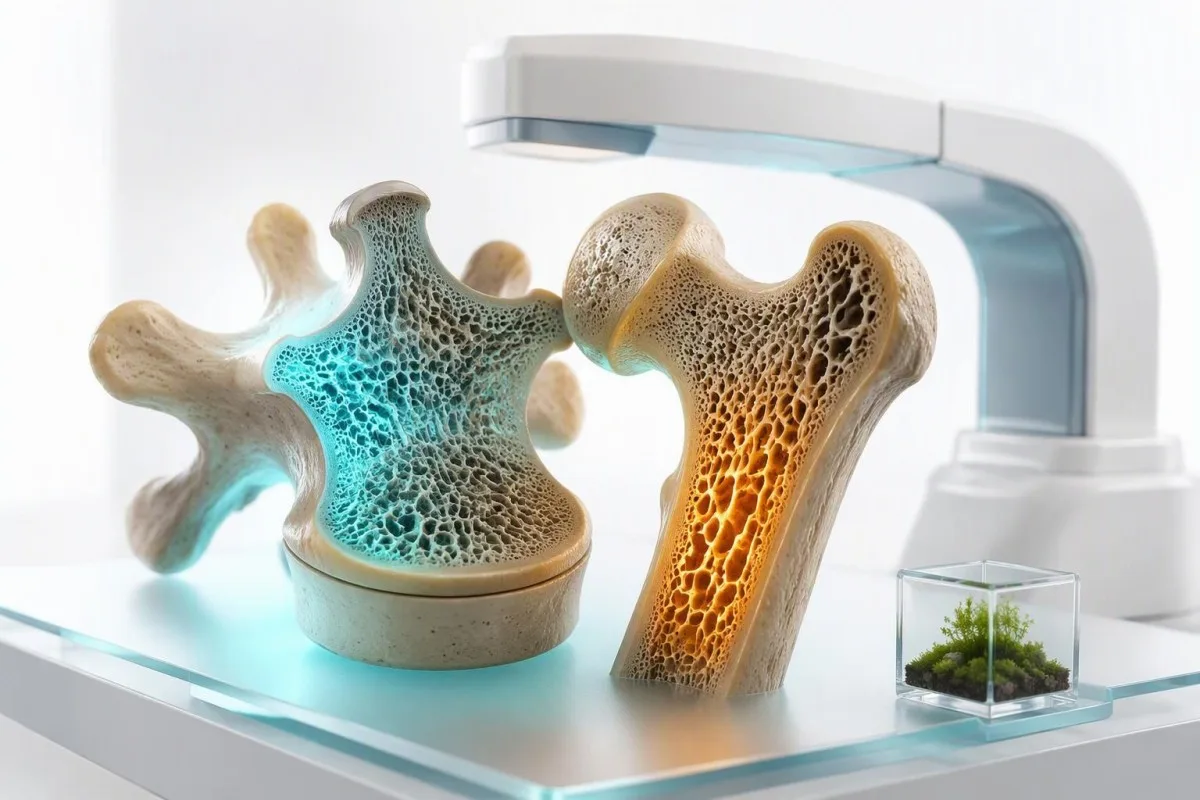
Chan urrainn deuchainnean fala dùmhlachd cnàimh a thomhas no osteoporosis a dhearbhadh leotha fhèin. Ach, faodaidh iad cion bhiotamain D, tinneas parathyroid, dìth gnìomh dubhaig, call hormon, agus malabsorption a nochdadh a dh’ fhaodadh a bhith a’ luathachadh call cnàimh gu sàmhach.


- Sganadh DXA tha feum air gus osteoporosis a dhearbhadh; tha sgòr T de -2.5 no nas ìsle a’ coinneachadh ris a’ chrìoch dhiagnostach.
- 25-hydroxyvitamin D fo 20 ng/mL (50 nmol/L) a’ comharrachadh cion agus faodaidh e casg a chuir air gabhail ri calcium.
- Calcium còmhla ri PTH is e am paidhle deuchainn fala as feumaile airson hyperparathyroidism prìomhach a lorg.
- Faodaidh calcium serum fuireach àbhaisteach ann an osteoporosis leis gu bheil an t-sloc a’ solarachadh calcium gus ìrean fala a chumail seasmhach.
- Creatinine agus eGFR aithnich tinneas dubhaig leantainneach, a dh’ atharraicheas metabolism mèinnearach agus roghainnean leigheis.
- TSH fo 0.1 mIU/L faodaidh e cus hormon tìoroid a chomharrachadh a mheudaicheas cunnart brisidh, gu sònraichte às deidh menopause.
- calcium fual 24-uair a’ toirt cuideachadh air fa-near eadar ìosal calcium a ghabhail a-steach bho chall calcium san urine agus cuid de thinneasan parathyroid.
- Tha DXA mar as trice iomchaidh an dèidh brisidh air sgàth laigse, le cleachdadh steroidan fad-ùine, no airson boireannaich 65 bliadhna a dh'aois agus nas sine.
An urrainn do dheuchainn fala osteoporosis call cnàimh a dhearbhadh?
Chan urrainn do dheuchainn fala sam bith a bhith a' dearbhadh osteoporosis oir chan eil deuchainnean fala a' tomhas dùmhlachd mèinnearachd cnàimh. Bidh sgan DXA a' dearbhadh osteoporosis nuair a tha an sgòr T as ìsle iomchaidh -2.5 no nas ìsle, fhad 's a tha deuchainnean fala is urine a' comharrachadh luchd-cuideachaidh a ghabhas làimhseachadh a dh'fhaodadh a bhith ag adhbhrachadh dhan chnàimh a bhith a' lagachadh.
Tha calcium serum, phosphate, vitimín D, agus hormone parathyroid a' nochdadh riaghladh mèinnearachd, chan e an uiread de mhèinnearachd a tha ann mar-thà anns a' chrom no an smior. Mar sin, chan eil panal àbhaisteach a' cur às do osteoporosis; gu dearbh, tha mòran euslaintich le sgòr T de -3.0 aig a bheil toraidhean calcium gu tur àbhaisteach. An Dr. Tòmas Klein, MD air faicinn an neo-thuigse seo a chuir dàil air tar-chur DXA airson bhliadhnaichean.
Tha Kantesti na Anailisiche deuchainn fala AI a chuireas calcium, PTH, vitimín D, gnìomh dubhaig, agus toraidhean thyroid ann an aon phàtran co-chòrdail clionaigeach seach a bhith a' làimhseachadh aon chomharradh mar dhearbhadh. Anns a' phròiseas ath-bhreithneachaidh againn, faodaidh toradh vitimín D ìosal taic a thoirt do làimhseachadh, ach cha chuir e an àite toradh DXA no measadh cunnairt brisidh.
Faodaidh brisidh air sgàth laigse—fear a thachras bho thuiteam bho àirde seasamh no nas lugha—a bhith a' stèidheachadh osteoporosis clionaigeach eadhon mus bi DXA ri fhaighinn. Tha stiùireadh AACE 2020 a' moladh measadh air adhbharan àrd-sgoile ann an daoine le osteoporosis no brisidhean air sgàth laigse, gu h-àraid nuair a tha call cnàimh tràth, dona, no gu h-iongantach luath (Camacho et al., 2020). An stiùireadh biomarker againn a' mìneachadh carson a tha feum air co-theacsa clionaigeach fhathast air toradh raon-iomraidh.
Na freagairtean a bheir an dà sheòrsa deuchainn
Freagairtean DXA, “Dè cho dùmhail ”s a tha a“ chnàimh an-diugh?” Freagairtean deuchainn obair-lann, “A bheil pròiseas hormonail, beathachaidh, dubhaig, gastrointestinal, no pròiseas co-cheangailte ri cungaidh-leigheis a' cuideachadh le call?” Tha an dà fhreagairt cudromach nuair a tha thu a' co-dhùnadh a bheil calcium leis fhèin gu leòr, a bheil feum air làimhseachadh airson suidheachadh a ghabhas atharrachadh, no a bheil bu chòir beachdachadh air cungaidh-leigheis casg brisidh.
Cuin a tha feum agad air sganadh DXA seach buill-bodhaig?
Tha feum air sgan DXA nuair a tha aois, eachdraidh brisidh, nochdadh cungaidh-leigheis, no factaran cunnairt a' nochdadh dùmhlachd cnàimh nas ìsle; chan urrainn deuchainnean fala a chur na h-àite. Bidh DXA a' tomhas dùmhlachd mèinnearachd cnàimh aig an smior lumbar agus a' chrom le nochdadh glè ìosal air rèididheachd, mar as trice nas lugha na 10 microsieverts.
Bu chòir do bhoireannaich 65 bliadhna a dh'aois agus nas sine san fharsaingeachd a bhith air sgrìonadh airson osteoporosis le DXA, agus feumaidh boireannaich postmenopausal nas òige measadh stèidhichte air cunnart. Tha deuchainn na bu thràithe ciallach às deidh brisidh air trauma ìosal, call àirde de chòrr air 4 cm, menopause ro-luath ro aois 40, no làimhseachadh steroid co-ionann prednisone de 5 mg gach latha airson 3 mìosan no barrachd.
A sgòr T a' coimeas dùmhlachd cnàimh ri sluagh iomraidh òg fallain: -1.0 no nas àirde tha àbhaisteach, -1.0 gu -2.5 tha osteopenia, agus -2.5 no nas ìsle tha osteoporosis. A sgòr Z a' coimeas ri daoine den aon aois agus gnè; bu chòir sgòr Z aig -2.0 no nas ìsle ann an inbheach premenopausal no fear fo 50 a bhith a' brosnachadh sgrùdadh nas dlùithe airson osteoporosis àrd-sgoile.
Faodaidh DXA a bhith a“ coimhead brèag-mhisneachail aig an smior lumbar ann an seann daoine le osteoarthritis, cruinneachadh calcaidh aortic, no atharrachaidhean dùmhlachd droma. Is e sin as coireach gu bheil mi a” coimeas a' chrom, an smior, eachdraidh brisidh, agus uaireannan measadh brisidh droma seach a bhith a' toirt misneachd do chuideigin bho aon àireamh droma a tha coltach "math". Toraidhean Osteocalcin faodaidh iad co-theacsa tionndaidh a chur ris, ach chan eil iad a' cur an àite ìomhaighean.
Dè na buill-bodhaig osteoporosis àrd-sgoile as cumanta a tha aig a’ chiad loidhne?
Tha am prìomh phanaile lab secondary osteoporosis mar as trice a’ toirt a-steach calcium, albumin, creatinine le eGFR, phosphatase alcaileach, 25-hydroxyvitamin D, CBC, phosphate, agus PTH nuair a tha calcium neo-àbhaisteach. Tha am panail mionaideach ag atharrachadh le aois, comharraidhean, cungaidhean-leigheis, pàtran brisidh, agus toradh an DXA.
A pannal coileanta meitabileach a’ toirt seachad calcium, albumin, creatinine, bicarbonate, agus comharran grùthan, fhad ‘s a tha phosphatase alcaileach a’ toirt sealladh farsaing air cruthachadh cnàimh no tinneas hepatobiliary. Tha ìre iomlan calcium inbheach mar as trice 8.5 gu 10.5 mg/dL (2.12 gu 2.62 mmol/L), ach feumar an ùine obair-lann agus dùmhlachd albumin a sgrùdadh mus canar gu bheil toradh àrd no ìosal.
Faodaidh CBC nochdadh anemia a tha a’ comharrachadh galar celiac, sè cronach, tinneas dubhaig, eas-òrdughan smior, no cion beathachaidh. Ann an euslainteach le Z-sgòr ìosal agus anemia neo-shoilleir, tha mi fada nas dualtaiche serology celiac agus sgrùdaidhean pròtain a chuir ris na dìreach a bhith a’ comhairleachadh barrachd bainne.
Tha an stiùireadh UK 2017 a’ comhairleachadh deuchainnean fala bunaiteach gus casg a chuir air osteoporosis àrd-sgoile ann an euslaintich a thathas a’ measadh airson brisidhean lagachd (Compston et al., 2017). Dè cho tric a dh’ fheumar dearbhadh a dhèanamh air bhiotamain D an crochadh air an luach tòiseachaidh, an dòs, an gabhail a-steach, agus an robh suidheachadh mar galar celiac fhathast gnìomhach.
Deuchainnean nach eil cumanta do a h-uile duine
Tha magnesium, antibodies celiac, electrophoresis pròtain serum, deuchainn cortisol, hormonaichean gnè, agus calcium fual 24-uair nan deuchainnean cuimsichte seach sgrìonadh uile-choitcheann. Bidh òrdachadh a h-uile càil aig an aon àm gu tric a’ cruthachadh neo-riaghailteachdan gun fhiosta; bidh obair mhath a’ leantainn nan comharran seach a bhith a’ ruith gach toradh cuibheasach.
Ciamar a bu chòir calcium agus albumin a mhìneachadh airson call cnàimh?
Tha calcium àrd le PTH neo-iomchaidh àbhaisteach no àrd a’ togail dragh airson hyperparathyroidism prìomh, adhbhar a ghabhas làimhseachadh airson call cnàimh. Tha calcium ìosal nas lugha de chumha àbhaisteach de osteoporosis gun iom-ghnìomh agus mar as trice a’ comharrachadh cion bhiotamain D, droch-ghabhail, tinneas dubhaig, hypoparathyroidism, no buaidhean cungaidh-leigheis.
Mu 40% den calcium a tha a’ cuairteachadh air albumin-bound, mar sin faodaidh albumin ìosal toirt air calcium iomlan nochdadh ìosal eadhon nuair a tha calcium gnìomhach gu bith-eòlasach gu leòr. Faodaidh obair-lann calcium atharraichte le albumin a thoirt seachad, ach gu dìreach tha calcium ionized nas fheàrr nuair a tha an toradh cuibheasach, tha albumin gu mòr neo-àbhaisteach, no tha eas-òrdugh searbhag-bun a’ nochdadh.
calcium atharraichte leantainneach os cionn timcheall air 10.2 gu 10.5 mg/dL (2.55 gu 2.62 mmol/L), a rèir an obair-lann, tha e airidh air deuchainn ath-aithris le PTH. Bu chòir PTH a bhith air a chumail suas nuair a tha calcium àrd; mura h-eil, bidh hyperparathyroidism bun-sgoile nas dualtaiche. Calcium àrdaichte gu aotrom gu tric chan eil e na èiginn, ach cha bu chòir dìmeas a dhèanamh air toraidhean ath-aithris.
Aon ribe clionaigeach: faodaidh diuretics thiazide, lithium, dìth uisge, agus antacids calcium carbonate àrdachadh gu aotrom. Bidh mi ag iarraidh air euslaintich a h-uile botal stuth a thoirt a-steach, oir faodaidh toraidhean “taic cnàimh” a bhith a' gabhail a-steach 1,200 mg de calcium a bharrachd air bhiotamain D, agus tha sin ag atharrachadh gach cuid an toradh agus an ath cho-dhùnadh.
Carson nach eil calcium àbhaisteach a' dìon an sgeilp
Tha calcium serum àbhaisteach air a dhìon gu dlùth le PTH, bhiotamain D, dubhagan, agus an sgeilp. Nuair a tha solar calcium daithead neo-iomchaidh no a dh' fhailicheas gabhail a-steach bhiotamain D, faodaidh ath-ghabhail cnàimh cuideachadh le bhith a' gleidheadh dùmhlachd calcium fala taobh a-staigh raon 8.5 gu 10.5 mg/dL - pròiseas mairsinn èifeachdach geàrr-ùine le cosgais sgeilp san fhad-ùine.
Dè a tha deuchainn PTH agus bhiotamain D a’ nochdadh?
Is e am pàtran deuchainn calcium PTH bhiotamain D as fhiosaiche 25-hydroxyvitamin D ìosal le PTH àrd agus calcium àbhaisteach no ìosal-àbhaisteach, a tha gu tric a' comharrachadh hyperparathyroidism àrd-sgoile. Tha am pàtran seo a' ciallachadh gu bheil an corp ag obair nas cruaidhe gus cothromachadh calcium a chumail suas agus dh' fhaodadh e a bhith a' tarraing air stòrasan cnàimh.
A 25-hydroxyvitamin D tha ìre fo 20 ng/mL (50 nmol/L) san fharsaingeachd air a mheas mar chion; tha 20 gu 29 ng/mL gu tric air a ghairm neo-iomchaidheachd, ged a tha buidhnean proifeiseanta ag aontachadh mu dheidhinn a bheil feum aig gach luach san raon seo air làimhseachadh. Is e an deuchainn 25-hydroxy an tomhas ceart de stòrasan bodhaig, chan e 1,25-dihydroxyvitamin D, a dh' fhaodadh a bhith àbhaisteach no àrdaichte ann an cion.
Tha raointean iomraidh PTH sònraichte do dheuchainn, gu cumanta timcheall air 15 gu 65 pg/mL (1.6 gu 6.9 pmol/L). Tha PTH de 78 pg/mL còmhla ri bhiotamain D de 12 ng/mL agus calcium de 9.1 mg/dL mar as trice a' comharrachadh hyperparathyroidism àrd-sgoile co-chòrdach; tha PTH de 78 le calcium de 10.8 mg/dL a' comharrachadh slighe gu math eadar-dhealaichte.
Tha Kantesti na àrd-ùrlar mìneachaidh deuchainn fala AI a leughas bhiotamain D, calcium, albumin, eGFR, agus PTH mar dhuilgheadas fiseòlais ceangailte, a' gabhail a-steach a bheil am pàtran a' cosgadh luchd-clionaigeach leantainn seach stuthan dòs àrd fèin-òrdaichte. Airson deasbad sàbhailteachd practaigeach, faic dòsan bhiotamain D agus K2.
Ùine ath-sgrùdaidh ciallach
An dèidh tòiseachadh air bhiotamain D, tha ath-dheuchainn 25-hydroxyvitamin D agus calcium ann an timcheall air 8 gu 12 seachdainean reusanta airson cion, malabsorption, dòsan àrda, tinneas dubhaig, no toradh calcium àrd roimhe seo. Tha dòsan cumail suas làitheil de 800 gu 2,000 IU freagarrach do dh' iomadh inbheach, fhad 's a bu chòir clàran luchdaidh a bhith air an aonachadh leis an neach-leigheis.
Cuin a tha deuchainn calcium 24-uair a thìde cudromach?
Tha deuchainn calcium fual 24-uair as fheumail nuair a thachras osteoporosis le clachan dubhaig, PTH àrd, solar calcium neo-shoilleir ìosal, no call calcium dubhaig air a chreidsinn. Chan eil e a' dearbhadh osteoporosis, ach is urrainn dha mìneachadh carson a tha cothromachadh calcium àicheil a dh' aindeoin daithead a tha coltach gu math.
Tha mòran obraichean-lann a' beachdachadh air timcheall air 100 gu 250 mg de calcium gach 24 uair àbhaisteach airson inbhich a tha a' ithe daithead àbhaisteach, ach tha an mìneachadh feumail an urra ri solar sodium, dìlseachd cruinneachaidh, gnè, meud bodhaig, agus dòighean ionadail. Mar as trice canar hypercalciuria ri luach os cionn 250 mg/latha ann am boireannaich no 300 mg/latha ann an fir, ged a dh' atharraicheas crìochan.
Faodaidh calcium fual àrd a bhith còmhla ri solar sodium àrd, diuretics lùb, hypercalciuria idiopathic, hyperparathyroidism bun-sgoile, sarcoidosis, no cus bhiotamain D. Tha an cothlamadh de chlachan calcium ath-chuairteach, calcium fual de 350 mg/latha, agus dùmhlachd hip a tha a' crìonadh na chomharra nas làidire na aon chruinneachadh àrdaichte a-mhàin. Adhbharan calcium fual àrd is fhiach ath-sgrùdadh mus tèid stuthan a mheudachadh gu sìmplidh.
Tha cruinneachadh furasta a mhilleadh: a bhith a' dìth aon sampall tron latha, a' cruinneachadh airson 20 seach 24 uairean, no ag atharrachadh daithead gu mòr a' dèanamh an àireamh nas lugha feumail. Faodaidh lèirmheas gluasad AI cuideachadh dhaoine gus an ceann-latha cruinneachaidh, dòs stuth, eGFR, agus serum calcium a chumail ri taobh na aithisg; ar iùl teicneòlais a' toirt cunntas air mar a tha co-theacsa structarail a' leasachadh mìneachadh obair-lann.
Carson a tha deuchainnean tìoroide air an toirt a-steach do dheuchainnean fala airson call cnàimh?
Bidh cus hormona thyroid a' luathachadh tionndadh cnàimh, mar sin bu chòir TSH air a chumail suas a bhith air a sgrùdadh ann an daoine le osteoporosis no brisidhean neo-shoilleir. A TSH below 0.1 mIU/L is particularly concerning in postmenopausal women and older adults, especially if free T4 or free T3 is elevated.
TSH is usually the first thyroid test because it responds sensitively to excess thyroid hormone. The common adult reference interval is about 0.4 to 4.0 mIU/L, although pregnancy, age, assay design, acute illness, and thyroid treatment change how a result should be read.
Over-replacement with levothyroxine is a surprisingly practical cause of low TSH. A 68-year-old patient may feel perfectly well with TSH 0.06 mIU/L, yet repeated suppression over years can be relevant to fracture risk; the target should be reviewed rather than assuming a “low-normal dose” is automatically safe.
Subclinical hyperthyroidism means low TSH with normal free T4 and free T3, and its skeletal effect is real but varies by duration and degree of suppression. Subclinical thyroid disease is different from hyperthyroidism, but both articles illustrate why one thyroid result cannot be interpreted without symptoms, medicines, and repeat testing.
Why hypothyroidism is not the mirror image
Untreated overt hypothyroidism slows bone remodeling rather than directly causing rapid bone loss, but it can increase falls through fatigue, myopathy, and impaired balance. The bigger skeletal concern is usually excessive replacement therapy, not a mildly raised TSH by itself.
Dè na deuchainnean a lorgas malabsorption air cùl osteoporosis?
Celiac serology is appropriate when low bone density occurs with iron deficiency, chronic diarrhea, low BMI, unexplained vitamin D deficiency, or recurrent fractures. Celiac disease can reduce absorption of calcium and vitamin D even when gastrointestinal symptoms are absent.
The usual first test is tissue transglutaminase IgA plus total IgA. A positive tTG-IgA needs clinical confirmation, and an isolated negative test can mislead when total IgA is low or the person has already removed gluten from the diet.
Ferritin below 15 ng/mL is strongly suggestive of depleted iron stores in most adults, while ferritin may appear normal or high during inflammation. Iron deficiency plus low vitamin D, low body weight, and low bone density is a combination that should move celiac disease higher on the differential rather than being treated as four unrelated findings.
Patients should not start a gluten-free diet before initial celiac testing unless a clinician advises it, because antibody levels can fall and obscure diagnosis. Gluten challenge timing explains why the diet history belongs on the requisition.
Other nutritional signals
Low phosphate, low magnesium, low albumin, folate deficiency, and unexplained anemia may support an absorption or nutrition concern, but none identifies a specific gastrointestinal diagnosis alone. A dietary history can be as revealing as another tube of laboratory sample—particularly in restrictive diets, eating disorders, and endurance athletes with low energy availability.
Ciamar a dh’ atharraicheas deuchainnean dubhaig measadh osteoporosis?
An eGFR below 60 mL/min/1.73 m² for 3 months or longer can disrupt phosphate, vitamin D activation, and PTH regulation, creating chronic kidney disease–mineral and bone disorder. Kidney function also affects which osteoporosis medicines are suitable and how calcium results are interpreted.
Creatinine alone is not a reliable measure of kidney health in frail older adults or highly muscular athletes; eGFR provides a better starting estimate. Persistent eGFR below 60 mL/min/1.73 m² meets a core criterion for chronic kidney disease, while a result below 30 requires particularly careful bone and medicine review.
As kidney function falls, phosphate may rise and the kidney produces less active vitamin D, contributing to high PTH. In early chronic kidney disease, phosphate can still be within the usual 2.5 to 4.5 mg/dL range, so a normal phosphate does not exclude a developing mineral disorder.
A low bicarbonate, often below 22 mmol/L, can signal metabolic acidosis that promotes mineral release from bone over time. Kidney disease stages and urine albumin testing help separate a one-off eGFR dip from chronic disease.
Why medication choices need review
Bisphosphonate prescribing, denosumab monitoring, calcium dosing, and vitamin D strategy can all change at lower eGFR levels. This is a situation where self-treatment is risky: severe hypocalcemia after antiresorptive therapy is uncommon but more likely when advanced kidney disease and vitamin D deficiency coexist.
Cuin a bu chòir deuchainnean pròtain a bhith air an beachdachadh le osteoporosis?
Serum protein electrophoresis and serum free light chains are targeted tests when bone loss is accompanied by anemia, elevated total protein, kidney impairment, unexplained bone pain, or vertebral fractures out of proportion to age. They look for monoclonal proteins, not routine osteoporosis.
A beàrn gamma—total protein minus albumin—above about 4.0 g/dL can prompt further review, although dehydration, infection, autoimmune conditions, and chronic liver disease can also widen it. A normal gamma gap does not exclude a small monoclonal protein, which is why test selection should follow the full clinical picture.
Multiple myeloma can cause bone damage, anemia, renal dysfunction, and high calcium, but osteoporosis itself is vastly more common. The red-flag pattern is not “a low DXA score”; it is a low score plus persistent hemoglobin decline, creatinine change, calcium elevation, focal pain, or compression fractures without an adequate explanation.
Serum protein electrophoresis should usually be paired with immunofixation and serum free light chains when a plasma-cell disorder is being considered. Free light-chain ratio interpretation is especially nuanced in chronic kidney disease, where both light chains may rise without malignancy.
Cuin a tha deuchainnean estrogen agus testosterone cuideachail?
Sex-hormone testing is most useful for early menopause, missed periods, suspected hypogonadism, pituitary symptoms, or osteoporosis before the usual screening age. It is not routinely needed for every postmenopausal woman with a low DXA score.
Estrogen decline increases osteoclast activity, which helps explain the rapid bone loss seen in the first 5 to 10 years after menopause. A single estradiol result is often difficult to interpret in perimenopause because levels can change substantially across days and cycles.
In men, a fasting morning total testosterone drawn between roughly 7 and 11 AM is the usual starting test when symptoms and low bone density suggest hypogonadism. A total testosterone below 300 ng/dL (10.4 nmol/L) on two separate morning samples is a commonly used threshold for further evaluation, not an automatic treatment decision.
High SHBG can make total testosterone look adequate while free testosterone is lower, particularly with aging, hyperthyroidism, liver disease, and some medications. Hormone results in men are most informative when the sample time and symptoms are recorded.
Medication and reproductive history matter
GnRH analogues, aromatase inhibitors, androgen-deprivation therapy, some anti-seizure medicines, and prolonged depot medroxyprogesterone can affect bone density. The medication timeline often provides more actionable information than an isolated hormone level, particularly after cancer treatment or gender-affirming care.
A bheil comharran ath-nuadhachaidh cnàimh a’ sealltainn call cnàimh gnìomhach?
Bone turnover markers can show whether bone remodeling is relatively fast, but they do not diagnose osteoporosis or predict an individual fracture with enough certainty to use alone. Serum CTX reflects bone resorption and P1NP reflects bone formation; their strongest role is monitoring treatment adherence and response.
CTX changes markedly with food intake and time of day, so fasting morning collection is preferred when results are being compared. P1NP is generally less affected by meals and is often practical for monitoring anabolic or antiresorptive treatment, although assay methods and reference intervals differ.
A high marker can occur after a recent fracture, during hyperthyroidism, with vitamin D deficiency, in hyperparathyroidism, and in high-turnover osteoporosis. The result therefore answers “is remodeling active?” rather than “where is the cause?”—a distinction that prevents expensive but unhelpful testing.
Tha Kantesti na Inneal mion-sgrùdaidh deuchainn fala le cumhachd AI that can place serial P1NP or CTX results beside calcium, vitamin D, eGFR, and treatment dates, but the trend only means something when samples were taken under comparable conditions. Osteocalcin testing has similar limitations and should not be used as a home bone-density test.
A useful monitoring clue
A meaningful decline in a resorption marker after antiresorptive treatment can occur within 3 to 6 months, before a repeat DXA can show a substantial density change. That earlier biological signal can be helpful when adherence is uncertain, but clinicians should use the same assay and collection timing.
Dè na cungaidhean-leigheis a dh’ adhbharaicheas call cnàimh no a dh’ atharraicheas buill-bodhaig cnàimh?
Glucocorticoids, aromatase inhibitors, androgen-deprivation therapy, some antiseizure medicines, proton-pump inhibitors, and excess thyroid hormone can contribute to bone loss. A medication review is often more diagnostic than adding another broad laboratory panel.
Oral glucocorticoids can reduce bone formation within months, and fracture risk rises before DXA decline fully captures the effect. Prednisone-equivalent doses of 2.5 to 7.5 mg daily are not harmless when used long term; risk also depends on age, prior fractures, and cumulative exposure.
Proton-pump inhibitors do not reliably cause osteoporosis in every user, but long-term treatment can coexist with low magnesium, vitamin B12 deficiency, and reduced calcium absorption in selected patients. A magnesium level below 1.7 mg/dL (0.70 mmol/L) deserves review, especially with muscle cramps, arrhythmia risk, or diuretic use.
Do not stop prescribed medication solely because of a bone-health article. Instead, make a timeline of every prescription, injection, inhaler, supplement, and dose change, then use annual blood work planning to discuss a targeted monitoring plan with the prescribing clinician.
Ciamar a bu chòir dhut ullachadh airson deuchainn calcium, PTH, agus bhiotamain D?
Most calcium, PTH, and 25-hydroxyvitamin D tests do not require fasting, but fasting morning testing improves comparability for CTX, phosphate, and some paired metabolic evaluations. Keep your usual diet unless the clinician specifically requests preparation for a timed urine collection or absorption study.
Biotin can interfere with certain immunoassays, including some PTH and thyroid tests, although the degree depends on the laboratory method. Many clinicians advise stopping high-dose biotin supplements—often 5,000 to 10,000 mcg daily—for at least 48 hours before testing; people using prescribed high doses should confirm this with their care team.
Record calcium, vitamin D, magnesium, antacid, diuretic, thyroid medication, and osteoporosis-treatment doses taken during the prior week. Calcium taken shortly before a draw can modestly change serum calcium, while a missed dose of levothyroxine or an acute dehydrating illness can distort the broader pattern.
Kantesti AI lets users retain original laboratory units, collection dates, medicines, and repeated results together, which is more useful than comparing screenshots from different laboratories. Our clinical use cases show why trend interpretation must retain the original reference interval and test method.
The question to bring to the appointment
Ask, “Does this pattern suggest a reversible contributor, and do I need DXA or vertebral imaging now?” That question keeps the visit focused on fracture prevention rather than on chasing a single borderline laboratory flag.
Dè na toraidhean buill-bodhaig co-cheangailte ri cnàmhan a dh’ fheumas ath-sgrùdadh meidigeach luath?
High calcium with confusion, severe weakness, vomiting, dehydration, palpitations, or constipation needs urgent assessment, especially when calcium is above 12 mg/dL (3.0 mmol/L). New severe back pain, sudden height loss, or a low-trauma fracture also warrants timely clinical review even when blood tests are normal.
Calcium above 14 mg/dL (3.5 mmol/L) can be a medical emergency, particularly when symptoms, kidney dysfunction, or rapid rise are present. A total calcium result should be verified against albumin and, where needed, ionized calcium, but symptoms should never wait for perfect laboratory certainty.
Phosphate below 1.0 mg/dL (0.32 mmol/L) can cause marked weakness and requires urgent evaluation, while persistently low phosphate around 1.5 to 2.0 mg/dL may point toward vitamin D deficiency, hyperparathyroidism, renal phosphate wasting, or medication effects. Comharraidhean phosphate ìosal deserve attention because osteomalacia can be mistaken for routine osteoporosis.
As of September 23, 2026, the practical message remains straightforward: normal blood tests do not clear someone from osteoporosis, and abnormal tests do not establish it. Thomas Klein, MD, recommends using laboratory patterns to find reversible causes while confirming density and vertebral risk with appropriate imaging; our inbhean dearbhaidh meidigeach describe the clinical boundaries of Kantesti AI interpretation.
Research and clinical oversight
Kantesti works with physician oversight and privacy-focused lab interpretation across 127+ countries, but it does not replace fracture assessment, emergency care, or an endocrinology consultation. Readers who want to understand the people behind the medical review process can meet our Bòrd Comhairleachaidh Meidigeach.
Ceistean Bitheanta
An urrainn do dheuchainn fala innseadh a bheil osteoporosis ort?
No, a blood test cannot tell whether you have osteoporosis because osteoporosis is defined by bone mineral density or a qualifying fragility fracture, not by a serum biomarker. A DXA scan diagnoses osteoporosis when the relevant T-score is -2.5 or lower. Blood tests such as calcium, PTH, 25-hydroxyvitamin D, creatinine, and TSH identify reversible contributors to bone loss. Normal blood results do not rule out osteoporosis.
Dè deuchainnean fala a bu chòir sgrùdadh a dhèanamh airson osteoporosis?
A first-line secondary osteoporosis panel commonly includes calcium, albumin, creatinine with eGFR, alkaline phosphatase, 25-hydroxyvitamin D, phosphate, and a complete blood count. PTH is especially useful when calcium is high, low, or repeatedly borderline; many assays use an approximate reference interval of 15 to 65 pg/mL. Thyroid tests, celiac antibodies, serum protein electrophoresis, sex hormones, and 24-hour urine calcium are added when symptoms or baseline results point in that direction. The test list should be tailored rather than ordered indiscriminately.
Dè an ìre de bhiotamain D a tha ro ìosal airson slàinte cnàimh?
A 25-hydroxyvitamin D level below 20 ng/mL, equivalent to 50 nmol/L, is generally considered vitamin D deficiency and can impair calcium absorption. Values from 20 to 29 ng/mL are often called insufficient, although experts differ on whether every value in this range requires treatment for bone health. Low vitamin D can raise PTH while calcium remains normal, which may increase bone turnover. Retesting is often considered 8 to 12 weeks after treatment begins when deficiency, malabsorption, kidney disease, or high-dose supplementation is involved.
An urrainn do ìrean àbhaisteach de chalcium cailceum call cnàimh a thoirmeasg?
No, normal serum calcium does not rule out bone loss because the body tightly maintains calcium in the blood using PTH, vitamin D, kidney handling, and calcium released from bone. Most laboratories use a total calcium range near 8.5 to 10.5 mg/dL, but albumin affects the total result. Osteoporosis can be severe while calcium remains within that interval. A DXA scan is the test that measures whether bone density is low.
A bheil PTH àrd a’ toirt air osteoporosis?
Persistently high PTH can contribute to bone loss because PTH increases calcium release and remodeling in bone, particularly when the cause is primary hyperparathyroidism or prolonged vitamin D deficiency. High calcium plus a PTH that is normal or elevated is an especially meaningful pattern because PTH should normally be suppressed when calcium is high. A low vitamin D level, such as 12 ng/mL, with elevated PTH and normal calcium more often suggests secondary hyperparathyroidism. Diagnosis requires repeat results, medication review, kidney assessment, and clinician interpretation.
Am bu chòir dhomh deuchainn calcium 24-uair a dhèanamh airson a' chnàmhan lag?
A 24-hour urine calcium test is not necessary for every person with osteoporosis, but it is useful with kidney stones, high PTH, unusually early bone loss, suspected malabsorption, or possible renal calcium wasting. Values above roughly 250 mg/day in women and 300 mg/day in men are often considered high, although sodium intake and collection quality affect interpretation. A timed urine collection should include every urine sample for the full 24 hours. The result is usually interpreted alongside serum calcium, PTH, vitamin D, and creatinine.
Faigh Mion-sgrùdadh Deuchainn Fala le Cumhachd AI an-diugh
Thig còmhla ri còrr is 2 mhillean neach air feadh an t-saoghail a tha a’ earbsa Kantesti airson mion-sgrùdadh sa bhad, ceart air deuchainnean obair-lann. Luchdaich suas na toraidhean deuchainn fala agad agus faigh mìneachadh coileanta air biomarcair 15,000+ ann an diogan.
📚 Foillseachaidhean Rannsachaidh le Iomraidhean
Klein, T., Mitchell, S., & Weber, H. (2026). Kantesti LTD. (2026). Urobilinogen san Urine Test: Leabhar-iùil Coileanta Deuchainn Fual 2026. Zenodo.. Rannsachadh Leigheis AI Kantesti.
Klein, T., Mitchell, S., & Weber, H. (2026). Kantesti LTD. (2026). Stiùireadh Sgrùdaidhean Iarainn: TIBC, Ceudad Iarainn & Comas Ceanglaidh. Zenodo.. Rannsachadh Leigheis AI Kantesti.
📖 Iomraidhean Meidigeach Taobh a-muigh
⚕️ Àicheadh Meidigeach
Tha an artaigil seo dìreach airson adhbharan foghlaim agus chan eil e a’ dèanamh comhairle mheidigeach. Cuir fios an-còmhnaidh gu solaraiche cùram slàinte teisteanasach airson co-dhùnaidhean breithneachaidh is leigheis.
Comharran earbsa E-E-A-T
Eòlas
Lèirmheas clionaigeach air a stiùireadh le lighiche air sruthan-obrach mìneachaidh obair-lann.
Eòlas
Fòcas air leigheas obair-lann air mar a bhios bith-chomharraidhean (biomarkers) a’ giùlan ann an co-theacsa clionaigeach.
Ùghdarrasachd
Air a sgrìobhadh le Dr. Thomas Klein le ath-sgrùdadh le Dr. Sarah Mitchell agus Prof. Dr. Hans Weber.
Earbsachd
Mìneachadh stèidhichte air fianais le slighean leanmhainn soilleir gus dragh a lughdachadh.