
Treatment depends on your child’s hydration and symptoms—not the positive result alone. Recent oral vaccination and continued viral shedding can complicate interpretation.

Βασικά συμπεράσματα
- Rotavirus PCR positive means rotavirus genetic material was detected in stool; it does not measure dehydration or automatically establish the cause of current symptoms.
- Symptomatic illness commonly lasts 3–8 days, but a child’s fluid losses and ability to drink determine whether home care is sufficient.
- Prolonged shedding can keep a sensitive stool PCR positive for several weeks, including beyond 4 weeks in some children after severe illness.
- Recent oral vaccination can explain stool detection, particularly during the first 1–2 weeks; routine PCR may not distinguish vaccine-derived from wild-type virus.
- Από του στόματος διαλύματα ενυδάτωσης should be mixed with exactly the packet’s stated water volume; doubling the powder can create an unsafe salt concentration.
- Dehydration treatment under NICE guidance uses 50 mL/kg of oral rehydration solution over 4 hours, plus maintenance needs, with clinical reassessment.
- Απαιτείται επείγουσα εκτίμηση is needed for markedly reduced urine, inability to retain fluids, or worsening alertness; no urine for about 8 hours is concerning, and young infants need earlier advice.
- Σημάδια επείγοντος include difficulty waking, green vomit, severe episodic abdominal pain, or signs of shock; a temperature of 38°C or higher in a baby under 3 months also needs urgent medical assessment.
- Αντιβιοτικά do not treat rotavirus, and a positive result alone warrants neither an antibiotic nor a routine antiviral prescription.
- Childcare return commonly requires at least 48 hours without vomiting or diarrhea under UK policies—not a negative repeat PCR.
What does a rotavirus PCR positive result mean?
A rotavirus PCR positive result means the stool sample contains rotavirus genetic material. Your child needs treatment for dehydration or troublesome symptoms—not for the result itself; an otherwise well child may need no medicine, especially after recovery or oral vaccination within the previous 1–2 weeks.
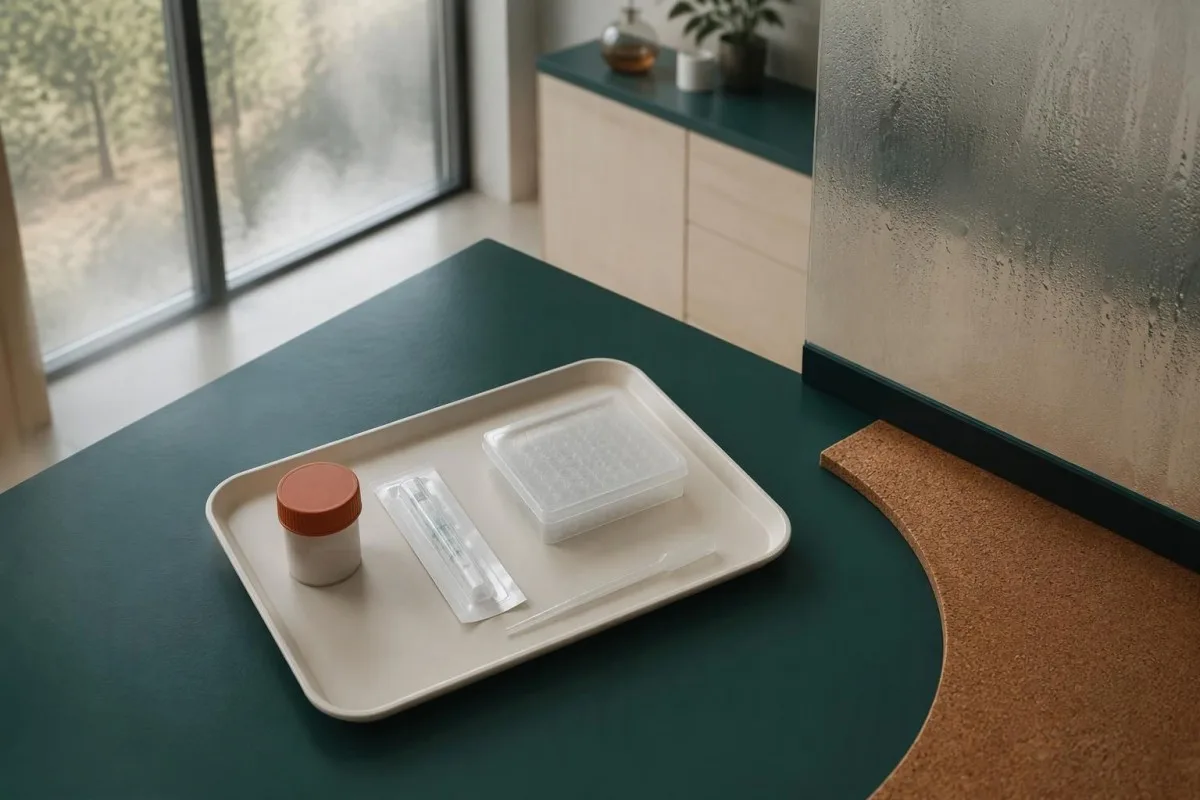
Stool PCR is a detection test, not a severity score. Rotavirus contains RNA, so molecular testing includes a reverse-transcription step before amplification; many gastrointestinal panels report rotavirus A as just 1 of several organisms tested.
A rotavirus stool test positive result can fit 3 different situations: current symptomatic illness, continued shedding after recovery, or detection of vaccine-derived virus after an oral dose. The same laboratory wording can therefore lead to different clinical decisions.
Cycle-threshold values cannot reliably determine treatment or contagiousness. A hypothetical Ct of 35 is not automatically harmless, and a Ct of 20 does not automatically require hospital care; sample handling, assay design, and stool composition affect these numbers.
Το Καντέστι είναι ένα Αναλυτής εξέτασης αίματος AI, not a stool-virus diagnostic service; 1 positive molecular result cannot replace examination of a child who is becoming unwell. Information σχετικά με τον οργανισμό μας explains our blood-test focus and why this article separates report interpretation from clinical triage.
Does the positive result explain your child’s symptoms?
Active rotavirus gastroenteritis is more likely when a positive stool PCR accompanies new watery diarrhea, vomiting, and sometimes fever. Symptoms usually begin about 2 days after exposure and last approximately 3–8 days, although vaccination status and the child’s underlying health can change the course.
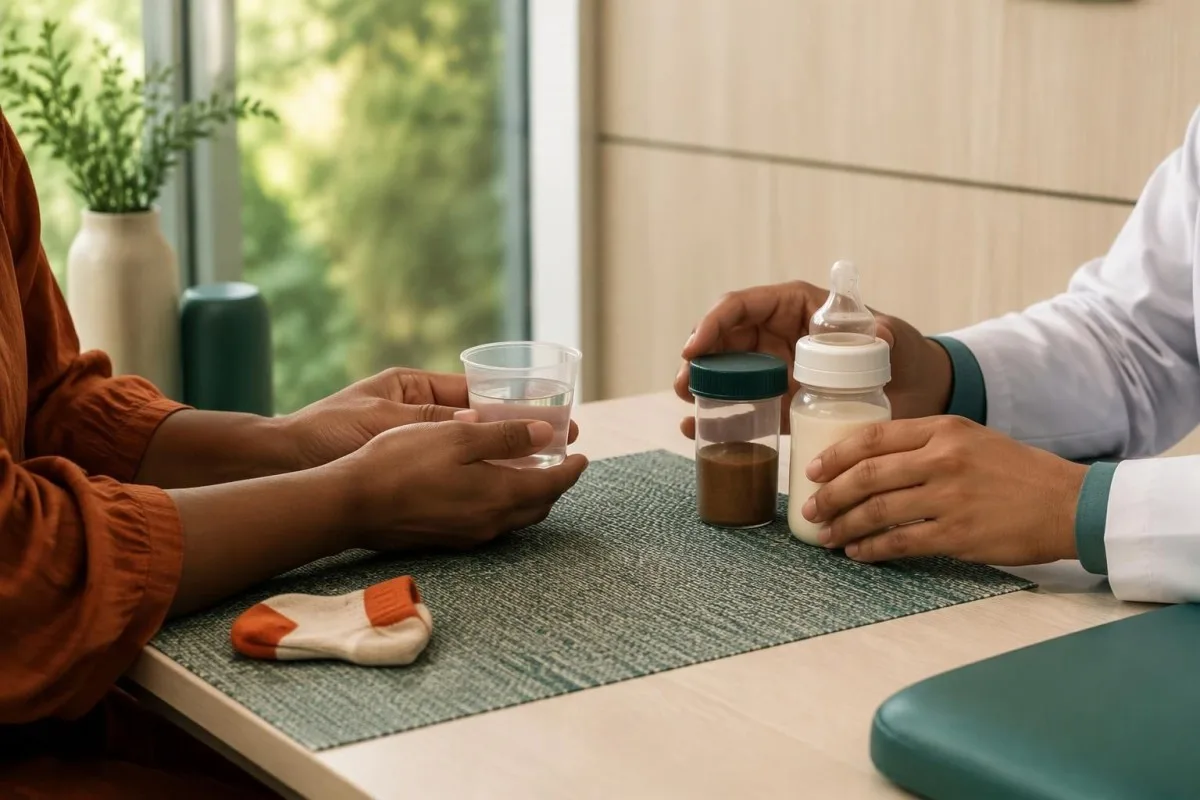
A symptom timeline helps establish whether detection is clinically meaningful. Record the first day of vomiting, the first loose stool, and whether symptoms are improving; a positive sample collected on day 2 of watery diarrhea means something different from one collected 3 weeks after recovery.
For example, a hypothetical 18-month-old with 6 watery stools today, repeated vomiting, and a newly positive PCR probably has clinically relevant gastroenteritis. The next decision is whether the child can replace fluid losses—not whether a second test can prove that the virus is present.
Multiplex panels can detect more than 1 organism. A second positive target may represent another cause, coinfection, or incidental detection; severe localized pain or stool with visible blood should not be explained away simply because rotavirus also appears on the report.
For children who use the toilet, the οδηγός μας για τη σύσταση των κοπράνων can help describe changes, but type 7 stool does not identify a specific pathogen. In infants, compare with their usual stool pattern because normal breastfed stools can already be loose.
How long does rotavirus shedding last after recovery?
Rotavirus shedding can outlast symptoms, and sensitive PCR may detect viral RNA for several weeks after a child feels well. The most intense shedding generally occurs around the acute illness, but detection beyond 4 weeks can occur; there is no universal day when every child’s PCR becomes negative.
Test sensitivity changes the apparent shedding period. A less-sensitive antigen test may become negative before PCR because molecular assays can detect smaller amounts of viral material; 2 tests performed on the same recovery day may therefore disagree without either laboratory making an error.
The Lancet report “Extended excretion of rotavirus after severe diarrhoea in young children” documented prolonged excretion using molecular methods (Richardson et al., 1998). Its findings support a several-week detection window after severe illness, but they should not be treated as a fixed timetable for every vaccinated child with mild symptoms.
A positive PCR after recovery does not prove the child is equally infectious throughout that period. A hypothetical child who is eating normally 21 days after illness may still have detectable RNA; PCR alone cannot determine how much viable virus is being transmitted at home.
Children with significant immune deficiency can have a different shedding course, especially when diarrhea continues beyond 2 weeks. Our explanation of adenovirus detection and shedding illustrates the broader distinction between molecular persistence and active illness, although the timelines are not interchangeable.
Could recent oral vaccination cause a positive stool PCR?
Recent oral rotavirus vaccination can cause a positive stool PCR because the vaccines contain live attenuated virus that can be shed in stool. Detection is particularly plausible during the first 1–2 weeks after a dose, and routine gastrointestinal panels may not distinguish vaccine-derived virus from wild-type rotavirus.
The vaccination date belongs beside the specimen date. In a hypothetical 9-week-old whose sample was collected 7 days after an oral dose, vaccine-related detection is a realistic explanation; that history is more useful than simply labeling the result a false positive.
Yen et al. described fecal shedding after the first dose of pentavalent rotavirus vaccine in Vaccine (2011). That publication demonstrates why detection soon after vaccination needs product and timing context; findings for 1 vaccine product should not be assumed to describe every oral vaccine identically.
Vaccination does not make dehydration signs safe to ignore. The first week after a dose also deserves attention if an infant develops repeated episodes of severe abdominal pain, pallor, unusual lethargy, or green vomiting because intussusception requires urgent assessment, regardless of the stool result.
Ask whether the laboratory offers vaccine-strain differentiation if the distinction would change care, particularly for an immunocompromised infant or an outbreak investigation. Our guide to qualitative and quantitative reports explains why 1 word—“detected”—does not supply strain identity, viral quantity, or clinical severity.
How can you check your child for dehydration at home?
Assess dehydration by combining urine output, drinking, alertness, and physical signs, rather than relying on thirst or 1 wet diaper. Children younger than 1 year, particularly those under 6 months, are at greater risk because fluid losses can represent a larger proportion of their body weight.
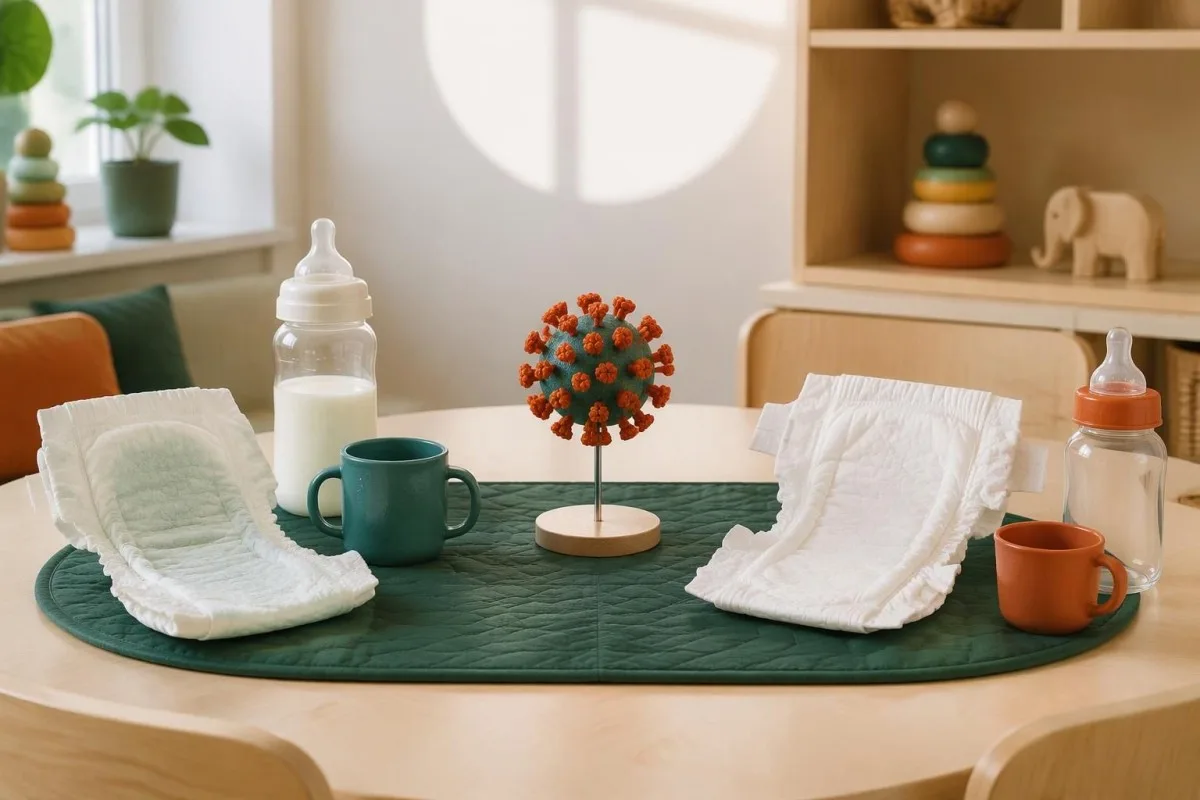
Urine output is useful only when compared with the child’s normal pattern. Markedly fewer wet diapers, dark concentrated urine, or no urine for about 8 hours should prompt urgent advice; seek help sooner in a young infant or when reduced urine accompanies poor drinking or drowsiness.
NICE identifies more than 5 diarrheal stools or more than 2 vomiting episodes in the previous 24 hours as dehydration risk factors in young children (NICE, 2009). These are screening clues, not a rule that a child with fewer episodes cannot become dehydrated.
Weight change can support assessment when reliable measurements exist. A hypothetical fall from 10.0 kg to 9.5 kg is a 5% weight loss, but different scales, clothing, and timing can distort the estimate; do not delay care while trying to obtain a precise home measurement.
Kantesti’s καθοδήγησή μας για την ασφάλεια της παιδιατρικής ΤΝ explains why digital interpretation cannot establish hydration from 1 laboratory value. Our dark urine explanation also distinguishes concentrated urine from color changes that need a different investigation.
Ποια προειδοποιητικά σημάδια απαιτούν επείγουσα ή έκτακτη φροντίδα;
Seek emergency care for difficulty waking, collapse, signs of shock, green vomit, or severe abdominal pain, even when rotavirus PCR is positive. A baby under 3 months with a temperature of 38°C or higher needs urgent medical assessment; a viral result does not exclude another serious condition.

Worsening responsiveness and poor circulation matter more than the stool count. A child who is unusually floppy, hard to wake, breathing abnormally, or pale and mottled needs emergency assessment; do not wait for an 8-hour urine threshold or another episode of diarrhea.
For infants aged 3–6 months, a temperature of 39°C or higher warrants prompt medical advice. Any age group needs urgent assessment when repeated vomiting prevents fluid replacement, urine falls markedly, or the caregiver notices a clear decline over a few hours.
Visible blood is not a typical reason to assume uncomplicated rotavirus. Even 1 episode of blood in stool deserves medical advice, particularly with fever, abdominal pain, or lethargy; our stool blood warning guide explains why appearance can change the urgency.
A hypothetical 4-year-old with a positive panel and pain concentrated in the right lower abdomen still needs assessment for another diagnosis. The appendicitis testing explanation shows why a reassuring test—or a convincing alternative laboratory finding—cannot replace abdominal examination.
How should you prepare and give oral rehydration solution?
Use a commercial oral rehydration solution, mixed exactly as directed, to replace water and electrolytes lost through diarrhea. The WHO reduced-osmolarity formulation contains sodium at 75 mmol/L and glucose at 75 mmol/L; its total osmolarity is 245 mOsm/L, although other approved formulations differ.
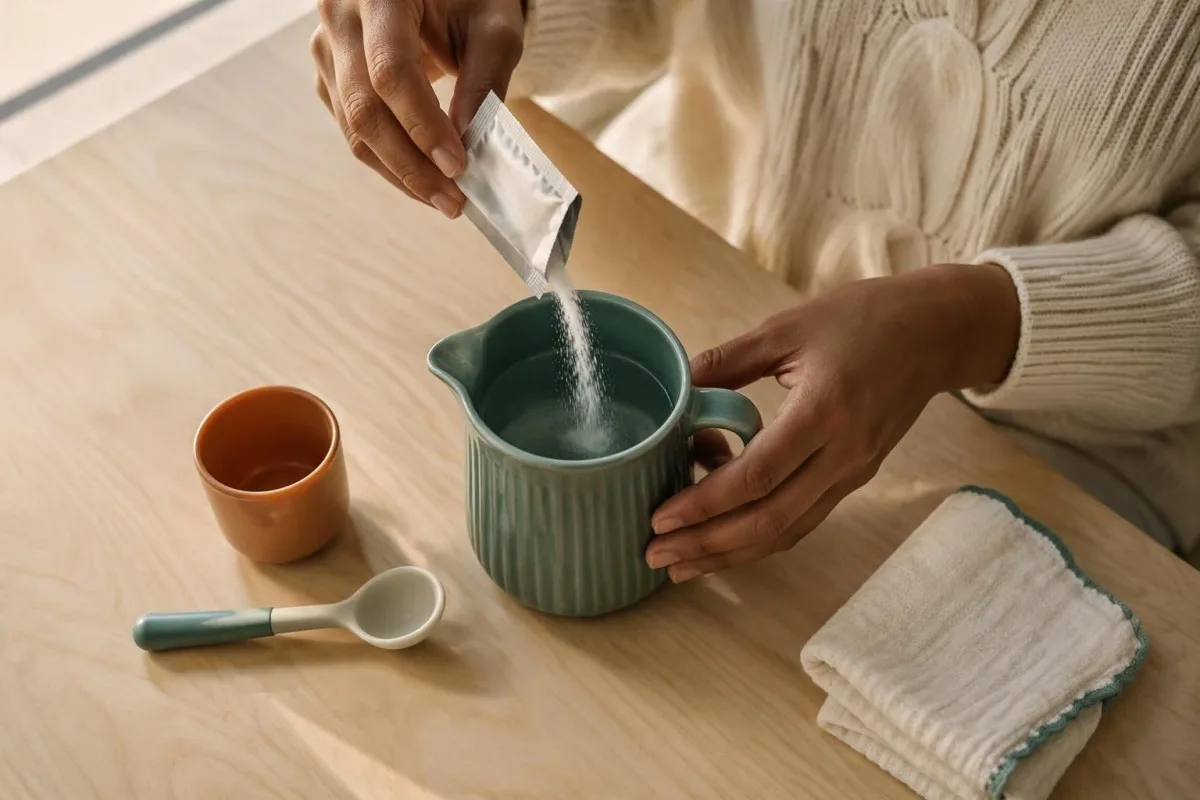
Packet size determines the required water volume. Some products require 200 mL and others 1 L, so never assume that every sachet makes the same amount; doubling the powder in the usual water volume doubles the intended concentration rather than making treatment more effective.
Start with a small, frequent amount—for example, 5 mL every 2–5 minutes during an initial trial—and adjust to the child’s weight, tolerance, and agreed hydration plan. An oral dosing device or spoon can make small amounts easier to control than asking a nauseated child to finish a full cup.
Glucose and sodium work together in intestinal absorption. This is why 1 bottle of plain water, fruit juice, or sports drink is not an equivalent replacement for properly mixed ORS; our επεξήγηση του πάνελ ηλεκτρολυτών describes the salts clinicians assess when illness is more severe.
Follow the product’s storage instructions, because many prepared solutions need to be discarded within 24 hours. Use safe drinking water and a clean container; do not add extra sugar, salt, juice, or formula to the prepared solution.
What if your child keeps vomiting the rehydration solution?
Vomiting does not automatically mean oral rehydration has failed, because small amounts may still be absorbed between episodes. After vomiting, pause for about 5–10 minutes and restart more slowly; urgent assessment is needed when the child cannot retain enough fluid or becomes less alert.
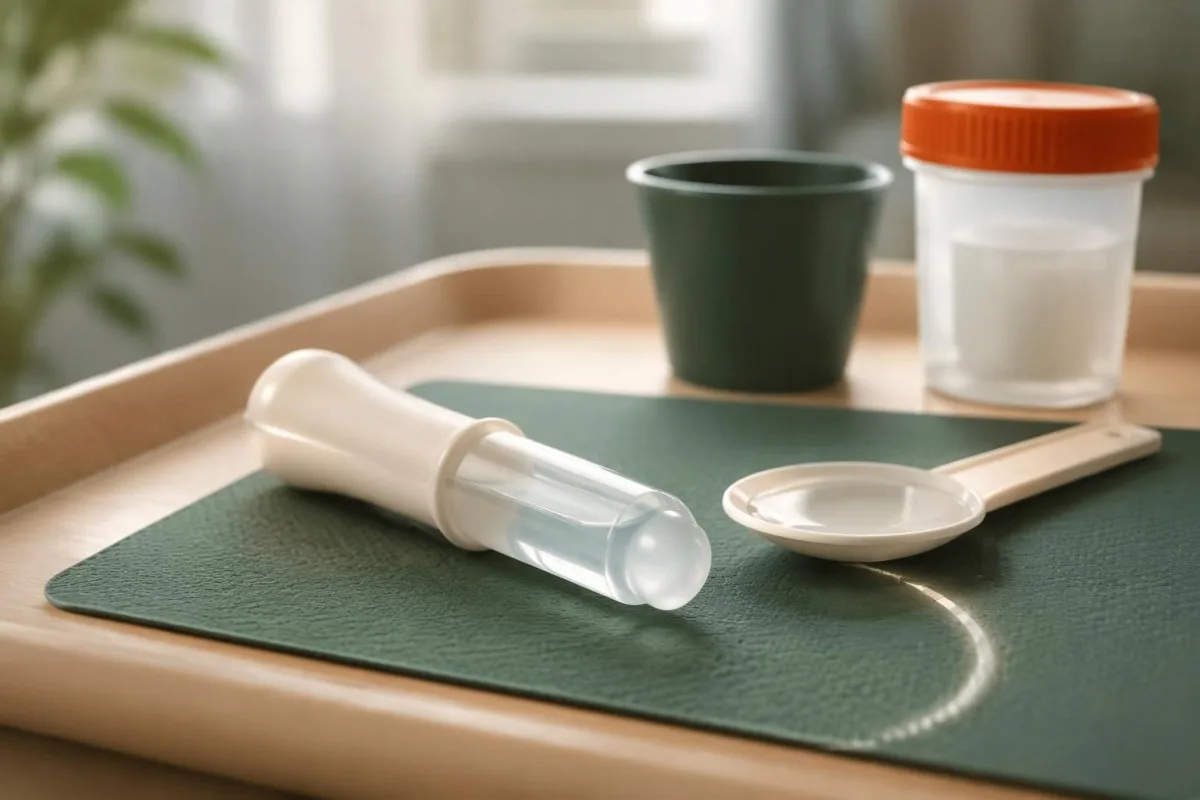
The size of each drink can affect vomiting. A hypothetical toddler who vomits after a 100 mL cup may tolerate 2–5 mL at a time; this is a short-term delivery strategy, not proof that the child is receiving an adequate total volume.
Track what stays down over 30–60 minutes alongside urine and behavior, rather than counting only attempted drinks. Persistent vomiting with declining urine or alertness needs urgent assessment, and green vomit needs emergency evaluation without another home rehydration trial.
Reduced intake can also cause low glucose in young children. A child who has taken almost no calories for 12 hours and becomes unusually sleepy needs assessment rather than continued unsupervised sipping; our οδηγός για αίτια χαμηλής γλυκόζης explains the mechanism, but pediatric thresholds need clinical interpretation.
A clinician may consider an antiemetic in selected children or use a nasogastric tube before intravenous fluids when oral delivery is unsuccessful. These are different decisions from treating the virus: 1 antiemetic dose does not replace reassessment, and electrolyte abnormalities can affect medication safety.
How much oral rehydration solution does a child need?
The required ORS volume depends on body weight, dehydration, and continuing losses. For children under 5 years with clinical dehydration, NICE recommends 50 mL/kg over 4 hours to replace the deficit, in addition to maintenance fluid, with regular clinical reassessment (NICE, 2009).
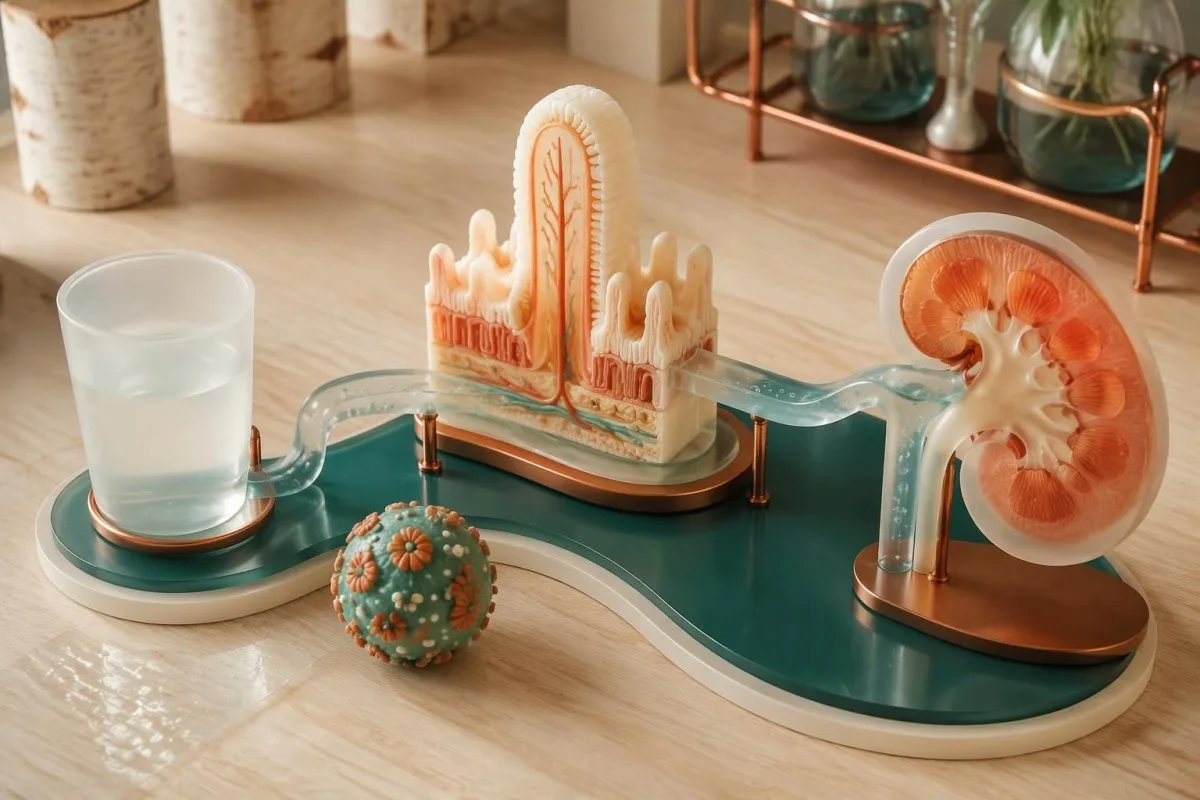
A worked volume is not a universal home prescription. For a hypothetical 10 kg child, 50 mL/kg equals 500 mL over 4 hours, or an average deficit-replacement component of 125 mL/hour; maintenance needs and continuing diarrhea are additional, and the child’s clinician should set the complete plan.
After rehydration, NICE suggests 5 mL/kg of ORS after each large watery stool for children at increased risk of recurrent dehydration. In the same hypothetical 10 kg child, that is 50 mL per large watery stool—not another full 500 mL course each time.
Guidelines use different deficit estimates because dehydration classifications differ. Some international protocols use approximately 75 mL/kg over 4 hours for “some dehydration,” whereas NICE uses 50 mL/kg for clinical dehydration; do not average 2 protocols or assume one volume is right without assessing the child.
Hypernatremic dehydration needs supervised management because correcting sodium too quickly can be harmful. A hypothetical sodium result of 151 mmol/L should trigger clinical review, not extra plain water at home; our high sodium warning guide explains why symptoms and correction speed matter.
Can your child breastfeed, drink formula, and eat normally?
Continue breastfeeding during gastroenteritis, and return to usual full-strength milk and age-appropriate foods after rehydration. Rotavirus commonly causes 3–8 days of symptoms, but withholding nutrition for that entire period is unnecessary; dehydration treatment and feeding are complementary rather than competing goals.
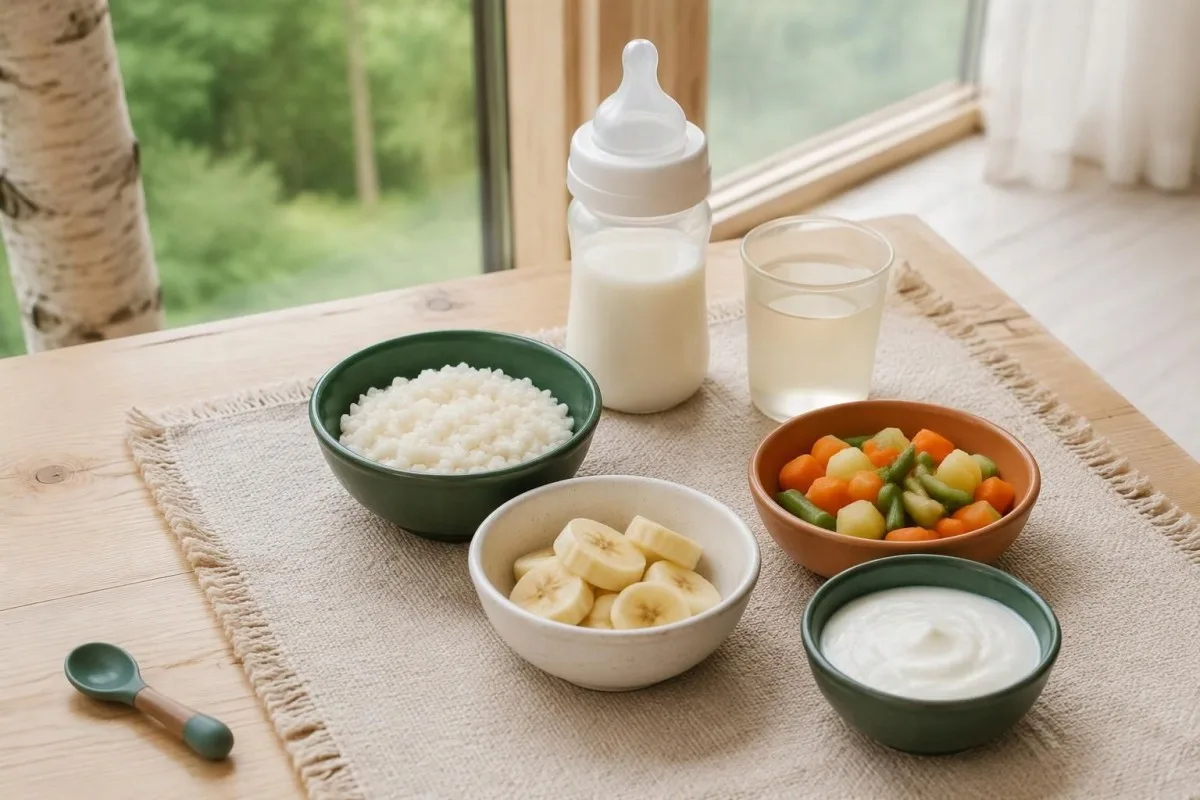
Formula should not routinely be diluted. Adding extra water to 1 normal feed reduces calories and changes its nutrient balance; infants should receive their usual correctly prepared formula unless their clinician recommends a specific alternative.
During an initial 4-hour rehydration phase, follow the clinician’s feeding plan; breastfeeding generally continues, while solids may be paused until rehydration is achieved. Afterwards, offer familiar foods in small portions rather than restricting the child to a prolonged banana-and-rice diet.
Temporary lactose malabsorption can follow intestinal illness, but lactose-free feeding is not automatically necessary. If watery stools repeatedly worsen after milk or continue beyond 1–2 weeks, discuss the pattern with a clinician; our lactose intolerance testing guide explains why symptoms and test selection need context.
A hypothetical 2-year-old eating less for 24 hours but drinking well and urinating normally can often be offered small, frequent meals without pressure. Avoid juice and fizzy drinks during diarrhea because their sugar concentration can worsen stool losses; infants still depend heavily on their usual milk feeds.
Why do antibiotics not treat rotavirus in children?
Antibiotics do not treat rotavirus because it is a virus, and routine pediatric care has no standard antiviral prescription for uncomplicated rotavirus gastroenteritis. A report with 1 positive rotavirus target therefore does not justify antibiotics; treatment focuses on hydration, feeding, and assessment for complications.
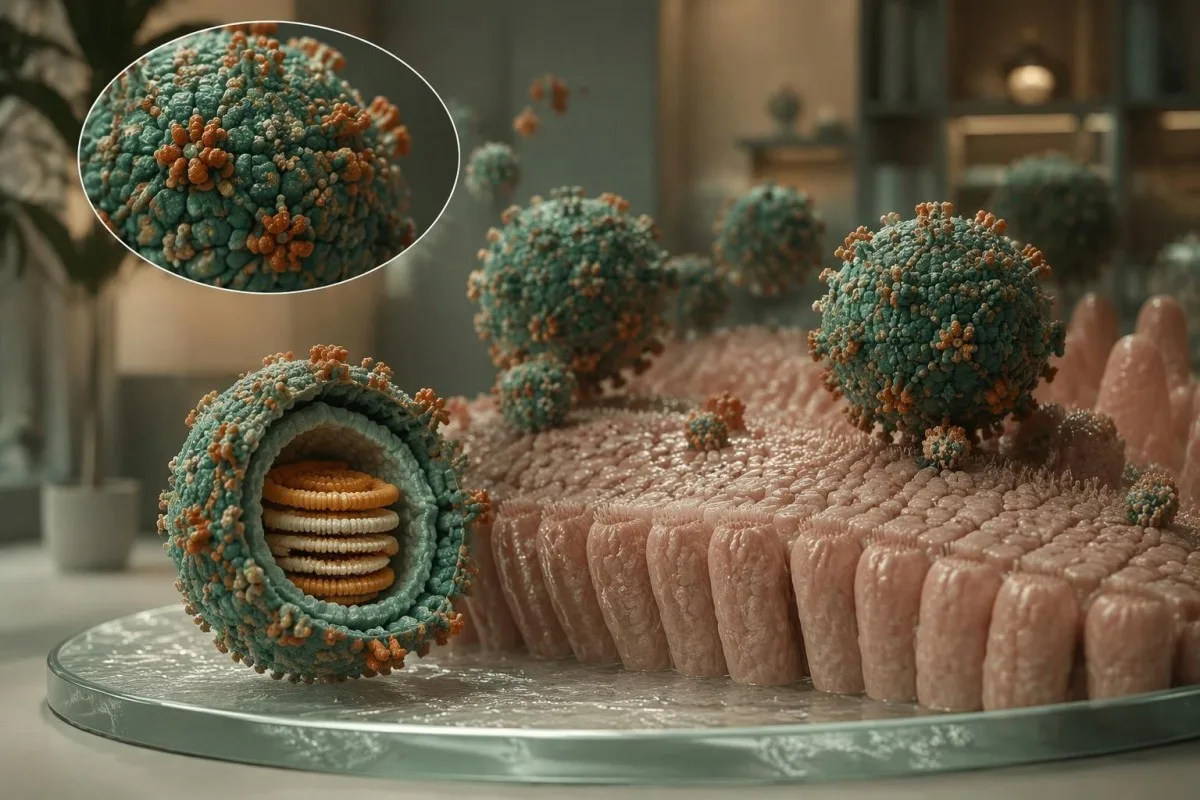
Antibacterial drugs target structures or processes that rotavirus does not possess. Giving an antibiotic for 3 days cannot stop viral RNA replication, and unnecessary treatment can cause adverse effects, disrupt intestinal bacteria, and complicate the interpretation of continued diarrhea.
A separate bacterial diagnosis can change the decision, but 2 detected organisms do not automatically require 2 medicines. Our Campylobacter antibiotic decision guide explains why bacterial treatment depends on severity and risk factors rather than the panel’s positive wording alone.
Do not give diarrhea-stopping medicines to young children without medical advice. For a hypothetical 3-year-old, reducing stool frequency with an unsuitable medicine does not correct dehydration; also avoid ibuprofen when the child is dehydrated or drinking poorly because kidney stress can increase.
Probiotic evidence is strain-specific and honestly mixed, so 1 commercially available product should not be assumed to shorten every rotavirus illness. Zinc recommendations also differ between national programs; neither probiotics nor supplements replace ORS, and parents should follow local pediatric guidance rather than combine several remedies.
When are blood tests or additional stool tests useful?
Most otherwise well children with uncomplicated gastroenteritis do not need blood tests. Testing becomes more useful when intravenous fluids are required, dehydration is severe, glucose disturbance is suspected, or symptoms do not fit the expected course; diarrhea that has not improved by day 7 may warrant further assessment.
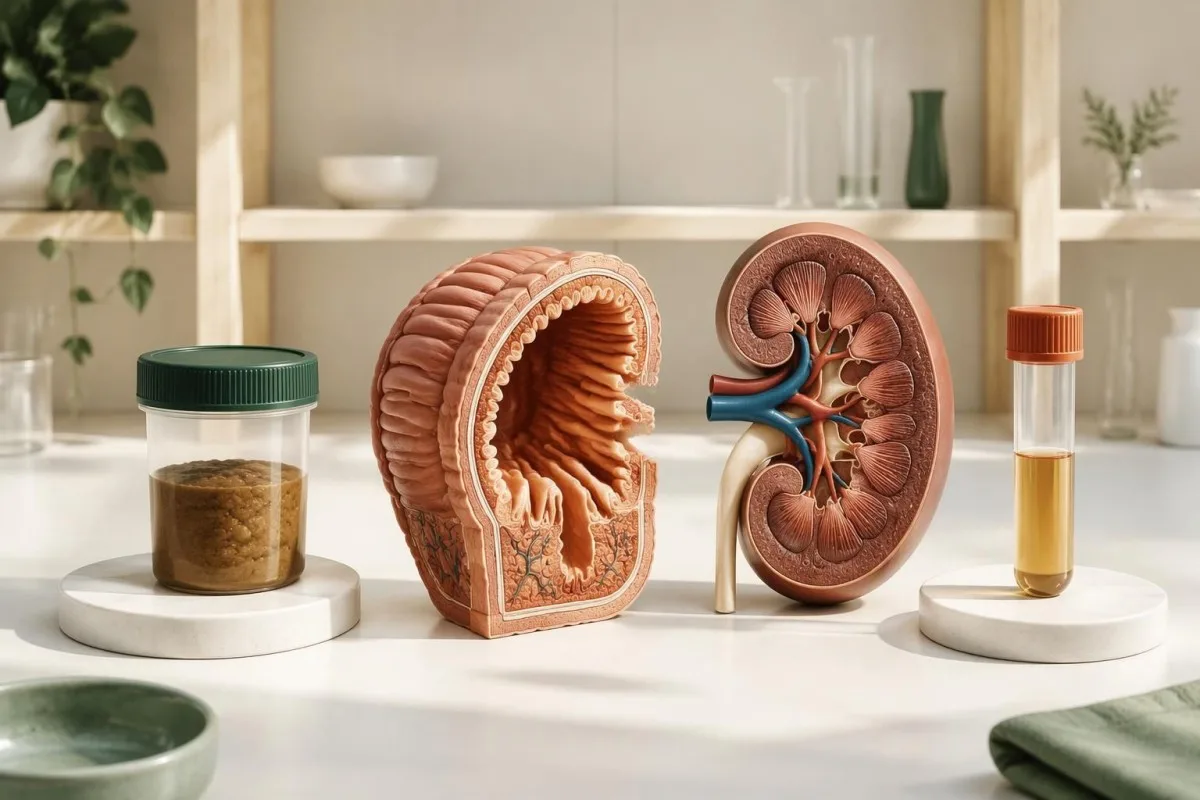
Electrolytes and glucose can reveal problems that a stool PCR cannot measure. NICE recommends appropriate laboratory assessment when intravenous fluids are needed or hypernatremia is suspected; 1 positive viral target cannot tell the clinician whether sodium, potassium, kidney function, or glucose is safe.
Kantesti AI explanations cannot establish hydration from 1 creatinine result or an adult-derived BUN/creatinine ratio. Our οδηγός BUN και κρεατινίνης explains the relationship, but pediatric creatinine values depend strongly on age and muscle mass, and adult ratio thresholds should not be imported into infant care.
Additional stool testing should answer a specific clinical question. Diarrhea lasting 14 days, recent travel, visible blood, immune deficiency, or a suspected outbreak can justify investigating another cause; repeatedly requesting the same panel may simply rediscover persistent viral material.
Το Καντέστι είναι ένα πλατφόρμα ερμηνείας εξετάσεων αίματος AI that can help explain clinician-ordered blood results, but 1 explanation is not a pediatric diagnosis or a treatment order. Our πλαίσιο κλινικής επικύρωσης describes the distinction between evaluating an interpretation system and proving that it can safely manage an acutely ill child.
Does your child need repeat PCR before returning to childcare?
A repeat negative rotavirus PCR is usually unnecessary after clinical recovery. Many UK childcare policies require at least 48 hours without vomiting or diarrhea, rather than laboratory clearance; local public-health instructions, outbreak arrangements, and immune deficiency can change the advice.
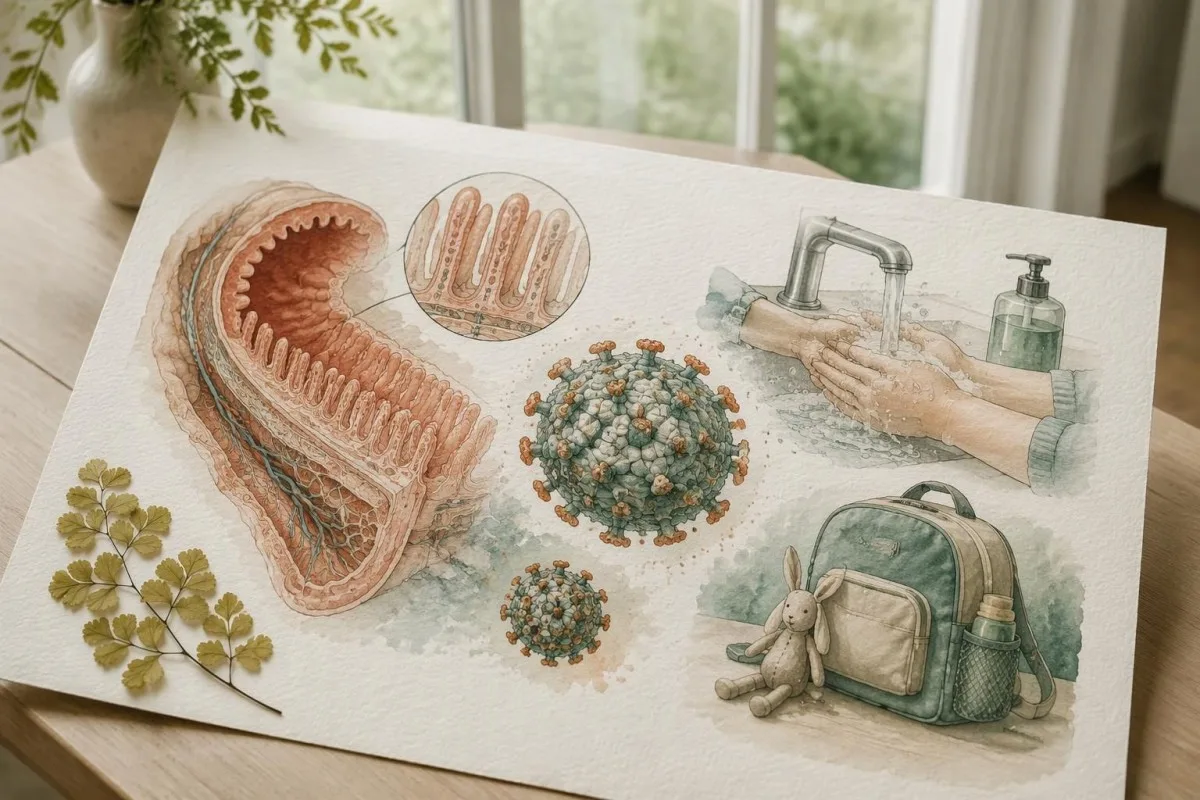
A test of cure can create confusion when shedding continues. A hypothetical child who has been symptom-free for 72 hours may still test positive without needing medicine or a new isolation period; childcare decisions should follow the applicable policy, not an assumed requirement that RNA must disappear.
Μας για την ανάρρωση από τον νοροϊό και τη μεταδοτικότητά του explains a similar distinction between symptom resolution and molecular detection. The commonly used 48-hour exclusion period does not mean transmission risk instantly becomes zero for either virus.
Handwashing and careful diaper handling remain useful after symptoms stop. Wash with soap and water for at least 20 seconds after toileting or diaper changes and before food preparation; clean contaminated surfaces using a product suitable for the surface and effective against the relevant virus.
UK gastroenteritis guidance advises avoiding swimming pools for 2 weeks after the last episode of diarrhea. Tell the childcare setting about symptoms and follow its local rules, while keeping recently vaccinated infants’ diaper hygiene careful without assuming vaccine-related PCR detection requires prolonged exclusion.
How should families use this report, AI, and research?
Use the stool report to support clinical decisions, not to override symptoms. Before contacting your child’s clinician, gather 4 items: the symptom timeline, urine and drinking history, oral vaccine dates, and the complete laboratory report; these usually add more decision value than the word “positive” alone.
Το Καντέστι είναι ένα υπηρεσία ερμηνείας δοκιμών AI focused on blood results, and 1 AI-generated explanation should never delay urgent pediatric assessment. Our αρχές μας για την υπεύθυνη ΤΝ describe why uncertainty and the boundary between explanation and clinical care must remain visible.
A useful handover describes what has changed. For example, a hypothetical parent can report that vomiting began 36 hours ago, the child has had 1 wet diaper in 8 hours, and ORS is repeatedly vomited; these concrete observations help a clinician prioritize care without needing a repeat PCR first.
The external sources supporting this article address 3 distinct questions: NICE provides pediatric dehydration management, Richardson et al. describe prolonged shedding, and Yen et al. examine vaccine shedding. Our πρότυπα ιατρικού περιεχομένου explain why a source about molecular detection cannot, by itself, establish a safe treatment plan.
The 2 Kantesti publications listed below are background resources about blood-test analysis and hematology interpretation. They are hosted on Zenodo and are not rotavirus treatment trials, pediatric triage validation studies, or evidence that AI can distinguish vaccine-derived from wild-type virus; the clinical references should guide those separate questions.
Συχνές ερωτήσεις
Σημαίνει ότι το παιδί μου χρειάζεται θεραπεία ένα θετικό αποτέλεσμα PCR για ροταϊό;
Ένα θετικό αποτέλεσμα PCR για ροταϊό δεν σημαίνει αυτόματα ότι το παιδί σας χρειάζεται φάρμακα. Η θεραπεία είναι απαραίτητη σε περίπτωση αφυδάτωσης ή κλινικά σημαντικών συμπτωμάτων, ενώ ένα παιδί που κατά τα άλλα είναι καλά μπορεί να συνεχίσει να αποβάλλει τον ιό ή να έχει θετική ανίχνευση μετά από χορήγηση από του στόματος εμβολίου τις προηγούμενες 1–2 εβδομάδες. Ένα θετικό αποτέλεσμα PCR δεν μπορεί να μετρήσει την απώλεια υγρών ή να αποκλείσει άλλη ασθένεια. Ζητήστε άμεσα ιατρική αξιολόγηση αν μειωθεί η ούρηση, αν δεν μπορεί να συγκρατήσει τα υγρά ή αν επιδεινωθεί η εγρήγορσή του.
Πόσο διαρκεί η αποβολή του ροταϊού στα παιδιά;
Η αποβολή ροταϊού μπορεί να συνεχιστεί μετά την υποχώρηση των συμπτωμάτων, ενώ η ευαίσθητη PCR κοπράνων μπορεί να παραμείνει θετική για αρκετές εβδομάδες. Έχει περιγραφεί ανίχνευση πέραν των 4 εβδομάδων, ιδιαίτερα μετά από σοβαρή νόσηση, αλλά δεν υπάρχει συγκεκριμένη ημερομηνία κάθαρσης για κάθε παιδί. Η θετικότητα στην PCR δεν αποδεικνύει ότι το επίπεδο μεταδοτικότητας παραμένει το ίδιο καθ’ όλη την ανάρρωση. Η επίμονη διάρροια ή η ανοσοανεπάρκεια απαιτεί εξατομικευμένη κλινική συμβουλή και όχι απλώς επαναλαμβανόμενες εξετάσεις.
Μπορεί το εμβόλιο κατά του ροταϊού να κάνει θετική μια εξέταση κοπράνων;
Ένα από του στόματος εμβόλιο κατά του ροταϊού μπορεί να προκαλέσει θετικό αποτέλεσμα στην PCR κοπράνων, επειδή μπορεί να αποβληθεί ιός προερχόμενος από το εμβόλιο μετά από μία δόση. Αυτή η εξήγηση είναι ιδιαίτερα σχετική κατά τις πρώτες 1–2 εβδομάδες, αν και ο χρόνος ποικίλλει ανάλογα με το εμβόλιο και τη μέθοδο εξέτασης. Οι συνήθεις έλεγχοι PCR γαστρεντερικών παθογόνων μπορεί να μην διακρίνουν τον ιό που προέρχεται από το εμβόλιο από τον άγριου τύπου ροταϊό. Ενημερώστε τον κλινικό γιατρό για τις ημερομηνίες εμβολιασμού και λήψης του δείγματος και μην αποδώσετε την αφυδάτωση ή τα σοβαρά κοιλιακά συμπτώματα σε φυσιολογική επίδραση του εμβολίου.
Πόσο διάλυμα ενυδάτωσης από το στόμα πρέπει να δώσω στο παιδί μου;
Ο όγκος του διαλύματος ενυδάτωσης από το στόμα (ORS) εξαρτάται από το βάρος του παιδιού σας, την αφυδάτωση και τις συνεχιζόμενες απώλειες υγρών. Το NICE συνιστά 50 mL/kg σε διάστημα 4 ωρών για παιδιά κάτω των 5 ετών με κλινική αφυδάτωση, επιπλέον των υγρών συντήρησης και με επανεκτίμηση. Επομένως, ένα υποθετικό παιδί 10 kg χρειάζεται 500 mL για την αναπλήρωση του ελλείμματος, αλλά αυτό δεν αποτελεί πλήρη εξατομικευμένη οδηγία για χορήγηση στο σπίτι. Παρασκευάστε το προϊόν ακριβώς σύμφωνα με τις οδηγίες και ζητήστε ιατρική συμβουλή αν το παιδί σας δεν μπορεί να συγκρατήσει αρκετά υγρά.
Βοηθούν τα αντιβιοτικά στη θεραπεία του ροταϊού στα παιδιά;
Τα αντιβιοτικά δεν θεραπεύουν τον ροταϊό, επειδή ο ροταϊός είναι ιός και όχι βακτήριο. Ένα πάνελ εξέτασης κοπράνων με 1 θετικό στόχο ροταϊού δεν δικαιολογεί τη χορήγηση αντιβιοτικών ή τη συνήθη συνταγογράφηση αντιιικού φαρμάκου. Το διάλυμα στοματικής επανυδάτωσης (ORS), η σίτιση και η παρακολούθηση για αφυδάτωση αποτελούν τις κύριες θεραπείες για ανεπίπλεκτη νόσο. Μια ξεχωριστά διαγνωσμένη βακτηριακή πάθηση μπορεί να απαιτεί διαφορετική θεραπεία, αλλά η σχετική απόφαση εξαρτάται από τα συμπτώματα, τη σοβαρότητα και τον εμπλεκόμενο μικροοργανισμό.
When should I take a child with rotavirus to hospital?
Emergency assessment is needed for difficulty waking, collapse, signs of shock, green vomit, or severe abdominal pain, regardless of a positive rotavirus test. A baby under 3 months with a temperature of 38°C or higher also needs urgent medical assessment. Markedly reduced urine, no urine for about 8 hours, or repeated inability to retain fluid warrants urgent advice; young infants need help sooner. Do not force oral fluids into a child who is not fully alert.
Does my child need a negative rotavirus test before returning to nursery?
A negative repeat rotavirus PCR is usually not required before returning to nursery or childcare after recovery. Many UK policies require at least 48 hours without vomiting or diarrhea, but local rules and outbreak instructions take priority. Stool PCR can remain positive after symptoms have stopped, so a test of cure may unnecessarily prolong uncertainty. Continue careful handwashing and follow local swimming restrictions, which UK gastroenteritis guidance sets at 2 weeks after the last diarrhea episode.
Δείτε πώς να διαβάσετε εξετάσεις αίματος
Ανεβάστε την εργαστηριακή σας αναφορά και η τεχνητή νοημοσύνη της Kantesti εξηγεί κάθε βιοδείκτη με απλή γλώσσα μέσα σε λίγα δευτερόλεπτα. Την έχουν χρησιμοποιήσει περισσότεροι από 2 εκατομμύρια άνθρωποι παγκοσμίως.
Αναφορές
- Klein, T., Mitchell, S., & Weber, H. (2026). AI Blood Test Analyzer: 2.5M Tests Analyzed | Global Health Report 2026. Ιατρική έρευνα της τεχνητής νοημοσύνης Kantesti. DOI
- Klein, T., Mitchell, S., & Weber, H. (2026). Εξέταση αίματος RDW: Πλήρης οδηγός για RDW-CV, MCV και MCHC. Ιατρική έρευνα της τεχνητής νοημοσύνης Kantesti. DOI
- National Institute for Health and Care Excellence (2009). Diarrhoea and vomiting caused by gastroenteritis in under 5s: diagnosis and management. NICE clinical guideline CG84.
- Richardson S et al. (1998). Extended excretion of rotavirus after severe diarrhoea in young children. The Lancet.
- Yen C et al. (2011). Detection of fecal shedding of rotavirus vaccine in infants following their first dose of pentavalent rotavirus vaccine. Vaccine.
- 2+ εκατομμύριαΕξετάσεις που αναλύθηκαν
- 127+χωρών
- 100+Γλώσσες
Σχετικά με την ιατρική ομάδα


Σήματα εμπιστοσύνης E-E-A-T
Εμπειρία
Κλινική ανασκόπηση από ιατρό για τις ροές εργασίας ερμηνείας εργαστηριακών αποτελεσμάτων.
Πραγματογνωμοσύνη
Εστίαση στην εργαστηριακή ιατρική στο πώς συμπεριφέρονται οι βιοδείκτες στο κλινικό πλαίσιο.
Αυθεντικότητα
Ιατρική αξιολόγηση από τον Δρ. Thomas Klein, με συνεισφορές από τη Δρ. Sarah Mitchell και τον Καθ. Δρ. Hans Weber.
Αξιοπιστία
Ερμηνεία βασισμένη σε τεκμηριωμένα δεδομένα με σαφείς οδούς παρακολούθησης για τη μείωση του συναγερμού.






Ιατρική αποποίηση ευθύνης
Αυτό το άρθρο προορίζεται μόνο για εκπαιδευτικούς σκοπούς και δεν αποτελεί ιατρική συμβουλή. Συμβουλεύεστε πάντα έναν κατάλληλο επαγγελματία υγείας για αποφάσεις σχετικά με τη διάγνωση και τη θεραπεία.
Δημοσιεύθηκε · Επικοινωνήστε με τη συντακτική ομάδα
Εκδίδεται από την Kantesti Ltd, εγγεγραμμένη στην Αγγλία και την Ουαλία, αριθμός εταιρείας. 17090423, Λονδίνο, Ηνωμένο Βασίλειο.
