A high calcitonin result can be frightening, but the number only becomes useful when the lab method, kidney function, medicines, thyroid ultrasound, CEA, and sometimes RET testing are interpreted together.


- Calcitonin test measures a hormone made mainly by thyroid C-cells; doctors use it most often when medullary thyroid cancer is suspected or monitored.
- Typical adult calcitonin levels are often below 5 pg/mL in women and below 8–10 pg/mL in men, but assay-specific reference ranges matter.
- High calcitonin above 100 pg/mL strongly raises concern for C-cell disease, especially with a thyroid nodule or elevated CEA.
- Borderline calcitonin between 10 and 30 pg/mL is commonly repeated fasting because medicines, kidney disease, smoking, and assay interference can distort results.
- Medullary thyroid cancer work-up usually includes repeat calcitonin, CEA, thyroid ultrasound, lymph-node assessment, and RET genetic testing if disease is confirmed or strongly suspected.
- False elevations can occur with proton pump inhibitors, chronic kidney disease, autoimmune thyroiditis, hypergastrinemia, heterophile antibodies, and some non-thyroid neuroendocrine conditions.
- FNA calcitonin washout can help when a thyroid nodule or neck node has suspicious imaging but routine cytology is unclear.
- After thyroidectomy for medullary thyroid cancer, undetectable or very low calcitonin suggests biochemical remission; rising calcitonin or a short doubling time needs specialist review.
What the calcitonin test measures in thyroid C-cells
Doctors order a calcitonin test when they need to check whether thyroid C-cells are overactive, most importantly in suspected or known medullary thyroid cancer. A clearly high result can point toward C-cell disease, but borderline results often come from medicines, kidney disease, smoking, or lab interference. The next step is usually repeat fasting calcitonin, CEA, thyroid ultrasound, and targeted follow-up rather than panic.
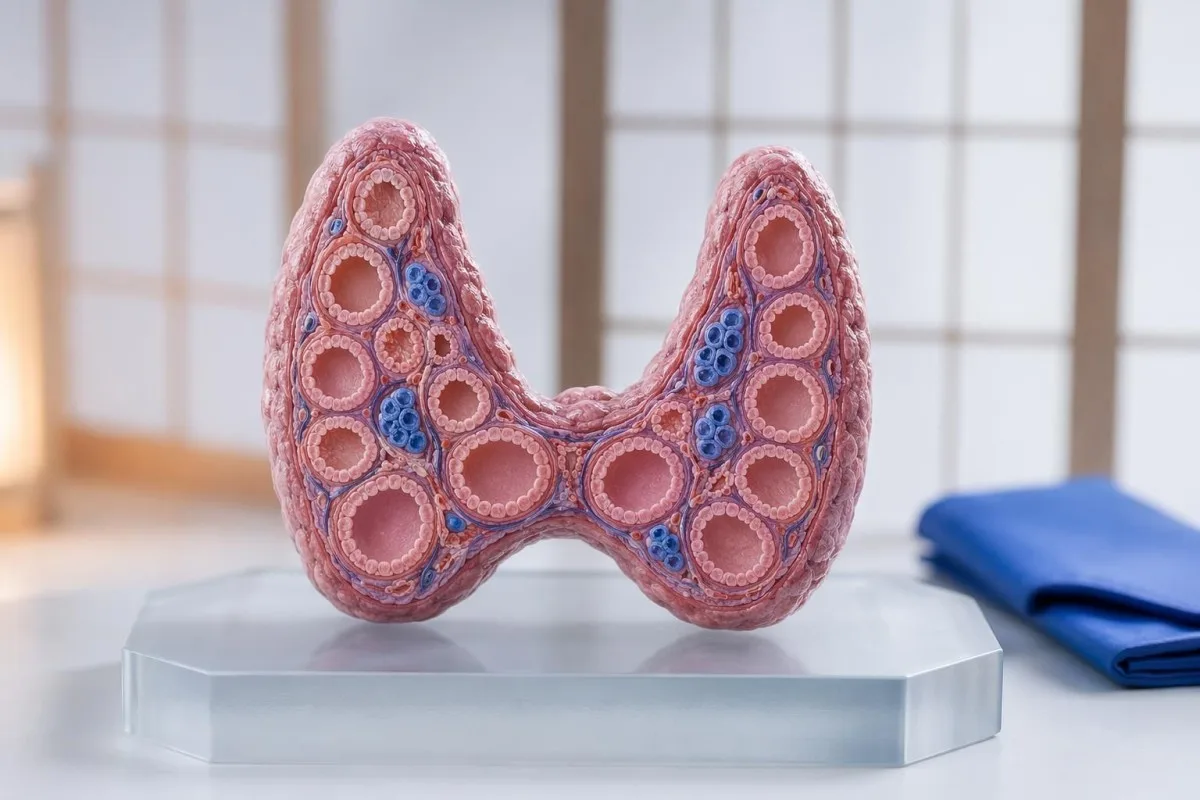
Calcitonin is a peptide hormone made mainly by parafollicular C-cells in the thyroid, and its day-to-day role in adult calcium control is modest. In clinical practice, I use it less as a calcium hormone and more as a C-cell signal, especially when a thyroid nodule does not behave like an ordinary nodule on a thyroid panel.
Kantesti is an AI blood test interpretation platform that reads calcitonin results alongside TSH, free T4, calcium, creatinine, CEA, and previous values rather than treating one number as a diagnosis. As of June 8, 2026, that context still matters because the 2015 American Thyroid Association guideline states that routine calcitonin screening in every thyroid nodule remains controversial, not mandatory (Wells et al., 2015).
Thomas Klein, MD, and our medical reviewers see one recurring mistake: patients compare a 14 pg/mL result from one lab with a 14 ng/L result from another and assume they are different. They are usually the same concentration because 1 pg/mL equals 1 ng/L, while 1 ng/mL equals 1000 pg/mL; if your report uses ng/mL, pause and verify the unit before interpreting it.
Our clinical articles are reviewed against physician standards by doctors listed on the Medical Advisory Board, because calcitonin is exactly the kind of marker where over-reading a mild elevation can cause harm. The practical first question is simple: was the test ordered for a real thyroid cancer concern, or was it added to a broad panel without a clear pre-test probability?
When doctors order calcitonin instead of routine thyroid labs
Doctors order calcitonin when symptoms, imaging, family history, or previous cancer treatment raises the probability of C-cell disease. A calcitonin test is not a replacement for TSH, free T4, or thyroid antibodies; it answers a different question.
The most defensible reasons are a thyroid nodule with suspicious ultrasound features, a family history of MEN2 or medullary thyroid cancer, an already diagnosed medullary thyroid cancer, or follow-up after thyroidectomy. I also see calcitonin ordered when a patient has chronic unexplained diarrhea, flushing, and a thyroid nodule, although those symptoms have many non-cancer causes.
The NICE thyroid cancer guideline from 2022 supports specialist evaluation when medullary thyroid cancer is suspected, and in practice that means calcitonin, CEA, ultrasound, and genetic risk assessment rather than a single isolated blood marker (NICE, 2022). For broader context on why tumor markers are poor screening tests when used casually, our guide to tumor marker ordering is a useful companion.
A 46-year-old patient in my clinic once had calcitonin checked during a wellness panel with no thyroid nodule, no family history, and no symptoms; the result was 12 pg/mL, and it normalized to 6 pg/mL after stopping a proton pump inhibitor and repeating fasting. That is very different from a 52-year-old with a 1.8 cm hypoechoic nodule, calcitonin 180 pg/mL, and CEA 14 ng/mL.
The pre-test probability changes everything. In a low-risk person, a borderline value may be a false alarm; in a person with a RET mutation or suspicious nodule, the same number deserves faster endocrine review.
Normal calcitonin levels, units, and sex-specific cutoffs
Normal calcitonin levels are assay-dependent, but many adult laboratories use roughly below 5 pg/mL for women and below 8–10 pg/mL for men. Men run slightly higher because C-cell mass and smoking prevalence differ across populations.
Calcitonin levels are usually reported in pg/mL or ng/L, and those two units are numerically equivalent. A result of 9 pg/mL may be normal for an adult man in one assay and flagged for an adult woman in another, which is why the reference interval printed on the report matters more than a generic internet cutoff.
Some European laboratories use lower decision limits for women, often around 5 pg/mL, while several North American reports use a single upper limit near 10 pg/mL. Kantesti links calcitonin with the broader biomarkers guide logic: a mild flag is not the same as a disease probability.
When patients upload older PDFs, the hidden trap is unit drift. A clinic may switch from pg/mL to pmol/L, and 1 pmol/L is approximately 3.4 pg/mL for calcitonin; our trend view treats that as a conversion problem, not a biological jump.
If the lab range says below 10 pg/mL and your result is 11 pg/mL, I would not call that medullary thyroid cancer from the number alone. I would check fasting status, medicines, kidney function, and whether the value repeats.
How high calcitonin changes medullary thyroid cancer risk
A calcitonin value above 100 pg/mL is much more concerning for medullary thyroid cancer than a value of 12–20 pg/mL. The higher the result, the more urgently clinicians look for C-cell hyperplasia, medullary thyroid cancer, and neck lymph-node involvement.
In my experience, the gray zone is 10–100 pg/mL; this is where false positives and early disease overlap. Elisei et al. reported in the Journal of Clinical Endocrinology and Metabolism that routine calcitonin testing in 10,864 thyroid nodule patients improved medullary thyroid cancer detection, but the paper also illustrates why borderline elevations require careful confirmation (Elisei et al., 2004).
A persistent calcitonin above 100 pg/mL, especially with a thyroid nodule, is a different clinical animal. Kantesti AI flags high calcitonin with CEA and ultrasound context because calcitonin alone suggests source, while CEA and imaging help estimate burden; for patient-friendly pattern reading, see our guide to blood test numbers.
Very high calcitonin, such as 500–1000 pg/mL, often correlates with larger tumor burden or metastatic disease in published surgical series, but there are exceptions. A small intrathyroidal medullary cancer can sometimes produce a surprising number, and advanced disease can occasionally produce less than expected.
The thing is, calcitonin is not a staging scan. It is a biochemical clue that tells the team how hard to look and which compartments of the neck, chest, liver, and bone may need assessment if the diagnosis is confirmed.
False high calcitonin causes doctors check first
False high calcitonin can occur from proton pump inhibitors, chronic kidney disease, smoking, autoimmune thyroiditis, hypergastrinemia, and assay antibodies. These causes do not make the result irrelevant, but they change how quickly clinicians escalate.
Proton pump inhibitors are a common culprit because they raise gastrin, and gastrin can stimulate C-cells in some people. I usually ask about omeprazole, pantoprazole, lansoprazole, and esomeprazole; if clinically safe, many endocrinologists repeat calcitonin after 1–2 weeks off a PPI or after switching strategy with the prescriber.
Chronic kidney disease can raise calcitonin because clearance changes and endocrine signaling becomes messy. A calcitonin of 25 pg/mL with an eGFR of 28 mL/min/1.73 m² means something different from 25 pg/mL with normal creatinine, so I always read it beside a renal panel rather than in isolation.
Smoking can nudge calcitonin upward, and autoimmune thyroiditis can do the same, usually mildly. If reflux therapy is part of the story, our article on long-term PPI labs can help patients prepare safer questions for their clinician.
Non-thyroid neuroendocrine conditions can produce calcitonin, but they are less common than medication, renal, or assay explanations in everyday outpatient practice. A false elevation is most plausible when calcitonin is mildly high, CEA is normal, ultrasound is clean, and the value falls on repeat testing.
Assay interference and lab handling that can mislead results
Assay interference can make calcitonin falsely high or falsely low, especially through heterophile antibodies, macrocalcitonin, or biotin-sensitive immunoassays. A surprising result should be repeated using the same lab or a different platform before major decisions.
Most calcitonin tests use immunometric assays, and those assays can be fooled by antibodies that bridge the test reagents. Heterophile antibody interference may produce a falsely high calcitonin, while high-dose biotin can distort some sandwich immunoassays, often toward falsely low results depending on the platform.
Kantesti is an AI biomarker interpretation platform that treats calcitonin as an assay-sensitive marker, so our clinical rules look for impossible combinations such as very high calcitonin with repeatedly normal CEA, normal ultrasound, and no trend. For related interference patterns, our explanation of biotin and thyroid labs is directly relevant.
Some labs prefer serum, others accept plasma, and sample stability varies by analyzer and transport chain. If a result will change surgery planning, I want the repeat sample drawn fasting in the morning, processed promptly, and ideally compared with the same assay before switching laboratories.
Our validation workflow is documented on the medical validation page because lab interpretation is not just a language problem; it is a pre-analytical and analytical problem too. A number that looks precise to one decimal place can still be clinically wrong.
What to do first after a high calcitonin result
After a high calcitonin result, the first step is usually confirmation: repeat fasting calcitonin, check CEA, review medicines, and verify kidney function. Emergency action is rarely needed unless symptoms or imaging suggest advanced disease.
For borderline values between 10 and 30 pg/mL, I often repeat within 2–6 weeks rather than sending the patient straight to surgery. The repeat should be fasting, preferably morning, with no biotin for at least 48–72 hours and with PPI changes only if the prescribing clinician agrees.
For values above 100 pg/mL, I move faster: endocrinology referral, high-resolution neck ultrasound, CEA, calcium, creatinine, and careful family history. Our general guide on when to repeat abnormal labs explains why a repeat test is sometimes protective rather than delaying care.
The most useful question for your doctor is not only, how high is it? Ask whether the calcitonin is reproducible, whether CEA is concordant, and whether the thyroid or lymph nodes show a target. Those three answers change the pathway.
If the repeat result drops from 22 pg/mL to 6 pg/mL after correcting a reversible factor, the probability of medullary thyroid cancer falls sharply. If it rises from 80 pg/mL to 140 pg/mL, I would not keep watching casually.
CEA, ultrasound, and neck mapping after high calcitonin
CEA and thyroid ultrasound help separate biochemical suspicion from visible disease. Calcitonin points toward C-cells, CEA adds tumor-burden context, and ultrasound maps the thyroid and cervical lymph nodes.
CEA is less specific than calcitonin, but in medullary thyroid cancer it often rises as disease burden increases or biology becomes more aggressive. A calcitonin of 180 pg/mL with CEA 16 ng/mL worries me more than calcitonin 18 pg/mL with CEA 1.2 ng/mL and a clean ultrasound.
A skilled thyroid ultrasound looks for nodule size, echogenicity, margins, calcifications, vascularity, and suspicious lymph nodes in central and lateral compartments. For background on what CEA can and cannot tell you, our CEA follow-up guide is useful because CEA is not a cancer screening shortcut.
Medullary thyroid cancer can hide in a nodule that cytology calls indeterminate, so clinicians do not rely on ultrasound alone. They combine anatomy with biomarkers; that is why a small 9 mm nodule with calcitonin 220 pg/mL can get more attention than a larger benign-appearing nodule with normal calcitonin.
If ultrasound shows suspicious lymph nodes, the next step may be fine-needle aspiration with calcitonin washout. I usually tell patients that neck mapping is not just to find the thyroid nodule; it helps the surgeon choose the correct operation the first time.
Calcium stimulation testing in borderline calcitonin cases
Calcium stimulation testing can help clarify borderline calcitonin elevations when basal values remain suspicious but not diagnostic. It is a specialist test, not a routine screening add-on.
Historically, pentagastrin stimulation was widely discussed, but it is unavailable in many countries now. Intravenous calcium stimulation is used in some endocrine centers; calcitonin is measured before and after calcium to see whether C-cells produce an exaggerated response.
This test is not for everyone because calcium infusion can cause flushing, warmth, nausea, or transient ECG changes, and protocols vary. If you are comparing calcium results around the same time, our calcium range guide explains why total and ionized calcium do not always move together.
Clinicians disagree on exact stimulated cutoffs, partly because assays differ and older studies used pentagastrin. In my practice, a markedly stimulated calcitonin supports further C-cell evaluation, while a flat response with normal CEA and clean imaging makes false elevation more plausible.
The hidden value of stimulation testing is psychological as much as biochemical. For a patient stuck with repeated 20–40 pg/mL results, a specialist-supervised dynamic test can prevent months of uncertain watching.
FNA calcitonin washout when cytology is unclear
FNA calcitonin washout measures calcitonin in fluid from a sampled thyroid nodule or lymph node. It can identify C-cell origin when routine cytology is indeterminate or when a lymph node is suspicious.
Fine-needle aspiration cytology can miss medullary thyroid cancer because the cells may not look classic, especially in small samples. Washout calcitonin adds a biochemical clue from the sampled site, and a high washout value compared with serum supports C-cell involvement.
This is where wording matters: a washout test is not the same as a serum calcitonin test, and the cutoff depends on the lab protocol. Kantesti's neural network does not diagnose tissue disease from a PDF, but it can flag that serum calcitonin, CEA, ultrasound, and cytology are discordant and need specialist review.
If surgery is being discussed, patients should also understand pre-operative lab checks, anaesthetic risk, calcium status, and medication timing. Our pre-surgery blood test guide covers the practical lab side that often gets overlooked when everyone is focused on the cancer marker.
A common clinical pattern is calcitonin 70 pg/mL, CEA normal, nodule cytology indeterminate, and ultrasound mildly suspicious. In that setting, washout calcitonin can tip the decision toward surgery or toward continued surveillance, depending on the whole picture.
RET genetic testing and family screening after suspected disease
RET genetic testing is recommended when medullary thyroid cancer is confirmed and often when suspicion is high. A germline RET mutation changes the patient’s care and may identify relatives who need early testing.
About 20–25% of medullary thyroid cancers are hereditary, most often through MEN2 syndromes linked to germline RET variants. The ATA guideline recommends RET germline testing for patients with medullary thyroid cancer because missing hereditary disease can miss pheochromocytoma risk and family prevention opportunities (Wells et al., 2015).
If RET is positive, clinicians usually screen for pheochromocytoma with plasma or urinary metanephrines before thyroid surgery, because an unrecognized adrenal catecholamine-producing growth can make anaesthesia dangerous. Family members may need cascade testing, and our hereditary disease labs article explains how relatives can organize results without mixing privacy boundaries.
MEN2A can include primary hyperparathyroidism, so calcium and PTH enter the conversation. MEN2B may show earlier and more aggressive medullary thyroid cancer, which is why some RET variants lead to childhood thyroidectomy recommendations in specialist guidelines.
I try to say this gently in clinic: a RET test is not only about you. It can protect a sibling, child, or parent who has normal calcitonin today but carries a variant that changes their timeline.
Monitoring calcitonin after thyroidectomy for medullary cancer
After thyroidectomy for medullary thyroid cancer, calcitonin should become undetectable or very low if all C-cell disease has been removed. Persistent or rising calcitonin suggests residual or recurrent disease.
Many specialists check calcitonin and CEA about 2–3 months after surgery, then at intervals based on risk and the early trend. A postoperative calcitonin below the assay detection limit is reassuring, while a detectable value such as 25 pg/mL may prompt imaging depending on baseline stage.
Doubling time is one of the most useful numbers in follow-up. A calcitonin doubling time shorter than 6–12 months is more concerning than a stable low-level value over several years, and our thyroidectomy lab guide helps patients separate thyroid hormone replacement targets from cancer marker monitoring.
CEA can rise even when calcitonin does not rise dramatically, particularly in more dedifferentiated disease. That mismatch is uncommon but clinically important, so I never follow calcitonin alone after confirmed medullary thyroid cancer.
Trend graphs reduce fear when numbers wobble by small amounts. For example, 3.1 to 3.8 pg/mL across two assays may be noise, while 12 to 28 to 64 pg/mL over 9 months is a biologic signal worth acting on; our trend analysis guide explains this slope-based thinking.
How Kantesti helps organize calcitonin follow-up
Kantesti helps patients organize calcitonin follow-up by reading the result with related labs, units, reference ranges, medicines, and previous trends. It does not replace an endocrinologist, but it can make the next appointment more focused.
Kantesti is an AI-powered blood test analysis tool used by 2M+ people across 127+ countries, and calcitonin is a good example of why context beats a single red flag. A 19 pg/mL result next to eGFR 32, PPI use, and normal CEA gets a different explanation than 190 pg/mL with a suspicious thyroid nodule.
Our AI maps calcitonin to thyroid markers, kidney function, calcium, CEA, medication notes, and historical values in about 60 seconds after a PDF or photo upload. The underlying approach is described in our technology guide, where we explain why rule-based safety checks sit beside neural interpretation.
For clinical governance, Thomas Klein, MD, reviews high-risk lab logic with the team and compares outputs against physician-reviewed cases. Our validation work includes population-scale benchmark methods, including hyperdiagnosis trap cases, described in the AI engine benchmark.
The most useful output is often a short list of questions: should I repeat fasting, should CEA be added, do I need ultrasound, and do my medications explain the value? That is the kind of list a busy endocrinology visit can actually use.
Bottom line: high calcitonin needs pattern-based next steps
High calcitonin should be handled as a pattern, not a verdict. The safest pathway is to confirm the result, rule out false elevations, add CEA and thyroid imaging, and involve endocrinology quickly when levels are clearly high or rising.
If your calcitonin is mildly elevated, the most practical next step is usually a repeat fasting calcitonin with CEA, creatinine, calcium, and a medication review. If your calcitonin is above 100 pg/mL or rising on repeat, I would treat that as a specialist endocrine problem, not a watch-and-wait wellness finding.
Thomas Klein, MD, often tells patients that a good calcitonin work-up tries to avoid two harms at once: missing medullary thyroid cancer and sending a person with a false-positive 14 pg/mL value into months of unnecessary fear. If you need help deciding what records to bring, our team can be reached through Contact Us.
Kantesti LTD. (2026). B Negative Blood Type, LDH Blood Test & Reticulocyte Count Guide. Figshare. DOI: 10.6084/m9.figshare.31333819. ResearchGate: publication search. Academia.edu: publication search.
Kantesti LTD. (2026). Diarrhea After Fasting, Black Specks in Stool & GI Guide 2026. Figshare. DOI: 10.6084/m9.figshare.31438111. ResearchGate: publication search. Academia.edu: publication search.
Frequently Asked Questions
What does a calcitonin test show?
A calcitonin test measures calcitonin, a hormone made mainly by thyroid C-cells. Doctors use it most often to investigate or monitor medullary thyroid cancer, not to assess ordinary hypothyroidism. Many adult reference ranges are below 5 pg/mL in women and below 8–10 pg/mL in men, but the assay printed on your report matters. A high result should be interpreted with CEA, kidney function, medicines, and thyroid ultrasound.
How high is calcitonin in medullary thyroid cancer?
Calcitonin above 100 pg/mL is strongly suspicious for medullary thyroid cancer, especially when a thyroid nodule or abnormal lymph node is present. Values between 10 and 100 pg/mL are a gray zone where early C-cell disease and false elevations overlap. Very high values, such as above 500 pg/mL, may suggest larger disease burden, but imaging and specialist assessment determine staging. One isolated result should not be used as the whole diagnosis.
Can calcitonin be high without thyroid cancer?
Yes, calcitonin can be high without thyroid cancer. Common non-cancer causes include proton pump inhibitors, chronic kidney disease, smoking, autoimmune thyroiditis, hypergastrinemia, heterophile antibody interference, and some non-thyroid neuroendocrine conditions. Mild elevations such as 10–30 pg/mL are the range where false positives are especially common. Repeating a fasting morning calcitonin with CEA and creatinine often clarifies the situation.
Should I stop my PPI before repeating calcitonin?
You should not stop a proton pump inhibitor on your own, but your clinician may advise a supervised pause or switch before repeating a borderline calcitonin result. PPIs can raise gastrin, and gastrin may mildly stimulate thyroid C-cells in some people. Many clinicians repeat calcitonin after 1–2 weeks off a PPI if it is medically safe. If you have severe reflux, Barrett’s esophagus, ulcers, or bleeding risk, the medication decision needs medical supervision.
What follow-up tests are usually done after high calcitonin?
Follow-up after high calcitonin usually includes repeat fasting calcitonin, CEA, creatinine or eGFR, calcium, thyroid ultrasound, and review of medicines and supplements such as biotin. If imaging shows a suspicious thyroid nodule or lymph node, fine-needle aspiration with calcitonin washout may be added. If medullary thyroid cancer is confirmed, RET germline genetic testing is recommended. The exact sequence depends on how high the calcitonin is and whether it repeats.
Is calcitonin the same as thyroglobulin?
Calcitonin and thyroglobulin are different thyroid-related markers used for different cancers. Calcitonin comes mainly from C-cells and is central to medullary thyroid cancer evaluation. Thyroglobulin comes from thyroid follicular cells and is mainly used after treatment for papillary or follicular thyroid cancer. A normal thyroglobulin does not rule out medullary thyroid cancer, and a normal calcitonin does not rule out ordinary thyroid hormone disorders.
What calcitonin level is reassuring after thyroidectomy?
After thyroidectomy for medullary thyroid cancer, an undetectable or very low calcitonin, often below 2 pg/mL depending on the assay, is reassuring. Detectable calcitonin after surgery may reflect residual C-cell tissue or persistent disease, especially if it rises over time. Calcitonin and CEA are commonly checked about 2–3 months after surgery and then at risk-based intervals. A short calcitonin doubling time, particularly under 6–12 months, needs specialist attention.
Can a normal calcitonin result rule out every type of thyroid cancer?
No. Calcitonin mainly helps detect medullary thyroid cancer, which starts in C-cells; most papillary and follicular thyroid cancers do not raise it. A suspicious thyroid nodule still needs ultrasound-based assessment and, when appropriate, a needle biopsy.
If I have medullary thyroid cancer, should my children be tested for a RET mutation?
If a pathogenic inherited RET variant is identified, each child has a 50% chance of inheriting it. First-degree relatives should be offered genetic counseling and targeted testing; the mutation type helps a specialist decide when thyroid surveillance or preventive treatment should begin.
What should I bring to my first endocrinology visit after a high calcitonin result?
Bring the original lab report, any prior calcitonin or CEA results, thyroid ultrasound images, kidney function tests, and a list of medicines and supplements. This helps your doctor decide whether to repeat testing, investigate false elevations, or move directly to imaging and biopsy planning.
Get AI-Powered Blood Test Analysis Today
Join over 2 million users worldwide who trust Kantesti for instant, accurate lab test analysis. Upload your blood test results and receive comprehensive interpretation of 15,000+ biomarkers in seconds.
📚 Referenced Research Publications
Klein, T., Mitchell, S., & Weber, H. (2026). Kantesti LTD. (2026). B Negative Blood Type, LDH Blood Test & Reticulocyte Count Guide. Figshare.. Kantesti AI Medical Research.
Klein, T., Mitchell, S., & Weber, H. (2026). Kantesti LTD. (2026). Diarrhea After Fasting, Black Specks in Stool & GI Guide 2026. Figshare.. Kantesti AI Medical Research.
📖 External Medical References
National Institute for Health and Care Excellence (2022). Thyroid cancer: assessment and management. NICE guideline NG230. NICE Guideline.
⚕️ Medical Disclaimer
This article is for educational purposes only and does not constitute medical advice. Always consult a qualified healthcare provider for diagnosis and treatment decisions.
E-E-A-T Trust Signals
Experience
Physician-led clinical review of lab interpretation workflows.
Expertise
Laboratory medicine focus on how biomarkers behave in clinical context.
Authoritativeness
Written by Dr. Thomas Klein with review by Dr. Sarah Mitchell and Prof. Dr. Hans Weber.
Trustworthiness
Evidence-based interpretation with clear follow-up pathways to reduce alarm.