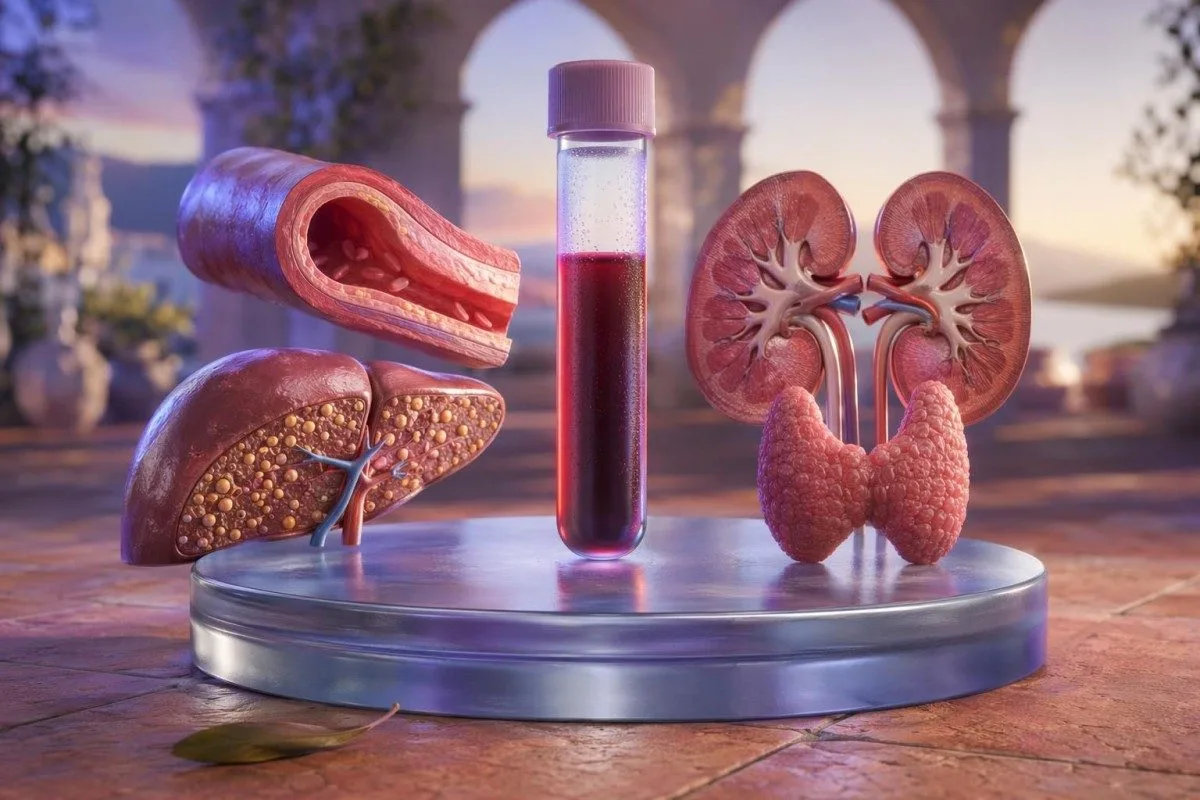
Your 40s are when normal-looking labs can start hiding early insulin resistance, fatty liver, thyroid drift, and quiet kidney decline. A better yearly panel looks for patterns, not just red flags.


- HbA1c of 5.7%-6.4% means prediabetes; 6.5% or higher supports diabetes on confirmatory testing.
- Fasting glucose is ideally 70-99 mg/dL; 100-125 mg/dL is prediabetes and 126 mg/dL or higher is diabetic range.
- Triglycerides should usually stay under 150 mg/dL; 200 mg/dL or higher often points toward insulin resistance or fatty liver risk.
- ALT persistently above about 35 U/L in women or 40 U/L in men deserves follow-up, even when the lab’s upper limit is looser.
- eGFR below 60 mL/min/1.73 m² for 3 months meets a CKD definition and should not be ignored.
- TSH around 0.4-4.0 mIU/L is a common reference range; TSH above 10 mIU/L is much harder to dismiss than a borderline elevation.
- Ferritin below 30 ng/mL often reflects low iron stores before hemoglobin falls.
- Vitamin D deficiency is usually 25-OH vitamin D below 20 ng/mL; 21-29 ng/mL is commonly called insufficient.
- CBC is useful, but it misses cholesterol, early glucose dysregulation, fatty liver, and many thyroid problems.
- Trend changes matter: a creatinine rise from 0.78 to 1.01 mg/dL can be clinically meaningful even if both values remain in range.
What an annual blood test in your 40s should actually include
For most adults in their 40s, an annual blood test should include a CBC, liver and kidney chemistry, fasting glucose, HbA1c, and a lipid panel. Add TSH, ferritin, B12, or 25-OH vitamin D when symptoms or risk factors point that way. That is the short answer, and it is the approach we use at Kantesti AI after reviewing millions of uploaded reports; our full blood panel explainer shows the building blocks if your lab uses different names.
As of April 24, 2026, the real shift in your 40s is not age itself but accumulated exposure. Blood pressure that has been borderline for 10 years, sleep that has worsened, extra visceral fat, and a little less exercise begin to show up first in labs rather than symptoms. Among the common blood tests ordered at annual physicals, A1c, lipids, ALT, creatinine, and eGFR usually carry more preventive value than people expect.
In our review workflow at Kantesti, the biggest miss in this decade is not a rare disease; it is an incomplete panel. I routinely see a 'normal' CBC beside an A1c of 5.9%, triglycerides of 196 mg/dL, and ALT of 41 U/L — a pattern that quietly predicts future cardiometabolic trouble years before anyone feels ill.
A smart routine blood test in your 40s should answer four questions: Is glucose handling starting to slip, are lipids genuinely low risk, is the liver or kidney under metabolic strain, and is there a correctable deficiency. If you want the longer view on who we are and how we review reports, About Us explains the clinical philosophy behind Kantesti, and our 15,000-plus biomarker guide is useful when your report includes unfamiliar markers.
When I add more than the core panel
I add ApoB, TSH, ferritin, B12, 25-OH vitamin D, or a urine albumin-creatinine ratio when symptoms, medication use, diet pattern, heavy periods, prior gestational diabetes, or a strong family history change the odds. The practical point is simple: the panel should reflect your risk, not the lab’s upsell menu.
Why a CBC still matters — and what it misses in your 40s
A CBC is still worth getting every year because it can uncover anemia, platelet problems, infection patterns, and sometimes chronic inflammation. But a CBC does not screen cholesterol, insulin resistance, fatty liver, thyroid disease, or early kidney decline, which is why many 40-year-olds are falsely reassured by a normal blood count.
Hemoglobin is generally about 12.0-15.5 g/dL in adult women and 13.5-17.5 g/dL in adult men. MCV of 80-100 fL is considered normal, and an RDW above roughly 14.5% often points to mixed or early deficiency even before hemoglobin drops.
I see this pattern all the time: a 44-year-old with fatigue has hemoglobin 12.8 g/dL, which looks fine on paper, yet her RDW is 15.2%. That is the moment I slow down rather than reassure too quickly, and patients who need a refresher on report structure usually do well with our blood test reading guide.
A WBC above 11.0 x10^9/L or platelets above 450 x10^9/L deserve context, not panic. Smoking, steroids, recent infection, iron depletion, sleep apnea, and hard training can all shift these counts, but persistent abnormalities should not be waved away in midlife because marrow disorders and chronic inflammatory patterns become a little less rare after 40.
What a normal CBC can hide
A completely normal CBC can coexist with prediabetes, high LDL, early fatty liver, low-normal B12, or early kidney disease. In other words, a CBC is necessary but nowhere near sufficient for preventive screening in your 40s.
Glucose, HbA1c, and insulin resistance: the 40s tipping point
If I could add only two metabolic tests to a routine blood test in your 40s, I would pick fasting glucose and HbA1c. A fasting glucose of 100-125 mg/dL meets prediabetes criteria, and an A1c of 5.7%-6.4% does the same.
An A1c of 6.5% or higher on confirmatory testing supports a diabetes diagnosis. A fasting glucose of 126 mg/dL or higher does too, but the two tests do not always agree — iron deficiency can push A1c upward slightly, while hemolysis, recent blood loss, or shortened red-cell survival can pull it down.
In our Kantesti AI reviews, the sneakiest 40s pattern is normal fasting glucose with high-normal A1c plus triglycerides above 150 mg/dL. That often reflects early insulin resistance, poor sleep, visceral fat, or alcohol intake rather than overt diabetes, and our diabetes test guide is a good companion if your clinician is deciding whether to repeat labs or move to a glucose tolerance test.
Fasting insulin can be useful, but I do not call it a universal annual test because assay methods vary more than patients realize. In practice, a fasting insulin persistently above about 15 µIU/mL or a HOMA-IR above roughly 2.0-2.5 raises suspicion, yet the actionable next step is usually lifestyle work and repeat testing, not a medication reflex.
If your result sits in the gray zone — say A1c 5.8% and fasting glucose 98 mg/dL — context matters more than the single number. Our prediabetes interpretation article explains why waist size, sleep, liver enzymes, and family history often predict the next five years better than glucose alone.
Lipid panel first, ApoB second: the heart-risk labs that matter
A fasting lipid panel belongs on nearly every annual blood test in your 40s because LDL-driven atherosclerosis usually progresses silently for decades. LDL-C below 100 mg/dL is a common general target, non-HDL-C below 130 mg/dL is reasonable for many adults, and fasting triglycerides should ideally stay under 150 mg/dL.
The 2018 AHA/ACC cholesterol guideline recommends ApoB as a risk-refining marker when triglycerides exceed 200 mg/dL, diabetes is present, or standard cholesterol numbers seem misleading (Grundy et al., 2019). In plain English, ApoB tells me how many atherogenic particles are circulating; an ApoB under 90 mg/dL is a practical target for many adults, and under 80 mg/dL is often used when risk is higher.
Here is the pattern that worries me most in 40-somethings: triglycerides 180-250 mg/dL, HDL below 40 mg/dL in men or below 50 mg/dL in women, and only mildly high LDL. That trio often signals insulin resistance and fatty liver risk even before blood pressure or weight have changed much, and our LDL range guide helps frame those thresholds.
I have seen plenty of fit patients assume exercise cancels out a high LDL. It does not. A 46-year-old cyclist with LDL 162 mg/dL, HDL 74 mg/dL, and ApoB 118 mg/dL still has a particle burden worth taking seriously; the athletic build changes the conversation, not the physics of plaque.
ALT, AST, and GGT: why liver labs become more useful in your 40s
Liver enzymes deserve more attention in your 40s because fatty liver, medication effects, alcohol, and metabolic syndrome become much more common. ALT is often the earliest clue; values persistently above about 35 U/L in women or 40 U/L in men deserve a second look, even if the lab still prints a higher upper limit.
A GGT above roughly 40 U/L in women or 60 U/L in men often strengthens the case that an ALT or ALP abnormality is hepatobiliary rather than noise. Some European labs use lower ALT upper limits than older North American panels, and in my experience that catches metabolic liver disease earlier.
This is one of those areas where exercise muddies the picture. I once reviewed a 43-year-old marathon runner with AST 89 U/L and normal ALT two days after a race; his CK was high and the liver was innocent. If you lift hard or race, wait 48-72 hours before a routine blood test aimed at liver interpretation.
Mild ALT elevation plus A1c 5.9%, triglycerides 220 mg/dL, and an increased waist circumference is often more revealing than ALT alone. Patients wanting a deeper read on enzyme patterns usually benefit from our liver function test guide and the related piece on the AST/ALT ratio.
Albumin below 3.5 g/dL or platelets trending downward with only modest enzyme changes make me pause, because chronic liver disease can look deceptively quiet. The dangerous mistake is not panicking over ALT 44; it is ignoring ALT 44 year after year.
Creatinine, eGFR, and bicarbonate: the kidney clues people miss
Kidney screening in your 40s starts with creatinine, eGFR, and basic electrolytes. An eGFR persistently below 60 mL/min/1.73 m² for at least 3 months meets a CKD definition, while a bicarbonate under 22 mmol/L or potassium above about 5.3 mmol/L can add urgency even before symptoms appear.
Creatinine is a useful screening test, but it is not a pure kidney test. A muscular 42-year-old may run 1.2 mg/dL and be fine; a frail person may look normal at 0.7 mg/dL while true kidney function is mediocre. That is why I look at the equation-derived eGFR, the trend, and the patient, not the creatinine in isolation.
Many labs now use the 2021 race-free CKD-EPI approach. Inker et al. (2021) showed that combining creatinine and cystatin C estimates kidney risk more accurately than creatinine alone, so I consider cystatin C when body composition makes the standard number feel untrustworthy.
The subtle pattern I see in midlife is creatinine at the high end of normal, eGFR in the 60s or 70s, and mild hypertension. That is often the moment to add a urine albumin-creatinine ratio — technically not a blood test, but too useful to ignore — and our kidney screening guide plus the piece on low GFR with normal creatinine explain why.
Uric acid is not universal, yet I often add it when blood pressure, obesity, or gout history is in the mix. A level above 7.0 mg/dL in men or 6.0 mg/dL in women does not diagnose kidney disease, but it often travels with the same metabolic terrain.
Do not forget the urine add-on
A normal creatinine does not exclude early kidney damage. If you have diabetes, hypertension, or previous preeclampsia, a urine albumin-creatinine ratio adds information that no serum test can replace.
TSH first, then free T4: when thyroid testing earns its place
For thyroid screening in your 40s, TSH is the first test that earns its keep; free T4 is the reflex add-on when TSH is abnormal or symptoms are strong. A typical TSH reference range is about 0.4-4.0 mIU/L, and a TSH above 10 mIU/L is much harder to dismiss than a borderline 4.3.
The evidence for universal yearly thyroid screening in asymptomatic adults is honestly mixed. I usually add TSH when there is fatigue, constipation, hair loss, infertility history, heavy periods, autoimmune disease, rising LDL, or a strong family history, and then use our thyroid panel guide to decide whether antibodies or free T3 add anything.
Biotin is a real lab spoiler. Doses of 5,000-10,000 µg/day, common in hair supplements, can falsely lower TSH and falsely raise free T4 on some immunoassays, so I tell patients to review our biotin and thyroid testing note before the draw.
One of the trickiest panels I reviewed this year was a 47-year-old man with fatigue, TSH 6.1 mIU/L, normal free T4, LDL 154 mg/dL, and ferritin 18 ng/mL. Treating the thyroid number alone would have missed half the story; combined borderline problems often create the symptoms patients actually feel.
Ferritin, B12, and vitamin D: the deficiency labs worth selecting, not shotgun-ordering
Deficiency testing in your 40s should be selective, not random. The add-ons I reach for most are ferritin, vitamin B12, and 25-hydroxy vitamin D, because these three explain a surprising amount of fatigue, hair shedding, restless legs, neuropathy, and slow recovery when the core panel is unrevealing.
Ferritin below 30 ng/mL often reflects depleted iron stores, even though some lab flags do not turn red until 12-15 ng/mL. A B12 level below 200 pg/mL is usually deficient, 200-350 pg/mL is borderline territory, and 25-OH vitamin D below 20 ng/mL is deficiency by the Endocrine Society framework; values 21-29 ng/mL are often called insufficient (Holick et al., 2011).
Normal hemoglobin does not rule out iron loss, and ferritin can look falsely reassuring when inflammation is present. If transferrin saturation is under 20%, I take low iron stores more seriously even when ferritin sits in the low-normal range.
Kantesti AI flags combinations like high RDW, ferritin 20-40 ng/mL, low-normal B12, or MCV drifting upward because that is where real patients get missed. Our vitamin deficiency marker guide is useful if you are sorting out which add-on is most rational, and our 25-OH versus active D explainer covers the vitamin D side in plain language.
Metformin, acid-suppressing drugs, vegetarian or vegan diets, and prior bariatric surgery make B12 testing more valuable. If low-normal results leave you puzzled, our piece on hidden B12 deficiency goes deeper into methylmalonic acid, symptom correlation, and the limits of serum B12 alone.
Who benefits most from deficiency testing
Heavy menstrual losses, vegetarian or vegan eating patterns, metformin, proton pump inhibitors, bariatric surgery, celiac risk, endurance training, and limited sun exposure all raise the yield of ferritin, B12, or vitamin D testing. In those groups, I am much more comfortable ordering targeted add-ons yearly.
How sex and life stage change the right annual panel in your 40s
Sex and life stage change the right annual panel more than many people realize. In women, ferritin, TSH, and glucose markers often matter more during the perimenopausal years; in men, the extra discussion usually centers on PSA and symptom-driven testosterone testing rather than blanket screening.
Perimenopause can shift lipids surprisingly fast. I have seen LDL-C rise 15-25 mg/dL over two years around the menopause transition without major weight change, so a woman’s usual cholesterol history matters, and our women’s midlife hormone guide helps when cycles, sleep, and iron loss all blur together.
Anyone with a history of gestational diabetes deserves especially close glucose follow-up in the 40s. Even when weight is stable, a yearly A1c is sensible because the long-term diabetes risk after gestational diabetes remains clearly above average.
PSA is not a mandatory annual lab for every man in his 40s. A PSA above 4.0 ng/mL has been the classic trigger for follow-up, but age, prostatitis, recent ejaculation, cycling, and benign enlargement can all nudge it upward, which is why the practical next step is context rather than fear; our PSA follow-up guide breaks that down.
Morning total testosterone can help when there is low libido, erectile dysfunction, anemia, loss of muscle, or unexplained low mood. I do not order it as a routine screen in asymptomatic men, and I nearly always want two early-morning samples before I call 300 ng/dL a meaningful low.
Tests I usually do not recommend every year in healthy 40-somethings
The tests I usually skip in a healthy 40-something are cortisol, broad autoimmune panels, and most tumor markers. These are not bad tests; they are just low-value annual screens when there are no symptoms, because false positives are common and the follow-up cascade gets expensive fast.
A full blood panel sounds thorough, but more is not always better. CA-125, CEA, AFP, random sex hormones, and one-off inflammatory markers can create anxiety without improving outcomes if there is no question being asked.
I say this as Thomas Klein, MD, after years of reviewing both sensible and chaotic lab orders: the most common mistake is ordering exotic tests before the basics. A 42-year-old with fatigue rarely benefits from a first-pass cortisol level if nobody has checked A1c, ferritin, TSH, sleep, alcohol intake, and medication effects.
This is where the quality of interpretation matters. Kantesti publishes its clinical approach and thresholds in our medical validation standards because accuracy is not just about reading one flagged number; it is about knowing when not to over-interpret an incidental result.
How to prepare, when to repeat, and how to interpret trends
For the best yearly comparison, do your annual blood test in the morning, use the same lab when you can, and fast 8-12 hours if glucose or triglycerides are being checked. Water is fine; strenuous exercise within 48 hours can distort AST, ALT, glucose, and even white counts.
Biotin should usually be stopped 48-72 hours before thyroid testing if your clinician agrees, and a recent steroid burst can transiently raise glucose and neutrophils. If you are unsure about coffee, supplements, or fasting windows, our fasting guide is the practical one I send patients.
Trends beat snapshots. A creatinine rise from 0.78 to 1.01 mg/dL or an ALT drift from 18 to 34 U/L can matter even when both numbers remain inside the printed reference range, and inter-lab differences of 5%-15% are common enough that staying with the same lab improves signal; our blood test comparison guide explains what changes are probably real.
At Kantesti, our physician-reviewed team — see the Medical Advisory Board — built the workflow around that pattern recognition. If you want a fast second read, upload your PDF or photo to Try Free AI Blood Test Analysis or use our AI-powered blood test interpretation to sort out which results are watch-and-wait, which deserve repeat testing, and which need a clinician now.
As Thomas Klein, MD, I am less interested in whether one value is a point above normal than whether five related values are drifting together. Bottom line: a smart routine blood test in your 40s is not about chasing every biomarker on the menu; it is about repeating the right core panel, adding a few targeted tests when your history justifies them, and resisting the false reassurance of normal-looking numbers.
Frequently Asked Questions
What annual blood test should a healthy 45-year-old get?
For most healthy 45-year-olds, the core annual blood test includes a CBC, comprehensive metabolic panel or equivalent liver and kidney chemistry, fasting glucose, HbA1c, and a lipid panel. That combination screens for anemia, electrolyte issues, liver enzyme changes, kidney filtration, prediabetes, diabetes, and cholesterol-related cardiovascular risk. I usually add TSH only when symptoms or family history support it, and I add ferritin, B12, or 25-OH vitamin D when diet, heavy periods, medications, or fatigue make deficiency more likely. If hypertension, diabetes, or previous preeclampsia is present, a urine albumin-creatinine ratio deserves consideration even though it is not a blood test.
Is a CBC enough for an annual blood test?
No, a CBC is not enough for a preventive yearly screen in your 40s. A CBC can detect anemia, abnormal white counts, and platelet problems, but it does not measure A1c, fasting glucose, LDL, triglycerides, ALT, creatinine, or TSH. I see many patients with a normal CBC and an A1c of 5.9%, triglycerides of 210 mg/dL, or ALT of 43 U/L, which are the results that actually change long-term risk. A normal blood count is reassuring, but it is only one piece of a proper routine blood test.
Do I need to fast before an annual blood test in my 40s?
Fasting for 8-12 hours is usually best when glucose and triglycerides are being measured because it improves consistency year to year. Water is fine, and most people tolerate morning testing best. Heavy exercise within 48 hours can raise AST, ALT, glucose, and even white counts, so I usually ask athletic patients to avoid hard training before the draw. If thyroid tests are included, biotin should often be stopped for 48-72 hours first if the prescribing clinician agrees.
Should thyroid be checked every year in your 40s?
Not everyone in their 40s needs yearly thyroid testing. A TSH test makes more sense when there is fatigue, hair loss, constipation, infertility history, heavy periods, autoimmune disease, rising cholesterol, or a family history of thyroid disease. A typical adult TSH range is about 0.4-4.0 mIU/L, but borderline values such as 4.5-6.0 often need context and repeat testing rather than instant treatment. A TSH above 10 mIU/L is usually more actionable, especially if free T4 is low or symptoms are convincing.
Which deficiency tests are worth asking for in your 40s?
The deficiency tests I find most useful in the 40s are ferritin, vitamin B12, and 25-OH vitamin D. Ferritin below 30 ng/mL often means low iron stores, B12 below 200 pg/mL is usually deficient, and 25-OH vitamin D below 20 ng/mL is considered deficient by common endocrine criteria. These tests are especially valuable with fatigue, hair shedding, restless legs, neuropathy, vegetarian or vegan diets, heavy menstrual bleeding, metformin use, acid-suppressing drugs, or limited sun exposure. I do not order them blindly for everyone, but I order them often enough that they clearly belong on the short list of smart add-ons.
How often should borderline abnormal blood tests be repeated?
The repeat interval depends on the marker. HbA1c usually needs about 3 months to show a meaningful new average, while mildly high ALT or GGT is often rechecked in 6-12 weeks after alcohol reduction, weight change, or medication review. Ferritin is commonly repeated after 8-12 weeks of iron treatment, and vitamin D is often rechecked after 8-16 weeks depending on dose and baseline level. Kidney numbers should be repeated sooner if dehydration, a new medication, or an acute illness may have distorted the first result.
What if all my results are normal but I still feel unwell?
Normal ranges are population windows, not guarantees that your labs are ideal for you. A ferritin of 22 ng/mL, B12 of 260 pg/mL, TSH of 4.2 mIU/L, or an A1c of 5.8% can all feel clinically relevant in the right patient even if one lab does not flag them in red. Trends and combinations matter: a mild rise in ALT, a drop in HDL, and creeping triglycerides may tell a better story than any single isolated result. Persistent symptoms still deserve a clinician’s review, because sleep, mood, medications, hormones, and conditions outside routine labs can all be part of the picture.
Can annual blood tests replace colorectal cancer screening in my 40s?
No—routine blood tests cannot rule out colorectal cancer, even when your blood count is normal. In the United States, average-risk screening starts at age 45; ask about stool-based tests or colonoscopy, with earlier assessment if you have symptoms or a strong family history.
What does an elevated Lp(a) result mean for me?
An elevated Lp(a) reflects inherited cardiovascular risk; diet and exercise remain valuable but usually do not lower it substantially. Your clinician may focus more closely on LDL cholesterol, blood pressure, smoking avoidance, and whether close relatives should be tested.
Can medications or supplements affect my annual blood test results?
Yes. Biotin can interfere with some thyroid and hormone tests, creatine supplements may raise creatinine, and statins or acetaminophen can affect liver enzymes. Tell your clinician about prescriptions, over-the-counter medicines, and supplements before the draw; do not stop prescribed medication unless advised.
Can a hard workout change my annual blood test results?
Yes. Strenuous exercise in the 24–48 hours before testing can temporarily raise muscle and liver-related markers such as CK, AST, ALT, and sometimes creatinine, so schedule labs after an easier day if you want a clean baseline.
Get AI-Powered Blood Test Analysis Today
Join over 2 million users worldwide who trust Kantesti for instant, accurate lab test analysis. Upload your blood test results and receive comprehensive interpretation of 15,000+ biomarkers in seconds.
📚 Referenced Research Publications
Klein, T., Mitchell, S., & Weber, H. (2026). AI Blood Test Analyzer: 2.5M Tests Analyzed | Global Health Report 2026. Kantesti AI Medical Research.
Klein, T., Mitchell, S., & Weber, H. (2026). RDW Blood Test: Complete Guide to RDW-CV, MCV & MCHC. Kantesti AI Medical Research.
📖 External Medical References
⚕️ Medical Disclaimer
This article is for educational purposes only and does not constitute medical advice. Always consult a qualified healthcare provider for diagnosis and treatment decisions.
E-E-A-T Trust Signals
Experience
Physician-led clinical review of lab interpretation workflows.
Expertise
Laboratory medicine focus on how biomarkers behave in clinical context.
Authoritativeness
Written by Dr. Thomas Klein with review by Dr. Sarah Mitchell and Prof. Dr. Hans Weber.
Trustworthiness
Evidence-based interpretation with clear follow-up pathways to reduce alarm.