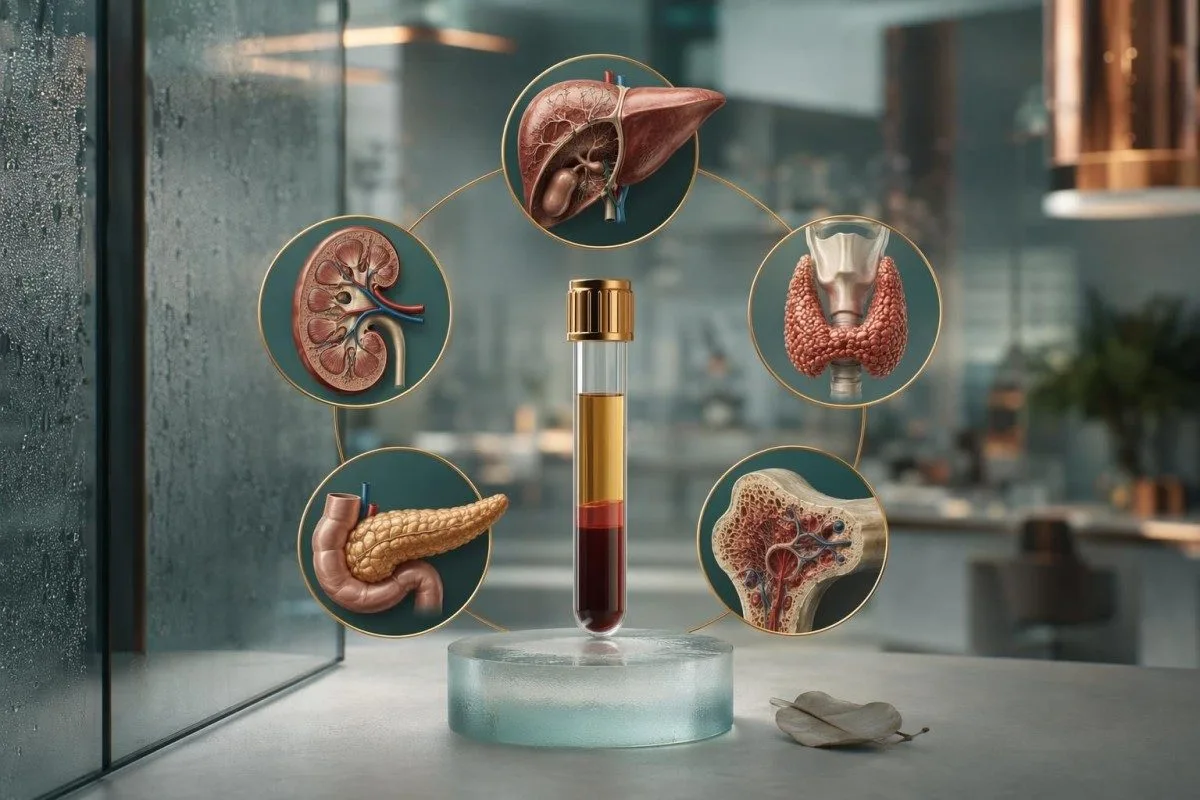
One blood draw can reveal a lot, but it cannot check everything. The smartest screening plan uses targeted labs plus urine tests, imaging, and age-based preventive care.


- HbA1c 5.7-6.4% suggests prediabetes; 6.5% or higher on repeat testing supports diabetes.
- Ferritin below 30 ng/mL often signals iron deficiency before hemoglobin drops.
- eGFR under 60 mL/min/1.73 m² for more than 3 months suggests chronic kidney disease and should be paired with urine ACR.
- TSH 0.4-4.0 mIU/L is a common adult reference range, but symptoms and free T4 often matter more than a borderline flag.
- hs-CRP above 10 mg/L usually reflects an acute inflammatory state and should be repeated after recovery.
- Lp(a) above 50 mg/dL or 125 nmol/L is considered elevated in most adults and is often worth checking once in a lifetime.
- PSA between 4 and 10 ng/mL overlaps heavily with benign enlargement, so it is not a universal cancer screen.
- Urine ACR 30 mg/g or higher can reveal kidney damage that a full body blood test may miss entirely.
What a full body blood test can realistically screen for
A full body blood test can screen for diabetes, anemia, kidney dysfunction, liver injury, cholesterol disorders, iron deficiency, and some thyroid problems, but it cannot reliably rule out most cancers, structural heart disease, colon polyps, glaucoma, sleep apnea, or many autoimmune conditions on its own. In practice, the best symptom-free plan is targeted labs plus blood pressure, urine testing, and age-based screening. We see this misconception every day when people use Kantesti AI blood test analyzer to interpret a standard blood test.
I'm Thomas Klein, MD, and the question I hear most is some version of this: 'Can I do one draw and know I'm fine?' The honest answer is no. A routine panel may uncover hemoglobin at 9.8 g/dL, creatinine at 1.7 mg/dL, ALT at 88 IU/L, or LDL-C at 182 mg/dL, but none of those numbers can inspect tissues, arteries, or skin.
A CBC can flag anemia, very high white cells, or platelet abnormalities. A chemistry panel can flag sodium at 126 mmol/L, calcium at 11.2 mg/dL, or bilirubin at 2.5 mg/dL; still, those are clues, not finished diagnoses.
Across our users in 127+ countries, Kantesti repeatedly sees the same pattern: the highest-yield screening plans are smaller and smarter, not broader and more expensive. When our AI reviews a report, we spend more time on the combination of markers and the direction of change than on the sheer number of analytes.
Here is the rule that helps most patients. If a condition is mainly structural, intermittent, or local—a 5 mm colon polyp, intermittent atrial fibrillation, early glaucoma, a kidney stone, or a suspicious mole—a blood draw is often the wrong tool.
What routine labs usually cover in a wellness blood test
A routine wellness blood test usually includes a CBC, chemistry panel, lipid panel, and glucose screening, often packaged as a comprehensive blood panel. That combination is good for common problems—anemia, electrolyte disorders, diabetes clues, kidney strain, and cholesterol risk—but it leaves big gaps.
A CBC measures red cells, white cells, and platelets. Typical adult reference ranges are roughly hemoglobin 12.0-15.5 g/dL in women and 13.5-17.5 g/dL in men, WBC 4.0-11.0 ×10⁹/L, and platelets 150-450 ×10⁹/L; abnormal results can point toward iron deficiency, marrow stress, immune activation, or blood loss, but they do not tell you the cause by themselves.
A chemistry panel covers kidney and liver signals. Creatinine often falls around 0.6-1.3 mg/dL, yet muscle mass matters a lot, and an eGFR below 60 mL/min/1.73 m² that persists for 3 months meets one definition of chronic kidney disease. ALT upper limits vary by lab; some older panels still accept values above 50 IU/L, while some European labs use lower upper limits closer to 35 IU/L.
For metabolic screening, the practical workhorses are glucose and lipids. The 2021 diabetes screening statement from the US Preventive Services Task Force supports fasting glucose, HbA1c, or oral glucose tolerance testing in adults aged 35-70 with overweight or obesity (US Preventive Services Task Force, 2021), and our separate reviews of a diabetes blood test and lipid panel results explain why one normal fasting number does not settle lifelong risk.
What often surprises people is what is not standard. Routine panels commonly omit ferritin, vitamin B12, TSH, ApoB, lipoprotein(a), vitamin D, and urine albumin, so someone can be told their 'full body' labs were normal and still have ferritin at 14 ng/mL or TSH at 6.8 mIU/L a month later.
What an expanded wellness blood test or executive health panel adds
An expanded wellness blood test or executive health panel usually adds ferritin, B12, vitamin D, TSH, hs-CRP, insulin, ApoB, and lipoprotein(a). Those extras can be genuinely useful, but only when they fit a person's risk profile and symptoms.
The highest-yield add-ons are the ones that change management. Our blood test biomarkers guide covers thousands of markers, but in everyday preventive care I get the most value from ApoB, lipoprotein(a), ferritin, TSH, B12, and 25-OH vitamin D.
A lipoprotein(a) level above 50 mg/dL or 125 nmol/L is considered elevated in most guidelines and is largely genetic. According to the 2018 AHA/ACC cholesterol guideline, ApoB becomes especially useful when triglycerides exceed 200 mg/dL or metabolic syndrome is present (Grundy et al., 2019), because the number of atherogenic particles can matter more than LDL-C alone.
A ferritin below 30 ng/mL often signals iron deficiency before anemia develops, especially in menstruating women, frequent blood donors, and endurance athletes. A B12 level below 200 pg/mL is more clearly deficient, while 200-350 pg/mL is the grey zone where symptoms, methylmalonic acid, homocysteine, and diet history matter more than the lab flag; thyroid testing gets more useful when it is interpreted alongside a thyroid panel, not just TSH in isolation.
The expensive catch is what some glossy panels still leave out. They may order testosterone, DHEA, or random cortisol in symptom-free people, yet skip a urine albumin-creatinine ratio, which often detects kidney injury earlier than serum creatinine in diabetes or hypertension. That is one of those awkward truths most marketing pages gloss over.
What a preventive blood test cannot detect on its own
A preventive blood test cannot directly inspect anatomy. It cannot see a colon polyp, a breast calcification, most early skin cancers, coronary artery narrowing, glaucoma, or sleep apnea, which is why blood work never replaces exams, imaging, or age-based screening.
Structural disease is the classic blind spot. You can have a perfectly ordinary CBC and chemistry panel and still have a 6 mm colon polyp or an early lung nodule, which is why our article on what blood tests can detect cancer early is more cautious than most patients expect.
Kidney disease is another common trap. A creatinine of 0.9 mg/dL may look reassuring, yet a urine albumin-creatinine ratio of 120 mg/g can reveal meaningful diabetic or hypertensive kidney injury long before the blood test changes much.
Bone health often gets oversimplified. Vitamin D can be 14 ng/mL, but osteoporosis is diagnosed with DEXA, not with a blood level, and many people with fragility fractures have normal calcium and fairly ordinary alkaline phosphatase.
Digestive disorders behave the same way. Iron deficiency, low albumin, or abnormal liver enzymes may raise suspicion, but inflammatory bowel disease, ulcers, celiac damage, and colon cancer still need stool testing, imaging, or endoscopy for confirmation.
Why cancer, autoimmune disease, and chronic infection often escape a single blood draw
Cancer, autoimmune disease, and chronic infection often escape a single blood draw because early disease may not yet alter the markers you measured. That is why reassuring labs do not automatically cancel a worrying story.
Most early solid cancers do not release a unique, reliable blood pattern. CEA, CA-125, and similar tumor markers have false positives from smoking, menstruation, benign cysts, liver disease, and inflammation, so they are poor screening tools in average-risk people; the exception most people know is PSA, and even there the 2018 USPSTF recommendation pushed shared decision-making rather than blanket testing for men aged 55-69 (US Preventive Services Task Force, 2018).
Even blood cancers can be subtle. I have seen patients with lymphoma whose CBC was nearly ordinary, platelets were normal, and LDH was only modestly raised, which is why persistent nodes, drenching sweats, or unexplained weight loss deserve more respect than a neat-looking lymphoma blood test.
Autoimmune screening is even messier. A low-titer ANA can be positive in healthy people, especially women and older adults, while patients with early vasculitis, inflammatory bowel disease, or seronegative arthritis can have normal ESR and CRP at the start; our review of the autoimmune panel blood test goes into those false positives in more depth.
Infectious screening only works if you order the right assay in the right window. A 4th-generation HIV antigen-antibody test usually turns positive about 18-45 days after exposure, which is why timing matters just as much as the number itself, and our HIV window period guide exists because a negative test on day 7 is often falsely comforting.
Why normal ranges create both false reassurance and false alarms
Normal ranges are statistical tools, not guarantees of health. A result can sit inside the lab interval and still be wrong for you, or fall outside the interval and still be harmless in context.
Most reference intervals capture the middle 95% of a reference population. That means about 1 in 20 healthy people will land outside range on any single analyte, which is exactly why isolated minor abnormalities are common on a blood test normal range report.
Pre-analytical factors change results more than most people realize. Hard training can push AST above 80 IU/L, dehydration can falsely raise hemoglobin and albumin, and biotin supplements as low as 5-10 mg/day can interfere with some thyroid and troponin assays.
As Thomas Klein, MD, I spend a surprising amount of clinic time undoing false reassurance. A normal HbA1c does not exclude abnormal glucose handling in patients with hemolysis, recent bleeding, or certain hemoglobin variants, and our article on HbA1c accuracy exists because the mismatch between symptoms and the lab is real.
Patterns are what matter. Ferritin 22 ng/mL plus MCV 82 fL and RDW 14.9% points toward early iron loss in a way ferritin alone does not, just as sodium 133 mmol/L means one thing in a young athlete after a race and something very different in an older adult taking a thiazide.
Who benefits from extra markers—and who usually does not
Extra markers help when the pretest probability is reasonable. If the chance of finding something meaningful is low, a larger panel usually buys more noise than value.
A personalized baseline matters more than a fashionable menu. That is why we often steer readers toward our personalized blood test approach rather than a one-size-fits-all shopping list.
A once-in-a-lifetime lipoprotein(a) measurement is reasonable for many adults, and I push harder for it when there is premature heart disease in a first-degree relative. An Lp(a) above 125 nmol/L usually stays elevated for life because it is largely genetic, so repeating it every year rarely changes management.
Deficiency testing has better yield when history points that way. We add ferritin for heavy periods, blood donation, or endurance sport; B12 for vegan diets, metformin, or acid-suppressing drugs; and TSH when weight change, cold intolerance, constipation, palpitations, or fertility issues enter the story.
Hormones are where money often gets wasted. Random cortisol, broad sex-hormone panels, or DHEA in symptom-free adults create a lot of incidental findings, whereas a focused discussion around PSA, cardiovascular risk, and age-appropriate screening is usually more useful for the people reading our blood tests every man over 50 should get checklist.
How to build a smarter symptom-free screening plan
A smarter symptom-free plan combines a small core lab set with age-, risk-, and history-based non-blood screening. As of April 25, 2026, that is still far safer than ordering the widest panel you can find and hoping quantity beats judgment.
For many adults, the core starts with CBC, creatinine/eGFR, ALT or AST, fasting lipids, and fasting glucose or HbA1c every 1-3 years, not every quarter. If you are starting in midlife, our annual blood test in your 40s checklist is a practical starting point, and older adults often need a slightly different cadence that we outline in routine labs for seniors.
For diabetes, the 2021 USPSTF recommendation advises screening adults aged 35-70 with overweight or obesity using fasting glucose, HbA1c, or oral glucose tolerance testing (US Preventive Services Task Force, 2021). HbA1c 5.7-6.4% suggests prediabetes, and 6.5% or higher on repeat testing supports diabetes.
Blood tests must sit beside non-blood screening. Average-risk colorectal screening begins at 45 in many guidelines, cervical screening follows HPV-based national protocols, mammography starts around 40-50 depending on country, and blood pressure deserves checking at least yearly even when everything in the tube looked calm.
Most patients find screening easier when they build one annual plan around life stage rather than fear. If you already have lab PDFs or photos, you can use Try free AI Blood Test Analysis to organize the blood-work part in about 60 seconds, then focus the next step on what blood cannot cover.
Core labs for most adults
A practical core set is CBC, kidney function, liver enzymes, lipids, and a glucose marker. Add blood pressure, weight trend, medication review, and family history before you add more analytes.
Add-ons by risk profile
Add ferritin, B12, thyroid testing, ApoB, lipoprotein(a), or urine ACR when history suggests yield. In my experience, one relevant add-on is worth more than ten random ones.
Why patterns and trends beat a one-time executive health panel
Trends beat one-off snapshots because many biomarkers drift before they actually cross the lab limit. A slope often tells the truth sooner than a single normal stamp.
A ferritin drop from 80 to 28 ng/mL over 18 months matters, even if 28 is still reported as normal by a permissive lab. A creatinine rise from 0.8 to 1.1 mg/dL may also be clinically meaningful in a smaller older woman, which is why I care deeply about trajectories.
This is where a glossy panel often underdelivers. Without longitudinal review, you cannot see whether ApoB is creeping upward, whether ALT is tracking with triglycerides, or whether TSH keeps wobbling after illness; our blood test comparison work is built around that reality.
Kantesti's Medical Validation & Clinical Standards page explains how our 2.78T engine handles range context, pattern recognition, and cross-marker interpretation, and we published a dedicated benchmark across seven specialties with the pre-registered dataset also available on Figshare.
I'm Thomas Klein, MD, and I trust trends because biology is noisy. On our platform, users can upload a blood test PDF or photo in about 60 seconds across 75+ languages, but the real clinical value is simpler: today's panel makes sense only when it is compared with prior years, symptoms, medications, and family risk.
When symptoms or red flags matter more than screening labs
Symptoms outrank screening labs. New chest pain, one-sided weakness, severe breathlessness, black stools, jaundice, fainting, or confusion need medical evaluation even if your last preventive panel looked perfect.
A few numbers deserve rapid follow-up on their own. Potassium 6.0 mmol/L or higher, sodium 125 mmol/L or lower, hemoglobin below 8 g/dL, glucose above 300 mg/dL with symptoms, or bilirubin above 3 mg/dL with dark urine are not 'watch and wait' results.
Persistent symptom clusters matter too. Unintentional weight loss over 5% within 6-12 months, drenching night sweats, visible blood in stool or urine, a new lump, or enlarged lymph nodes lasting more than 2-4 weeks should push you beyond routine screening and into a proper exam.
This is one of the places where online lab interpretation can help but cannot replace care. Our Medical Advisory Board reviews content with that principle in mind: a normal panel lowers probability, but it never overrules the patient sitting in front of you.
Bottom line: use a full body blood test as one tool, not as a verdict. If the story and the numbers disagree, the next step is usually a clinician, the right physical examination, and the right non-blood test.
Frequently Asked Questions
Can a full body blood test detect cancer?
No, a full body blood test cannot reliably detect most cancers on its own. Blood work can show clues such as anemia, high calcium, abnormal liver enzymes, or elevated LDH, but many early solid cancers produce no unique blood pattern at all. Tumor markers such as PSA, CEA, and CA-125 have false positives and false negatives; for example, PSA between 4 and 10 ng/mL overlaps substantially with benign enlargement. Cancer screening still depends on the right test for the right tissue, such as stool testing, colonoscopy, mammography, HPV testing, imaging, or biopsy.
What is usually included in a wellness blood test?
A typical wellness blood test usually includes a CBC, a chemistry panel, a lipid panel, and either fasting glucose or HbA1c. Those tests can screen for anemia, infection clues, electrolyte disorders, kidney function changes, liver enzyme abnormalities, cholesterol problems, and diabetes risk. Many routine panels do not include ferritin, vitamin B12, TSH, ApoB, lipoprotein(a), or vitamin D unless they are specifically added. That is why a normal routine panel does not automatically exclude iron deficiency, thyroid disease, or early cardiometabolic risk.
Is an executive health panel better than standard blood work?
An executive health panel is only better when the added markers match your actual risk. Useful add-ons often include ferritin, B12, TSH, ApoB, lipoprotein(a), and sometimes hs-CRP, especially when family history, diet, medications, or symptoms make those tests likely to matter. An Lp(a) level above 50 mg/dL or 125 nmol/L is a good example of a marker that can change cardiovascular risk interpretation even when LDL-C looks acceptable. By contrast, random cortisol, broad hormone panels, or tumor markers in symptom-free adults often generate more confusion than benefit.
How often should healthy adults repeat preventive blood tests?
Most healthy adults do not need a very broad panel every few months. A reasonable core lab set is often repeated every 1-3 years, though people with diabetes, hypertension, kidney disease, lipid disorders, medication monitoring, or changing symptoms may need shorter intervals. Diabetes screening is specifically recommended for adults aged 35-70 with overweight or obesity, and lipid testing intervals depend on baseline risk and treatment decisions. The better rule is to repeat tests based on what you are tracking, not because a calendar app says more data is always better.
What conditions can normal blood work miss?
Normal blood work can miss structural, localized, or intermittent disease. Common examples include colon polyps, early breast cancer, many skin cancers, glaucoma, sleep apnea, arrhythmias, osteoporosis, and kidney disease that first shows up as urine albumin rather than a creatinine rise. A creatinine of 0.9 mg/dL can look normal while a urine albumin-creatinine ratio of 120 mg/g already shows kidney injury. Blood tests are powerful, but they do not replace urine testing, imaging, endoscopy, physical examination, or symptom review.
Do I need to fast before a full body blood test?
Fasting depends on which markers are being measured. For fasting glucose, insulin, and triglycerides, an 8-12 hour fast is usually preferred because recent food intake can shift the result enough to change interpretation. Many lipid panels can still be interpreted without fasting, especially total cholesterol, HDL-C, and often LDL-C, although very high triglycerides are more reliable fasting. Water is generally fine unless your lab gives different instructions, and heavy exercise the same morning is better avoided because it can raise enzymes such as AST and CK.
Get AI-Powered Blood Test Analysis Today
Join over 2 million users worldwide who trust Kantesti for instant, accurate lab test analysis. Upload your blood test results and receive comprehensive interpretation of 15,000+ biomarkers in seconds.
📚 Referenced Research Publications
Kantesti AI Research Team (2026). Clinical Validation of the Kantesti AI Engine (2.78T) on 15 Anonymised Blood Test Cases: A Pre-Registered Rubric-Based Benchmark Including Hyperdiagnosis Trap Cases Across Seven Medical Specialties. Figshare.
Kantesti AI Clinical Content Team (2026). Serum Proteins Guide: Globulins, Albumin & A/G Ratio Blood Test. Zenodo.
📖 External Medical References
⚕️ Medical Disclaimer
This article is for educational purposes only and does not constitute medical advice. Always consult a qualified healthcare provider for diagnosis and treatment decisions.
E-E-A-T Trust Signals
Experience
Physician-led clinical review of lab interpretation workflows.
Expertise
Laboratory medicine focus on how biomarkers behave in clinical context.
Authoritativeness
Written by Dr. Thomas Klein with review by Dr. Sarah Mitchell and Prof. Dr. Hans Weber.
Trustworthiness
Evidence-based interpretation with clear follow-up pathways to reduce alarm.