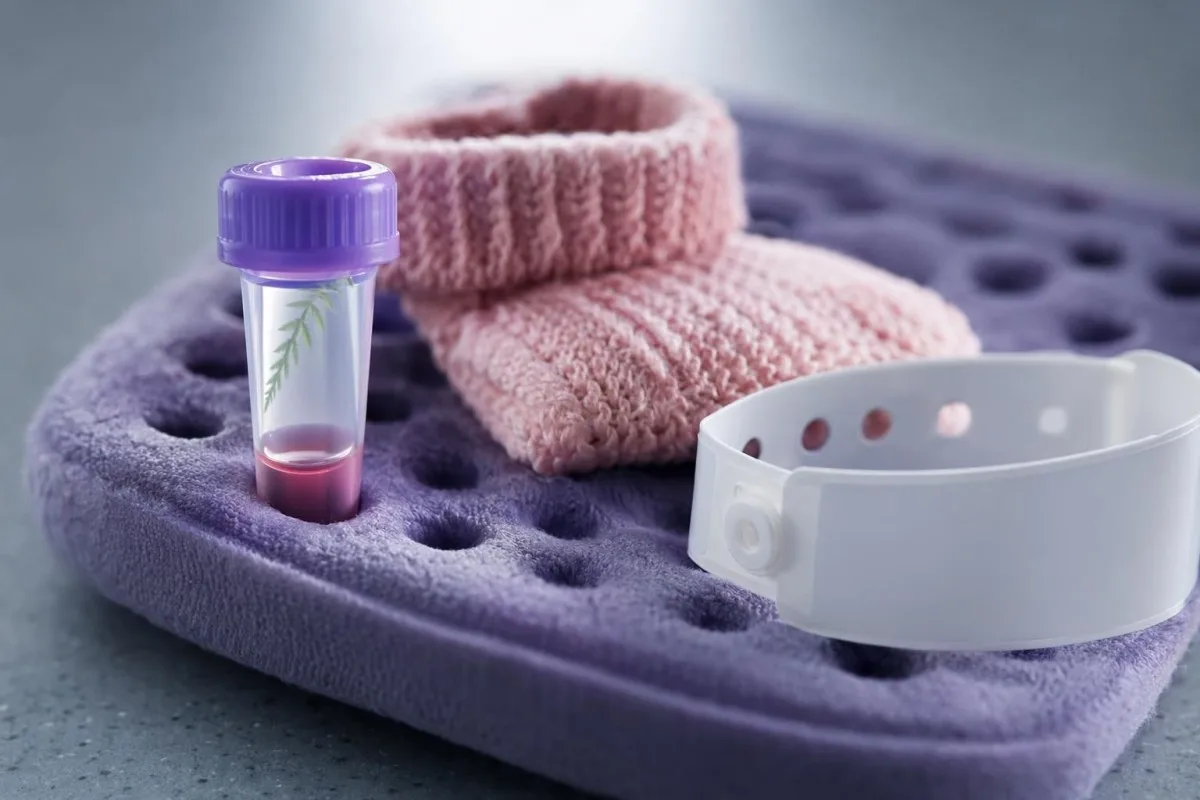
Baby lab results often look alarming when adult reference ranges are applied. The real question is the child’s age, sample type, trend, and symptoms.


- Infant blood test ranges are not adult ranges; newborn hemoglobin can be 14–24 g/dL and still be normal.
- Baby blood test results must be interpreted by exact age, especially in the first 72 hours, 2 months, and 6–12 months.
- Hemoglobin often falls to 9–11 g/dL at 8–12 weeks in term babies because of physiologic anemia of infancy.
- White blood cells can be 9,000–30,000/µL in the first day of life, then drift lower as lymphocytes become dominant.
- Bilirubin is judged by age in hours, not an adult cutoff; direct bilirubin above 1.0 mg/dL needs pediatric follow-up.
- Ferritin below 12 µg/L after 6 months suggests depleted iron stores when CRP is normal.
- Potassium above 6.5 mmol/L, sodium below 130 mmol/L, or glucose below 45 mg/dL in a young infant deserves urgent clinical advice.
- Pediatric blood test interpretation should combine the lab number with feeding, hydration, gestational age, medications, and whether the sample was capillary or venous.
Why infant lab results look abnormal beside adult ranges
An infant blood test can look abnormal by adult standards because babies are still switching from fetal life to independent circulation, feeding, liver clearance, kidney filtration, and immune defense. A newborn hemoglobin of 18 g/dL, an alkaline phosphatase of 350 IU/L, or a bilirubin of 8 mg/dL may be expected at one age and concerning at another.
I see this every week: a parent opens a portal, sees five red flags, and assumes something terrible is happening. Adult reference intervals are usually built from adults aged 18–65 years; they do not capture the first 12 months, when several markers naturally move by 20–200%.
As of May 22, 2026, the safest way to read baby blood test results is to compare them with pediatric reference intervals from the same lab whenever possible. Our Kantesti AI blood test analyzer checks age, units, sex, and marker relationships before explaining whether a result truly looks out of range.
A useful parent habit is to ask, “Is this range for my baby’s exact age?” rather than “Is this high or low?” For a deeper parent-facing chart, our pediatric range guide covers how a children blood test normal range changes from newborn to adolescence.
Age, prematurity and sample type change the answer
Age in days or weeks can change the meaning of a pediatric result more than the number itself. A potassium of 5.8 mmol/L from a heel-stick sample may be a collection artifact, while the same value from a clean venous sample in a sick 2-week-old gets my attention.
Premature babies often have lower iron stores, lower hemoglobin nadirs, and different creatinine behavior than term babies. A 30-week premature infant may reach a hemoglobin nadir of 7–9 g/dL, while a healthy term infant more often bottoms out around 9–11 g/dL.
Capillary samples are convenient, but they are not identical to venous samples. Squeezing the heel can dilute chemistry results with tissue fluid, and fragile cells can break during collection, falsely raising potassium by 0.5–2.0 mmol/L.
The CALIPER work by Colantonio et al. in Clinical Chemistry showed why pediatric reference intervals need age partitions rather than one child range for everyone (Colantonio et al., 2012). I often point new parents to our newborn testing guide because screening tests, diagnostic blood tests, and repeat confirmatory tests answer different questions.
CBC ranges: hemoglobin, hematocrit and MCV in babies
Infant hemoglobin normally starts high at birth, then falls during the first 2–3 months. A term newborn hemoglobin of 14–24 g/dL is often normal, while hemoglobin below 11 g/dL after 6–12 months should prompt an iron and nutrition review.
The classic dip is called physiologic anemia of infancy. It happens because oxygen exposure after birth reduces erythropoietin, and the baby’s older fetal red cells are cleared over weeks rather than replaced immediately.
MCV is also age-sensitive. A newborn MCV of 95–120 fL can be normal, but an MCV below 70 fL in a 9-month-old with a high RDW makes me think about iron deficiency or, less commonly, thalassemia trait.
When I review CBCs with parents, I compare hemoglobin, MCV, RDW, reticulocytes, and ferritin together. Our hemoglobin age chart and RBC versus hemoglobin guide explain why one CBC marker rarely tells the whole story.
White cells and differential: lymphocytes can dominate infancy
Infant white blood cell counts are usually higher than adult counts, especially around birth. A newborn WBC of 9,000–30,000/µL may be physiologic, while the pattern of neutrophils, lymphocytes, bands, and symptoms decides whether infection is likely.
Adults often run neutrophil-predominant differentials, but infants commonly show lymphocyte predominance after the first week of life. A lymphocyte percentage of 55–70% can be normal in a well baby, even when the portal marks it as high.
Absolute counts matter more than percentages. A baby with 70% lymphocytes and a normal absolute lymphocyte count is very different from a febrile 6-week-old with an ANC below 1,000/µL or a rising band count.
In practice, I worry more when a CBC abnormality travels with fever, lethargy, poor feeding, or an ill appearance. Our WBC age guide and neutrophil-lymphocyte explainer are useful when a differential looks “backwards” compared with adult results.
Platelets, MPV and clotting tests in infants
Infant platelet counts usually use a similar broad range to older children: about 150–450 × 10⁹/L. Counts above 500 × 10⁹/L are often reactive after infection or iron deficiency, while counts below 50 × 10⁹/L raise bleeding concern.
Reactive thrombocytosis looks dramatic but is usually not dangerous by itself. I have reviewed toddlers and older infants with platelets of 650–800 × 10⁹/L after a viral illness, and the number often settles over 2–6 weeks.
Low platelets are a different conversation. Petechiae, nosebleeds, blood in stool, or platelets below 50 × 10⁹/L should be discussed promptly, and platelets below 20 × 10⁹/L generally need urgent same-day guidance.
Clotting tests add another layer in newborns because vitamin K status matters. If PT/INR is prolonged, our platelet recovery guide and low platelet explainer can help parents frame better questions for the pediatrician.
Newborn bilirubin is judged by age in hours
Bilirubin is one of the clearest examples of why adult lab ranges mislead parents. A total bilirubin of 8 mg/dL is abnormal in an adult, but it may be expected on day 3 of life in a term newborn if the baby is feeding well and risk factors are low.
The 2022 American Academy of Pediatrics hyperbilirubinemia guideline uses age in hours, gestational age, and neurotoxicity risk factors rather than a single cutoff (Kemper et al., 2022). That is why a bilirubin value taken at 18 hours is judged very differently from one taken at 96 hours.
Direct bilirubin is the part I do not ignore. A direct bilirubin above 1.0 mg/dL, or a clearly rising direct fraction, needs pediatric follow-up because it can point toward cholestasis rather than routine newborn jaundice.
One clinical detail parents often miss: poor milk transfer can raise bilirubin and sodium together. If jaundice comes with fewer than 4 wet diapers per day after day 4, weight loss above 10%, or sleepiness during feeds, ask for same-day advice and review our bilirubin by age guide.
Glucose, sodium, potassium and CO2 can shift quickly
Infant glucose and electrolytes deserve faster attention than many other lab abnormalities because babies have less physiologic reserve. After the first 48 hours, persistent glucose below 60 mg/dL, sodium below 130 mmol/L, or potassium above 6.5 mmol/L should be discussed urgently.
Newborn glucose cutoffs are operational rather than perfect disease boundaries. Many pediatric teams act around 25–40 mg/dL in the first 4 hours, 35–45 mg/dL from 4–24 hours, and aim for more stable values after day 2.
Potassium is the lab value most commonly distorted by collection. A heel-stick sample with cellular breakage may report potassium at 6.2 mmol/L while the repeat venous sample returns at 4.8 mmol/L an hour later.
Sodium tells a feeding and fluid story. Hypernatremia above 150 mmol/L in a newborn can occur with dehydration and excess weight loss, so pair the number with diapers, weight, and feeding; our child glucose guide and electrolyte panel guide go deeper.
Creatinine, BUN and hydration in infant kidney results
Infant creatinine is low after the newborn period because babies have little muscle mass. A creatinine of 0.25–0.45 mg/dL may be normal in a healthy young infant, while adult eGFR equations should not be used for babies.
In the first 24–48 hours, newborn creatinine can partly reflect the mother’s creatinine. After 1–3 weeks, a term infant’s creatinine commonly falls into a much lower range than adults, and a “low” flag is usually meaningless.
BUN is also tricky. Breastfed infants may have BUN around 2–10 mg/dL, while dehydration or high protein load can push it higher; a BUN/creatinine ratio can look strange simply because creatinine is tiny.
Kantesti AI flags infant kidney results differently from adult kidney results by checking age, units, and whether the lab printed an adult eGFR. Parents can compare patterns with our kidney marker guide and BUN ratio guide.
ALT, AST, GGT and alkaline phosphatase during growth
Infant liver panels often contain one or two values that look high by adult standards. GGT can be several times the adult range in newborns, and alkaline phosphatase commonly rises because growing bone contributes to the result.
A newborn GGT of 100–200 IU/L may not carry the same meaning as a GGT of 180 IU/L in a 50-year-old adult. The key is whether bilirubin, stools, feeding, weight gain, and repeat values point in the same direction.
Alkaline phosphatase is even more misunderstood. An ALP of 150–420 IU/L can be perfectly plausible in an infant, and higher transient values sometimes appear during growth spurts or after minor illness.
ALT is usually the cleaner liver-cell marker, but mild elevations can follow viral infections or medications. If ALT stays above roughly 2 times the lab’s pediatric upper limit, I usually want a repeat panel and targeted history; our liver function guide and ALP range explainer help sort bone from liver clues.
Iron studies and ferritin: the 6 to 12 month turning point
Iron stores often become clinically relevant between 6 and 12 months because birth stores are being used up and solid food intake may still be inconsistent. Ferritin below 12 µg/L in an infant older than 6 months suggests depleted iron stores when CRP is normal.
The American Academy of Pediatrics report by Baker and Greer recommends screening around 12 months and earlier attention for high-risk infants, including prematurity and low birth weight (Baker and Greer, 2010). In my experience, the first clue is often high RDW or low ferritin before hemoglobin becomes clearly low.
Inflammation can falsely raise ferritin. A ferritin of 28 µg/L during a respiratory infection may not prove adequate iron stores, which is why pairing ferritin with CRP, MCV, RDW, and transferrin saturation is more useful.
Kantesti AI treats ferritin as an age- and inflammation-sensitive marker, not a simple high-low flag. Parents who see low iron markers can read our child iron deficiency guide and iron deficiency anemia patterns before asking about dosing or retesting.
TSH, free T4 and vitamin D have infant-specific cutoffs
Infant thyroid results are not adult thyroid results, especially in the first days after birth. TSH can surge above 60 mIU/L shortly after delivery, then should fall quickly; persistent TSH above 10 mIU/L after the newborn period needs pediatric review.
Newborn screening is designed to catch congenital hypothyroidism before symptoms are obvious. A borderline screen usually leads to confirmatory serum TSH and free T4, because treatment decisions depend on both values and the baby’s age in days.
Vitamin D is more straightforward but still age-linked. Many pediatric societies recommend 400 IU/day of vitamin D for breastfed or partly breastfed infants, and a 25-OH vitamin D below 20 ng/mL is commonly treated as deficiency.
Biotin drops, assay differences, and prematurity can complicate interpretation. Our pediatric thyroid guide and child vitamin D ranges cover the follow-up questions I would ask in clinic.
CRP, ESR and infection markers: trends beat one result
CRP and ESR can support infection or inflammation assessment, but a single normal value does not rule out serious illness in a young infant. CRP often rises after 6–12 hours, so a repeat at 24–48 hours may be more informative than the first result.
A CRP below 5–10 mg/L is reassuring only when the baby looks well and timing fits. Early bacterial infection, especially in the first few hours of fever, can still have a low CRP.
Procalcitonin has its own neonatal problem: it rises physiologically during the first 24–48 hours of life. That makes adult cutoffs unsafe in newborns, and it is one reason pediatric teams rely on clinical appearance, cultures, CBC trend, and risk factors.
ESR moves slowly and can be affected by anemia, fibrinogen, and age. If your pediatrician orders ESR, our infection marker guide and pediatric ESR explainer can help you understand why the trend matters.
Follow-up questions to ask after abnormal baby blood test results
Parents should ask for follow-up when a baby’s result is far outside the age-specific range, does not fit the child’s symptoms, or is paired with feeding, breathing, fever, jaundice, bruising, or dehydration concerns. The safest question is not “Is it normal?” but “Does this need repeating today, this week, or at the next visit?”
Bring the exact age, gestational age at birth, current weight, feeding pattern, medicines, supplements, and whether the sample was heel-stick or venous. Those 6 details can change interpretation more than another web search.
Ask whether the abnormality is isolated or part of a pattern. For example, high bilirubin plus poor weight gain and high sodium means something different from an isolated bilirubin of 9 mg/dL on day 4 in a thriving term newborn.
I also advise parents to ask for the pediatric reference interval printed on the report. If the result seems serious, compare the timing with our repeat testing guide and our critical values explainer; Kantesti’s medical advisory board reviews our patient education standards with exactly these safety questions in mind.
How Kantesti AI adds age-specific context safely
Kantesti AI can help parents understand baby blood test results by matching age, units, sample type clues, and marker patterns in about 60 seconds, but it does not replace a pediatrician. Our platform is designed to turn confusing flags into better questions, not to diagnose an infant at home.
Kantesti interprets more than 15,000 biomarkers across 75+ languages, and our system is used by families in 127+ countries. When parents upload a PDF or photo to our AI blood test platform, the output separates adult-reference flags from age-relevant pediatric concerns whenever enough information is available.
Dr. Thomas Klein, MD, and our clinical team built our review process around three checks: age fit, biological plausibility, and danger-pattern detection. Our medical validation standards describe how we test interpretation quality, and our benchmark methods explain why trap cases matter in pediatric-style reasoning.
For families, the practical use is simple: upload the report, read the age-specific explanation, then ask the pediatrician about the 2 or 3 markers that truly need action. You can try this with the free blood test demo, or read more about Kantesti as an organization before storing family results.
Kantesti AI. (2026). Multilingual AI Assisted Clinical Decision Support for Early Hantavirus Triage: Design, Engineering Validation, and Real-World Deployment Across 50,000 Interpreted Blood Test Reports. Figshare. DOI. ResearchGate: profile link. Academia.edu: profile link. Kantesti AI. (2026). Iron Studies Guide: TIBC, Iron Saturation & Binding Capacity. Zenodo. DOI. ResearchGate: profile link. Academia.edu: profile link.
Frequently Asked Questions
Why are my baby blood test results flagged high or low?
Baby blood test results are often flagged because the lab portal may compare them with adult or broad pediatric ranges rather than your baby’s exact age. Newborn hemoglobin can be 14–24 g/dL, WBC can be 9,000–30,000/µL, and bilirubin can rise during days 3–5 without meaning the same thing as an adult abnormality. Ask whether the printed reference range is age-specific and whether the sample was capillary or venous.
What hemoglobin level is normal for an infant?
A term newborn hemoglobin of about 14–24 g/dL is commonly normal, and many healthy term infants fall to about 9–11 g/dL at 8–12 weeks because of physiologic anemia of infancy. After 6–12 months, hemoglobin below 11 g/dL often triggers discussion of iron intake and possible iron studies. Hemoglobin below 8 g/dL, or any anemia with poor feeding, fast breathing, pallor, or lethargy, needs prompt pediatric assessment.
When is bilirubin high enough to worry in a newborn?
Newborn bilirubin is interpreted by age in hours, gestational age, and risk factors, not by one adult cutoff. A total bilirubin of 8 mg/dL may be expected around day 3 in a well term baby, but jaundice in the first 24 hours needs prompt review. Direct bilirubin above 1.0 mg/dL should be discussed with the pediatrician because it can suggest cholestasis rather than routine newborn jaundice.
Is high potassium on an infant blood test always dangerous?
High potassium on an infant blood test is not always dangerous because heel-stick or difficult samples can falsely raise potassium when cellular elements break during collection. A potassium of 5.8–6.2 mmol/L may be repeated if the baby is well and the sample was hemolyzed. Potassium above 6.5 mmol/L, abnormal heart rhythm symptoms, poor feeding, or a clean venous sample with persistent elevation should be treated as urgent.
What ferritin level suggests iron deficiency in babies?
Ferritin below 12 µg/L in an infant older than 6 months suggests depleted iron stores when CRP is normal. Ferritin can rise during infection, so a value such as 25–30 µg/L during illness may not prove iron stores are adequate. Pediatricians often interpret ferritin with hemoglobin, MCV, RDW, transferrin saturation, diet history, and growth pattern.
What TSH level is abnormal in an infant?
TSH can surge above 60 mIU/L shortly after birth, so the baby’s age in hours or days matters. After the newborn period, persistent TSH above about 10 mIU/L usually needs pediatric follow-up, especially if free T4 is low. Borderline newborn screens are commonly repeated with serum TSH and free T4 because early treatment of congenital hypothyroidism is time-sensitive.
Can Kantesti AI interpret an infant blood test?
Kantesti AI can interpret an infant blood test by checking the child’s age, units, biomarker pattern, and common pediatric range differences, usually in about 60 seconds. It can help parents identify which results are likely age-related and which should be discussed with a pediatrician. It is not a replacement for urgent care, newborn jaundice management, fever assessment in babies under 3 months, or a clinician who can examine the child.
Get AI-Powered Blood Test Analysis Today
Join over 2 million users worldwide who trust Kantesti for instant, accurate lab test analysis. Upload your blood test results and receive comprehensive interpretation of 15,000+ biomarkers in seconds.
📚 Referenced Research Publications
Klein, T., Mitchell, S., & Weber, H. (2026). Multilingual AI Assisted Clinical Decision Support for Early Hantavirus Triage: Design, Engineering Validation, and Real-World Deployment Across 50,000 Interpreted Blood Test Reports. Kantesti AI Medical Research.
Klein, T., Mitchell, S., & Weber, H. (2026). Iron Studies Guide: TIBC, Iron Saturation & Binding Capacity. Kantesti AI Medical Research.
📖 External Medical References
⚕️ Medical Disclaimer
This article is for educational purposes only and does not constitute medical advice. Always consult a qualified healthcare provider for diagnosis and treatment decisions.
E-E-A-T Trust Signals
Experience
Physician-led clinical review of lab interpretation workflows.
Expertise
Laboratory medicine focus on how biomarkers behave in clinical context.
Authoritativeness
Written by Dr. Thomas Klein with review by Dr. Sarah Mitchell and Prof. Dr. Hans Weber.
Trustworthiness
Evidence-based interpretation with clear follow-up pathways to reduce alarm.