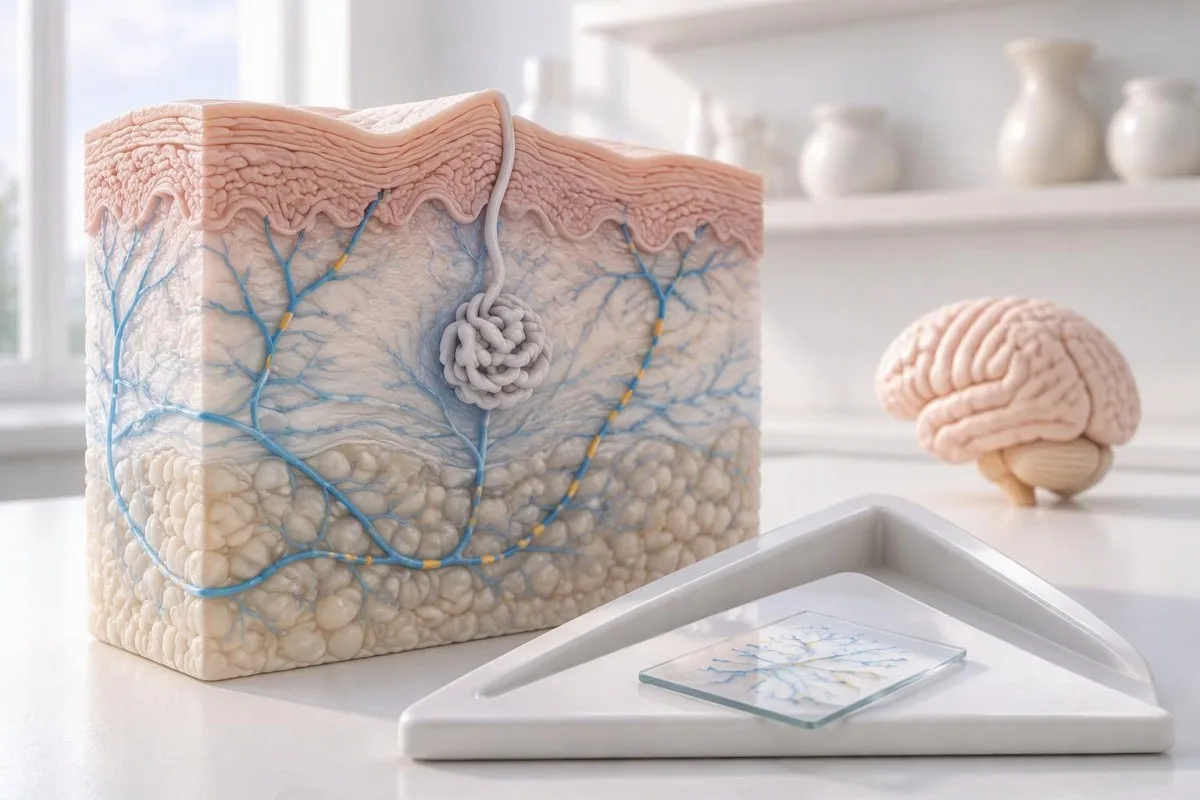
A skin biopsy can identify a protein associated with Parkinson’s, but it cannot name the disease by itself. The useful answer comes from combining the tissue finding with your symptoms, neurological examination, and clinical history.


- Syn-One test detects phosphorylated alpha-synuclein in skin nerves; a positive result supports a synucleinopathy, not Parkinson’s disease alone.
- Parkinson’s detection was 92.7% in a selected group of 96 clinically diagnosed patients in a 2024 multicenter JAMA study.
- Other synucleinopathies also tested positive: 98.2% for multiple system atrophy, 96.0% for dementia with Lewy bodies, and 100% for pure autonomic failure in that study.
- Control findings were positive in 4 of 120 participants without clinical evidence of synucleinopathy, equivalent to 3.3%.
- Negative findings lower suspicion but do not exclude Parkinson’s; 7 of 96 clinically diagnosed Parkinson’s participants tested negative in the 2024 study.
- Utambuzi wa kliniki requires assessment of bradykinesia together with rigidity or rest tremor; a skin result does not replace that examination.
- Ukusanyaji wa sampuli commonly involves three approximately 3 mm skin samples from the neck, thigh, and lower leg under local anesthetic.
- Maamuzi ya matibabu should address the clinical syndrome and symptoms; neither starting nor stopping Parkinson’s medication should depend on the biopsy alone.
Can the Syn-One test actually detect Parkinson’s disease?
The Syn-One test can detect phosphorylated alpha-synuclein in skin nerves, a finding associated with Parkinson’s disease and other synucleinopathies. A positive result supports that disease family but cannot independently distinguish Parkinson’s from multiple system atrophy, dementia with Lewy bodies, or pure autonomic failure. A negative result does not rule Parkinson’s out.
A skin biopsy for Parkinson’s disease is therefore best understood as a supportive biological test, not a replacement for a movement-disorders assessment. The laboratory examines peripheral nerve fibers; it does not sample the substantia nigra, the brain region closely involved in Parkinson’s motor symptoms. That distinction explains why an abnormal skin finding cannot establish the cause of every tremor or walking problem.
Consider an illustrative 67-year-old with gradually smaller handwriting, reduced right-arm swing, and slowness when fastening buttons. A positive skin finding would fit a clinical suspicion of Parkinson’s, whereas the same finding in someone with prominent early blood-pressure failure and poor balance would prompt a different diagnostic discussion. These are hypothetical examples, not reported patient cases.
Kantesti ni Mchambuzi wa mtihani wa damu wa AI that helps explain accompanying laboratory reports; it does not perform this skin assay or diagnose Parkinson’s from a PDF. Thomas Klein’s editorial focus here is the boundary between detecting a protein and diagnosing a person. Our shirika na mtazamo wa kimatibabu describe the blood-test context of this article, not specialist certification for skin pathology.
How is the skin sample collected and examined?
The Syn-One test commonly uses three approximately 3 mm punch skin samples, collected under local anesthetic from the posterior neck, thigh, and lower leg. A specialized laboratory processes the tissue and looks for phosphorylated alpha-synuclein within nerve fibers using immunofluorescence.
Sampling three locations matters because peripheral deposits are not necessarily distributed evenly. Tissue processing, section thickness, antibody selection, and how many sections are examined can affect detection; an ordinary dermatology pathology examination is not automatically equivalent to this specialized assay. Before collection, confirm that the specimens will go to the intended laboratory using its required handling protocol.
The clinically useful question is not simply whether a slide contains a fluorescent speck. The signal must be interpreted in its anatomical setting, including whether it localizes to a nerve fiber rather than surrounding material. Ask whether the report comments on sample adequacy, the sites examined, and any additional nerve-fiber measurements—these details help explain an unexpected result.
Although some reports include descriptive measurements, the main diagnostic finding is generally detected versus not detected, rather than a blood-style concentration in ng/mL. Our explanation of matokeo ya ubora na wingi helps separate those reporting formats. There is no universally accepted skin alpha-synuclein concentration that translates directly into a Parkinson’s stage.
What does a positive Syn-One test mean?
A positive Syn-One test means the laboratory detected phosphorylated alpha-synuclein in the examined skin nerve tissue. In an appropriate clinical setting, that supports a synucleinopathy; it does not independently establish Parkinson’s disease, determine severity, or predict when disability will develop.
Alpha-synuclein is a naturally occurring neuronal protein; the test is not looking for an entirely foreign substance. Phosphorylation at serine 129 is a modification associated with aggregated alpha-synuclein in synucleinopathies. Detecting this modification in skin nerves is biologically informative, but it does not tell the neurologist which brain networks are driving the person’s symptoms.
A positive finding is also not a hereditary risk score. It does not identify a Parkinson’s-associated gene variant, establish that a child will inherit a disorder, or measure the percentage of brain cells affected. Those are three different questions requiring different evidence, and confusing them can turn a useful pathology result into an unnecessarily frightening family conversation.
Nor should the amount of staining be treated as a countdown. A laboratory may describe distribution or burden, but a single report does not provide a validated individual timeline to falls, dementia, or loss of independence. For comparison, neurofilament light chain interpretation addresses another neurological biomarker whose biological signal also needs clinical context.
How accurate is the Syn-One test in published research?
The strongest widely cited multicenter evidence found skin phosphorylated alpha-synuclein in 92.7% of clinically diagnosed Parkinson’s participants, with positivity in 3.3% of controls. Those figures describe selected research groups; they are not a universal accuracy estimate for every person referred with tremor.
Gibbons et al. reported the study in JAMA in 2024 across 30 sites, with 343 participants in the primary analysis. Detection occurred in 89 of 96 participants with Parkinson’s, 54 of 55 with multiple system atrophy, 48 of 50 with dementia with Lewy bodies, and all 22 with pure autonomic failure. Four of 120 controls were positive.
Those results are encouraging, but the reference diagnoses were clinical rather than autopsy-confirmed. The study did not establish sensitivity in very early or prodromal disease, and its control group was not a full representation of confusing clinic referrals with essential tremor, progressive supranuclear palsy, corticobasal syndromes, or mixed neurological conditions. These limitations matter more than an advertising phrase such as “over 90% accurate.”
Kuanzia Oktoba 24, 2026, this article anchors its numerical discussion to that identifiable 2024 publication rather than assuming an unverified new guideline or regulatory update. Kantesti’s mfumo wa uthibitishaji wa kliniki concerns our own blood-report interpretation methodology, not validation of the Syn-One test. Accuracy evidence cannot be transferred from one technology to another.
Why doesn’t a positive result equal a Parkinson’s diagnosis?
A positive result does not equal Parkinson’s because several different disorders share alpha-synuclein pathology, and the probability of disease also depends on the clinical picture before testing. Specificity against healthy controls is not the same as specificity for Parkinson’s against other synucleinopathies.
In the Gibbons et al. study, multiple system atrophy actually had a higher detection percentage than Parkinson’s: 98.2% versus 92.7%. Calling a positive result “Parkinson’s-specific” therefore reverses what the evidence shows. The assay may support the presence of the broader pathology family while leaving the subtype question unresolved.
Here is a deliberately hypothetical calculation: assume a test has 93% sensitivity and 97% specificity in the population being assessed. At a 10% pretest probability, a positive result gives approximately a 78% post-test probability; at a 1% pretest probability, it gives approximately 24%. These are teaching calculations, not validated Syn-One predictive values or probabilities specifically for Parkinson’s.
The practical issue is whether the suspected disorder was plausible before the sample was taken. A biomarker in someone with a matching neurological syndrome carries different weight from an unexpected finding in a person without objective signs. Our positive antibody interpretation guide explains a related reasoning principle, although this skin assay detects tissue protein—not antibodies circulating in blood.
Can a negative Syn-One test rule out Parkinson’s?
A negative Syn-One test cannot rule out Parkinson’s disease. It means phosphorylated alpha-synuclein was not detected in the tissue examined; a neurologist must decide whether that finding meaningfully lowers suspicion or conflicts with an otherwise convincing clinical syndrome.
Seven of the 96 clinically diagnosed Parkinson’s participants in the 2024 JAMA study tested negative. That 7.3% negative proportion is a useful reminder that even promising assays miss some clinically affected people. It does not establish the false-negative rate for every disease stage, laboratory method, genetic background, or referral population.
A negative result can reflect biological variability, deposits outside the sampled tissue, or limitations in sampling and detection. Early-disease performance remains less certain than performance in established clinical syndromes, and inadequate tissue should not be treated as a reassuring negative. Ask whether all three specimens were adequate before discussing what the result means for your diagnosis.
Persistent bradykinesia, rigidity, or progressive gait change deserves follow-up even after a negative biopsy. The next step may be reassessment, medication review, imaging for a particular differential diagnosis, or simply observing the clinical course—not automatically repeating the skin procedure. Our discussion of vipimo hasi vya kingamwili vya neva illustrates why a negative laboratory finding must be matched to the question the assay can answer.
How do neurologists distinguish Parkinson’s from MSA?
Neurologists distinguish Parkinson’s from multiple system atrophy, or MSA, primarily through the clinical pattern, including autonomic dysfunction, cerebellar signs, motor progression, and response to treatment. A positive skin alpha-synuclein finding can occur in both conditions and cannot independently separate them.
Parkinson’s often begins asymmetrically and may show a clear, sustained response to levodopa. MSA becomes more concerning when severe autonomic dysfunction appears early, particularly urinary retention or substantial orthostatic hypotension, alongside parkinsonism or cerebellar dysfunction. None of these clues is absolute, and one unusual symptom should not be turned into a diagnosis without the wider examination.
For example, an illustrative 61-year-old with movement slowness, recurrent faintness on standing, and worsening bladder emptying needs more than a tremor assessment. The clinician may examine blood-pressure changes, review medications, and investigate urinary function before interpreting the positive skin result. Dehydration, prostate-related obstruction, diabetes, and medication effects can also complicate that picture.
Research into the distribution and burden of cutaneous alpha-synuclein may eventually improve subtype classification, but those patterns are not interchangeable with an independently validated diagnosis from a routine positive report. Contrast this with Huntington genetic testing, where the assay addresses a specific genetic mechanism. Different neurological tests have fundamentally different diagnostic jobs.
Which symptoms and examination findings carry the most weight?
For Parkinson’s assessment, the central motor finding is bradykinesia combined with rigidity or rest tremor. Neurologists also examine asymmetry, gait, eye movements, balance, and other neurological signs; skin biopsy findings are interpreted alongside—not instead of—those observations.
The 2015 Movement Disorder Society criteria define parkinsonism as bradykinesia plus rest tremor or rigidity (Postuma et al., 2015). Bradykinesia is not merely feeling tired or moving slowly: repetitive movements are assessed for slowness and a decrement in amplitude or speed. A hand that starts tapping well and progressively produces smaller movements tells a different story from a hand limited by pain.
Reduced arm swing, softer speech, smaller handwriting, and difficulty turning in bed can support the history, but each has alternatives. Shoulder disease can reduce arm swing; arthritis can affect handwriting; sedating medicines can slow movement. A positive skin finding should not make the clinician stop checking those competing explanations, particularly when only one symptom seems abnormal.
The location of symptoms matters too. Numbness concentrated in the thumb, index, and middle fingers suggests a local nerve problem more readily than Parkinson’s; our carpal tunnel symptom patterns explain that distribution. Bringing a short symptom timeline and a complete medication list often helps more than arriving with a single laboratory percentage.
What if memory, sleep, or blood pressure problems come first?
Memory changes, dream enactment, or autonomic symptoms can shift the interpretation toward dementia with Lewy bodies, pure autonomic failure, or a possible prodromal syndrome. A positive skin result supports biological suspicion but does not determine which disorder will emerge or when.
The 2017 DLB Consortium report retains the clinical 1-year rule: dementia before or within one year of parkinsonism favors the label dementia with Lewy bodies; dementia developing after established Parkinson’s favors Parkinson’s disease dementia (McKeith et al., 2017). This is a practical naming convention, not a biological switch. Skin alpha-synuclein positivity cannot date when cognitive or motor symptoms began.
Pure autonomic failure can involve neurogenic orthostatic hypotension without established parkinsonism or dementia. A conventional orthostatic hypotension threshold is a sustained fall of at least 20 mmHg systolic or 10 mmHg diastolic within three minutes of standing, although a clinician must assess context and possible causes. A positive skin finding does not make every episode of dizziness neurodegenerative.
Dream enactment should prompt a sleep history and, when indicated, video polysomnography to evaluate REM sleep behavior disorder and its mimics. The procedure is different from an MSLT used for narcolepsy; our sleep study testing guide explains that distinction. A positive biopsy in someone without a defined motor syndrome should lead to measured follow-up, not a promised date of future Parkinson’s.
How does a skin biopsy compare with DaT imaging and MRI?
Skin alpha-synuclein testing, dopamine-transporter imaging, and MRI answer different questions. Skin testing assesses peripheral protein deposits, DaT imaging assesses presynaptic dopaminergic function, and MRI looks for structural explanations or features relevant to alternative diagnoses.
An abnormal DaT scan can support a presynaptic dopaminergic deficit, but it usually cannot independently distinguish Parkinson’s from degenerative parkinsonian disorders such as MSA or progressive supranuclear palsy. A normal MRI does not exclude Parkinson’s either. Two abnormal supportive tests may increase confidence in part of the biological story without resolving the disease subtype.
When findings disagree, there is no automatic rule that the skin test outranks the scan or the scan outranks the examination. A positive skin result with normal dopaminergic imaging might raise questions about a nonmotor synucleinopathy, timing, technical factors, or an unrelated cause of symptoms. The appropriate response is to revisit the clinical question, not average two incompatible results into a score.
Kantesti ni jukwaa la tafsiri ya vipimo vya damu la AI that can explain accompanying findings such as vitamin B12 or thyroid results; our blood-report tools do not substitute for reading neurological imaging or skin histology. Our mwongozo wa teknolojia na tafsiri describes that scope. For potentially treatable sensory or balance contributors, vitamini B12 yaliyo mpakani deserve their own clinical assessment.
Which blood tests can help explain similar symptoms?
Blood tests cannot currently diagnose Parkinson’s through a routine general laboratory panel, but targeted testing can identify treatable contributors to tremor, fatigue, neuropathy, or cognitive symptoms. Depending on the presentation, clinicians may check thyroid function, vitamin B12, glucose, electrolytes, and kidney or liver function.
Thyrotoxicosis can produce a fine action tremor, palpitations, and weight loss, whereas Parkinson’s assessment focuses on a different motor pattern. TSH and free T4 help investigate thyroid physiology, but they do not confirm or exclude alpha-synuclein pathology. Our thyroxine and thyroid testing guide explains why the paired results are more useful than interpreting either hormone alone.
Copper deficiency is another reason to resist a one-test explanation, particularly when gait difficulty accompanies sensory loss or anemia. Excess zinc intake can reduce copper absorption; these findings point toward a different mechanism from Parkinson’s and can coexist with unrelated conditions. Our guides to upungufu wa shaba husababisha na excess zinc nerve symptoms describe that connection.
Kantesti can help explain units, reference intervals, and changes across accompanying blood reports, but no CBC, ferritin level, or general metabolic panel can validate a positive skin alpha-synuclein result. The sensible approach is targeted testing guided by the examination rather than ordering dozens of unrelated markers. A correctable deficiency deserves treatment even when a separate neurological diagnosis remains under consideration.
Will a positive or negative result change treatment?
A Syn-One result may change diagnostic confidence or follow-up planning, but treatment should remain guided by the clinical syndrome and symptom burden. A positive finding alone is not an instruction to start levodopa, and a negative finding alone is not an instruction to stop it.
Before ordering the test, ask what would change after each possible outcome. If the examination already strongly supports Parkinson’s and the treatment plan would remain identical whether the biopsy is positive or negative, the additional value may be limited. In an uncertain presentation, however, biological support might justify specialist reassessment or a different discussion about autonomic and cognitive monitoring.
Medication response is useful information, but it is not a perfect diagnostic experiment. Dose, duration, adherence, side effects, and which symptom is being measured all affect interpretation; tremor may respond differently from slowness or rigidity. Do not make a large medication change yourself to see whether the biopsy was “right”—bring the report and symptom history to the prescribing clinician.
Medication-induced parkinsonism also needs consideration, especially with dopamine-blocking drugs, and some people have more than one contributing mechanism. Our guide to athari za dawa kwa wazee provides a useful preparation checklist for that conversation. Exercise, fall prevention, physiotherapy, and management of constipation or blood-pressure symptoms should address actual needs rather than wait for a laboratory label.
What should you check about safety, cost, and privacy?
Before a skin biopsy, confirm procedure suitability, total costs, coverage, laboratory handling, and who will explain the result. Small skin samples usually involve a minor outpatient procedure, but local anesthetic reactions, scarring, infection, or bleeding are possible and need individualized discussion.
Tell the clinician about anticoagulants, antiplatelet medicines, anesthetic allergies, healing problems, and previous unusual scarring. Do not stop a prescribed blood thinner on your own: the clinician must balance procedure-related bleeding against the reason the medicine was prescribed. Ask for written site-care instructions and a contact route for increasing redness, discharge, persistent bleeding, or fever.
Request a written estimate separating the laboratory charge from collection, consultation, and any follow-up fees. Coverage, prior authorization, and availability vary by insurer and country; a quoted turnaround should come from the collecting service rather than a generic article. Laboratory accreditation, regulatory status, and evidence of clinical usefulness are separate questions—one does not automatically establish the others.
Kantesti ni Zana ya uchambuzi wa vipimo vya damu inayotumia AI, not the laboratory receiving your skin specimens. Our faragha na mbinu za data explain handling of information submitted to our service, while the skin-test provider has its own policies. Before sharing an accompanying laboratory report, review our orodha ya ukaguzi wa faragha ya kupakia ripoti and remove identifiers that are unnecessary for the task.
What should happen next, and which research supports the discussion?
After a Syn-One result, ask your neurologist three questions: Which diagnosis best fits my examination, how does this result change that probability, and what changes in my care now? The directly relevant evidence concerns skin alpha-synuclein and neurological diagnostic criteria; unrelated research should not be used to claim Parkinson’s test accuracy.
For a positive result, request the proposed clinical subtype and the findings that support it; for a negative result, ask which diagnoses remain plausible and whether sample adequacy was satisfactory. Thomas Klein’s closing advice is straightforward: keep the neurological examination at the center of the decision. A laboratory finding should make the reasoning clearer, not hide the uncertainty behind a percentage.
Arrange follow-up around the pace of symptoms, not around a universal biopsy timetable. Sudden weakness, new inability to walk, acute confusion, or rapidly worsening swallowing or breathing needs urgent assessment rather than a routine Parkinson’s appointment. Our habari ya bodi ya ushauri wa kimatibabu describes clinical governance; a named byline or publication date should not be mistaken for proof that an individual report has received specialist review.
The two related repository items below are included for transparency about broader Kantesti research topics, not as evidence that the Syn-One test detects Parkinson’s. Neither title addresses cutaneous alpha-synuclein or validates the detection percentages quoted here. A Figshare DOI identifies a repository record; it does not by itself establish peer review, independent replication, or clinical effectiveness.
Women’s health guide: Ovulation, menopause & hormonal symptoms. (n.d.). Figshare. https://doi.org/10.6084/m9.figshare.31830721. This title-first citation is used because authorship and publication date were not independently verified for this draft; the associated mwongozo wetu wa afya ya homoni kwa wanawake concerns a separate clinical subject, not Parkinson’s biomarker performance.
Multilingual AI assisted clinical decision support for early hantavirus triage: Design, engineering validation, and real-world deployment across 50,000 interpreted blood test reports. (n.d.). Figshare. https://doi.org/10.6084/m9.figshare.32230290. The 50,000-report figure appears in the supplied publication title and is not presented here as an independently verified deployment result; ResearchGate and Academia.edu links below are discovery searches, not verified copies of either work.
Maswali Yanayoulizwa Mara Kwa Mara
Je, kipimo chanya cha Syn-One kinamaanisha nina ugonjwa wa Parkinson?
Kipimo chanya cha Syn-One kinamaanisha kuwa alpha-synuclein iliyofosforilishwa iligunduliwa katika tishu za neva za ngozi zilizochunguzwa, wala haimaanishi kuwa ugonjwa wa Parkinson umethibitishwa kwa njia huru. Katika utafiti wa JAMA wa mwaka 2024, matokeo chanya yalipatikana kwa 92.7% ya washiriki wenye Parkinson na pia kwa washiriki wenye atrofia ya mifumo mingi, shida ya akili yenye miili ya Lewy, na kushindwa kwa mfumo wa neva unaojiendesha pekee. Daktari wa neva hutumia muundo wa dalili na uchunguzi kubaini utambuzi unaolingana zaidi. Matokeo haya hayaweki hatua ya ugonjwa wala ubashiri wa mtu binafsi.
Kipimo cha Syn-One cha Parkinson kina usahihi kwa kiwango gani?
Utafiti wa JAMA wa vituo vingi wa mwaka 2024 uligundua alpha-synuclein iliyofosforishwa kwenye ngozi kwa washiriki 89 kati ya 96 waliokuwa wamegunduliwa kliniki kuwa na Parkinson, sawa na 92.7%. Watu wanne kati ya 120 waliokuwa katika kundi dhibiti walipatikana na matokeo chanya, sawa na 3.3%. Takwimu hizi zilitokana na makundi teule ya utafiti na hazithibitishi usahihi kwa kila mtu mwenye dalili za awali au utambuzi usio na uhakika wa mtetemeko. Utafiti huo pia haukuthibitisha kuwa matokeo chanya hutofautisha Parkinson na magonjwa mengine ya synucleinopathy.
Je, unaweza kuwa na ugonjwa wa Parkinson licha ya kipimo cha Syn-One kuonyesha matokeo hasi?
Ndiyo, ugonjwa wa Parkinson bado unawezekana hata baada ya kipimo cha Syn-One kuonyesha matokeo hasi. Washiriki saba kati ya 96 waliogunduliwa kliniki kuwa na ugonjwa wa Parkinson walikuwa na matokeo hasi katika utafiti wa JAMA wa mwaka 2024. Matokeo hasi yanamaanisha kwamba protini lengwa haikugunduliwa katika tishu iliyochunguzwa, na umuhimu wake hutegemea ubora wa sampuli, jinsi ugonjwa unavyojitokeza na kiwango cha awali cha kushukiwa kliniki. Bradykinesia, ukakamavu au dalili za mwendo zinazozidi kuwa mbaya zinaendelea kuhitaji tathmini ya neva.
Je, kipimo cha Syn-One kinaweza kutofautisha ugonjwa wa Parkinson na MSA?
Matokeo chanya ya Syn-One hayawezi, yenyewe pekee, kutofautisha ugonjwa wa Parkinson na atrofia ya mifumo mingi, au MSA. Utafiti wa JAMA wa 2024 uligundua matokeo chanya kwa 92.7% ya washiriki wenye Parkinson na 98.2% ya washiriki wenye MSA. Madaktari bingwa wa magonjwa ya neva huchunguza hitilafu za mfumo wa neva unaojiendesha, dalili za serebela, maendeleo ya ugonjwa na mwitikio wa matibabu ili kutathmini aina ndogo ya ugonjwa. Utafiti kuhusu mifumo ya usambazaji wa tishu haupaswi kuchanganywa na utambuzi wa uhakika wa aina ndogo ya ugonjwa kutokana na ripoti ya kawaida yenye matokeo chanya.
Ni sampuli ngapi za biopsi ya ngozi huchukuliwa kwa kipimo cha Syn-One?
Kipimo cha Syn-One kwa kawaida huhusisha kuchukua sampuli tatu za ngozi kwa kutumia kifaa cha kuchomoa ngozi chenye kipenyo cha takriban mm 3, kutoka sehemu ya nyuma ya shingo, paja na sehemu ya chini ya mguu. Kwa kawaida, ganzi ya eneo husika hutumiwa wakati wa kuchukua sampuli. Kuchukua sampuli kutoka maeneo mengi husaidia kuzingatia usambazaji usio sawa wa akiba za alpha-synuclein katika neva za pembeni. Mtaalamu wa afya anayechukua sampuli anapaswa kuthibitisha utaratibu hususa, tahadhari za dawa, utunzaji baada ya kuchukuliwa kwa sampuli na mipango ya kujadili matokeo.
Je, nianze au niache kutumia dawa za Parkinson kwa sababu ya matokeo hayo?
Do not start or stop Parkinson’s medication solely because a Syn-One test is positive or negative. The 2024 study included seven clinically diagnosed Parkinson’s participants with negative skin findings, showing why a negative result cannot automatically overturn the clinical diagnosis. Medication decisions depend on the examination, symptoms, benefit, adverse effects, and alternative explanations. Discuss any proposed change with the prescribing neurologist before altering treatment.
Can a positive Syn-One test predict future Parkinson’s before symptoms?
A positive skin alpha-synuclein finding does not provide a validated individual date for developing Parkinson’s disease. The 2024 multicenter JAMA study did not establish performance in very early or prodromal disease. People with dream enactment or autonomic symptoms may need specialist follow-up, but a positive finding does not determine which syndrome will emerge. It should not be treated as a countdown to disability or dementia.
Pata Uchambuzi wa Vipimo vya Damu kwa AI Leo
Jiunge na zaidi ya watumiaji 2 milioni duniani kote wanaoamini Kantesti kwa uchambuzi wa papo hapo na sahihi wa vipimo vya maabara. Pakia matokeo yako ya vipimo vya damu na upate tafsiri ya kina ya viashiria vya 15,000+ ndani ya sekunde.
📚 Machapisho ya Utafiti Yanayorejelewa
Klein, T., Mitchell, S., & Weber, H. (2026). Mwongozo wa Afya wa Wanawake: Ovulation, Kukoma Hedhi na Dalili za Homoni. Kantesti uchambuzi wa damu kwa AI ya utafiti wa matibabu.
Klein, T., Mitchell, S., & Weber, H. (2026). Usaidizi wa AI wa Kliniki wa Uamuzi wa Mapema wa Hantavirus: Muundo, Uhandisi wa Uthibitishaji, na Utekelezaji Halisi kwa Ripoti 50,000 za Vipimo vya Damu Vilivyotafsiriwa. Kantesti uchambuzi wa damu kwa AI ya utafiti wa matibabu.
📖 Marejeo ya Nje ya Tiba
Gibbons CH et al. (2024). Skin Biopsy Detection of Phosphorylated α-Synuclein in Patients With Synucleinopathies. JAMA.
Postuma RB et al. (2015). MDS clinical diagnostic criteria for Parkinson's disease. Movement Disorders.
McKeith IG et al. (2017). Diagnosis and management of dementia with Lewy bodies: Fourth consensus report of the DLB Consortium. Uganga wa akili.
⚕️ Kanusho la Kimatibabu
Makala haya ni kwa madhumuni ya elimu tu na si ushauri wa kimatibabu. Wasiliana na mtoa huduma aliyehitimu kila wakati kwa maamuzi ya utambuzi na matibabu.
E-E-A-T Trust Signals
Uzoefu
Mapitio ya kimatibabu inayoongozwa na daktari ya mifumo ya tafsiri ya maabara.
Utaalamu
Kuzingatia dawa za maabara kuhusu jinsi viashiria (biomarkers) vinavyobadilika katika muktadha wa kliniki.
Mamlaka
Imeandikwa na Dk. Thomas Klein kwa mapitio ya Dk. Sarah Mitchell na Prof. Dk. Hans Weber.
Uaminifu
Tafsiri inayotegemea ushahidi yenye njia zilizo wazi za ufuatiliaji ili kupunguza tahadhari za hofu.