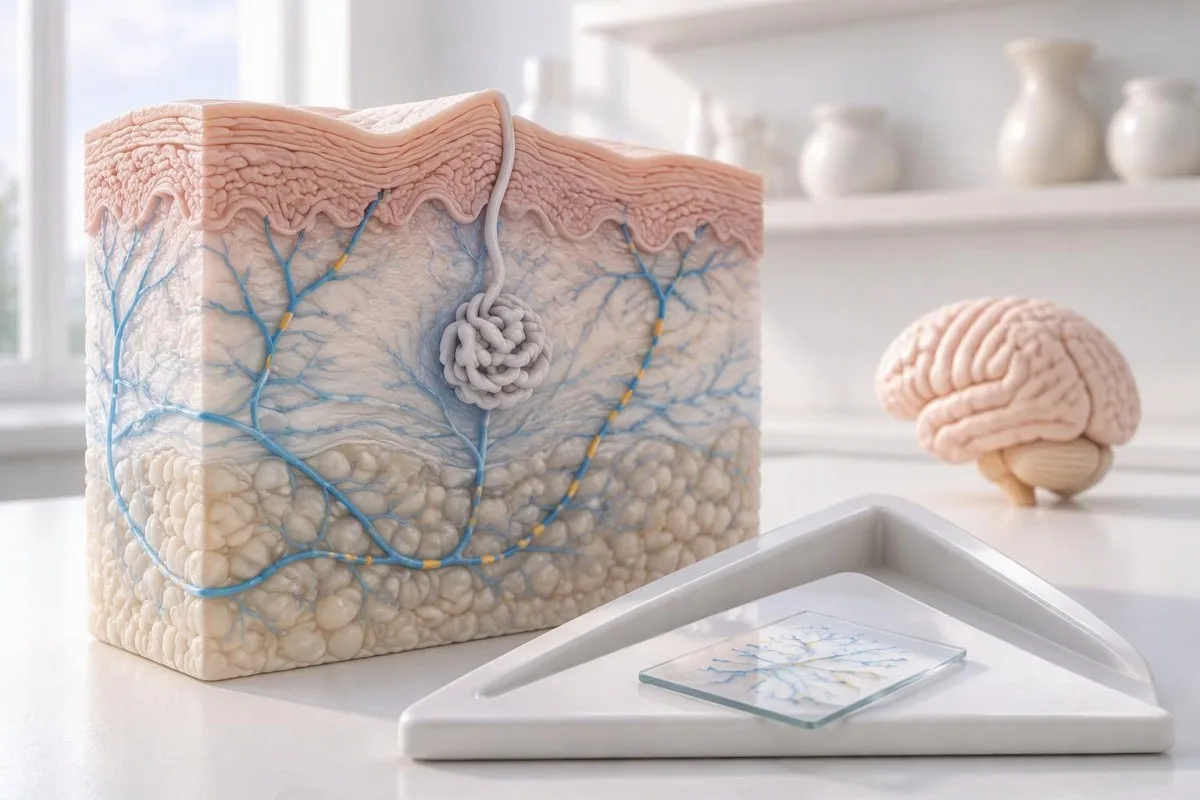
Тире биопсиясе Паркинсон авыруы белән бәйле аксымны ачыклый ала, ләкин авыруның исемен үзе генә билгели алмый. Файдалы җавап тукымадагы табылдыкны симптомнарыгыз, неврологик тикшерү нәтиҗәләре һәм клиник тарихыгыз белән бергә караудан килә.


- Syn-One тесты тире нервларында фосфорланган альфа-синуклеинны ачыклый; уңай нәтиҗә синуклеинопатияне хуплый, ләкин бары тик Паркинсон авыруын гына расламый.
- Паркинсонны ачыклау 2024 елда JAMA журналында басылган күп үзәкле тикшеренүдә клиник диагноз куелган 96 пациенттан торган сайлап алынган төркемдә 92.7% булды.
- Башка синуклеинопатияләр дә уңай нәтиҗә бирде: күп системалы атрофия өчен 98.2%, Леви тәнчекләре белән деменция өчен 96.0% һәм әлеге тикшеренүдә саф автоном җитешсезлек өчен 100%.
- Контроль төркемдәге табылдыклар синуклеинопатиянең клиник билгеләре булмаган 120 катнашучының 4сендә уңай булды, бу 3.3%ка тиң.
- Тискәре табылдыклар шикне түбәнәйтә, ләкин Паркинсон авыруын кире какмый; 2024 елгы тикшеренүдә клиник яктан Паркинсон авыруы диагнозы куелган 96 катнашучының 7сендә тест тискәре нәтиҗә күрсәткән.
- Клиник диагноз брадикинезияне ригидлык яки тынычлыктагы тремор белән бергә бәяләүне таләп итә; тире анализы ул тикшерүне алыштырмый.
- Үрнәк алу гадәттә җирле анестезия астында муеннан, боттан һәм балтырның аскы өлешеннән якынча 3 мм зурлыктагы өч тире үрнәге алуны үз эченә ала.
- Дәвалау карарлары клиник синдромны һәм симптомнарны исәпкә алырга тиеш; Паркинсон даруларын башлау да, туктату да бары тик биопсия нәтиҗәсенә генә бәйле булырга тиеш түгел.
Syn-One тесты Паркинсон авыруын чыннан да ачыклый аламы?
.Әр сүзнең Syn-One тесты тире нервларында фосфорланган альфа-синуклеинны ачыклый ала, бу Паркинсон авыруы һәм башка синуклеинопатияләр белән бәйле күренеш. Уңай нәтиҗә бу авырулар төркемен хуплый, ләкин Паркинсон авыруын күп системалы атрофиядән, Леви тельцалы деменциядән яки саф автоном җитешсезлектән аерып күрсәтә алмый. Тискәре нәтиҗә Паркинсон авыруын кире какмый.
Шуңа күрә Паркинсон авыруын ачыклау өчен тире биопсиясен иң дөрес итеп диагнозны раслаучы биологик тест, дип аңларга кирәк; ул хәрәкәт бозылышлары белгече бәяләвен алыштырмый. Лаборатория периферик нерв җепселләрен тикшерә; Паркинсонның хәрәкәт симптомнарында зур роль уйнаучы баш мие өлкәсе — кара матдәдән үрнәк алмый. Бу аерма тиредәге тайпылышлы табылдыкның һәр тремор яки йөрү проблемасының сәбәбен ачыклый алмавын аңлата.
Мисал өчен, әкренләп вак яза башлаган, уң кулының селтәнүе кимегән һәм төймәләрне эләктергәндә хәрәкәтләре акрынайган 67 яшьлек кешене күз алдыгызга китерегез. Тиредә уңай табылдык Паркинсон авыруына карата клиник шик белән туры килер иде, ә кан басымы иртәдән үк нык төшү һәм начар тигезлек саклау күзәтелгән кешедә шул ук табылдык башкача диагностика турында сөйләшүгә этәрер иде. Болар — фараз ителгән мисаллар, хәбәр ителгән пациент очраклары түгел.
Кантести - ЯИ анализы лаборатория хисапларын аңлатырга ярдәм итә; ул бу тире анализын үткәрми һәм PDF файлына карап Паркинсон авыруына диагноз куймый. Томас Кляйнның бу мәкаләдәге редакторлык игътибары — аксымны ачыклау белән кешегә диагноз кую арасындагы чик. Безнең оешма һәм клиник юнәлеш бу мәкаләдәге кан анализы контекстын тасвирлый, тире патологиясе буенча белгеч сертификатын түгел.
Тире үрнәген ничек алалар һәм тикшерәләр?
Syn-One тестында гадәттә якынча 3 мм зурлыктагы өч панч-биопсия тире үрнәге, алына; алар җирле анестезия астында муенның арткы өлешеннән, боттан һәм балтырның аскы өлешеннән җыела. Махсуслашкан лаборатория тукыманы эшкәртә һәм иммунофлюоресценция ярдәмендә нерв җепселләре эчендә фосфорланган альфа-синуклеинны эзли.
Өч урыннан үрнәк алу мөһим, чөнки периферик тупланмаларның тигез бүленмәве мөмкин. Тукыманы эшкәртү, кисем калынлыгы, антитәнчек сайлау һәм тикшерелгән кисемнәр саны ачыклау нәтиҗәсенә йогынты ясарга мөмкин; гадәти дерматология патологиясе тикшерүе бу махсус анализга автоматик рәвештә тиң түгел. Үрнәкләр алынганчы, аларның тиешле лабораториягә шул лаборатория таләп иткән эшкәртү протоколы буенча җибәреләчәген раслагыз.
Клиник яктан файдалы сорау — препаратта флюоресцент ноктаның булу-булмавы гына түгел. Сигнал анатомик урынына карап аңлатылырга тиеш: мәсәлән, аның тирәдәге материалда түгел, ә нерв җепселендә урнашу-урнашмавы. Хисапта үрнәкнең яраклылыгы, тикшерелгән урыннар һәм нерв җепселләренә кагылышлы өстәмә үлчәүләр турында мәгълүмат бармы дип сорагыз — бу нечкәлекләр көтелмәгән нәтиҗәне аңлатырга ярдәм итә.
Кайбер хисапларда тасвирлама үлчәүләр булса да, төп диагностик табылдык гадәттә ачыкланды яки ачыкланмады, рәвешендә бирелә, кан анализындагы кебек нг/мл белән күрсәтелгән концентрация рәвешендә түгел. Безнең санды һәм сыйфатлы нәтиҗәләр аңлатмабыз бу хисап форматларын аерырга ярдәм итә. Тире альфа-синуклеины концентрациясенең Паркинсон авыруы стадиясенә турыдан-туры бәйләнгән, бөтен җирдә кабул ителгән күрсәткече юк.
Syn-One тестының уңай нәтиҗәсе нәрсәне аңлата?
A уңай Syn-One тесты лабораториянең тикшерелгән тире нерв тукымасында фосфорланган альфа-синуклеинны ачыклаганын аңлата. Клиник хәлгә туры килгәндә, бу синуклеинопатия булуын хуплый; ләкин ул үзе генә Паркинсон авыруын раслый алмый, аның авырлыгын билгеләми һәм инвалидлыкның кайчан үсәчәген фаразламый.
Alpha-synuclein is a naturally occurring neuronal protein; the test is not looking for an entirely foreign substance. Phosphorylation at serine 129 is a modification associated with aggregated alpha-synuclein in synucleinopathies. Detecting this modification in skin nerves is biologically informative, but it does not tell the neurologist which brain networks are driving the person’s symptoms.
A positive finding is also not a hereditary risk score. It does not identify a Parkinson’s-associated gene variant, establish that a child will inherit a disorder, or measure the percentage of brain cells affected. Those are three different questions requiring different evidence, and confusing them can turn a useful pathology result into an unnecessarily frightening family conversation.
Nor should the amount of staining be treated as a countdown. A laboratory may describe distribution or burden, but a single report does not provide a validated individual timeline to falls, dementia, or loss of independence. For comparison, neurofilament light chain interpretation addresses another neurological biomarker whose biological signal also needs clinical context.
Басылып чыккан тикшеренүләрдә Syn-One тесты никадәр төгәл?
The strongest widely cited multicenter evidence found skin phosphorylated alpha-synuclein in 92.7% of clinically diagnosed Parkinson’s participants, with positivity in 3.3% of controls. Those figures describe selected research groups; they are not a universal accuracy estimate for every person referred with tremor.
Gibbons et al. reported the study in JAMA in 2024 across 30 sites, with 343 participants in the primary analysis. Detection occurred in 89 of 96 participants with Parkinson’s, 54 of 55 with multiple system atrophy, 48 of 50 with dementia with Lewy bodies, and all 22 with pure autonomic failure. Four of 120 controls were positive.
Those results are encouraging, but the reference diagnoses were clinical rather than autopsy-confirmed. The study did not establish sensitivity in very early or prodromal disease, and its control group was not a full representation of confusing clinic referrals with essential tremor, progressive supranuclear palsy, corticobasal syndromes, or mixed neurological conditions. These limitations matter more than an advertising phrase such as “over 90% accurate.”
2026 елга 2026 елның 24 октябре, this article anchors its numerical discussion to that identifiable 2024 publication rather than assuming an unverified new guideline or regulatory update. Kantesti’s клиник валидация фреймворкы бар concerns our own blood-report interpretation methodology, not validation of the Syn-One test. Accuracy evidence cannot be transferred from one technology to another.
Ни өчен уңай нәтиҗә Паркинсон диагнозына тиң түгел?
A positive result does not equal Parkinson’s because several different disorders share alpha-synuclein pathology, and the probability of disease also depends on the clinical picture before testing. Specificity against healthy controls is not the same as specificity for Parkinson’s against other synucleinopathies.
In the Gibbons et al. study, multiple system atrophy actually had a higher detection percentage than Parkinson’s: 98.2% versus 92.7%. Calling a positive result “Parkinson’s-specific” therefore reverses what the evidence shows. The assay may support the presence of the broader pathology family while leaving the subtype question unresolved.
Here is a deliberately hypothetical calculation: assume a test has 93% sensitivity and 97% specificity in the population being assessed. At a 10% pretest probability, a positive result gives approximately a 78% post-test probability; at a 1% pretest probability, it gives approximately 24%. These are teaching calculations, not validated Syn-One predictive values or probabilities specifically for Parkinson’s.
The practical issue is whether the suspected disorder was plausible before the sample was taken. A biomarker in someone with a matching neurological syndrome carries different weight from an unexpected finding in a person without objective signs. Our positive antibody interpretation guide explains a related reasoning principle, although this skin assay detects tissue protein—not antibodies circulating in blood.
Syn-One тестының тискәре нәтиҗәсе Паркинсон авыруын кире кага аламы?
A negative Syn-One test cannot rule out Parkinson’s disease. It means phosphorylated alpha-synuclein was not detected in the tissue examined; a neurologist must decide whether that finding meaningfully lowers suspicion or conflicts with an otherwise convincing clinical syndrome.
Seven of the 96 clinically diagnosed Parkinson’s participants in the 2024 JAMA study tested negative. That 7.3% negative proportion is a useful reminder that even promising assays miss some clinically affected people. It does not establish the false-negative rate for every disease stage, laboratory method, genetic background, or referral population.
A negative result can reflect biological variability, deposits outside the sampled tissue, or limitations in sampling and detection. Early-disease performance remains less certain than performance in established clinical syndromes, and inadequate tissue should not be treated as a reassuring negative. Ask whether all three specimens were adequate before discussing what the result means for your diagnosis.
Persistent bradykinesia, rigidity, or progressive gait change deserves follow-up even after a negative biopsy. The next step may be reassessment, medication review, imaging for a particular differential diagnosis, or simply observing the clinical course—not automatically repeating the skin procedure. Our discussion of тискәре неврологик антитәнәфес тестлар illustrates why a negative laboratory finding must be matched to the question the assay can answer.
Неврологлар Паркинсон авыруын MSAдан ничек аера?
Neurologists distinguish Parkinson’s from multiple system atrophy, or MSA, primarily through the clinical pattern, including autonomic dysfunction, cerebellar signs, motor progression, and response to treatment. A positive skin alpha-synuclein finding can occur in both conditions and cannot independently separate them.
Parkinson’s often begins asymmetrically and may show a clear, sustained response to levodopa. MSA becomes more concerning when severe autonomic dysfunction appears early, particularly urinary retention or substantial orthostatic hypotension, alongside parkinsonism or cerebellar dysfunction. None of these clues is absolute, and one unusual symptom should not be turned into a diagnosis without the wider examination.
For example, an illustrative 61-year-old with movement slowness, recurrent faintness on standing, and worsening bladder emptying needs more than a tremor assessment. The clinician may examine blood-pressure changes, review medications, and investigate urinary function before interpreting the positive skin result. Dehydration, prostate-related obstruction, diabetes, and medication effects can also complicate that picture.
Research into the distribution and burden of cutaneous alpha-synuclein may eventually improve subtype classification, but those patterns are not interchangeable with an independently validated diagnosis from a routine positive report. Contrast this with Huntington genetic testing, where the assay addresses a specific genetic mechanism. Different neurological tests have fundamentally different diagnostic jobs.
Кайсы симптомнар һәм тикшерү нәтиҗәләре иң зур әһәмияткә ия?
For Parkinson’s assessment, the central motor finding is bradykinesia combined with rigidity or rest tremor. Neurologists also examine asymmetry, gait, eye movements, balance, and other neurological signs; skin biopsy findings are interpreted alongside—not instead of—those observations.
.Әр сүзнең 2015 Movement Disorder Society criteria define parkinsonism as bradykinesia plus rest tremor or rigidity (Postuma et al., 2015). Bradykinesia is not merely feeling tired or moving slowly: repetitive movements are assessed for slowness and a decrement in amplitude or speed. A hand that starts tapping well and progressively produces smaller movements tells a different story from a hand limited by pain.
Reduced arm swing, softer speech, smaller handwriting, and difficulty turning in bed can support the history, but each has alternatives. Shoulder disease can reduce arm swing; arthritis can affect handwriting; sedating medicines can slow movement. A positive skin finding should not make the clinician stop checking those competing explanations, particularly when only one symptom seems abnormal.
The location of symptoms matters too. Numbness concentrated in the thumb, index, and middle fingers suggests a local nerve problem more readily than Parkinson’s; our carpal tunnel symptom patterns explain that distribution. Bringing a short symptom timeline and a complete medication list often helps more than arriving with a single laboratory percentage.
Хәтер, йокы яки кан басымы проблемалары беренче булып күренсә, нишләргә?
Memory changes, dream enactment, or autonomic symptoms can shift the interpretation toward dementia with Lewy bodies, pure autonomic failure, or a possible prodromal syndrome. A positive skin result supports biological suspicion but does not determine which disorder will emerge or when.
.Әр сүзнең 2017 DLB Consortium report retains the clinical 1-year rule: dementia before or within one year of parkinsonism favors the label dementia with Lewy bodies; dementia developing after established Parkinson’s favors Parkinson’s disease dementia (McKeith et al., 2017). This is a practical naming convention, not a biological switch. Skin alpha-synuclein positivity cannot date when cognitive or motor symptoms began.
Pure autonomic failure can involve neurogenic orthostatic hypotension without established parkinsonism or dementia. A conventional orthostatic hypotension threshold is a sustained fall of at least 20 mmHg systolic or 10 mmHg diastolic within three minutes of standing, although a clinician must assess context and possible causes. A positive skin finding does not make every episode of dizziness neurodegenerative.
Dream enactment should prompt a sleep history and, when indicated, video polysomnography to evaluate REM sleep behavior disorder and its mimics. The procedure is different from an MSLT used for narcolepsy; our sleep study testing guide explains that distinction. A positive biopsy in someone without a defined motor syndrome should lead to measured follow-up, not a promised date of future Parkinson’s.
Тире биопсиясен DaT визуализациясе һәм МРТ белән ничек чагыштырырга?
Skin alpha-synuclein testing, dopamine-transporter imaging, and MRI answer different questions. Skin testing assesses peripheral protein deposits, DaT imaging assesses presynaptic dopaminergic function, and MRI looks for structural explanations or features relevant to alternative diagnoses.
An abnormal DaT scan can support a presynaptic dopaminergic deficit, but it usually cannot independently distinguish Parkinson’s from degenerative parkinsonian disorders such as MSA or progressive supranuclear palsy. A normal MRI does not exclude Parkinson’s either. Two abnormal supportive tests may increase confidence in part of the biological story without resolving the disease subtype.
When findings disagree, there is no automatic rule that the skin test outranks the scan or the scan outranks the examination. A positive skin result with normal dopaminergic imaging might raise questions about a nonmotor synucleinopathy, timing, technical factors, or an unrelated cause of symptoms. The appropriate response is to revisit the clinical question, not average two incompatible results into a score.
Кантести - AI кан анализы нәтиҗәләрен аңлату платформасы that can explain accompanying findings such as vitamin B12 or thyroid results; our blood-report tools do not substitute for reading neurological imaging or skin histology. Our технологияләр һәм аңлату буенча кулланма describes that scope. For potentially treatable sensory or balance contributors, чиктәш нәтиҗәләрен deserve their own clinical assessment.
Охшаш симптомнарны аңлатырга нинди кан анализлары ярдәм итә ала?
Blood tests cannot currently diagnose Parkinson’s through a routine general laboratory panel, but targeted testing can identify treatable contributors to tremor, fatigue, neuropathy, or cognitive symptoms. Depending on the presentation, clinicians may check thyroid function, vitamin B12, glucose, electrolytes, and kidney or liver function.
Thyrotoxicosis can produce a fine action tremor, palpitations, and weight loss, whereas Parkinson’s assessment focuses on a different motor pattern. TSH and free T4 help investigate thyroid physiology, but they do not confirm or exclude alpha-synuclein pathology. Our thyroxine and thyroid testing guide explains why the paired results are more useful than interpreting either hormone alone.
Copper deficiency is another reason to resist a one-test explanation, particularly when gait difficulty accompanies sensory loss or anemia. Excess zinc intake can reduce copper absorption; these findings point toward a different mechanism from Parkinson’s and can coexist with unrelated conditions. Our guides to аз бакыр сәбәпләре һәм excess zinc nerve symptoms describe that connection.
Kantesti can help explain units, reference intervals, and changes across accompanying blood reports, but no CBC, ferritin level, or general metabolic panel can validate a positive skin alpha-synuclein result. The sensible approach is targeted testing guided by the examination rather than ordering dozens of unrelated markers. A correctable deficiency deserves treatment even when a separate neurological diagnosis remains under consideration.
Уңай яки тискәре нәтиҗә дәвалауны үзгәртерме?
A Syn-One result may change diagnostic confidence or follow-up planning, but treatment should remain guided by the clinical syndrome and symptom burden. A positive finding alone is not an instruction to start levodopa, and a negative finding alone is not an instruction to stop it.
Before ordering the test, ask what would change after each possible outcome. If the examination already strongly supports Parkinson’s and the treatment plan would remain identical whether the biopsy is positive or negative, the additional value may be limited. In an uncertain presentation, however, biological support might justify specialist reassessment or a different discussion about autonomic and cognitive monitoring.
Medication response is useful information, but it is not a perfect diagnostic experiment. Dose, duration, adherence, side effects, and which symptom is being measured all affect interpretation; tremor may respond differently from slowness or rigidity. Do not make a large medication change yourself to see whether the biopsy was “right”—bring the report and symptom history to the prescribing clinician.
Medication-induced parkinsonism also needs consideration, especially with dopamine-blocking drugs, and some people have more than one contributing mechanism. Our guide to олы яшьтәгеләрдә медикаментларның йогынтысы provides a useful preparation checklist for that conversation. Exercise, fall prevention, physiotherapy, and management of constipation or blood-pressure symptoms should address actual needs rather than wait for a laboratory label.
Иминлек, бәя һәм хосусыйлык мәсьәләләрендә нәрсәләрне тикшерергә кирәк?
Before a skin biopsy, confirm procedure suitability, total costs, coverage, laboratory handling, and who will explain the result. Small skin samples usually involve a minor outpatient procedure, but local anesthetic reactions, scarring, infection, or bleeding are possible and need individualized discussion.
Tell the clinician about anticoagulants, antiplatelet medicines, anesthetic allergies, healing problems, and previous unusual scarring. Do not stop a prescribed blood thinner on your own: the clinician must balance procedure-related bleeding against the reason the medicine was prescribed. Ask for written site-care instructions and a contact route for increasing redness, discharge, persistent bleeding, or fever.
Request a written estimate separating the laboratory charge from collection, consultation, and any follow-up fees. Coverage, prior authorization, and availability vary by insurer and country; a quoted turnaround should come from the collecting service rather than a generic article. Laboratory accreditation, regulatory status, and evidence of clinical usefulness are separate questions—one does not automatically establish the others.
Кантести - AI нигезендәге кан анализы тикшерү коралы, not the laboratory receiving your skin specimens. Our хосусыйлык һәм мәгълүмат белән эш итү тәртибе explain handling of information submitted to our service, while the skin-test provider has its own policies. Before sharing an accompanying laboratory report, review our отчетны йөкләү серсүзлеге чек-листы and remove identifiers that are unnecessary for the task.
Алга таба нәрсә булырга тиеш, һәм бу фикер алышуны нинди тикшеренүләр раслый?
After a Syn-One result, ask your neurologist three questions: Which diagnosis best fits my examination, how does this result change that probability, and what changes in my care now? The directly relevant evidence concerns skin alpha-synuclein and neurological diagnostic criteria; unrelated research should not be used to claim Parkinson’s test accuracy.
For a positive result, request the proposed clinical subtype and the findings that support it; for a negative result, ask which diagnoses remain plausible and whether sample adequacy was satisfactory. Thomas Klein’s closing advice is straightforward: keep the neurological examination at the center of the decision. A laboratory finding should make the reasoning clearer, not hide the uncertainty behind a percentage.
Arrange follow-up around the pace of symptoms, not around a universal biopsy timetable. Sudden weakness, new inability to walk, acute confusion, or rapidly worsening swallowing or breathing needs urgent assessment rather than a routine Parkinson’s appointment. Our медицина консультатив советы мәгълүматы describes clinical governance; a named byline or publication date should not be mistaken for proof that an individual report has received specialist review.
The two related repository items below are included for transparency about broader Kantesti research topics, not as evidence that the Syn-One test detects Parkinson’s. Neither title addresses cutaneous alpha-synuclein or validates the detection percentages quoted here. A Figshare DOI identifies a repository record; it does not by itself establish peer review, independent replication, or clinical effectiveness.
Women’s health guide: Ovulation, menopause & hormonal symptoms. (n.d.). Figshare. https://doi.org/10.6084/m9.figshare.31830721. This title-first citation is used because authorship and publication date were not independently verified for this draft; the associated хатын-кызларның гормональ сәламәтлеге буенча кулланма concerns a separate clinical subject, not Parkinson’s biomarker performance.
Multilingual AI assisted clinical decision support for early hantavirus triage: Design, engineering validation, and real-world deployment across 50,000 interpreted blood test reports. (n.d.). Figshare. https://doi.org/10.6084/m9.figshare.32230290. The 50,000-report figure appears in the supplied publication title and is not presented here as an independently verified deployment result; ResearchGate and Academia.edu links below are discovery searches, not verified copies of either work.
Еш бирелә торган сораулар
Syn-One тестының уңай нәтиҗәсе миндә Паркинсон авыруы бар дигәнне аңлатамы?
Уңай Syn-One тесты тикшерелгән тире нерв тукымасында фосфорланган альфа-синуклеин ачыклануын аңлата, ләкин Паркинсон авыруының бәйсез рәвештә расланганын аңлатмый. 2024 елда JAMA журналында басылган тикшеренүдә уңай нәтиҗәләр Паркинсон авыруы булган катнашучыларның 92.7%-ында, шулай ук күп системалы атрофия, Леви тельцалы деменция һәм беренчел автоном җитешсезлек булган катнашучыларда да күзәтелгән. Невролог нинди диагнозның иң туры килүен симптомнар үзенчәлекләренә һәм тикшерү нәтиҗәләренә карап билгели. Нәтиҗә авыру стадиясен дә, аерым кешенең прогнозын да билгеләми.
Syn-One тесты Паркинсон авыруын ачыклауда никадәр төгәл?
2024 елгы күп үзәкле JAMA тикшерүендә клиник диагноз куелган Паркинсон авыруы булган 96 катнашучының 89ында тиредә фосфорланган альфа-синуклеин ачыкланган, бу 92.7% тәшкил итә. 120 контроль катнашучының дүртесендә уңай нәтиҗә булган, бу 3.3% тәшкил итә. Бу күрсәткечләр сайлап алынган тикшеренү төркемнәреннән алынган һәм иртә симптомнары булган яки тремор диагнозы билгесез һәр кешегә карата төгәллекне расламый. Тикшеренү шулай ук уңай нәтиҗәнең Паркинсон авыруын башка синуклеинопатияләрдән аерып күрсәтүен расламаган.
Syn-One тесты тискәре булса да, Паркинсон авыруы булырга мөмкинме?
0 Әйе, Syn-One тесты тискәре булса да, Паркинсон авыруы булу мөмкинлеге кала. 2024 елгы JAMA тикшеренүендә клиник диагноз куелган Паркинсон авыруы булган 96 катнашучының җидесендә нәтиҗәләр тискәре булган. Тискәре нәтиҗә тикшерелгән тукымада максатлы аксым ачыкланмаганын аңлата, ә аның әһәмияте үрнәкнең яраклылыгына, авыруның ничек чагылуына һәм алдан булган клиник шик дәрәҗәсенә бәйле. Брадикенезия, ригидлык яки йөрүдәге симптомнар прогрессиясе дәвам итсә, неврологик бәяләү кирәк.
Syn-One тесты Паркинсон авыруын MSAдан аера аламы?
0 Позитив Syn-One нәтиҗәсе Паркинсон авыруын күп системалы атрофиядән (MSA) аерым рәвештә аера алмый. 2024 елгы JAMA тикшеренүендә Паркинсон авыруы булган катнашучыларның 92.7%ында һәм MSA булган катнашучыларның 98.2%ында тест уңай нәтиҗә күрсәткән. Неврологлар типны билгеләү өчен вегетатив дисфункцияне, мидәге кече ми билгеләрен, авыруның үсешен һәм дәвалауга җавапны бәяли. Тукымаларда таралу үрнәкләрен тикшерүне гадәти уңай нәтиҗә нигезендә типка төгәл диагноз кую белән бутамаска кирәк.
Syn-One тесты өчен ничә тире биопсиясе алына?
Syn-One тесты гадәттә муенның арткы өлешеннән, боттан һәм балтырдан алынган, диаметры якынча 3 мм булган өч тире биопсиясен үз эченә ала. Материал алу өчен, гадәттә, җирле анестезия кулланыла. Берничә урыннан үрнәк алу периферик нервларда альфа-синуклеин тупланмаларының тигез бүленмәвен исәпкә алырга ярдәм итә. Материал алучы клиницист төгәл протоколны, даруларга кагылышлы саклык чараларын, процедурадан соңгы кайгыртуны һәм нәтиҗә турында фикер алышу тәртибен расларга тиеш.
Нәтиҗәгә карап Паркинсон авыруына каршы даруны башларгамы, әллә туктатыргамы?
0 Дару дигән Syn-One тесты уңай яки тискәре чыккан өчен генә Паркинсон авыруына каршы даруларны башламагыз яки туктатмагыз. 2024 елгы тикшеренүдә клиник яктан Паркинсон диагнозы куелган, ләкин тире нәтиҗәләре тискәре булган җиде катнашучы бар иде; бу тискәре нәтиҗәнең клиник диагнозны автоматик рәвештә кире кага алмавын күрсәтә. Дару кабул итүгә кагылышлы карарлар тикшерү нәтиҗәләренә, симптомнарга, даруның файдасына, тискәре йогынтыларына һәм башка мөмкин булган аңлатмаларга бәйле. Дәвалауны үзгәрткәнче, тәкъдим ителгән үзгәрешне дару билгеләгән невролог белән тикшерегез.
Уңай Syn-One тесты симптомнар барлыкка килгәнче үк киләчәктә Паркинсон авыруы булачагын фаразлый аламы?
Тире альфа-синуклеинга уңай нәтиҗә Паркинсон авыруының кайчан башланачагына бәйле расланган шәхси датаны күрсәтми. 2024 елда күп үзәкле JAMA тикшеренүе авыруның бик иртә яки продромаль стадиясендә тестның нәтиҗәлелеген билгеләмәде. Хыялларны гамәлгә ашыру яки вегетатив симптомнары булган кешеләргә белгеч күзәтүе кирәк булырга мөмкин, әмма уңай нәтиҗә нинди синдром барлыкка киләчәген билгеләми. Моны инвалидлыкка яки деменциягә кадәр калган вакытны исәпләү дип кабул итәргә ярамый.
Бүген үк AI белән эшләнгән кан анализы тикшерүе
Дөнья буенча 2 миллионнан артык кулланучы кушылыгыз: алар Kantestiны тиз һәм төгәл лаборатория анализы өчен ышана. Кан анализы нәтиҗәләрегезне йөкләгез һәм 15,000+ биомаркерларын секундлар эчендә тулы аңлатма белән алыгыз.
📚 Сылтама бирелгән тикшеренү басмалары
Klein, T., Mitchell, S., & Weber, H. (2026). Хатын-кызлар сәламәтлеге өчен кулланма: Овуляция, менопауза һәм гормональ симптомнар. Kantesti AI медицина тикшеренүе.
Klein, T., Mitchell, S., & Weber, H. (2026). Иртә Хантавирус триажы өчен күп телле AI ярдәме белән клиник карар кабул итү ярдәме: дизайн, инженер валидация һәм 50,000 аңлатылган кан анализы отчетлары буенча реаль дөньяда урнаштыру. Kantesti AI медицина тикшеренүе.
📖 Тышкы медицина белешмәләре
Gibbons CH et al. (2024). Skin Biopsy Detection of Phosphorylated α-Synuclein in Patients With Synucleinopathies. JAMA.
Postuma RB et al. (2015). MDS clinical diagnostic criteria for Parkinson's disease. Movement Disorders.
McKeith IG et al. (2017). Diagnosis and management of dementia with Lewy bodies: Fourth consensus report of the DLB Consortium. Неврология.
⚕️ Медицина кисәтүе
Бу мәкалә бары тик белем бирү максатларында гына һәм медицина киңәше булып тормый. Диагноз һәм дәвалау карарлары өчен һәрвакыт квалификацияле сәламәтлек саклау белгеченә мөрәҗәгать итегез.
E-E-A-T ышаныч сигналлары
Тәҗрибә
Табиб җитәкчелегендә лаборатория нәтиҗәләрен аңлату эш процессларын клиник тикшерү.
Белгечлек
Лаборатория медицинасы: биомаркерларның клиник контекстта үз-үзләрен тотышын аңлау.
Авторититет
Доктор Томас Кляйн тарафыннан язылган, доктор Сара Митчелл һәм профессор доктор Ханс Вебер тарафыннан тикшерелгән.
Ышанычлылык
Ачык күзәтү юллары белән куркуны киметү өчен дәлилләргә нигезләнгән аңлату.