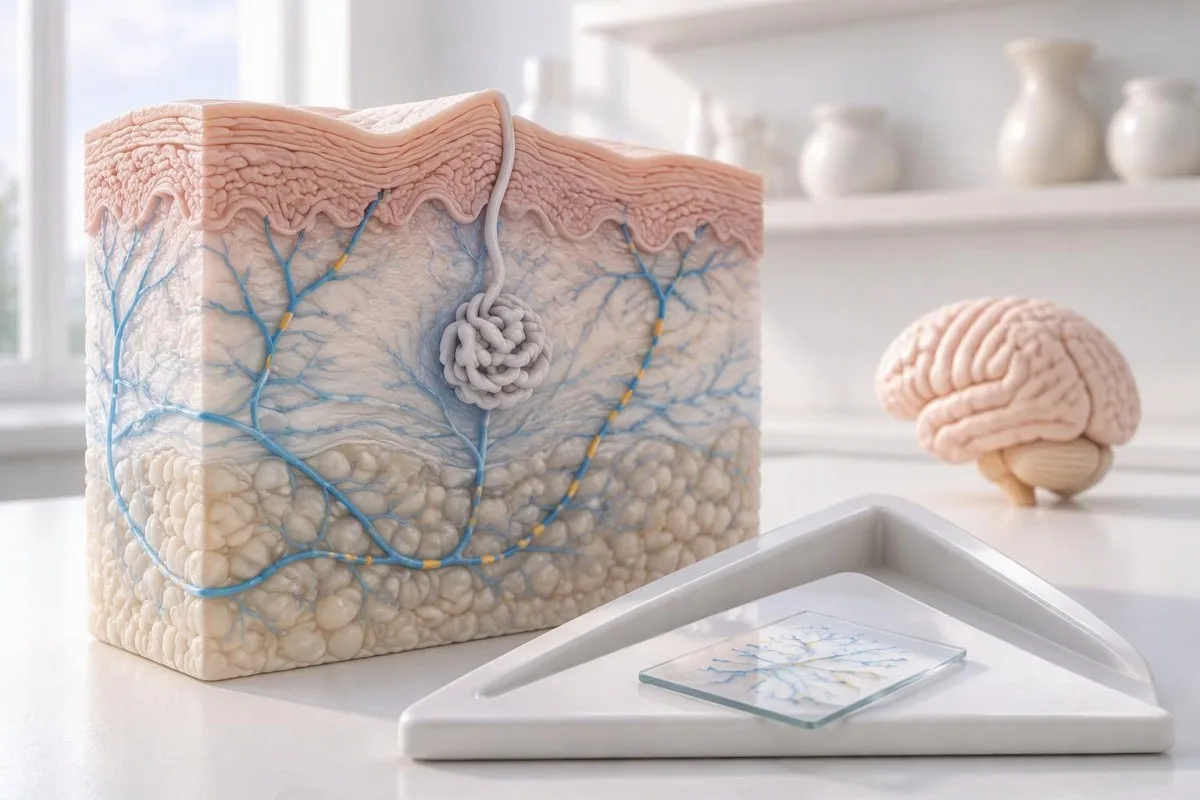
Біяпсія скуры можа выявіць бялок, звязаны з хваробай Паркінсана, але сама па сабе не можа вызначыць захворванне. Карысны адказ атрымліваюць, калі супастаўляюць вынікі даследавання тканкі з вашымі сімптомамі, вынікамі неўралагічнага агляду і клінічным анамнезам.


- Тэст Syn-One выяўляе фасфарыляваную альфа-сінуклеіну ў скурных нервах; станоўчы вынік сведчыць на карысць сінуклеінапатыі, але не толькі хваробы Паркінсана.
- Выяўленне хваробы Паркінсана склала 92.7% у адабранай групе з 96 пацыентаў з клінічным дыягназам у шматцэнтравым даследаванні JAMA 2024 года.
- Іншыя сінуклеінапатыі таксама далі станоўчы вынік: 98.2% для множнай сістэмнай атрафіі, 96.0% для дэменцыі з цельцамі Леві і 100% для чыстай вегетатыўнай недастатковасці ў гэтым даследаванні.
- Вынікі ў кантрольнай групе былі станоўчымі ў 4 з 120 удзельнікаў без клінічных прыкмет сінуклеінапатыі, што адпавядае 3.3%.
- Адмоўныя вынікі зніжае падазрэнне, але не выключае хваробу Паркінсана; у даследаванні 2024 года ў 7 з 96 удзельнікаў з клінічным дыягназам хваробы Паркінсана тэст даў адмоўны вынік.
- Клінічны дыягназ патрабуе ацэнкі брадыкінезіі разам з рыгіднасцю або тремарам спакою; вынік даследавання скуры не замяняе такое абследаванне.
- Збор узору звычайна прадугледжвае ўзяцце трох узораў скуры памерам прыблізна 3 мм з шыі, сцягна і ніжняй часткі галёнкі пад мясцовай анестэзіяй.
- Прыняцце рашэнняў аб лячэнні павінна ўлічваць клінічны сіндром і сімптомы; пачынаць ці спыняць прыём прэпаратаў ад хваробы Паркінсана не варта толькі на падставе біяпсіі.
Ці можа тэст Syn-One сапраўды выявіць хваробу Паркінсана?
Гэты Тэст Syn-One можа выявіць фасфарыляваны альфа-сінуклеін у скурных нервах, што звязана з хваробай Паркінсана і іншымі сінуклеінапатыямі. Станоўчы вынік сведчыць на карысць захворвання з гэтай групы, але сам па сабе не дазваляе адрозніць хваробу Паркінсана ад множнай сістэмнай атрафіі, дэменцыі з цельцамі Леві або чыстай аўтаномнай недастатковасці. Адмоўны вынік не выключае хваробу Паркінсана.
Таму біяпсію скуры пры хваробе Паркінсана лепш разумець як дапаможны біялагічны тэст, а не замену ацэнкі спецыялістам па рухальных расстройствах. У лабараторыі даследуюць валокны перыферычных нерваў; тканку чорнай субстанцыі — аддзела мозгу, цесна звязанага з рухальнымі сімптомамі хваробы Паркінсана, — не бяруць. Гэта адрозненне тлумачыць, чаму паталагічная знаходка ў скуры не можа ўстанавіць прычыну кожнага тремару або праблемы з хадой.
Разгледзім для прыкладу 67-гадовага чалавека, почырк якога паступова драбнее, размах правай рукі пры хадзе паменшыўся, а зашпільваць гузікі стала цяжэй. Станоўчая знаходка ў скуры адпавядала б клінічнаму падазрэнню на хваробу Паркінсана, тады як тая ж знаходка ў чалавека з выяўленым парушэннем рэгуляцыі артэрыяльнага ціску на ранняй стадыі і дрэннай раўнавагай стала б нагодай для іншай дыягнастычнай дыскусіі. Гэта гіпатэтычныя прыклады, а не апісанні рэальных выпадкаў.
Кантэсці — гэта Аналізатар крыві са штучным інтэлектам што дапамагае растлумачыць спадарожныя лабараторныя заключэнні; ён не праводзіць гэты аналіз скуры і не дыягнастуе хваробу Паркінсана па PDF-файле. Тут рэдакцыйны акцэнт Томаса Кляйна — на мяжы паміж выяўленнем бялку і пастаноўкай дыягназу чалавеку. Нашы арганізацыя і клінічны фокус апісваюць кантэкст аналізаў крыві ў гэтым артыкуле, а не сертыфікацыю спецыялістаў у галіне паталогіі скуры.
Як бяруць і даследуюць узор скуры?
У тэсце Syn-One звычайна выкарыстоўваюць тры скурныя ўзоры, атрыманыя панч-біяпсіяй, памерам прыблізна 3 мм, якія бяруць пад мясцовай анестэзіяй з задняй паверхні шыі, сцягна і ніжняй часткі галёнкі. Спецыялізаваная лабараторыя апрацоўвае тканку і з дапамогай імунафлуарэсцэнцыі шукае фасфарыляваны альфа-сінуклеін у нервовых валокнах.
Важна ўзяць узоры з трох участкаў, бо перыферычныя адклады не абавязкова размеркаваны раўнамерна. На выяўленне могуць уплываць апрацоўка тканкі, таўшчыня зрэзаў, выбар антыцелаў і колькасць даследаваных зрэзаў; звычайнае паталагагічнае даследаванне ў дэрматалогіі не з'яўляецца аўтаматычна эквівалентам гэтага спецыялізаванага аналізу. Перад узяццем узораў удакладніце, ці будуць яны накіраваныя ў патрэбную лабараторыю паводле яе пратакола абыходжання з матэрыялам.
Клінічна важнае пытанне — не проста тое, ці ёсць на шкле флуарэсцэнтная кропка. Сігнал трэба інтэрпрэтаваць з улікам яго анатамічнага размяшчэння, у тым ліку высветліць, ці лакалізуецца ён у нервовым валокне, а не ў навакольным матэрыяле. Удакладніце, ці ёсць у заключэнні звесткі пра прыдатнасць узору, даследаваныя ўчасткі і дадатковыя вымярэнні нервовых валокнаў: гэтыя дэталі дапамагаюць растлумачыць нечаканы вынік.
Хоць у некаторых заключэннях прыводзяцца апісальныя вымярэнні, асноўная дыягнастычная выснова звычайна фармулюецца як выяўлены або не выяўлены, а не як канцэнтрацыя ў нг/мл, падобная да паказчыкаў аналізу крыві. Наша тлумачэнне якасныя і колькасныя вынікі дапамагае адрозніць гэтыя фарматы заключэнняў. Не існуе агульнапрызнанай канцэнтрацыі альфа-сінуклеіну ў скуры, якая б непасрэдна адпавядала стадыі хваробы Паркінсана.
Што азначае станоўчы вынік тэсту Syn-One?
A станоўчы вынік тэсту Syn-One азначае, што лабараторыя выявіла фасфарыляваны альфа-сінуклеін у даследаванай тканцы скурных нерваў. У адпаведным клінічным кантэксце гэта сведчыць на карысць сінуклеінапатыі; само па сабе яно не пацвярджае хваробу Паркінсана, не вызначае яе цяжкасць і не прадказвае, калі разаўецца інваліднасць.
Alpha-synuclein is a naturally occurring neuronal protein; the test is not looking for an entirely foreign substance. Phosphorylation at serine 129 is a modification associated with aggregated alpha-synuclein in synucleinopathies. Detecting this modification in skin nerves is biologically informative, but it does not tell the neurologist which brain networks are driving the person’s symptoms.
A positive finding is also not a hereditary risk score. It does not identify a Parkinson’s-associated gene variant, establish that a child will inherit a disorder, or measure the percentage of brain cells affected. Those are three different questions requiring different evidence, and confusing them can turn a useful pathology result into an unnecessarily frightening family conversation.
Nor should the amount of staining be treated as a countdown. A laboratory may describe distribution or burden, but a single report does not provide a validated individual timeline to falls, dementia, or loss of independence. For comparison, neurofilament light chain interpretation addresses another neurological biomarker whose biological signal also needs clinical context.
Наколькі дакладны тэст Syn-One паводле апублікаваных даследаванняў?
The strongest widely cited multicenter evidence found skin phosphorylated alpha-synuclein in 92.7% of clinically diagnosed Parkinson’s participants, with positivity in 3.3% of controls. Those figures describe selected research groups; they are not a universal accuracy estimate for every person referred with tremor.
Gibbons et al. reported the study in JAMA in 2024 across 30 sites, with 343 participants in the primary analysis. Detection occurred in 89 of 96 participants with Parkinson’s, 54 of 55 with multiple system atrophy, 48 of 50 with dementia with Lewy bodies, and all 22 with pure autonomic failure. Four of 120 controls were positive.
Those results are encouraging, but the reference diagnoses were clinical rather than autopsy-confirmed. The study did not establish sensitivity in very early or prodromal disease, and its control group was not a full representation of confusing clinic referrals with essential tremor, progressive supranuclear palsy, corticobasal syndromes, or mixed neurological conditions. These limitations matter more than an advertising phrase such as “over 90% accurate.”
Па стане на 24 кастрычніка 2026 г., this article anchors its numerical discussion to that identifiable 2024 publication rather than assuming an unverified new guideline or regulatory update. Kantesti’s клінічную рамку валідацыі concerns our own blood-report interpretation methodology, not validation of the Syn-One test. Accuracy evidence cannot be transferred from one technology to another.
Чаму станоўчы вынік не азначае дыягназ хваробы Паркінсана?
A positive result does not equal Parkinson’s because several different disorders share alpha-synuclein pathology, and the probability of disease also depends on the clinical picture before testing. Specificity against healthy controls is not the same as specificity for Parkinson’s against other synucleinopathies.
In the Gibbons et al. study, multiple system atrophy actually had a higher detection percentage than Parkinson’s: 98.2% versus 92.7%. Calling a positive result “Parkinson’s-specific” therefore reverses what the evidence shows. The assay may support the presence of the broader pathology family while leaving the subtype question unresolved.
Here is a deliberately hypothetical calculation: assume a test has 93% sensitivity and 97% specificity in the population being assessed. At a 10% pretest probability, a positive result gives approximately a 78% post-test probability; at a 1% pretest probability, it gives approximately 24%. These are teaching calculations, not validated Syn-One predictive values or probabilities specifically for Parkinson’s.
The practical issue is whether the suspected disorder was plausible before the sample was taken. A biomarker in someone with a matching neurological syndrome carries different weight from an unexpected finding in a person without objective signs. Our positive antibody interpretation guide explains a related reasoning principle, although this skin assay detects tissue protein—not antibodies circulating in blood.
Ці можа адмоўны вынік тэсту Syn-One выключыць хваробу Паркінсана?
A negative Syn-One test cannot rule out Parkinson’s disease. It means phosphorylated alpha-synuclein was not detected in the tissue examined; a neurologist must decide whether that finding meaningfully lowers suspicion or conflicts with an otherwise convincing clinical syndrome.
Seven of the 96 clinically diagnosed Parkinson’s participants in the 2024 JAMA study tested negative. That 7.3% negative proportion is a useful reminder that even promising assays miss some clinically affected people. It does not establish the false-negative rate for every disease stage, laboratory method, genetic background, or referral population.
A negative result can reflect biological variability, deposits outside the sampled tissue, or limitations in sampling and detection. Early-disease performance remains less certain than performance in established clinical syndromes, and inadequate tissue should not be treated as a reassuring negative. Ask whether all three specimens were adequate before discussing what the result means for your diagnosis.
Persistent bradykinesia, rigidity, or progressive gait change deserves follow-up even after a negative biopsy. The next step may be reassessment, medication review, imaging for a particular differential diagnosis, or simply observing the clinical course—not automatically repeating the skin procedure. Our discussion of адмоўных неўралагічных аналізаў на антыцелы illustrates why a negative laboratory finding must be matched to the question the assay can answer.
Як неўролагі адрозніваюць хваробу Паркінсана ад МСА?
Neurologists distinguish Parkinson’s from multiple system atrophy, or MSA, primarily through the clinical pattern, including autonomic dysfunction, cerebellar signs, motor progression, and response to treatment. A positive skin alpha-synuclein finding can occur in both conditions and cannot independently separate them.
Parkinson’s often begins asymmetrically and may show a clear, sustained response to levodopa. MSA becomes more concerning when severe autonomic dysfunction appears early, particularly urinary retention or substantial orthostatic hypotension, alongside parkinsonism or cerebellar dysfunction. None of these clues is absolute, and one unusual symptom should not be turned into a diagnosis without the wider examination.
For example, an illustrative 61-year-old with movement slowness, recurrent faintness on standing, and worsening bladder emptying needs more than a tremor assessment. The clinician may examine blood-pressure changes, review medications, and investigate urinary function before interpreting the positive skin result. Dehydration, prostate-related obstruction, diabetes, and medication effects can also complicate that picture.
Research into the distribution and burden of cutaneous alpha-synuclein may eventually improve subtype classification, but those patterns are not interchangeable with an independently validated diagnosis from a routine positive report. Contrast this with Huntington genetic testing, where the assay addresses a specific genetic mechanism. Different neurological tests have fundamentally different diagnostic jobs.
Якія сімптомы і вынікі агляду маюць найбольшую вагу?
For Parkinson’s assessment, the central motor finding is bradykinesia combined with rigidity or rest tremor. Neurologists also examine asymmetry, gait, eye movements, balance, and other neurological signs; skin biopsy findings are interpreted alongside—not instead of—those observations.
Гэты 2015 Movement Disorder Society criteria define parkinsonism as bradykinesia plus rest tremor or rigidity (Postuma et al., 2015). Bradykinesia is not merely feeling tired or moving slowly: repetitive movements are assessed for slowness and a decrement in amplitude or speed. A hand that starts tapping well and progressively produces smaller movements tells a different story from a hand limited by pain.
Reduced arm swing, softer speech, smaller handwriting, and difficulty turning in bed can support the history, but each has alternatives. Shoulder disease can reduce arm swing; arthritis can affect handwriting; sedating medicines can slow movement. A positive skin finding should not make the clinician stop checking those competing explanations, particularly when only one symptom seems abnormal.
The location of symptoms matters too. Numbness concentrated in the thumb, index, and middle fingers suggests a local nerve problem more readily than Parkinson’s; our carpal tunnel symptom patterns explain that distribution. Bringing a short symptom timeline and a complete medication list often helps more than arriving with a single laboratory percentage.
Што, калі праблемы з памяццю, сном або артэрыяльным ціскам з'яўляюцца першымі?
Memory changes, dream enactment, or autonomic symptoms can shift the interpretation toward dementia with Lewy bodies, pure autonomic failure, or a possible prodromal syndrome. A positive skin result supports biological suspicion but does not determine which disorder will emerge or when.
Гэты 2017 DLB Consortium report retains the clinical 1-year rule: dementia before or within one year of parkinsonism favors the label dementia with Lewy bodies; dementia developing after established Parkinson’s favors Parkinson’s disease dementia (McKeith et al., 2017). This is a practical naming convention, not a biological switch. Skin alpha-synuclein positivity cannot date when cognitive or motor symptoms began.
Pure autonomic failure can involve neurogenic orthostatic hypotension without established parkinsonism or dementia. A conventional orthostatic hypotension threshold is a sustained fall of at least 20 mmHg systolic or 10 mmHg diastolic within three minutes of standing, although a clinician must assess context and possible causes. A positive skin finding does not make every episode of dizziness neurodegenerative.
Dream enactment should prompt a sleep history and, when indicated, video polysomnography to evaluate REM sleep behavior disorder and its mimics. The procedure is different from an MSLT used for narcolepsy; our sleep study testing guide explains that distinction. A positive biopsy in someone without a defined motor syndrome should lead to measured follow-up, not a promised date of future Parkinson’s.
Чым біяпсія скуры адрозніваецца ад DaT-візуалізацыі і МРТ?
Skin alpha-synuclein testing, dopamine-transporter imaging, and MRI answer different questions. Skin testing assesses peripheral protein deposits, DaT imaging assesses presynaptic dopaminergic function, and MRI looks for structural explanations or features relevant to alternative diagnoses.
An abnormal DaT scan can support a presynaptic dopaminergic deficit, but it usually cannot independently distinguish Parkinson’s from degenerative parkinsonian disorders such as MSA or progressive supranuclear palsy. A normal MRI does not exclude Parkinson’s either. Two abnormal supportive tests may increase confidence in part of the biological story without resolving the disease subtype.
When findings disagree, there is no automatic rule that the skin test outranks the scan or the scan outranks the examination. A positive skin result with normal dopaminergic imaging might raise questions about a nonmotor synucleinopathy, timing, technical factors, or an unrelated cause of symptoms. The appropriate response is to revisit the clinical question, not average two incompatible results into a score.
Кантэсці — гэта Платформа AI для расшыфроўкі аналізу крыві that can explain accompanying findings such as vitamin B12 or thyroid results; our blood-report tools do not substitute for reading neurological imaging or skin histology. Our кіраўніцтва па тэхналогіі і інтэрпрэтацыі describes that scope. For potentially treatable sensory or balance contributors, памежных вынікаў аналізу на вітамін B12 deserve their own clinical assessment.
Якія аналізы крыві могуць дапамагчы растлумачыць падобныя сімптомы?
Blood tests cannot currently diagnose Parkinson’s through a routine general laboratory panel, but targeted testing can identify treatable contributors to tremor, fatigue, neuropathy, or cognitive symptoms. Depending on the presentation, clinicians may check thyroid function, vitamin B12, glucose, electrolytes, and kidney or liver function.
Thyrotoxicosis can produce a fine action tremor, palpitations, and weight loss, whereas Parkinson’s assessment focuses on a different motor pattern. TSH and free T4 help investigate thyroid physiology, but they do not confirm or exclude alpha-synuclein pathology. Our thyroxine and thyroid testing guide explains why the paired results are more useful than interpreting either hormone alone.
Copper deficiency is another reason to resist a one-test explanation, particularly when gait difficulty accompanies sensory loss or anemia. Excess zinc intake can reduce copper absorption; these findings point toward a different mechanism from Parkinson’s and can coexist with unrelated conditions. Our guides to нізкі ўзровень медзі выклікае і excess zinc nerve symptoms describe that connection.
Kantesti can help explain units, reference intervals, and changes across accompanying blood reports, but no CBC, ferritin level, or general metabolic panel can validate a positive skin alpha-synuclein result. The sensible approach is targeted testing guided by the examination rather than ordering dozens of unrelated markers. A correctable deficiency deserves treatment even when a separate neurological diagnosis remains under consideration.
Ці зменіць станоўчы або адмоўны вынік лячэнне?
A Syn-One result may change diagnostic confidence or follow-up planning, but treatment should remain guided by the clinical syndrome and symptom burden. A positive finding alone is not an instruction to start levodopa, and a negative finding alone is not an instruction to stop it.
Before ordering the test, ask what would change after each possible outcome. If the examination already strongly supports Parkinson’s and the treatment plan would remain identical whether the biopsy is positive or negative, the additional value may be limited. In an uncertain presentation, however, biological support might justify specialist reassessment or a different discussion about autonomic and cognitive monitoring.
Medication response is useful information, but it is not a perfect diagnostic experiment. Dose, duration, adherence, side effects, and which symptom is being measured all affect interpretation; tremor may respond differently from slowness or rigidity. Do not make a large medication change yourself to see whether the biopsy was “right”—bring the report and symptom history to the prescribing clinician.
Medication-induced parkinsonism also needs consideration, especially with dopamine-blocking drugs, and some people have more than one contributing mechanism. Our guide to уплыў лекаў на пажылых людзей provides a useful preparation checklist for that conversation. Exercise, fall prevention, physiotherapy, and management of constipation or blood-pressure symptoms should address actual needs rather than wait for a laboratory label.
Што варта даведацца пра бяспеку, кошт і прыватнасць?
Before a skin biopsy, confirm procedure suitability, total costs, coverage, laboratory handling, and who will explain the result. Small skin samples usually involve a minor outpatient procedure, but local anesthetic reactions, scarring, infection, or bleeding are possible and need individualized discussion.
Tell the clinician about anticoagulants, antiplatelet medicines, anesthetic allergies, healing problems, and previous unusual scarring. Do not stop a prescribed blood thinner on your own: the clinician must balance procedure-related bleeding against the reason the medicine was prescribed. Ask for written site-care instructions and a contact route for increasing redness, discharge, persistent bleeding, or fever.
Request a written estimate separating the laboratory charge from collection, consultation, and any follow-up fees. Coverage, prior authorization, and availability vary by insurer and country; a quoted turnaround should come from the collecting service rather than a generic article. Laboratory accreditation, regulatory status, and evidence of clinical usefulness are separate questions—one does not automatically establish the others.
Кантэсці — гэта Інструмент аналізу вынікаў аналізу крыві з падтрымкай AI, not the laboratory receiving your skin specimens. Our палітыка прыватнасці і апрацоўкі даных explain handling of information submitted to our service, while the skin-test provider has its own policies. Before sharing an accompanying laboratory report, review our кантрольны спіс прыватнасці загрузкі справаздач and remove identifiers that are unnecessary for the task.
Што павінна адбыцца далей і якія даследаванні пацвярджаюць гэтае абмеркаванне?
After a Syn-One result, ask your neurologist three questions: Which diagnosis best fits my examination, how does this result change that probability, and what changes in my care now? The directly relevant evidence concerns skin alpha-synuclein and neurological diagnostic criteria; unrelated research should not be used to claim Parkinson’s test accuracy.
For a positive result, request the proposed clinical subtype and the findings that support it; for a negative result, ask which diagnoses remain plausible and whether sample adequacy was satisfactory. Thomas Klein’s closing advice is straightforward: keep the neurological examination at the center of the decision. A laboratory finding should make the reasoning clearer, not hide the uncertainty behind a percentage.
Arrange follow-up around the pace of symptoms, not around a universal biopsy timetable. Sudden weakness, new inability to walk, acute confusion, or rapidly worsening swallowing or breathing needs urgent assessment rather than a routine Parkinson’s appointment. Our інфармацыя медыцынскай кансультатыўнай рады describes clinical governance; a named byline or publication date should not be mistaken for proof that an individual report has received specialist review.
The two related repository items below are included for transparency about broader Kantesti research topics, not as evidence that the Syn-One test detects Parkinson’s. Neither title addresses cutaneous alpha-synuclein or validates the detection percentages quoted here. A Figshare DOI identifies a repository record; it does not by itself establish peer review, independent replication, or clinical effectiveness.
Women’s health guide: Ovulation, menopause & hormonal symptoms. (n.d.). Figshare. https://doi.org/10.6084/m9.figshare.31830721. This title-first citation is used because authorship and publication date were not independently verified for this draft; the associated даведкі па жаночым гарманальным здароўі concerns a separate clinical subject, not Parkinson’s biomarker performance.
Multilingual AI assisted clinical decision support for early hantavirus triage: Design, engineering validation, and real-world deployment across 50,000 interpreted blood test reports. (n.d.). Figshare. https://doi.org/10.6084/m9.figshare.32230290. The 50,000-report figure appears in the supplied publication title and is not presented here as an independently verified deployment result; ResearchGate and Academia.edu links below are discovery searches, not verified copies of either work.
Часта задаваныя пытанні
Ці азначае станоўчы вынік тэсту Syn-One, што ў мяне хвароба Паркінсана?
0 Пазітыўны вынік тэсту Syn-One азначае, што ў даследаванай нервовай тканцы скуры быў выяўлены фасфарыляваны альфа-сінуклеін, а не тое, што хвароба Паркінсана была незалежна пацверджана. У даследаванні JAMA 2024 года станоўчыя вынікі былі атрыманы ў 92.7% удзельнікаў з хваробай Паркінсана, а таксама ў удзельнікаў з множнай сістэмнай атрафіяй, дэменцыяй з цельцамі Леві і чыстай аўтаномнай недастатковасцю. Неўролаг вызначае, які дыягназ найбольш адпавядае карціне сімптомаў і вынікам агляду. Вынік не вызначае стадыю хваробы або індывідуальны прагноз.
Наколькі дакладны тэст Syn-One на хваробу Паркінсана?
Шматцэнтраванае даследаванне JAMA 2024 года выявіла фосфарыляваную альфа-сінуклеін у скуры ў 89 з 96 удзельнікаў з клінічна дыягнаставанай хваробай Паркінсана, што адпавядае 92.7%. Станоўчы вынік быў у чатырох са 120 асоб з кантрольнай групы, што адпавядае 3.3%. Гэтыя лічбы атрыманы ў адабраных даследчых групах і не пацвярджаюць дакладнасць для кожнага чалавека з раннімі сімптомамі або з няпэўным дыягназам трымору. Даследаванне таксама не пацвердзіла, што станоўчы вынік дазваляе адрозніць хваробу Паркінсана ад іншых сінуклеінапатый.
Ці можа быць хвароба Паркінсана пры адмоўным выніку тэсту Syn-One?
Так, хвароба Паркінсана застаецца магчымай нават пасля адмоўнага тэсту Syn-One. У даследаванні JAMA 2024 года ў сямі з 96 удзельнікаў з клінічна дыягнаставанай хваробай Паркінсана былі выяўлены адмоўныя вынікі. Адмоўны вынік азначае, што мэтавы бялок не быў выяўлены ў даследаванай тканцы, а яго значэнне залежыць ад дастатковасці ўзору, праяў хваробы і папярэдняй клінічнай падазронасці. Захаванне брадыкінезіі, рыгіднасці або прагрэсаванне парушэнняў хады па-ранейшаму патрабуе неўралагічнага абследавання.
Ці можа тэст Syn-One адрозніць хваробу Паркінсана ад МСА?
Станоўчы вынік Syn-One сам па сабе не дазваляе адрозніць хваробу Паркінсана ад множнай сістэмнай атрафіі (МСА). Даследаванне, апублікаванае ў JAMA ў 2024 годзе, выявіла станоўчыя вынікі ў 92.7% удзельнікаў з хваробай Паркінсана і ў 98.2% удзельнікаў з МСА. Неўролагі ацэньваюць вегетатыўную дысфункцыю, мазжачковыя прыкметы, прагрэсаванне захворвання і адказ на лячэнне, каб вызначыць падтып. Даследаванні размеркавання патэрнаў у тканках не варта блытаць з канчатковай дыягностыкай падтыпу на падставе звычайнага станоўчага заключэння.
Колькі біяпсій скуры бяруць для тэсту Syn-One?
Тэст Syn-One звычайна прадугледжвае ўзяцце трох узораў скуры метадам панч-біяпсіі памерам прыблізна 3 мм з задняй паверхні шыі, сцягна і ніжняй часткі нагі. Для ўзяцця ўзораў звычайна выкарыстоўваюць мясцовы анестэтык. Узяцце ўзораў з некалькіх месцаў дапамагае ўлічыць нераўнамернае размеркаванне адкладаў альфа-сінуклеіну ў перыферычных нервах. Клініцыст, які бярэ ўзоры, павінен пацвердзіць дакладны пратакол, меры засцярогі адносна лекаў, рэкамендацыі па доглядзе пасля працэдуры і парадак абмеркавання выніку.
Ці варта мне пачаць прымаць ці спыніць прыём лекаў ад хваробы Паркінсана з-за гэтага выніку?
Не пачынайце і не спыняйце прыём лекаў ад хваробы Паркінсана толькі на падставе станоўчага або адмоўнага выніку тэсту Syn-One. У даследаванні 2024 года ўдзельнічалі сем чалавек з клінічным дыягназам хваробы Паркінсана, у якіх вынікі даследавання скуры былі адмоўнымі, што паказвае, чаму адмоўны вынік не можа аўтаматычна скасоўваць клінічны дыягназ. Рашэнні аб прыёме лекаў залежаць ад вынікаў агляду, сімптомаў, карысці, пабочных эфектаў і альтэрнатыўных тлумачэнняў. Абмяркуйце любую прапанаваную змену з неўролагам, які прызначыў лячэнне, перш чым змяняць яго.
Ці можа станоўчы тэст Syn-One прадказаць развіццё хваробы Паркінсана да з'яўлення сімптомаў?
Станоўчая знаходка альфа-сінуклеіну ў скуры не дазваляе дакладна вызначыць індывідуальную дату развіцця хваробы Паркінсана. Шматцэнтравое даследаванне JAMA 2024 года не ўстанавіла эфектыўнасць метаду пры вельмі ранняй хваробе або ў продрамальным перыядзе. Людзям, у якіх назіраюцца разыгрыванне сноў або аўтаномныя сімптомы, можа спатрэбіцца назіранне ў спецыяліста, але станоўчая знаходка не вызначае, які сіндром разаўецца. Яе не варта ўспрымаць як адлік часу да інваліднасці або дэменцыі.
Атрымаць аналіз крыві з AI сёння
Далучайцеся больш чым да 2 мільёнаў карыстальнікаў па ўсім свеце, якія давяраюць Kantesti для імгненнага, дакладнага аналізу лабараторных тэстаў. Загрузіце вынікі аналізу крыві і атрымайце поўную інтэрпрэтацыю біямаркераў 15,000+ за лічаныя секунды.
📚 Публікацыі даследаванняў са спасылкамі
Кляйн, Т., Мітчэл, С., і Вебер, Г. (2026). Кіраўніцтва па жаночым здароўі: авуляцыя, менапаўза і гарманальныя сімптомы. Kantesti AI Medical Research.
Кляйн, Т., Мітчэл, С., і Вебер, Г. (2026). Шматмоўная AI-падтрымка пры прыняцці клінічных рашэнняў для ранняга трыажу хантавірусу: дызайн, інжынерная валідацыя і разгортванне ў рэальных умовах для 50 000 прааналізаваных справаздач аб аналізах крыві. Kantesti AI Medical Research.
📖 Знешнія медыцынскія спасылкі
Gibbons CH et al. (2024). Skin Biopsy Detection of Phosphorylated α-Synuclein in Patients With Synucleinopathies. JAMA.
Postuma RB et al. (2015). MDS clinical diagnostic criteria for Parkinson's disease. Movement Disorders.
McKeith IG et al. (2017). Diagnosis and management of dementia with Lewy bodies: Fourth consensus report of the DLB Consortium. Неўралогія.
⚕️ Медыцынская адмова ад адказнасці
Гэты артыкул прызначаны толькі для адукацыйных мэт і не з’яўляецца медычнай парадай. Заўсёды кансультуйцеся з кваліфікаваным спецыялістам аховы здароўя для прыняцця рашэнняў па дыягностыцы і лячэнні.
Сігналы даверу E-E-A-T
Вопыт
Клінічны агляд, які вядзе лекар, працэсаў інтэрпрэтацыі лабараторных паказчыкаў.
Экспертыза
Фокус лабараторнай медыцыны на тым, як біямаркеры паводзяць сябе ў клінічным кантэксце.
Аўтарытэтнасць
Напісана доктарам Томасам Кляйнам, з аглядам доктара Сара Мітчэл і праф. доктара Ганса Вебера.
Надзейнасць
Інтэрпрэтацыя на аснове доказаў з выразнымі шляхамі далейшых дзеянняў, каб паменшыць трывогу.