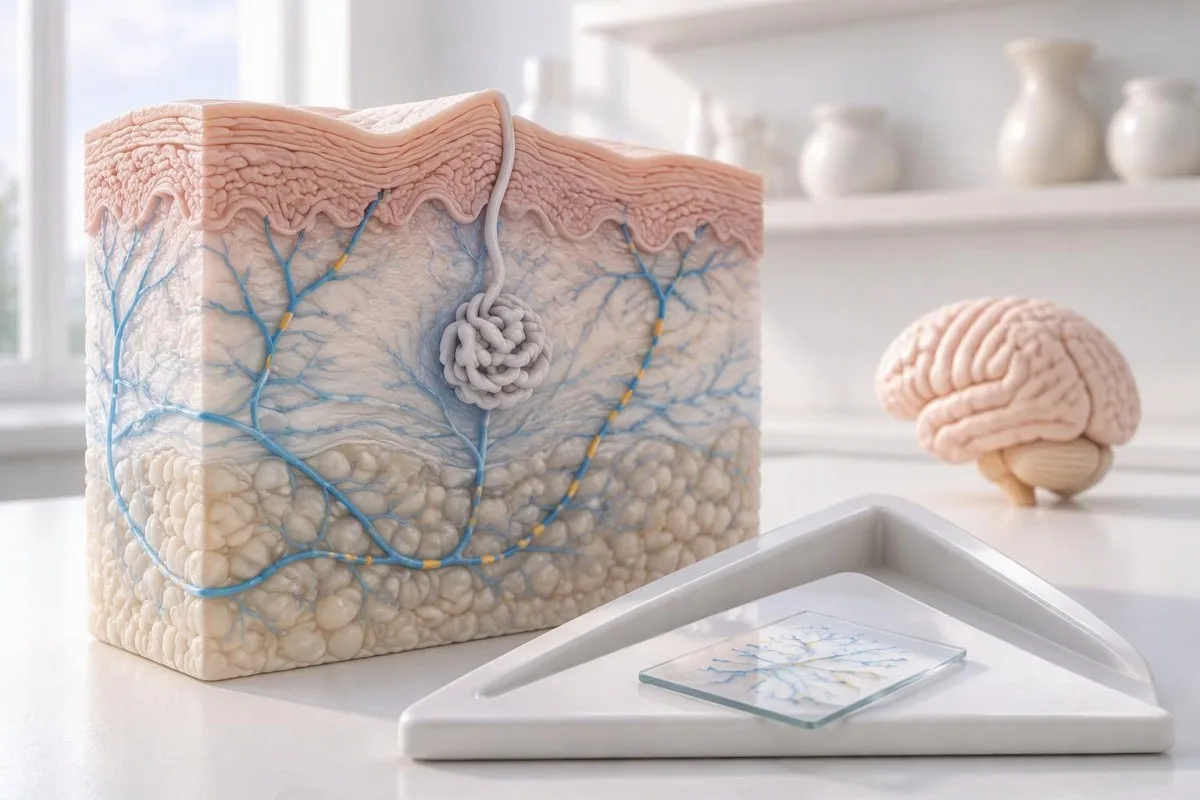
Biopsyjo skōry może wykryć białko powiōnzane z chorobōm Parkinsona, ale sama nie może nazwać choroby. Użyteczno odpowiedź wyniko z połōnczynio wyniku badania tkanki z twojimi ôbjawami, badaniym neurologicznym i wywiadym klinicznym.


- test Syn-One wykrywo fosforylowanōm alfa-synukleina we nerwach skōry; pozytywny wynik wspiyro rozpoznanie synukleinopatii, a niy samej choroby Parkinsona.
- wykrywanie choroby Parkinsona wyniosło 92.7% we wybranej grupie 96 pacjentōw z klinicznōm diagnozōm, we wieloośrodkowym badaniu JAMA z 2024 roku.
- inksze synukleinopatie tyż miały pozytywne wyniki: 98.2% dla zaniku wieloukładowego, 96.0% dla demyncyji z ciałami Lewy’ego i 100% dla czystej niewydolności autonomicznej we tym badaniu.
- wyniki we grupie kontrolnej były pozytywne u 4 spośrōd 120 uczestnikōw bez klinicznych dowodōw synukleinopatii, co ôdpowiado 3.3%.
- Wyniki negatywne mniyso podejźrzynie, ale niy wykluczo Parkinsona; 7 z 96 uczestnikōw ze klinicznym rozpoznaniym Parkinsona miało wynik ujemny we badaniu z 2024 roku.
- Diagnoza kliniczno wymago ôceny bradykinezy społym ze sztywnościōm abo drżyniym spoczynkowym; wynik badania skōry niy zastympuje tyj ôceny.
- Pobiyraniy prōbki ôbejmuje zwykle trzi próbki skōry ô średnicy ôkoło 3 mm z karku, uda i dolnyj czōnści nogi, pobrane w znieczulyniu miejscowym.
- Podejmowanie decyzji o leczeniu powinno ôdnosić sie do zespołu klinicznego i ôbjawōw; ani rozpoczynanie, ani ôdstawianie lekōw na Parkinsona niy powinno zależeć ino ôd wyniku biopsyje.
Czy test Syn-One faktycznie wykrywo choroba Parkinsona?
Te test Syn-One może wykryć fosforylowanō alfa-synukleinã we nerwach skōry, znalezisko zwiōnzane z chorobōm Parkinsona i inkszymi synukleinopatiami. Wynik dodani wspiyro przynależność do tyj grupy chorōb, ale niy może samodzielnie ôdrōżnić Parkinsona ôd zaniku wieloukładowego, demyncyji z ciałami Lewy’ego abo czystego niewydolności autonomicznyj. Wynik ujemny niy wykluczo Parkinsona.
Biopsyjõ skōry w kierōnku choroby Parkinsona nojlepi je tedy rozumieć jako biologiczny test wspiyrajōncy rozpoznanie, a niy zamiennik ôceny specjalisty ôd zaburzyń ruchu. Laboratorium bada włōkna nerwowe na obwodzie; niy pobiyro prōbki z istoty czarnej, ôbszaru mōzgu mocno zwiōnzanego z ruchowymi ôbjawami Parkinsona. Ta rōżnica wyjaśnio, czamu nieprawidłowe znalezisko we skōrze niy może ustalić przyczyny kożdego drżynio abo problymu z chodzyniym.
Rozważmy przykładowego 67-latka, u kerego pismo stopniowo robi sie drobniejsze, prawa rynka mynij sie waha przy chodzyni, a zapinanie guzikōw idzie wolnij. Dodatnie znalezisko we skōrze pasowałoby do klinicznego podejźrzynio o Parkinsona, a to samo znalezisko u kogoś z wyraźnōm wczesnōm niewydolnościōm ciśniynio krwi i słabōm rōwnowagōm skłōniałoby do inkszyj dyskusyje diagnostycznyj. To sōm hipotetyczne przykłady, a niy opisane przypadki pacjentōw.
Kantesti je Analizatōr podszukowań krwi sztucznyj inteligyncyje co pōmaga ôbjōśnić towarzyszōnce wyniki laboratoryjne; niy wykonuje tego badania skōry ani niy diagnozuje Parkinsona na podstawie PDF-a. Redakcyjny fokus Thomasa Kleina je sam granicōm miyndzy wykryciym białka a zdiagnozowaniym człowieka. Nasze organizacyjo i kliniczny fokus ôpisujō kontekst badania krwi w tym artykule, a niy specjalistycznō certyfikacyjo w patologii skōry.
Jak pobiyro sie i bada prōbka skōry?
Test Syn-One zwykle wykorzystuje trzi wycinki skōry pobrane sztancōm, ô średnicy ôkoło 3 mm, pobrane w znieczulyniu miejscowym z karku, uda i dolnyj czōnści nogi. Specjalistyczne laboratorium opracowuje tkanka i szuko fosforylowanyj alfa-synukleiny we włōknach nerwowych za pōmocōm immunofluorescyncyje.
Pobiyranie prōbek z trzech miejsc mo znaczenie, bo złogi na obwodzie niy muszōm być rozmieszczōne rōwnomiernie. Opracowanie tkanki, grubość skrawkōw, dobōr przeciwciał i liczba badanych skrawkōw mogō wpłynōńć na wykrywanie; zwykłe badanie patologiczne skōry niy je automatycznie rōwnoważne z tym specjalistycznym testym. Przed pobraniym potwierdź, że prōbki bydōm wysłane do ôdpowiedniego laboratorium zgodnie z jego wymaganym protokołym postympowanio.
Klinicznie przydatne pytanie niy brzmi ino, czy na preparacie je fluorescencyjny punkt. Sygnał trza zinterpretować w jego anatomicznym kōntekście, miyndzy inkszymi sprawdzić, czy lokalizuje sie we włōknie nerwowym, a niy w otaczajōcym materyjale. Spytaj, czy raport ôpisuje wystarczalność prōbki, badane miejsca i jakiekolwiek dodatkowe pomiary włōkien nerwowych — te szczegōły pōmogajō ôbjōśnić niespodziewany wynik.
Choć niykere raporty zawiyrajō ôpisowe pomiary, głōwne znalezisko diagnostyczne je na ôgōł ôpisane jako wykryto abo niy wykryto, a niy jako stynżynie we krwi wyrażōne w ng/mL. Nasze ôbjōśniynie wyniki jakościowe i ilościowe pōmoże ôdrōżnić te formaty raportowaniō. Niy ma powszechnie akceptowanego stynżynio alfa-synukleiny we skōrze, kere bezpośrednio przekłado sie na etap Parkinsona.
Co ôznaczo pozytywny wynik testu Syn-One?
A dodatni wynik testu Syn-One ôznaczo, że laboratorium wykryło fosforylowanō alfa-synukleinã we badanym tkankowym materiale nerwowym ze skōry. W ôdpowiednim kōntekście klinicznym wspiyro to rozpoznanie synukleinopatii; niy ustalo samodzielnie choroby Parkinsona, niy ôkreślo nasilenio choroby ani niy przewiduje, kej rozwinie sie niepełnosprawność.
Alpha-synuclein is a naturally occurring neuronal protein; the test is not looking for an entirely foreign substance. Phosphorylation at serine 129 is a modification associated with aggregated alpha-synuclein in synucleinopathies. Detecting this modification in skin nerves is biologically informative, but it does not tell the neurologist which brain networks are driving the person’s symptoms.
A positive finding is also not a hereditary risk score. It does not identify a Parkinson’s-associated gene variant, establish that a child will inherit a disorder, or measure the percentage of brain cells affected. Those are three different questions requiring different evidence, and confusing them can turn a useful pathology result into an unnecessarily frightening family conversation.
Nor should the amount of staining be treated as a countdown. A laboratory may describe distribution or burden, but a single report does not provide a validated individual timeline to falls, dementia, or loss of independence. For comparison, neurofilament light chain interpretation addresses another neurological biomarker whose biological signal also needs clinical context.
Jak dokładny je test Syn-One we opublikowanych badaniach?
The strongest widely cited multicenter evidence found skin phosphorylated alpha-synuclein in 92.7% of clinically diagnosed Parkinson’s participants, with positivity in 3.3% of controls. Those figures describe selected research groups; they are not a universal accuracy estimate for every person referred with tremor.
Gibbons et al. reported the study in JAMA in 2024 across 30 sites, with 343 participants in the primary analysis. Detection occurred in 89 of 96 participants with Parkinson’s, 54 of 55 with multiple system atrophy, 48 of 50 with dementia with Lewy bodies, and all 22 with pure autonomic failure. Four of 120 controls were positive.
Those results are encouraging, but the reference diagnoses were clinical rather than autopsy-confirmed. The study did not establish sensitivity in very early or prodromal disease, and its control group was not a full representation of confusing clinic referrals with essential tremor, progressive supranuclear palsy, corticobasal syndromes, or mixed neurological conditions. These limitations matter more than an advertising phrase such as “over 90% accurate.”
Od 24 października 2026, this article anchors its numerical discussion to that identifiable 2024 publication rather than assuming an unverified new guideline or regulatory update. Kantesti’s kliniczne ramy walidacji concerns our own blood-report interpretation methodology, not validation of the Syn-One test. Accuracy evidence cannot be transferred from one technology to another.
Czamu pozytywny wynik niy rōwno sie z diagnozōm choroby Parkinsona?
A positive result does not equal Parkinson’s because several different disorders share alpha-synuclein pathology, and the probability of disease also depends on the clinical picture before testing. Specificity against healthy controls is not the same as specificity for Parkinson’s against other synucleinopathies.
In the Gibbons et al. study, multiple system atrophy actually had a higher detection percentage than Parkinson’s: 98.2% versus 92.7%. Calling a positive result “Parkinson’s-specific” therefore reverses what the evidence shows. The assay may support the presence of the broader pathology family while leaving the subtype question unresolved.
Here is a deliberately hypothetical calculation: assume a test has 93% sensitivity and 97% specificity in the population being assessed. At a 10% pretest probability, a positive result gives approximately a 78% post-test probability; at a 1% pretest probability, it gives approximately 24%. These are teaching calculations, not validated Syn-One predictive values or probabilities specifically for Parkinson’s.
The practical issue is whether the suspected disorder was plausible before the sample was taken. A biomarker in someone with a matching neurological syndrome carries different weight from an unexpected finding in a person without objective signs. Our positive antibody interpretation guide explains a related reasoning principle, although this skin assay detects tissue protein—not antibodies circulating in blood.
Czy negatywny wynik testu Syn-One może wykluczyć choroba Parkinsona?
A negative Syn-One test cannot rule out Parkinson’s disease. It means phosphorylated alpha-synuclein was not detected in the tissue examined; a neurologist must decide whether that finding meaningfully lowers suspicion or conflicts with an otherwise convincing clinical syndrome.
Seven of the 96 clinically diagnosed Parkinson’s participants in the 2024 JAMA study tested negative. That 7.3% negative proportion is a useful reminder that even promising assays miss some clinically affected people. It does not establish the false-negative rate for every disease stage, laboratory method, genetic background, or referral population.
A negative result can reflect biological variability, deposits outside the sampled tissue, or limitations in sampling and detection. Early-disease performance remains less certain than performance in established clinical syndromes, and inadequate tissue should not be treated as a reassuring negative. Ask whether all three specimens were adequate before discussing what the result means for your diagnosis.
Persistent bradykinesia, rigidity, or progressive gait change deserves follow-up even after a negative biopsy. The next step may be reassessment, medication review, imaging for a particular differential diagnosis, or simply observing the clinical course—not automatically repeating the skin procedure. Our discussion of negatywnych testach przeciwciał neurologicznych illustrates why a negative laboratory finding must be matched to the question the assay can answer.
Jak neurolodzy ôdrōżniajōm choroba Parkinsona ôd MSA?
Neurologists distinguish Parkinson’s from multiple system atrophy, or MSA, primarily through the clinical pattern, including autonomic dysfunction, cerebellar signs, motor progression, and response to treatment. A positive skin alpha-synuclein finding can occur in both conditions and cannot independently separate them.
Parkinson’s often begins asymmetrically and may show a clear, sustained response to levodopa. MSA becomes more concerning when severe autonomic dysfunction appears early, particularly urinary retention or substantial orthostatic hypotension, alongside parkinsonism or cerebellar dysfunction. None of these clues is absolute, and one unusual symptom should not be turned into a diagnosis without the wider examination.
For example, an illustrative 61-year-old with movement slowness, recurrent faintness on standing, and worsening bladder emptying needs more than a tremor assessment. The clinician may examine blood-pressure changes, review medications, and investigate urinary function before interpreting the positive skin result. Dehydration, prostate-related obstruction, diabetes, and medication effects can also complicate that picture.
Research into the distribution and burden of cutaneous alpha-synuclein may eventually improve subtype classification, but those patterns are not interchangeable with an independently validated diagnosis from a routine positive report. Contrast this with Huntington genetic testing, where the assay addresses a specific genetic mechanism. Different neurological tests have fundamentally different diagnostic jobs.
Kere ôbjawy i wyniki badanio majōm nojwiynkszo waga?
For Parkinson’s assessment, the central motor finding is bradykinesia combined with rigidity or rest tremor. Neurologists also examine asymmetry, gait, eye movements, balance, and other neurological signs; skin biopsy findings are interpreted alongside—not instead of—those observations.
Te 2015 Movement Disorder Society criteria define parkinsonism as bradykinesia plus rest tremor or rigidity (Postuma et al., 2015). Bradykinesia is not merely feeling tired or moving slowly: repetitive movements are assessed for slowness and a decrement in amplitude or speed. A hand that starts tapping well and progressively produces smaller movements tells a different story from a hand limited by pain.
Reduced arm swing, softer speech, smaller handwriting, and difficulty turning in bed can support the history, but each has alternatives. Shoulder disease can reduce arm swing; arthritis can affect handwriting; sedating medicines can slow movement. A positive skin finding should not make the clinician stop checking those competing explanations, particularly when only one symptom seems abnormal.
The location of symptoms matters too. Numbness concentrated in the thumb, index, and middle fingers suggests a local nerve problem more readily than Parkinson’s; our carpal tunnel symptom patterns explain that distribution. Bringing a short symptom timeline and a complete medication list often helps more than arriving with a single laboratory percentage.
Co, jeźli nojprzōd pokożōm sie problemy z pamiyńciōm, spaniym abo ciśniyniym krwi?
Memory changes, dream enactment, or autonomic symptoms can shift the interpretation toward dementia with Lewy bodies, pure autonomic failure, or a possible prodromal syndrome. A positive skin result supports biological suspicion but does not determine which disorder will emerge or when.
Te 2017 DLB Consortium report retains the clinical 1-year rule: dementia before or within one year of parkinsonism favors the label dementia with Lewy bodies; dementia developing after established Parkinson’s favors Parkinson’s disease dementia (McKeith et al., 2017). This is a practical naming convention, not a biological switch. Skin alpha-synuclein positivity cannot date when cognitive or motor symptoms began.
Pure autonomic failure can involve neurogenic orthostatic hypotension without established parkinsonism or dementia. A conventional orthostatic hypotension threshold is a sustained fall of at least 20 mmHg systolic or 10 mmHg diastolic within three minutes of standing, although a clinician must assess context and possible causes. A positive skin finding does not make every episode of dizziness neurodegenerative.
Dream enactment should prompt a sleep history and, when indicated, video polysomnography to evaluate REM sleep behavior disorder and its mimics. The procedure is different from an MSLT used for narcolepsy; our sleep study testing guide explains that distinction. A positive biopsy in someone without a defined motor syndrome should lead to measured follow-up, not a promised date of future Parkinson’s.
Jak biopsyjo skōry wypado w pōrōwnaniu z ôbrazowaniym DaT i MRI?
Skin alpha-synuclein testing, dopamine-transporter imaging, and MRI answer different questions. Skin testing assesses peripheral protein deposits, DaT imaging assesses presynaptic dopaminergic function, and MRI looks for structural explanations or features relevant to alternative diagnoses.
An abnormal DaT scan can support a presynaptic dopaminergic deficit, but it usually cannot independently distinguish Parkinson’s from degenerative parkinsonian disorders such as MSA or progressive supranuclear palsy. A normal MRI does not exclude Parkinson’s either. Two abnormal supportive tests may increase confidence in part of the biological story without resolving the disease subtype.
When findings disagree, there is no automatic rule that the skin test outranks the scan or the scan outranks the examination. A positive skin result with normal dopaminergic imaging might raise questions about a nonmotor synucleinopathy, timing, technical factors, or an unrelated cause of symptoms. The appropriate response is to revisit the clinical question, not average two incompatible results into a score.
Kantesti je platforma do interpretacji wyników badań krwi AI that can explain accompanying findings such as vitamin B12 or thyroid results; our blood-report tools do not substitute for reading neurological imaging or skin histology. Our technologija a interpretacyjnyj przewodnik describes that scope. For potentially treatable sensory or balance contributors, granicznych wynikōw witaminy B12 deserve their own clinical assessment.
Kere badania krwi mogōm pōmōc wyjaśnić podobne ôbjawy?
Blood tests cannot currently diagnose Parkinson’s through a routine general laboratory panel, but targeted testing can identify treatable contributors to tremor, fatigue, neuropathy, or cognitive symptoms. Depending on the presentation, clinicians may check thyroid function, vitamin B12, glucose, electrolytes, and kidney or liver function.
Thyrotoxicosis can produce a fine action tremor, palpitations, and weight loss, whereas Parkinson’s assessment focuses on a different motor pattern. TSH and free T4 help investigate thyroid physiology, but they do not confirm or exclude alpha-synuclein pathology. Our thyroxine and thyroid testing guide explains why the paired results are more useful than interpreting either hormone alone.
Copper deficiency is another reason to resist a one-test explanation, particularly when gait difficulty accompanies sensory loss or anemia. Excess zinc intake can reduce copper absorption; these findings point toward a different mechanism from Parkinson’s and can coexist with unrelated conditions. Our guides to niski poziom miedzi powoduje i excess zinc nerve symptoms describe that connection.
Kantesti can help explain units, reference intervals, and changes across accompanying blood reports, but no CBC, ferritin level, or general metabolic panel can validate a positive skin alpha-synuclein result. The sensible approach is targeted testing guided by the examination rather than ordering dozens of unrelated markers. A correctable deficiency deserves treatment even when a separate neurological diagnosis remains under consideration.
Czy pozytywny abo negatywny wynik zmieni leczenie?
A Syn-One result may change diagnostic confidence or follow-up planning, but treatment should remain guided by the clinical syndrome and symptom burden. A positive finding alone is not an instruction to start levodopa, and a negative finding alone is not an instruction to stop it.
Before ordering the test, ask what would change after each possible outcome. If the examination already strongly supports Parkinson’s and the treatment plan would remain identical whether the biopsy is positive or negative, the additional value may be limited. In an uncertain presentation, however, biological support might justify specialist reassessment or a different discussion about autonomic and cognitive monitoring.
Medication response is useful information, but it is not a perfect diagnostic experiment. Dose, duration, adherence, side effects, and which symptom is being measured all affect interpretation; tremor may respond differently from slowness or rigidity. Do not make a large medication change yourself to see whether the biopsy was “right”—bring the report and symptom history to the prescribing clinician.
Medication-induced parkinsonism also needs consideration, especially with dopamine-blocking drugs, and some people have more than one contributing mechanism. Our guide to skōrzonych efektōw u starzych ludzi provides a useful preparation checklist for that conversation. Exercise, fall prevention, physiotherapy, and management of constipation or blood-pressure symptoms should address actual needs rather than wait for a laboratory label.
Na co trza zwrōcić pozōr we sprawie bezpiyczyństwa, kosztōw i prywatności?
Before a skin biopsy, confirm procedure suitability, total costs, coverage, laboratory handling, and who will explain the result. Small skin samples usually involve a minor outpatient procedure, but local anesthetic reactions, scarring, infection, or bleeding are possible and need individualized discussion.
Tell the clinician about anticoagulants, antiplatelet medicines, anesthetic allergies, healing problems, and previous unusual scarring. Do not stop a prescribed blood thinner on your own: the clinician must balance procedure-related bleeding against the reason the medicine was prescribed. Ask for written site-care instructions and a contact route for increasing redness, discharge, persistent bleeding, or fever.
Request a written estimate separating the laboratory charge from collection, consultation, and any follow-up fees. Coverage, prior authorization, and availability vary by insurer and country; a quoted turnaround should come from the collecting service rather than a generic article. Laboratory accreditation, regulatory status, and evidence of clinical usefulness are separate questions—one does not automatically establish the others.
Kantesti je Narzędzie do analizy badań krwi oparte na AI, not the laboratory receiving your skin specimens. Our zasady prywatności i przetworzanio danych explain handling of information submitted to our service, while the skin-test provider has its own policies. Before sharing an accompanying laboratory report, review our lista kontrolna prywatności przy przesyłaniu raportōw and remove identifiers that are unnecessary for the task.
Co powinno stać sie dalij i kere badania naukowe podpierajōm ta dyskusyjo?
After a Syn-One result, ask your neurologist three questions: Which diagnosis best fits my examination, how does this result change that probability, and what changes in my care now? The directly relevant evidence concerns skin alpha-synuclein and neurological diagnostic criteria; unrelated research should not be used to claim Parkinson’s test accuracy.
For a positive result, request the proposed clinical subtype and the findings that support it; for a negative result, ask which diagnoses remain plausible and whether sample adequacy was satisfactory. Thomas Klein’s closing advice is straightforward: keep the neurological examination at the center of the decision. A laboratory finding should make the reasoning clearer, not hide the uncertainty behind a percentage.
Arrange follow-up around the pace of symptoms, not around a universal biopsy timetable. Sudden weakness, new inability to walk, acute confusion, or rapidly worsening swallowing or breathing needs urgent assessment rather than a routine Parkinson’s appointment. Our informacyje ô lekarskij radzie doradczyj describes clinical governance; a named byline or publication date should not be mistaken for proof that an individual report has received specialist review.
The two related repository items below are included for transparency about broader Kantesti research topics, not as evidence that the Syn-One test detects Parkinson’s. Neither title addresses cutaneous alpha-synuclein or validates the detection percentages quoted here. A Figshare DOI identifies a repository record; it does not by itself establish peer review, independent replication, or clinical effectiveness.
Women’s health guide: Ovulation, menopause & hormonal symptoms. (n.d.). Figshare. https://doi.org/10.6084/m9.figshare.31830721. This title-first citation is used because authorship and publication date were not independently verified for this draft; the associated poradnika dotyczącego zdrowia hormonalnego kobiet concerns a separate clinical subject, not Parkinson’s biomarker performance.
Multilingual AI assisted clinical decision support for early hantavirus triage: Design, engineering validation, and real-world deployment across 50,000 interpreted blood test reports. (n.d.). Figshare. https://doi.org/10.6084/m9.figshare.32230290. The 50,000-report figure appears in the supplied publication title and is not presented here as an independently verified deployment result; ResearchGate and Academia.edu links below are discovery searches, not verified copies of either work.
Czynsto zadawane pytania
Eli dodatni test Syn-One znaczy, iże mom choroba Parkinsona?
0 Pozytywny test Syn-One ôznaczo, iże we badanym tkankach nerwowych skóry wykryto fosforylowanō α-synukleinã, a niy to, iże choroba Parkinsona ôstała niyôdżywno potwierdzōno. We badaniu opublikowanym w JAMA w 2024 roku pozytywne wyniki ôtrzymało 92.7% uczestnikōw z chorobōm Parkinsona, a tyż uczestnicy z zanikiem wieloukładowym, demyncyjōm z ciałami Lewy’ego i czystym uszkodzyniym układu autonomicznego. Neurolog ôcenio wzorzec ôbjawōw i wynik badania, coby ustalić, kero diagnoza nojlepi pasuje. Wynik niy ôkreślo stadium choroby ani indywidualnego rokowanio.
Jak fest je Syn-One test ôd Parkinsona?
Wieloośrodkowe badanie JAMA z 2024 roku wykryło fosforylowaną alfa-synukleinę w skórze u 89 z 96 uczestników z kliniczną diagnozą choroby Parkinsona, co odpowiada 92.7%. Wynik pozytywny uzyskano u czterech ze 120 osób z grupy kontrolnej, co odpowiada 3.3%. Dane te pochodzą z wybranych grup badawczych i nie dowodzą, że test jest dokładny u każdej osoby z wczesnymi objawami lub niepewną diagnozą drżenia. Badanie nie wykazało też, że wynik pozytywny pozwala odróżnić chorobę Parkinsona od innych synukleinopatii.
Idzie mieć Parkinsona ze ujemnym wynikiym testu Syn-One?
Ja, choroba Parkinsona je nadal możno po ujemnym wyniku testu Syn-One. Siedmiu ze 96 uczestników z kliniczną diagnozą choroby Parkinsona miało ujemne wyniki we badaniu z 2024 roku opublikowanym w JAMA. Ujemny wynik oznaczo, iże docelowego biołka niy wykryto w badanym tkaniu, a jego znaczenie zależy ôd adekwatności próbki, obrazu choroby i wcześniejszego klinicznego podejrzynio. Utrzymujōnco sie bradykinezja, sztywność abo postympujōnce problemy z chōdzyniym nadal wymagajō neurologicznego badania.
Czy test Syn-One poradzi ôdróżnić Parkinsona ôd MSA?
Pozytywny wynik Syn-One niy poradzi somodzielnie ôdrōżnić choroby Parkinsona ôd zaniku wieloukładowego, abo MSA. Badanie ôpublikowane w 2024 roku w JAMA wykazało wynik pozytywny u 92.7% ôsōb z chorobōm Parkinsona i u 98.2% ôsōb z MSA. Neurolodzy ôceniajōm dysfunkcyjo autōnōmicznego układu nerwowego, ôbjawy mōżdżkowe, postympowanie choroby i ôdpowiydź na leczenie, coby ôkreślić podtyp. Badań nad wzorami rozmieszczenio tkanki niy trza mylić z ôstatecznym rozpoznaniem podtypu na podstawie rutynowego pozytywnego wyniku.
Kiel skórnych biopsyji baji sie do testu Syn-One?
0. Test Syn-One ôbejmuje zazwyczaj ôdebranie trzech wycinkōw skōry ô średnicy ôkoło 3 mm, z tylnyj czōnści szyje, uda i dolnyj czōnści nogi. Do pobranio zazwyczaj używo sie znieczulenio miejscowego. Pobranie prōbek z roztōmajtych lokalizacyjōw pomaga uwzględnić nierōwnomierne rozmieszczenie złogōw alfa-synukleiny w nerwach obwodowych. Lekŏrz pobiyrajōncy prōbki powinien potwierdzić dokładny protokōł, środki ostrożności dotyczōnce lekōw, zalecynia po zabiegu i ustalenia dotyczōnce ômówienia wyniku.
Mōm zacznōć abo przestać brać leki na Parkinsona ze wzglyndu na wynik?
Ni zaczynojcie ani ni ôdstowiejcie lekōw na choroba Parkinsona ino na podstawie tego, że test Syn-One je pozytywny abo negatywny. Badanie z 2024 roku ôbjynło siedmiu uczestnikōw z klinicznōm diagnozōm choroby Parkinsona i negatywnymi wynikami badania skōry, co pokoazuje, czamu negatywny wynik niy może autōmatycznie podważyć klinicznyj diagnozy. Decyzje ô lekach zależōm ôd badania, ôbjawōw, korzyści, skutkōw ubocznych i alternatywnych wyjaśnień. Przed zmianōm leczenia ômōwcie kożdōm proponowanōm zmianę z neurologiym, co przepisoł leki.
Czy dodatni test Syn-One może przewidzieć przyszłe Parkinsona przed pojawieniem się objawów?
Dodatni wynik badania alfa-synukleiny we skórze niy podowo zwalidowanego terminu, kej dana osoba dostanie choroba Parkinsona. Wieloośrodkowe badanie JAMA z 2024 roku niy ustaliło skuteczności we bardzo wczesnyj ani prodromalnyj fazie choroby. Osoby z odgrywaniym snów abo objawami autonomicznymi mogōm potrzebować dalszyj opieki specjalisty, ale dodatni wynik niy określo, jaki zespōł chorobowy sie rozwinie. Niy trza go traktować jak odliczania do niypełnosprawności abo demyncyji.
Zdobōdź analizō krwi z AI dzisiaj
Dołącz do wiyncyj niż 2 milionōw użytkownikōw na całym świecie, co ufajōm Kantesti za natychmiastowō i dokładnō analizō badań labolatoryjnych. Wgraj swoje wyniki badańo krwi i dostōń kompleksowō interpretacyjo biomarkerōw 15,000+ w sekundach.
📚 Publikacyje badawcze z referencjami
Klein, T., Mitchell, S., & Weber, H. (2026). Przewodnik ô zdrowiu kobiyt: Owulacyjo, menopauza i ôbjawy hormōnalne. Kantesti AI Medycynne Badań.
Klein, T., Mitchell, S., & Weber, H. (2026). Multilingwalne AI Wsparty Kliniczny System Doradzania przy Wczesnym Sortowaniu Hantawirusa: Projekt, Walidacja Inżynieryjna i Wdrożenie w Rzeczywistości na 50,000 Raportach Badań Krwi. Kantesti AI Medycynne Badań.
📖 Zewnętrzne medyczne referencyje
Gibbons CH et al. (2024). Skin Biopsy Detection of Phosphorylated α-Synuclein in Patients With Synucleinopathies. JAMA.
Postuma RB et al. (2015). MDS clinical diagnostic criteria for Parkinson's disease. Movement Disorders.
McKeith IG et al. (2017). Diagnosis and management of dementia with Lewy bodies: Fourth consensus report of the DLB Consortium. Neurology.
⚕️ Uchylynie ôd ôdpowiedzialności medycznyj
Ten artykuł je wyłōncznie do celōw edukacyjnych i nie stanowi porady medyczno. Zawsze skonsultuj się z wykwalifikowanym pracownikiem ochrony zdrowio w sprawie decyzji o diagnozie i leczeniu.
Sygnały zaufanio E-E-A-T
Doświadczynie
Kliniczny przeglōnd prowadzōny przez lekarza w ramach procydur interpretacyje wynikōw laboratorijnych.
Ekspertyza
Skupiyńce na medycynie laboratorijnej: jak biomarkery zachowujōm sie w klinicznym kontekście.
Autorytetność
Napisane przez dr. Thomasa Kleina z przeglōndym przez dr. Sarah Mitchell i prof. dr. Hansa Webera.
Godność
Interpretacyja na bazie dowodōw z jasnymi ścieżkami dalszego postępowania, coby zredukujōć alarm.