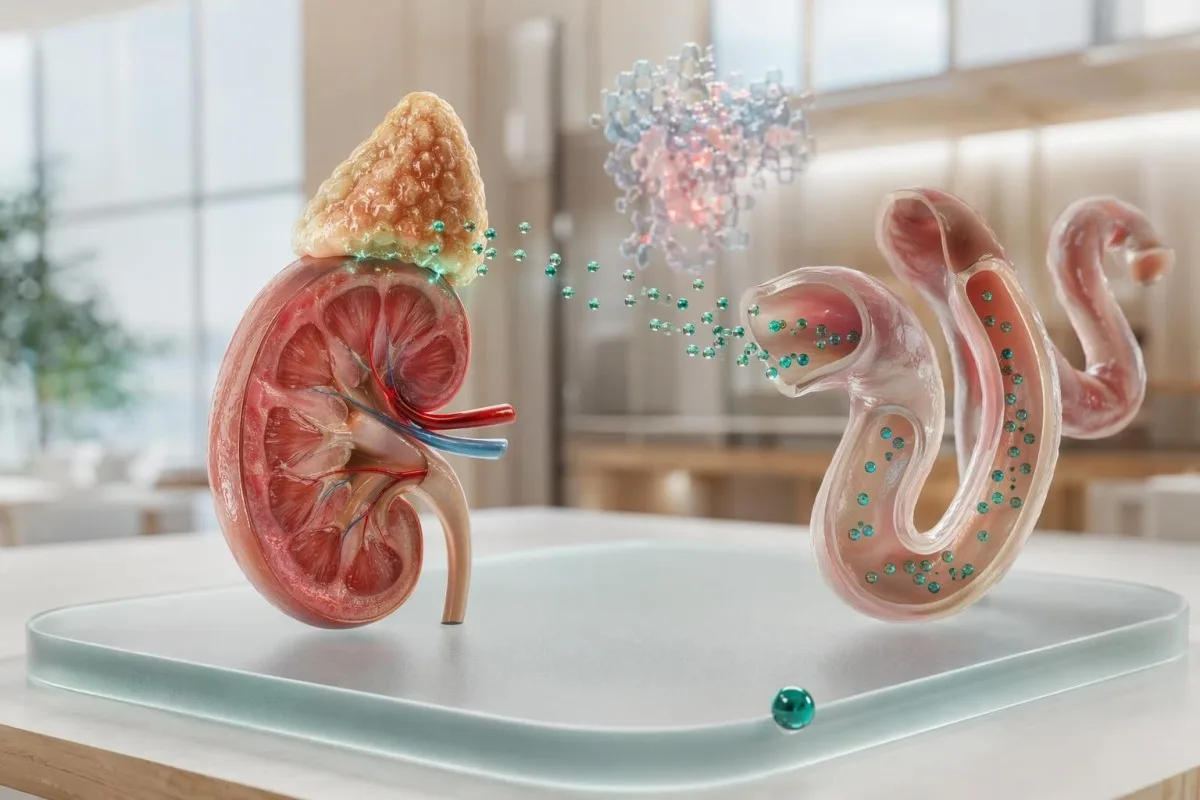
Een hoog-aldosteronresultaat is het meest van belang wanneer renine is onderdrukt, de bloeddruk moeilijk te controleren is, of het kalium laag is. Alleen het getal diagnosticeert zelden de oorzaak.


- Aldosterontest wijst op primair hyperaldosteronisme wanneer aldosteron ongepast hoog is, renine laag is en er hypertensie of een laag kalium aanwezig is.
- Reninetest helpen primair hyperaldosteronisme te onderscheiden van uitdroging, vernauwing van de nierslagader, effecten van diuretica en hart- of nierziekte.
- Aldosteron-renine-ratio wordt vaak als positief beschouwd wanneer ARR boven 20-30 ng/dL per ng/mL/u ligt met aldosteron van ten minste 10-15 ng/dL, maar de afkapwaarde verandert per lab-eenheid.
- Primaire aldosteronisme wordt gevonden in ongeveer 5-10% van alle hypertensie en tot ongeveer 20% van resistente hypertensie in specialistische studies.
- Potassium is meestal 3,5-5,0 mmol/L bij volwassenen; waarden onder 3,5 mmol/L maken een overmaat aan aldosteron verdachter, vooral als er geen duidelijke medicatieoorzaak is.
- Medicatie-effecten zijn gebruikelijk: spironolacton, eplerenon, amiloride, diuretica, bètablokkers, ACE-remmers en ARB’s kunnen allemaal renine of aldosteron verstoren.
- Bevestigende testen kan onder meer bestaan uit een zoutinfusietest, orale natriumbelasting, captoprilprovocatietest of fludrocortison-suppressietest na een positief screeningsresultaat.
- Alvorens te herhalen een afwijkend resultaat, vraag naar zoutinname, correctie van kalium, houding, tijdstip van de dag, meeteenheden en of bloeddrukmedicatie veilig moet worden aangepast.
Wat een uitslag van een aldosterontest wel en niet kan diagnosticeren
Een aldosterontest suggereert primair hyperaldosteronisme wanneer aldosteron hoog is voor de situatie, renine onderdrukt is, en de patiënt hypertensie, een laag kaliumgehalte of beide heeft. Op zichzelf is aldosteron niet genoeg; een gestrest, uitgedroogd, zoutbeperkt of met diuretica behandeld lichaam kan aldosteron passend verhogen.
Met ingang van 8 juni 2026 behandelen de meeste poliklinieken voor endocriene hypertensie het aldosteronresultaat nog steeds als een contextmarker, niet als een ja-of-nee-diagnose. Een zittende ochtend-aldosteronwaarde van 18 ng/dL kan verdacht zijn als de plasmarenineactiviteit onder 1,0 ng/mL/u ligt, maar hetzelfde aldosteron kan fysiologisch zijn na zoutrestrictie of volumeverlies.
Ik ben Thomas Klein, MD, en wanneer ik dit patroon klinisch beoordeel, is de eerste vraag die ik stel saai maar doorslaggevend: wat waren de bloeddruk en het kalium in dezelfde week? Een kalium van 3,1 mmol/L met een bloeddruk van 158/96 mmHg vertelt een heel ander verhaal dan kalium 4,4 mmol/L en een normale thuismeting-log.
Kantesti is een AI-bloedtestanalysator waarbij aldosteron naast kalium, natrium, bicarbonaat, creatinine, de context van de bloeddruk en het tijdstip van medicatie wordt gelezen, in plaats van één hormoon als een op zichzelf staande vlag te behandelen. Dat is belangrijk omdat patiënten vaak geïsoleerde PDF-pagina’s uploaden; onze artsen zien veel gevallen waarin het antwoord verborgen zit in de omliggende biochemie, niet in de hormoonlijn zelf.
Als je naar een gemarkeerde waarde kijkt zonder notities, begin dan met het vertalen van het getal, de eenheid, de afnamelocatie en de bijbehorende testen voordat je aan bijnierziekte denkt. Onze gids voor bloedtestcijfers is een nuttige inleiding voor dat soort patroonlezen.
Wanneer hoog aldosteron wijst op primair hyperaldosteronisme
Hoog aldosteron wijst op primair hyperaldosteronisme wanneer het verhoogd blijft ondanks een lage reninewaarde, vooral bij resistente hypertensie, spontaan laag kalium, of een toevallige bijnierbevinding. De klassieke screening is aldosteron, renine en de aldosteron-renine-ratio afgenomen onder gecontroleerde omstandigheden.
De richtlijn van de Endocrine Society uit 2016 beveelt screening aan bij mensen met resistente hypertensie, hypertensie plus een laag kaliumgehalte, hypertensie met een bijnierincidentaloom, slaapapneu met hypertensie, of een familiegeschiedenis van vroege hypertensie of beroerte vóór het 40e levensjaar (Funder et al., 2016). In de spreekkamer voeg ik nog één praktische trigger toe: een patiënt die vóór de leeftijd van 50 drie medicijnen nodig heeft, verdient een zorgvuldige beoordeling.
Primair hyperaldosteronisme is niet zeldzaam. Brown en collega’s vonden biochemisch bewijs over het hele spectrum van hypertensie, met percentages die stegen van ongeveer 11% in stadium 1 hypertensie tot meer dan 20% bij resistente hypertensie in een studie uit 2020 in Annals of Internal Medicine (Brown et al., 2020).
De bloeddrukhint is vaak subtiel. Veel patiënten zitten jarenlang rond 142-152 systolisch, voelen zich goed en krijgen te horen dat ze gewone essentiële hypertensie hebben, totdat het kalium daalt na een thiazide of de ARR eindelijk wordt gecontroleerd.
Gebruik thuismetingen als de waarden in de kliniek schommelen. Voor achtergrond over drukcategorieën en waarom herhaalde metingen ertoe doen, zie onze gids voor bloeddrukbereiken.
Waarom de reninetest de betekenis van aldosteron verandert
A reninetest vertelt je of aldosteron wordt aangestuurd door het nier-reninesysteem of te onafhankelijk wordt geproduceerd. Lage renine met hoge aldosteron is het biochemische kenmerk dat primaire aldosteronisme aannemelijk maakt.
Renine is het upstream-signaal. Wanneer het bloedvolume laag is of de nierdoorbloeding verminderd is, stijgt renine en volgt aldosteron; wanneer aldosteron autonoom is, wordt natrium vastgehouden, zet het volume uit en wordt renine meestal onder ongeveer 1,0 ng/mL/u onderdrukt door plasma-renineactiviteit.
Kantesti AI interpreteert aldosterontest patronen door lage-reninestaten te scheiden van hoge-reninestaten, omdat beide aldosteron boven de referentiewaarde van het lab kunnen laten zien. Een renineresultaat van 8 ng/mL/u met aldosteron 25 ng/dL suggereert vaak secundaire aldosteronactivatie, terwijl renine 0,2 ng/mL/u met hetzelfde aldosteron in een heel andere richting wijst.
Daarom zijn kalium, bicarbonaat en nierfunctie belangrijk. Overmaat aan aldosteron kan kalium verlagen en bicarbonaat verhogen, dus een basaal-chemiepatroon kan het hormoonresultaat stilletjes ondersteunen; onze elektrolytenpanel gids legt die verschuivingen in gewone taal uit.
Een renineresultaat kan worden gerapporteerd als plasma-renineactiviteit in ng/mL/u of directe renineconcentratie in mU/L of pg/mL. Die methoden zijn niet uitwisselbaar, en ik heb gezien dat heel verstandige patiënten na het wisselen van laboratoria de verkeerde referentiewaarden met elkaar vergeleken.
Hoe je de aldosteron-renine-ratio leest zonder valkuilen met eenheden
De aldosteron-renine-ratio is een screeningsratio, geen definitieve diagnose. Veel laboratoria beschouwen een ARR boven 20-30 ng/dL per ng/mL/u als positief wanneer aldosteron minstens 10-15 ng/dL is, maar afkapwaarden veranderen met de test en de eenheden.
Een veelvoorkomend patroon is een plasma-aldosteronconcentratie van 15 ng/dL of hoger met een plasma-renineactiviteit onder 1,0 ng/mL/u, wat een ARR boven 20-30 oplevert. In SI-eenheden is 10 ng/dL aldosteron ongeveer 277 pmol/L, en sommige laboratoria voor directe renine gebruiken afkapwaarden rond 70 pmol/mU, maar lokale validatie wint.
Het neurale netwerk van Kantesti controleert compatibiliteit van eenheden voordat het commentaar geeft op ARR, omdat een ng/dL-naar-pmol/L-verwarring een interpretatiefout van 27,7 keer kan veroorzaken. Als je rapport is veranderd van PRA naar directe renineconcentratie, vergelijk dan de ratio niet met je oude afkapwaarde.
Ook de noemer telt. Een heel hoge ratio die alleen wordt veroorzaakt door bijna niet-detecteerbare renine kan misleidend zijn als aldosteron laag is, zoals 4 ng/dL met renine 0,1 ng/mL/u. De meeste endocrinologische teams vereisen een minimale aldosteronconcentratie voordat de screening als positief wordt aangemerkt.
Als twee rapporten tegenstrijdig lijken, controleer dan de regel met eenheden voordat je je zorgen maakt over ziekteprogressie. Onze gids voor verschillende lab-eenheden laat zien waarom dezelfde fysiologie op papier kan lijken te veranderen.
Laag kalium als aanwijzing die het resultaat moeilijker te negeren maakt
Een laag kaliumgehalte versterkt het vermoeden van een overmaat aan aldosteron, omdat aldosteron de kaliumuitscheiding in de urine verhoogt. Het kaliumgehalte bij volwassenen is meestal ongeveer 3,5-5,0 mmol/L, en een uitslag onder 3,5 mmol/L verdient verklaring.
Het misverstand dat ik nog wekelijks hoor, is dat primair hyperaldosteronisme altijd een laag kaliumgehalte veroorzaakt. Dat is niet zo; veel bevestigde patiënten hebben een kaliumgehalte tussen 3,7 en 4,3 mmol/L, vooral in het begin van de ziekte of vóórdat diuretica worden toegevoegd.
Een kaliumgehalte van 3,0-3,4 mmol/L bij hypertensie is de zone waarin ik afrem en de medicatielijst zorgvuldig controleer. Een waarde onder 3,0 mmol/L, spierzwakte, hartkloppingen of ECG-afwijkingen kunnen urgent worden, ongeacht het aldosteronverhaal.
Een laag kaliumgehalte kan ook de aldosteronsecretie onderdrukken en een vals-negatieve screening veroorzaken. Dat merkwaardige detail is belangrijk: een patiënt kan primair hyperaldosteronisme hebben, maar als het kalium 2,9 mmol/L is op de dag van afname, kan aldosteron minder indrukwekkend lijken dan verwacht.
Als kalium de afwijkende waarde is die je hierheen bracht, lees dan onze diepere gids voor een laag kaliumresultaat voordat je zelf supplementen verhoogt.
Medicatie, zout en houding kunnen de uitslag omkeren
Bloeddrukmedicatie, zoutinname, kaliumstatus, houding en tijdstip van de dag kunnen allemaal aldosteron en renine veranderen. Daarom is een herhaling nodig aldosterontest soms keert het de eerste uitkomst om.
Spironolacton en eplerenon kunnen renine verhogen en ARR moeilijker te interpreteren maken, dus veel specialisten houden ze 4-6 weken aan als de bloeddruk en het kalium dat toelaten. Amiloride, triamtereen en lis- of thiazidediuretica hebben vaak ongeveer 2-4 weken nodig, maar deze middelen zonder toezicht stoppen kan onveilig zijn.
Bètablokkers en clonidine onderdrukken renine en kunnen vals-positieve ratio’s creëren. ACE-remmers en ARB’s verhogen vaak renine en kunnen vals-negatieve ratio’s creëren; calciumantagonisten en alfablokkers worden soms als tijdelijke vervanging gebruikt omdat ze ARR meestal minder verstoren.
Zoutbeperking is nog zo’n valkuil. Als een patiënt minder dan 1,5 g natrium per dag eet, kunnen renine en aldosteron samen stijgen, terwijl een normaal-zoutdieet het vaak makkelijker maakt om autonoom aldosteron te identificeren.
Wanneer medicatie voor de bloeddruk recent is gewijzigd, moet het kalium binnen een praktische termijn opnieuw worden gecontroleerd, vaak na 1-2 weken bij patiënten met een hoger risico. Onze gids voor wijzigingen in BP-medicatie legt de timing van kalium uit die bij die beslissing hoort.
Wat je moet vragen voordat je een afwijkende screenings test herhaalt
Voordat je een afwijkende aldosteron-reninescreening herhaalt, vraag je of het kalium is gecorrigeerd, of de zoutinname voldoende was, of de medicatie is nagekeken en of het monster in de vereiste houding van het laboratorium is afgenomen. Die vier details voorkomen veel valse alarmen.
Mijn praktische checklist is kort: kalium boven 3,5 mmol/L, geen ernstige zoutbeperking, ochtendafname en een gedocumenteerde rustperiode zittend of liggend. Sommige laboratoria vragen om patiënten minstens 2 uur rechtop te laten zijn en 5-15 minuten zittend vóór de afname; anderen gebruiken een liggend protocol.
Kantesti is een AI lab test interpretatieservice die gebruikers ertoe aanzet om medicatie- en afnamecontext in te voeren wanneer ARR ongebruikelijk lijkt. Die extra voorgeschiedenis kan de voorgestelde volgende vraag veranderen van “Heb ik een bijniertumor?” naar “Werd renine onderdrukt door de timing van bètablokkers?”
Vraag of hetzelfde laboratorium en dezelfde assay zullen worden gebruikt. Een herhaling in een ander laboratorium kan geldig zijn, maar moet worden geïnterpreteerd als een nieuwe test in plaats van een zuivere trendlijn als de methoden voor aldosteron of renine zijn veranderd.
Als je beslist of je nu moet herhalen of moet wachten, behandelt onze gids voor herhaal-afwijkende labs de bredere logica die ik gebruik voor grenswaarden.
Bevestigende tests na een positieve aldosteron-renine-ratio
Een positieve aldosteron-renine-ratio wordt meestal gevolgd door een bevestigingstest voor onderdrukking, tenzij het biochemische patroon heel sterk is. Het doel is aan te tonen dat aldosteron niet onderdrukt wanneer zout- of medicatiesignalen het zouden moeten onderdrukken.
De zoutinfusietest geeft doorgaans 2 liter 0,9% zoutoplossing gedurende 4 uur onder toezicht. In veel protocollen ondersteunt aldosteron boven 10 ng/dL daarna primaire hyperaldosteronisme, terwijl onder 5 ng/dL ertegen pleit; zittende protocollen kunnen andere drempels gebruiken.
Orale zoutbelasting controleert 24-uurs urine-aldosteron na hoge zoutinname, waarbij vaak urine-natrium boven 200 mEq/dag nodig is om te bewijzen dat de uitdaging voldoende was. Urine-aldosteron boven ongeveer 12 µg/24 uur wordt vaak als ondersteunend beschouwd, maar hartfalen, nierziekte en ernstige hypertensie kunnen deze test risicovol maken.
De captoprilchallenge gebruikt 25-50 mg captopril en meet of aldosteron binnen 1-2 uur op passende wijze daalt. Het is makkelijker uit te voeren dan onderdrukking met fludrocortison, maar bij grensgevallen ontstaat nog steeds onenigheid tussen clinici.
Nierfunctie en volumetolerantie bepalen welke bevestiging veilig is. Een patiënt met een verlaagde eGFR of vocht-overbelasting heeft een voorzichtiger plan nodig, en onze nierfunctiepaneel gids legt uit welke niermarkers als basis meestal eerst worden beoordeeld.
Wanneer scans en bemonstering van de bijnieraders (adrenal vein sampling) ter sprake komen
Beeldvorming wordt overwogen na biochemische bevestiging, niet ervoor. Een CT-scan kan de bijnieranatomie tonen, maar bemonstering van bijniervenen is vaak nodig om unilaterale aldosteronproductie te onderscheiden van bilaterale bijnieroveractiviteit.
Dit is zo’n plek waar patiënten begrijpelijkerwijs een whiplashgevoel krijgen. Een bijniernodus van 9 mm op CT kan irrelevant zijn, terwijl een bijnier die er normaal uitziet nog steeds aldosteron kan overproduceren; leeftijdsgebonden niet-functionerende noduli komen vaker voor na het 40e levensjaar.
Bijnierveneuze sampling meet aldosteron en cortisol uit beide bijniervenen en vergelijkt de kanten. Cortisol wordt gebruikt om de katheterpositie te bevestigen, dus een normale cortisoluitslag elders in je bloedonderzoek vervangt de procedure niet.
Operatie wordt meestal besproken wanneer eenzijdige aandoening is aangetoond en de patiënt een geschikte operatieve kandidaat is. Bilaterale aandoening wordt meestal medisch behandeld met mineralocorticoïdreceptorblokkers zoals spironolacton of eplerenon.
Voor lezers die bijnierhormonen vergelijken, onze cortisolpatronengids legt uit waarom verschillende bijnieronderzoeken heel verschillende vragen beantwoorden.
Wanneer hoog aldosteron geen primair hyperaldosteronisme is
Hoog aldosteron is geen primair hyperaldosteronisme wanneer renine ook hoog is of passend geactiveerd. Dit patroon wijst vaak op vernauwing van de nierslagader, het diuretische effect, dehydratie, hartfalen, vochtretentie in de lever of ernstige natriumbeperking.
Secundair hyperaldosteronisme is het lichaam dat probeert de circulatie te verdedigen. Een renine van 6 ng/mL/u met aldosteron 35 ng/dL is meestal niet dezelfde ziekte als renine 0,2 ng/mL/u met aldosteron 18 ng/dL.
Nierslagaderstenose kan renine uit de onderdoorbloede nier stimuleren, wat leidt tot hoog aldosteron en moeilijk te behandelen hypertensie. De aanwijzing kan een plots stijgende creatinine zijn na behandeling met een ACE-remmer of ARB, een abdominale bruit, of een asymmetrische niergrootte op beeldvorming.
Diuretica zijn de alledaagse nabootsers. Ik heb ARR-verwijzingen gezien waarbij het hele patroon werd verklaard door een 10 dagen eerder gestarte thiazide, met kalium 3,2 mmol/L en renine passend hoog.
Als creatinine, GFR, of urine-albumine ook veranderen, lees dan onze gids voor nierbloedtesten voordat je aanneemt dat de bijnier het enige probleem is.
Speciale situaties: zwangerschap, cycli, nierziekte en leeftijd
Zwangerschap, oestrogeentherapie, timing in de menstruatiecyclus, nierziekte en hogere leeftijd kunnen de interpretatie van renine of aldosteron veranderen. In deze situaties kan dezelfde numerieke ARR een andere mate van betrouwbaarheid hebben.
Zwangerschap verhoogt renine en aldosteron aanzienlijk, waardoor primair hyperaldosteronisme biochemisch moeilijker te detecteren kan zijn. Ernstige hypertensie met kalium onder 3,5 mmol/L tijdens de zwangerschap is nooit een toevallige bevinding, maar het diagnostische traject vereist obstetrische en endocriene supervisie.
Oestrogeenbevattende therapie kan reninemetingen beïnvloeden, met name bij directe renine-assays, en kan in sommige laboratoria een vals-positieve ARR veroorzaken. Het bewijs is hier niet perfect netjes, dus ik vraag het laboratorium welke reninemethode is gebruikt voordat ik een herhaling adviseer.
Het hormooncontentteam van Kantesti bespreekt timingproblemen in ons onderzoek-gekoppelde vrouwenhormoon-gids, omdat endocriene tests zelden losstaan van de levensfase. Voor bloeddrukdrempels tijdens de zwangerschap, onze zwangerschap-bloeddrukgids is specifieker.
Oudere volwassenen voegen nog een extra complicatie toe: renine is vaak lager met de leeftijd, door nierstijfheid en langdurige hypertensie. Dat kan ARR doen toenemen, dus de aldosteronconcentratie, medicatielijst en het klinische beeld wegen zwaarder dan alleen de ratio.
Vragen die je aan je arts moet stellen vóór behandeling
Vraag vóór behandeling of primair hyperaldosteronisme is bevestigd, of het eenzijdig of bilateraal lijkt, en hoe kalium, nierfunctie en bloeddruk zullen worden gemonitord. Behandelbeslissingen mogen niet berusten op één enkele screeningsratio.
Spironolacton wordt vaak gestart met ongeveer 12,5-25 mg per dag en langzaam aangepast, terwijl eplerenon kan worden gebruikt wanneer gevoeligheid van de borsten, menstruatie-effecten of seksuele bijwerkingen een probleem vormen. Kalium en creatinine worden bij patiënten met een hoger risico doorgaans binnen 1-2 weken na dosiswijzigingen opnieuw gecontroleerd.
Vraag wat succes voor jou betekent. Sommige patiënten normaliseren kalium binnen dagen, maar hebben maanden nodig voor verbetering van de bloeddruk; anderen hebben na een operatie nog steeds twee medicijnen nodig, omdat vaatstijfheid en langdurige hypertensie niet van de ene op de andere dag verdwijnen.
Monticone en collega’s rapporteerden een hoger cardiovasculair risico bij primaire aldosteronisme dan bij essentiële hypertensie met een vergelijkbare bloeddruk, waaronder meer beroertes, atriumfibrilleren en hartschade (Monticone et al., 2018). Daarom bagatelliseer ik “milde” aldosteronexcess niet wanneer het patroon consistent is.
Onze artsen en adviseurs beoordelen endocriene-hypertensiecontent via Kantesti’s medisch adviespanel. Thomas Klein, MD, raadt ook aan om een schriftelijke medicatietijdlijn mee te nemen, niet alleen een lijst met pillen, naar de afspraak.
Hoe Kantesti aldosteron leest in een patroon over het hele panel
Kantesti leest aldosteron als onderdeel van een multi-markerpatroon dat renine, kalium, natrium, bicarbonaat, creatinine, medicatie en trendgeschiedenis omvat. Die aanpak vermindert overreactie op geïsoleerde hormoonwaarschuwingen.
Kantesti is een AI-aangedreven tool voor analyse van bloedtesten gebruikt door 2M+ mensen in 127+ landen, en aldosteroninterpretatie is precies het soort casus waarbij context beter is dan een groen-of-rood-waarschuwingsvlag. Een uitslag van 16 ng/dL kan routineus, verdacht of niet te interpreteren zijn, afhankelijk van renine, kalium, zoutinname en medicatie.
Onze AI stelt geen diagnose van primair aldosteronisme op basis van een geüpload PDF. Hij signaleert patronen die een gesprek met een arts verdienen, zoals onderdrukte renine met aldosteron boven 15 ng/dL en kalium onder 3,5 mmol/L, en legt vervolgens uit wat de uitslag mogelijk kan vertekenen.
Als je de technische kant wilt, onze technologiegids beschrijft hoe gestructureerde labwaarden worden geparseerd uit foto’s en PDF’s. Onze medische validatie pagina legt de klinische beoordelingsstandaarden uit die ten grondslag liggen aan het signaleren van risico’s.
Voor mensen die in de tijd meer dan één hormoon of elektrolyt volgen, is de biomarkergids een betere thuishaven dan een artikel met één marker. De richting van de trend is belangrijk: een kaliumdrift van 4,2 naar 3,5 mmol/L over 18 maanden is niet hetzelfde als één willekeurige 3,5.
Onderzoeksnotities en wat nog onzeker blijft
Het sterkste bewijs ondersteunt screening van geselecteerde patiënten met hypertensie, het bevestigen van positieve screenings, en het subtyperen van bevestigd primair aldosteronisme vóór de operatie. Het onzekere deel is waar je de grens trekt voor milde autonome aldosteronexcess.
Het vakgebied verschuift weg van een binair model. Brown et al. toonden een continuüm van renine-onafhankelijke aldosteronproductie aan, wat overeenkomt met wat ik klinisch zie: sommige patiënten halen de klassieke drempels niet, maar hun lage-renine hypertensie en kaliumdrift lijken biologisch betekenisvol.
Kantesti LTD, beschreven op onze Over ons pagina, financiert intern werk voor klinische validatie, maar houdt interpretatie voor patiënten conservatief voor YMYL-medische content. We vertellen liever een gebruiker “vraag naar herhaalde ARR-voorwaarden” dan dat we een diagnose suggereren die endocriene bevestiging nodig heeft.
Onze AI-evaluatie op populatieschaal is gepubliceerd als de klinische validatiebenchmark, en bevat ook gevallen waarin overdiagnose-traps worden gescoord als een fout. Dat is belangrijk voor aldosteron, omdat valse zekerheid kan leiden tot onnodige scans, angst en medicatiewijzigingen.
Kortom: als je aldosteron hoog is, vraag dan om renine, kalium, medicatie, houding en eenheden voordat je om een scan vraagt. Die vijfdelige vraag voorkomt veel verkeerde stappen.
Veelgestelde vragen
Welke aldosteronspiegel is zorgwekkend voor primaire hyperaldosteronisme?
Een aldosteronwaarde is zorgwekkend wanneer deze ongepast hoog is terwijl renine is onderdrukt, niet alleen omdat deze boven de referentiewaarden ligt. Veel clinici worden verdacht wanneer aldosteron ten minste 10-15 ng/dL bedraagt met plasmarenine-activiteit onder 1,0 ng/mL/u en een aldosteron-renine-ratio boven 20-30. Een waarde boven 20 ng/dL met duidelijk onderdrukte renine en hypertensie is een sterker patroon. De analysemethode van het laboratorium, houding, zoutinname en medicatie moeten nog worden gecontroleerd.
Waarom wordt een reninetest besteld in combinatie met een aldosterontest?
Een reninetest wordt samen met een aldosterontest aangevraagd, omdat renine laat zien of aldosteron op passende wijze reageert op signalen van het niervolume. Een hoge aldosteronspiegel met een hoge reninewaarde wijst vaak op secundaire activatie, zoals diuretica, uitdroging of vernauwing van de nierslagader. Een hoge aldosteronspiegel met een lage reninewaarde suggereert autonome aldosteronproductie en geeft aanleiding tot bezorgdheid over primair hyperaldosteronisme. De ratio is meestal informatief dan elk van beide waarden afzonderlijk.
Kan primair hyperaldosteronisme optreden met een normaal kaliumgehalte?
Ja, primair hyperaldosteronisme kan optreden met een normaal kaliumgehalte. Het kaliumgehalte bij volwassenen is meestal ongeveer 3,5–5,0 mmol/l, en veel bevestigde patiënten met primair hyperaldosteronisme blijven binnen dat bereik, vooral in het begin. Laag kalium onder 3,5 mmol/l maakt de diagnose verdachter, maar een normaal kaliumgehalte sluit het niet uit. Resistente hypertensie met onderdrukte renine is voldoende reden om bij veel patiënten screening te bespreken.
Beïnvloeden bloeddrukmedicijnen de aldosteron-renineverhouding?
Ja, verschillende bloeddrukmedicatie kan de aldosteron-renineverhouding beïnvloeden. Spironolacton, eplerenon, amiloride, triamtereen en diuretica kunnen renine verhogen en kunnen leiden tot vals-negatieve of moeilijk leesbare resultaten. Bètablokkers en clonidine kunnen renine onderdrukken en kunnen leiden tot vals-positieve verhoudingen. ACE-remmers en ARB’s verhogen vaak renine, dus elke medicatiewijziging vóór de test moet onder toezicht gebeuren in plaats van alleen.
Moet spironolacton worden stopgezet voordat een aldosterontest opnieuw wordt uitgevoerd?
Spironolacton wordt vaak 4-6 weken aangehouden voordat aldosteron-reninetesten worden uitgevoerd, als het veilig is om dit te doen, omdat het direct de mineralocorticoïdreceptoren blokkeert en renine kan verhogen. Eplerenon wordt in veel protocollen op vergelijkbare wijze behandeld. Patiënten met ernstige hypertensie, hartfalen, nierziekte of instabiliteit van het kaliumgehalte mogen het niet stopzetten zonder een plan van een arts. Veiligere tijdelijke substituten kunnen verapamil SR, hydralazine of alfablokkers zijn bij geselecteerde patiënten.
Welke bevestigende test wordt uitgevoerd na een positieve aldosteron-renineverhouding?
Bevestigende tests na een positieve aldosteron-renine-ratio kunnen bestaan uit een zoutinfusietest, orale natriumbelasting, een captoprilchallenge of een suppressietest met fludrocortison. In één veelgebruikt protocol voor een zoutinfusie wordt 2 liter 0.9% zoutoplossing gedurende 4 uur toegediend, en aldosteron boven 10 ng/dL daarna ondersteunt primair hyperaldosteronisme. Orale natriumbelasting vereist vaak een urine-natriumwaarde boven 200 mEq/dag om voldoende zoutinname aan te tonen. De veiligste test hangt af van de nierfunctie, de status van het hart, de ernst van de bloeddruk en het kalium.
Is primaire hyperaldosteronisme te genezen?
Primair hyperaldosteronisme kan soms functioneel worden genezen of sterk worden verbeterd wanneer één bijnier de bron is en een operatie passend is. Bilaterale aandoening wordt gewoonlijk behandeld met mineralocorticoïdreceptorblokkers zoals spironolacton of eplerenon, in plaats van met een operatie. Kalium kan snel normaliseren, maar de bloeddruk kan maanden nodig hebben om te verbeteren en kan mogelijk niet volledig normaliseren als er al jaren hypertensie aanwezig is. Subtypering met beeldvorming en vaak bemonstering van de bijnieraders helpt bepalen welke behandelingsroute wordt gekozen.
Heb ik een bijnierader Sampling nodig vóór de operatie voor primaire hyperaldosteronisme?
Meestal, ja, als een operatie wordt overwogen, omdat een CT-scan onschadelijke bijniernodi kan laten zien en niet betrouwbaar kan vaststellen welke klier te veel aldosteron produceert. Bijnierader Sampling vergelijkt de hormoonproductie van beide klieren en helpt bij de keuze tussen een eenklieroperatie en medicatie.
Moeten mijn familieleden worden getest als bij mij primaire hyperaldosteronisme is vastgesteld?
Vertel eerstegraads familieleden, inclusief ouders, broers/zussen en kinderen, over de diagnose. Familieleden met een hoge bloeddruk, vooral als die begon vóór de leeftijd van 40 of als die verband hield met een vroege beroerte, moeten hun arts vragen naar screening op aldosteron en renine.
Kan het eten van zoethout mijn aldosteron- of kaliumresultaten beïnvloeden?
Ja. Regelmatig gebruik van echt zoethout of producten die glycyrrhizine bevatten kan de bloeddruk verhogen en het kalium verlagen, terwijl het aldosteron vaak onderdrukt. Vertel je zorgverlener dit vóór het testen en vraag wanneer het veilig is om te stoppen en opnieuw te testen.
Ontvang vandaag nog AI-aangedreven bloedtestanalyse
Sluit je aan bij meer dan 2 miljoen gebruikers wereldwijd die Kantesti vertrouwen voor directe, nauwkeurige analyse van labtests. Upload je bloedwaarden resultaten en ontvang binnen enkele seconden een uitgebreide interpretatie van 15,000+-biomarkers.
📚 Geraadpleegde wetenschappelijke publicaties
Klein, T., Mitchell, S., & Weber, H. (2026). Gezondheidsgids voor vrouwen: ovulatie, menopauze en hormonale symptomen. Kantesti AI medisch onderzoek.
Klein, T., Mitchell, S., & Weber, H. (2026). Klinische validatie van de Kantesti AI-engine (2.78T) op 100,000 geanonimiseerde bloedtestcases in 127 landen: een vooraf geregistreerde, rubric-gebaseerde benchmark op populatieschaal inclusief hyperdiagnose valkuil-cases — V11 Second Update. Kantesti AI medisch onderzoek.
📖 Externe medische referenties
⚕️ Medische disclaimer
Dit artikel is uitsluitend bedoeld voor educatieve doeleinden en vormt geen medisch advies. Raadpleeg altijd een gekwalificeerde zorgverlener voor beslissingen over diagnose en behandeling.
E-E-A-T Vertrouwenssignalen
Ervaring
Klinische beoordeling door artsen van lab-interpretatieworkflows.
Expertise
Laboratoriumgeneeskunde met focus op hoe biomarkers zich gedragen in een klinische context.
Gezag
Geschreven door Dr. Thomas Klein, met review door Dr. Sarah Mitchell en Prof. Dr. Hans Weber.
Betrouwbaarheid
Evidence-based interpretatie met duidelijke vervolgstappen om onrust te verminderen.