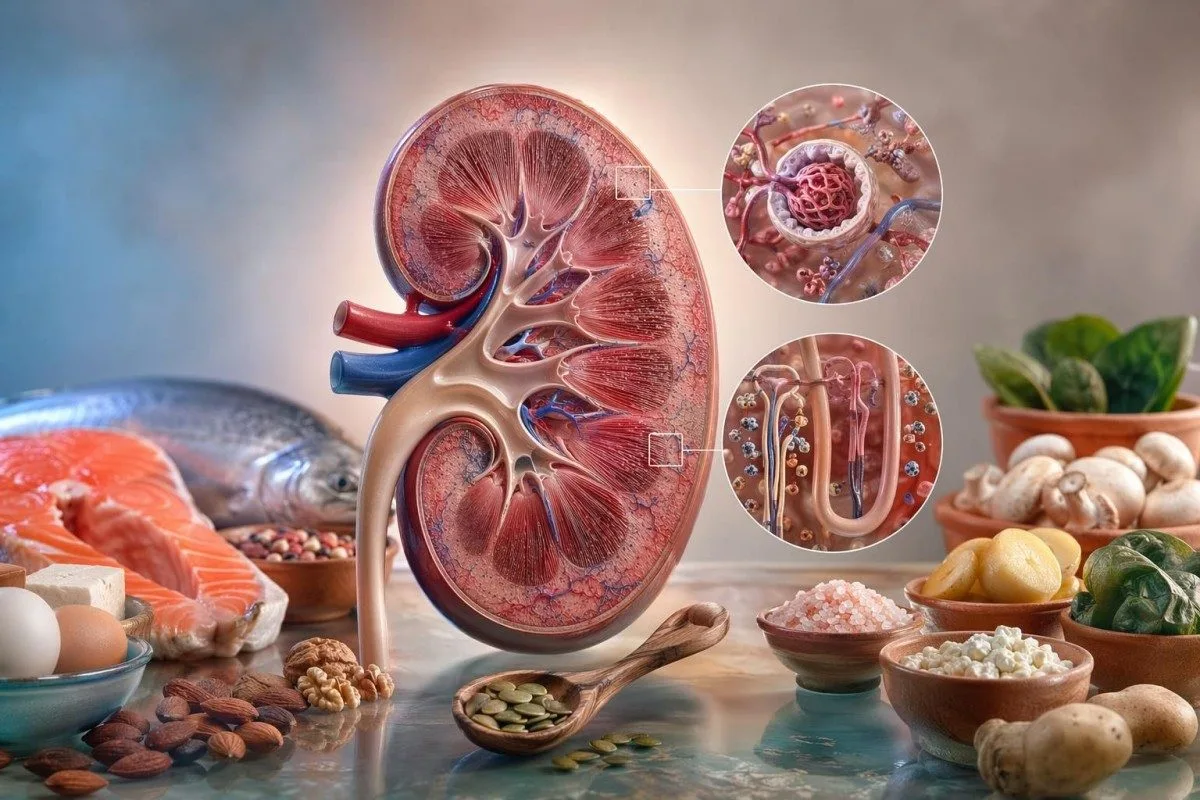
Nyrenæring er ikke en enkelt matliste. Dine tryggeste valg avhenger av eGFR, urin-albumin, kalium, bikarbonat, fosfat, blodtrykk, medisiner og hva dine tidligere laboratorietester allerede viste.


- eGFR under 60 mL/min/1.73 m² i mer enn 3 måneder antyder kronisk nyresykdom, spesielt når urin ACR er 30 mg/g eller høyere.
- BUN vanligvis 7–20 mg/dL hos voksne; en økning etter proteinrik mat kan skje uten en tilsvarende økning i kreatinin.
- Kreatinin kan øke etter kokt kjøtt, kreatin-tilskudd, dehydrering, hard trening eller trimetoprim, så trender betyr mer enn en enkelt verdi.
- Sodium under ca. 2000 mg/dag er ofte anbefalt for CKD med høyt blodtrykk, men idrettsutøvere, pasienter med lavt natriuminntak og noen eldre voksne trenger forsiktighet.
- Potassium vanligvis 3,5–5,0 mmol/L; mat rik på kalium er ikke automatisk forbudt med mindre laboratorietester, medisiner eller eGFR gjør retensjon sannsynlig.
- Phosphorus er farligere fra tilsetningsstoffer enn fra bønner eller nøtter fordi tilsatt fosfor kan absorberes ved 90–100%.
- Magnesium vanligvis 1,7–2,2 mg/dL; mat rik på magnesium kan hjelpe metabolsk helse, men tilskudd kan være risikabelt ved avansert CKD.
- Urinalbuminkreatinin-ratio under 30 mg/g er vanligvis normalt, 30–300 mg/g er moderat økt, og over 300 mg/g signaliserer høyere nyre- og kardiovaskulær risiko.
Den tryggeste nyrediett starter med ditt faktiske laboratoriemønster
En god diett ved nyresykdom beskytter laboratorieverdier ved å matche protein, natrium, kalium og fosfor mot din GFR, urinprotein, elektrolytter og medisiner—ikke ved å forby de samme matvarene for alle. Hvis kalium er 4,2 mmol/L, fosfat er 3,6 mg/dL og urin ACR er høy, bekymrer jeg meg ofte mer for natrium og blodtrykk enn for en banan.
Jeg er Thomas Klein, MD, og når jeg vurderer nyrepaneler i Kantesti AI, er det første spørsmålet ikke “hvilken mat er dårlig?” Det er om mønsteret ser ut som tap av filtrasjon, dehydrering, medikamenteffekt, proteinsøl, syrebelastning, mineralubalanse eller rett og slett et støyete enkeltresultat; vår diett ved nyresykdom tolkning starter der.
Per 29. april 2026 definerer KDIGO kronisk nyresykdom ved avvik i nyrestruktur eller -funksjon som har vært til stede i minst 3 måneder, inkludert eGFR under 60 mL/min/1.73 m² or urin ACR på 30 mg/g eller høyere (KDIGO, 2024). Dette tidskravet betyr noe; jeg har sett engstelige pasienter legge om hele kostholdet etter ett kreatininresultat etter trening som normaliserte 10 dager senere.
En nyttig ramme: Kosthold øker sjelden “eGFR” direkte i løpet av en uke, men det kan flytte risikomarkører rundt eGFR. Natrium kan endre blodtrykk og albuminuri, protein kan flytte BUN, tilberedt kjøtt kan dytte kreatinin, kaliuminntak kan avdekke nedsatt utskilling, og fosforadditiver kan presse PTH lenge før en pasient merker noe.
For bakgrunn om aldersrelatert filtrasjon og hvorfor ett enkelt estimat kan villede, er vår eGFR aldersveiledning en god lesning ved siden av. Det praktiske er å sammenligne ditt nåværende panel med tidligere kreatinin, cystatin C hvis tilgjengelig, ACR, CO2, kalium, fosfat og blodtrykk—ikke å følge et fotokopiert nyrekosthold fra et venterom.
eGFR, kreatinin og cystatin C forteller forskjellige ernæringshistorier
eGFR-estimater filtrering, mens kreatinin og cystatin C er ingrediensene som brukes for å estimere den. Kreatinin påvirkes sterkt av muskelmasse, inntak av kjøtt og noen medisiner, mens cystatin C er mindre knyttet til muskel, men kan endre seg med inflammasjon, bruk av steroider og tyreoideastatus.
En kreatininbasert eGFR på 58 mL/min/1,73 m² betyr ikke det samme i en 32-årig kroppsbygger som i en 82-åring med vekttap. Kantesti AI sammenligner kreatinin, kroppskontekst, BUN, elektrolytter og historiske resultater ved hjelp av vår kliniske valideringsstandarder i stedet for å behandle flagget som diagnosen.
Serumkreatinin er vanligvis omtrent 0,6–1,1 mg/dL hos voksne kvinner og 0,7–1,3 mg/dL hos voksne menn, men referanseområder varierer med metode og populasjon. Noen europeiske laboratorier rapporterer kreatinin i µmol/L, der 1,0 mg/dL er omtrent 88,4 µmol/L, og sammenblanding av enheter er mer vanlig enn pasienter tror.
Cystatin C kan være nyttig når kreatinin ser ut til å være ute av proporsjon med personen foran oss. En skrøpelig pasient med “normal” kreatinin på 0,9 mg/dL kan fortsatt ha lav faktisk filtrasjon, mens en muskuløs pasient med kreatinin på 1,4 mg/dL kan ha en mer betryggende eGFR basert på cystatin C.
Når eGFR og kreatinin er uenige, se etter tidspunkt for kosthold før du antar forverring. Vår veiledning til en lav GFR med normal kreatinin forklarer hvorfor ligninger kan villede i ytterkantene av alder, muskelmasse og kroppsstørrelse.
Protein endrer BUN raskere enn det endrer eGFR
Proteininntak påvirker BUN mest direkte, ikke eGFR. BUN ligger vanligvis fra 7–20 mg/dL hos voksne, og en stigning etter en proteinrik uke kan reflektere urindannelse snarere enn plutselig nyreskade.
KDOQIs ernæringsretningslinje fra 2020 anbefaler individualiserte proteiner, inkludert omtrent 0.55–0.60 g/kg/day for metabolisk stabile voksne med CKD-stadier 3–5 uten diabetes når de er under veiledning, og 0.6–0.8 g/kg/day for mange voksne med diabetes og CKD (Ikizler et al., 2020). Dialyse er annerledes; mange dialysepasienter trenger omtrent 1.0–1.2 g/kg/day fordi behandling øker aminosyretap.
Jeg ser dette mønsteret hele tiden: en pasient starter med 140 g/dag med proteinpulver, BUN stiger fra 16 til 31 mg/dL, kreatinin beveger seg knapt, og urin ACR er uendret. Det mønsteret er ikke det samme som en fallende eGFR, men det er et signal om å spørre om proteinmålet passer nyrestadiet, kroppsvekt, treningsbelastning og appetitt.
Et BUN-kreatinin-forhold over 20:1 antyder ofte dehydrering, høyt proteininntak, nitrogenbelastning i mage-tarmkanalen eller redusert nyre-perfusjon snarere enn iboende nyreskade i seg selv. Vår BUN tolkning guide går dypere inn på hvorfor BUN er en støyende markør når den leses alene.
En tryggere proteinjustering er vanligvis gradvis: trim overflødig pulver først, spre proteinet utover måltider, og unngå å falle under det som forhindrer muskeltap. Hos eldre voksne er jeg forsiktig med aggressiv restriksjon fordi sarkopeni kan senke kreatinin og få eGFR til å se bedragersk bedre ut.
Kreatinin kan stige fra kjøtt, kreatin og hard trening
Kreatinin kan stige av grunner som har lite å gjøre med permanent nyreskade. Kokt kjøtt, kreatintilskudd, dehydrering, tung styrketrening og medisiner som trimetoprim kan alle øke kreatinin eller senke beregnet eGFR midlertidig.
En 41 år gammel syklist lastet opp et panel etter et helgeritt: kreatinin 1,38 mg/dL, eGFR 61 mL/min/1,73 m², BUN 28 mg/dL og CK mildt forhøyet. Tre dager med hydrering og ingen hard trening førte kreatinin tilbake til 1,08 mg/dL; det er derfor kontekst slår panikk.
Kreatinin produseres fra muskelkreatin, så høyere muskelmasse og nylig muskelsvikt kan øke resultatet. Den reneste gjentestingen er ofte etter 24–48 timer uten intens trening og uten et stort måltid med kokt kjøtt kvelden før, spesielt hvis resultatet vil avgjøre en henvisning.
Kreatinmonohydrat er ikke automatisk nyre-toksisk hos friske voksne, men ved CKD kompliserer det tolkningen fordi det kan øke kreatinin-genereringen. Hvis din eGFR allerede er grenseverdi, vår kreatinin-områdeveiledning forklarer når cystatin C eller en urin ACR kan klargjøre historien.
Ikke “vannbelast” aggressivt før en gjentest. Overhydrering kan fortynne natrium og albumin, mens vanlig hydrering—klar til lys gul urin, ingen oppkast eller diaré—er vanligvis nok for en rettferdig nyrekjemi-test.
Natrium påvirker nyresykdomsrisiko gjennom trykk og urinprotein
Natrium er en av de viktigste kostholdsendringene i CKD fordi den kan senke blodtrykket og redusere urinalbumin. Serum-natrium er vanligvis 135–145 mmol/L, så nyrefordelen sees ofte i blodtrykk og ACR heller enn selve natriumverdien i blodet.
KDIGO og mange nefrologiklinikker sikter vanligvis mot et natriuminntak under ca. 2,000 mg/day hos CKD-pasienter med hypertensjon, selv om skrøpelige eldre, svette personer og personer med lavt natriuminntak trenger individuell rådgivning. Et lavt saltkosthold som forårsaker svimmelhet, fall eller natrium på 130 mmol/L er ikke en gevinst.
Det DASH-diett for blodtrykk er kraftig, men nyrepasienter kan trenge en modifisert versjon fordi standard DASH er rik på kalium og fosforholdige matvarer. I DASH-Sodium-studien senket kombinasjonen av DASH-kosthold og lavt natriuminntak systolisk blodtrykk med ca. 7,1 mmHg hos voksne uten hypertensjon og 11,5 mmHg hos voksne med hypertensjon sammenlignet med et høy-natrium kontrollkosthold (Sacks et al., 2001).
Albuminuri er der natrium blir interessant. Ved høyt natriuminntak reduserer ACE-hemmere og ARB-er ofte protein i urinen mindre effektivt; når natrium faller, kan samme medisin se mer potent ut på neste ACR.
Hvis hjemmemålingene dine er høye, sammenlign dem med standardisert teknikk før du klandrer middagen. Vår veiledning for blodtrykksområde forklarer hvorfor mansjettstørrelse, hviletid og tidspunkt for morgemedisinering kan endre tallet med 10 mmHg.
Mat rik på kalium er ikke automatisk forbudt
Matvarer med høyt kaliuminnhold trenger bare restriksjoner når laboratoriemønsteret ditt viser risiko for kaliumretensjon. Et kalium på 3,8 mmol/L på et tiazid diuretikum er et annet problem enn 5,7 mmol/L på spironolakton med eGFR 28.
Serumkalium varierer vanligvis fra 3,5–5,0 mmol/L, og verdier over 5,5 mmol/L fortjener generelt rask gjennomgang. En verdi på 6,0 mmol/L eller høyere kan være akutt, spesielt med svakhet, hjertebank, EKG-forandringer, avansert CKD eller kaliumøkende medisiner.
Common matvarer med høyt kaliuminnhold inkluderer bananer, appelsiner, poteter, tomater, spinat, avokado, tørket frukt, bønner og kokosvann. Haken: kalium fra hele planter absorberes ofte mindre fullstendig enn kaliumsalter i kosttilskudd, lav-natrium salt-erstatninger og bearbeidede matvarer.
Jeg har sett pasienter fjerne nesten all frukt og grønnsaker etter ett kalium på 5,2 mmol/L, og deretter returnere med forstoppelse, acidose og elendighet. Før du gjør det, sjekk for hemolyse på prøven, nylige medisinendringer, salterstatninger, trimetoprim, NSAIDs, ACE-hemmere, ARBs, spironolakton, og om blodtrekkingen var vanskelig.
For pasienter som virkelig trenger senking, hjelper porsjonsstørrelse og tilberedningsmetode. Vår kalium rekkeviddeguide dekker uttrekking av poteter, unngåelse av kaliumklorid-salter og overvåking av trenden etter endringer.
Kalium, CO2 og klorid forklarer mer sammen
Beslutninger om nyrediett er tryggere når kalium leses sammen med CO2, klorid og natrium. Lav CO2 kan tyde på metabolsk acidose, som endrer proteintoleranse, risiko for bein-mineraler og hvor mye plantemat en pasient trygt kan bruke.
Serum CO2 i en grunnleggende metabolsk panel reflekterer vanligvis bikarbonat og ligger ofte mellom 22–29 mmol/L. Ved CKD kan CO2 under 22 mmol/L tyde på metabolsk acidose, som er knyttet til muskeltap, beinbuffring og raskere nyrenes tilbakegang i noen kohorter.
Her er et mønster jeg ikke ignorerer: kalium 5,3 mmol/L, klorid 111 mmol/L, CO2 18 mmol/L og eGFR 34 mL/min/1,73 m². Den kombinasjonen kan gjøre en “alkalisk” diett med mye frukt attraktiv i teorien, men kaliumrisikoen betyr at en kliniker kan vurdere bikarbonatbehandling, medikamentgjennomgang eller nøye utvalgt lavere-potassium-produsenter i stedet.
Kantesti's nevrale nettverk grupperer elektrolytter i mønstre i stedet for å lese dem som isolerte flagg. Hvis du ønsker det grunnleggende først, vår elektrolyttpanel-veiledning forklarer hvordan natrium, kalium, klorid og CO2 peker mot dehydrering, syre-base-forstyrrelser eller medikamenteffekter.
Ikke bruk natron alene hvis du har høyt blodtrykk, hevelser eller hjertesvikt. En teskje inneholder omtrent 1 200 mg natrium, nok til å motvirke en nøye lav-natrium nyreplan.
Mat rik på magnesium kan hjelpe, men tilskudd krever forsiktighet
Matvarer med høyt magnesiuminnhold er vanligvis tryggere enn magnesiumtilskudd ved CKD, men avansert nyresykdom endrer marginen. Serum magnesium måles vanligvis 1,7–2,2 mg/dL, og nivåer over ca. 2,6 mg/dL tyder på retensjon eller overdrevent inntak i mange laboratorier.
Magnesiumrike matvarer inkluderer gresskarfrø, mandler, cashewnøtter, bønner, linser, spinat, mørk sjokolade og fullkorn. Disse samme matvarene kan også inneholde kalium eller fosfor, så riktig porsjon avhenger av fosfat, kalium, tarmvaner, diabetesstatus og eGFR-stadium.
Bevisene rundt magnesium og CKD er ærlig talt blandede. Lavt magnesium er assosiert med insulinresistens, arytmirisiko og vaskulær forkalkning i observasjonsarbeid, men tilskudd kan akkumuleres når eGFR er lav, spesielt med magnesiumholdige avføringsmidler eller antacida.
Jeg er mye mer komfortabel med matførst magnesium når kalium er normalt og fosfat er kontrollert. Vår magnesiumområde-guide forklarer hvorfor et “normalt” serum magnesium likevel kan overse intracellulær utarming, spesielt hos personer som tar PPI eller slyngediuretika.
Et praktisk kontrollpunkt: hvis eGFR er under 30 mL/min/1,73 m², spør før du tar magnesiumglycinat, citrat eller oksid. Magnesiumtoksisitet kan forårsake lavt blodtrykk, trege reflekser, søvnighet og rytmeproblemer når nivåene stiger betydelig.
Fosfor-tilsetningsstoffer påvirker laboratorietester mer enn bønner gjør
Fosfor fra tilsetningsstoffer er vanligvis mer forstyrrende for laboratoriet enn fosfor som naturlig er fanget i plantemat. Serum fosfor er vanligvis 2,5–4,5 mg/dL, men PTH og FGF23 kan stige før fosfor forlater referanseområdet.
Dette er den delen pasienter sjelden hører: fosfor i coladrikker, bearbeidet kjøtt, holdbare bakevarer og “forbedrede” ferdigprodukter kan absorberes 90–100%, mens plantefytatfosfor ofte absorberes langt mindre. Så en bønnegryte og et bearbeidet måltid med tilsatt fosfat kan ha svært forskjellige laboratorieeffekter selv om etiketten ser lik ut.
Høyt fosfor ved CKD er knyttet til sekundær hyperparatyreose, risiko for vaskulær forkalkning og problemer med beinomsetningen. Et PTH-resultat som stiger med normalt kalsium og fosfor kan være et tidlig mineral-bein-tegn, ikke en grunn til å tilfeldig kutte all protein.
Matetiketter er frustrerende fordi fosformilligram ikke alltid er oppført. Se etter ord i ingredienslisten som inneholder “fos”, og kombiner det med renalpanelet ditt; vår PTH blodprøveveiledning forklarer hvordan kalsium, vitamin D, fosfat og PTH passer sammen.
Jeg ber ofte pasienter om å fjerne fosfattilsetninger i 4–6 uker før vi kutter sunne hele matvarer. Denne ene endringen kan redusere fosforbelastningen uten å forverre fiberinntaket, forstoppelse, kolesterol eller glukosekontroll.
Urinprotein responderer ofte først på natrium og blodtrykk
Urinalbumin er en av de mest kostholdsresponsive nyresrisikomarkørene, spesielt via natrium og blodtrykk. ACR under 30 mg/g er generelt normalt, 30–300 mg/g er moderat økt, og over 300 mg/g er alvorlig økt.
Når jeg ser eGFR 72 mL/min/1.73 m² med ACR 420 mg/g, kaller jeg ikke nyrene “fine” bare fordi kreatinin er normal. Albuminuri forutsier nyre- og kardiovaskulær risiko, og det forbedres ofte når natriuminntaket faller, blodtrykket forbedres og diabetesbehandlingen strammes.
Proteinkvalitet betyr noe, men proteinkilde betyr også noe. Plantebaserte proteiner kan redusere syrebelastningen og forbedre blodtrykket, mens svært høye animalske protein-dietter kan øke renal hemodynamisk stress hos disponerte pasienter; effektstørrelsen varierer, og klinikere er uenige om hvor strenge man skal være i tidlig CKD.
Serumalbumin varierer vanligvis fra 3,5–5,0 g/dL, og lav serumalbumin med høyt urinprotein kan tyde på betydelig urinpåvirkningstap. Vår lav albumin-veiledning forklarer hvorfor hevelse, leversykdom, betennelse og nyretap må skilles fra.
Et praktisk triks: gjenta ACR på en morgenurin hvis mulig. Trening, feber, urinveisinfeksjon, menstruasjon, alvorlig hyperglykemi og en svært fortynnet prøve kan alle gjøre urinen protein vanskeligere å tolke.
DASH-mønsteret kan være nyrevennlig etter modifikasjon
DASH-dietten for blodtrykk kan hjelpe CKD-pasienter, men standard DASH er ikke automatisk trygg for alle med redusert eGFR. Det høye innholdet av frukt, grønnsaker, nøtter og belgfrukter kan øke kalium eller fosfor hos pasienter som ikke klarer å skille dem ut godt.
Ved tidlig CKD med normalt kalium gir DASH-mønsteret ofte fysiologisk mening: lavere natrium, mer fiber, mer umettede fettsyrer og bedre blodtrykk. Ved CKD stadium 4 med kalium 5,6 mmol/L, kan den samme måltidsplanen trenge kaliumreduserte grønnsaker, mindre belgfruktporsjoner og unngåelse av salterstatninger.
Poenget er at DASH er et mønster, ikke en kommando om å spise de mest kaliumrike matvarene daglig. Du kan beholde den natriumreduserende strukturen mens du velger epler fremfor appelsinjuice, ris eller pasta fremfor potet, og usaltede ferskvarer fremfor ferdigprodukter med tilsatt fosfat.
Pasienter med diabetes får et ekstra lag. Hvis A1c er høy, kan glukosekontroll redusere risikoen for albuminuri, og vår veiledning for blodprøver ved diabetes forklarer hvorfor A1c, fasteglukose og nyremarkører bør leses sammen.
Min vanlige test er kjedelig, men nyttig: endre én kostholdsvariabel i 2–4 uker, og sjekk deretter laboratoriet som mest sannsynlig vil bevege seg. Hvis du endrer natrium, kalium, protein og kosttilskudd samtidig, kan ingen si hvilken spak som hjalp.
Medisiner kan endre hva som regnes som trygg mat
Råd om nyrediett endres når medisiner endrer kalium-, natrium-, kreatinin- eller syre-basebalansen. ACE-hemmere, ARB-er, spironolakton, SGLT2-hemmere, diuretika, NSAIDs, trimetoprim og fosfatbindere kan alle endre hvordan mat vises i laboratorietester.
ACE-hemmere og ARB-er kan øke kreatininet litt etter oppstart, ofte akseptabelt opptil omtrent 30% hvis kalium forblir trygt og pasienten er klinisk stabil. Den lille økningen i kreatinin kan reflektere lavere intraglomerulært trykk, noe som kan være nyrebeskyttende når albuminuri er til stede.
Spironolakton og eplerenon er hvor matlister med høyt kaliuminnhold blir mer relevante. En pasient som spiser mat med høyt kaliuminnhold, kan ha det fint til et kaliumsparende legemiddel legges til; deretter kan et salterstatning med kaliumklorid raskt skyve laboratoriet fra 4.8 til 6,1 mmol/L.
NSAIDs er et stille problem. Å ta ibuprofen under dehydrering, sykdom eller hard trening kan redusere nyreperfusjon, øke kreatinin og få en ellers fornuftig plan for protein eller natrium til å se skadelig ut.
Kosttilskudd fortjener samme respekt som resepter. Vår veiledning for tidspunkt for tilskudd dekker interaksjoner, og for nyrepasienter spør jeg spesielt om kreatin, magnesium, kalium, høydose vitamin C, gurkemeieekstrakter og kosttilskudd for bodybuilding.
Gjentatte laboratorietester bør tidsinnstilles for å svare på ett spørsmål
Det beste gjentatte nyrelaboratoriet er tidsbestemt rundt den spesifikke diettendringen du gjorde. BUN kan endre seg i løpet av dager etter justering av protein, kalium kan endre seg innen 24–72 timer etter en større utløsende faktor, og ACR trenger ofte flere uker med jevnere blodtrykk og natriuminntak.
Hvis det er kreatinin som er bekymringen, ta ny prøve etter vanlig hydrering, ingen intens trening i 24–48 timer og ingen stor middag med tilberedt kjøtt kvelden før. Hvis det er kalium som er bekymringen, ta ny prøve tidligere etter at du har stoppet kaliumklorid-salt eller et risikofylt tilskudd, særlig når eGFR er under 45 mL/min/1,73 m².
For urin ACR liker jeg to av tre unormale prøver før jeg kommer med store påstander, med mindre verdien er veldig høy eller det kliniske bildet er åpenbart. ACR kan svinge med infeksjon, trening, feber, glukosesprang og til og med tidspunktet for innsamling.
Kantesti AI leser trender på tvers av opplastede PDF-er og bilder, ikke bare isolerte topper og bunner. Vår verktøyet for blodprøvehistorikk hjelper pasienter å se om kreatinin endret seg med 0,05 mg/dL “støy” eller med en klinisk meningsfull stigning.
Ha en enkel 7-dagers notat før nye laboratorieprøver: proteingram hvis du følger dem, uvanlige restaurantmåltider, saltalternativer, kosttilskudd, treningsøkter, diaré, oppkast og nye medisiner. Dette notatet forklarer ofte resultatet raskere enn en ny, dyr test.
Noen laboratoriemønstre bør ikke vente på dietteksperimenter
Kostendringer er ikke nok når nyrelaboratorieprøver tyder på akutt risiko. Kalium på 6,0 mmol/L eller høyere, raskt økende kreatinin, alvorlig acidose, svært lavt natrium, hevelse med lav albumin, eller symptomer som brystsmerter, forvirring eller alvorlig svakhet trenger rask medisinsk vurdering.
En økning i kreatinin på 0,3 mg/dL innen 48 timer kan oppfylle kriteriene for akutt nyreskade i riktig klinisk situasjon. Det er veldig annerledes enn en langsom økning over flere år, og det bør ikke håndteres bare ved å spise mindre protein.
Kaliumsymptomer kan være vage eller utebli. Jeg har sett pasienter med kalium 6,4 mmol/L som følte “litt mer trøtt” og ingenting mer, og det er derfor høyt kalium tas alvorlig selv når personen ser frisk ut.
Svært lavt natrium er en annen felle. Hvis natrium er under 130 mmol/L, kan det å drikke ekstra vann fordi “nyrene må skylles” gjøre ting verre; vår lavnatrium-guide forklarer hvorfor fortynning, medisiner og hormoner må sorteres ut.
Bruk kosthold som et langsiktig “spak”, ikke som akuttbehandling. Hvis en laboratorierapport sier at det er kritisk, eller pasienten har kortpustethet, besvimelse, brystsmerter, alvorlig oppkast eller ny forvirring, kommer klinisk behandling før planlegging av mat.
Hvordan Kantesti kobler nyrelaboratorietester til matvalg
Kantesti kobler nyreernæring til hele laboratoriemønsteret: eGFR, kreatinin, BUN, elektrolytter, CO2, kalsium, fosfat, albumin og urinemarkører. Vår AI sier ikke at alle nyrepasienter må unngå de samme matvarene; den leter etter den begrensningen som faktisk viser seg i dataene.
Vår plattform kan lese en laboratorie-PDF eller et bilde på omtrent 60 sekunder og oversette resultatet til mønstre i vanlig språk. Hvis du vil prøve den med ditt eget nyrepanel, bruk vår gratis blodprøveanalyse og inkluder urin ACR eller urinalyse hvis du har det.
Kantesti AI tolker over 15 000 biomarkører på tvers av blodkjemi, nyrepaneler, urinmarkører, metabolske tester og mikronæringsstoffer. For pasienter som ønsker å forstå markørnavn før opplasting, vår biomarker guide forklarer forkortelsene som vanligvis vises på nyre-rapporter.
Jeg forteller fortsatt pasienter det samme som jeg sier på klinikken: AI-tolkning er ikke en erstatning for din nefrolog, fastlege eller nyrediettist. Det er en måte å oppdage mønstre, forberede bedre spørsmål og unngå den klassiske feilen med å begrense kalium, protein eller fosfor uten bevis.
Kantesti's medisinske team er beskrevet på vår medisinske rådgivende styre, og selskapets bakgrunn er tilgjengelig på Om Kantesti. Thomas Klein, MD, gjennomgår nyre-relatert innhold med samme skjevhet som jeg bruker klinisk: beskytt pasienten først, optimaliser deretter tallene.
Forskningsnotater, validering og hva vi fortsatt ikke vet
Bevisene for nyrediett er sterkest for natriumbegrensning, blodtrykkskontroll, albuminurireduksjon og veiledede proteindoser. Bevisene er svakere for universell kaliumrestriksjon, aggressiv fosforrestriksjon i tidlig CKD og mineral korrigering basert på kosttilskudd uten laboratoriebekreftelse.
Kantesti LTD. (2026). Klinisk valideringsrammeverk v2.0. Zenodo. DOI-lenke. Også tilgjengelig via ResearchGate-søk og Academia.edu-søk.
Kantesti LTD. (2026). AI Blood Test Analyzer: 2.5M Tests Analyzed | Global Health Report 2026. Zenodo. DOI-lenke. Også tilgjengelig via ResearchGate record og Academia.edu-oppføring.
For en bredere teknisk referanse, har vår AI-motor også blitt evaluert i et forhåndsregistrert populasjons-skala valideringsdatasett på tvers av spesialiteter; metodene er tilgjengelige i AI-motor. Det fjerner ikke usikkerheten fra nyrenæring, men det gjør mønsterlesingsprosessen revisjonsbar.
Hovedbudskap fra meg, Thomas Klein, MD: den beste nyrediett er den som forbedrer den risikable markøren du faktisk har uten å skape en ny. Hvis kaliumet ditt er normalt, ikke vær redd for hver grønnsak; hvis ACR er høy, ta natrium og blodtrykk alvorlig; hvis fosfor stiger, let etter tilsetningsstoffer før du kutter ut all næringsrik mat, og bruk Kantesti AI-blodprøveanalysator for å spore mønsteret over tid.
Ofte stilte spørsmål
Hva er den beste dietten for nyresykdom basert på blodprøver?
Det beste kostholdet ved nyresykdom avhenger av eGFR, urin ACR, kalium, fosfor, bikarbonat, blodtrykk, diabetesstatus og medisiner. En person med eGFR 72 ml/min/1,73 m² og ACR 250 mg/g kan ha mest nytte av redusert natrium og kontroll av blodtrykket, mens en person med eGFR 28 og kalium 5,8 mmol/L kan trenge kaliumrestriksjon. Proteinmålene er også ulike: veiledede CKD-planer uten dialyse kan bruke omtrent 0,55–0,8 g/kg/dag, mens dialysepasienter ofte trenger omtrent 1,0–1,2 g/kg/dag.
Kan endring av kosthold forbedre eGFR?
Kosthold øker vanligvis ikke den reelle eGFR dramatisk i løpet av noen få dager, men det kan forbedre risikomarkører rundt eGFR. Lavere natrium kan redusere blodtrykk og urinalbumin, å unngå dehydrering kan normalisere en falskt forhøyet kreatinin, og å redusere overdreven proteininntak kan senke BUN. Hvis eGFR stiger etter å ha stoppet hard trening, tilberedt kjøtt eller kreatin før testing, kan det gjenspeile en renere måling heller enn reparasjon av nyrevev.
Bør alle med nyresykdom unngå matvarer som inneholder mye kalium?
Nei, matvarer med høyt kalium bør ikke forbys automatisk hos alle personer med nyresykdom. Kalium ligger vanligvis i området 3,5–5,0 mmol/L, og restriksjon er mest relevant når kalium gjentatte ganger er over omtrent 5,0–5,5 mmol/L, når eGFR er lav, eller når medisiner som ACE-hemmere, ARB-er eller spironolakton øker risikoen for hyperkalemi. Kalium fra hele matvarer som frukt og grønnsaker er ikke det samme som kaliumklorid-baserte salterstatninger, som kan øke kalium raskt.
Hvorfor økte BUN-verdien min etter å ha spist mer protein?
BUN stiger når kroppen produserer mer urea fra proteinmetabolismen, så dietter med høyt proteininnhold kan øke BUN uten en tilsvarende økning i kreatinin. Voksent BUN ligger vanligvis på omtrent 7–20 mg/dL, selv om referanseområdene varierer mellom laboratorier. En BUN-kreatinin-ratio over 20:1 tyder ofte på dehydrering, høyt proteininntak, gastrointestinal nitrogenbelastning eller redusert nyreperfusjon, snarere enn nyreskade i seg selv.
Er DASH-dietten trygg ved nyresykdom?
DASH-dietten kan være nyttig ved nyresykdom når blodtrykket er høyt, men den kan trenge modifikasjon hvis kalium eller fosfor er forhøyet. Den opprinnelige DASH-Sodium-studien viste reduksjoner i systolisk blodtrykk på omtrent 7,1 mmHg hos ikke-hypertensive voksne og 11,5 mmHg hos hypertensive voksne når DASH-kosthold ble kombinert med lavt natrium. Ved CKD stadium 4 eller tilbakevendende hyperkalemi kan standard DASH-matvarer med høyt kalium måtte byttes ut med alternativer med lavere kalium.
Hvilke fosforrike matvarer betyr mest for nyreprøver?
Fosforadditiver betyr vanligvis mer enn naturlig fosfor i bønner, nøtter eller fullkorn, fordi tilsetningsfosfor kan absorberes ved 90–100%. Serumfosfor ligger vanligvis i området 2,5–4,5 mg/dL, men PTH kan stige før fosfor blir unormalt. Pasienter med kronisk nyresykdom (CKD) bør se etter ingrediensord som inneholder “phos” på emballerte matvarer før de kutter alle næringsrike planteproteiner.
Når bør nyreprøver behandles som akutte?
Nyre-relaterte laboratorieresultater kan være akutte når kalium er 6,0 mmol/L eller høyere, kreatinin stiger raskt, natrium er svært lavt, CO2 er alvorlig lavt, eller symptomer som brystsmerter, besvimelse, forvirring, alvorlig svakhet eller kortpustethet oppstår. En kreatininøkning på 0,3 mg/dL i løpet av 48 timer kan oppfylle kriteriene for akutt nyreskade i riktig sammenheng. Kostholdsendringer bør ikke brukes som eneste respons på kritiske nyre- eller elektrolyttresultater.
Kan jeg ta ibuprofen eller naproksen hvis jeg har nyresykdom?
Unngå å bruke ibuprofen, naproksen og lignende NSAIDs rutinemessig med mindre legen din sier at de er passende; de kan redusere blodstrømmen til nyrene og øke risikoen for akutt nyreskade, spesielt ved dehydrering, diuretika eller ACE-hemmere/ARB-medisiner. Spør om tryggere smertelindringsalternativer tilpasset din tilstand.
Hvor mye vann bør jeg drikke hvis jeg har nyresykdom?
De fleste med tidlig CKD trenger ikke å tvinge i seg ekstra vann; drikk etter tørst og hold urinen lys gul med mindre behandleren din har gitt et væskemål. Be om individuell veiledning hvis du har hevelser, hjertesvikt, lavt natrium eller svært lav urinproduksjon.
Kan jeg bruke salterstatninger hvis jeg har nyresykdom?
Vær forsiktig, fordi mange salterstatninger inneholder kaliumklorid, som kan øke blodkalium hos personer med CKD eller ved bruk av ACE-hemmere, ARB-er, spironolacton eller finerenon. Spør legen din før du bruker dem regelmessig, spesielt hvis kaliumnivået ditt noen gang har vært utenfor normalområdet.
Få AI-drevet analyse av blodprøver i dag
Bli med over 2 millioner brukere over hele verden som stoler på Kantesti for øyeblikkelig, nøyaktig analyse av laboratorietester. Last opp blodprøveresultatene dine og få omfattende tolkning av 15,000+-biomarkører på sekunder.
📚 Refererte forskningspublikasjoner
Klein, T., Mitchell, S., & Weber, H. (2026). Klinisk valideringsrammeverk v2.0 (medisinsk valideringsside). Kantesti KI medisinsk forskning.
Klein, T., Mitchell, S., & Weber, H. (2026). AI Blood Test Analyzer: 2.5M Tests Analyzed | Global Health Report 2026. Kantesti KI medisinsk forskning.
📖 Eksterne medisinske referanser
KDIGO CKD Work Group (2024). KDIGO 2024 kliniske retningslinjer for evaluering og håndtering av kronisk nyresykdom. Kidney International.
⚕️ Medisinsk ansvarsfraskrivelse
Denne artikkelen er kun for informasjonsformål og utgjør ikke medisinsk rådgivning. Rådfør deg alltid med en kvalifisert helsepersonell for beslutninger om diagnose og behandling.
E-E-A-T tillitssignaler
Experience
Klinisk gjennomgang ledet av lege av arbeidsflyter for laboratorietolkning.
Expertise
Fagområde laboratoriemedisin med fokus på hvordan biomarkører oppfører seg i klinisk kontekst.
Authoritativeness
Skrevet av Dr. Thomas Klein med gjennomgang av Dr. Sarah Mitchell og Prof. Dr. Hans Weber.
Trustworthiness
Evidensbasert tolkning med tydelige oppfølgingsveier for å redusere uro.