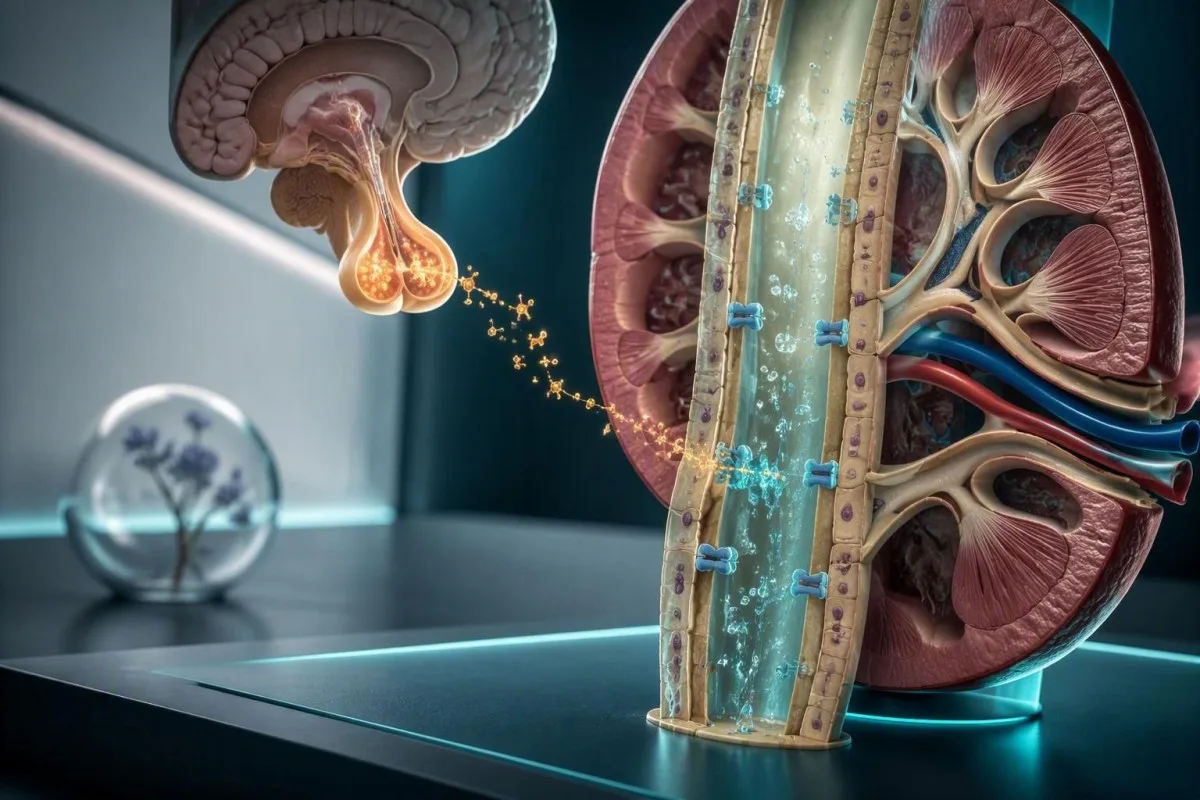
A high copeptin result usually reflects vasopressin-system activation from dehydration, physical stress, or illness—not a diagnosis by itself. Its real value comes from reading it beside sodium, serum osmolality, urine osmolality, and collection conditions.


- High copeptin often reflects dehydration, nausea, pain, exercise, infection, surgery, or low circulating volume rather than a single disease.
- Copeptin ≥21.4 pmol/L in a hypotonic polyuria work-up strongly supports nephrogenic diabetes insipidus when measured with appropriate clinical context.
- Stimulated copeptin >4.9 pmol/L after a supervised hypertonic-saline protocol generally argues against central diabetes insipidus and supports primary polydipsia.
- Low sodium plus high copeptin can occur in SIADH, but copeptin alone cannot confirm SIADH because stress and medications also raise it.
- Serum sodium 135–145 mmol/L and measured serum osmolality about 275–295 mOsm/kg are essential paired results for interpreting copeptin.
- Шээсний осмоляр чанар <300 mOsm/kg during hypernatraemia or high serum osmolality suggests inadequate antidiuretic action and needs prompt clinical assessment.
- Collection conditions matter because strenuous exercise, vomiting, acute pain, fasting, and IV fluids can materially change copeptin concentrations.
- Яаралтай тусламжийн шинж тэмдэг with sodium ≥150 mmol/L, confusion, severe weakness, seizure, or inability to keep fluids down require urgent care rather than repeat outpatient testing.
What a high copeptin result usually means
A high copeptin level means the body has activated its arginine vasopressin system, usually to conserve water or respond to physiological stress. The result is most informative when it is paired with sodium and osmolality; a high number by itself cannot distinguish dehydration from SIADH, nephrogenic diabetes insipidus, acute illness, or a difficult sample collection day.
Copeptin is the stable C-terminal fragment released in equal amounts with arginine vasopressin (AVP). AVP itself breaks down rapidly and is technically awkward to measure, whereas copeptin remains measurable in plasma. In practical terms, copeptin tells us that the body has received a “hold on to water” signal, not why that signal was sent.
When I review a panel with copeptin above the laboratory interval, I first ask whether the sodium is high, low, or normal. High copeptin with sodium 148 mmol/L points us toward water loss or impaired renal water response; high copeptin with sodium 126 mmol/L points toward non-osmotic AVP release, including possible SIADH. This is one of those areas where context matters more than the flag beside the number.
Кантести бол AI цусны шинжилгээний анализатор that reads copeptin beside electrolytes, kidney markers, glucose, and prior results rather than treating one hormone fragment as a verdict. A useful companion review is our guide to serum osmolality results, because measured osmolality often explains the result more clearly than copeptin alone.
Why laboratories do not share one universal upper limit
Copeptin assays differ, and many laboratories report only a method-specific reference interval rather than a disease cutoff. A result of 12 pmol/L may be ordinary in a person with mild dehydration but inappropriate in someone with high serum osmolality who is producing litres of very dilute urine.
Why copeptin rises when the body needs to save water
Copeptin rises when osmoreceptors detect concentrated body fluids or when the circulation is under stress. The hypothalamus releases AVP with copeptin, and AVP helps the kidney reabsorb water through collecting-duct V2 receptors.
A serum osmolality increase of only 1% to 2% can stimulate AVP release in a healthy person. That sensitivity explains why a long flight, diarrhoea, an overnight fast, or a sweaty workout can produce a meaningful copeptin rise without endocrine disease. Шээсний осмолялийн шинжилгээ shows whether the kidney actually followed the signal.
Non-osmotic stimuli can be stronger than thirst. Nausea, pain, hypoglycaemia, hypoxia, major exercise, infection, myocardial injury, and surgery all stimulate AVP release even when sodium is not high. I have seen copeptin interpreted as “dehydration” in a patient whose sodium was 133 mmol/L after severe nausea—an example of stress signalling, not simple water deficit.
Dr. Thomas Klein’s clinical rule is simple: a copeptin value has to make physiological sense. If sodium, glucose, urea, measured osmolality, urine osmolality, medication exposure, and the patient’s fluid intake tell different stories, repeat or dynamic testing is usually safer than forcing a diagnosis from a resting result.
Copeptin test results: useful thresholds and their limits
There is no single normal copeptin range that diagnoses every condition. In specialist evaluation of hypotonic polyuria, basal copeptin of at least 21.4 pmol/L strongly supports nephrogenic diabetes insipidus, while hypertonic-saline stimulated copeptin above 4.9 pmol/L generally supports primary polydipsia over central diabetes insipidus.
The 21.4 pmol/L threshold is designed for a specific problem: suspected nephrogenic diabetes insipidus in a person producing excessive dilute urine. It is not a general “danger level.” A person with severe gastroenteritis or acute coronary illness may exceed that value because copeptin is also a stress biomarker.
In the multicentre trial by Christ-Crain and colleagues, a copeptin cutoff of 4.9 pmol/L after hypertonic saline distinguished primary polydipsia from central diabetes insipidus with substantially better accuracy than water deprivation alone (Christ-Crain et al., 2018). This protocol requires serial sodium monitoring and should not be attempted by drinking less water at home.
Kantesti AI interprets copeptin test results by checking whether the requested cutoff matches the assay, clinical question, and collection protocol. For perspective on why a laboratory flag is not automatically a diagnosis, see хэвийн бус хүрээнээс гадуурх үр дүн нь юу гэсэн утгатай вэ.
High copeptin from dehydration and volume loss
Dehydration commonly raises copeptin because concentrated plasma triggers AVP release. The most convincing pattern is high or rising sodium, serum osmolality above about 295 mOsm/kg, concentrated urine, and a history of fluid loss or limited access to water.
Dehydration does not always cause hypernatraemia. Someone who can drink freely may replace enough water to keep sodium at 140 mmol/L while still generating high copeptin and concentrated urine. Conversely, a sodium of 151 mmol/L with urine osmolality below 300 mOsm/kg is not the usual dehydration response and raises concern for diabetes insipidus or impaired thirst.
The BUN-to-creatinine pattern can offer a modest clue, but it is not definitive. Urea can rise with gastrointestinal bleeding, high protein intake, steroids, or catabolism; creatinine changes with muscle mass and medicines. Our detailed BUN болон креатинины харьцуулалт explains why neither marker replaces osmolality.
A 52-year-old endurance runner may have copeptin elevation after a race, a urine specific gravity above 1.025, and creatinine mildly above baseline for 24 to 48 hours. In my experience, a repeat morning sample after normal eating, drinking, and 24 hours without intense exercise is often more clinically useful than an alarmed interpretation of the post-race panel.
High copeptin causes beyond dehydration
Acute physiological stress is a major cause of high copeptin, even without a water-balance disorder. Nausea, pain, fever, sepsis, hypoxia, myocardial injury, stroke, surgery, severe exercise, and low blood pressure can all raise AVP and copeptin.
Copeptin has been studied as a prognostic biomarker in acute care because it integrates stress signalling. That usefulness also creates a common misunderstanding: it is not a screening test for heart attack, infection, or cancer in a well outpatient. A raised result obtained during illness may simply document that the neuroendocrine stress system was active.
Glucose deserves careful attention. Marked hyperglycaemia raises effective osmolality and can cause osmotic diuresis, thirst, and high copeptin; sodium should be interpreted after considering the glucose concentration. People with thirst and frequent urination should also review high glucose warning symptoms, particularly if ketones, vomiting, or weight loss are present.
Кантести бол AI цусны шинжилгээний тайлал платформ that places acute-phase results in their time sequence, since a copeptin result during hospitalisation should not be compared casually with a healthy outpatient baseline. A recovering illness can change sodium, urea, creatinine, CRP, and fluid intake simultaneously.
Can high copeptin diagnose SIADH?
High copeptin can occur in SIADH, but it cannot diagnose SIADH on its own. SIADH is diagnosed from hypotonic hyponatraemia, inappropriately concentrated urine, urine sodium, normal thyroid and adrenal function, and exclusion of low effective circulating volume.
In SIADH, AVP activity is inappropriate for the low plasma osmolality, so copeptin may be measurable or high despite sodium below 135 mmol/L. Yet SIADH has several physiological subtypes, and copeptin overlaps substantially with nausea, medicines, pulmonary disease, and hospital stress. The more reliable practical framework is explained in our SIADH blood test guide.
The 2014 European hyponatraemia guideline defines hypotonic hyponatraemia using effective serum osmolality below 275 мОсм/кг and recommends urine osmolality and urine sodium early in the diagnostic sequence (Spasovski et al., 2014). A urine osmolality above 100 mOsm/kg shows antidiuretic activity, but it does not establish its cause.
Medication history changes the odds. SSRIs, carbamazepine, oxcarbazepine, desmopressin, some antipsychotics, cyclophosphamide, and thiazide diuretics can contribute to hyponatraemia; do not stop a prescribed medicine abruptly based on one result. Sodium below 120 mmol/L, seizure, confusion, repeated vomiting, or severe headache needs emergency assessment.
Copeptin and diabetes insipidus: the patterns clinicians use
Copeptin helps separate central diabetes insipidus, nephrogenic diabetes insipidus, and primary polydipsia in people with hypotonic polyuria. The starting question is whether urine output is truly excessive—typically more than 3 litres daily in an adult or more than 50 mL/kg per 24 hours—and whether urine is dilute.
Central diabetes insipidus results from inadequate AVP production or release, often after pituitary-region disease, neurosurgery, trauma, autoimmune inflammation, or infiltrative disease. In complete central DI, copeptin may be very low despite high sodium or high osmolality; a basal value below 2.6 pmol/L can support the diagnosis in the appropriate hyperosmolar setting.
Nephrogenic diabetes insipidus means the kidney does not respond adequately to AVP. Copeptin is usually high because the hypothalamus is sending the right signal, while urine remains inappropriately dilute. Lithium exposure, hypercalcaemia, hypokalaemia, chronic kidney disease, and inherited V2-receptor or aquaporin-2 defects are recognised causes; our литийн хяналтын гарын авлага covers one particularly important medication pathway.
Christ-Crain et al. (2018) found that copeptin-guided hypertonic-saline testing improved diagnostic accuracy for polyuria-polydipsia syndromes compared with the traditional water-deprivation approach. This does not mean every thirsty person needs copeptin: uncontrolled diabetes mellitus, diuretics, hypercalcaemia, kidney disease, and excessive caffeine intake should be considered first.
Why sodium and osmolality must be paired with copeptin
Sodium and measured serum osmolality determine whether a high copeptin level is physiologically appropriate. A result is generally appropriate when high copeptin accompanies hyperosmolality or fluid loss, and potentially inappropriate when it accompanies true hypo-osmolality and persistent concentrated urine.
Serum sodium normally runs about 135–145 ммоль/л, although the laboratory interval should take priority. Measured serum osmolality is usually about 275 to 295 mOsm/kg; calculated osmolality may differ when ethanol, mannitol, radiocontrast agents, or other unmeasured osmoles are present. That gap can alter the entire interpretation.
Urine osmolality supplies the kidney-side answer. With hypernatraemia, a urine osmolality above 600 mOsm/kg usually shows a strong water-conserving response, whereas persistently dilute urine below 300 mOsm/kg suggests that AVP is absent or ineffective. Our электролитийн самбарын заавар explains urgent combinations that should not wait for an online interpretation.
Kantesti’s neural network compares these values as a pattern and highlights contradictions, such as high copeptin with very dilute urine. That is a follow-up trigger, not a diagnosis: a timed 24-hour urine collection, simultaneous plasma and urine osmolality, and specialist-supervised stimulation testing may be needed.
How collection conditions can distort copeptin test results
Copeptin is highly sensitive to collection conditions because stress and acute fluid shifts stimulate AVP release. A value taken after strenuous exercise, vomiting, prolonged fasting, a painful procedure, IV fluid treatment, or acute illness may not reflect baseline water regulation.
For an outpatient baseline sample, I usually want the laboratory request to document time of draw, fluid intake, urine output, recent exercise, fever, nausea, and medicines. A patient who drank 3 litres in an hour to “prepare” for testing can suppress osmolality; someone who deliberately restricts water can create a potentially unsafe and misleading high-stress state.
Assay handling matters too. Copeptin is much more stable than AVP, but results remain method-dependent, and a laboratory’s stated specimen type and reference interval must be used. This is similar to the pre-analytical detail discussed in our АКТГ-ын цагийн хуваарь, although copeptin itself is less fragile than ACTH.
As of September 19, 2026, I would not advise a home water-deprivation test. If a clinician suspects diabetes insipidus, controlled testing protects against sodium rising too rapidly; even mild baseline hypernatraemia can become dangerous when water access is restricted.
Medicines, kidney function, and high copeptin
Kidney disease and certain medicines can complicate a high copeptin result because they alter both water handling and biomarker clearance. Reduced eGFR, lithium, desmopressin, diuretics, glucocorticoids, and drugs that trigger nausea or SIADH all change the clinical picture.
Copeptin concentrations tend to rise as kidney function declines, so a result in chronic kidney disease should not be interpreted with a diabetes-insipidus cutoff designed for otherwise stable patients. eGFR below 60 мл/мин/1.73 м²-оос доогуур is a meaningful contextual threshold, but acute kidney injury, age, muscle mass, and hydration all affect creatinine-based estimates.
Lithium can cause nephrogenic DI after long exposure, often with thirst, nocturia, and dilute urine. Hypercalcaemia and hypokalaemia can also reduce the kidney’s concentrating ability; a calcium of 2.75 mmol/L or potassium of 3.0 mmol/L deserves separate assessment even if copeptin is elevated. Read our overview of бага зэрэг өндөр кальци for why calcium needs confirmation and cause-finding.
Кантести бол AI-аар ажилладаг цусны шинжилгээний үр дүнгийн шинжилгээний хэрэгсэл that can surface medication-sensitive clusters—sodium, potassium, calcium, eGFR, glucose, and osmolality—before a clinical review. It cannot determine whether a prescription should be changed, and medication decisions belong with the prescriber who knows the indication and timeline.
When high copeptin results need urgent medical care
A high copeptin number itself is rarely an emergency; the accompanying sodium, symptoms, and fluid balance determine urgency. Seek urgent assessment for confusion, seizure, fainting, severe weakness, inability to drink, persistent vomiting, or sodium at or above 150 mmol/L.
Hypernatraemia can cause intense thirst, irritability, lethargy, muscle twitching, and neurological symptoms as brain cells lose water. Adults with sodium ≥160 ммоль/л have a particularly high risk of complications, but the rate of change matters as much as the absolute value. Our high sodium symptom guide outlines warning signs in plain language.
Hyponatraemia is the opposite biochemical problem but can coexist with high copeptin in SIADH or nausea-driven AVP release. Symptoms become more concerning when sodium falls rapidly, especially below 125 ммоль/Л-ээс доош; severe headache, confusion, seizure, and reduced consciousness warrant emergency services rather than oral salt or water experiments.
A practical point from Dr. Thomas Klein: do not respond to an unexplained copeptin result by forcing fluids or restricting fluids. Both can be harmful when sodium is abnormal. Bring the full laboratory report, medication list, 24-hour fluid estimate, and urine-output history to the clinician.
What clinicians usually check after elevated copeptin
The next step after elevated copeptin is usually a targeted fluid-balance assessment, not a repeat copeptin test alone. Clinicians commonly review simultaneous sodium, glucose, calcium, potassium, creatinine/eGFR, serum osmolality, urine osmolality, urine sodium, and 24-hour urine volume.
A reliable history can be surprisingly diagnostic. We ask about thirst that wakes someone at night, measured urine volume, new headache or visual symptoms, head injury, pituitary surgery, lithium, diuretics, pregnancy, and recent hospital care. Polyuria means high volume, not simply frequent small voids—a distinction that prevents many unnecessary DI referrals.
If hypotonic polyuria is confirmed, an endocrinologist may use a hypertonic saline copeptin protocol, copeptin after arginine stimulation, or a carefully supervised water-deprivation test depending on local expertise. The 4.9 pmol/L hypertonic-saline threshold cannot be transplanted into an unsupervised random sample. For accurate reporting, see our blood test PDF checklist.
Kantesti AI supports the preparation step by organising the relevant results and prior trends for a clinician conversation. Our эмнэлзүйн баталгаажуулалтын стандартууд explain why contextual interpretation and human clinical oversight remain necessary for complex endocrine testing.
Common misconceptions about high copeptin
High copeptin does not automatically mean SIADH, dehydration, diabetes insipidus, or a pituitary disorder. It signals AVP-system activity, and the same result can arise from several very different physiological states.
“High copeptin means diabetes insipidus” is backwards in many cases. In complete central DI, copeptin can be low because AVP release is deficient; in nephrogenic DI it can be high because AVP release is intact but the kidney does not respond. The urine and sodium pattern tells the difference.
“Drinking more water will fix the result” is also unsafe advice. Excessive free-water intake may worsen hyponatraemia in SIADH, while inadequate intake can worsen hypernatraemia in DI. The натрийн бага хэмжээний шинж тэмдгийн гарын авлагыг is relevant because water advice must be matched to the actual sodium disorder.
A final misconception is that a normal sodium rules out a problem. Early DI, compensated polydipsia, or intermittent AVP stimulation can all occur with sodium between 135 and 145 mmol/L. Repeated paired tests under consistent conditions often reveal more than a single technically perfect but poorly timed result.
Using a copeptin result safely in real life
A copeptin result is safest when used as one piece of a documented fluid-balance story. Record the exact collection time, symptoms, recent fluid intake, urine output, exercise, illness, and medications before comparing it with a previous measurement.
Most patients find it helpful to write down fluid intake and urine volume for 24 hours before an endocrine appointment, without deliberately changing either. A measured urine volume over 3 litres per day, particularly with night-time thirst and low urine osmolality, is more actionable than a vague report of “urinating often.”
Kantesti can organise a copeptin report alongside sodium, osmolality, glucose, and kidney trends for discussion with a professional; our эмнэлзүйн хэрэглээний жишээ show how structured result summaries can reduce missed context. Our physician reviewers, listed on the Эмнэлгийн зөвлөх зөвлөл, emphasise that dynamic endocrine protocols must remain clinician-led.
The bottom line is reassuring for many people: a high copeptin level often reflects a temporary and appropriate stress or dehydration response. But high copeptin plus major sodium disturbance, dilute urine despite hyperosmolality, or rapidly changing thirst and urine output warrants timely medical assessment rather than self-treatment.
Research publication and clinical evidence
The strongest current evidence supports copeptin mainly as a specialist diagnostic tool for polyuria-polydipsia syndromes, not as a stand-alone screening biomarker. Evidence publication and technical validation are useful, but neither replaces a clinician’s assessment of sodium, osmolality, symptoms, and safety.
The landmark randomised diagnostic comparison by Christ-Crain et al. used supervised hypertonic saline to evaluate copeptin in suspected diabetes insipidus and primary polydipsia (Christ-Crain et al., 2018). The European hyponatraemia guideline remains useful for SIADH-style work-ups because it prioritises serum and urine osmolality over isolated hormone values (Spasovski et al., 2014).
Kantesti Ltd is a privacy-focused health organisation, and Kantesti AI uses multilingual lab-context analysis with human clinical governance rather than claiming to diagnose endocrine disease from a PDF. Readers interested in methodology can review our AI технологийн заавар and the referenced research publications below.
Klein, T. (2026). Women’s Health Guide: Ovulation, Menopause & Hormonal Symptoms. Figshare. https://doi.org/10.6084/m9.figshare.31830721. ResearchGate болон Academia.edu records may provide additional discovery routes. Klein, T. (2026). Multilingual AI Assisted Clinical Decision Support for Early Hantavirus Triage: Design, Engineering Validation, and Real-World Deployment Across 50,000 Interpreted Blood Test Reports. Figshare. https://doi.org/10.6084/m9.figshare.32230290. ResearchGate болон Academia.edu records may provide additional discovery routes.
Байнга асуудаг асуултууд
Копептинийн түвшин өндөр байх нь юу гэсэн үг вэ?
Копептинийн өндөр түвшин нь ихэвчлэн аргинин вазопрессиний систем идэвхтэй байгааг илтгэнэ, энэ нь ихэвчлэн шингэн алдалт, цусны осмол тогтмол ихсэх, дотор муухайрах, өвдөх, дасгал хийх, халдвар эсвэл эргэлдэж буй цусны эзэлхүүн багасах зэрэг шалтгааны улмаас үүсдэг. Энэ нь дангаараа нэг нөхцөл байдлыг оношлохгүй. Гипотоник полиури оношлож буй хүнд, 21.4 pmol/L ба түүнээс дээш копептиний суурь түвшин нь нефроген чихрийн шижин өвчинг баттай дэмждэг боловч энэ хязгаар нь ерөнхий үзлэгт зориулагдаагүй болно. Натри, цусны осмол тогтмол, шээсний осмол тогтмол, шинж тэмдэг, цуглуулсан нөхцөл байдал нь утгыг тодорхойлно.
Шингээлтгүй байдал нь copeptin-ийг өндөр болгож чадах уу?
Тийм. Шингэн дутагдал нь copeptin-ийг нэмэгдүүлэх шалтгаан болдог, учир нь плазмын осмол тохиолдолд 1%-аас 2%-ийн өсөлт нь arginine vasopressin-ийг ялгаруулдаг. Ихэвчлэн шээс өтгөрөх, шээсний хольц нэмэгдэх, заримдаа натри нь 145 ммоль/л-ээс дээш байх нь хэвийн үзэгдэл боловч, хүн ус ууж чадаж байвал натри хэвийн байж болно. Шээсний осмол тохиолдол нь 300 mOsm/kg-аас доош байх үед натри өндөр байх нь энгийн шингэн дутагдлын хэв маягт хамаарахгүй бөгөөд эмнэлзүйн хяналт шаардлагатай.
Копептины өндөр байвал SIADH гэсэн үг үү?
Үгүй. Копептины өндөр түвшин нь SIADH-д тохиолдож болох ч nausea, өвчин, уушгины өвчин, эм, цочмог өвчин нь копептиныг нэмэгдүүлдэг тул SIADH-ийг баталж чадахгүй. SIADH-ийн үнэлгээ нь гипотоник гипонатреми, ихэвчлэн сийвэнгийн осмолярность 275 mOsm/kg-аас доогуур, шээсний осмолярность 100 mOsm/kg-аас дээгүүр, шээсний натрийн шинжилгээ, ба тиреоид, бөөрний, бөөрний болон эзлэхүүнтэй холбоотой шалтгаануудыг хасах шаардлагатай. Мэдрэлийн шинж тэмдэг бүхий 125 ммоль/л-аас доогуур натрийн үр дүн нь яаралтай тусламж шаардлагатай.
Чонов утман нь чихрийн шижингийн өтгөн өвчинг илтгэх нь ямар түвшинд байдаг вэ?
Ашиглах боломжтой копептингийн босго нь судалж буй чихрийн шижингийн төрөл болон туршилтын протоколоос хамаарна. Гипотоник полиури өвчтэй хүний хувьд копептингийн суурь түвшин 21.4 pmol/L-ээс доошгүй байх нь бөөрний чихрийн шижин өвчнийг илт баталдаг. Гипертоник давсны уусмалаар зохицуулсан өдөөлтийн дараа 4.9 pmol/L-ээс дээш копептин нь төв чихрийн шижин өвчнөөс илүүтэйгээр анхдагч полидипси өвчнийг дэмждэг. Төв чихрийн шижин өвчний бүрэн илрэл нь тохирох гипертоник нөхцөлд 2.6 pmol/L-ээс доош, тэр ч байтугай маш бага копептингийн утгыг үзүүлж болно.
Копептин цусны шинжилгээ өгөхөөс өмнө нэмж ус уух хэрэгтэй юу?
Захиалсан эмч онцгой заавар өгөөгүй л бол copeptin шинжилгээ өгөхөөс өмнө ус их уух эсвэл ус уухаа зориудаар хязгаарлаж болохгүй. Хурдан ус уух нь осмол болон хэмжиж буй физиологийг өөрчилж болзошгүй бөгөөд ус хязгаарлах нь натрийг нэмэгдүүлж, зайлсшгүй эрсдэлийг бий болгож болно. Үүний оронд таны ердийн шингэн авах хэмжээ, саяхны дасгал, бөөлжих, халуурах, эм, дээж авах цагийг тэмдэглэнэ үү. Тусгай стимуляци эсвэл хасах туршилтууд нь цуврал натрийн хэмжилт бүхий эмнэлгийн хяналт шаарддаг.
Копептиныг хэзээ яаралтай үзэх вэ?
Копептин өндөр гарах нь зөвхөн копептиний тоо биш, харин аюултай шингэн тэнцвэр алдагдах шинж тэмдэг эсвэл натрийн хэмжээ их хэмжээгээр хэвийн хэмжээнээс хэтэрсэн тохиолдолд яаралтай арга хэмжээ авах шаардлагатай. Төөрөх, таталт өгөх, ухаан алдах, туйлын сулрах, ус ууж чадахгүй байх, байнга бөөлжих, эсвэл натрийн хэмжээ 150 ммоль/Л ба түүнээс дээш байвал яаралтай үзүүлэх шаардлагатай. Натрийн хэмжээ 160 ммоль/Л ба түүнээс дээш байх нь ялангуяа шээс нь шингэн хэвээр байвал анхаарал татаж байдаг. Натрийн хэмжээ их хэмжээгээр хэвийн хэмжээнээс хэтэрсэн байвал гэрээр ус, давс, нэмэлт тэжээл өгч залруулах гэж бүү оролдоо.
Өнөөдөр AI-аар дэмжигдсэн цусны шинжилгээний тайлал аваарай
Лабораторийн шинжилгээний агшин зуур, үнэн зөв тайлалд итгэдэг дэлхийн 2 сая гаруй хэрэглэгчтэй нэгдээрэй. Цусны шинжилгээний хариугаа байршуулж, 15,000+ биомаркеруудын цогц тайллыг хэдхэн секундын дотор аваарай.
📚 Иш татсан судалгааны нийтлэлүүд
Клейн, Т., Митчелл, С., ба Вебер, Х. (2026). Эмэгтэйчүүдийн эрүүл мэндийн гарын авлага: Суперовуляци, цэвэршилт ба дааврын шинж тэмдгүүд. Kantesti AI Медикл Рисерч.
Клейн, Т., Митчелл, С., ба Вебер, Х. (2026). Гантовирусын эрт үеийн ялгаварлалтыг хэлний олон улсын хиймэл оюун ухааны тусламжтай эмнэлзүйн шийдвэр гаргах дэмжлэг: 50,000 тайланг тайлбарласан цусны шинжилгээний тайлангаар загварчлал, инженерчлэлийн баталгаажуулалт, бодит байдалд нэвтрүүлсэн байдал. Kantesti AI Медикл Рисерч.
📖 Гадаад эмнэлгийн лавлагаа
⚕️ Эмнэлгийн мэдэгдэл
Энэ нийтлэл зөвхөн боловсролын зорилготой бөгөөд эмнэлгийн зөвлөгөө биш болно. Оношилгоо, эмчилгээний шийдвэр гаргахдаа мэргэшсэн эрүүл мэндийн үйлчилгээ үзүүлэгчтэй заавал зөвлөлдөнө.
E-E-A-T итгэлийн дохио
Туршлага
Эмчийн удирдлагатай лабораторийн тайлалын ажлын урсгалын клиник хяналт.
Мэргэшсэн байдал
Биомаркерууд клиникийн нөхцөлд хэрхэн ажиллаж/өөрчлөгдөж байгаад чиглэсэн лабораторийн анагаах ухаан.
Эрх мэдэл
Доктор Томас Клейн бичсэн, Доктор Сара Митчелл, Проф. Доктор Ханс Вебер нар хянан тохиолдуулсан.
Найдвартай байдал
Сэрэмжлүүлгийг бууруулахын тулд тодорхой дараагийн алхамтай, нотолгоонд суурилсан тайлал.