
Mažas prealbumino kiekis neįrodo nepakankamos mitybos: uždegimas, kepenų funkcija, inkstų funkcija ir skysčių pusiausvyra gali nepriklausomai nuo suvartojamo maisto kiekio pakeisti rezultatą. Kad skaičių būtų galima tinkamai interpretuoti, reikia atsižvelgti į svorio pokyčius, raumenų masės mažėjimą, faktinį suvartojamo maisto kiekį ir tyrimą paskatinusią ligą.

Svarbiausios išvados
- Mažas prealbumino kiekis reiškia, kad cirkuliuojančio baltymo koncentracija yra mažesnė už jūsų laboratorijos nustatytas ribas; 12 mg/dL rezultatas nepatvirtina nepakankamos mitybos.
- Normali prealbumino koncentracija suaugusiesiems dažniausiai yra maždaug 20–40 mg/dL, tai atitinka 0,20–0,40 g/L, tačiau laboratorijų nustatomos ribos skiriasi.
- Uždegimas gali sumažinti prealbumino gamybą net ir pakankamai valgant; dėl maždaug 2–3 dienų pusinės eliminacijos laiko su liga susiję pokyčiai išryškėja greitai.
- CRP kontekstas padeda paaiškinti mažą prealbumino kiekį, tačiau nėra patvirtintos CRP korekcijos formulės, pagal kurią būtų galima nustatyti mitybos būklę.
- Nepakankamos mitybos diagnozė pagal GLIM reikalauja atlikti mitybos rizikos patikrą ir nustatyti bent 1 fenotipinį bei 1 etiologinį kriterijų, o ne vien mažą baltymo rodiklį.
- Svorio netekimas daugiau nei 5 % per 6 mėnesius yra GLIM fenotipinis kriterijus, net jei KMI išlieka didesnis už įprastą sveiko svorio intervalą.
- Mitybos palaikymas turėtų atitikti dokumentuotus poreikius ir valgymo sunkumus; bendrosios NICE rekomendacijos – 25–35 kcal/kg per dieną – netinka kaip pradiniai tikslai visiems.
- Maitinimo atnaujinimo rizika reikalauja klinikinio įvertinimo po ilgo laikotarpio, kai maisto suvartojama minimaliai; daugiau nei 10 dienų valgant mažai arba visai negaunant maisto yra vienas iš NICE didelės rizikos kriterijų.
Ar mažas prealbumino kiekis reiškia, kad jūsų mityba nepakankama?
Mažas prealbumino kiekis gali būti susijęs su nepakankama mityba, tačiau vien pagal jį diagnozės nustatyti negalima. 12 mg/dL koncentracija gali atspindėti uždegimą, sutrikusią gamybą kepenyse, nepakankamą maisto suvartojimą arba kelių veiksnių derinį; norint įvertinti mitybos būklę, reikia įvertinti svorį, raumenis, maisto suvartojimą ir pagrindinę ligą.

Laboratorijos žyma apibūdina vieno baltymo koncentraciją, o ne raumenyse sukaupto baltymo kiekį. 2021 m. ASPEN pozicijos dokumente teigiama, kad albuminas ir prealbuminas pirmiausia apibūdina uždegimą, o ne mitybos būklę, todėl jų negalima naudoti kaip kūno baltymų ar raumenų masės pakaitinių rodiklių (Evans ir kt., 2021). Maži rodikliai vis tiek gali padėti nustatyti žmones, kuriems reikia atidesnės klinikinės priežiūros.
Įsivaizduokite suaugusįjį, kuris valgo kaip įprastai, bet suserga plaučių uždegimu, o jo prealbumino kiekis yra 11 mg/dL. Kitas suaugęs žmogus, kurio rodiklis toks pats, galėjo beveik nieko nevalgyti 3 savaites dėl rijimo sunkumų; vienodas skaičius gydytojams nepasako, kuris paaiškinimas tinka. Abu žmones reikia įvertinti, tačiau gydymo prioritetai skiriasi.
Kantesti yra DI kraujo tyrimų analizatorius, padedantis paaiškinti, kodėl 12 mg/dL prealbumino rezultatą reikia vertinti klinikiniame kontekste, o ne automatiškai žymėti kaip nepakankamą mitybą. Mūsų organizacija ir tikslas tikslas – padėti suprasti laboratorinę informaciją, o ne pakeisti gydytojo apžiūrą ar dietologo įvertinimą. Svarbu išsiaiškinti, kas paaiškina rezultatą ir kokie nepriklausomi įrodymai patvirtina mitybos problemą.
Kokia yra normali prealbumino koncentracija?
Dažnai naudojamas suaugusiųjų normalus prealbumino intervalas yra maždaug 20–40 mg/dL, tai atitinka 0,20–0,40 g/L. Pirmenybę teikite savo tyrimo ataskaitoje nurodytam intervalui, nes ribas lemia amžius, tyrimo metodas ir laboratorijos etaloninė populiacija.
Skirtingi etaloniniai intervalai nebūtinai reiškia, kad viena laboratorija klysta. Kai kuriose ataskaitose nurodomi maždaug 15–36 mg/dL intervalai, todėl hipotetinė 18 mg/dL reikšmė vienoje laboratorijoje gali būti pažymėta kaip nukrypstanti, o kitoje – ne; nė viena klasifikacija pati savaime nepatvirtina, ar mityba yra pakankama. Etaloniniai intervalai apibūdina palyginamąją populiaciją, o diagnostiniai kriterijai turi padėti nustatyti kliniškai reikšmingą būklę.
Vienetų konvertavimas gali padėti išvengti kur kas didesnio nesusipratimo nei ribinio rodiklio žyma. 200 mg/L prealbumino atitinka 20 mg/dL ir 0,20 g/L; taigi 0,18 g/L nurodanti ataskaita reiškia 18 mg/dL, o ne neįprastai mažą koncentraciją. Prieš lygindami dvi ataskaitas, sutikrinkite vienetus, laboratorijos intervalą ir mėginių paėmimo aplinkybes, o ne lyginkite vien atspausdintus skaičius.
Mažesnė nei 10 mg/dL koncentracija yra gerokai žemesnė už daugelį suaugusiųjų etaloninių intervalų, tačiau nėra universalios skubios pagalbos ribos, pagrįstos vien prealbumino rodikliu, ar patvirtintos nepakankamos mitybos sunkumo skalės. albumino ir serumo baltymų vadovas paaiškina, kodėl cirkuliuojančių baltymų rodikliai nepakeičia mitybos būklės įvertinimo. Vaikų rezultatus reikia interpretuoti pagal amžių; toliau pateiktos suaugusiųjų lentelės negalima taikyti vaikams.
| Lygis | Diapazonas | Ką tai reiškia |
|---|---|---|
| Įprastas suaugusiųjų intervalas | 20–40 mg/dL | Patenka į vieną dažnai naudojamą intervalą; nepakankamos mitybos neatmeta. |
| Mažiau už šį pavyzdinį intervalą | 10–<20 mg/dL | Review inflammation, intake, liver function, kidney function, and fluid balance. |
| Markedly below this interval | <10 mg/dl | Needs clinical explanation; not a stand-alone malnutrition grade or emergency cutoff. |
| Above this example interval | >40 mg/dL | May occur with reduced renal catabolism or medication effects; does not prove excellent nutrition. |
Ką iš tikrųjų matuoja prealbumino tyrimas?
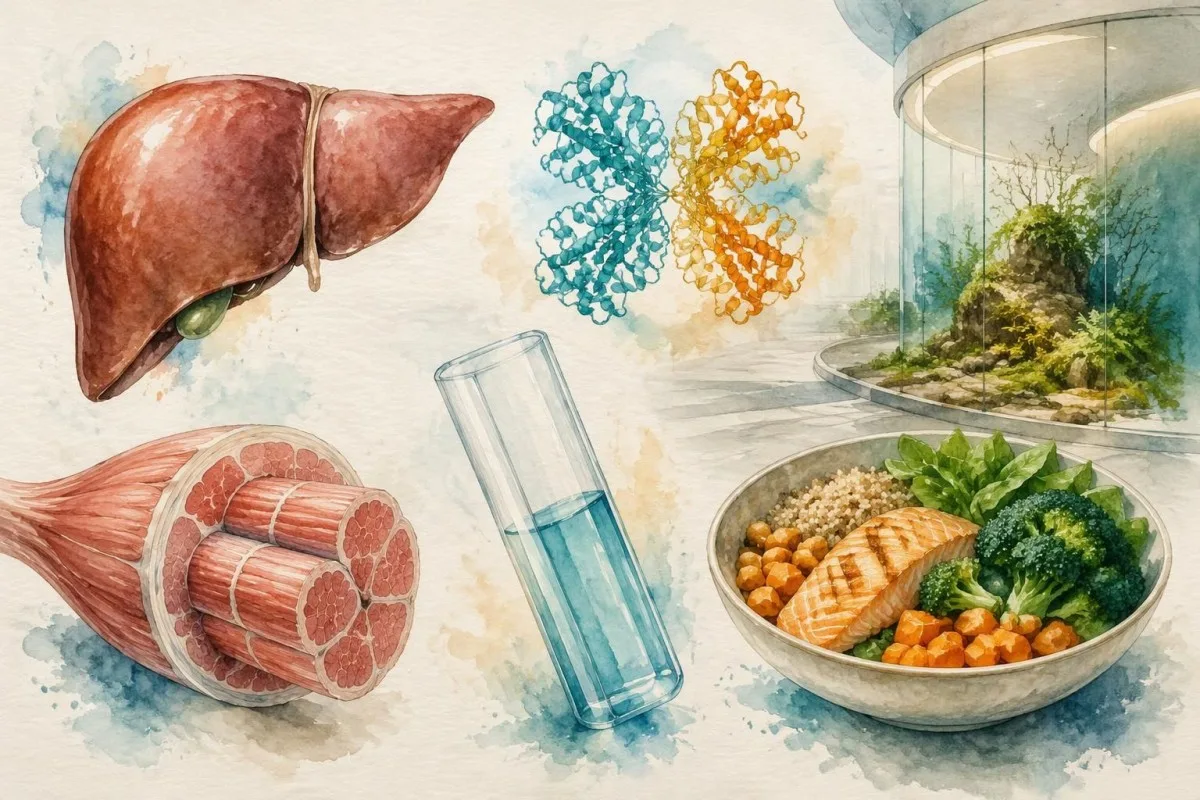
The prealbumin test measures transtiretinu, a transport protein produced mainly by the liver for circulation. Its approximately 2–3-day half-life allows relatively rapid changes, but a rapid response does not make it specific to food intake.
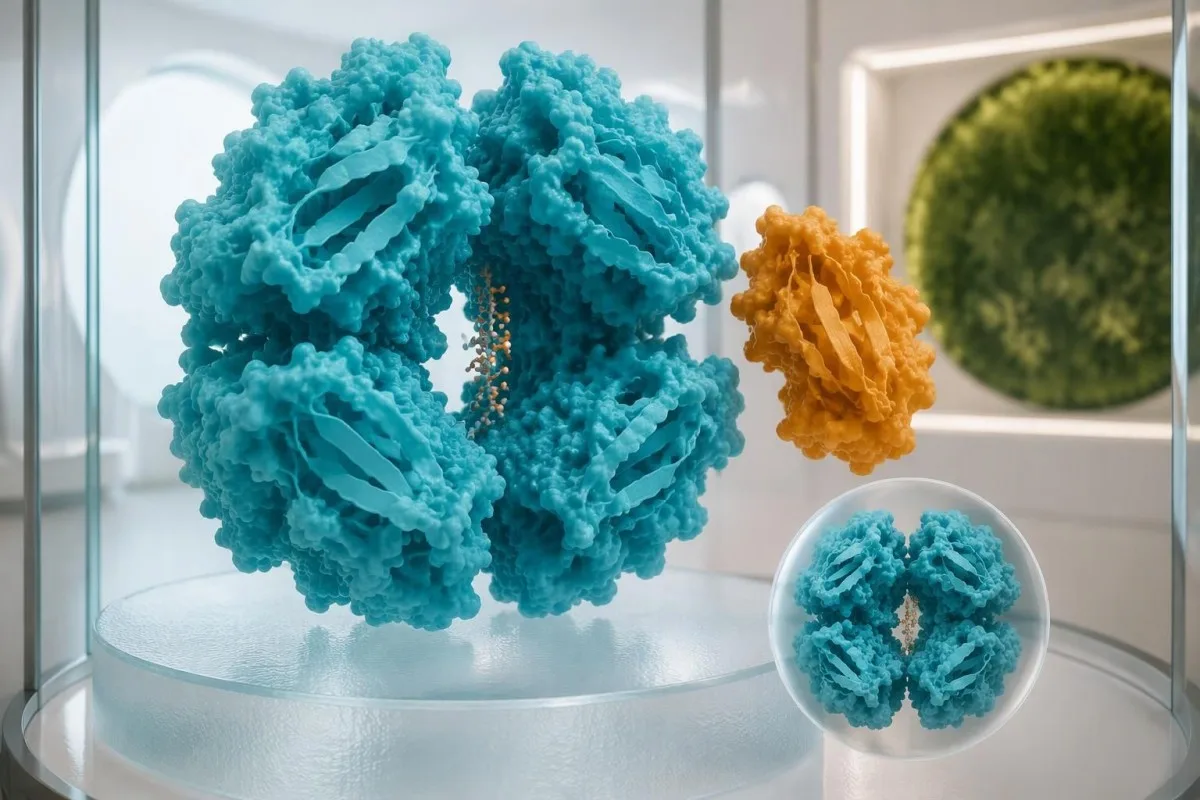
Prealbumin is not an immature form of albumin and does not turn into albumin. The name comes from its migration ahead of albumin during electrophoresis; albumin has a much longer circulating half-life, roughly 20 days, compared with about 2–3 days for prealbumin. These different turnover rates explain why the two results can move at different speeds during an illness.
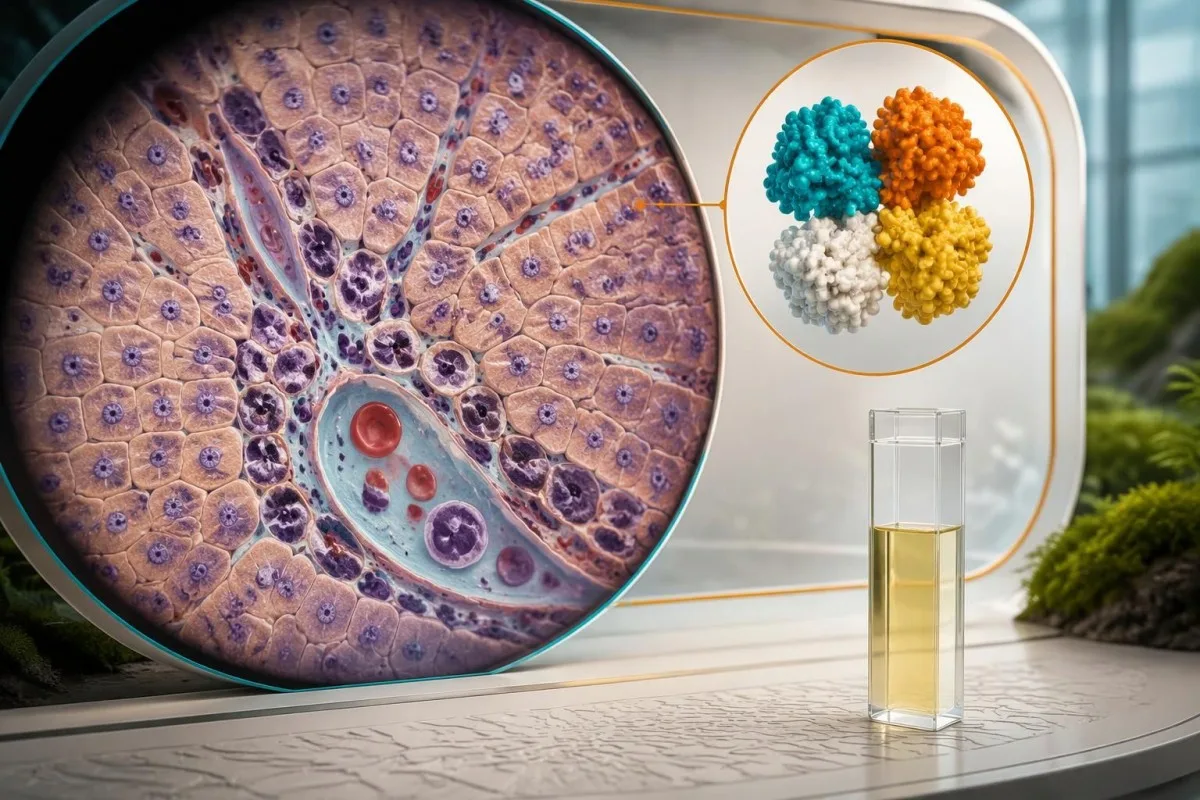
Transthyretin normally forms a tetramer of 4 protein subunits and carries some circulating thyroxine, or T4. It also interacts with retinol-binding protein, which carries vitamin A; a low prealbumin concentration nevertheless does not independently diagnose either thyroid disease or vitamin A deficiency. Transport-protein concentration, hormone activity, and tissue nutrient stores answer different biological questions.
A low concentration is also different from finding a disease-associated variant in the TTR gene. A hypothetical prealbumin result of 14 mg/dL is not a genetic screening result and does not diagnose hereditary ATTR amyloidosis; that evaluation uses a separate clinical and genetic pathway. Our explanation of TTR variants and amyloidosis helps separate these easily confused meanings of the same protein name.
Kodėl uždegimas mažina prealbumino kiekį, nors valgote?
Prealbumin is a negative acute-phase protein: its circulating concentration often falls during inflammation as liver protein production changes. A hypothetical value of 10 mg/dL during severe illness can therefore occur even when recent calorie and protein intake have been adequate.
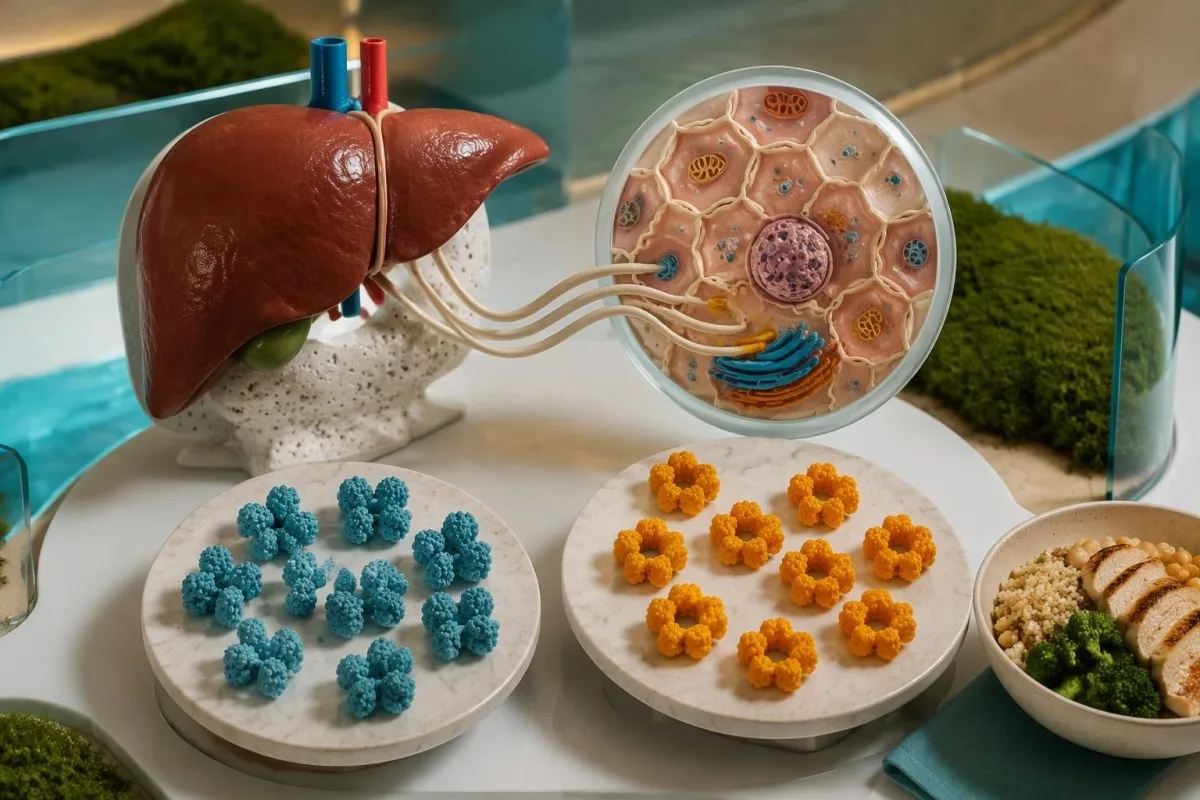
Inflammatory signaling changes what the liver produces rather than simply indicating that the patient skipped meals. Mediators including interleukin-6 promote the acute-phase response, while concentrations of proteins such as prealbumin can decline; its 2–3-day half-life makes that shift relatively quick. The IL-6 interpretation guide explains why timing and illness context matter, although IL-6 testing is not routinely needed to assess nutrition.
Inflammation can lower prealbumin independently of intake and also increase nutritional risk through appetite loss and catabolism. These are 2 overlapping processes, not competing explanations: a person may initially eat adequately yet lose muscle during prolonged illness because the body's metabolic demands and tissue breakdown have changed. Calling the result 'just inflammation' can therefore be as misleading as calling it proof of starvation.
Other negative acute-phase proteins may move in the same direction, so a combination of low prealbumin and low transferrin does not provide 2 independent confirmations of malnutrition. Their shared response to inflammation can create an apparently convincing pattern from the same underlying mechanism. Our guide to inflammation and low transferrin explains why clinicians examine the cause before interpreting several low transport proteins as dietary deficiencies.
Kaip reikėtų kartu vertinti prealbumino ir CRP rodiklius?
CRP helps identify inflammatory context, but it cannot correct prealbumin into a nutrition score. A hypothetical combination of prealbumin 12 mg/dL and CRP 90 mg/L strongly raises concern that an acute-phase response is influencing the protein result.
A normal CRP reduces evidence for a substantial systemic acute-phase response at that moment, but it does not prove that low prealbumin is dietary. Many laboratories use a CRP upper limit around 5 mg/L, while others use 10 mg/L; sampling timing, localized disease, and liver disease can complicate interpretation. There is no universal CRP cutoff below which prealbumin becomes a validated malnutrition test.
Discordant inflammatory markers should lead to questions about timing, symptoms, and treatment rather than a mathematical workaround. A hypothetical patient with prealbumin 13 mg/dL, CRP 4 mg/L, and a normal white cell count still needs an intake and weight history; clinicians may also investigate liver function or persistent symptoms. Our discussion of disagreeing infection markers explains why one reassuring marker cannot settle the whole clinical picture.
Kantesti AI can help readers distinguish a prealbumin result of 12 mg/dL from a CRP result of 90 mg/L and understand what each measurement contributes. Neither a prealbumin-to-CRP ratio nor dividing one value by the other is an accepted substitute for nutritional assessment. When CRP is missing, that uncertainty should remain visible—not be replaced by a confident dietary diagnosis.
Kaip kepenų ir inkstų ligos keičia prealbumino kiekį?
Liver disease can reduce prealbumin production, while impaired kidney function can increase its concentration through reduced catabolism. A value of 15 mg/dL or 45 mg/dL therefore cannot be interpreted as poor or excellent nutrition without knowing the organ-function context.
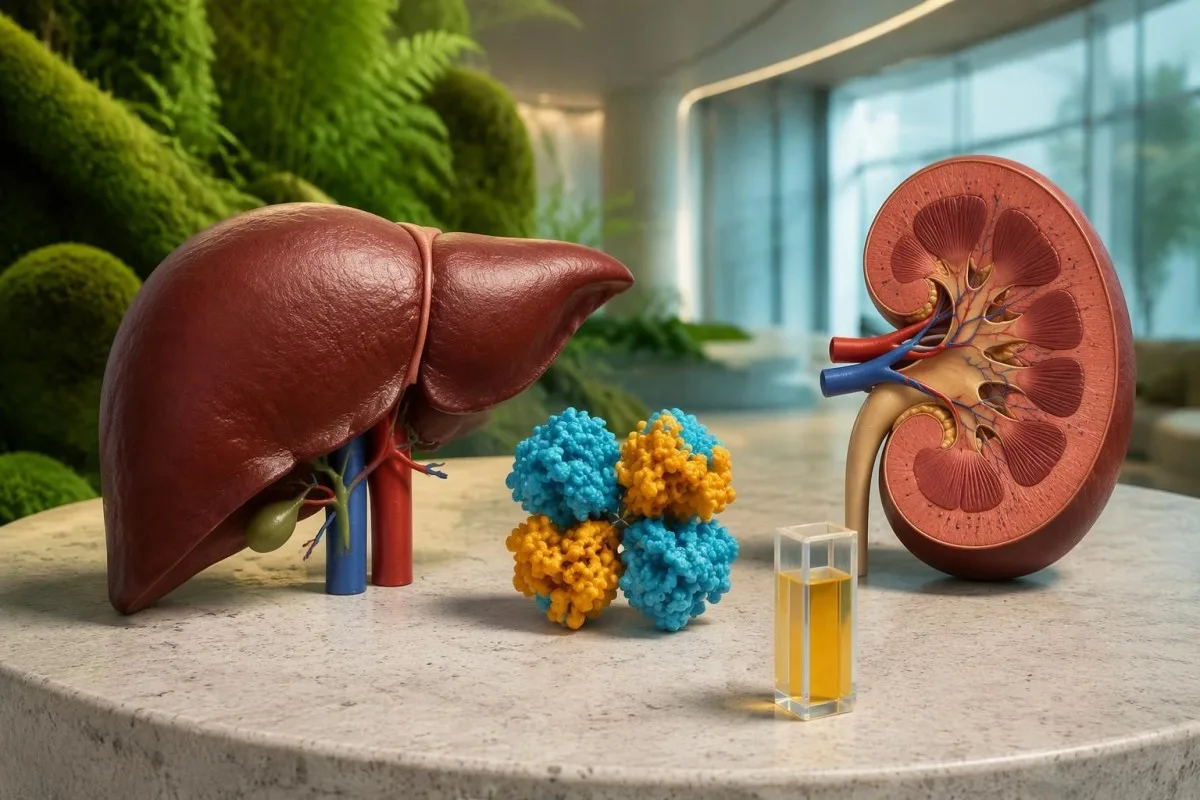
Reduced hepatic synthetic capacity is different from an isolated rise in a liver enzyme. A hypothetical ALT of 80 IU/L does not quantify how much prealbumin the liver can produce; clinicians consider the broader pattern, including albumin, bilirubin, coagulation results, history, and examination. The laboratoriniai cirozės požymiai guide explains why apparently modest enzyme changes can coexist with more significant liver dysfunction.
Kidney disease can pull the result in more than one direction because reduced catabolism may raise prealbumin while concurrent inflammation or poor intake lowers it. A hypothetical adult with eGFR 25 mL/min/1.73 m² and prealbumin 38 mg/dL may still have clinically significant weight and muscle loss. Our guide to mažo eGFR įspėjamuosius ženklus explains the kidney findings that deserve attention beyond this transport protein.
Protein loss in urine should be assessed directly rather than inferred from prealbumin. Urine albumin or protein measurements, serum albumin, and kidney evaluation answer questions that a prealbumin concentration of 16 mg/dL cannot resolve; nephrotic conditions do not produce a reliably predictable prealbumin pattern. The practical step is to bring renal results and liver results to the same appointment, especially before changing protein intake substantially.
Ar skysčiai, vaistai arba tyrimo metodo problemos gali pakeisti rezultatus?
Fluid balance, some medicines, and method-specific assay interference can change prealbumin test results. A hypothetical decline from 22 to 16 mg/dL after major fluid administration may partly reflect dilution rather than a sudden change in nutritional reserves.
Prealbumin is a concentration measurement, so the amount of circulating fluid affects how the result is expressed. Rapid fluid retention can lower measured concentrations, while dehydration can raise them; a 3 kg weight increase over several days may represent fluid rather than new tissue. Clinicians therefore distinguish weight recovery from edema and avoid interpreting a falling protein concentration in isolation after resuscitation.
Corticosteroids can increase prealbumin concentrations, although the overall result also depends on the illness being treated. A hypothetical change from 18 to 25 mg/dL after corticosteroid treatment could reflect medication effects, reduced inflammation, nutritional changes, or a mixture of all 3. Record the medicine's name, dose, and start date rather than assuming every increase means that a nutrition plan succeeded.
An unexpected isolated result deserves a check of units, specimen quality, and the laboratory's interference notes before extensive dietary changes. A hypothetical prealbumin of 9 mg/dL alongside several unexpected assay findings may justify discussion with the laboratory; interference is method-dependent, not something every patient needs repeat testing for. Our explanation of inflammation and plasma zinc also shows why several low circulating nutrients or proteins may share a non-dietary explanation.
Pagal kokius kriterijus iš tikrųjų diagnozuojama nepakankama suaugusiųjų mityba?
GLIM diagnoses adult malnutrition using at least 1 phenotypic criterion and 1 etiologic criterion after nutritional risk screening. Phenotypic criteria include weight loss, low BMI, or reduced muscle mass; etiologic criteria include reduced intake or assimilation, or inflammation and disease burden.

The international GLIM consensus uses unintentional weight loss greater than 5% within 6 months, or greater than 10% beyond 6 months, as a phenotypic criterion (Cederholm et al., 2019). A hypothetical change from 70 to 66 kg is approximately 5.7% loss, even if the person still appears well nourished. The timing and whether the loss was intended matter as much as the arithmetic.
GLIM's commonly used non-Asian low-BMI thresholds are below 20 kg/m² for adults younger than 70 and below 22 kg/m² for adults aged 70 or older, with population-specific adaptations. These are diagnostic-framework thresholds, not universal healthy-weight boundaries; reduced muscle mass can establish a phenotype even when BMI is higher. Neither BMI nor prealbumin alone captures how much functional tissue a person has lost.
Kantesti is an AI biomarker interpretation platform that explains why prealbumin of 14 mg/dL cannot replace GLIM's clinical criteria. Specific deficiencies can coexist with malnutrition, but a low folate result is a different diagnostic question from total calorie and protein adequacy; our guide to folate deficiency causes makes that distinction. A nutrition assessment should identify the syndrome and its cause, not collect abnormal laboratory flags as a substitute.
Ką turėtų apimti tinkamas mitybos būklės vertinimas?
A useful nutrition assessment documents weight trajectory, actual intake, eating barriers, muscle changes, and disease burden. Reviewing the previous 1–6 months often reveals more than a single prealbumin concentration, particularly when fluid retention or a higher BMI hides tissue loss.

A higher BMI does not exclude malnutrition after substantial unintentional weight loss. A hypothetical adult weighing 80 kg who falls to 74 kg has lost 7.5%; at 1.65 m tall, the current BMI remains approximately 27.2 kg/m² despite that meaningful change. Clinicians ask whether clothing fits differently, strength has declined, and swelling is masking further tissue loss rather than judging nutritional status from appearance.
Reduced intake should be investigated as a symptom with a cause, not treated as a failure of motivation. Difficulty swallowing, painful eating, nausea, dental problems, limited food access, and medication effects require different solutions; a 3-day food record can help describe the pattern but does not diagnose malabsorption. Persistent swallowing problems may need evaluation such as the pathway described in our achalasia diagnostic guide.
Digestive investigations should follow symptoms and risk factors instead of being ordered because prealbumin is below 20 mg/dL. Chronic diarrhea with weight loss may warrant targeted evaluation for intestinal disease, whereas visible food fragments alone do not establish nutrient malabsorption. Our guide to stool inflammation tests explains what those tests can contribute; muscle assessment and intake history still remain necessary even when gastrointestinal testing identifies a cause.
Kada prealbumino tyrimą iš tikrųjų naudinga pakartoti?
Repeating prealbumin is useful only when the result will answer a defined clinical question. Its 2–3-day half-life does not justify routine testing every few days, and an increase cannot independently prove that nutrition treatment has restored muscle or body protein.

Prealbumin can rise as inflammation resolves even when food intake has changed very little. In a hypothetical recovery, prealbumin increases from 10 to 18 mg/dL while CRP falls from 120 to 8 mg/L over 10 days; the pattern supports a changing acute-phase response but cannot quantify how much nutrition contributed. Improved concentration is not equivalent to restored strength, healed tissue, or replenished lean mass.
If a clinician chooses to repeat testing, an interval such as 1–2 weeks after a meaningful clinical change may be reasonable, but it is not a universal guideline schedule. Record the illness course, fluid status, medication changes, intake, and laboratory method at both time points. Our guide to meaningful laboratory trends explains why the circumstances surrounding each measurement determine whether comparison is informative.
Kantesti can help organize dated prealbumin measurements, but 2 results cannot reveal unrecorded food intake or establish muscle recovery. ASPEN's 2021 position paper advises against using visceral proteins as nutrition markers, so clinical outcomes and documented intake should lead monitoring rather than a target prealbumin value (Evans et al., 2021). Ask what management decision would change before arranging another measurement.
Ar reikėtų vartoti daugiau baltymų, kad padidėtų prealbumino kiekis?
Increase nutrition when an assessment identifies inadequate intake or increased needs—not simply to push prealbumin above 20 mg/dL. A low result does not specify a protein dose, and kidney disease, severe illness, fluid restrictions, and refeeding risk can change the appropriate plan.
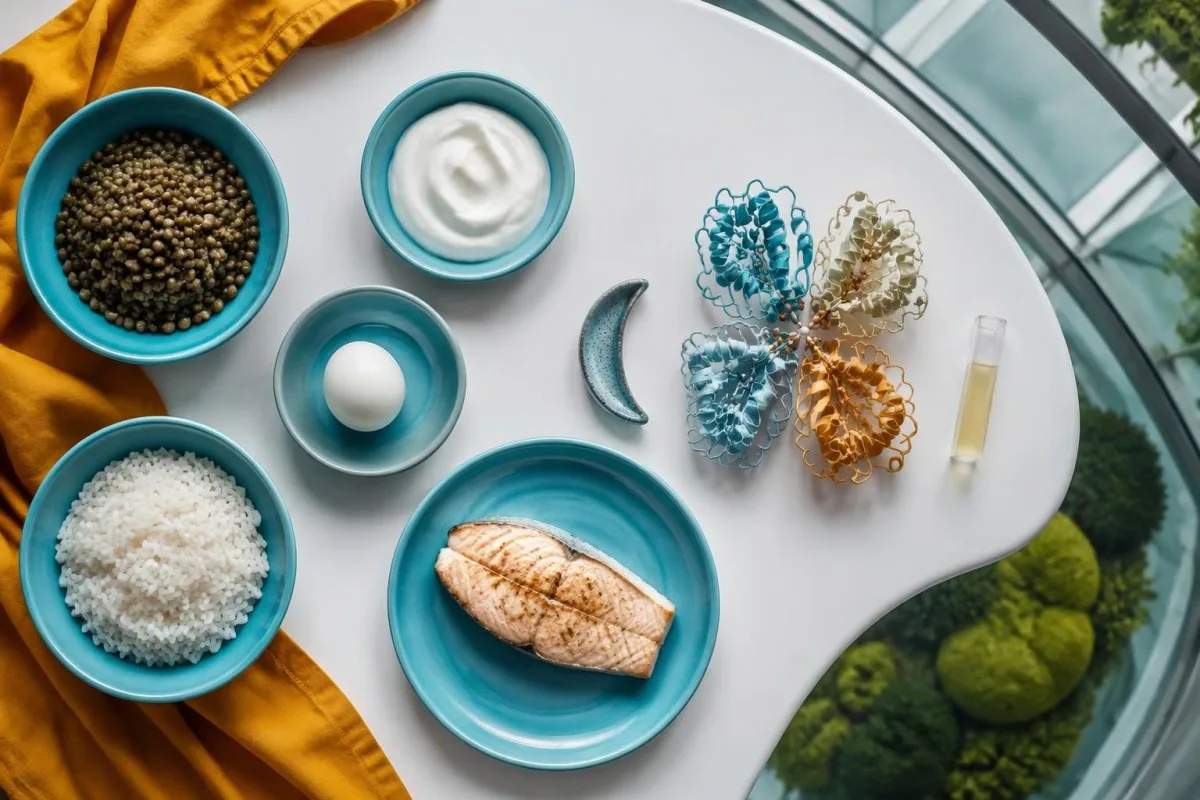
For adults requiring nutrition support who are not severely ill and are not at refeeding risk, NICE CG32 gives general estimates of 25–35 kcal/kg/day and 0.8–1.5 g protein/kg/day (NICE, 2006). These are planning ranges with clinical exceptions, not instructions for everyone with low prealbumin. The CG32 nutrition-support guidance also addresses fluid, electrolytes, micronutrients, and the route through which nutrition is delivered.
A hypothetical 60 kg adult would have an estimated range of 1,500–2,100 kcal/day and 48–90 g protein/day under those general assumptions. The wide range reflects different needs; it is not a reason to choose the highest protein intake automatically, particularly with kidney disease. Our discussion of saugaus inkstų ligonių maitinimosi ribos explains why an AI-generated plan still needs appropriate clinical constraints.
Food fortification or oral nutrition supplements may help when ordinary meals do not meet documented needs, but treating the eating barrier remains necessary. A hypothetical person managing only 50% of meals because of persistent nausea needs evaluation of the nausea as well as a feasible nutrition plan. There is no established prealbumin threshold that automatically requires protein powders, intravenous nutrition, or a particular supplement formulation.
Kada dėl mažo suvartojamo maisto kiekio ir ligos reikia skubiai kreiptis pagalbos?
Urgency comes from symptoms, prolonged inadequate intake, and metabolic risk—not the prealbumin number alone. NICE identifies more than 10 days with little or no nutrition as one high-risk criterion for refeeding problems, which require supervised nutrition restoration.
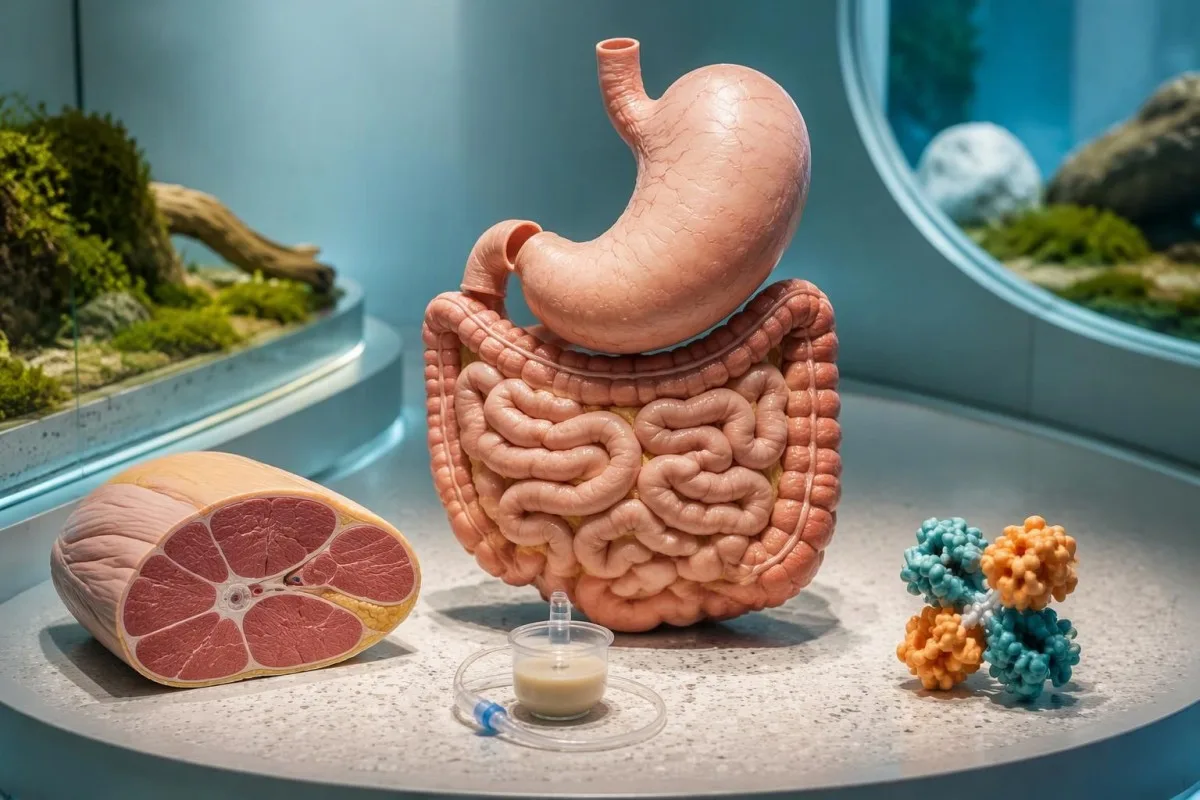
Seek urgent care for confusion, fainting, severe weakness, inability to keep fluids down, very little urine, or breathing difficulty, regardless of whether prealbumin is 8 or 28 mg/dL. Persistent vomiting or diarrhea can create dehydration and electrolyte problems before a transport-protein result becomes informative. Our digestive warning signs guide helps distinguish symptoms that need assessment rather than another nutrition-marker test.
Refeeding risk depends on history and clinical findings, not on a low prealbumin concentration. NICE lists BMI below 16 kg/m², unintentional weight loss greater than 15% over 3–6 months, more than 10 days of minimal intake, or low potassium, phosphate, or magnesium before feeding as individual high-risk criteria; combinations of less severe findings can also qualify. A normal initial electrolyte result does not guarantee that body stores are adequate.
For people who have eaten little or nothing for more than 5 days, NICE recommends initially introducing nutrition at no more than 50% of requirements for the first 2 days, with monitoring. High-risk plans may start at no more than 10 kcal/kg/day under experienced clinical supervision, with thiamine and electrolyte management (NICE, 2006). These figures explain why simply drinking several high-calorie supplements at once can be unsafe after prolonged restriction—they are not a home treatment protocol.
Kaip DI gali padėti saugiai interpretuoti prealbumino kiekį?
AI can explain prealbumin terminology, organize related results, and identify missing context; it cannot diagnose nutritional status from a laboratory report alone. A result of 12 mg/dL needs information about illness, intake, weight, medications, and organ function before its meaning becomes clearer.
Kantesti is an AI blood test interpretation platform that helps explain why prealbumin of 12 mg/dL and CRP of 90 mg/L should be read as different measurements. Our Dirbtinio intelekto technologijos paaiškinimas describes the interpretation workflow; the safe clinical boundary remains the same whether the explanation is generated quickly or reviewed slowly. Software cannot palpate muscle, observe swallowing, or independently verify the meals someone actually consumed.
A useful interpretation separates measured facts from missing information instead of presenting one confident diagnosis. For example, a hypothetical report containing prealbumin 12 mg/dL but no CRP or weight history should describe those gaps and suggest discussion of nutritional screening, rather than assign a malnutrition grade. Check whether the explanation preserves your laboratory's units and reference interval before using it to prepare questions for an appointment.
Clinical standards should be judged against the specific task, not a broad accuracy claim that covers every medical decision. Even a correct interpretation of 20 mg/dL cannot establish nutrition adequacy without an assessment, and no software benchmark changes that limitation. Our validavimo ir priežiūros sistema is relevant to evaluating methodology; decisions about nutrition support, diagnosis, or urgent care remain matters for qualified healthcare professionals.
Kurie leidiniai pagrindžia šiuos mitybos vertinimo apribojimus?
The clinical conclusions here rest on nutrition guidance, not on unrelated AI publications. The 2021 ASPEN position paper, the 2019 GLIM consensus, and NICE CG32 address different questions: protein-marker limitations, malnutrition diagnosis, and safe nutrition support.
ASPEN's 2021 paper explains why low visceral proteins should not serve as nutrition markers, while GLIM's 2019 consensus specifies the clinical criteria needed to diagnose malnutrition. Neither establishes a prealbumin-only diagnostic cutoff such as 10 or 15 mg/dL; these numbers can describe laboratory abnormalities without proving their cause. NICE CG32 adds practical safety guidance for nutrition support, including the separate assessment of refeeding risk.
Shared inflammatory effects also explain why a broader laboratory panel needs careful interpretation rather than simple abnormal-result counting. A hypothetical low prealbumin of 13 mg/dL alongside low transferrin may reflect one acute-phase mechanism; ferritin can move in the opposite direction during inflammation and complicate assessment of iron stores. Our geležies tyrimų interpretavimo vadovą explains why biochemical pattern recognition must remain connected to the clinical question.
Kantesti's 2 Figshare publications listed below concern women's health education and multilingual hantavirus decision support, respectively. They are included as separate research resources, not as evidence that prealbumin diagnoses malnutrition or that an AI nutrition plan improves clinical outcomes. Our medicininio turinio standartai explain the source-quality distinction readers should expect: a repository DOI identifies a publication, but it does not by itself establish peer review or relevance to this nutrition question.
Dažnai užduodami klausimai
Ar mažas prealbumino kiekis visada reiškia prastą mitybą?
Mažas prealbumino kiekis ne visada reiškia nepakankamą mitybą ir vien pagal jį šios būklės diagnozuoti negalima. 12 mg/dL rezultatas gali rodyti uždegimą, sumažėjusią prealbumino gamybą kepenyse, nepakankamą maisto suvartojimą arba kelias kartu veikiančias priežastis. Vertinant suaugusiųjų nepakankamą mitybą atsižvelgiama į nevalingą svorio kritimą, raumenų masę, suvartojamo maisto kiekį ar jo pasisavinimą ir ligos naštą. Pagal GLIM sistemą, atlikus mitybos rizikos patikrą, būtinas bent 1 fenotipinis ir 1 etiologinis kriterijus.
Koks yra normalus prealbumino kiekis?
Suaugusiesiems dažnai taikomas apytikris prealbumino pamatinis intervalas yra 20–40 mg/dL, tai atitinka 0,20–0,40 g/L. Kai kurios laboratorijos taiko kitokius intervalus, todėl pirmenybę reikėtų teikti jūsų tyrimo ataskaitoje nurodytam intervalui. 200 mg/L vertė atitinka 20 mg/dL, į tai svarbu atsižvelgti lyginant ataskaitas, kuriose naudojami skirtingi matavimo vienetai. Į intervalą patenkantis rezultatas neatmeta nepakankamos mitybos, o vaikų tyrimų rezultatus reikia vertinti atsižvelgiant į amžių.
Ar uždegimas gali sumažinti prealbumino kiekį, jei valgau pakankamai?
Uždegimas gali sumažinti prealbumino kiekį net ir tada, kai pastaruoju metu maisto suvartojama pakankamai, nes prealbuminas yra neigiamas ūmios fazės baltymas. Jo maždaug 2–3 dienų pusinės eliminacijos laikas leidžia koncentracijai gana greitai keistis, kai ligos metu pakinta baltymų gamyba kepenyse. CRP gali padėti nustatyti šį kontekstą, tačiau nėra patvirtintos CRP korekcijos formulės, skirtos mitybos būklei įvertinti. Net ir tinkama mityba visiškai neapsaugo nuo su liga susijusio raumenų nykimo užsitęsusio katabolizmo metu.
Ar pavojingas mažesnis nei 10 mg/dL prealbumino kiekis?
Prealbumino kiekis, mažesnis nei 10 mg/dl, yra gerokai mažesnis už daugelį suaugusiesiems taikomų pamatinių intervalų, tačiau vien šis rodiklis nereiškia, kad būklė yra skubi, ir nėra patvirtinto nepakankamos mitybos sunkumo laipsnio kriterijus. Skubumą gydytojai nustato įvertinę pagrindinę ligą, maisto suvartojimą, svorio pokyčius, organų funkciją ir simptomus. Dėl sumišimo, alpimo, negalėjimo išlaikyti skysčių skrandyje, labai sumažėjusio šlapimo kiekio ar pasunkėjusio kvėpavimo būtina skubiai kreiptis į medikus, nepriklausomai nuo prealbumino rodiklio. Jei ilgą laiką suvartojama labai mažai maisto, prieš sparčiai didinant maisto kiekį taip pat reikia įvertinti pakartotinio maitinimo sindromo riziką.
Kaip greitai prealbumino kiekis turėtų padidėti pagerėjus mitybai?
Nėra patikimo prealbumino padidėjimo laikotarpio, kuris įrodytų, kad mitybos gydymas veikia. Nors jo pusinės eliminacijos laikas yra maždaug 2–3 dienos, prealbumino kiekis gali padidėti dėl nuslūgusio uždegimo arba pasikeitusio vaistų ir skysčių poveikio. Todėl hipotetinis padidėjimas nuo 10 iki 18 mg/dL pats savaime neleidžia kiekybiškai įvertinti mitybos būklės atsikūrimo. Stebint būklę, pirmenybę reikėtų teikti dokumentuotam maisto suvartojimui, svoriui, vertinamam kartu su skysčių balansu, raumenų funkcijai ir pagrindinei klinikinei būklei.
Ar turėčiau vartoti baltymų papildus, jei prealbumino kiekis yra mažas?
Vien tik mažas prealbumino rodiklis nepatvirtina, kad reikia vartoti baltymų papildus, ir neleidžia nustatyti saugios dozės. Atrinktiems suaugusiesiems, kuriems reikia mitybos palaikymo, bet kurie neserga sunkia liga ir kuriems negresia pakartotinio maitinimo sindromas, NICE pateikia bendras planavimo rekomendacijas – 0,8–1,5 g baltymų/kg per parą, tačiau individualūs poreikiai ir apribojimai skiriasi. Inkstų ligos, rijimo sutrikimai ir ilgai trunkantis labai mažas maisto vartojimas gali lemti, koks planas tinkamas. Aptarkite faktinį maisto suvartojimą ir mitybos riziką su gydytoju ar dietologu, užuot mėginę padidinti laboratorinio tyrimo rodiklį.
Sužinokite, kaip skaityti kraujo tyrimo rezultatus
Įkelkite laboratorinio tyrimo ataskaitą ir Kantesti AI per kelias sekundes paprasta kalba paaiškins kiekvieną biomarkerį. Juo naudojasi daugiau nei 2 milijonai žmonių visame pasaulyje.
Nuorodos
- Klein, T., Mitchell, S., & Weber, H. (2026). Moterų sveikatos vadovas: ovuliacija, menopauzė ir hormoniniai simptomai. Kantesti AI medicininiai tyrimai. DOI
- Klein, T., Mitchell, S., & Weber, H. (2026). Daugiakalbė DI pagalba teikiama klinikinė sprendimų parama ankstyvajai hantaviruso triagei: projektavimas, inžinerinis patvirtinimas ir diegimas realiomis sąlygomis, apimantis 50 000 interpretuotų kraujo tyrimų ataskaitų. Kantesti AI medicininiai tyrimai. DOI
- Evans DC et al. (2021). The Use of Visceral Proteins as Nutrition Markers: An ASPEN Position Paper. Nutrition in Clinical Practice. DOI
- Cederholm T et al. (2019). GLIM criteria for the diagnosis of malnutrition – A consensus report from the global clinical nutrition community. Clinical Nutrition. DOI
- National Institute for Health and Care Excellence (2006). Nutrition support for adults: oral nutrition support, enteral tube feeding and parenteral nutrition. NICE Clinical Guideline CG32.
- 2M+Ištirti tyrimai
- 127+Šalys
- 100+Kalbos
Apie medicinos komandą


E-E-A-T patikimumo signalai
Patirtis
Gydytojo vadovaujama klinikinė laboratorinių tyrimų interpretavimo darbo eigų peržiūra.
Ekspertizė
Laboratorinės medicinos dėmesys tam, kaip biomarkeriai elgiasi klinikiniame kontekste.
Autoritetas
Mediciniškai peržiūrėjo dr. Thomas Klein, prisidėjo dr. Sarah Mitchell ir prof. dr. Hans Weber.
Patikimumas
Įrodymais pagrįsta interpretacija su aiškiais tolesnių veiksmų keliais, siekiant sumažinti nerimą.


Medicininė atsakomybės ribojimo nuostata
Šis straipsnis skirtas tik mokymo tikslais ir nesudaro medicininės konsultacijos. Visada kreipkitės į kvalifikuotą sveikatos priežiūros specialistą dėl diagnozės ir gydymo sprendimų.
Paskelbta · Susisiekite su redakcine komanda
Išleido Kantesti Ltd, registruota Anglijoje ir Velse, įmonės Nr. 17090423, Londonas, Jungtinė Karalystė.
