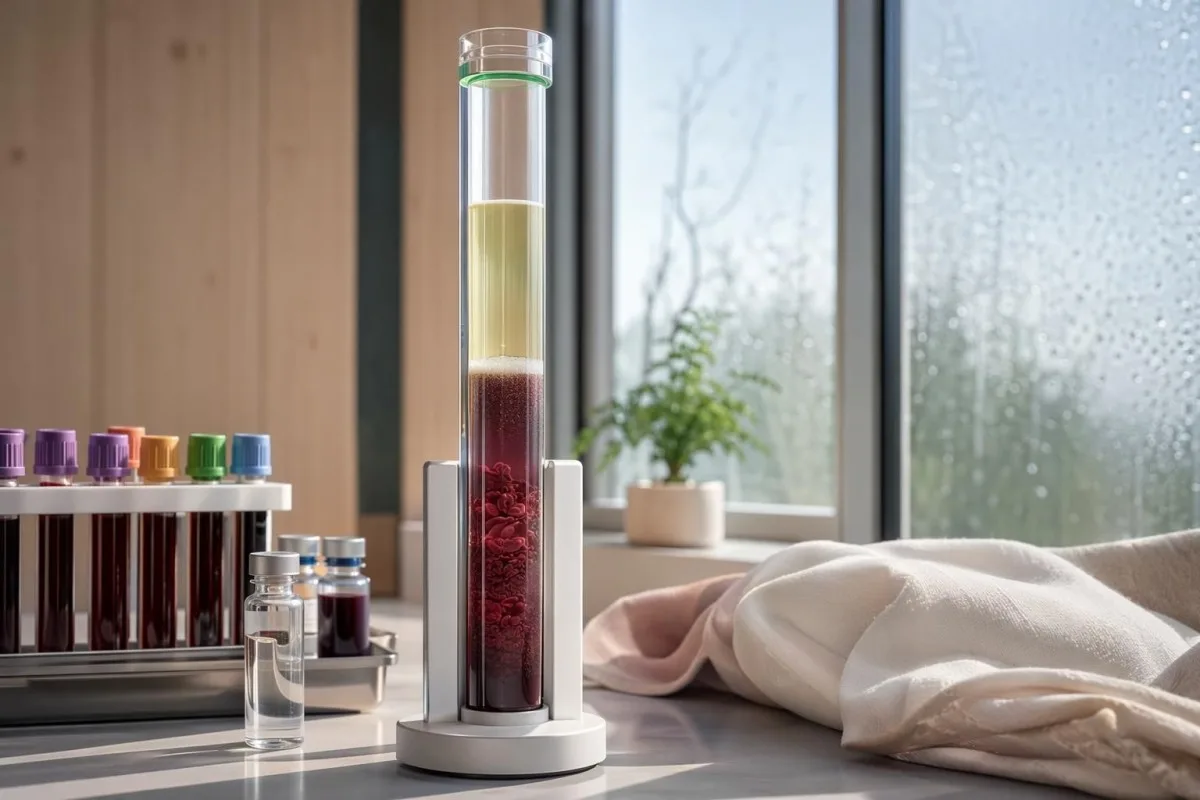
ESR can look alarmingly high in a normal pregnancy because plasma proteins, anemia, and fluid shifts change how quickly red cells settle. The trick is knowing when ESR is background noise and when symptoms or companion labs make it clinically loud.


- High ESR during pregnancy can be physiological; values up to 70 mm/hour in late pregnancy are reported in non-anemic women.
- What does high ESR mean depends on context: pregnancy, anemia, fibrinogen, infection, autoimmune disease, and kidney disease can all raise it.
- CRP is usually better for acute infection because it starts rising within 6-8 hours and changes faster than ESR.
- ESR can stay high for weeks after inflammation settles, so it is poor for judging whether an infection is improving day by day.
- Anemia exaggerates ESR; a hemoglobin below 10.5 g/dL in pregnancy can make the sed rate look more concerning than it is.
- Urgent symptoms matter more than ESR: fever of 38°C or higher, flank pain, chest pain, severe headache, vision changes, or reduced fetal movement need same-day care.
- Companion labs change risk: CRP above 30-50 mg/L, platelets below 100 × 10⁹/L, creatinine above about 0.9 mg/dL, or proteinuria make follow-up more urgent.
- A sed rate high in pregnancy with normal CRP, normal urine, stable blood pressure, and no symptoms is often watched rather than treated.
What does high ESR mean in pregnancy?
A high ESR during pregnancy usually means red cells are settling faster because pregnancy raises fibrinogen and other plasma proteins; it does not automatically mean infection. As of July 6, 2026, I still treat ESR as a context marker, not a diagnosis. If you are asking what does high ESR mean, the honest answer is: in pregnancy, it is often expected unless fever, pain, abnormal urine, high CRP, anemia, kidney changes, or blood pressure changes point elsewhere.
Kantesti is an AI blood test interpretation platform that reads ESR alongside CBC, CRP, urine results, and pregnancy timing rather than treating one flagged value as a verdict. In my clinical work as Dr. Thomas Klein, I have seen a late-pregnancy ESR of 65 mm/hour cause real panic, even when CRP was 3 mg/L and the patient felt completely well.
The erythrocyte sedimentation rate is measured in mm/hour and reflects how quickly red cells settle in a vertical tube. If you want the non-pregnancy mechanics first, our deeper guide to the sedimentation rate explains why ESR rises and falls slowly compared with newer inflammation markers.
One useful rule: ESR asks whether the plasma environment has changed, while symptoms ask whether the patient is unwell. A pregnant patient with ESR 78 mm/hour, fever 38.4°C, and right-sided back pain is a different case from ESR 78 mm/hour, normal urine, normal CRP, and no symptoms.
Why ESR rises physiologically during pregnancy
ESR rises in pregnancy because fibrinogen, immunoglobulins, and plasma volume change the way red cells stack and settle. This is physiology, not a flaw in the test.
Fibrinogen commonly rises from roughly 200-400 mg/dL outside pregnancy to about 400-650 mg/dL in late pregnancy. That extra fibrinogen encourages rouleaux formation, a stacking pattern that makes ESR climb even when CRP is normal.
Pregnancy is also a controlled immune adaptation, not an immune shutdown. Mor and Cardenas described pregnancy as a complex immune state rather than simple suppression, which fits what we see clinically: mild inflammatory shifts can be normal, but focal symptoms still matter (Mor & Cardenas, 2010).
This is why elevated ESR pregnancy reports often look more dramatic than the patient feels. For acute inflammatory interpretation, I usually compare ESR with CRP in pregnancy, because the two markers answer different questions.
Trimester ESR ranges that prevent overreaction
Pregnancy ESR ranges are much higher than ordinary adult ranges, especially in the second half of pregnancy. A value that looks abnormal on a generic lab report may sit inside published pregnancy-specific ranges.
The best pregnancy-specific ESR data many clinicians still quote comes from van den Broek and Letsky in BJOG. They reported non-anemic reference intervals of about 18-48 mm/hour in the first half of pregnancy and 30-70 mm/hour in the second half (van den Broek & Letsky, 2001).
Anemia pushes the ranges higher. In the same BJOG paper, anemic women had ESR ranges of roughly 21-62 mm/hour in the first half and 40-95 mm/hour in the second half of pregnancy, which explains why a sed rate high in pregnancy can be misleading if hemoglobin is low.
A generic non-pregnant female reference range of 0-20 or 0-29 mm/hour is not enough for antenatal interpretation. Pregnancy also changes white cell ranges, so I often pair ESR with our WBC pregnancy guide before I decide whether a flagged inflammation marker is meaningful.
When ESR is less useful than CRP
ESR is less useful than CRP when you need to know whether inflammation is new, worsening, or improving over days. CRP moves faster, while ESR is heavily distorted by pregnancy and anemia.
CRP begins rising about 6-8 hours after an inflammatory trigger, often peaks around 48 hours, and has a plasma half-life of about 19 hours. Pepys and Hirschfield’s JCI review remains a clear explanation of why CRP kinetics are useful for acute monitoring (Pepys & Hirschfield, 2003).
ESR can remain elevated for weeks after the original trigger settles because fibrinogen and immunoglobulin patterns normalize slowly. That lag is why I do not use ESR alone to decide whether antibiotics are working at 24-72 hours.
If CRP is 3 mg/L and ESR is 72 mm/hour in late pregnancy, I usually look for anemia, fibrinogen effects, and chronic conditions before assuming infection. If CRP is 85 mg/L with fever, I pay attention quickly; our CRP after infection guide explains the expected fall once the trigger is controlled.
Companion labs that make high ESR matter
A high ESR becomes more clinically important when CRP, CBC, urine, kidney function, liver enzymes, or platelets are also abnormal. The pattern is far more informative than the sed rate alone.
The combination I watch most closely is ESR plus CRP plus neutrophils plus urine. A CRP above 30-50 mg/L, rising neutrophil count, and positive urine nitrites or leukocyte esterase can point toward infection even if the ESR would be explainable by pregnancy.
CBC details matter. Hemoglobin below 10.5 g/dL, platelets below 100 × 10⁹/L, or a marked left shift changes the conversation; for a refresher on what the counts mean, see our guide to CBC components.
When I, Dr. Thomas Klein, review antenatal panels, I also check albumin and creatinine because pregnancy should lower creatinine, not raise it. A creatinine around 0.9 mg/dL or higher in pregnancy can be more concerning than it looks on a standard adult reference range.
Symptoms that make a high ESR urgent
High ESR needs urgent follow-up when it appears with fever, severe pain, breathing symptoms, neurological symptoms, high blood pressure signs, or reduced fetal movement. Symptoms outrank the ESR value.
Call your maternity unit, obstetric clinician, or emergency service the same day for fever of 38°C or higher, shaking chills, chest pain, shortness of breath, fainting, severe headache, visual changes, right upper abdominal pain, or new swelling with high blood pressure. ESR does not triage these symptoms; the patient does.
Reduced fetal movement after the usual stage when movement is established should not be explained away by a lab number. Our guide to pregnancy lab red flags lists the same-day patterns I would rather over-check than miss.
Pain location helps. Flank pain with urinary symptoms suggests a different pathway from swollen painful joints, persistent cough, calf swelling, or severe pelvic pressure, even if all four scenarios can share an ESR of 80 mm/hour.
Infection patterns where ESR can mislead
ESR can be high in pregnancy without infection, so infection workup should rely on symptoms, CRP, cultures, urinalysis, and examination. The most common trap is treating the ESR instead of the source.
Urinary infection is the classic example. A pregnant patient with burning urination, flank pain, fever, CRP 60 mg/L, and positive nitrites needs prompt assessment; ESR may be high, but it adds little to the decision.
A urine dip can miss or overcall infection depending on hydration, contamination, and timing. If urinary symptoms are present, our urine culture comparison explains why culture can matter even after a quick dipstick.
Severe infection can also show lactate elevation, low blood pressure, confusion, or very fast breathing. In pregnancy, a heart rate above 110 beats/min can occur for benign reasons, but fever plus tachycardia plus high CRP is not a pattern I would watch casually at home.
Autoimmune disease: when ESR still helps
ESR can still be useful in pregnancy when the question is chronic autoimmune activity rather than acute infection. It is imperfect, but trends can support the story when symptoms and disease-specific tests agree.
Inflammatory arthritis, lupus, vasculitis, and inflammatory bowel disease can all flare in pregnancy or postpartum. ESR alone cannot diagnose these conditions, but ESR 95 mm/hour with swollen joints, morning stiffness lasting over 60 minutes, and anemia deserves a targeted review.
CRP may be normal in some autoimmune patterns, especially certain lupus presentations. That is one reason I avoid a simplistic rule that normal CRP always means nothing inflammatory is happening.
If joint pain, rash, mouth ulcers, Raynaud symptoms, or urine protein appear with a high ESR, the workup may include ANA, complement C3/C4, urine protein, and disease-specific antibodies. Our joint pain lab guide walks through those first-line patterns.
High ESR is not the test for preeclampsia
ESR is not a reliable test for preeclampsia; blood pressure, urine protein, platelets, creatinine, AST, and ALT matter more. A normal or high ESR does not rule preeclampsia in or out.
The usual diagnostic threshold for hypertension in pregnancy is 140/90 mmHg or higher after 20 weeks, measured correctly and confirmed according to local protocols. Severe-range readings, often 160/110 mmHg or higher, need urgent clinical action.
Proteinuria is commonly defined as 300 mg or more in 24 hours, a protein-to-creatinine ratio of 0.3 mg/mg, or about 30 mg/mmol in many UK-style reports. Our guide to blood pressure in pregnancy gives practical call thresholds that matter more than ESR.
I become more concerned when platelets fall below 100 × 10⁹/L, AST or ALT rise to about twice the upper limit, or creatinine rises above the pregnancy-expected range. Those changes can be clinically significant even if ESR is only mildly elevated.
Anemia and iron deficiency can exaggerate ESR
Anemia can make ESR look higher because fewer red cells and altered cell spacing allow faster settling. In pregnancy, iron deficiency is one of the common reasons ESR looks more alarming than the clinical picture.
A hemoglobin below 11.0 g/dL in the first or third trimester, or below 10.5 g/dL in the second trimester, is commonly used to define anemia in pregnancy. Ferritin below 30 ng/mL often supports iron deficiency, though inflammation can falsely lift ferritin.
This is where pattern reading saves patients from bad advice. ESR 88 mm/hour with hemoglobin 9.8 g/dL, ferritin 8 ng/mL, CRP 2 mg/L, and no fever is often an iron-and-pregnancy pattern rather than an infection pattern.
For pregnancy-specific iron interpretation, our iron range guide is more useful than a single serum iron result. Serum iron can swing after meals and supplements; ferritin, transferrin saturation, MCV, and CRP make the story clearer.
When to repeat ESR instead of reacting
Repeat ESR when the result does not match symptoms, companion labs, or the pregnancy stage. A recheck is reasonable when the patient is well and CRP, urine, blood pressure, and CBC are reassuring.
I usually avoid repeating ESR within 24-48 hours unless something clinically changed, because ESR is slow by design. A 1-3 week interval is often more meaningful if the goal is to see whether a chronic inflammatory pattern is drifting.
Pre-analytical issues matter more than most people realize. ESR can shift if the tube is delayed, tilted, underfilled, or not mixed properly, and a different laboratory method can produce slightly different values.
A sudden jump from 35 to 100 mm/hour with normal CRP and no symptoms deserves a sanity check before alarm. Our delta check guide explains how clinicians separate a true biological change from a handling or reporting issue.
How Kantesti AI reads ESR in context
Kantesti AI interprets ESR by comparing it with pregnancy timing, CBC indices, CRP, urine markers, kidney function, liver enzymes, and prior trends. The aim is not to diagnose pregnancy complications by algorithm, but to surface patterns worth discussing with a clinician.
Kantesti is an AI-powered blood test analysis tool used by more than 2M people across 127 countries, and pregnancy ESR is exactly the sort of result that needs context. Our system is designed to avoid the common false reassurance of normal single markers and the equally common panic caused by isolated flags.
The model checks whether ESR is paired with CRP above 10 mg/L, hemoglobin below trimester thresholds, platelets below 150 × 10⁹/L, creatinine above pregnancy-expected values, or urine protein. This is the same pattern-first logic I use in clinic, just applied consistently across uploaded reports.
For readers who want to understand the technical layer, our AI technology guide explains how structured lab data, units, trend analysis, and safety prompts interact. No AI system should replace maternity care; it should help you ask better questions faster.
Questions to ask after an elevated ESR result
After an elevated ESR in pregnancy, ask what the ESR is being compared with: trimester, hemoglobin, CRP, urine, blood pressure, and symptoms. That question is more useful than asking whether the number is simply high.
A practical script is: Is this ESR high for my trimester and hemoglobin, or only high for a non-pregnant range? That one sentence often reveals whether the lab flag is clinically meaningful.
Then ask whether CRP, urine culture, CBC differential, platelets, creatinine, AST, ALT, and blood pressure were reviewed together. Kantesti’s AI biomarker interpretation platform can organize those questions, and our clinical validation page describes the oversight principles behind that approach.
If you have symptoms, bring exact details: temperature in °C, blood pressure readings, urine symptoms, pain location, fetal movement changes, and how long symptoms have been present. A 12-hour fever history and a 3-week fatigue history lead clinicians down very different paths.
Research notes and bottom line for high ESR
The bottom line is simple: high ESR in pregnancy is often expected, but high ESR plus worrying symptoms or abnormal companion labs deserves prompt follow-up. I would rather interpret one ESR carefully than chase five isolated flags blindly.
Kantesti medical content is written with physician oversight, and our Medical Advisory Board reviews the safety framing for high-risk topics like pregnancy labs. This matters because the wrong tone can either frighten a well patient or reassure someone who needs same-day care.
Kantesti LTD is described on our About Us page as a privacy-focused health technology company, and the medical writing team separates educational interpretation from diagnosis. For women’s health context beyond ESR, see our research-linked women’s health guide.
Klein, T., & Kantesti Medical Writing Group. (2026). Women’s Health Guide: Ovulation, Menopause & Hormonal Symptoms. Figshare. https://doi.org/10.6084/m9.figshare.31830721. ResearchGate | Academia.edu.
Klein, T., & Kantesti Medical Writing Group. (2026). Diarrhea After Fasting, Black Specks in Stool & GI Guide 2026. Figshare. https://doi.org/10.6084/m9.figshare.31438111. ResearchGate | Academia.edu. Symptom triage across body systems is different from ESR interpretation, but the same rule applies: patterns beat isolated numbers.
Frequently Asked Questions
What does high ESR mean during pregnancy?
High ESR during pregnancy usually means the blood is settling faster because pregnancy increases fibrinogen, immunoglobulins, and plasma volume. Published pregnancy-specific ranges can reach about 70 mm/hour in non-anemic women in the second half of pregnancy and about 95 mm/hour in anemic women. A high ESR becomes more concerning when it appears with fever, pain, high CRP, abnormal urine, low platelets, kidney changes, or high blood pressure.
Is an ESR of 60 or 70 normal in late pregnancy?
An ESR of 60-70 mm/hour can be within reported ranges for the second half of pregnancy, especially if hemoglobin is low or fibrinogen is high. In the BJOG pregnancy ESR study, non-anemic women in the second half of pregnancy had values reported up to about 70 mm/hour. The result should still be checked against CRP, CBC, urine testing, blood pressure, and symptoms rather than dismissed automatically.
Why is CRP often preferred over ESR in pregnancy?
CRP is often preferred over ESR in pregnancy because CRP changes faster and is less distorted by anemia and pregnancy-related fibrinogen shifts. CRP can start rising within 6-8 hours after an inflammatory trigger and often peaks around 48 hours. ESR may remain high for weeks, so it is less useful for deciding whether an infection is improving day by day.
When should I call a doctor for high ESR during pregnancy?
Call a maternity clinician the same day if high ESR appears with fever of 38°C or higher, chills, flank pain, chest pain, shortness of breath, severe headache, visual changes, right upper abdominal pain, reduced fetal movement, or blood pressure readings around 140/90 mmHg or higher. ESR alone rarely decides urgency. Symptoms plus abnormal CRP, urine protein, platelets, creatinine, AST, or ALT should be treated as a higher-risk pattern.
Can iron deficiency make ESR high in pregnancy?
Yes, iron deficiency anemia can make ESR higher because anemia changes red cell spacing and settling behavior. Hemoglobin below 11.0 g/dL in the first or third trimester, or below 10.5 g/dL in the second trimester, commonly meets pregnancy anemia criteria. Ferritin below 30 ng/mL often supports iron deficiency, but ferritin should be interpreted with CRP because inflammation can raise it.
What labs should be checked with elevated ESR pregnancy results?
Elevated ESR pregnancy results are best interpreted with CRP, CBC with differential, hemoglobin, platelets, ferritin or iron studies, urinalysis, urine culture when indicated, creatinine, AST, ALT, and blood pressure. CRP above 30-50 mg/L, platelets below 100 × 10⁹/L, creatinine around 0.9 mg/dL or higher, or significant urine protein makes follow-up more urgent. A normal CRP and normal urine make acute infection less likely, but symptoms still matter.
Can high ESR harm the baby?
High ESR itself does not harm the baby; it is a marker, not a toxin or disease. The important question is whether the ESR reflects a condition that could affect pregnancy, such as infection, autoimmune flare, kidney disease, or preeclampsia-related complications. If fetal movement changes, fever develops, or blood pressure is high, seek clinical advice promptly rather than focusing on the ESR number.
Does a high ESR mean I need antibiotics?
No. Antibiotics are considered when a clinician identifies or strongly suspects a bacterial infection from your symptoms, examination, and targeted tests such as urine testing or culture; ESR by itself cannot identify the cause of inflammation.
Get AI-Powered Blood Test Analysis Today
Join over 2 million users worldwide who trust Kantesti for instant, accurate lab test analysis. Upload your blood test results and receive comprehensive interpretation of 15,000+ biomarkers in seconds.
📚 Referenced Research Publications
Klein, T., Mitchell, S., & Weber, H. (2026). Diarrhea After Fasting, Black Specks in Stool & GI Guide 2026. Kantesti AI Medical Research.
Klein, T., Mitchell, S., & Weber, H. (2026). Women's Health Guide: Ovulation, Menopause & Hormonal Symptoms. Kantesti AI Medical Research.
📖 External Medical References
⚕️ Medical Disclaimer
This article is for educational purposes only and does not constitute medical advice. Always consult a qualified healthcare provider for diagnosis and treatment decisions.
E-E-A-T Trust Signals
Experience
Physician-led clinical review of lab interpretation workflows.
Expertise
Laboratory medicine focus on how biomarkers behave in clinical context.
Authoritativeness
Written by Dr. Thomas Klein with review by Dr. Sarah Mitchell and Prof. Dr. Hans Weber.
Trustworthiness
Evidence-based interpretation with clear follow-up pathways to reduce alarm.