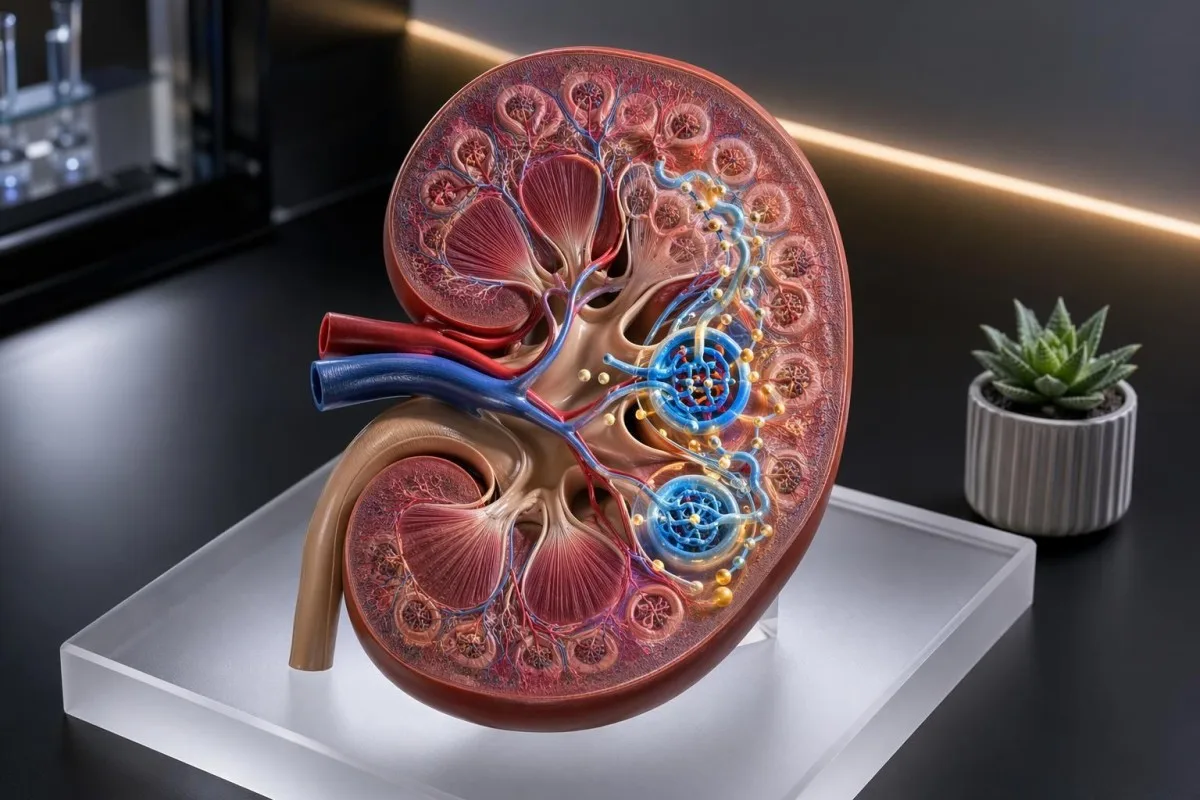
Cystatin C can give a more credible kidney filtration estimate when creatinine is distorted by muscle, diet, ageing, or acute illness. The most useful answer usually comes from comparing both markers rather than choosing a winner.


- Cystatin C blood test results are usually reported in mg/L; many adult laboratories use roughly 0.60-1.00 mg/L, but each laboratory's own interval controls.
- Cystatin C eGFR below 60 mL/min/1.73 m² for 3 months or more may meet the filtration criterion for chronic kidney disease.
- Combined eGFRcr-cys is generally more accurate than creatinine-only or cystatin-C-only eGFR when the two tests are both available.
- Muscle mass can raise creatinine without reducing filtration; a muscular athlete may have a creatinine eGFR near 60 with a reassuring cystatin C result.
- Low muscle mass can make creatinine eGFR look falsely reassuring, particularly in frailty, malnutrition, amputation, or advanced liver disease.
- Thyroid disease and steroids can shift cystatin C independently of kidney filtration, so a single result needs clinical context.
- Urine ACR of 3 mg/mmol or 30 mg/g or more can show kidney damage even when eGFR remains above 60 mL/min/1.73 m².
- Acute illness makes every estimating equation less reliable because neither creatinine nor cystatin C immediately reaches a steady state.
What a cystatin C result adds to a kidney assessment
A cystatin C blood test is most helpful when creatinine may not reflect your true filtration rate. Cystatin C is made by nearly all nucleated cells and is much less dependent on muscle mass or a steak dinner, so it can refine eGFR in athletes, frail older adults, people with major weight change, and those with unusual diets. As Dr. Thomas Klein, I use it to resolve a question, not to declare one marker “right” and the other “wrong.”
Cystatin C is freely filtered at the glomerulus and is then almost completely reabsorbed and broken down in the proximal tubule; it is not returned to the circulation in meaningful amounts. A higher serum cystatin C therefore usually corresponds to lower filtration, although it is not a direct measure of kidney clearance.
For an adult with stable kidney function, an eGFR of 90 mL/min/1.73 m² or higher is in G1, while 45-59 mL/min/1.73 m² is G3a. Kidney disease is not diagnosed from one eGFR alone: persistence for at least 3 months or another marker of kidney injury is required. Our blood test biomarkers guide helps place this result alongside potassium, bicarbonate, albumin, and urine findings.
Kantesti is an AI blood test analyzer that reads cystatin C alongside creatinine, age, sex, and related renal markers rather than treating a laboratory flag as a diagnosis. In my experience, that contextual reading prevents needless alarm after hard training and prevents false reassurance in someone losing muscle.
Cystatin C versus creatinine: why the estimates diverge
Creatinine largely reflects filtration plus creatine turnover from muscle, whereas cystatin C reflects filtration plus a different set of non-kidney influences. The two results diverge most often when body composition has changed or never matched the assumptions built into a creatinine equation.
Creatinine production is higher in people with greater skeletal muscle mass and can rise after cooked meat, creatine supplements, dehydration, or intense exercise. A short explanation of exercise-related creatinine shifts is available in our creatinine after exercise guide. Cystatin C usually changes far less after a protein-heavy meal or a gym session.
The reverse problem matters clinically. A 78-year-old person with sarcopenia may have creatinine of 0.65 mg/dL (57 µmol/L) and creatinine eGFR of 90, yet cystatin C of 1.35 mg/L can yield an eGFR closer to 45; neither number should be dismissed without checking urine albumin, weight trajectory, medication use, and illness.
Creatinine assays are inexpensive and widely standardized, which explains their role in routine panels. Cystatin C testing costs more and assay calibration is not perfectly interchangeable between laboratories, so the same laboratory and method are preferable for serial monitoring.
Cystatin C test results explained: result, range and eGFR
A cystatin C value should be interpreted with the laboratory range and the eGFR equation printed on the report. A result within range does not automatically prove normal filtration, and a mildly high value is not enough by itself to diagnose chronic kidney disease.
Many laboratories quote adult cystatin C reference intervals around 0.60-1.00 mg/L, though intervals of 0.53-0.95 mg/L or 0.62-1.15 mg/L are also used. A reference interval describes 95% of a selected population; it is not a personal kidney-function target or a universal disease cutoff.
The clinically actionable line is commonly the calculated cystatin C eGFR, expressed as mL/min/1.73 m². An eGFR of 60-89 can be normal in the absence of albuminuria or structural disease, especially with increasing age, whereas a persistent value below 60 merits formal assessment.
Kantesti AI interprets cystatin C results by checking whether the report uses a cystatin-only equation or the combined 2021 CKD-EPI equation. If your report omits the equation, compare the raw value only with that laboratory's interval and ask the ordering clinician which eGFR was used.
When clinicians order cystatin C instead of creatinine alone
Clinicians commonly order cystatin C when creatinine eGFR is 45-59 mL/min/1.73 m² without other kidney-damage markers, or when muscle mass makes creatinine unreliable. It is a confirmation and precision test, not usually a replacement for standard renal blood work.
A 30-year-old endurance athlete with creatinine 1.32 mg/dL (117 µmol/L) and eGFRcr of 68 may have cystatin C 0.78 mg/L and a much less concerning combined estimate. The pattern is particularly common after high-volume training, creatine use, or recent strength gains; our normal GFR guide explains why an estimate is not a measured clearance.
Cystatin C is also useful after limb amputation, in neuromuscular conditions, eating disorders, cirrhosis, severe obesity, or hospital-associated muscle loss. Those circumstances alter creatinine generation enough that a normal-looking creatinine may conceal reduced filtration.
The 2024 KDIGO guideline specifically supports cystatin C or combined creatinine-cystatin C estimation when creatinine eGFR may be inaccurate and a decision depends on precision. For a direct comparison of methods, see our cystatin C GFR recheck article.
What it means when cystatin C and creatinine eGFR disagree
When eGFRcys is lower than eGFRcr, the difference may signal hidden low muscle mass, non-kidney cystatin C effects, or genuinely higher health risk. A gap of 15-20 mL/min/1.73 m² is enough to pause and investigate rather than averaging values by eye.
A lower eGFRcys than eGFRcr is frequent in frailty, smoking, systemic tissue response, corticosteroid exposure, and hyperthyroidism. Shlipak and colleagues found that cystatin-C-based classification identified higher mortality and cardiovascular risk among people whose creatinine eGFR seemed less concerning (Shlipak et al., 2013); this does not prove cystatin C causes risk.
A higher eGFRcys than eGFRcr often points toward above-average muscle mass, recent cooked meat, creatine, or exercise. I have reviewed bodybuilders with creatinine around 1.5 mg/dL (133 µmol/L) whose combined eGFR was near 80, but I still check blood pressure and urine albumin before calling the result benign.
One practical rule helps: verify the date, hydration, exercise, supplements, and any rapid weight change before repeating a test. Low creatinine itself carries useful context, as discussed in our low creatinine and muscle guide.
Why combined cystatin C eGFR is often the best estimate
The combined creatinine-cystatin C equation is usually the most accurate routine eGFR when both markers are measured in a stable adult. Its advantage is statistical and biological: one marker's non-kidney bias can partly offset the other's.
Inker et al. developed the 2021 race-free CKD-EPI equations against measured GFR and found the combined equation more accurate than either single-marker equation across study populations (Inker et al., 2021). The combined result is not simply the arithmetic average of two eGFR values; it comes from a validated nonlinear equation using age and sex.
KDIGO 2024 recommends eGFRcr-cys when cystatin C is available and greater accuracy will affect diagnosis, staging, drug dosing, or referral. For chronic kidney disease staging, G3a is 45-59, G3b is 30-44, G4 is 15-29, and G5 is below 15 mL/min/1.73 m².
Kantesti is an AI-powered blood test analysis tool that can compare reported eGFRcr, eGFRcys, and eGFRcr-cys across visits while retaining the laboratory's units and date. Readers curious about the logic behind those pattern checks can review our AI technology guide.
Factors that can raise or lower cystatin C without a GFR change
Thyroid status, glucocorticoid treatment, smoking, body fat, systemic illness, and some cancers can alter cystatin C independently of filtration. These effects are real but usually do not erase the test's value; they tell us when a combined estimate is safer than cystatin C alone.
Hyperthyroidism tends to increase cystatin C and can make eGFRcys look lower, while hypothyroidism can lower cystatin C and make eGFRcys look higher. If TSH or free T4 is abnormal, correct the thyroid disorder first when the kidney question is not urgent; our thyroid tests guide covers the relevant pairing.
Prednisone and other systemic glucocorticoids can increase cystatin C production, sometimes within days, without a matching fall in measured GFR. Higher body mass, current smoking, and active systemic tissue response are associated with higher cystatin C as well, so the raw value should never be interpreted without history.
Pregnancy deserves separate caution because filtration rises early while standard adult equations are not validated for obstetric decision-making. Children require paediatric equations rather than adult CKD-EPI reporting, and transplant recipients may have additional medication-related complexities.
How the cystatin C test is performed and how to prepare
Cystatin C is a routine venous laboratory sample and fasting is usually not required. The test is commonly measured by particle-enhanced immunonephelometry or immunoturbidimetry, methods that detect cystatin C protein through an antibody reaction.
You can generally eat, drink water, and take prescribed medicines before the test unless other tests on the same order require fasting. Do not stop thyroid medicine, steroids, or supplements merely to improve a result; document them, because interpretation is more useful than an artificially altered number.
Avoid scheduling a “baseline” renal panel immediately after an ultramarathon, severe vomiting, or a hospital admission if the clinical situation permits. Creatinine can lag 24-48 hours behind abrupt GFR changes, and cystatin C also needs time to reach a new steady state.
A laboratory result should state the specimen date, cystatin C in mg/L, eGFR equation, and reference interval. If several kidney tests were drawn together, our renal panel fasting guide explains which results food can meaningfully shift.
Confirming chronic kidney disease: cystatin C needs urine context
A low cystatin C eGFR confirms reduced filtration more credibly when it persists for at least 3 months or occurs with albuminuria, urinary abnormalities, or structural kidney findings. A normal cystatin C cannot exclude early kidney damage because filtration may remain preserved.
A urine albumin-creatinine ratio, or ACR, is the preferred companion test. ACR below 3 mg/mmol (30 mg/g) is A1, 3-30 mg/mmol is A2, and above 30 mg/mmol is A3; persistent A2 or A3 albuminuria can establish kidney disease even with eGFR above 60.
The combination that concerns me most is a falling eGFR, rising ACR, and blood pressure above target, not a borderline cystatin C alone. Patients with diabetes should also have urine ACR checked at least annually once screening is indicated, because albumin leak can precede eGFR loss.
Protein or blood on a urine dipstick needs confirmation rather than assumption. Our detailed urine ACR kidney guide and blood in urine guide explain the next laboratory steps.
Using cystatin C for medication dosing decisions
Cystatin C can change medication decisions when creatinine eGFR is likely biased, but the prescribing label and the clinician's judgment still govern dosing. This is especially relevant near a threshold for metformin, direct oral anticoagulants, antibiotics, chemotherapy, or contrast procedures.
eGFR is indexed to a standard body surface area of 1.73 m², while some drug decisions require an unindexed value in mL/min. Clinicians can calculate this by multiplying indexed eGFR by the patient's body surface area and dividing by 1.73; that distinction matters in very small or very large adults.
Some medicine labels still specify Cockcroft-Gault creatinine clearance rather than CKD-EPI eGFR, so do not substitute a cystatin C value into a dosing chart yourself. The 2024 KDIGO guideline advises considering combined eGFR where drug dosing needs greater accuracy, particularly when creatinine is unreliable.
Kantesti functions as an AI lab test interpretation service that can flag an eGFR discrepancy for clinician discussion, not issue a prescription change. For the related urea pattern, see our peer-reviewed BUN-to-creatinine reference guide.
Acute illness, ageing and body composition: situations requiring caution
Neither creatinine nor cystatin C eGFR is fully reliable during acute kidney injury because serum levels are changing before they reach equilibrium. During sepsis, dehydration, heart failure, or rapidly changing urine output, the trend and bedside assessment outrank a single calculated eGFR.
Older adults can have stable, modestly reduced eGFR without symptoms, but sudden change is never “just age.” A creatinine increase of 0.3 mg/dL (26.5 µmol/L) within 48 hours meets one KDIGO criterion for acute kidney injury and calls for timely clinical assessment.
Frailty is a major reason to consider cystatin C because creatinine generation may fall before body weight visibly changes. In a 75-year-old with recurrent falls, low appetite, and creatinine eGFR of 78, a lower combined eGFR may affect medication safety more than the creatinine number suggests; our elderly blood test guide gives useful context.
In hospital, fluid accumulation can dilute both markers and muscle breakdown can complicate creatinine interpretation. When a decision is urgent, measured clearance, repeated samples, urine output, imaging, and specialist input may be more informative than any equation.
How to follow cystatin C trends without overreacting
A cystatin C trend is meaningful when results use the same assay, are measured during similar health states, and show a persistent direction across at least two or three time points. Tiny changes near the reference limit can reflect analytical and biological variation rather than worsening filtration.
A rise from 0.82 to 0.86 mg/L may be noise, especially if the laboratory or assay changed. A rise from 0.82 to 1.08 mg/L with falling combined eGFR, increasing ACR, or new hypertension deserves a deliberate review even when both values are not dramatically flagged.
Record intercurrent illness, steroid courses, thyroid treatment changes, smoking status, major training blocks, and weight change beside each test date. This modest habit often explains an apparent kidney decline that otherwise looks mysterious.
Kantesti can organize serial renal markers so that cystatin C is viewed beside creatinine, potassium, urea, and urine results rather than as an isolated number. Our lab trend graph guide explains why slope and timing matter more than a single green or red flag.
When cystatin C results need urgent or specialist review
Seek urgent clinical assessment for a reduced eGFR with very low urine output, breathlessness, swelling, confusion, chest symptoms, severe vomiting, or high potassium—not for cystatin C alone. A nephrology referral is often appropriate for persistent eGFR below 30 mL/min/1.73 m², rapid decline, heavy albuminuria, or unexplained urinary findings.
Potassium above 6.0 mmol/L, rapidly rising creatinine, new confusion, or markedly reduced urination may need same-day emergency evaluation. A cystatin C result commonly returns as a send-out test and should never delay care for those symptoms; potassium can also be spuriously high from collection issues, which our potassium draw error guide covers.
Specialist referral is commonly considered for eGFR below 30, ACR above 70 mg/mmol, resistant hypertension, suspected genetic disease, recurrent stones, or a sustained eGFR fall exceeding 5 mL/min/1.73 m² per year. Thresholds vary by health system and risk calculator, so this remains a discussion rather than a self-referral rule.
Dr. Thomas Klein's practical advice is to bring original laboratory reports, a medication list, home blood-pressure readings, and urine results to that discussion. Our Medical Advisory Board supports physician-led review of complex laboratory patterns.
A practical checklist before acting on your cystatin C result
Before acting on a cystatin C result, confirm the units, equation, laboratory range, creatinine eGFR, urine ACR, and whether you were acutely unwell. That six-part check catches most avoidable interpretation errors and creates a useful agenda for your clinician.
Ask one focused question: “Does my combined eGFR change what we do next?” If the answer is no, repeating cystatin C may add little; if the answer affects medication, diagnosis, imaging, or referral, the test has done exactly what it was ordered to do.
As of July 18, 2026, no home test or AI interpretation can establish the cause of kidney disease from cystatin C alone. Kantesti AI can identify meaningful discrepancies and trend patterns, while diagnosis still depends on a clinician, confirmed measurements, urine data, imaging when indicated, and your clinical history.
For readers who want to understand how result extraction and clinical safeguards are assessed, our medical validation standards describe the boundaries of automated interpretation. Keep the original PDF, because the equation name and local reference interval are often more informative than a portal's red flag.
Frequently Asked Questions
What is a normal cystatin C level in adults?
A typical adult cystatin C reference interval is roughly 0.60-1.00 mg/L, but the exact normal range varies by laboratory assay and population. Values above the local upper limit may reflect lower glomerular filtration, but thyroid disease, steroid treatment, smoking, obesity, and systemic illness can also raise cystatin C. The calculated cystatin C eGFR and the laboratory's stated reference interval are more clinically useful than applying one universal cutoff.
Is cystatin C more accurate than creatinine?
Cystatin C is often more informative than creatinine when muscle mass, diet, creatine supplements, amputation, frailty, or liver disease make creatinine unreliable. The combined creatinine-cystatin C eGFR is generally more accurate than either marker alone in stable adults, according to the 2021 CKD-EPI equation validation. During acute kidney injury, neither estimated GFR is fully reliable because the markers have not reached steady state.
What does a high cystatin C blood test mean?
A high cystatin C level usually suggests lower kidney filtration and produces a lower cystatin C eGFR, especially when it remains elevated on repeat testing. A cystatin C value above about 1.30 mg/L is often clearly above common adult reference intervals, although the report's own range remains decisive. High cystatin C can also occur with hyperthyroidism, systemic corticosteroids, smoking, obesity, and inflammatory illness, so creatinine, urine ACR, and clinical history should be reviewed together.
Can I have normal creatinine but low cystatin C eGFR?
Yes. Normal creatinine can coexist with low cystatin C eGFR when a person has low muscle mass, such as with ageing, frailty, malnutrition, amputation, or chronic illness. For example, creatinine of 0.65 mg/dL may generate an eGFR above 90 while cystatin C of 1.35 mg/L may suggest eGFR near 45, depending on age and sex. This discordance should prompt review of combined eGFR, urine ACR, blood pressure, nutrition, thyroid status, and medicines.
Do I need to fast for a cystatin C test?
Fasting is not usually required for a cystatin C blood test because food has far less direct effect on cystatin C than cooked meat has on creatinine. Water is encouraged unless a clinician has set fluid limits, and prescribed medication should generally be continued. If cystatin C is ordered with glucose, lipids, or another fasting-dependent test, follow the instructions for the full panel rather than for cystatin C alone.
Does eGFR below 60 always mean chronic kidney disease?
An eGFR below 60 mL/min/1.73 m² does not establish chronic kidney disease unless it persists for at least 3 months or occurs with another marker of kidney damage. Urine albumin-creatinine ratio of 3 mg/mmol or 30 mg/g or more, persistent blood in urine, structural abnormalities, or a known inherited disorder can provide that supporting evidence. Acute dehydration, infection, medication effects, and temporary illness can lower eGFR without representing chronic disease.
Can cystatin C help decide whether contrast dye is safe for a CT scan?
Clinicians consider your current eGFR, whether you have acute kidney injury, and the type of scan; cystatin C can refine the estimate when creatinine is misleading. Tell the imaging team about recent illness, diabetes, heart failure, and kidney medicines rather than cancelling a needed scan yourself.
Get AI-Powered Blood Test Analysis Today
Join over 2 million users worldwide who trust Kantesti for instant, accurate lab test analysis. Upload your blood test results and receive comprehensive interpretation of 15,000+ biomarkers in seconds.
📚 Referenced Research Publications
Klein, T., Mitchell, S., & Weber, H. (2026). RDW Blood Test: Complete Guide to RDW-CV, MCV & MCHC. Kantesti AI Medical Research.
Klein, T., Mitchell, S., & Weber, H. (2026). BUN/Creatinine Ratio Explained: Kidney Function Test Guide. Kantesti AI Medical Research.
📖 External Medical References
⚕️ Medical Disclaimer
This article is for educational purposes only and does not constitute medical advice. Always consult a qualified healthcare provider for diagnosis and treatment decisions.
E-E-A-T Trust Signals
Experience
Physician-led clinical review of lab interpretation workflows.
Expertise
Laboratory medicine focus on how biomarkers behave in clinical context.
Authoritativeness
Written by Dr. Thomas Klein with review by Dr. Sarah Mitchell and Prof. Dr. Hans Weber.
Trustworthiness
Evidence-based interpretation with clear follow-up pathways to reduce alarm.