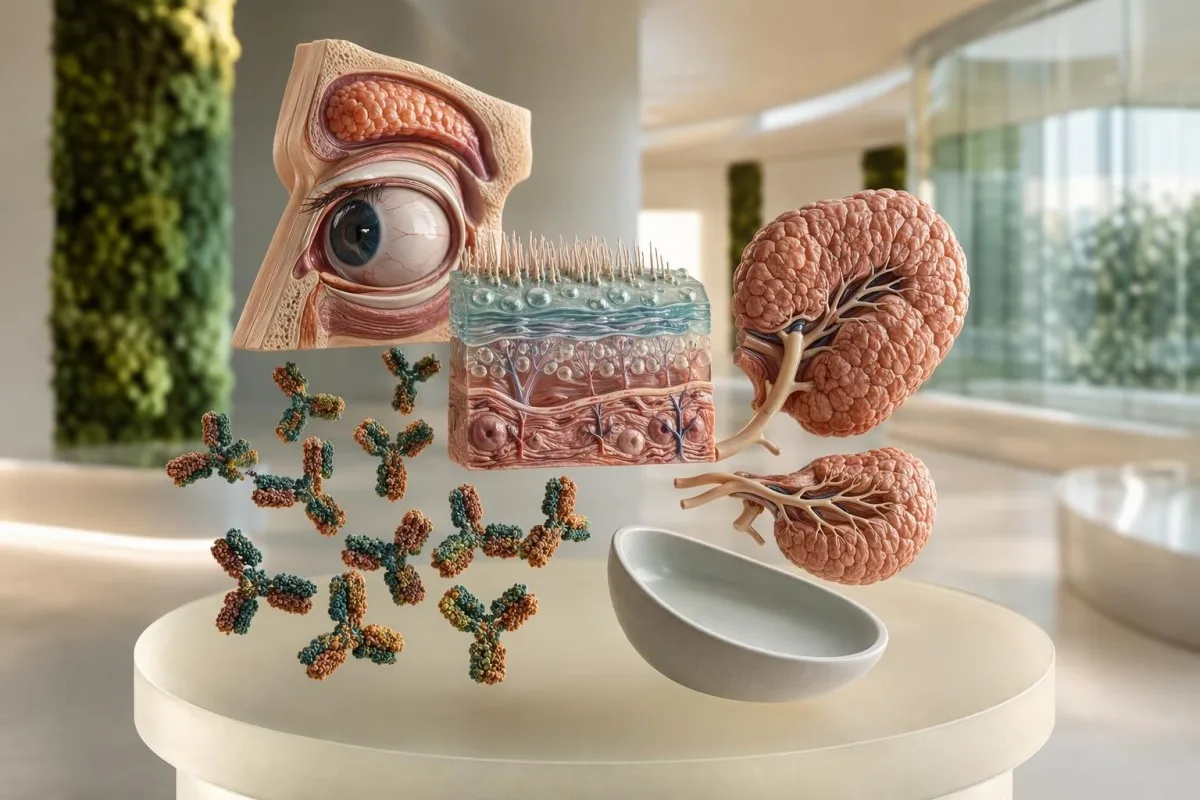
Persistent dry eyes can be allergy, medication, menopause, screen strain — or an autoimmune signal. The trick is reading ANA, SSA/Ro, SSB/La, RF, ESR and CRP as a pattern, not as isolated flags.


- Autoimmune blood test results can support Sjögren’s when ANA, SSA/Ro, SSB/La, RF, ESR or CRP fit dry eyes, dry mouth, fatigue or joint pain.
- SSA/Ro antibody is the most useful Sjögren’s blood marker; it is positive in roughly 60–75% of primary Sjögren’s cases, depending on the assay and population.
- ANA test results are common in Sjögren’s, but a low titer such as 1:80 can occur in healthy adults, especially women over 50.
- SSB/La antibody is less sensitive than SSA/Ro and is rarely enough by itself to diagnose Sjögren’s in 2026 clinical practice.
- Rheumatoid factor is often reported positive above 14 IU/mL, but it can rise with Sjögren’s, rheumatoid arthritis, hepatitis C, chronic infection or aging.
- ESR and CRP do not behave the same way; ESR may rise with high immunoglobulins while CRP can stay normal in many Sjögren’s patients.
- Normal labs do not rule out Sjögren’s; about 15–30% of clinically convincing patients may be seronegative on standard antibody testing.
- Classification criteria use a weighted score of 4 or more, where anti-SSA/Ro positivity counts 3 points and a positive minor salivary gland tissue examination also counts 3 points.
- Kantesti AI can help organize your autoimmune panel, CBC, kidney markers and inflammation results in about 60 seconds, but diagnosis still belongs with your clinician.
When dry eyes need a Sjögren’s autoimmune blood test
An autoimmune blood test is worth discussing when dry eyes persist for more than 3 months and come with dry mouth, swollen salivary glands, fatigue, joint aches, dental decay, neuropathy, or unexplained inflammation. The usual first Sjögren’s blood test includes ANA test, anti-SSA/Ro, anti-SSB/La, rheumatoid factor, ESR and CRP; normal results do not fully rule it out.
I’m Thomas Klein, MD, and in clinical review work I see the same pattern weekly: someone has tried allergy drops, new glasses, omega-3 capsules and humidifiers, yet the mouth feels like cotton at night. That is the moment I stop treating dry eye as an eye-only complaint and ask whether the blood test pattern fits a systemic autoimmune process.
At Kantesti AI, our platform reads autoimmune markers beside CBC, kidney, liver, thyroid, iron and inflammation results, because Sjögren’s rarely announces itself with one neat abnormality. If you are trying to understand what is inside an autoimmune panel guide, the missing context is often the symptom pattern.
As of May 15, 2026, no blood test alone diagnoses Sjögren’s syndrome in routine practice. A positive SSA/Ro result is a strong clue, but objective eye testing, salivary flow, dental findings and sometimes minor salivary gland tissue examination can matter just as much.
What the ANA test can and cannot tell you
The ANA test can support a Sjögren’s workup, but it is not a Sjögren’s-specific test. A titer of 1:160 or higher is generally more meaningful than 1:80, although the lab method, age, sex and symptoms change how I interpret it.
ANA is reported as a titer and sometimes a pattern, such as speckled, homogeneous, nucleolar or centromere. In Sjögren’s, a speckled pattern is common but not diagnostic; I have seen patients with classic dryness and SSA positivity whose ANA pattern added almost nothing clinically.
A negative ANA by indirect immunofluorescence makes lupus less likely, but it does not exclude Sjögren’s. This is why our AI flags discordant patterns — for example, dry mouth with positive SSA/Ro but negative ANA — rather than treating the ANA as the gatekeeper.
Many patients arrive worried because an ANA of 1:80 is marked positive. I usually explain that low-titer ANA can appear in 10–20% of otherwise well adults, while a titer of 1:320 or above deserves more careful symptom matching and repeat context; our ANA titer guide goes deeper into that gray zone.
SSA/Ro and SSB/La antibodies: the strongest blood clues
Anti-SSA/Ro is the most useful routine antibody in a Sjögren’s blood test. Anti-SSA/Ro is positive in roughly 60–75% of primary Sjögren’s patients, while anti-SSB/La is usually less common and less useful when it appears alone.
When I review a panel showing dry eyes, dry mouth and positive SSA/Ro, my threshold for referral drops sharply. Mariette and Criswell’s 2018 New England Journal of Medicine review describes anti-SSA/Ro as a central serologic feature of primary Sjögren’s, but also makes clear that it is not present in every patient.
SSB/La used to be treated more heavily in older discussions, yet isolated SSB without SSA is now handled cautiously. In practice, an isolated SSB/La result needs confirmation, symptom correlation and sometimes repeat testing by a different method, because false positives do happen.
SSA has two main antigen targets, Ro52 and Ro60, and some labs report them separately. That split can matter: Ro52 may appear in several autoimmune and inflammatory conditions, so I look for the whole pattern, including RF, immunoglobulins, complements and CBC; our C3 C4 and ANA guide explains why complement results can reframe antibody interpretation.
Rheumatoid factor, ESR and CRP patterns that fit Sjögren’s
Rheumatoid factor, ESR and CRP can support Sjögren’s, but they are not specific. RF is often flagged above 14 IU/mL, ESR is commonly above 20–30 mm/hour in inflammatory states, and CRP may stay normal even when Sjögren’s is active.
RF confuses people because it sounds like it belongs only to rheumatoid arthritis. In real clinics, I see RF positivity in Sjögren’s, hepatitis C, chronic lung disease, older age and mixed autoimmune pictures; a positive RF should prompt questions, not panic.
ESR and CRP are often mismatched in Sjögren’s. ESR can rise because immunoglobulins make red cellular elements settle faster in the tube, while CRP may remain under 5 mg/L unless there is infection, arthritis flare, vasculitis or another inflammatory driver.
A patient with dry mouth, RF of 58 IU/mL, ESR of 42 mm/hour and CRP of 2 mg/L does not have a tidy result, but that pattern is familiar to rheumatologists. For the details behind RF false positives, see our rheumatoid factor guide; for CRP assay differences, our CRP test comparison helps separate standard CRP from cardiac hs-CRP.
Why normal labs do not rule out Sjögren’s
Normal ANA, SSA/Ro, SSB/La, RF, ESR and CRP do not fully rule out Sjögren’s syndrome. In clinical cohorts, about 15–30% of patients with convincing Sjögren’s features may be seronegative on standard antibody testing.
This is one of those areas where context matters more than the number. A person with Schirmer testing of 2 mm in 5 minutes, recurrent dental decay and salivary gland swelling deserves a serious workup even if the first antibody panel is bland.
False reassurance is common when a lab portal says everything is normal. I have seen patients spend 2–4 years cycling through allergy treatment before someone measured salivary flow or asked about needing water to swallow dry food.
If your ANA is negative but symptoms persist, the next step is not ordering every rare antibody on the internet. It is usually a structured review of medications, objective eye tests, dental findings, salivary gland imaging or rheumatology referral; our article on negative ANA symptoms covers that situation in more detail.
Dry eye, dry mouth and fatigue: allergy, aging or autoimmune?
Dry eyes with dry mouth are more suspicious for Sjögren’s than dry eyes alone. Allergy usually causes itching and watery discharge, while Sjögren’s dryness often feels gritty, burning, sticky and persistent across both eyes and mouth.
The medication list is the unglamorous part of the visit, but it catches many cases. Antihistamines, tricyclic antidepressants, some SSRIs and SNRIs, anticholinergic bladder medicines, isotretinoin, diuretics and some sleep aids can dry eyes and mouth within days to weeks.
Aging changes tear film, especially after menopause, but aging should not cause parotid swelling, purpura, neuropathy, persistent joint swelling or ESR of 60 mm/hour. That is the distinction patients often feel but cannot name.
Allergy blood tests measure IgE-type sensitization, not Sjögren’s autoimmunity. If your main question is whether pollen, pets or food allergy explains the eyes, our allergy blood test limits will keep you from mixing up IgE testing with an autoimmune panel.
What a useful autoimmune panel includes beyond ANA
A useful autoimmune panel for dry eyes should not stop at ANA. I usually want SSA/Ro, SSB/La, RF, ESR, CRP, CBC, CMP, urinalysis, urine albumin-creatinine ratio, immunoglobulins and sometimes complements C3/C4.
CBC can reveal leukopenia, lymphopenia, anemia or platelet changes that shift suspicion toward systemic autoimmunity. A white blood cell count below 4.0 x 10⁹/L with positive SSA/Ro has a different meaning than the same antibody in a person with a perfectly quiet CBC.
CMP and urine testing matter because Sjögren’s can affect kidneys through tubulointerstitial nephritis or renal tubular acidosis. A low CO2/bicarbonate, potassium changes or urine pH that stays high can be an early clue, even before creatinine rises.
Kantesti AI interprets more than 15,000 biomarker names and unit variants, which helps when one lab reports ESR in mm/hr and another writes mm/hour. Our blood test biomarkers guide is useful if your report uses abbreviations that make the autoimmune section look like alphabet soup.
How doctors combine blood tests with eye and saliva tests
Doctors diagnose Sjögren’s by combining blood results with objective dryness tests. The 2016 ACR/EULAR criteria classify primary Sjögren’s at a score of 4 or more, with anti-SSA/Ro positivity worth 3 points and a positive minor salivary gland tissue examination worth 3 points.
Shiboski et al. published the 2016 ACR/EULAR classification criteria in Arthritis & Rheumatology, and the scoring system is still widely used in 2026. Schirmer testing of 5 mm or less in 5 minutes, ocular staining score of 5 or more, and unstimulated saliva flow of 0.1 mL/min or less each add 1 point.
Classification criteria are designed for consistency, not for replacing clinical diagnosis. I have seen patients who miss the formal threshold early on, then meet it 18 months later when antibody, dental and ocular findings become clearer.
Blurred or gritty vision deserves ophthalmology input because severe dryness can injure the corneal surface. If vision symptoms are part of the story, our blurred vision lab clues can help you separate autoimmune clues from sugar, B12 and thyroid patterns.
Red flags that deserve faster rheumatology review
Dryness plus systemic red flags should move faster than routine dry eye care. Persistent salivary gland swelling, palpable purpura, numbness, low complement C4, unexplained anemia, kidney abnormalities or weight loss deserve prompt medical review.
The lymphoma risk in primary Sjögren’s is often quoted around 5–10% over a lifetime, but the risk is not evenly spread. Recurrent gland swelling, low C4, cryoglobulins, palpable purpura and persistent lymph node enlargement worry me far more than dry eye alone.
Joint aches are common, but true inflammatory arthritis usually brings morning stiffness lasting more than 30–60 minutes, visible swelling or warmth. Aches that migrate after poor sleep are not the same clinical signal as swollen MCP joints with RF positivity.
When joint pain sits beside dry eyes, I look for rheumatoid arthritis, lupus, thyroid disease, viral triggers and medication effects. Our joint pain blood test guide explains how ESR, CRP, RF, anti-CCP and CBC patterns narrow that list.
Kidney, nerve and CBC clues patients often miss
Sjögren’s can affect more than tear and saliva glands. Kidney tubular problems, peripheral neuropathy, low white blood cells, anemia and high immunoglobulins may appear before someone receives a formal autoimmune diagnosis.
A low potassium level below 3.5 mmol/L with low bicarbonate can point toward renal tubular acidosis, a known Sjögren’s complication. Creatinine may still look normal, which is why a standard kidney screen can miss early tubular dysfunction.
Neuropathy can feel like burning feet, pins-and-needles, numb patches or electric shocks. I do not blame every nerve symptom on Sjögren’s; B12 deficiency, diabetes, thyroid disease, alcohol, chemotherapy and spinal disease are common rivals.
If kidney or nerve symptoms are present, trend review matters more than a single green tick in a portal. Our urine ACR kidney guide and numbness blood test article show the practical markers I check before assuming autoimmunity is the whole story.
How Kantesti AI reads Sjögren’s patterns without overcalling
Kantesti AI reads Sjögren’s-related labs by grouping antibodies, inflammation, CBC, kidney, thyroid and medication-relevant markers into a single interpretation. It does not diagnose Sjögren’s, but it can flag patterns that deserve clinician review and reduce the risk of focusing on one misleading result.
In our analysis of 2M+ blood test uploads across 127+ countries, the most common patient mistake is treating a positive ANA as a diagnosis. The second most common mistake is dismissing severe dryness because the ANA is negative.
Our neural network checks unit systems, reference intervals, biomarker aliases and pattern conflicts in about 60 seconds. The method is reviewed against clinical standards described on our medical validation page, and difficult cases are escalated in the product logic rather than dressed up as certainty.
Kantesti AI also looks for non-autoimmune explanations: high glucose, low B12, thyroid disease, iron deficiency, kidney patterns and medication monitoring needs. For a plain discussion of where AI helps and where it should stay humble, see our AI interpretation guide.
Preparing for repeat testing and specialist visits
Repeat testing is reasonable when symptoms evolve, the first panel was incomplete, or a result conflicts with the clinical picture. I usually avoid repeating ANA every few weeks; a 3–6 month interval makes more sense unless a clinician sees a new red flag.
Bring the actual lab report, not just a screenshot of green and red flags. ANA method, dilution cutoff, SSA assay type and reference interval can change the meaning; some European labs use different screening thresholds than large US commercial panels.
Write down dryness details in numbers: artificial tear use per day, nighttime water sips, dental cavities in the last 2 years, and whether you need liquid to swallow crackers. Clinicians take symptom quantification more seriously than vague “I feel dry all the time” notes, even when the complaint is real.
If you are comparing old and new results, check units before assuming a trend. Our guides on repeating abnormal labs and lab value units can prevent a false alarm before a rheumatology visit.
Treatment decisions are not based on antibodies alone
Sjögren’s treatment is chosen by symptoms and organ involvement, not by antibody level alone. Artificial tears, prescription eye drops, saliva substitutes, dental fluoride, pilocarpine or cevimeline, and sometimes hydroxychloroquine or immunosuppression are considered for different clinical patterns.
Price et al. published British Society for Rheumatology guidance for adult primary Sjögren’s management, and their approach matches what I see clinically: dryness care, dental protection and systemic-risk assessment come before chasing antibody numbers. Hydroxychloroquine may help some joint and fatigue symptoms, but evidence for dryness itself is honestly mixed.
Pilocarpine and cevimeline can increase saliva in selected patients, but they can also cause sweating, flushing, urinary frequency, nausea or asthma issues. That is why medication choice should be individualized rather than copied from someone else’s forum post.
Before starting longer-term medicines, clinicians often check CBC, liver enzymes, kidney function and sometimes eye safety depending on the drug. Our medication monitoring timeline is a practical companion when treatment moves beyond lubricating drops and dental prevention.
Upload your results for a careful next-step summary
You can upload a PDF or photo of your autoimmune labs to Kantesti and get an AI-powered interpretation in about 60 seconds. Our system can organize ANA, SSA/Ro, SSB/La, RF, ESR, CRP and related labs into a patient-friendly summary for your next clinician conversation.
The safest use of AI here is not self-diagnosis. It is preparation: knowing which results are specific, which are nonspecific, what may need repeating, and what symptoms deserve faster review.
Kantesti is CE Marked and built around GDPR, HIPAA and ISO 27001-aligned safeguards, with apps used in more than 100,000 downloads. You can try the free blood test analysis if you want a structured read before seeing your GP, ophthalmologist or rheumatologist.
Our story as Kantesti LTD is simple enough: make lab interpretation understandable without pretending an algorithm replaces clinical judgment. For Sjögren’s, that humility matters because normal labs and real disease can coexist.
Kantesti research publications and clinical governance
Kantesti’s medical content and AI safety model are reviewed against clinical governance standards, not just product metrics. Our Medical Advisory Board reviews high-risk interpretation areas because autoimmune testing can cause both missed diagnoses and overdiagnosis.
Klein, T., Mitchell, S., & Kantesti AI Research Group. (2026). Multilingual AI Assisted Clinical Decision Support for Early Hantavirus Triage: Design, Engineering Validation, and Real-World Deployment Across 50,000 Interpreted Blood Test Reports. Figshare. DOI: 10.6084/m9.figshare.32230290. ResearchGate: ResearchGate publication record. Academia.edu: Academia.edu publication record.
Klein, T., Mitchell, S., & Kantesti AI Research Group. (2026). Clinical Validation of the Kantesti AI Engine (2.78T) on 100,000 Anonymised Blood Test Cases Across 127 Countries: A Pre-Registered, Rubric-Based, Population-Scale Benchmark Including Hyperdiagnosis Trap Cases — V11 Second Update. Figshare. DOI: 10.6084/m9.figshare.32095435. ResearchGate: ResearchGate publication record. Academia.edu: Academia.edu publication record.
Why place this below a Sjögren’s article? Because autoimmune blood testing is exactly where hyperdiagnosis traps happen: low-titer ANA, weak RF positivity, borderline ESR, and symptoms that may come from medication or thyroid disease rather than autoimmunity.
The bottom line I give patients is plain: use Kantesti to understand your labs, then use a qualified clinician to examine you, test tear and saliva function, and decide whether Sjögren’s is truly present. Good medicine needs both pattern recognition and hands-on judgment.
Frequently Asked Questions
What autoimmune blood test is used for dry eyes and dry mouth?
The usual autoimmune blood test for persistent dry eyes and dry mouth includes ANA, anti-SSA/Ro, anti-SSB/La, rheumatoid factor, ESR and CRP. Many clinicians also add CBC, CMP, urinalysis, urine albumin-creatinine ratio, immunoglobulins and complements C3/C4 to look for systemic involvement. Anti-SSA/Ro is the strongest routine Sjögren’s blood marker and is positive in roughly 60–75% of primary Sjögren’s cases. A negative panel does not fully rule out Sjögren’s if objective eye or saliva testing is abnormal.
Can you have Sjögren’s with a negative ANA test?
Yes, Sjögren’s can occur with a negative ANA test, although ANA is positive in many patients. About 15–30% of clinically convincing Sjögren’s patients may be seronegative on standard antibody panels, depending on the population and testing method. If symptoms are strong, doctors may use Schirmer testing, ocular staining, salivary flow measurement, salivary gland ultrasound or minor salivary gland tissue examination. A negative ANA should lower suspicion in some cases, not close the case automatically.
Is SSA/Ro positive enough to diagnose Sjögren’s?
SSA/Ro positivity is a strong Sjögren’s clue, but it is not always enough by itself to diagnose the condition. The 2016 ACR/EULAR criteria give anti-SSA/Ro positivity 3 points, and classification usually requires 4 or more points when symptoms and objective tests are included. SSA/Ro can also appear in lupus, neonatal lupus risk assessment and other autoimmune patterns. Doctors interpret it with symptoms, eye testing, saliva testing, CBC, kidney markers and examination findings.
Why is ESR high but CRP normal in Sjögren’s?
ESR can be high while CRP is normal in Sjögren’s because ESR is affected by immunoglobulin levels, anemia, age and red cellular element settling behavior. CRP often stays below 5 mg/L unless there is infection, active inflammatory arthritis, vasculitis or another strong inflammatory driver. This ESR-CRP mismatch is common enough that doctors do not dismiss Sjögren’s just because CRP is normal. The pattern is more meaningful when paired with SSA/Ro, RF, CBC and symptoms.
What RF level is concerning in a Sjögren’s workup?
Rheumatoid factor is often reported positive above 14 IU/mL, but the level is not specific for Sjögren’s. A result of 14–30 IU/mL may be a low positive finding, while values above 50–100 IU/mL are more likely to influence clinical suspicion when symptoms fit. RF can rise in rheumatoid arthritis, Sjögren’s, hepatitis C, chronic infection, lung disease and older age. Doctors usually interpret RF beside anti-CCP, SSA/Ro, ESR, CRP and joint examination.
When should dry eyes be checked for autoimmune disease?
Dry eyes should be checked for autoimmune disease when they persist longer than 3 months and occur with dry mouth, fatigue, joint swelling, parotid gland swelling, neuropathy, dental decay, rash, low blood counts or kidney abnormalities. Dry eye alone is common and may come from screens, contact lenses, allergy, menopause, eyelid disease or medication side effects. Dry eye plus dry mouth is a stronger Sjögren’s pattern, especially when artificial tears are needed many times daily. Objective tests such as Schirmer testing and salivary flow can be as important as blood tests.
Can untreated dry mouth from possible Sjögren’s damage my teeth?
Dry mouth reduces saliva’s natural protection against cavities, so arrange a dental visit and ask about fluoride toothpaste or varnish. Sip water regularly, consider sugar-free xylitol gum if appropriate, and limit frequent sugary or acidic drinks.
What can I do safely for dry eyes while waiting for a Sjögren’s evaluation?
Use preservative-free artificial tears as needed, take regular screen breaks, and protect your eyes from wind or dry air. Seek prompt eye care for eye pain, marked redness, light sensitivity, or a sudden change in vision, as these symptoms need assessment beyond routine dryness.
Should I stop wearing contact lenses before Sjögren’s eye testing?
Ask the eye clinic before the appointment, because contact lenses and frequent drops can affect surface findings. Many clinicians prefer lenses out on the test day, and preservative-free artificial tears are usually the safest lubricant to discuss.
Get AI-Powered Blood Test Analysis Today
Join over 2 million users worldwide who trust Kantesti for instant, accurate lab test analysis. Upload your blood test results and receive comprehensive interpretation of 15,000+ biomarkers in seconds.
📚 Referenced Research Publications
Klein, T., Mitchell, S., & Weber, H. (2026). Multilingual AI Assisted Clinical Decision Support for Early Hantavirus Triage: Design, Engineering Validation, and Real-World Deployment Across 50,000 Interpreted Blood Test Reports. Kantesti AI Medical Research.
Klein, T., Mitchell, S., & Weber, H. (2026). Clinical Validation of the Kantesti AI Engine (2.78T) on 100,000 Anonymised Blood Test Cases Across 127 Countries: A Pre-Registered, Rubric-Based, Population-Scale Benchmark Including Hyperdiagnosis Trap Cases — V11 Second Update. Kantesti AI Medical Research.
📖 External Medical References
Price EJ et al. (2017). The British Society for Rheumatology guideline for the management of adults with primary Sjögren’s Syndrome. Rheumatology.
⚕️ Medical Disclaimer
This article is for educational purposes only and does not constitute medical advice. Always consult a qualified healthcare provider for diagnosis and treatment decisions.
E-E-A-T Trust Signals
Experience
Physician-led clinical review of lab interpretation workflows.
Expertise
Laboratory medicine focus on how biomarkers behave in clinical context.
Authoritativeness
Written by Dr. Thomas Klein with review by Dr. Sarah Mitchell and Prof. Dr. Hans Weber.
Trustworthiness
Evidence-based interpretation with clear follow-up pathways to reduce alarm.