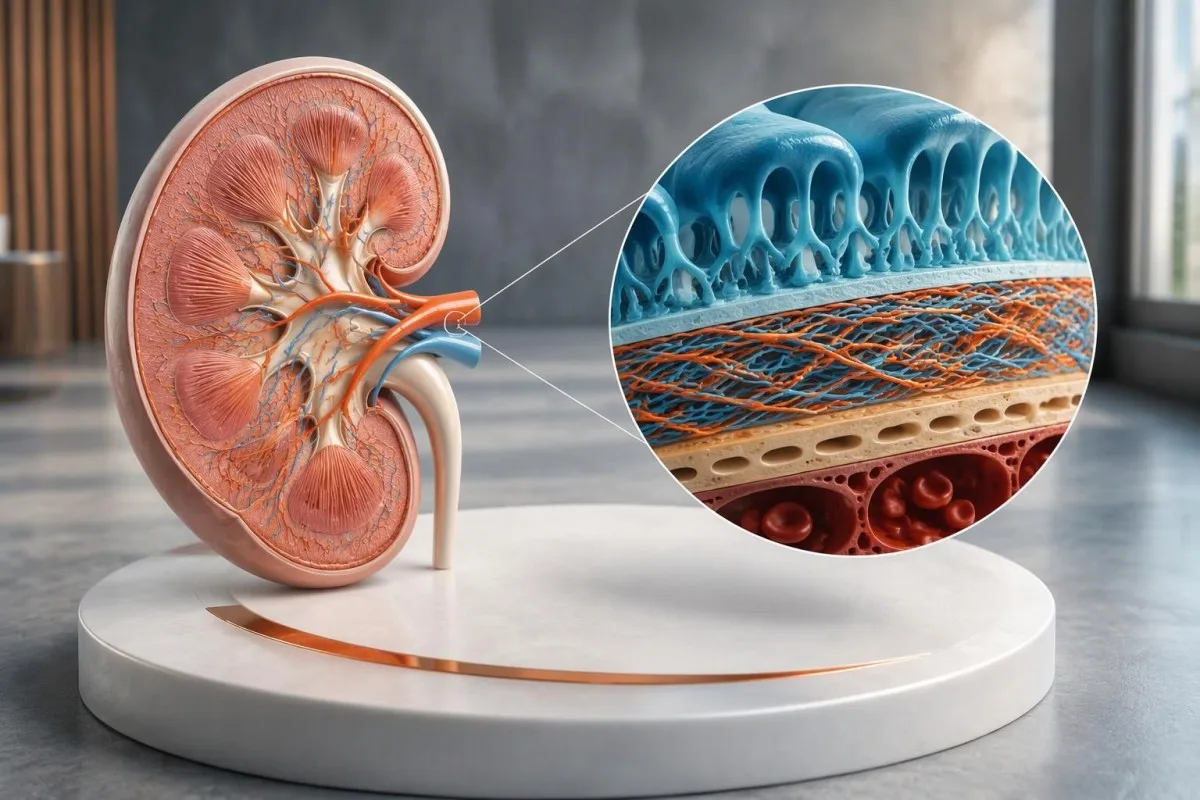
Alport syndrome genetic testing can establish a molecular diagnosis when pathogenic or likely pathogenic COL4A3, COL4A4 or COL4A5 findings fit the inheritance pattern. A variant of uncertain significance does not confirm Alport syndrome; confirmed findings help determine kidney surveillance, hearing and eye assessments, and which relatives need testing.

Key takeaways
- Three genes—COL4A3, COL4A4 and COL4A5—encode the collagen IV chains central to Alport syndrome; testing should generally evaluate all three.
- A VUS is an unresolved finding, not a positive diagnosis, and should not independently determine treatment, predictive family testing or reproductive decisions.
- COL4A5 inheritance is X-linked: a heterozygous mother has a 50% chance of passing the variant to each child, regardless of the child's sex.
- An affected father with a constitutional COL4A5 variant passes that variant to all daughters and no sons; daughters can develop kidney disease.
- Recessive Alport syndrome usually requires two pathogenic variants in the same gene, COL4A3 or COL4A4, on opposite chromosome copies.
- A single COL4A3 or COL4A4 variant can cause collagen IV-associated kidney disease; heterozygous relatives should not automatically be described as unaffected carriers.
- Urine ACR of 30 mg/g or more, approximately 3 mg/mmol, marks clinically relevant albuminuria when persistent; a normal eGFR does not exclude early Alport kidney involvement.
- Confirmed family testing usually targets the exact familial pathogenic variant rather than repeating a broad panel, but recessive families may require testing for both variants.
What does Alport syndrome genetic testing confirm?
Alport syndrome genetic testing can establish a molecular diagnosis when pathogenic or likely pathogenic findings in COL4A3, COL4A4 or COL4A5 match the expected inheritance pattern. The same test can return uncertain or negative findings that do not settle the diagnosis; a gene name alone is not enough.

A positive molecular result identifies an inherited problem in the collagen IV network supporting kidney filtration structures. The three relevant collagen chains also occur in the inner ear and selected eye structures, explaining why one genetic diagnosis can lead to several different assessments. Hearing loss or eye changes are not required before kidney-directed care begins.
The result answers a different question from a creatinine measurement: DNA testing identifies a cause, whereas kidney tests measure its current consequences. For example, a hypothetical child with a confirmed COL4A5 variant and an eGFR above 90 mL/min/1.73 m² can still have Alport syndrome. Preserved filtration does not mean that the inherited condition is inactive.
Kantesti is an AI blood test analyzer that helps explain routine kidney-related laboratory results, not a substitute for clinical genetic interpretation. Our organization and purpose are separate from the accredited laboratory responsible for classifying a DNA variant. Keep the original genetic report alongside urine results and kidney measurements so all three sources inform the clinical discussion.
When should persistent hematuria prompt testing?
Persistent glomerular hematuria should prompt consideration of COL4A3, COL4A4 and COL4A5 testing, especially when accompanied by albuminuria, kidney impairment or a family history of similar findings. The 2022 Clinical Journal of the American Society of Nephrology guideline supports testing for persistent dysmorphic hematuria and other suggestive presentations (Savige et al., 2022).

One positive urine dipstick does not establish persistent kidney-origin hematuria. Menstrual contamination, urinary tract conditions and recent strenuous exercise can change the result; repeat testing and microscopy help distinguish these possibilities. Our explanation of exercise-related pink urine describes why a transient episode and a recurring familial pattern deserve different responses.
A hypothetical 28-year-old with repeated microscopic hematuria, a parent with unexplained kidney impairment and a sibling with hearing loss has several connected clues. By contrast, an isolated episode after a long run provides less evidence for an inherited collagen disorder. Dysmorphic red cells or red-cell casts on urine sediment examination support a glomerular source but do not identify the responsible gene.
Absence of family history does not exclude Alport syndrome because de novo variants, small families and unrecognized mild disease can obscure inheritance. Hearing and eye findings may appear later than urine abnormalities, so requiring all three organ systems to be affected would miss early disease. Testing can also be appropriate in unexplained focal segmental glomerulosclerosis or kidney failure, even when hematuria is not the presenting complaint.
Which tests detect COL4A3, COL4A4 and COL4A5 variants?
A clinical kidney-gene panel should usually examine all three Alport-associated genes and include both sequence analysis and deletion/duplication assessment. A COL4A4 genetic test limited to selected variants can miss other relevant changes, so the laboratory's methods and coverage matter more than the test's marketing name.

Sequence analysis finds many single-letter changes and small insertions or deletions, while copy-number methods look for missing or duplicated DNA segments. Neither approach guarantees detection of every deep intronic change, structural rearrangement or low-level mosaic variant. Ask whether the report documents coverage gaps in each of the three genes rather than assuming that a negative panel examined every relevant position.
A DNA sample can often be obtained from an EDTA laboratory sample or saliva; the specimen choice does not tell you how comprehensive the analysis is. Consumer raw-data files are not equivalent to an accredited diagnostic panel, and potentially consequential findings require clinical confirmation. Other inherited kidney disorders also need different interpretive pathways, as our discussion of Fabry diagnostic testing illustrates.
If a familial pathogenic variant is already known, targeted testing is usually more efficient than starting again with a broad panel. Conversely, a person with an unexplained severe phenotype may need a wider kidney panel, exome or genome analysis after specialist review. Before ordering, clarify three practical points: what variant classes are assessed, whether family samples may be requested, and whether future reinterpretation is available.
How do you read the genetic laboratory report?
Read the gene, exact variant, zygosity and classification together, then check the laboratory's diagnostic conclusion and technical limitations. Clinical laboratories commonly use five classifications: pathogenic, likely pathogenic, uncertain significance, likely benign and benign; these categories describe evidence about causation, not five levels of disease severity.

The exact identifier matters because two changes in the same gene can have very different effects. A report may include an HGVS DNA description beginning with c., a protein description beginning with p., and a reference transcript; save all of these rather than copying only COL4A5 positive. Transcript versions can affect how an apparently identical position is written across two laboratories.
Zygosity describes how many relevant chromosome copies carry a finding: heterozygous, homozygous, hemizygous or sometimes mosaic. For recessive interpretation, two variants also need phase information—whether they sit on opposite copies or the same copy of a gene. A hypothetical report listing two COL4A3 variants without phase confirmation does not automatically establish recessive Alport syndrome.
At Kantesti, we distinguish a DNA variant classification from an out-of-range routine laboratory value. Our laboratory marker guide helps explain measurements such as creatinine, but a numerical reference interval cannot classify an inherited sequence change. Ask the genetics team to explain the conclusion in one sentence: what condition is supported, what inheritance pattern applies, and what remains unresolved.
What do COL4A3, COL4A4 and COL4A5 findings mean?
COL4A5 pathogenic variants usually cause X-linked Alport syndrome, while COL4A3 and COL4A4 pathogenic variants can cause dominant or recessive collagen IV-associated kidney disease. The COL4A3 variant meaning therefore depends on classification, the number of affected copies, phase and the person's kidney findings—not simply whether a variant was detected.

COL4A3, COL4A4 and COL4A5 encode the alpha-3, alpha-4 and alpha-5 collagen IV chains, which assemble into a specialized network. Changes affecting this network can produce hematuria before measurable loss of filtration. However, truncating, splice-altering and missense variants are not interchangeable, and the laboratory must evaluate the actual molecular evidence rather than assuming every change disrupts collagen.
A single pathogenic COL4A3 or COL4A4 finding can be clinically relevant even when the person has only microscopic hematuria. Terminology varies between autosomal dominant Alport syndrome, thin basement membrane nephropathy and collagen IV-associated nephropathy; the older phrase benign familial hematuria can give false reassurance. Kidney-failure estimates also differ between selected affected families and population cohorts, so one percentage should not be applied to every heterozygous person.
An inherited collagen finding does not necessarily explain unusually rapid decline, heavy proteinuria or every kidney abnormality. A second acquired or genetic condition may coexist, particularly when severity differs markedly from the family pattern. Our discussion of APOL1 kidney risk variants explains a different genetic risk mechanism; an APOL1 result and a pathogenic collagen variant should not be interpreted as equivalent diagnoses.
How does X-linked Alport syndrome affect family risk?
A heterozygous mother with a COL4A5 pathogenic variant has a 50% chance of transmitting it in each pregnancy. A father with a constitutional COL4A5 pathogenic variant transmits it to all daughters and no sons; these probabilities describe transmission, not the eventual severity of kidney disease.

Females with a COL4A5 pathogenic variant are not necessarily unaffected carriers. X-chromosome inactivation contributes to variation in kidney involvement, and some develop albuminuria, hypertension or kidney failure. A mother with mild hematuria can therefore have a son with more severe disease, while her own need for monitoring remains real.
For a hypothetical mother with one confirmed COL4A5 variant and three children, each child's transmission probability remains 50%. One child's negative result does not change the next child's probability, and two affected siblings do not mean every future child will inherit the variant. The genetics team should separate the chance of inheritance from age-dependent disease expression when discussing reproductive choices.
An apparently new COL4A5 finding can still warrant parental evaluation because low-level mosaicism may be missed by routine testing. Recurrence risk after negative parental results is therefore not always exactly zero, and specialized assessment may be needed when reproductive decisions depend on the answer. For contrast, TTR-related family inheritance follows an autosomal dominant pattern rather than the father-to-daughter restriction of X-linked transmission.
How do dominant, recessive and digenic results differ?
Autosomal dominant disease can follow one pathogenic COL4A3 or COL4A4 variant; autosomal recessive Alport syndrome usually requires two pathogenic variants in the same gene, in trans. If both parents are heterozygous for relevant variants in that same gene, each pregnancy has a 25% chance of the child inheriting both.
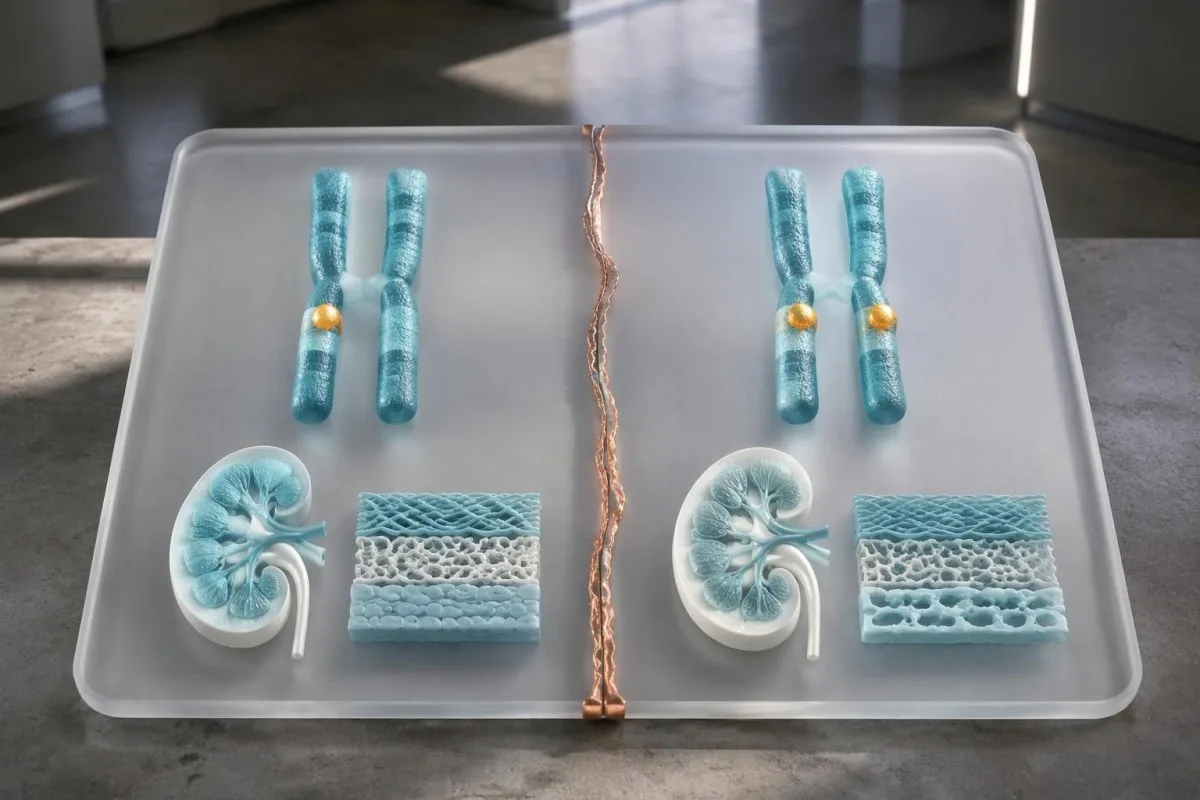
In the classic recessive calculation, each pregnancy has a 25% chance of inheriting both parental variants, a 50% chance of inheriting one and a 25% chance of inheriting neither. The middle group is not automatically kidney-risk-free because one pathogenic COL4A3 or COL4A4 variant can itself cause kidney disease. This differs from many conditions where heterozygous carriers usually have no disease manifestations.
Two variants on the same chromosome copy, called in cis, do not establish the usual biallelic recessive arrangement. Testing parents can reveal phase: one variant inherited from each parent supports an in-trans configuration, whereas both inherited together may indicate cis. Our carrier-screening interpretation guide illustrates why copy arrangement can matter, although SMA's specific assay limitations should not be transferred to collagen genes.
Digenic findings involve relevant variants in two different Alport-associated genes, such as COL4A3 and COL4A4, and require individualized interpretation. Because COL4A3 and COL4A4 are close together on chromosome 2, whether variants travel together or separately can change family calculations. Do not assign a generic 25% recurrence risk to every report containing two variants; the genes, phase and parental results determine the appropriate model.
Why does a VUS not confirm Alport syndrome?
A variant of uncertain significance does not confirm Alport syndrome because the available evidence cannot establish whether that DNA change causes disease. The ACMG/AMP framework explicitly separates a VUS from pathogenic and likely pathogenic findings; uncertain variants should not be used independently for clinical decision-making (Richards et al., 2015).

A VUS is not a weakly positive result, and it is not automatically harmless. Laboratories weigh population frequency, segregation, predicted effects, functional evidence and other data; computational predictions alone generally cannot settle causation. The framework's likely pathogenic category represents greater than 90% confidence in pathogenicity, not a greater than 90% chance of kidney failure for the person carrying the variant.
A hypothetical 34-year-old with persistent hematuria and one COL4A4 VUS still needs clinical evaluation of the hematuria. Monitoring or treatment may be justified by albuminuria, blood pressure or kidney function, but the justification comes from those findings—not from relabeling the VUS as confirmed Alport syndrome. The same distinction applies in Lynch syndrome result interpretation, where uncertainty is also different from a confirmed inherited diagnosis.
Selected relatives may be tested for segregation analysis to help the laboratory investigate an uncertain finding. That research into classification is different from predictive cascade testing that labels relatives affected or unaffected. Request a route for reinterpretation, confirm who will contact you, and retain the original report; review after roughly 12–24 months may be discussed, but laboratories do not share one universal reanalysis schedule.
Can a negative genetic test rule out Alport syndrome?
A negative genetic test does not completely rule out Alport syndrome, particularly when testing was limited or the clinical pattern remains strongly suggestive. Conversely, a negative targeted test for a well-established familial pathogenic variant usually excludes inheritance of that particular variant, subject to the assay's stated limitations.
Review what negative actually means: no reportable variant in three adequately assessed genes is different from no variant among a small predefined list. Coverage gaps, copy-number limitations, deep intronic changes and mosaicism can leave a diagnosis unresolved. A specialist may consider expanded testing or reanalysis rather than ordering the identical limited panel a second time.
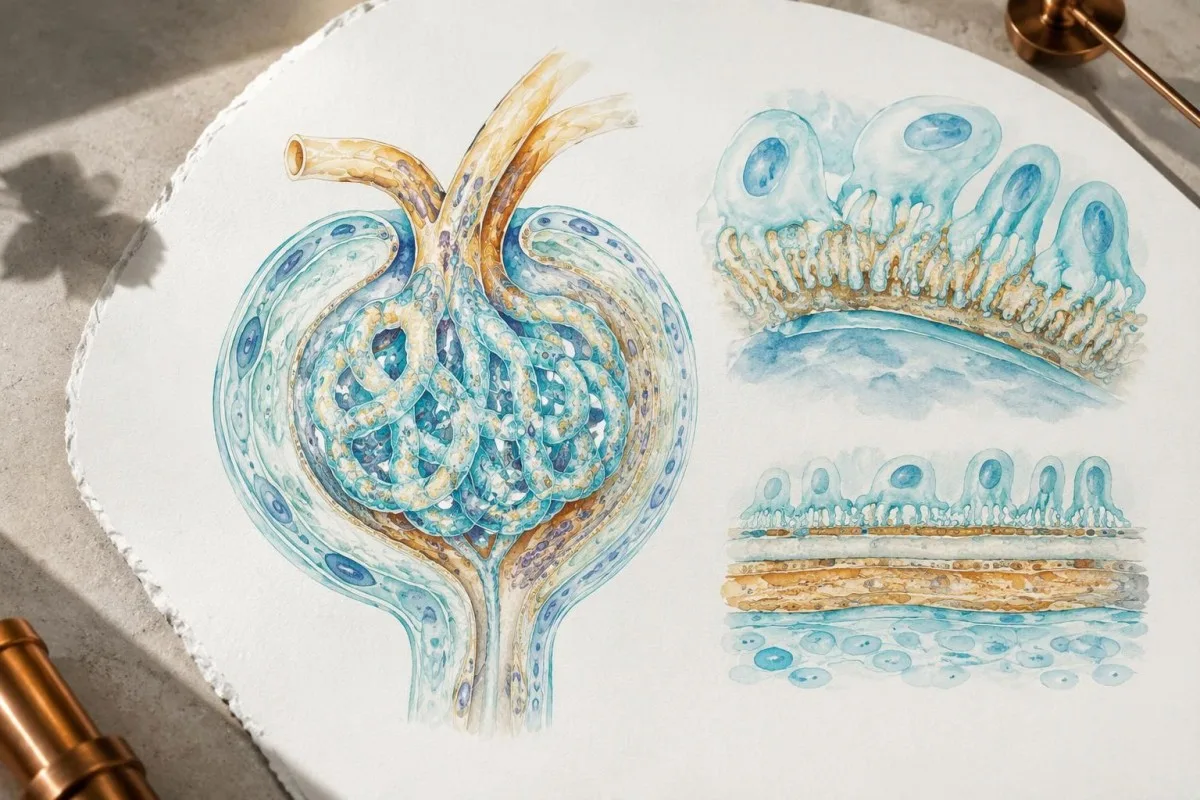
Kidney biopsy can remain useful when molecular testing is inconclusive, although it is not required for every confirmed genetic diagnosis. Electron microscopy may show thinning, thickening or lamellation of the glomerular basement membrane; thin membranes alone are not unique to one genotype. Collagen IV staining and the person's age can add context, but neither a nonspecific tissue finding nor a VUS should be treated as genetic proof.
An acquired glomerular disease can also explain proteinuria or kidney decline, including in someone with an inherited collagen finding. Our guide to PLA2R antibody interpretation describes a different diagnostic pathway for membranous nephropathy. If the course changes abruptly over weeks rather than following the expected family pattern, reassess the cause instead of attributing every abnormal result to Alport syndrome.
Which kidney checks follow a confirmed result?
Confirmed Alport-associated findings should lead to urine albumin assessment, kidney function measurement and blood-pressure monitoring. A urine albumin-to-creatinine ratio of at least 30 mg/g, approximately 3 mg/mmol, indicates clinically relevant albuminuria when persistent; an eGFR above 90 mL/min/1.73 m² does not exclude early inherited kidney disease.

Use a urine ACR rather than relying only on a protein dipstick, because low-level albumin leakage can precede a clearly positive dipstick. Exercise, fever and collection contamination can temporarily raise ACR, so an unexpected elevation often needs confirmation with a suitable repeat sample. Our ACR preparation guide explains how first-morning collection improves comparability.
Creatinine-based eGFR is influenced by muscle mass, diet and some medications, so a borderline value may need additional context or cystatin C assessment. A hypothetical muscular adult whose eGFR changes from 92 to 78 mL/min/1.73 m² should have the timing, hydration and urine findings reviewed before the change is labeled progression. Our explanation of creatinine in muscular adults addresses that interpretive trap.
Kantesti is an AI blood test interpretation platform that can help organize supplied creatinine and eGFR results alongside their dates; it does not replace urine testing or a nephrologist's surveillance plan. Follow-up may be every 6–12 months in stable disease and more frequent with albuminuria, declining function or treatment changes. The BUN and creatinine relationship adds context, but neither value alone measures inherited collagen damage.
| Level | Range | What it means |
|---|---|---|
| ACR category A1 | <30 mg/g; <3 mg/mmol | Normal to mildly increased albumin excretion; does not exclude Alport syndrome. |
| ACR category A2 | 30–300 mg/g; 3–30 mg/mmol | Moderately increased albuminuria; confirm persistence and discuss kidney-protective care. |
| ACR category A3 | >300 mg/g; >30 mg/mmol | Severely increased albuminuria; warrants closer clinical assessment, but is not automatically an emergency. |
When do confirmed results change kidney treatment?
Confirmed inheritance can support earlier kidney-protective treatment rather than waiting for eGFR to fall. The ERKNet/ERA/ESPN 2024 guideline supports renin–angiotensin system blockade when microalbuminuria develops across genetic subgroups, and earlier consideration in males with X-linked disease and people with recessive Alport syndrome (Torra et al., 2025).

ACE inhibitors or angiotensin receptor blockers reduce pressure within the glomerular filtration system and can reduce albumin leakage. For males with X-linked Alport syndrome and people with recessive disease, guideline-supported consideration can begin after age 2 when microscopic hematuria is present, even before albuminuria. In heterozygous COL4A3/COL4A4 disease and females with X-linked disease, isolated hematuria generally does not trigger the same automatic early-treatment approach.
Starting or increasing these medicines requires blood-pressure, potassium and creatinine checks, often within about 1–2 weeks according to the person's risk and local protocol. A creatinine rise greater than 30% from baseline warrants assessment rather than automatic reassurance, especially with dehydration or interacting medicines. Kantesti AI can help organize supplied laboratory trends, while our medication-monitoring workflow explains why treatment dates belong beside each result.
SGLT2 inhibitors may be considered for appropriate adults with albuminuric chronic kidney disease, but Alport-specific trial evidence is less extensive than evidence across broader CKD populations. ACE inhibitors and ARBs require preconception review because they are unsuitable during pregnancy; never stop prescribed treatment without arranging an alternative plan. Our guide to supplement safety in CKD also explains why no supplement can repair a COL4A5 gene mutation.
What hearing and eye assessments are needed?
Confirmed Alport syndrome should prompt genotype-appropriate hearing assessment and an ophthalmic examination, because kidney tests cannot detect inner-ear or eye involvement. Surveillance intensity differs: males with X-linked disease and people with recessive disease generally need more structured screening than heterozygous COL4A3/COL4A4 relatives.

Alport-associated hearing loss is usually sensorineural and often develops after birth, so a normal newborn hearing screen does not end surveillance. The ERKNet/ERA/ESPN 2024 guideline recommends an initial hearing assessment around age 4 for males with X-linked disease and people with recessive disease, followed by annual assessment through childhood. Adult and female X-linked schedules are less frequent and should reflect symptoms and specialist advice (Torra et al., 2025).
An ophthalmic assessment looks for findings such as anterior lenticonus, retinal flecks and other characteristic changes rather than simply checking visual acuity. A person can read an eye chart normally while still having diagnostically informative retinal findings. Our explanation of different eye examination tools clarifies why slit-lamp, retinal imaging and pressure measurements answer different questions.
Absence of hearing or eye abnormalities does not overturn a properly established molecular diagnosis, especially in a young child or a heterozygous relative. Conversely, hearing difficulty alone does not prove a COL4A5 variant is pathogenic because common unrelated causes exist. Sudden hearing loss or a sudden visual change deserves prompt assessment rather than waiting for the next routine appointment, even if a 12-month screening schedule is already in place.
Who in the family should have targeted testing?
Relatives at risk should usually be offered testing for the exact familial pathogenic or likely pathogenic variant, with genetic counseling before and after the result. For recessive Alport syndrome, family testing may need both variants; a VUS does not provide the same basis for labeling relatives genetically affected or unaffected.

Build a pedigree across approximately three generations when possible, recording kidney failure, persistent hematuria, hearing difficulties and the ages at which these appeared. Genetic testing can be appropriate for children because results may change childhood surveillance and treatment, unlike some adult-onset conditions where predictive testing is deferred. The counseling discussion should explain the child's likely medical benefit rather than treating family curiosity as sufficient justification.
Potential related kidney donors need particular care because a normal creatinine result does not exclude a familial collagen variant. Donation decisions require transplant-team assessment of genotype, age, albuminuria and other risks; a relative should not be cleared solely because they feel well. Share the actual laboratory PDF through a clinician-approved route, as described in our secure family result-sharing guide, rather than forwarding a cropped positive-result screenshot.
Kantesti's Family Health Risk feature can help organize family context, but it cannot calculate Mendelian risk accurately without the confirmed variant and inheritance model. An adult relative's genetic information also belongs to that individual, not automatically to the entire family account. Our privacy and data guidance explains data-handling boundaries; separately, clinical genetics teams can discuss prenatal testing or preimplantation testing when a causative familial finding is established.
How should you use results, records and research?
Use the genetic report to establish inherited cause and serial clinical measurements to guide ongoing care. A practical record keeps three elements distinct: the exact variant classification, the confirmed inheritance pattern, and dated urine ACR, kidney-function, hearing and eye findings; none should be inferred from an AI-generated summary alone.

Kantesti is an AI-powered blood test analysis tool that can explain supplied kidney-related laboratory measurements in context, not an accredited genetic diagnostic service. For a hypothetical person with one COL4A3 VUS and an ACR of 85 mg/g, the albuminuria needs clinical attention while the inherited diagnosis remains unresolved. Our technical and clinical oversight information describes the boundaries between automated interpretation and professional medical decisions.
Clinical guidance and related publications have different evidentiary roles. The three external references below support Alport testing, variant classification and management; our Zenodo guides are educational publications, not Alport genetic studies or proof that AI can classify collagen variants. The complement and ANA guide relates to selected acquired kidney differentials, whereas the Nipah publication is unrelated to inherited collagen disease and should not be cited as diagnostic support.
Bring four questions to the next appointment: is the finding causative, what inheritance model applies, what monitoring starts now, and which relatives need targeted testing? Ask who is responsible for variant reinterpretation and how a changed classification will reach the family. Our medical content standards describe how we separate educational explanation from diagnosis; the correct next step depends on the original evidence, not how reassuring a summary sounds.
Frequently asked questions
Does a COL4A5 mutation always mean Alport syndrome?
A pathogenic or likely pathogenic COL4A5 variant can establish X-linked Alport syndrome when the finding is clinically validated and interpreted in the appropriate context. A COL4A5 variant of uncertain significance does not establish that diagnosis. A heterozygous mother has a 50% chance of transmitting a confirmed variant in each pregnancy, but transmission probability does not predict severity. Females who inherit a causative variant can develop kidney disease and should not automatically be considered unaffected carriers.
What does a single COL4A3 variant mean?
A single pathogenic COL4A3 variant can cause collagen IV-associated kidney disease, including persistent hematuria and sometimes progressive kidney impairment. A single COL4A3 VUS does not confirm inherited kidney disease, and a benign variant is not a causative result. Recessive Alport syndrome usually requires two pathogenic variants in COL4A3 on opposite chromosome copies. Monitoring for someone with a clinically relevant heterozygous finding commonly includes urine ACR, blood pressure and kidney function every 6–12 months, adjusted to individual risk.
Can a COL4A4 genetic test diagnose Alport syndrome?
A COL4A4 genetic test can support a molecular diagnosis when it identifies pathogenic or likely pathogenic findings that fit a dominant or recessive inheritance pattern. Two variants need phase assessment before they are assumed to cause recessive disease. Testing should generally also assess COL4A3 and COL4A5 because all three genes can produce overlapping kidney presentations. A limited COL4A4 test or a VUS result does not exclude or confirm every form of Alport syndrome.
Should relatives be tested for an Alport VUS?
Relatives should not undergo predictive cascade testing for an Alport VUS as though it were a confirmed disease-causing variant. A genetics team may request samples from selected affected and unaffected relatives to study segregation and help resolve classification. That analysis does not justify assigning relatives a definitive Alport diagnosis or a simple 50% disease risk based on the VUS. Clinical kidney abnormalities still need assessment independently of whether the uncertain variant is shared.
Can kidney function be normal with Alport syndrome?
Kidney filtration can be normal in early Alport syndrome, including an eGFR above 90 mL/min/1.73 m². Microscopic hematuria or albuminuria may appear before creatinine rises. Persistent urine ACR of at least 30 mg/g, approximately 3 mg/mmol, indicates clinically relevant albumin leakage even when filtration remains preserved. A confirmed genotype can also justify surveillance or early treatment consideration before reduced eGFR develops.
What happens after a positive Alport genetic test?
A confirmed positive Alport genetic test should lead to an inheritance-specific care plan, including kidney assessment and appropriate hearing and eye evaluation. Kidney monitoring usually includes urine ACR, creatinine-based eGFR and blood pressure, often every 6–12 months in stable disease. Higher-risk children, people with albuminuria and anyone starting kidney-protective medication may need more frequent checks. At-risk relatives can then be offered targeted testing for the confirmed familial variant or variants with genetic counseling.
Get your blood test results explained
Upload your lab report and Kantesti's AI explains each biomarker in plain language within seconds. Used by more than 2 million people worldwide.
References
- Klein, T., Mitchell, S., & Weber, H. (2026). C3 C4 Complement Blood Test & ANA Titer Guide. Kantesti AI Medical Research. DOI
- Klein, T., Mitchell, S., & Weber, H. (2026). Nipah Virus Blood Test: Early Detection & Diagnosis Guide 2026. Kantesti AI Medical Research. DOI
- Savige J et al. (2022). Guidelines for Genetic Testing and Management of Alport Syndrome. Clinical Journal of the American Society of Nephrology. DOI
- Richards S et al. (2015). Standards and guidelines for the interpretation of sequence variants: a joint consensus recommendation of the American College of Medical Genetics and Genomics and the Association for Molecular Pathology. Genetics in Medicine. DOI PubMed
- Torra R et al. (2025). Diagnosis, management and treatment of the Alport syndrome – 2024 guideline on behalf of ERKNet, ERA and ESPN. Nephrology Dialysis Transplantation.
- 2M+Tests analysed
- 127+Countries
- 100+Languages
About the medical team


E-E-A-T Trust Signals
Experience
Physician-led clinical review of lab interpretation workflows.
Expertise
Laboratory medicine focus on how biomarkers behave in clinical context.
Authoritativeness
Medically reviewed by Dr. Thomas Klein, with contributions from Dr. Sarah Mitchell and Prof. Dr. Hans Weber.
Trustworthiness
Evidence-based interpretation with clear follow-up pathways to reduce alarm.






Medical disclaimer
This article is for educational purposes only and does not constitute medical advice. Always consult a qualified healthcare provider for diagnosis and treatment decisions.
Published · Contact the editorial team
Published by Kantesti Ltd, registered in England & Wales, company no. 17090423, London, United Kingdom.
