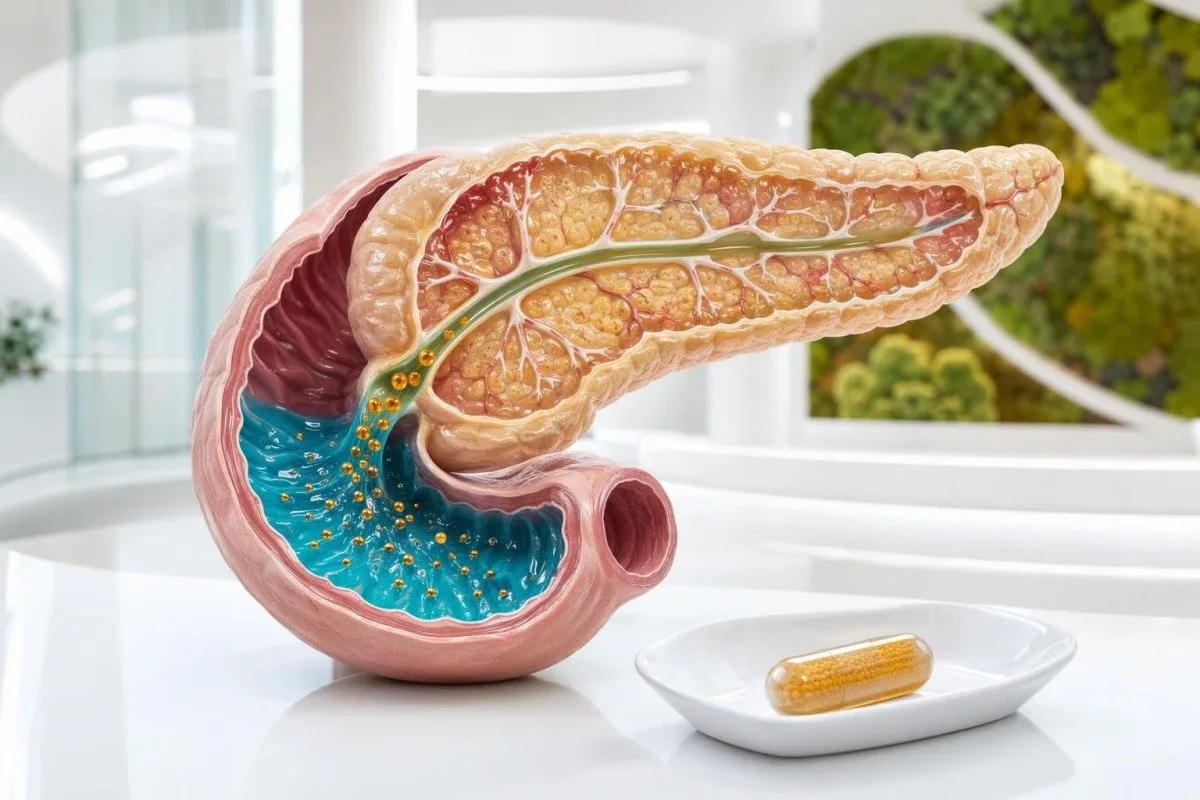
Enzymes are not a cure-all for bloating. The useful question is whether your symptoms and labs point to maldigestion, malabsorption, bile problems, celiac disease, or something else entirely.


- Fecal elastase above 200 µg/g is generally normal; 100-200 µg/g is borderline and below 100 µg/g strongly suggests pancreatic enzyme insufficiency.
- Oily floating stools plus unintentional weight loss above 5% in 6-12 months is more concerning than bloating alone.
- Fat-soluble vitamins A, D, E, and K can fall when fat digestion fails; 25-OH vitamin D below 20 ng/mL is deficiency in many guidelines.
- Pancreatic lipase above 3 times the lab upper limit suggests acute pancreatic injury, but normal lipase does not rule out chronic exocrine insufficiency.
- Iron deficiency with ferritin below 30 ng/mL, low B12, or high RDW may point to malabsorption rather than a simple enzyme shortage.
- Digestive enzyme supplements are usually unnecessary when weight, albumin, CBC, vitamin levels, and stool patterns are stable.
- Prescription pancreatic enzymes are dosed in lipase units, often 25,000-50,000 units with meals, while over-the-counter blends vary widely.
- Probiotics for gut health and a prebiotics supplement may help selected IBS-type symptoms, but they do not replace pancreatic enzymes when fecal elastase is low.
- Supplement recommendations based on blood test results should combine symptoms, trends, medication history, and stool testing rather than one flagged marker.
When a digestive enzymes supplement is actually reasonable
A digestive enzymes supplement is reasonable when oily stools, unexplained weight loss, or persistent diarrhea line up with lab clues such as low fecal elastase, low fat-soluble vitamins, falling albumin, or anemia patterns. Bloating alone rarely proves enzyme need. As of May 3, 2026, I would not start long-term enzymes without checking whether the pattern fits pancreatic, bile, small-bowel, or dietary causes.
In our clinical review workflow at Kantesti AI, the signal that changes my thinking is not one symptom; it is the cluster. A person with 3 greasy stools daily, a 6 kg weight loss, vitamin D of 14 ng/mL, and fecal elastase of 78 µg/g is in a very different category from someone with evening gas after lentils.
I see this pattern often after patients buy broad enzyme blends because a social post promised flatter abs in 7 days. The better first step is a structured review of gut-related markers, and our guide to blood tests for gut health explains why blood work can suggest malabsorption but cannot fully diagnose it.
The HaPanEU chronic pancreatitis guideline supports pancreatic enzyme replacement when pancreatic disease causes maldigestion, especially when weight loss or nutritional deficits are present (Löhr et al., 2017). That does not mean every over-the-counter capsule is useful; prescription therapy and supermarket enzyme blends are not the same tool.
Symptoms that point beyond ordinary bloating
Oily, pale, floating, hard-to-flush stools are more suggestive of fat maldigestion than simple bloating. Weight loss above 5% over 6-12 months, night diarrhea, new diabetes, or persistent upper abdominal pain should push the evaluation beyond trial-and-error supplements.
The stool description matters. True steatorrhea often means bulky, shiny, foul-smelling stools that leave an oily film; patients sometimes describe needing 4 or 5 flushes, which is more useful than simply saying diarrhea.
A 39-year-old patient I reviewed, Thomas Klein, MD, still remembers because the clue was oddly mundane: his stools floated after every high-fat meal, but not after rice and soup. His albumin was 3.2 g/dL, vitamin E was low, and fecal elastase later returned at 62 µg/g, so the supplement question became a pancreatic work-up question.
Gas within 2 hours of beans, onions, wheat, or dairy can be fermentation rather than enzyme failure. Our article on digestive symptom timing is useful because morning diarrhea, fasting diarrhea, and post-meal bloating point to different mechanisms.
Stool elastase and fecal fat are the most direct clues
Fecal elastase is the most commonly used noninvasive test for pancreatic exocrine insufficiency. Values above 200 µg/g are usually reassuring, 100-200 µg/g is borderline, and below 100 µg/g strongly suggests significant pancreatic enzyme output failure.
Loser et al. validated fecal elastase-1 as a tubeless pancreatic function test in Gut in 1996, and it remains common because one stool sample is easier than older direct pancreatic stimulation tests. The catch is water: a very watery stool can dilute elastase and create a falsely low result, so repeat testing is often sensible when the clinical picture does not fit.
A 72-hour fecal fat test is old-fashioned and annoying, but it still answers a different question: how much fat is actually being lost. More than 7 g of stool fat per day on a 100 g fat diet is abnormal, and results above 15 g/day usually make clinicians take malabsorption seriously.
When a borderline fecal elastase appears beside normal weight, normal albumin, and normal vitamin levels, I usually pause before recommending enzymes. This is where repeat testing, described in our abnormal lab repeat guide, prevents a single messy sample from becoming a lifelong diagnosis.
Low vitamins A, D, E, or K can reveal fat malabsorption
Low fat-soluble vitamins can support the case for enzyme therapy when symptoms suggest fat maldigestion. Vitamin D below 20 ng/mL, low vitamin A or E, or a prolonged PT/INR can indicate that fat absorption is failing, though diet, liver disease, and medications can produce similar results.
The pattern matters more than one low vitamin. Vitamin D deficiency is common worldwide, so a 25-OH vitamin D of 17 ng/mL by itself does not prove pancreatic insufficiency; vitamin D of 17 ng/mL plus low vitamin A, oily stools, and weight loss is a different story.
Vitamin K is often inferred rather than directly measured because PT/INR rises when clotting factor activation is impaired. A normal INR is roughly 0.8-1.2 in adults not taking anticoagulants, and an unexpected INR of 1.4 with pale stools makes me think about bile flow, liver function, and fat absorption before I think about wellness supplements.
If your report shows low vitamin D, compare it with calcium, albumin, PTH, magnesium, and kidney markers before blaming digestion. Our guides to the vitamin D blood test and vitamin deficiency markers help separate low intake from poor absorption.
Anemia patterns can point to the wrong supplement
Iron, B12, and folate patterns can reveal malabsorption that digestive enzymes alone will not fix. Ferritin below 30 ng/mL suggests iron deficiency in many adults, B12 below 200 pg/mL is usually low, and MCV above 100 fL points toward macrocytosis from B12, folate, alcohol, liver disease, or medications.
I get cautious when someone has bloating, low ferritin, high RDW, and loose stools because celiac disease, inflammatory bowel disease, heavy menstrual loss, and occult bleeding can all sit behind that pattern. Enzymes may make meals feel easier while the real diagnosis continues quietly.
Iron deficiency usually appears before hemoglobin falls. A ferritin of 18 ng/mL with hemoglobin of 13.1 g/dL can still be early iron deficiency, and our iron deficiency anemia lab guide explains why serum iron alone is too volatile for decision-making.
B12 deficiency can exist without anemia, especially in older adults, people using metformin or proton-pump inhibitors, and vegans. When B12 is borderline at 200-350 pg/mL, methylmalonic acid above about 0.40 µmol/L can support functional deficiency; see our guide on B12 deficiency without anemia for the common traps.
Amylase and lipase do not measure enzyme reserve
Amylase and lipase are injury markers, not pancreatic digestive capacity tests. Lipase above 3 times the lab upper limit supports acute pancreatitis in the right symptoms, but normal lipase does not rule out chronic pancreatic exocrine insufficiency.
This distinction catches many patients. A lipase of 38 IU/L can be completely normal while fecal elastase is 72 µg/g because a scarred pancreas may not be acutely leaking enzymes into the bloodstream.
A 52-year-old marathon runner I reviewed had an amylase of 122 IU/L after a hard race and no abdominal pain; that did not justify digestive enzymes or a pancreatitis label. Exercise, kidney function, salivary sources, and lab variation can nudge amylase, so the broader pancreatic blood test context matters.
Kantesti's neural network reads amylase and lipase beside triglycerides, calcium, kidney function, bilirubin, and symptoms because pancreatitis risk is a pattern problem. Our AI-powered blood test interpretation does not treat a normal lipase as proof that fat digestion is normal.
Bile flow problems can mimic enzyme deficiency
Bile duct or liver problems can cause pale stools, greasy stools, itching, and low fat-soluble vitamins even when pancreatic enzymes are adequate. High ALP, high GGT, elevated bilirubin, or dark urine should shift attention toward cholestasis and hepatobiliary evaluation.
Bile is the detergent that lets pancreatic lipase access dietary fat. If bile does not reach the intestine, adding enzymes may not solve the problem; the stool can still look pale and oily because fat emulsification is impaired upstream.
Typical adult ALP reference intervals are roughly 44-147 IU/L, though labs vary, and GGT above about 60 IU/L in men or 40 IU/L in women often strengthens the case for a hepatobiliary source. Bilirubin above 1.2 mg/dL with itching or yellowing needs prompt medical review, not a supplement experiment.
When I see high GGT plus high ALP, I open our liver function pattern guide before I consider enzymes. For alcohol, fatty liver, medication, and bile-duct clues, our article on high GGT meaning adds the practical branch points.
Celiac and inflammation labs should be checked first
Celiac disease and inflammatory gut disease can cause bloating, diarrhea, weight loss, anemia, and vitamin deficiencies without primary pancreatic enzyme failure. A positive tTG-IgA with adequate total IgA, CRP above 10 mg/L, or low albumin should change the work-up.
The mistake I see is starting gluten avoidance and enzymes on the same weekend, then losing the chance to interpret celiac testing. Tissue transglutaminase IgA is most useful while the person is eating gluten, and total IgA is needed because IgA deficiency can make the screen falsely negative.
CRP is not a gut-specific test, but a CRP of 28 mg/L with diarrhea and weight loss is not an IBS pattern in my book. Low albumin below 3.5 g/dL can reflect inflammation, liver disease, kidney loss, or protein-losing enteropathy; it is not automatically poor protein intake.
Before adding enzymes, review our celiac blood test guide and our piece on low albumin clues. A supplement that masks symptoms for 6 months can delay a diagnosis that needs a completely different treatment.
Diabetes, triglycerides, and weight loss change the risk picture
New diabetes, high triglycerides, or unexplained weight loss can make pancreatic disease more plausible and should not be handled with supplements alone. Triglycerides above 500 mg/dL increase pancreatitis risk, and levels above 1,000 mg/dL are a major red flag.
The pancreas has endocrine and exocrine jobs, so glucose and stool symptoms sometimes travel together. A new HbA1c of 7.2% plus steatorrhea and weight loss in a 61-year-old deserves a clinician's eyes because pancreatic disease can disturb both insulin production and enzyme output.
High triglycerides are not just a heart marker. Severe hypertriglyceridemia can trigger acute pancreatitis, and a patient with triglycerides of 1,250 mg/dL, abdominal pain, and vomiting needs urgent care rather than digestive enzymes from a pharmacy shelf.
If weight loss is part of the picture, our pre-diet lab checklist can help sort intentional from unintentional change. Our triglyceride guide explains why very high triglycerides require a different safety plan.
Dose and enzyme type matter more than marketing claims
Prescription pancreatic enzyme replacement is usually dosed by lipase units, while over-the-counter digestive enzyme blends often list mixed plant, fungal, or animal-derived enzymes in inconsistent units. Many adults with confirmed pancreatic insufficiency start around 25,000-50,000 lipase units with meals and 10,000-25,000 with snacks under medical guidance.
If fecal elastase is low and symptoms fit, the question becomes replacement, not casual supplementation. Struyvenberg et al. described practical pancreatic enzyme replacement therapy principles in BMC Medicine, including dosing with meals and titrating to stool response, weight, and nutritional markers (Struyvenberg et al., 2017).
Lactase is different. A person with lactose intolerance may do well with 3,000-9,000 FCC lactase units before dairy, while alpha-galactosidase can reduce gas from beans and some vegetables; neither treats pancreatic insufficiency or low vitamin E.
Kantesti AI can support supplement recommendations based on blood test patterns, but I still want a named target and a stop date. Our guide to AI supplement recommendations pairs well with our article on supplement timing conflicts because dose, timing, and interactions matter.
When enzymes are usually unnecessary
Digestive enzymes are usually unnecessary when bloating is the only symptom and weight, CBC, albumin, vitamin levels, liver markers, and stool pattern are stable. In that situation, meal composition, constipation, lactose intolerance, fermentable carbohydrates, stress physiology, and medication effects are more common explanations.
I am not against a short, targeted trial when the risk is low, but open-ended enzyme use can muddy the water. If someone starts 6 ingredients at once and feels 20% better, we still do not know whether the benefit came from lactase, placebo effect, smaller meals, or less dairy.
Normal ranges can mislead in both directions. A value barely inside range may still be a personal decline, while one small flagged value can be noise; our guide on blood test normal range is exactly the reasoning I use in clinic.
Be especially skeptical of enzyme marketing tied to IgG food panels. Food IgG often reflects exposure rather than intolerance, and our food intolerance blood test review explains why removing 20 foods based only on IgG can backfire nutritionally.
Risks, interactions, and red flags before taking enzymes
Digestive enzyme products can cause mouth irritation, abdominal cramping, diarrhea, constipation, allergic reactions, and confusing symptom changes. High-dose prescription pancreatic enzymes have a safety ceiling, often kept below 10,000 lipase units/kg/day, especially in cystic fibrosis care because of fibrosing colonopathy concerns.
Do not use enzymes to treat severe upper abdominal pain, persistent vomiting, fever, black stools, jaundice, or rapid weight loss. Those are diagnostic clues, not wellness problems, and delaying evaluation by 4-8 weeks can be clinically costly.
Products containing proteases may irritate the mouth if capsules are opened or chewed, and some formulations are animal-derived, which can matter for allergies and personal preferences. People on anticoagulants should be cautious with any supplement routine that changes vitamin K intake or affects INR monitoring.
If you take warfarin, direct oral anticoagulants, seizure medicines, diabetes drugs, or transplant medicines, ask for medication-specific advice before adding supplements. Our INR safety guide and medication monitoring timeline show why timing changes can alter lab interpretation.
Probiotics and prebiotics are not enzyme replacements
Probiotics for gut health may help selected people with IBS-type symptoms, antibiotic-associated diarrhea, or certain microbial imbalance patterns, but they do not replace pancreatic lipase, amylase, or protease. A prebiotics supplement feeds microbes; it does not digest fat for you.
The distinction is practical. If fecal elastase is 54 µg/g and vitamin A is low, a probiotic is not the missing enzyme; if fecal elastase is 310 µg/g and bloating follows onions, a prebiotic may actually worsen symptoms at first because fermentation increases gas.
Most patients tolerate prebiotics better when they start low, often 2-3 g/day of partially hydrolyzed guar gum or inulin rather than the 10 g scoop on the label. If symptoms flare within 24-48 hours, dose and fiber type matter more than brand loyalty.
Blood tests cannot map the microbiome with precision, but they can identify anemia, inflammation, albumin loss, or thyroid disease that gets mislabeled as dysbiosis. Our article on inflammation blood tests helps decide whether gut symptoms need broader medical review.
How Kantesti reads lab patterns before recommending supplements
Kantesti AI interprets possible enzyme need by combining stool-related clues, nutritional markers, CBC patterns, liver and pancreatic markers, medication history, and lab trends. Our platform does not treat a single low vitamin or a bloating symptom as proof that a digestive enzymes supplement is needed.
In our analysis of 2M+ user uploads across 127+ countries, the most useful flags are paired abnormalities: low fecal elastase plus low vitamin E, low albumin plus high CRP, or low ferritin plus positive celiac serology. Kantesti's neural network reviews more than 15,000 biomarkers, but the clinical question remains human: does the story fit?
Our medical team, reviewed through the Medical Advisory Board, built interpretation rules that separate diagnostic urgency from nutrition optimization. The blood test biomarkers guide is useful if you want to see how common markers such as albumin, MCV, ferritin, ALP, and bilirubin connect.
You can upload a PDF or photo for an AI interpretation in about 60 seconds through our AI blood test platform, then use the free blood test demo if you want a quick first pass. It is not a replacement for a clinician when red flags exist, but it often helps patients ask better questions.
Research standards behind Kantesti supplement guidance
Kantesti's supplement guidance is built around clinical validation, traceable biomarker logic, and explicit uncertainty rather than automatic product suggestions. Thomas Klein, MD, reviews high-risk medical content with our clinical team so digestive symptoms, nutritional deficiencies, and pancreatic markers are not reduced to a one-click supplement answer.
Our medical validation standards describe how we test interpretation quality across specialties, including trap cases where a supplement would be the wrong answer. We also publish technical context through the Kantesti AI Engine benchmark, including the 2.78T validation study, because medical AI needs audit trails.
Kantesti LTD. (2026). Clinical Validation Framework v2.0. Zenodo. https://doi.org/10.5281/zenodo.17993721. Related profiles: ResearchGate and Academia.edu.
Kantesti LTD. (2026). AI Blood Test Analyzer: 2.5M Tests Analyzed | Global Health Report 2026. Zenodo. https://doi.org/10.5281/zenodo.18175532. You can read more about Kantesti as an organization and contact our team through Contact Us if you are a clinician, researcher, or health organization.
Frequently Asked Questions
Do digestive enzyme supplements help with bloating?
Digestive enzyme supplements may help bloating when the trigger is a specific enzyme gap, such as lactose intolerance responding to 3,000-9,000 FCC lactase units before dairy. They are less likely to help when bloating comes from constipation, IBS, stress physiology, small intestinal fermentation, or high-FODMAP foods. If bloating occurs with oily stools, weight loss above 5% in 6-12 months, low albumin, anemia, or fecal elastase below 200 µg/g, medical testing is more appropriate than guessing.
What lab test shows you need pancreatic enzymes?
Fecal elastase is the most common noninvasive test used to screen for pancreatic exocrine insufficiency. A result above 200 µg/g is usually normal, 100-200 µg/g is borderline, and below 100 µg/g strongly suggests significant pancreatic enzyme deficiency when symptoms fit. A 72-hour fecal fat result above 7 g/day on a 100 g fat diet also supports fat malabsorption, but it does not identify the cause by itself.
Can low vitamin D mean I need digestive enzymes?
Low vitamin D alone usually does not mean you need digestive enzymes because 25-OH vitamin D below 20 ng/mL is common from low sun exposure, low intake, higher body weight, liver or kidney issues, and medication effects. Enzyme need becomes more plausible when low vitamin D appears with low vitamins A or E, prolonged INR, oily stools, weight loss, and low fecal elastase. The pattern is stronger than any single vitamin result.
Are over-the-counter digestive enzymes the same as prescription pancreatic enzymes?
Over-the-counter digestive enzymes are not the same as prescription pancreatic enzyme replacement therapy. Prescription products are standardized in lipase units and are commonly dosed around 25,000-50,000 lipase units with meals under clinician guidance. Many over-the-counter blends use mixed units, variable enzyme sources, and lower or unclear activity, so they should not be used as a substitute for confirmed pancreatic exocrine insufficiency.
Should I take probiotics for gut health instead of enzymes?
Probiotics for gut health and digestive enzymes solve different problems. Probiotics may help selected IBS-type symptoms or antibiotic-associated diarrhea, while enzymes help break down lactose, certain carbohydrates, proteins, or fats depending on the enzyme. If fecal elastase is below 100 µg/g with greasy stools and low fat-soluble vitamins, probiotics do not replace pancreatic enzymes.
Can digestive enzymes be risky?
Digestive enzymes can be risky when they delay diagnosis of pancreatitis, celiac disease, inflammatory bowel disease, bile duct obstruction, or cancer warning signs. They can also cause abdominal symptoms, mouth irritation if capsules are opened, allergic reactions, and medication-monitoring confusion. Severe abdominal pain, jaundice, black stools, fever, persistent vomiting, or rapid weight loss should be evaluated urgently rather than treated with supplements.
Can Kantesti give supplement recommendations based on blood test results?
Kantesti can provide supplement recommendations based on blood test patterns, but our AI weighs symptoms, trends, medications, and red flags rather than recommending a product from one abnormal value. For enzyme questions, Kantesti looks at CBC, ferritin, B12, folate, albumin, liver markers, pancreatic markers, fat-soluble vitamins, and available stool results. Results that suggest fecal elastase below 200 µg/g, unexplained anemia, or weight loss are framed as medical follow-up signals, not casual supplement prompts.
Get AI-Powered Blood Test Analysis Today
Join over 2 million users worldwide who trust Kantesti for instant, accurate lab test analysis. Upload your blood test results and receive comprehensive interpretation of 15,000+ biomarkers in seconds.
📚 Referenced Research Publications
Klein, T., Mitchell, S., & Weber, H. (2026). Clinical Validation Framework v2.0 (Medical Validation Page). Kantesti AI Medical Research.
Klein, T., Mitchell, S., & Weber, H. (2026). AI Blood Test Analyzer: 2.5M Tests Analyzed | Global Health Report 2026. Kantesti AI Medical Research.
📖 External Medical References
⚕️ Medical Disclaimer
This article is for educational purposes only and does not constitute medical advice. Always consult a qualified healthcare provider for diagnosis and treatment decisions.
E-E-A-T Trust Signals
Experience
Physician-led clinical review of lab interpretation workflows.
Expertise
Laboratory medicine focus on how biomarkers behave in clinical context.
Authoritativeness
Written by Dr. Thomas Klein with review by Dr. Sarah Mitchell and Prof. Dr. Hans Weber.
Trustworthiness
Evidence-based interpretation with clear follow-up pathways to reduce alarm.