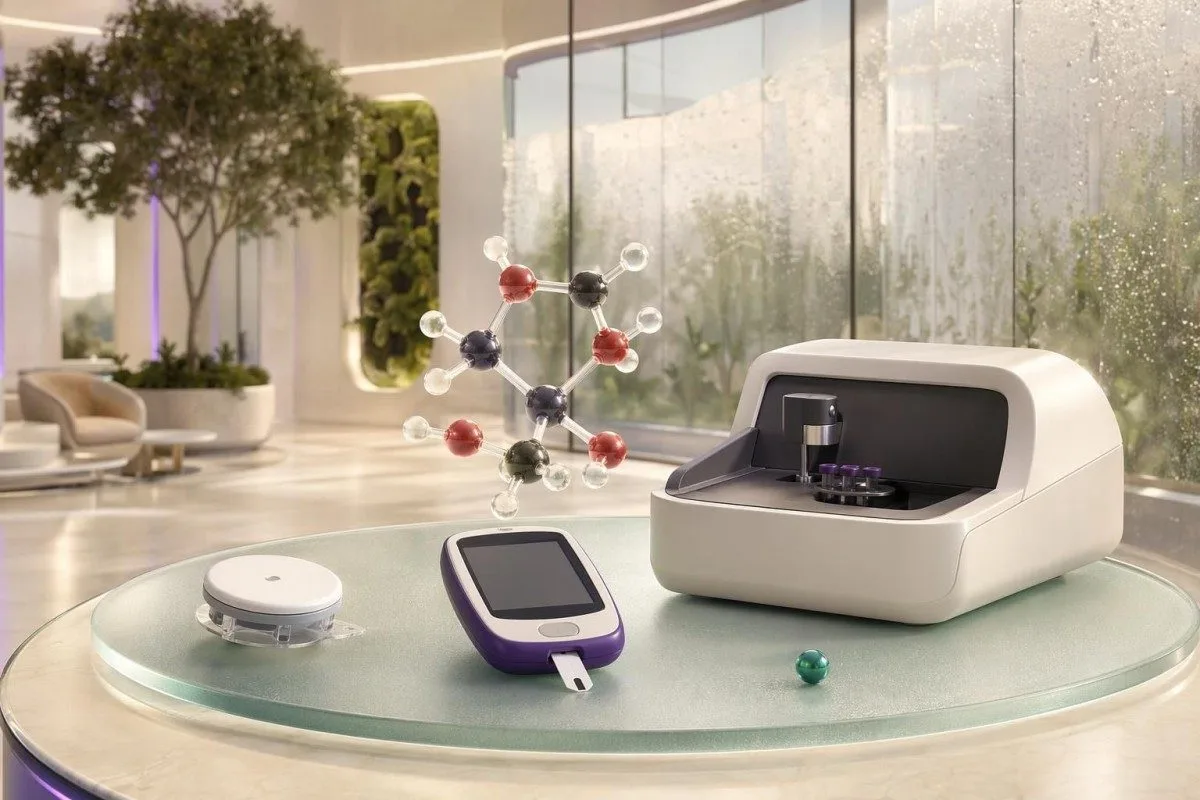
CGMs, fingerstick meters and laboratory glucose tests are all useful, but they are not measuring the exact same compartment at the exact same moment. That is why a 126 on one device and a 108 on another may be boring measurement science—or a clue worth checking.


- Normal fasting lab glucose is 70–99 mg/dL, or 3.9–5.5 mmol/L, in most non-pregnant adults.
- Prediabetes by fasting lab glucose is 100–125 mg/dL, while diabetes is diagnosed at 126 mg/dL or higher on repeat testing.
- Fingerstick glucose normal range is usually interpreted like lab glucose, but home meters may legally vary by about 15% at higher readings.
- CGM blood sugar range is not a diagnostic range; in people without diabetes, most values usually sit around 70–140 mg/dL with brief meal peaks.
- Interstitial lag means CGM readings commonly trail fingerstick glucose by 5–15 minutes during exercise, meals, stress or insulin action.
- Lab glucose vs glucometer mismatches are largest after meals because capillary glucose can run 20–70 mg/dL higher than venous glucose.
- Confirmed low glucose below 54 mg/dL is clinically significant and should not be dismissed as a sensor error without checking context.
- Follow-up is needed for repeated fasting values 126 mg/dL or higher, random values 200 mg/dL or higher with symptoms, or unexplained severe lows.
What normal blood sugar means on each test
The normal range for blood sugar is usually 70–99 mg/dL fasting in a venous lab sample, under 140 mg/dL two hours after eating, and roughly 70–140 mg/dL most of the day on CGM in people without diabetes. Fingerstick meters and CGMs can differ by 10–20 mg/dL—or more during rapid change—because meters read capillary glucose while CGMs estimate interstitial glucose 5–15 minutes behind blood. As of May 3, 2026, diagnosis still depends on lab plasma glucose or HbA1c, not a lone CGM spike; Kantesti AI can help you read the full pattern, especially when HbA1c and fasting sugar disagree as explained in our A1c versus fasting sugar guide.
A fasting venous plasma glucose of 70–99 mg/dL is considered normal for most non-pregnant adults. A fasting value of 100–125 mg/dL suggests prediabetes, while 126 mg/dL or higher on repeat lab testing meets a diabetes threshold under American Diabetes Association criteria.
Fingerstick meters are designed for day-to-day decisions, not perfect laboratory precision. A home meter reading of 112 mg/dL and a lab plasma glucose of 101 mg/dL taken minutes apart can be medically the same result, particularly if the person just walked upstairs or washed their hands poorly.
CGM adds another layer because it tracks interstitial glucose, not glucose directly inside the bloodstream. In our analysis of uploaded glucose reports at Kantesti, the most confusing cases are not the high numbers—they are the normal-looking lab values paired with CGM spikes after rice, cereal, fruit juice or night-shift meals.
Why lab glucose is still the diagnostic reference
A venous plasma glucose measured by an accredited laboratory is the reference standard for diagnosing abnormal glucose metabolism. Laboratory glucose is preferred because sample handling, calibration and analytic quality control are more tightly controlled than in consumer meters or CGM sensors.
The ADA Professional Practice Committee states that fasting plasma glucose, oral glucose tolerance testing and HbA1c are accepted diagnostic tests for diabetes when proper methods are used (ADA Professional Practice Committee, 2024). A lab fasting glucose of 126 mg/dL or higher should usually be repeated on a different day unless there are classic symptoms such as excessive thirst, frequent urination and weight loss.
Sample handling matters more than many people realise. If a laboratory tube sits unprocessed at room temperature, glycolysis can lower glucose by roughly 5–7% per hour, which is why prompt centrifugation or appropriate inhibitors are part of serious glucose testing, as described in the laboratory guidance by Sacks et al. (2011).
When I review a report showing glucose of 128 mg/dL with no HbA1c attached, I do not call it diabetes from one line. I ask whether the person fasted for at least 8 hours, whether the sample was delayed, and whether the same person has an HbA1c pattern consistent with the result; our fasting blood sugar range guide goes deeper on that morning-rise problem.
Some European labs report glucose in mmol/L rather than mg/dL, and the conversion is simple: divide mg/dL by 18. A glucose of 108 mg/dL is 6.0 mmol/L, which looks numerically smaller but means the same biological thing.
Fingerstick glucose normal range and meter limits
The fingerstick glucose normal range is usually interpreted as 70–99 mg/dL fasting and below 140 mg/dL two hours after eating in people without diabetes. The catch is that fingerstick meters are allowed a practical error margin, so one isolated value rarely carries the same weight as a laboratory result.
Most modern home meters are plasma-calibrated, but they still use a capillary sample from the fingertip. Under ISO-style performance expectations, many meters should be within about ±15 mg/dL when glucose is below 100 mg/dL and within about ±15% when glucose is 100 mg/dL or higher.
A patient once brought me three meter readings from the same hand: 118, 132 and 121 mg/dL within four minutes. That was not mysterious diabetes physiology; it was normal meter scatter plus slightly uneven sample size on the test strip.
Hands matter. Fruit residue, hand cream, sweat after exercise and cold fingers can shift a fingerstick by 10–30 mg/dL, which is enough to turn a normal-looking reading into a worrying one.
If your meter looks wrong, wash with warm water, dry fully, repeat with a fresh strip and compare against your next lab result rather than chasing every number. For broader interpretation of flagged values, our blood test normal range article explains why a single high or low value often misleads.
CGM blood sugar range and the interstitial lag
The CGM blood sugar range is best read as a trend range, not a diagnostic range. CGM sensors estimate glucose in interstitial fluid, so they commonly lag fingerstick blood glucose by 5–15 minutes when glucose is rising or falling quickly.
In someone without diabetes, a CGM trace often spends most of the day between 70 and 140 mg/dL, with short-lived post-meal peaks that can touch 150–160 mg/dL. I am cautious about calling every brief spike abnormal, because meal composition, sleep debt and sensor placement can all change the curve.
For many adults with diabetes, the International Consensus on Time in Range recommends aiming for more than 70% of CGM readings between 70 and 180 mg/dL, less than 4% below 70 mg/dL and less than 1% below 54 mg/dL (Battelino et al., 2019). Those diabetes targets are not the same as normal physiology in a person without diabetes.
The thing is, CGM is often most useful when the number is moving. An arrow rising from 105 to 135 mg/dL after breakfast tells me more than one static value, especially when paired with meal timing and the patterns described in our after-eating blood sugar guide.
A CGM reading of 68 mg/dL during sleep may be real, but it may also be a pressure artifact from lying on the sensor. If the person feels well and a fingerstick is 92 mg/dL, I treat the event as a sensor clue, not an emergency.
Why lab glucose vs glucometer differs after eating
Lab glucose vs glucometer disagreement is usually largest after meals because capillary glucose rises faster and higher than venous glucose. A fingerstick taken 45 minutes after food can be 20–70 mg/dL higher than a venous lab sample drawn at nearly the same time.
After carbohydrates enter the intestine, glucose reaches arterial and capillary blood before venous return fully equilibrates. That is why post-meal fingerstick values often look higher than venous lab glucose, while fasting values are usually closer together.
I see this pattern in active people who test right after a café breakfast before their annual labs. Their meter may show 168 mg/dL at 50 minutes, while the lab venous glucose comes back 118 mg/dL; neither device necessarily failed.
Meal timing should be documented to the nearest 15 minutes when you compare devices. Kantesti AI interprets glucose reports by reading the glucose value alongside fasting status, HbA1c, triglycerides, insulin and medication context, not as a lonely number.
Unit changes also create fake disagreement. If one report says 6.3 mmol/L and another says 113 mg/dL, those are essentially the same result; our lab unit conversion guide covers these traps.
Fasting, pre-meal and two-hour ranges compared
Fasting, pre-meal and two-hour glucose ranges are not interchangeable because physiology changes across the day. A fasting glucose of 98 mg/dL can be normal, while a two-hour post-meal value of 98 mg/dL may simply mean a modest meal or strong insulin response.
For people without diabetes, fasting laboratory glucose is generally 70–99 mg/dL, and a two-hour oral glucose tolerance test value below 140 mg/dL is considered normal. The ADA diagnostic framework uses 140–199 mg/dL at two hours for impaired glucose tolerance and 200 mg/dL or higher for diabetes (ADA Professional Practice Committee, 2024).
Pre-meal home values are usually interpreted similarly to fasting values if the person has not eaten for several hours. A pre-dinner fingerstick of 112 mg/dL after a stressful workday is different from a true 8-hour fasting lab glucose of 112 mg/dL.
One practical trick: compare like with like. A Monday fasting CGM average should be compared with other fasting CGM averages, not with a Saturday restaurant-meal peak.
When the question is early diabetes risk, I prefer looking at fasting glucose, HbA1c, waist trend, triglycerides and sometimes fasting insulin together. Our HbA1c normal range guide explains why a 5.6% result may deserve more attention in some families than others.
When a mismatch is just normal measurement noise
A mismatch is usually normal measurement noise when CGM, meter and lab values differ by about 10–20 mg/dL and the trend, symptoms and timing make sense. Glucose is dynamic, so perfect agreement across devices is not the goal.
Modern glucose meters and CGMs are clinically useful without being identical to a central laboratory analyzer. A CGM of 104 mg/dL, fingerstick of 116 mg/dL and lab glucose of 109 mg/dL are effectively concordant in everyday care.
Thomas Klein, MD, often teaches our clinical review team to ask a simple first question: did the result change the decision? If no medication dose, diagnosis or safety plan changes from a 12 mg/dL difference, I usually treat it as measurement noise.
Normal noise becomes less normal when it is directional. If the CGM is always 35 mg/dL lower than fingerstick for several days, or one meter always reads high compared with lab glucose, the device or technique deserves scrutiny.
Repeat testing is more valuable than arguing with one number. Our blood test variability article explains the difference between biological variation and analytic variation across common lab markers.
Mismatches that need medical follow-up
A glucose mismatch needs medical follow-up when it is repeated, symptomatic, medication-related or crosses diagnostic thresholds. Repeated fasting lab glucose 126 mg/dL or higher, random glucose 200 mg/dL or higher with symptoms, or confirmed lows below 54 mg/dL should not be watched casually.
The most concerning mismatch is a reassuring CGM average paired with diabetes-range lab results. CGMs can miss early fasting hyperglycemia if calibration is poor, wear time is patchy or the person mainly scans after meals have settled.
The reverse also happens. A normal fasting lab glucose with repeated CGM peaks above 200 mg/dL after ordinary meals can suggest impaired glucose tolerance, especially when HbA1c is rising from 5.4% to 5.8% over 12–18 months.
Same-day advice is sensible for glucose above 250 mg/dL with vomiting, ketones, dehydration, steroid use or pregnancy. For people using insulin or sulfonylureas, recurrent values below 70 mg/dL deserve medication review even when symptoms are mild.
If you are unsure whether a result is urgent, the first step is not internet panic; it is pattern capture and clinician review. Our critical lab values guide lists the kind of results that should prompt faster action.
Low readings: true hypoglycemia or sensor artifact
A low CGM reading should be confirmed with a fingerstick when symptoms do not match the number. Glucose below 70 mg/dL is an alert level, and below 54 mg/dL is clinically significant hypoglycemia in most adults.
CGM compression lows are common during sleep because pressure around the sensor can reduce local interstitial readings. A flat overnight trace suddenly dropping to 48 mg/dL and rebounding without food often behaves like artifact, not true hypoglycemia.
True hypoglycemia has a story. Tremor, sweating, confusion, hunger, palpitations or blurred vision with a fingerstick of 52 mg/dL is very different from an asymptomatic CGM alarm while sleeping on the sensor.
Non-diabetic hypoglycemia is uncommon, but I take it seriously when confirmed by laboratory or high-quality fingerstick readings. Causes include medication exposure, alcohol without food, adrenal insufficiency, post-bariatric hypoglycemia and rare insulin-producing disorders.
People who notice visual changes during glucose swings should not assume every symptom is sugar. Our blurred vision blood test guide explains why B12, thyroid and other markers may belong in the same work-up.
Pregnancy, children, athletes and older adults
Glucose interpretation changes in pregnancy, childhood, endurance training and older age. The same 95 mg/dL fasting value may be acceptable in one adult, borderline in pregnancy screening and unremarkable in a teenager after a poor night of sleep.
Pregnancy uses tighter thresholds because fetal exposure to glucose matters. Many gestational diabetes frameworks treat fasting glucose around 92 mg/dL or higher during an oral glucose tolerance test as abnormal, depending on the protocol used locally.
Endurance athletes can show surprising glucose curves. I have seen marathon runners with CGM dips into the 60s overnight and post-race spikes above 180 mg/dL, neither of which meant classic diabetes in isolation.
Older adults are different again because falls, frailty, kidney disease and medication burden change the risk-benefit calculation. In an 82-year-old using insulin, avoiding lows below 70 mg/dL may matter more than achieving a perfect fasting value of 95 mg/dL.
Shift work is a frequent hidden driver. Circadian disruption can raise post-meal glucose by 10–30 mg/dL compared with the same meal eaten earlier, which is why our night shift lab guide includes metabolic markers.
How HbA1c and insulin reframe glucose readings
HbA1c and insulin help explain whether a glucose mismatch is a one-day event or part of a metabolic pattern. HbA1c below 5.7% is usually normal, 5.7–6.4% suggests prediabetes and 6.5% or higher supports diabetes when confirmed appropriately.
A fasting glucose of 103 mg/dL with HbA1c of 5.1% is often a different case from fasting glucose of 103 mg/dL with HbA1c of 6.1%. The number is the same; the metabolic background is not.
Fasting insulin can add another clue, although clinicians disagree on exact cutoffs. In my practice, fasting insulin above roughly 15–20 µIU/mL with triglycerides rising and HDL falling often suggests insulin resistance before fasting glucose becomes frankly abnormal.
Kantesti AI links glucose with HbA1c, insulin, triglycerides, ALT, waist-risk clues and medication history when those data are available. This pattern-based method is closer to how clinicians think than a green-or-red flag beside one result.
If insulin resistance is the concern, read glucose beside the full metabolic panel. Our insulin blood test guide and prediabetes blood test article explain why borderline results can still matter.
How to prepare so glucose tests are not misleading
The best way to avoid misleading glucose results is to standardise timing, fasting status, exercise and medication notes. For fasting glucose, most labs expect 8–12 hours without calories, with water allowed unless your clinician says otherwise.
Do not do a hard workout right before a fasting glucose test unless that reflects the question your clinician is asking. Intense exercise can lower glucose in some people and raise it in others through adrenaline and cortisol.
Sleep is not a small detail. One night of short sleep can worsen insulin sensitivity the next morning, and I often see fasting glucose rise by 5–15 mg/dL after travel, illness or a high-stress week.
Steroids, some antipsychotic medicines, certain diuretics and high-dose niacin can raise glucose. If a result changed after a medication started, bring the exact dose and start date to the visit rather than relying on memory.
Water is usually fine during a fast, and dehydration can concentrate some lab results while also stressing the body. For practical fasting rules, our water before blood test guide keeps the advice simple.
How Kantesti AI reads glucose results safely
Kantesti AI interprets glucose results by analysing the reported value, unit, fasting status, reference range, related biomarkers and trend history. Our platform is designed to flag patterns, not replace urgent medical care or a clinician who knows your full story.
Our AI blood test analyzer can read a PDF or photo report in about 60 seconds, then place glucose beside HbA1c, kidney markers, lipids, liver enzymes and medication-relevant clues. That matters because glucose interpretation changes when creatinine is high, ALT is elevated or triglycerides are 280 mg/dL.
Thomas Klein, MD, reviews glucose cases with one recurring rule: never let a device reading outrank the patient. A trembling person with confirmed 49 mg/dL needs treatment, even if the CGM app looks calm; a well person with one CGM spike after dessert needs context, not a label.
Kantesti's neural network is trained to recognise unit mismatches, borderline patterns and longitudinal drift across uploaded reports. Our methods and physician oversight are described in medical validation materials and by our Medical Advisory Board.
If you want a structured read of your latest lab report, you can upload it through our free blood test analysis. Please use emergency services, not an app, for severe hypoglycemia, confusion, ketones, chest pain or dehydration.
A safe home plan for comparing CGM, meter and lab results
A safe comparison plan uses paired checks at stable times rather than random checking during glucose swings. The most useful comparison is often fasting CGM trend, fingerstick meter and recent lab glucose recorded within the same 1–2 week window.
Pick three comparison moments: waking before food, two hours after a typical meal and bedtime. Do this for 3–7 days, and write down food, exercise, illness, sleep and medications beside the values.
If CGM and meter differ, check direction and timing. A CGM of 180 mg/dL while the meter is 145 mg/dL may be expected if glucose is falling quickly after exercise or insulin; the reverse may occur while glucose is rising after a meal.
Avoid over-testing if the data makes you anxious. I have seen patients check 40 times a day and become less safe because they start correcting normal variation with snacks or unnecessary medication changes.
Keeping old reports is not busywork. Trend comparison is often what turns borderline glucose into a useful prevention plan, and our lab result storage guide explains how to keep records usable without creating a data mess.
What to ask when the numbers do not fit
When glucose numbers do not fit, ask your clinician which measurement should guide decisions, whether confirmation is needed and what threshold should trigger same-day care. A clear plan is better than guessing from three devices.
Useful questions include: was my lab glucose fasting, what was my HbA1c, should I repeat fasting glucose, and do I need an oral glucose tolerance test? If CGM peaks are the issue, ask whether the peaks last 15 minutes or 2 hours, because duration changes the meaning.
Ask about medication effects if your glucose changed after steroids, psychiatric medication, hormonal treatment or diuretic adjustments. A 20 mg/dL rise that begins two weeks after prednisone is interpreted differently from a slow 3-year drift upward.
If kidney disease, anemia, pregnancy or recent transfusion is present, HbA1c may be less reliable. In those cases, clinicians may lean more on plasma glucose, fructosamine, CGM patterns or repeat testing.
Kantesti is built by a medical and engineering team focused on lab interpretation across countries, languages and unit systems; you can learn more about us on About Kantesti. For background on ordering and interpreting diabetes-related markers, our diabetes blood test guide is a useful companion.
Research notes, publications and clinical standards
This article follows established glucose diagnostic standards while explaining the messy device-to-device differences patients see at home. Our interpretation approach also draws on Kantesti research workflows for reading uploaded lab reports across units, countries and report formats.
The external standards used here are deliberately conservative: ADA diagnostic thresholds, laboratory quality guidance and CGM consensus targets. That is why we treat a lab fasting glucose of 126 mg/dL differently from a single CGM peak of 126 mg/dL after breakfast.
Kantesti LTD. (2026). B Negative Blood Type, LDH Blood Test & Reticulocyte Count Guide. Figshare. https://doi.org/10.6084/m9.figshare.31333819. ResearchGate: ResearchGate. Academia.edu: Academia.edu.
Kantesti LTD. (2026). Diarrhea After Fasting, Black Specks in Stool & GI Guide 2026. Figshare. https://doi.org/10.6084/m9.figshare.31438111. ResearchGate: ResearchGate publication index. Academia.edu: Academia.edu publication index.
Thomas Klein, MD, and the Kantesti clinical team update glucose content as diagnostic standards, CGM accuracy data and laboratory reporting practices evolve. For technical benchmarking of our medical AI workflow, see the Kantesti AI benchmark and our DOI record for clinical validation.
Frequently Asked Questions
What is the normal range for blood sugar on a lab test?
The normal range for blood sugar on a fasting venous laboratory test is usually 70–99 mg/dL, or 3.9–5.5 mmol/L, in non-pregnant adults. A fasting value of 100–125 mg/dL suggests prediabetes, and 126 mg/dL or higher on repeat testing meets a diabetes diagnostic threshold. A two-hour oral glucose tolerance test is normal below 140 mg/dL and diabetes-range at 200 mg/dL or higher.
Why is my CGM different from my fingerstick meter?
A CGM can differ from a fingerstick meter because CGM estimates glucose in interstitial fluid, while fingerstick testing measures capillary glucose. During meals, exercise or insulin action, CGM often lags behind fingerstick readings by 5–15 minutes. A difference of 10–20 mg/dL can be normal, but repeated larger mismatches should be checked with meter technique, sensor placement and lab confirmation.
Which is more accurate, lab glucose or glucometer?
Lab glucose is more accurate for diagnosis because it is measured under controlled laboratory conditions with quality checks and standardised sample handling. A glucometer is accurate enough for daily monitoring but may vary by about ±15 mg/dL below 100 mg/dL or about ±15% at higher values. If diagnosis is the question, clinicians usually confirm with fasting plasma glucose, HbA1c or an oral glucose tolerance test.
Can a healthy person have a CGM spike above 140 mg/dL?
Yes, a healthy person can briefly spike above 140 mg/dL on CGM after a carbohydrate-heavy meal, especially within the first 30–60 minutes. What matters is the size, duration and recurrence of the spike; returning below 140 mg/dL by about two hours is generally more reassuring than staying high. Repeated peaks above 180 mg/dL after ordinary meals deserve clinical review, particularly if HbA1c is rising.
When should mismatched glucose readings worry me?
Mismatched glucose readings should worry you when they are repeated, symptomatic or cross safety thresholds. Repeated fasting lab glucose of 126 mg/dL or higher, random glucose of 200 mg/dL or higher with symptoms, confirmed glucose below 54 mg/dL, or glucose above 250 mg/dL with illness or ketones needs medical follow-up. A one-time 10–20 mg/dL difference between CGM and meter is usually not dangerous by itself.
Should I use CGM readings to diagnose diabetes?
CGM readings should not be used alone to diagnose diabetes. CGM is excellent for trends, time in range and finding meal-related spikes, but diagnosis still relies on validated laboratory tests such as fasting plasma glucose, HbA1c or oral glucose tolerance testing. If CGM repeatedly shows values above 180–200 mg/dL, use that as a reason to request formal lab testing.
Get AI-Powered Blood Test Analysis Today
Join over 2 million users worldwide who trust Kantesti for instant, accurate lab test analysis. Upload your blood test results and receive comprehensive interpretation of 15,000+ biomarkers in seconds.
📚 Referenced Research Publications
Klein, T., Mitchell, S., & Weber, H. (2026). B Negative Blood Type, LDH Blood Test & Reticulocyte Count Guide. Kantesti AI Medical Research.
Klein, T., Mitchell, S., & Weber, H. (2026). Diarrhea After Fasting, Black Specks in Stool & GI Guide 2026. Kantesti AI Medical Research.
📖 External Medical References
ADA Professional Practice Committee (2024). 2. Diagnosis and Classification of Diabetes: Standards of Care in Diabetes—2024. Diabetes Care.
⚕️ Medical Disclaimer
This article is for educational purposes only and does not constitute medical advice. Always consult a qualified healthcare provider for diagnosis and treatment decisions.
E-E-A-T Trust Signals
Experience
Physician-led clinical review of lab interpretation workflows.
Expertise
Laboratory medicine focus on how biomarkers behave in clinical context.
Authoritativeness
Written by Dr. Thomas Klein with review by Dr. Sarah Mitchell and Prof. Dr. Hans Weber.
Trustworthiness
Evidence-based interpretation with clear follow-up pathways to reduce alarm.