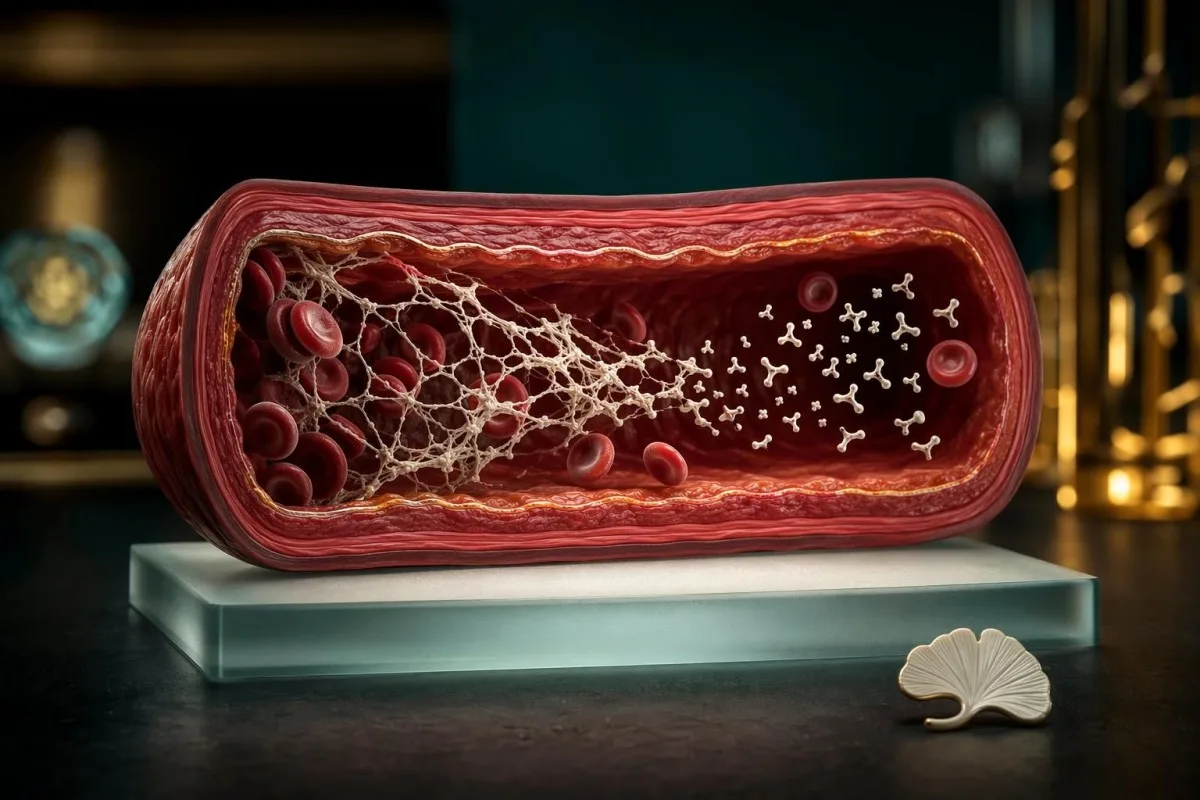
D-dimer is a clot-breakdown signal, but after infection it often reflects immune repair rather than a dangerous clot. The trick is reading the number with symptoms, trends, units, and companion labs.


- D-dimer meaning: a high result means increased breakdown of cross-linked fibrin; it does not prove a blood clot by itself.
- Common cutoff: many adult labs flag D-dimer above 500 ng/mL FEU, equal to 0.50 mg/L FEU or about 250 ng/mL DDU.
- High D-dimer after COVID: persistent elevation can last for weeks to months; Townsend et al. found 25.3% of convalescent COVID-19 patients had elevated D-dimer around 4 months.
- D-dimer blood clot risk: sudden breathlessness, chest pain, one-sided leg swelling, fainting, coughing blood, or oxygen saturation below 94% makes a high result urgent.
- Age-adjusted cutoff: after age 50, many clinicians use age × 10 ng/mL FEU to help rule out pulmonary embolism in low-risk patients.
- Inflammation pattern: high CRP or ESR, high fibrinogen, and reactive platelets often point toward post-infectious tissue response rather than an isolated clot.
- Urgent pattern: rising D-dimer plus symptoms, low oxygen, fast heart rate, abnormal troponin, or new leg swelling needs same-day clinical evaluation.
- Unit trap: FEU values are roughly twice DDU values, so 1000 ng/mL FEU is similar to 500 ng/mL DDU.
- Retest timing: if symptoms are absent and the result is mildly high, clinicians often repeat D-dimer with CBC, CRP, fibrinogen, kidney function, and liver tests in 2–6 weeks.
- Kantesti use: Kantesti AI can read D-dimer in context with CBC, CRP, platelets, PT/INR, aPTT, ferritin, kidney markers, and symptom notes, but it cannot replace emergency assessment.
High D-Dimer Means Fibrin Turnover, Not Automatically a Clot
A high D-dimer means your body is breaking down cross-linked fibrin, the mesh used in clot formation and tissue repair. After COVID or another infection, that can happen from inflammation alone, but it can also signal deep vein thrombosis or pulmonary embolism when symptoms fit. Most labs flag values above 500 ng/mL FEU. When I review results in Kantesti AI, the first question is never “how high?” but “what else is happening?”
D-dimer is a fibrin degradation product, so a raised result tells us that clot-building and clot-cleanup pathways have recently been active. A normal D-dimer in a low-risk patient can help rule out a clot, but a high D-dimer cannot diagnose one; for range basics, see our D-dimer range guide.
I’m Thomas Klein, MD, and in clinical practice I have seen a 31-year-old runner with a D-dimer of 780 ng/mL FEU after influenza and no clot, and a 67-year-old with 640 ng/mL FEU who did have a small pulmonary embolism. The number overlapped; the symptoms did not.
The practical split is simple: a mildly high value after infection with improving energy, normal oxygen, and falling CRP usually behaves differently from a high value with chest pain, a swollen calf, or oxygen saturation below 94%. That is why our doctors and reviewers on the medical advisory board insist on pattern-based interpretation rather than treating D-dimer as a stand-alone alarm.
Why D-Dimer Can Stay High After COVID
High D-dimer after COVID can persist because SARS-CoV-2 may activate endothelial cells, platelets, complement pathways, and fibrinolysis long after fever has gone. In plain terms: the immune system may still be cleaning up vascular and tissue injury even when the nasal test is negative and the patient feels mostly recovered.
Townsend et al. reported in the Journal of Thrombosis and Haemostasis that 25.3% of convalescent COVID-19 patients still had elevated D-dimer up to about 4 months after infection, and some had normal CRP at the same time (Townsend et al., 2021). That mismatch is one reason high D-dimer after COVID can unsettle patients: the usual “inflammation is gone” markers may already look tidy.
A pattern I see often in long-COVID lab reviews is D-dimer around 600–1200 ng/mL FEU, normal platelets, normal PT/INR, and CRP below 5 mg/L. That pattern does not exclude clotting, but it often fits low-grade endothelial repair better than acute thrombosis when the patient has no new shortness of breath; our long COVID blood test guide covers the wider marker set.
COVID severity matters, but not perfectly. I have reviewed outpatient cases with modest acute illness and prolonged D-dimer elevation, and hospitalized cases where D-dimer normalized by 6–8 weeks; biology refuses to behave like a spreadsheet.
Why Other Infections Raise D-Dimer Too
High D-dimer after infection happens because pneumonia, sepsis, urinary infections, viral illness, and even severe skin or abdominal infections can trigger coagulation as part of immune defense. Fibrin walls off injured tissue, and plasmin later breaks it down, releasing D-dimer into the bloodstream.
Bacterial pneumonia is a classic example: alveolar tissue response can raise fibrinogen and D-dimer even without a leg clot or pulmonary embolism. If CRP is 80 mg/L, white blood cells are 14 × 10⁹/L, and D-dimer is 900 ng/mL FEU, the infection may be the driver, but symptoms still decide urgency.
The same logic applies after influenza, RSV, dengue-like viral syndromes, pyelonephritis, or infected wounds. Our infection blood test guide explains why procalcitonin, CRP, neutrophils, and platelets often clarify whether the immune system is still actively fighting.
Here is a detail many patients never hear: D-dimer has a short circulating half-life, roughly 6–8 hours, so persistent elevation usually means ongoing production rather than an old result “stuck” in the blood. That ongoing production may be harmless repair, or it may be a clot that has not been found yet.
D-Dimer Ranges Depend on FEU, DDU, and Age
A typical adult D-dimer cutoff is less than 500 ng/mL FEU, but laboratories use different units and assays. FEU values are about twice DDU values, so 500 ng/mL FEU roughly equals 250 ng/mL DDU, and misreading the unit can double the apparent severity.
Some European and hospital labs report D-dimer as mg/L FEU, where 0.50 mg/L FEU is the same cutoff as 500 ng/mL FEU. Others report µg/mL, and that small unit shift is where patients understandably get lost; our biomarkers guide is built to catch exactly these unit traps.
Age changes the math. In patients older than 50, many clinicians use an age-adjusted cutoff of age × 10 ng/mL FEU for low-risk pulmonary embolism assessment, so a 72-year-old may have an adjusted threshold near 720 ng/mL FEU.
Righini et al. validated age-adjusted D-dimer in suspected pulmonary embolism and showed it reduced unnecessary imaging in older patients without materially increasing missed events when used with clinical probability (Righini et al., 2014). That last phrase matters: age adjustment is not meant for people with high-risk symptoms.
When a High D-Dimer Suggests Blood Clot Risk
A high D-dimer suggests blood clot risk when it appears with compatible symptoms or high pre-test probability. The strongest clues are one-sided leg swelling, sudden breathlessness, sharp chest pain with breathing, fainting, coughing blood, recent surgery, active cancer, pregnancy/postpartum status, estrogen therapy, or prolonged immobility.
Kearon et al. showed in the New England Journal of Medicine that D-dimer thresholds can be safely adjusted by clinical probability in selected patients: <1000 ng/mL in low clinical probability and <500 ng/mL in moderate probability (Kearon et al., 2019). That strategy is not for patients who look unstable or have high-probability features.
In clinic, I worry more about a D-dimer of 850 ng/mL FEU with a new swollen calf than a D-dimer of 1400 ng/mL FEU three weeks after pneumonia in someone walking normally with oxygen saturation 98%. The reason is Bayesian, not emotional: symptoms move the pre-test probability before the lab result arrives.
If your report also includes PT, INR, aPTT, fibrinogen, or protein C/S results, read them as a coagulation story rather than separate islands. Our coagulation test guide walks through why one abnormal clotting marker rarely tells the whole truth.
Symptoms That Make High D-Dimer Urgent
High D-dimer becomes urgent when symptoms suggest a clot in the lungs, legs, brain, or major circulation. Seek emergency care for sudden breathlessness, chest pain worse with deep breathing, fainting, coughing blood, new one-sided leg swelling, oxygen saturation below 94%, or a resting heart rate above 120 bpm with illness.
Pulmonary embolism can present subtly. I have seen patients describe it as “I just cannot get a full breath,” with oxygen 93%, pulse 108 bpm, and a D-dimer only moderately elevated; that combination deserves more respect than the lab flag alone.
Leg clot symptoms are usually asymmetric: one calf is larger, warmer, more tender, or newly swollen compared with the other. A normal-looking D-dimer after anticoagulant treatment does not safely exclude a clot if the story is strong; our critical lab values page explains why symptoms override reassuring numbers.
Neurologic red flags are different but just as serious: sudden weakness, facial droop, speech trouble, severe new headache, or vision loss. D-dimer is not a stroke test, but a high value in that setting should not distract anyone from urgent neurologic assessment.
Follow-Up Labs That Separate Inflammation From Thrombosis
Follow-up labs help separate inflammation from urgent thrombosis by showing whether the body is in immune-repair mode, coagulation-consumption mode, or organ-stress mode. CBC, platelets, CRP, ESR, fibrinogen, PT/INR, aPTT, creatinine, liver enzymes, troponin, and BNP each add a different clue.
An inflammatory recovery pattern often looks like CRP 10–50 mg/L, fibrinogen high, platelets mildly high above 400 × 10⁹/L, and stable hemoglobin. Our CRP after infection article explains why CRP may fall faster than D-dimer after the same illness.
A more dangerous consumption pattern can show low platelets, prolonged PT/INR, prolonged aPTT, low fibrinogen below 150 mg/dL, and very high D-dimer. That combination raises concern for disseminated intravascular coagulation, severe sepsis, advanced liver disease, or major thrombosis.
For chest symptoms, troponin and BNP matter because they hint at heart strain or myocardial injury. A high D-dimer with troponin above the lab’s 99th percentile or BNP markedly elevated changes the conversation from “repeat later” to “assess now.”
There is a quiet kidney angle too. Reduced eGFR can raise baseline D-dimer and also changes imaging choices, so creatinine and eGFR should be checked before contrast CT whenever possible.
When Imaging Is Needed After a High D-Dimer
Imaging is needed when clinical probability for clot is moderate or high, or when symptoms persist despite an alternative explanation. D-dimer tells us fibrin breakdown is happening somewhere; ultrasound, CT pulmonary angiography, or V/Q scanning tells us where and whether it is clinically dangerous.
A swollen leg usually starts with compression ultrasound because it is fast, noninvasive, and does not require contrast. A positive proximal deep vein thrombosis on ultrasound often explains the D-dimer and can spare a patient unnecessary chest imaging if lung symptoms are absent.
For suspected pulmonary embolism, CT pulmonary angiography is common, but it is not harmless: contrast exposure, radiation, and incidental findings all carry cost. Our AI lab analysis tool can organize the lab context, yet no app should be used to avoid emergency imaging when oxygen, pulse, or symptoms look unsafe.
V/Q scanning may be preferred when contrast is risky, including some patients with reduced kidney function or pregnancy-specific protocols. If PT/INR is also abnormal, our PT and INR guide helps separate clotting tendency from medication effect or liver-related changes.
Why the D-Dimer Trend Matters More Than One Flag
A D-dimer trend is often more useful than a single flagged result because falling values usually suggest recovery, while rising values may signal ongoing inflammation, new clot formation, cancer, surgery-related change, or unresolved infection. The same value means something different on day 7, day 30, and day 90.
If a patient’s D-dimer moves from 1800 to 950 to 520 ng/mL FEU over six weeks after COVID, I usually feel reassured if symptoms are improving. If it moves from 520 to 1100 to 2100 ng/mL FEU, I want a fresh clinical assessment, not just another spreadsheet.
For people without red-flag symptoms, many clinicians repeat D-dimer in 2–6 weeks alongside CBC, CRP, fibrinogen, kidney function, and liver enzymes. Our lab trend comparison guide explains how to tell a real movement from normal assay noise.
Do not repeat D-dimer daily at home or through private testing unless a clinician is using it for a clear reason. More data can create more anxiety when the decision should actually be symptom-led.
Older Adults, Pregnancy, Cancer, and Kidney Disease Change the Baseline
Older age, pregnancy, cancer, kidney disease, recent surgery, trauma, and hospitalization can raise baseline D-dimer without a new clot. These groups need different thresholds and more careful clinical probability assessment because a standard 500 ng/mL FEU cutoff becomes less specific.
Pregnancy is the classic trap: D-dimer often rises across trimesters, and many healthy third-trimester patients exceed 1000 ng/mL FEU. Clinicians use pregnancy-adapted algorithms rather than a simple normal/abnormal label, especially when symptoms overlap with normal pregnancy breathlessness.
Cancer and recent surgery raise both D-dimer and true clot risk. A patient two weeks after abdominal surgery with D-dimer 2400 ng/mL FEU may be showing healing, but that same setting also increases venous thromboembolism risk enough that symptoms deserve a low threshold for imaging.
Viral infections can also shift platelet counts for weeks. If your D-dimer is high and platelets are unusually low or high, read our platelet recovery guide before assuming the D-dimer is the only important result.
Kidney disease adds another layer because reduced clearance and chronic inflammation can push D-dimer upward. A stable eGFR of 45 mL/min/1.73 m² may make a mild D-dimer elevation less specific, but it does not make clot symptoms safe to ignore.
Medicines Can Blur D-Dimer Interpretation
Anticoagulants, antiplatelet drugs, estrogen therapy, steroids, and recent hospital treatment can all blur D-dimer interpretation. A falling D-dimer after starting heparin or a DOAC may reflect treatment response, but it does not prove the clot has resolved or that symptoms are harmless.
If someone takes apixaban, rivaroxaban, dabigatran, warfarin, or heparin, the timing of the D-dimer matters. Testing after even 24–48 hours of anticoagulation can reduce D-dimer and make the result less useful for ruling out a clot.
Estrogen-containing contraception, hormone therapy, active cancer treatment, and long-haul travel all change the risk conversation before the lab is even opened. Our blood thinner testing guide explains why INR, anti-Xa, kidney function, and timing can matter more than a single D-dimer flag.
One rare but memorable exception is vaccine-induced immune thrombotic thrombocytopenia after certain adenoviral-vector vaccines, usually described 4–42 days after exposure, with low platelets and very high D-dimer. It is rare, but the pattern of low platelets plus thrombosis symptoms should never be waved away as “just post-viral.”
How Kantesti AI Reads D-Dimer in Context
Kantesti AI interprets D-dimer by analyzing the result, units, reference range, age, sex, symptoms if provided, CBC, platelets, CRP, ESR, fibrinogen, PT/INR, aPTT, kidney markers, liver enzymes, and prior trends. Our platform does not diagnose a clot; it helps organize risk clues quickly.
In our analysis of millions of uploaded blood tests across 127+ countries, the most common D-dimer error is unit confusion: mg/L FEU, ng/mL FEU, and DDU are mixed up in patient notes. Kantesti AI flags those mismatches before giving interpretation language.
Our model also looks for discordant patterns, such as high D-dimer with low platelets, high D-dimer with normal CRP, or D-dimer rising while ferritin and CRP fall. The methodology is described in our medical validation standards and in the population-scale Kantesti AI benchmark.
I still tell patients the same thing: if you have chest pain, breathlessness, fainting, or one-sided leg swelling, do not wait for AI interpretation. Use emergency care first, then use Kantesti to understand the lab story afterward.
What to Do Next If Your D-Dimer Is High
If your D-dimer is high, the next step depends on symptoms, risk factors, units, and whether the value is rising or falling. No symptoms plus mild elevation often means planned follow-up; symptoms such as chest pain, breathlessness, or unilateral leg swelling mean same-day medical assessment.
First, confirm the unit and cutoff. A value of 0.62 mg/L FEU is 620 ng/mL FEU, while 620 ng/mL DDU is closer to 1240 ng/mL FEU, and that difference changes how worried clinicians feel.
Second, write down the timeline: infection date, fever days, immobility, surgery, flights longer than 4–6 hours, estrogen use, pregnancy/postpartum status, cancer history, and any anticoagulants. If you want a structured review, you can try free analysis by uploading your blood test PDF or photo.
Third, ask for the right companion tests rather than repeating D-dimer alone: CBC with platelets, CRP, ESR, fibrinogen, PT/INR, aPTT, creatinine/eGFR, ALT/AST, and sometimes troponin or BNP if breathless. A virtual review can help non-urgent cases, and our telehealth lab review article explains when that is sensible.
Common Misconceptions About High D-Dimer
The biggest misconception is that high D-dimer equals a blood clot. It does not. D-dimer is sensitive but not specific, which means it catches many clot-related cases but also rises after infection, pregnancy, surgery, trauma, cancer, liver disease, kidney disease, and inflammatory disorders.
Another misconception is that a negative D-dimer always rules out clot. It only helps rule out clot in low- or intermediate-risk patients before anticoagulants are started; in high-risk symptoms, imaging can still be needed.
A third misconception is that D-dimer can measure “how bad” long COVID is. It may contribute to the picture, but fatigue, dysautonomia, exercise intolerance, ferritin, CRP, CBC, thyroid markers, and organ function often explain more than D-dimer alone.
Finally, lab mechanics matter. Sample handling, assay method, unit conversion, and reference intervals can all affect the flag, so our lab error checks guide is worth reading before comparing two reports from different laboratories.
Research Notes and the Bottom Line for Patients
Bottom line: high D-dimer after COVID or infection often reflects fibrin turnover from tissue repair, but it becomes urgent when paired with clot symptoms or high-risk history. As of May 12, 2026, the safest interpretation still combines symptoms, units, clinical probability, and companion labs.
Thomas Klein, MD, reviews Kantesti educational content with a clinical lens: we would rather tell you “this needs urgent care” too early than falsely reassure you with a clever-sounding lab explanation. For our organization, governance, and clinical review approach, see About Kantesti.
For readers who track our broader laboratory interpretation publications, two recent Kantesti references are: Kantesti Medical Team. (2026). Urobilinogen in Urine Test: Complete Urinalysis Guide 2026. Zenodo. https://doi.org/10.5281/zenodo.18226379; and Kantesti Medical Team. (2026). Iron Studies Guide: TIBC, Iron Saturation & Binding Capacity. Zenodo. https://doi.org/10.5281/zenodo.18248745.
Those papers are not D-dimer guidelines; they show our wider commitment to structured biomarker interpretation, unit clarity, and repeatable patient education. If your D-dimer is high and you feel unwell, act on symptoms first and use lab interpretation second.
Frequently Asked Questions
What does high D-dimer mean after COVID?
High D-dimer after COVID means your body is breaking down cross-linked fibrin, which can happen during vascular repair, inflammation, or a true clot. Many labs flag D-dimer above 500 ng/mL FEU, but post-COVID elevations of 600–1200 ng/mL FEU can persist for weeks or months without a clot. Townsend et al. found 25.3% of convalescent COVID-19 patients had elevated D-dimer around 4 months. Urgent symptoms such as chest pain, breathlessness, fainting, or one-sided leg swelling should be assessed the same day.
Can D-dimer stay high after infection without a blood clot?
Yes, D-dimer can stay high after infection without a blood clot because immune repair activates fibrin formation and fibrin breakdown. Pneumonia, sepsis, urinary infection, influenza-like illness, and COVID can all raise D-dimer above 500 ng/mL FEU. A falling trend with improving symptoms, normal oxygen, stable platelets, and falling CRP is usually more reassuring than one isolated abnormal result. A rising D-dimer or new clot symptoms needs medical review.
What D-dimer level is dangerous?
No single D-dimer level is automatically dangerous, but values above 1000–2000 ng/mL FEU deserve closer attention when unexplained or rising. Any high D-dimer with sudden breathlessness, chest pain, fainting, coughing blood, oxygen saturation below 94%, or one-sided leg swelling is potentially urgent. Very high levels can also occur in severe infection, trauma, cancer, surgery, pregnancy, liver disease, kidney disease, or DIC. Clinical probability and symptoms decide the urgency more than the number alone.
How long does D-dimer stay elevated after COVID or infection?
D-dimer may remain elevated for several weeks after infection and can persist for 2–4 months after COVID in some patients. The molecule itself clears quickly, with a rough half-life of 6–8 hours, so persistent elevation usually means ongoing fibrin turnover rather than an old result lingering. Many clinicians repeat D-dimer with CBC, CRP, fibrinogen, PT/INR, aPTT, creatinine, and liver tests in 2–6 weeks if symptoms are absent. Persistent elevation with new symptoms should not wait for routine retesting.
Does a normal D-dimer rule out a clot?
A normal D-dimer can help rule out a clot only when the patient has low or intermediate clinical probability and has not already started anticoagulant treatment. The common adult cutoff is below 500 ng/mL FEU, and age-adjusted cutoffs use age × 10 ng/mL FEU after age 50 in selected patients. A normal D-dimer should not override high-risk symptoms such as severe breathlessness, fainting, or a clearly swollen one-sided calf. In high-probability cases, imaging may be needed regardless of D-dimer.
Should I take aspirin or blood thinners for a high D-dimer?
Do not start aspirin or anticoagulants just because D-dimer is high unless a clinician tells you to. Blood thinners reduce clot risk but can cause bleeding, and the right treatment depends on whether there is confirmed thrombosis, atrial fibrillation, surgery risk, pregnancy, kidney function, and other factors. A high D-dimer after infection often needs symptom review and companion labs, not automatic medication. If you have chest pain, shortness of breath, fainting, or one-sided leg swelling, seek urgent assessment instead of self-treating.
Which tests should be checked with high D-dimer?
Useful follow-up tests with high D-dimer include CBC with platelets, CRP, ESR, fibrinogen, PT/INR, aPTT, creatinine/eGFR, ALT, AST, and sometimes troponin or BNP when breathlessness or chest symptoms are present. High CRP with high fibrinogen and reactive platelets often points toward inflammation, while low platelets with prolonged PT/aPTT and low fibrinogen can suggest coagulation consumption. Repeat testing is often considered in 2–6 weeks for mild, asymptomatic elevations. Imaging is needed when symptoms or clinical probability suggest thrombosis.
Get AI-Powered Blood Test Analysis Today
Join over 2 million users worldwide who trust Kantesti for instant, accurate lab test analysis. Upload your blood test results and receive comprehensive interpretation of 15,000+ biomarkers in seconds.
📚 Referenced Research Publications
Klein, T., Mitchell, S., & Weber, H. (2026). Kantesti Medical Team. (2026). Urobilinogen in Urine Test: Complete Urinalysis Guide 2026. Zenodo.. Kantesti AI Medical Research.
Klein, T., Mitchell, S., & Weber, H. (2026). Kantesti Medical Team. (2026). Iron Studies Guide: TIBC, Iron Saturation & Binding Capacity. Zenodo.. Kantesti AI Medical Research.
📖 External Medical References
⚕️ Medical Disclaimer
This article is for educational purposes only and does not constitute medical advice. Always consult a qualified healthcare provider for diagnosis and treatment decisions.
E-E-A-T Trust Signals
Experience
Physician-led clinical review of lab interpretation workflows.
Expertise
Laboratory medicine focus on how biomarkers behave in clinical context.
Authoritativeness
Written by Dr. Thomas Klein with review by Dr. Sarah Mitchell and Prof. Dr. Hans Weber.
Trustworthiness
Evidence-based interpretation with clear follow-up pathways to reduce alarm.