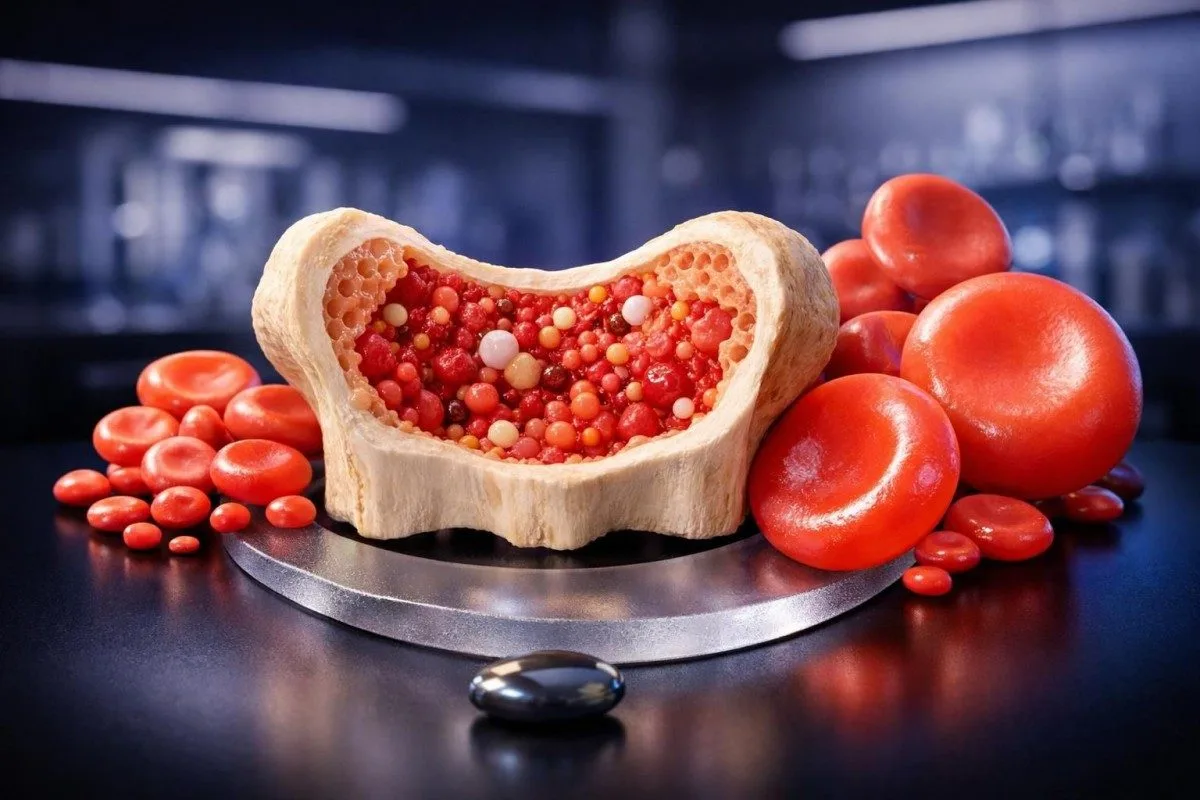
A high RDW usually means your red cells vary more in size than expected — most often from iron deficiency, B12 or folate deficiency, mixed anemia, recent blood loss, or recovery after treatment. A low RDW is usually benign, and a normal MCV can still hide a problem when small and large cells average each other out.


- RDW-CV typical adult range is 11.5-14.5%; values above this usually mean increased red-cell size variation.
- RDW-SD is often 39-46 fL; values above 46-48 fL can show anisocytosis even when RDW-CV looks only borderline high.
- MCV below 80 fL suggests microcytosis; above 100 fL suggests macrocytosis.
- Iron deficiency often shows high RDW + low MCV, and ferritin <30 ng/mL supports the diagnosis in most adults.
- Vitamin B12 deficiency becomes likely when B12 is <200 pg/mL; 200-300 pg/mL is borderline and may need methylmalonic acid or homocysteine.
- Normal MCV does not exclude anemia; mixed small and large cells can still average to 80-100 fL.
- Anemia thresholds commonly used in adults are hemoglobin <13.0 g/dL in men and <12.0 g/dL in nonpregnant women.
- RDW after treatment can rise for 1-2 weeks after iron or B12 therapy because new reticulocytes are larger than older cells.
- Urgent review is smarter if hemoglobin is <8 g/dL, or if RDW changes come with chest pain, fainting, black stools, or shortness of breath at rest.
What RDW Measures on a Complete Blood Count
RDW measures how different your red cells are in size. A high RDW, usually above about 14.5% on RDW-CV, means there is more size variation than expected — something we see early in iron deficiency, B12 or folate deficiency, recent blood loss, or mixed anemia. A low RDW is rarely meaningful. If you want fast blood test results explained, start by pairing RDW with how to read your lab report instead of treating it as a diagnosis by itself.
RDW is the width of the red-cell size distribution, not the amount of blood and not your iron level directly. On a complete blood count, an RDW-CV above roughly 14.5% tells us the marrow is releasing cells that do not match each other well in size, which often happens when nutrition, bleeding, inflammation, or marrow response has changed.
The tricky part is specificity. Salvagno et al. described RDW as a simple marker with many applications, but they also stressed that it cannot diagnose a cause on its own (Salvagno et al., 2015). In my experience, RDW 15.3% with ferritin 11 ng/mL means far more than RDW 15.3% with ferritin 95 ng/mL and a perfectly stable hemoglobin.
I’m Thomas Klein, MD, and this is one of the CBC flags I explain most often. A 38-year-old teacher I saw had hemoglobin 12.1 g/dL, which her lab did not flag, but RDW was 15.7% and MCV 84 fL; ferritin later came back 9 ng/mL, and the real problem was early iron deficiency before classic anemia had fully appeared.
Red cells circulate for about 120 days, so older normal cells can sit beside newer small or large cells for weeks. That is why RDW often changes before the average cell size looks dramatic — a point many patients miss when they only focus on whether the CBC blood test is marked normal or abnormal.
RDW-CV vs RDW-SD: Normal Ranges and Why Labs Differ
RDW-CV is usually 11.5-14.5% in adults, while RDW-SD is commonly around 39-46 fL; some analyzers use upper limits closer to 56 fL. When Kantesti AI reviews a CBC, it first checks which RDW method your lab reports, because the same patient can look mildly abnormal on one format and unremarkable on the other.
Reference intervals vary more than patients expect. Some UK and US labs still use 11.5-14.5%, some use 11.7-15.4%, and some European laboratories place the upper limit around 14.8%. A lab’s analyzer, calibration method, and the local reference population all matter, which is why I tell patients to compare themselves to the stated interval on their own report, not a screenshot from the internet.
There is a mathematical wrinkle most sites ignore. RDW-CV is derived from the standard deviation of cell volume divided by MCV, then multiplied by 100, so the same absolute spread can look larger when MCV is low and smaller when MCV is high. If two patients have a volume spread of 13 fL, the one with MCV 70 fL has an RDW-CV near 18.6%, while the one with MCV 100 fL lands around 13.0% — identical variability, different percentage.
That is why RDW-SD can be useful when the average cell size is drifting. In a busy CBC differential guide, RDW-SD above about 46-48 fL often catches true anisocytosis that RDW-CV understates. Most patients never hear this because many reports only show one RDW line and nobody explains the denominator effect.
Another practical tip: trend within the same lab beats one-off comparison between labs. A move from 13.2% to 14.6% in the same person can matter even when both numbers look near the edge of normal, especially if MCV is slipping at the same time. If your report language is confusing, our blood test abbreviations decoder helps patients separate RDW, RBC, MCV, MCH, and hematocrit without guessing.
High RDW with Low MCV Usually Points to Iron Deficiency First
High RDW plus low MCV most often suggests iron deficiency, especially when MCV is below 80 fL, MCH is low, and ferritin is below 30 ng/mL. When I see that trio, I move iron deficiency to the top of the list before I start chasing rarer explanations. For cell size basics, our MCV guide is the fastest companion read.
Iron deficiency often produces a mixed population of cells before it produces a dramatic fall in hemoglobin. Older circulating cells may still be near normal size, while newer cells become progressively smaller and paler, so the average MCV drops and RDW climbs. A common early combination is hemoglobin 11.8-13.0 g/dL, MCV 78-82 fL, and RDW 15-17%.
I also look at MCH, because it often falls before patients understand what is happening. Low MCH below roughly 27 pg strengthens the idea that cells are carrying less hemoglobin, and our MCH article explains why a patient can feel washed out even with only mild anemia on paper. Platelets can be mildly elevated too — values around 450-550 x10^9/L are not unusual in iron deficiency and can distract people into thinking the problem is elsewhere.
Ferritin usually settles the argument, though inflammation can muddy the water. Camaschella’s NEJM review remains one of the best summaries: ferritin <30 ng/mL strongly supports iron deficiency in most adults, but an inflammatory state can push ferritin upward and hide depleted iron stores (Camaschella, 2015). That is why I still use ferritin together with saturation, CRP, symptoms, and sometimes repeat testing rather than leaning on one number. For a deeper cut, see our ferritin ranges guide.
Here is the nuance patients rarely hear: RDW may rise weeks before MCV becomes frankly low. In menstruating women, postpartum patients, endurance athletes with GI blood loss, and people with frequent blood donation, I often see RDW drift from 13.4% to 15.0% while MCV still sits in the low-normal 80s. That is not proof, but it is a nudge to check iron stores before symptoms get louder.
Iron deficiency versus thalassemia trait
Low MCV does not always mean iron deficiency. Thalassemia trait often shows MCV below 80 fL with a relatively normal or only slightly high RDW, and the RBC count may stay high-normal rather than falling. In day-to-day practice, high RDW pushes me more toward iron deficiency, while very low MCV with a steady RDW and unexpectedly preserved RBC count makes me think inherited microcytosis deserves a closer look.
High RDW with High MCV Raises B12, Folate, Alcohol, or Medication Questions
High RDW plus high MCV suggests macrocytosis, and the common causes are vitamin B12 deficiency, folate deficiency, alcohol use, liver disease, hypothyroidism, and medication effects. When MCV exceeds 100 fL and RDW is 15% or higher, I stop treating the CBC as routine and start asking targeted questions.
A vitamin B12 level below 200 pg/mL makes deficiency likely, and 200-300 pg/mL is the awkward borderline zone where methylmalonic acid or homocysteine can help. Patients often assume they would be severely anemic if B12 were truly low, but that is not how it always behaves. Numb feet, balance changes, mouth soreness, or brain fog can show up before hemoglobin falls much at all. Our vitamin B12 test guide walks through that pattern in more detail.
Diet is one pathway, absorption is another. Strict vegan diets, long-term metformin use, proton pump inhibitors, prior gastric surgery, pernicious anemia, and small-bowel disease all come up in this workup. For patients who avoid animal products, yearly monitoring is sensible; our routine vegan lab checklist covers the usual surveillance markers beyond just B12.
A blood film can be more revealing than patients realize. Macro-ovalocytes and hypersegmented neutrophils may point toward megaloblastic change before the chemistry side is fully sorted out, and Aslinia et al. highlighted that macrocytosis has a wide differential that includes B12, folate, liver disease, alcohol, thyroid disease, and marrow disorders (Aslinia et al., 2006). In plain English: high RDW with high MCV is a clue, not a verdict.
Medication review is one of those unglamorous steps that pays off. Hydroxyurea, methotrexate, some anticonvulsants, zidovudine, and chemotherapy exposures can all widen the picture. When our physicians discuss these patterns on the Medical Advisory Board, we spend as much time on history and drug lists as we do on the CBC itself — because context really does outrank the isolated number.
Why a Normal MCV Can Still Hide Iron or B12 Problems
A normal MCV does not rule out anemia or deficiency. If small cells and large cells circulate together, they can average out to an MCV between 80 and 100 fL, while RDW rises and quietly tells you the population is mixed. That is one reason our AI blood test platform never interprets MCV without RDW, hemoglobin, and the rest of the CBC.
This is simple arithmetic, but it fools people all the time. If half of your red cells cluster around 72 fL and the other half around 108 fL, the average lands near 90 fL — perfectly normal on paper — even though the smear would look strikingly uneven. High RDW is often the clue that stops me from falsely reassuring someone with a 'normal MCV.'
Mixed deficiency is the classic example. Iron deficiency pushes cell size down, while B12 or folate deficiency pushes it up; inflammation or kidney disease can flatten the picture even more. When ferritin sits around 20-40 ng/mL and B12 sits around 200-300 pg/mL, I usually want fuller iron studies interpretation before saying everything is fine.
Malabsorption is another under-discussed cause of the normal-MCV trap. A patient with untreated celiac disease may show ferritin 14 ng/mL, B12 228 pg/mL, hemoglobin 11.9 g/dL, MCV 88 fL, and RDW 16.1% — a messy but very real combination. If GI symptoms, weight loss, bloating, or family history fit, our celiac screening guide becomes relevant surprisingly quickly.
After years in clinic, I, Thomas Klein, MD, pay extra attention when patients are told their CBC is 'basically normal' but still feel exhausted, breathless on stairs, or unusually cold. A hemoglobin of 12.0 g/dL may be technically acceptable in some lab comments, yet it deserves more thought if RDW is high and the patient’s baseline used to be 13.5 g/dL. For context on who counts as anemic, see our hemoglobin ranges by age and sex.
Transfusions and recent treatment can blur the picture
Recent transfusion, IV iron, or B12 replacement can temporarily normalize averages while widening distribution. In the first 2-6 weeks after treatment, old deficient cells and new recovering cells often coexist, so MCV may look calmer than the biology really is. That is one reason a single CBC can mislead if you do not know what happened in the previous month.
Low RDW or Normal RDW: Usually Less Dramatic Than Patients Fear
Low RDW is usually not clinically important, and a normal RDW does not rule out anemia. Most labs do not even comment on a low value because it simply means the cells are fairly uniform in size. The harder clinical question is whether the rest of the panel is quiet or not.
If hemoglobin is low but RDW is normal, I think about conditions that produce a more uniform cell population. Anemia of chronic inflammation, kidney disease, some inherited microcytic states, and early acute blood loss can all do that. In those cases, a normal RDW can falsely reassure patients who are only watching the flagged column and ignoring the hematocrit trend.
A genuinely low RDW — say 10.8-11.2% on a lab with a lower limit of 11.5% — is rarely a disease signal by itself. I do not usually chase it unless something else is odd, because uniformity is not dangerous on its own. Most patients with isolated low RDW need explanation, not more testing.
There are analytical exceptions. Delayed sample processing, cold agglutinins, marked hyperglycemia, and instrument-specific quirks can distort MCV more than people realize, which then nudges the derived RDW-CV. When the number does not fit the patient sitting in front of me, I would rather repeat the CBC than build a whole diagnosis on a result that smells off.
Kantesti’s interpretation engine is deliberately conservative here. Our model does not overcall low RDW, and it gives more weight to hemoglobin, MCV, RBC count, trend direction, and corroborating chemistry; the reasoning sits behind our Medical Validation & Clinical Standards. A normal RDW is reassuring only when the rest of the story is quiet too.
When RDW Is High Without Classic Iron or B12 Deficiency
RDW can rise before, after, or outside nutritional anemia. Recovery after bleeding, iron treatment, B12 treatment, hemolysis, liver disease, alcohol exposure, and some marrow disorders can all push it up, sometimes while hemoglobin is improving rather than worsening.
One of the commonest false alarms is recovery after treatment. Reticulocytes are larger than mature red cells, so after oral iron, IV iron, or B12 replacement, RDW often rises for 1-2 weeks even as hemoglobin starts climbing. I have seen patients panic over RDW 17.8% when the real headline was that hemoglobin had improved from 9.4 to 10.6 g/dL and fatigue was finally easing. If tiredness is the main symptom, our blood tests for fatigue guide helps place RDW in context.
Recent blood loss behaves similarly. After a GI bleed or heavy menstrual cycle, the marrow sends out younger cells while older cells remain in circulation, and the size mix widens before the picture settles. This is one reason I ask about the previous 4-6 weeks, not just today’s symptoms.
There are less benign causes too. Hemolysis can raise RDW because the marrow is churning out larger replacement cells; liver disease and alcohol use can widen cell size; and marrow disorders such as myelodysplastic syndromes sometimes produce a stubbornly high RDW that does not improve with iron or B12. When bilirubin, LDH, reticulocyte count, or liver enzymes move in the same direction, RDW becomes more than background noise.
Trends matter more than isolated snapshots. A stable RDW around 14.8% for years means something different from a jump from 13.1% to 16.4% over six months, and that is exactly why I like side-by-side review. Our blood test comparison guide shows patients how to spot meaningful movement without overreacting to decimal points.
Which Follow-Up Tests Matter Most — and When to Worry
If RDW is high, the next useful tests are usually ferritin, transferrin saturation, vitamin B12, folate, reticulocyte count, CRP, and sometimes creatinine, TSH, or a peripheral smear. The number alone is not urgent, but the combination can be.
As of April 14, 2026, the adult anemia cutoffs most clinicians still use are hemoglobin <13.0 g/dL in men and <12.0 g/dL in nonpregnant women. If hemoglobin is <8 g/dL, or if there is chest pain, fainting, black stools, shortness of breath at rest, or pregnancy with symptoms, I treat that as same-day territory rather than a casual follow-up.
Symptoms change the urgency. High RDW with a normal hemoglobin can usually wait for an outpatient workup, but high RDW plus dizziness, palpitations, progressive fatigue, weight loss, neuropathy, or obvious bleeding deserves a much quicker review. Our blood test symptoms decoder is built for that exact fork in the road.
There is another practical point patients like: CBC testing does not require fasting. Iron studies are sometimes easier to compare in the morning and away from supplements, but ferritin itself is not a fasting test. If you want a structured review from a PDF or phone photo, our blood test PDF upload guide explains how we extract CBC markers safely and read them in context.
When follow-up is needed, I usually repeat the CBC in 2-8 weeks depending on severity and treatment. A slow drift may justify watchful repetition, while hemoglobin that is falling by 1 g/dL over a short interval pushes me to accelerate the workup. For a broader RDW reference discussion, our RDW reference guide covers the mechanics in more depth.
When same-day care is smarter
Seek urgent care if low hemoglobin is paired with chest pain, severe breathlessness, collapse, active bleeding, melena, or confusion. In older adults and patients with heart disease, even hemoglobin around 8-9 g/dL can feel far worse than the raw number suggests. This is one of those places where symptoms outrank internet cutoff charts.
How Kantesti Interprets RDW in Context — Not as a Standalone Flag
Kantesti AI does not treat RDW as a yes-or-no abnormality. Our system reads it beside MCV, MCH, hemoglobin, ferritin, B12, symptoms, and prior trends, which is why patients often get a more useful answer than the generic one-line lab comment. If you want the backstory on our team, see About Us.
In our analysis of more than 2 million uploaded reports from 127+ countries, isolated RDW flags are common and often underexplained. Kantesti’s neural network pays particular attention to patterns such as high RDW + low MCV, high RDW + normal MCV, and high RDW after treatment, then cross-checks them against a much wider marker map. That wider map sits inside our biomarker library, which now spans more than 15,000 markers and ratios.
Here is what I have found clinically useful: patients do better when they can compare today’s CBC with last year’s, not just read a single report in isolation. Our platform was built around that reality, so trend analysis is front and center, and the output is written for real humans rather than for billing codes. We also support interpretation across 75+ languages, which matters more than people think when the same CBC abbreviations are translated differently across regions.
We built Kantesti with physician oversight because hematology shortcuts can go wrong fast. RDW is sensitive, but it is not specific; ferritin can be masked by inflammation, B12 can look 'borderline normal,' and a normal MCV can hide a mixed picture. That is why our workflow combines AI pattern recognition with medically reviewed logic, secure handling, and the clinical standards patients expect from a CE-marked, HIPAA- and GDPR-aligned, ISO 27001-certified service.
Bottom line: if your RDW blood test is high, low, or confusing, do not read it alone. Upload the CBC and any iron or B12 results you have to try the free demo, and our system will usually sort whether the pattern fits iron deficiency, B12 or folate deficiency, mixed anemia, recovery, or something that needs a clinician sooner rather than later.
Frequently Asked Questions
What does a high RDW mean on a CBC blood test?
A high RDW means your red cells vary more in size than expected, a finding called anisocytosis. In most adult labs, RDW-CV above about 14.5% is considered high, but the result only becomes useful when paired with MCV, hemoglobin, ferritin, B12, and symptoms. High RDW commonly appears in iron deficiency, B12 or folate deficiency, recent blood loss, hemolysis, liver disease, and during recovery after iron or B12 treatment. By itself, it is a clue rather than a diagnosis.
Can you have a normal MCV and still have iron deficiency or B12 deficiency?
Yes — a normal MCV of 80-100 fL does not rule out iron deficiency or B12 deficiency. Mixed populations of small and large red cells can average to a normal MCV while RDW rises above 14.5%, which is why clinicians sometimes catch a problem only after looking beyond the average. This happens in combined iron and B12 deficiency, malabsorption states such as celiac disease, recent transfusion, and early treatment recovery. In practice, ferritin below 30 ng/mL or B12 below 200 pg/mL can still matter even when MCV looks normal.
Is low RDW bad?
Low RDW is usually not bad and is rarely a sign of disease by itself. A value around 10.8-11.2% on a lab with a lower limit of 11.5% usually just means the red cells are fairly uniform in size. Clinicians worry much more about low hemoglobin, abnormal MCV, bleeding symptoms, kidney disease, or inflammatory patterns than they do about an isolated low RDW. Most patients with low RDW need reassurance, not a long diagnostic workup.
What RDW level is dangerous?
There is no universal RDW number that is dangerous on its own. An RDW-CV above 17-18% is clearly abnormal and often reflects marked size variation, but urgency depends on what comes with it — especially hemoglobin, symptoms, bleeding, chest pain, fainting, or shortness of breath. A patient with RDW 18.2% and hemoglobin 12.8 g/dL is very different from a patient with RDW 18.2% and hemoglobin 7.6 g/dL. The dangerous part is usually the underlying anemia or blood loss, not RDW itself.
How quickly does RDW change after iron treatment?
RDW can rise within 1-2 weeks after iron treatment because new reticulocytes are larger than the older iron-deficient cells still circulating. This can briefly make the CBC look worse before it looks better, even while hemoglobin starts to increase by about 0.5-1.0 g/dL over a few weeks. That pattern is common after oral iron, IV iron, or recovery from blood loss. A temporary RDW rise during treatment is often a recovery signal rather than treatment failure.
Do I need more tests if RDW is high but hemoglobin is normal?
Often yes, especially if RDW is above 14.5% and you have fatigue, heavy periods, GI symptoms, neuropathy, or a falling MCV. The usual next tests are ferritin, transferrin saturation, vitamin B12, folate, reticulocyte count, and sometimes CRP, creatinine, TSH, or a peripheral smear. High RDW with normal hemoglobin can be the earliest laboratory clue of iron deficiency, mixed deficiency, or recovery after recent bleeding. If symptoms are absent and other CBC markers are stable, repeat testing in 4-8 weeks is sometimes enough.
Do I need to fast before an RDW blood test?
RDW is part of a complete blood count and usually does not require fasting. If your clinician also orders iron studies, ask whether they want a morning sample or any preparation, since instructions can vary by laboratory.
Can pregnancy change my RDW result?
During pregnancy, expanding blood volume and increased iron needs can change CBC values, and iron deficiency may raise RDW before anemia becomes obvious. Prenatal clinicians usually interpret RDW with hemoglobin and iron testing rather than treating the number alone.
Can a recent blood transfusion affect RDW results?
Yes. Transfused red cells can be a different size from your own cells, so RDW may stay temporarily high while both cell populations circulate; tell your doctor if you had a transfusion in the past 3 months.
Get AI-Powered Blood Test Analysis Today
Join over 2 million users worldwide who trust Kantesti for instant, accurate lab test analysis. Upload your blood test results and receive comprehensive interpretation of 15,000+ biomarkers in seconds.
📚 Referenced Research Publications
Klein, T., Mitchell, S., & Weber, H. (2026). BUN/Creatinine Ratio Explained: Kidney Function Test Guide. Kantesti AI Medical Research.
Klein, T., Mitchell, S., & Weber, H. (2026). Urobilinogen in Urine Test: Complete Urinalysis Guide 2026. Kantesti AI Medical Research.
📖 External Medical References
⚕️ Medical Disclaimer
This article is for educational purposes only and does not constitute medical advice. Always consult a qualified healthcare provider for diagnosis and treatment decisions.
E-E-A-T Trust Signals
Experience
Physician-led clinical review of lab interpretation workflows.
Expertise
Laboratory medicine focus on how biomarkers behave in clinical context.
Authoritativeness
Written by Dr. Thomas Klein with review by Dr. Sarah Mitchell and Prof. Dr. Hans Weber.
Trustworthiness
Evidence-based interpretation with clear follow-up pathways to reduce alarm.