A borderline sweat chloride result of 30–59 mmol/L does not confirm cystic fibrosis. It means the result needs follow-up: usually repeat testing at an experienced center, review of symptoms and newborn screening, and sometimes CFTR genetic or functional evaluation.


- Low sweat chloride: Less than 30 mmol/L makes cystic fibrosis less likely, but does not completely exclude it when symptoms or genetics are strongly suggestive.
- Intermediate sweat chloride: Levels of 30–59 mmol/L are inconclusive—not a confirmed cystic fibrosis diagnosis and not automatically a carrier result.
- Elevated sweat chloride: A valid result of 60 mmol/L or higher supports cystic fibrosis in the appropriate clinical setting and needs specialist confirmation.
- Давтан шинжилгээ: An intermediate result generally warrants another sweat chloride test within 1–2 months, with earlier assessment for symptomatic infants or concerning symptoms.
- All ages: Current Cystic Fibrosis Foundation diagnostic thresholds use less than 30, 30–59, and at least 60 mmol/L for infants, children, and adults.
- Collection quality: An insufficient sweat sample cannot be reported as a reliable negative result; separate collection sites should not be pooled.
- CFTR evaluation: Persistent intermediate results, suggestive symptoms, or abnormal newborn screening may justify sequencing, deletion/duplication analysis, and genetic counseling.
- AI limits: Sweat chloride measures sweat, not blood. AI interpretation of accompanying laboratory results cannot establish or exclude cystic fibrosis.
What do low, intermediate, and elevated results mean?
Sweat chloride test results below 30 mmol/L make cystic fibrosis less likely; 30–59 mmol/L is intermediate; and 60 mmol/L or higher supports cystic fibrosis in the right clinical setting. A borderline result is a reason to investigate—not a diagnosis, a severity score, or a reason to start treatment on your own.
The 2017 Cystic Fibrosis Foundation consensus applies these 3 thresholds across ages, rather than using a higher intermediate boundary for older children and adults (Farrell et al., 2017). Some older reports still describe 40–59 mmol/L as borderline after infancy; a result of 35 mmol/L should not be dismissed simply because an outdated reference interval calls it normal.
A result of 59 mmol/L and one of 60 mmol/L fall into different categories, but biology does not change abruptly between those numbers. Collection quality, symptoms, screening history, and repeat measurements determine how confidently the category can be used. Our explanation of хэвийн бус лабораторийн дохиоллын discusses why a flagged number is not itself a diagnosis.
I am Thomas Klein, MD, Chief Medical Officer at Kantesti, and my clinical framing is to separate the measurement from the diagnosis before discussing either. Kantesti is an AI blood test analyzer; sweat chloride is a separate specialist test, not a blood biomarker. Our байгууллага болон клиник эрх хэмжээ explain that distinction, which matters particularly when someone uploads a mixed laboratory report.
What does the sweat chloride test actually measure?
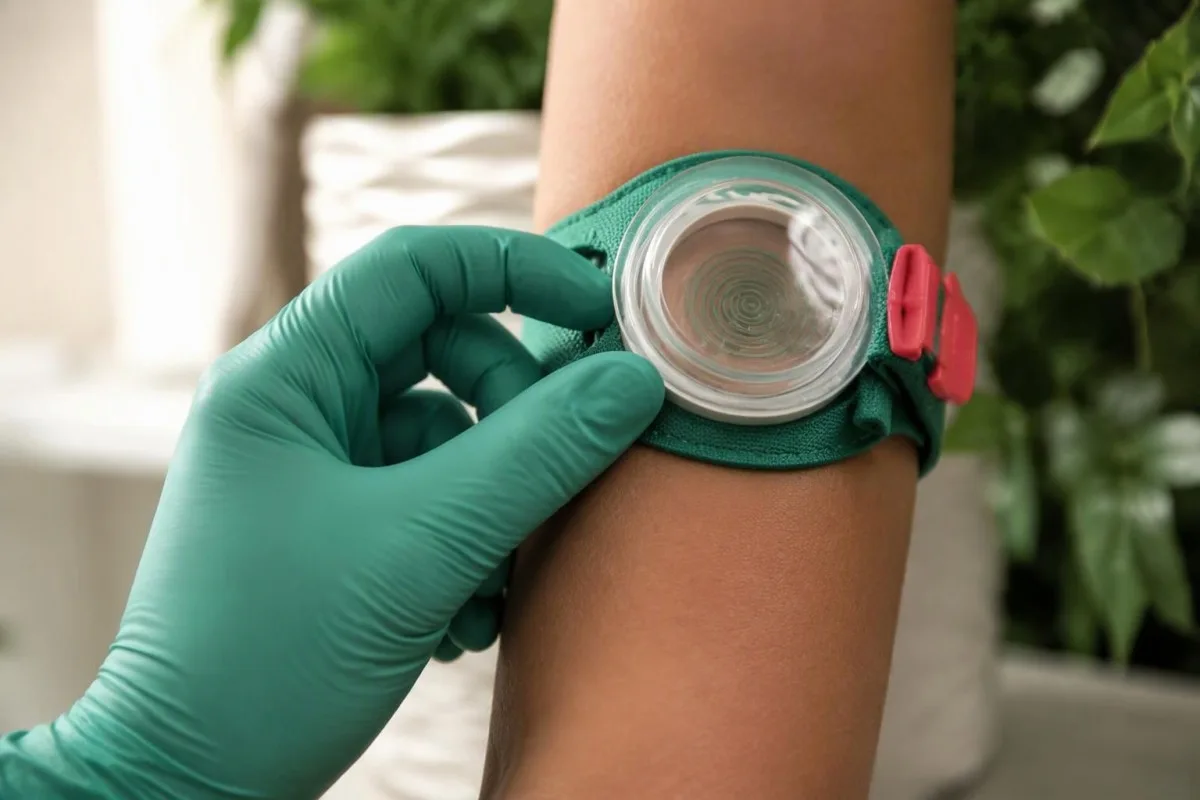
The sweat chloride test measures chloride concentration in sweat after pilocarpine stimulates a small collection area. It assesses one consequence of CFTR channel function: how effectively the sweat duct reabsorbs chloride before sweat reaches the surface. The diagnostic result is reported in mmol/L, not as an amount of sweat produced.
The sweat gland first produces fluid, and its duct then reabsorbs salt. Reduced CFTR function can leave more chloride in the final sweat, producing values of 60 mmol/L or higher in many people with cystic fibrosis. This is a functional clue, but it does not directly measure lung damage, pancreatic function, or the number of genetic variants present.
Sweat chloride and serum chloride describe different compartments. A person can have elevated sweat chloride while the chloride concentration in a metabolic panel is normal—or low after substantial salt loss. Our discussion of serum chloride and fluids concerns blood chemistry; its reference intervals cannot be substituted for the 30–59 mmol/L sweat interval.
The units can also look different without representing different thresholds: for chloride, 1 mmol/L equals 1 mEq/L because chloride has a single electrical charge. Sweat conductivity is another matter—it reflects multiple ions, often expressed as sodium chloride equivalents. A conductivity result must not be interpreted using diagnostic sweat chloride thresholds, even when the report looks reassuringly numerical.
Why does an intermediate result not confirm cystic fibrosis?
An intermediate sweat chloride result does not confirm cystic fibrosis because 30–59 mmol/L overlaps several clinical situations. These include some people with cystic fibrosis, people with other CFTR-associated conditions, and people without a CFTR disorder. The same value can therefore lead to different conclusions depending on the evidence around it.
For an illustrative comparison, consider a thriving infant with 38 mmol/L after newborn screening and an adult with 38 mmol/L plus recurrent pancreatitis and bronchiectasis. Neither number independently proves cystic fibrosis, but the second history raises different diagnostic questions. This is why I would not attach a single percentage probability to every borderline sweat chloride test without knowing the referral context.
Persistent intermediate results on 2 separate occasions can still occur in cystic fibrosis, and the 2017 consensus recommends considering extended CFTR analysis or specialized functional testing in that setting (Farrell et al., 2017). Conversely, 2 intermediate measurements do not automatically convert uncertainty into a confirmed diagnosis. Repetition establishes persistence; it does not explain the cause by itself.
Borderline is also not another word for carrier. A person with 1 identified CF-causing variant may be a carrier, but the initial genetic panel might have missed another variant, or the symptoms may have another explanation. Our discussion of borderline stool test follow-up illustrates the broader distinction between an indeterminate measurement and a named disease; the follow-up tests themselves are different.
What does a positive sweat chloride result require next?
A properly collected sweat chloride result of at least 60 mmol/L supports a cystic fibrosis diagnosis when there is compatible newborn screening, a relevant family history, or characteristic clinical features. Specialist assessment should follow promptly. Confirmation usually uses repeat testing on a separate date or an independent diagnostic method, such as appropriate CFTR analysis.
A report saying sweat chloride test positive deserves more than a telephone message reading only the flag. Ask for the actual concentration, the collection method, whether the sample was sufficient, and the plan for confirmation. A measured chloride of 72 mmol/L is meaningful evidence; a positive conductivity screening result is not an interchangeable diagnostic finding.
The distinction between a category and a concentration matters at both ends of the scale. Chloride concentrations above roughly 160 mmol/L are outside the expected physiological range for sweat and should trigger immediate laboratory review rather than assumptions about unusually severe disease. The collection and analytical record may be more informative than another decimal place on the report.
Positive-range sweat chloride is not, by itself, an emergency severity score. A clinically stable child with 68 mmol/L needs a timely CF specialist pathway; a child with dehydration or breathing difficulty needs urgent care regardless of the sweat value. Our guide to чанарын болон тоон үр дүн explains why the measured number should accompany the positive label.
Can a low result rule out cystic fibrosis?
Sweat chloride below 30 mmol/L makes cystic fibrosis less likely, but cannot absolutely exclude it when symptoms or CFTR findings are strongly suggestive. A low result is most reassuring when the sample was valid, the person has no characteristic symptoms, and the screening or family-history concern has been adequately addressed.
Certain CFTR variants preserve enough sweat-duct function to produce lower chloride concentrations despite clinically relevant disease. The 2017 consensus therefore allows further evaluation when a value below 30 mmol/L conflicts with genotype or evolving clinical features (Farrell et al., 2017). A normal newborn screen also does not eliminate every possible CF diagnosis in a child who later develops suggestive symptoms.
Age does not create a separate low-result exception: a value of 27 mmol/L has the same diagnostic category in a toddler and an adult. What changes is the history available to interpret it—growth trajectory in a young child, for example, versus years of recurrent pancreatitis or unexplained bronchiectasis in an adult. The referral question should travel with the laboratory result.
A child with 24 mmol/L, persistent greasy stools, and faltering growth still needs an explanation for the symptoms, even if cystic fibrosis becomes less likely. The next step may include pancreatic, gastrointestinal, or nutritional assessment rather than simply repeating every test. Our guidance on хүүхдийн хиймэл оюун ухааны тайлбарын хязгаарлалт explains why pediatric decisions require age-specific clinical oversight.
How are intermediate results handled after newborn screening?
An infant with an abnormal newborn screen and intermediate sweat chloride needs assessment through a CF specialist pathway, but may not have cystic fibrosis. Some clinically well infants receive the designation CRMS/CFSPID, meaning the screening and diagnostic findings remain inconclusive. This designation has specific criteria; it should not be applied to every borderline result.
CRMS/CFSPID generally applies after positive newborn screening when sweat chloride is below 30 mmol/L with 2 CFTR variants, at least 1 of uncertain consequence, or when chloride is 30–59 mmol/L with no more than 1 CF-causing variant. The infant should not have clinical features establishing CF. A symptomatic child or an adult with borderline chloride needs a different diagnostic framing.
The 2024 Cystic Fibrosis Foundation guideline recommends repeat sweat chloride at 6 months and annually through at least age 8 for children with CRMS/CFSPID (Green et al., 2024). Fewer than 10% are reclassified as CF in the evidence summarized by that guideline, although individual risk varies. That estimate describes a defined screened population—not all children with intermediate chloride.
For screen-positive newborns, diagnostic sweat testing is generally arranged after 10 days of age and ideally by 4 weeks, when the infant is over 2 kg and at least 36 weeks corrected gestational age. Feeding, stool pattern, and weight gain help determine urgency. Our explanation of pediatric growth assessment addresses broader growth questions; a borderline sweat result does not itself justify growth-hormone testing.
What does borderline sweat chloride mean in adults?
Sweat chloride levels 30–59 mmol/L are intermediate in adults, just as they are in children. Persistent intermediate results deserve particular attention when there is unexplained bronchiectasis, recurrent pancreatitis, chronic sinus disease with other suggestive features, or obstructive infertility. Adult diagnosis is possible; age alone does not exclude cystic fibrosis.
Imagine an illustrative 34-year-old with chloride of 44 mmol/L, repeated pancreatitis, and otherwise normal routine blood chemistry. The normal metabolic panel does not settle the CFTR question, because it measures neither sweat-duct transport nor pancreatic duct function. A specialist might pursue extended genetics and pancreatic assessment while also checking more common causes of recurrent pancreatitis.
Bronchiectasis has several possible causes, and 1 intermediate sweat result should not end that investigation. Depending on the history, clinicians may evaluate immune deficiency, aspiration, ciliary disorders, and other inherited respiratory conditions. Our guide to альфа-1 антитрипсиний шинжилгээг discusses a different inherited lung-risk pathway; it is complementary only when the clinical pattern supports testing.
Male infertility can occasionally be the first clue to CFTR-associated disease, especially when congenital absence of the vas deferens causes obstruction. A sperm count of 0 is not enough to establish that anatomy or a CF diagnosis, and hormonal explanations require different evaluation. Our semen analysis interpretation guide explains why reproductive assessment must accompany—not be replaced by—CFTR testing.
Could collection problems make the result misleading?
Collection problems can make sweat chloride results unreliable, and insufficient sweat is not a negative test. Evaporation, contamination, incorrect handling, and inadequate sample volume can interfere with interpretation. Before drawing conclusions from a borderline result, confirm that the laboratory performed quantitative chloride analysis on an acceptable sample.
Common minimum quantities are 75 mg for gauze or filter-paper collection and 15 µL for a Macroduct collection system; collection generally lasts no more than 30 minutes. Samples from separate sites should not be pooled to reach the minimum. The Cystic Fibrosis Foundation sweat-testing guidance describes these collection safeguards because an apparently precise number cannot rescue an inadequate specimen (LeGrys et al., 2007).
A report marked QNS—quantity not sufficient—means no reliable diagnostic concentration was obtained. If one arm yields an acceptable sample and the other does not, the center should explain which result is valid; the unsuccessful site is not a second negative measurement. Likewise, conflicting bilateral values should prompt a quality review rather than an improvised average that hides disagreement.
Copied reports introduce another avoidable problem: 35 mmol/L can become 85 mmol/L through transcription or image-reading error. Our PDF транскрипцийн жагсаалт is useful for verifying numbers against the original report, not for validating the sweat procedure. Kantesti’s эмнэлзүйн стандартууд, хязгаарлалтуудыг should also be distinguished from accreditation of the laboratory that collected and measured the sweat.
When should testing be repeated at an accredited center?
An intermediate sweat chloride result generally warrants repeat quantitative testing within 1–2 months at an accredited CF center or an appropriately accredited laboratory experienced in sweat testing. Earlier specialist assessment is appropriate for symptomatic infants, poor growth, recurrent pancreatitis, or significant respiratory concerns. Persistent uncertainty should not be managed through repeated low-quality collections.
The right center depends on your country: CF-center accreditation and laboratory accreditation are related but not identical. Ask whether the laboratory regularly performs pediatric and adult sweat chloride testing, monitors insufficient-sample rates, and uses quantitative chloride rather than conductivity alone. For a result of 46 mmol/L, an experienced collection team may be more useful than choosing a laboratory solely for convenience.
Repeat tests can cross categories because of biological and analytical variation. Values of 29 and 33 mmol/L on separate dates deserve context; they do not prove that CFTR function suddenly deteriorated. Our discussion of laboratory changes over time explains the general distinction between variation and disease progression, although sweat testing has its own collection requirements.
For a valid repeat, follow the center’s instructions, maintain normal hydration, and avoid lotions or creams on the collection site. Do not fast, overdrink water, or stop prescribed medicines unless instructed; disclose all medicines, especially CFTR modulators. If the first sample was QNS, the repeat may simply be the first interpretable test—not a confirmation of any earlier diagnostic category.
When is CFTR genetic evaluation appropriate?
CFTR genetic evaluation is appropriate when sweat chloride remains intermediate, newborn screening is abnormal, family history is relevant, or characteristic symptoms persist despite a low result. Testing may need to extend beyond a common-variant panel to sequencing and deletion/duplication analysis. A negative limited panel cannot exclude all clinically relevant CFTR variants.
Finding 2 variants is not automatically equivalent to finding 2 CF-causing variants. Classification matters, and the variants usually need to be on opposite gene copies—in trans—to support the recessive diagnostic explanation. Parental testing can help establish phase; 2 variants on the same copy, in cis, leave the other copy unresolved.
A variant of uncertain significance cannot be promoted to a disease-causing finding simply because sweat chloride is 41 mmol/L. Specialists combine curated variant evidence, the phenotype, family testing, and sometimes functional assessment. Genetic counseling should explain what the result establishes, what it leaves unanswered, and whether relatives or a reproductive partner need targeted evaluation.
Kantesti is an AI blood test interpretation platform, not a CFTR variant-classification laboratory. Our хиймэл оюун ухааны технологийн тайлбар describes how laboratory information is organized, but 1 unresolved genetic finding requires qualified interpretation rather than an automated disease label. When I review accompanying chemistry, I treat the genetic report as a separate evidence source with its own method, coverage, and limitations.
Which additional tests can clarify an inconclusive result?
Specialist CFTR functional tests can help when sweat chloride and genetics remain inconclusive. Nasal potential difference assesses ion transport in nasal epithelium, while intestinal current measurement assesses transport in intestinal tissue. These tests require validated protocols at experienced reference centers; they are not routine blood tests or interchangeable screening tools.
The 2017 consensus recommends that nasal potential difference and intestinal current measurement be performed in validated reference centers when needed for diagnosis (Farrell et al., 2017). Availability varies internationally, and 1 abnormal functional measurement must be interpreted using the center’s protocol and clinical context. Referral is often more sensible than asking a general laboratory to improvise an unfamiliar assay.
Organ-specific tests answer different questions. Fecal elastase below 200 µg/g can suggest pancreatic exocrine insufficiency, but a watery sample may dilute the measurement and a normal result does not exclude pancreatic-sufficient CF. Our ялгадсан эластазыг тайлбарлах гарын авлага explains those limitations; pancreatic status is evidence about organ function, not a substitute for establishing CFTR-related diagnosis.
Fat malabsorption may also justify stool-fat assessment, with collection and dietary requirements determined by the laboratory. Adult fecal fat above about 7 g/day on an appropriate standardized intake suggests steatorrhea, but the cause may be pancreatic, intestinal, or biliary. Our fecal fat result guide helps separate documenting malabsorption from naming its cause.
Can other conditions or medicines affect sweat chloride?
Technical problems and some non-CF conditions can produce elevated or intermediate sweat chloride, while medicines can affect sweat production or CFTR function. Severe malnutrition, untreated hypothyroidism, and adrenal insufficiency are among reported non-CF associations. These possibilities require a clinically directed assessment; they should not become an excuse to dismiss a valid result of 60 mmol/L or higher.
Adrenal insufficiency deserves consideration when fatigue, weight loss, low blood pressure, pigmentation changes, or abnormal electrolytes accompany the diagnostic question. A sweat value of 48 mmol/L alone does not justify a cortisol workup, but the combined pattern may. Our guide to adrenal insufficiency warning signs explains when symptoms make that alternative urgent.
Malnutrition can be a confounder and also a consequence of an underlying disorder, so correcting nutrition does not automatically resolve the CF question. A child with 43 mmol/L and chronic diarrhea may need evaluation for celiac disease or another malabsorption cause as well as CFTR assessment. Our explanation of IgA-related celiac testing pitfalls is relevant when negative celiac antibodies conflict with a suggestive history.
CFTR modulators can lower sweat chloride because they improve channel function; a treated value below 30 mmol/L does not erase an established CF diagnosis. Drugs that reduce sweating, such as topiramate in some patients, can make adequate collection harder without providing a reliable prediction of chloride concentration. Give the center a complete medication list, and never stop treatment just to produce an untreated number.
What should families do while the diagnosis is uncertain?
While a borderline result is being clarified, keep specialist follow-up, monitor relevant symptoms, and avoid starting CF-specific treatment without an indication. A sweat chloride value of 30–59 mmol/L does not justify routine pancreatic enzymes, antibiotics, high-dose vitamins, or extra salt on its own. Supportive care should address demonstrated problems rather than a provisional label.
Bring the original sweat report, newborn-screening record if applicable, genetic report, medication list, and growth measurements to the appointment. Recording 2–3 concrete observations—such as stool frequency, weight trend, or repeated chest illnesses—is usually more useful than an exhaustive diary. Ask who will arrange the repeat test and who will explain a result that remains intermediate.
Nutrition testing should be driven by symptoms and growth, not by the sweat number alone. Iron deficiency can accompany restricted intake or malabsorption, but a ferritin result does not confirm CF; iron treatment also needs an appropriate indication. Our complete iron studies guide explains how to distinguish low stores from inflammation-related changes when a clinician requests that assessment.
Routine chemistry can help assess complications: low chloride and bicarbonate elevation may accompany salt depletion, while low albumin needs a separate nutritional, hepatic, or protein-loss explanation. Our Цусны ийлдсийн уургийн тайлбарын гарын авлага provides that context. Seek urgent care for breathing difficulty, marked lethargy, repeated vomiting, or substantially reduced urination—do not wait 1–2 months for the planned sweat retest.
How should the result be explained and documented?
A useful sweat chloride explanation records the exact value, units, collection quality, clinical context, and next diagnostic step. As of October 8, 2026, this article uses the 2017 CF diagnostic consensus and the 2024 CRMS/CFSPID management guideline—not a newly invented 2026 cutoff. The central distinction remains unchanged: intermediate is not confirmed CF.
For a result of 42 mmol/L, a clear clinical note might say: intermediate quantitative sweat chloride, adequate sample, CF diagnosis unresolved, repeat at an experienced center and review CFTR testing. That wording is more useful than possible CF without a plan. If the repeat is below 30 mmol/L but symptoms remain concerning, the note should explain why investigation is continuing.
Kantesti is an AI lab test interpretation service that can help explain accompanying blood chemistry, but cannot confirm cystic fibrosis from sweat chloride or genetics. At Kantesti, the safe boundary is to distinguish report explanation from specialist diagnosis; our medical advisory responsibilities describe the role of clinical oversight. A value of 60 mmol/L or higher should trigger a clinical pathway, not an AI-generated treatment prescription.
As Thomas Klein, MD, my practical recommendation is to ask 3 questions: was the specimen valid, does the clinical story fit, and what evidence will resolve the uncertainty? The related Zenodo publications below address general laboratory interpretation, not sweat chloride diagnostic validation. The CF-specific external references are the sources supporting the thresholds, confirmation strategy, and follow-up recommendations in this article.
Байнга асуудаг асуултууд
Хил заагт байдаг хөлсний хлорид нь цистик фиброз гэсэн үг үү?
30–59 ммоль/л-ын цусны шөлтэй байдал нь дангаараа цистик фиброзыг оношлохгүй. Энэ нь ХП-тэй хүмүүс, бусад ХПТ-тэй холбоотой өвчин, ХПТ-тэй холбоогүй өвчин зэргийг хамардаг. Дахин тоон шинжилгээг туршлагатай төвд хийж, шинж тэмдэг, скрининг, заримдаа ХПТ-ийн өргөтгөсөн үнэлгээг хийх нь зүйтэй. Дундаж үр дүн хоёр удаа гарсан ч автоматаар оношлохын оронд нэмэлт тайлбар хийх шаардлагатай.
Эерэг хөлсний хлоридын шинжилгээний үр дүн гэж юу вэ?
60 ммоль/л буюу түүнээс дээш хэмжээтэй шүүсний хлоридийн тоон хэмжээ нь эерэг оношлогооны хүрээнд ордог бөгөөд клиник шинж тэмдэг, нялх хүүхдийн скрининг, эсвэл гэр бүлийн түүхтэй нийцсэн үед цистик фиброзыг дэмжинэ. Дээж нь цуглуулах болон аналитик шаардлагыг хангасан байх ёстой. Мэргэжилтний баталгаажуулалт нь ихэвчлэн өөр өдөр давтан шинжилгээ хийх эсвэл бие даасан оношлогооны аргыг шаарддаг. Шүүсний эерэг дамжуулалт нь шүүсний хлоридийн эерэг тоон үр дүнтэй харилцан солигдох боломжгүй.
Насанд хүрсэн хүний 汗 chloride-ийн 35-ийн үр дүн хэвийн үү?
35 ммоль/л-ийн ислийн хлоридын үр дүн нь 2017 оны Кистик Фиброзын Сангийн оношлогооны зөвшилцлийн дагуу насанд хүрэгчдэд дунд зэргийн байна. Одоогийн ангилал нь 30 ммоль/л-ээс доош, 30–59 ммоль/л, болон бүх насныханд 60 ммоль/л-ээс их байна. Хүүхэд байхаас хойшхи зарим лабораторийн хуучин хязгаарт 40 ммоль/л-ийг дунд зэргийн хил хязгаар болгон ашиглаж байжээ. Тиймээс насанд хүрэгчдийн 35 ммоль/л-ийн үр дүнг хуучирсан интервалаар хаяхын оронд эмнэлзүйн контекстэд хянах ёстой.
Дунд шатны хөлс шинжлэх шинжилгээг хэр удалгүй давтан хийх ёстой вэ?
30–59 ммоль/л-ийн завсрын хөлсний хлоридын үр дүн нь туршлагатай, зохих ёсоор итгэмжлэгдсэн төвд 1–2 сарын дотор дахин тоон шинжилгээ хийлгэхийг ерөнхийдөө шаарддаг. Шинж тэмдэгтэй нярай, өсөлт муутай, эсвэл амьсгал, нойр булчирхайн талаар ноцтой санаа зовнил үүсвэл илүү эрт мэргэжилтэнтэй зөвлөлдөх шаардлагатай. CRMS/CFSPID гэж тодорхойлогдсон хүүхдүүд 6 сартайдаа болон 8 нас хүртлээ жил бүр хөлс шинжилгээг давтан хийлгэх зэрэг удаан хугацааны хуваарьтай байдаг. Давтан оношлогоо ба үргэлжилсэн хяналтын хуваарь нь өөр өөр зорилгыг хангадаг.
Төвлөрсөн булчирхайн өвчинг 30-аас доош хөлсний хлоридтой байж болох уу?
Цистик фиброз нь заримдаа 30 ммоль/л-ээс доош хөлсний хлоридын хэмжээтэй байж болно, ялангуяа зарим CFTR хувилбарууд нь хөлсний сувгийн үйл ажиллагааг хадгалдаг тохиолдолд. Хэмжээ бага гарах нь CF-ийн магадлалыг бууруулдаг боловч шинж тэмдэг эсвэл генетикийн хувьд хүчтэй сэжиглэгдэж байвал бүрэн хасах боломжгүй. Байнга тохиолддог гуурсан хоолойн өргөсөлт, давтагддаг нойр булчирхайн үрэвсэл, эсвэл шалтгаан тодорхойгүй шимэгдэл нь мэргэжлийн цаашдын үнэлгээг баталгаажуулж болно. Хангалттай дээж болон зөв тоон аргыг мөн баталгаажуулах ёстой.
Нэг CFTR мутаци нь хил заагт байгаа хөлсний шинжилгээг тайлбарлаж чадах уу?
Цусны шингэний гуурсан хоолойн үйл ажиллагааг алдагдуулдаг (CF-causing CFTR) нэг удаа тодорхойлогдсон хувилбар нь дангаараа цистик фиброз өвчнийг оношлох эсвэл шүүрлийн хлоридын 30-59 ммоль/л үр дүнг бүрэн тайлбарлаж чадахгүй. Хязгаарлагдмал шинжилгээ нь өөр нэг хувилбарыг алдаж болно, мөн эмнэлзүйн шинж тэмдгүүд нь өөр шалтгаантай байж болно. Хэрэв сэжиглэл хэвээр байвал нэмэлт дараалал тогтоох, устгах/давхарлах шинжилгээ, мөн генетикийн зөвлөгөө авах шаардлагатай байж болно. Хэрэв 2 хувилбар олдвол тэдгээрийн ангилал болон ген хуулбарлах эсэх нь мөн чухал ач холбогдолтой.
What does quantity not sufficient mean on a sweat test?
Quantity not sufficient, or QNS, means too little sweat was collected to produce a reliable diagnostic result. Common minimum quantities are 15 µL for Macroduct collection or 75 mg for gauze or filter-paper collection. QNS is not a negative sweat chloride test and cannot exclude cystic fibrosis. Repeat collection is needed, and separate collection sites should not be pooled to meet the minimum.
Өнөөдөр AI-аар дэмжигдсэн цусны шинжилгээний тайлал аваарай
Лабораторийн шинжилгээний агшин зуур, үнэн зөв тайлалд итгэдэг дэлхийн 2 сая гаруй хэрэглэгчтэй нэгдээрэй. Цусны шинжилгээний хариугаа байршуулж, 15,000+ биомаркеруудын цогц тайллыг хэдхэн секундын дотор аваарай.
📚 Иш татсан судалгааны нийтлэлүүд
Клейн, Т., Митчелл, С., ба Вебер, Х. (2026). Шээсэнд уробилиноген илрүүлэх шинжилгээ: 2026 оны бүрэн шээсний шинжилгээний гарын авлага. Kantesti AI Медикл Рисерч.
Клейн, Т., Митчелл, С., ба Вебер, Х. (2026). Төмрийн судалгааны гарын авлага: TIBC, Төмрийн ханалт ба холбох чадвар. Kantesti AI Медикл Рисерч.
📖 Гадаад эмнэлгийн лавлагаа
Green DM et al. (2024). Cystic Fibrosis Foundation Evidence-Based Guideline for the Management of CRMS/CFSPID. Хүүхдийн эмч.
LeGrys VA et al. (2007). Diagnostic Sweat Testing: The Cystic Fibrosis Foundation Guidelines. Хүүхдийн эмнэлгийн сэтгүүл.
⚕️ Эмнэлгийн мэдэгдэл
Энэ нийтлэл зөвхөн боловсролын зорилготой бөгөөд эмнэлгийн зөвлөгөө биш болно. Оношилгоо, эмчилгээний шийдвэр гаргахдаа мэргэшсэн эрүүл мэндийн үйлчилгээ үзүүлэгчтэй заавал зөвлөлдөнө.
E-E-A-T итгэлийн дохио
Туршлага
Эмчийн удирдлагатай лабораторийн тайлалын ажлын урсгалын клиник хяналт.
Мэргэшсэн байдал
Биомаркерууд клиникийн нөхцөлд хэрхэн ажиллаж/өөрчлөгдөж байгаад чиглэсэн лабораторийн анагаах ухаан.
Эрх мэдэл
Доктор Томас Клейн бичсэн, Доктор Сара Митчелл, Проф. Доктор Ханс Вебер нар хянан тохиолдуулсан.
Найдвартай байдал
Сэрэмжлүүлгийг бууруулахын тулд тодорхой дараагийн алхамтай, нотолгоонд суурилсан тайлал.