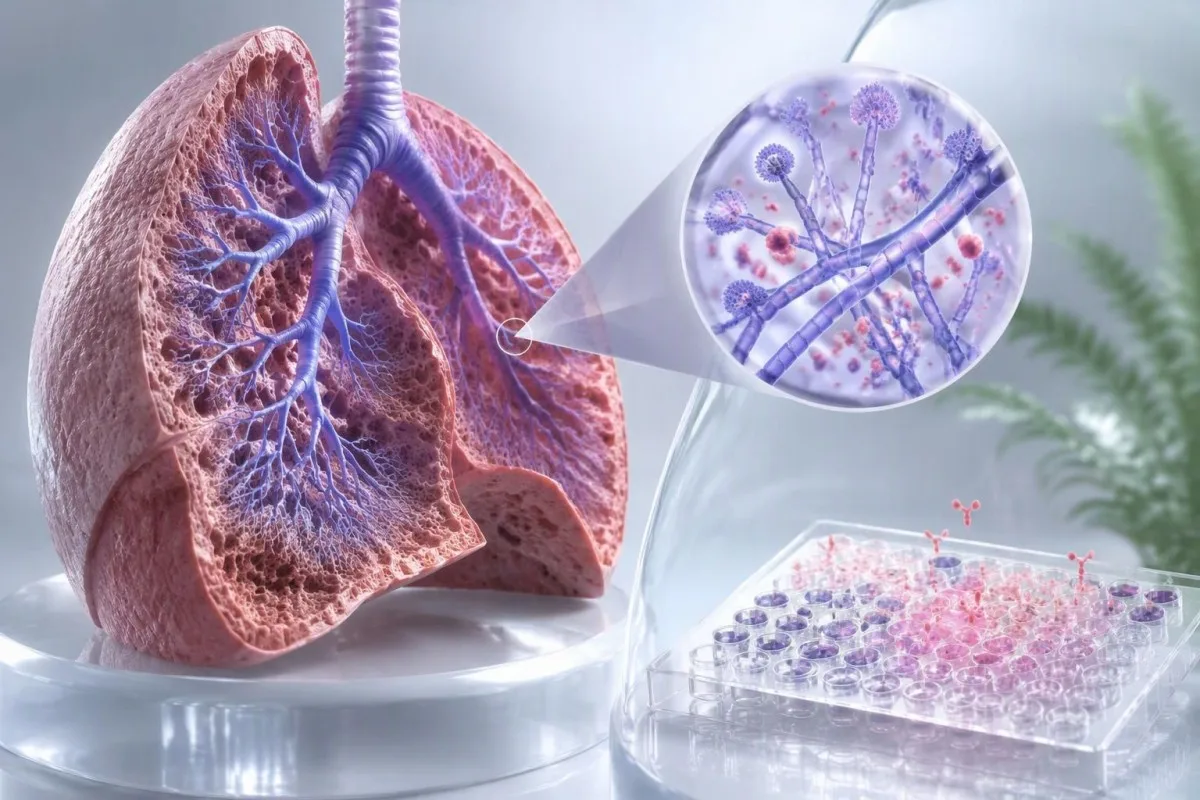
सकारात्मक गैलेक्टोमैनन परिणाम संभावित इनवेसिव एस्परजिलोसिस का समर्थन करता है, लेकिन इसकी पुष्टि नहीं करता। नमूना, प्रतिरक्षा स्थिति, स्कैन के निष्कर्ष और दवाएँ तय करती हैं कि अगला कदम तत्काल मूल्यांकन, अतिरिक्त जाँच या भ्रामक परिणाम की पड़ताल होना चाहिए।.

मुख्य निष्कर्ष
- पॉजिटिव परिणाम का अर्थ है कि परीक्षण ने फंगल कोशिका-भित्ति एंटीजन का पता लगाया; यह अपने-आप में इनवेसिव एस्परजिलोसिस स्थापित नहीं करता।.
- गैलेक्टोमैनन इंडेक्स आम तौर पर इकाईरहित ऑप्टिकल डेंसिटी अनुपात होता है, न कि फंगल गणना, ng/mL में सांद्रता या प्रतिशत संभावना।.
- प्रयोगशाला कटऑफ अक्सर 0.5 का इंडेक्स होता है, लेकिन प्रयोगशाला की परीक्षण-विशिष्ट व्याख्या को प्राथमिकता दी जाती है।.
- शोध-सीमाएँ 2020 की EORTC/MSGERC परिभाषाओं में सीरम या प्लाज़्मा ≥1.0, BAL ≥1.0, या सीरम/प्लाज़्मा ≥0.7 के साथ BAL ≥0.8 शामिल हैं।.
- सीरम बनाम BAL महत्वपूर्ण है: सीरम से फेफड़ों तक सीमित रोग का पता नहीं चल सकता, जबकि ब्रोंकोएल्वियोलर लैवेज ऊतक में आक्रमण के बिना वायुमार्ग में उपनिवेशन का पता लगा सकता है।.
- प्रतिरक्षा जोखिम लंबे समय तक गंभीर न्यूट्रोपीनिया, प्रत्यारोपण और पर्याप्त प्रतिरक्षादमन के साथ बढ़ता है; 10 दिनों से अधिक समय तक ANC का 0.5 × 10^9/L से कम होना एक मान्य अनुसंधान-आधारित होस्ट कारक है।.
- ऐंटिफंगल उपचार एंटीजन का पता लगाना कम कर सकता है; मोल्ड-सक्रिय उपचार के दौरान नकारात्मक परिणाम से संक्रमण को सुरक्षित रूप से नकारा नहीं जा सकता।.
- त्वरित मूल्यांकन तब आवश्यक है जब उच्च जोखिम वाले प्रतिरक्षादमन और बुखार या श्वसन लक्षणों के साथ सकारात्मक परिणाम हो; सांस लेने में गंभीर कठिनाई, भ्रम या खून की काफी खांसी के लिए आपातकालीन देखभाल आवश्यक है।.
सकारात्मक गैलेक्टोमैनन परीक्षण का वास्तव में क्या अर्थ है?
A गैलेक्टोमैनन परीक्षण सकारात्मक परिणाम का अर्थ है कि फंगल कोशिका-भित्ति एंटीजन का पता चला, लेकिन इससे इनवेसिव एस्परगिलस संक्रमण की पुष्टि नहीं होती। व्याख्या सीरम बनाम ब्रोंकोएल्वियोलर लैवेज, प्रतिरक्षा स्थिति, इमेजिंग, ऐंटिफंगल दवा के संपर्क और गलत-सकारात्मक परिणामों के कारणों पर निर्भर करती है; बुखार या श्वसन लक्षणों वाले उच्च जोखिम के रोगियों को किसी अन्य संख्या की प्रतीक्षा करने के बजाय विशेषज्ञ से तुरंत आकलन कराना चाहिए।.

गैलेक्टोमैनन एक एंटीजन है, एंटीबॉडी नहीं, और यह परीक्षण फंगल कोशिका-भित्तियों से मुक्त हुए पदार्थ का पता लगाता है, न कि किसी व्यक्ति की प्रतिरक्षा-स्मृति का। इसलिए सीरम का 0.8 सूचकांक पिछला संपर्क, 80% संक्रमण की संभावना या आठ जीवों का अर्थ नहीं है; ऐसी व्याख्याएं परीक्षण के संकेत को नैदानिक निदान समझने की भूल करती हैं।.
इनवेसिव एस्परगिलोसिस का अर्थ है कि एस्परगिलस ऊतक में प्रवेश कर उसे क्षति पहुँचा चुका है, जबकि वायुमार्ग में उपनिवेशन का अर्थ है कि जीव मौजूद है, लेकिन आक्रमण का प्रमाण नहीं है। BAL का 1.4 सूचकांक दोनों स्थितियों में मिल सकता है, इसलिए चिकित्सक परिणाम को ब्रोंकोस्कोपी के कारण, श्वसन संबंधी निष्कर्षों और इमेजिंग से जोड़कर देखते हैं; वे सकारात्मक संकेत को उपचार का आदेश नहीं मानते।.
Kantesti एक AI रक्त-परीक्षण विश्लेषक है, जो संक्रमण की पुष्टि किए बिना, नमूने और दी गई नैदानिक जानकारी के साथ रिपोर्ट किए गए गैलेक्टोमैनन सूचकांक को समझाने में मदद कर सकता है।. हमारा कंपनी पृष्ठभूमि हमारी भूमिका स्पष्ट करता है; हमारा मार्गदर्शक मोल्ड के संपर्क संबंधी परीक्षणों की सीमाएँ इनवेसिव फंगल परीक्षण को पर्यावरणीय संपर्क के दावों से भी अलग करता है।.
सीरम और BAL गैलेक्टोमैनन परिणामों में असहमति क्यों हो सकती है
सीरम गैलेक्टोमैनन परिसंचारी एंटीजन को मापता है, जबकि BAL गैलेक्टोमैनन ब्रोंकोस्कोपी के दौरान निचले वायुमार्गों से एकत्र किए गए द्रव में एंटीजन को मापता है।. वास्तविक, फेफड़ों तक सीमित एस्परगिलोसिस में सीरम का नकारात्मक परिणाम और BAL का सकारात्मक परिणाम एक साथ हो सकते हैं; दोनों नमूने अलग-अलग हिस्सों से लिए जाते हैं, ये एक ही नैदानिक संकेत के परस्पर बदलने योग्य रूप नहीं हैं।.
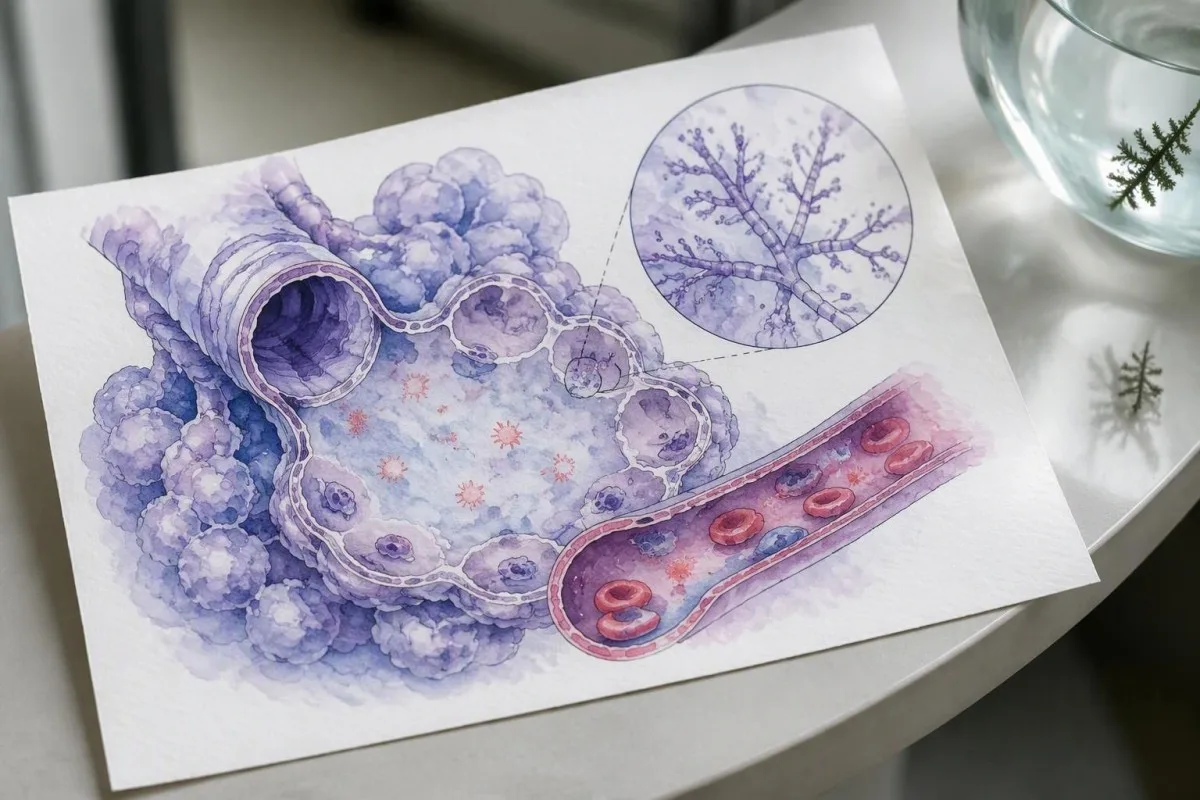
चयनित हीमैटोलॉजिक कैंसर या स्टेम-सेल प्रत्यारोपण वाले रोगियों में सीरम से पता लगाना आम तौर पर कई गैर-न्यूट्रोपेनिक आबादियों की तुलना में बेहतर होता है।. न्यूट्रोफिल की सुरक्षित गतिविधि और वायुमार्गों में केंद्रित रोग परिसंचारी एंटीजन को सीमित कर सकते हैं, इसलिए 0.2 का सीरम सूचकांक संदिग्ध छाती CT और अनुकूल BAL निष्कर्षों को खारिज नहीं कर सकता।.
BAL परीक्षण से यह जांच फेफड़ों की प्रक्रिया के अधिक निकट आती है, लेकिन इससे उपनिवेशन और नमूना-संग्रह से संबंधित संदूषण की संभावना भी सामने आती है। उदाहरण के लिए, 1.1 का BAL सूचकांक और 0.1 का सीरम सूचकांक होने पर वायुमार्ग रोग, लैवेज संग्रह द्रव और श्वसन कल्चर की समीक्षा आवश्यक है—यह निष्कर्ष नहीं कि प्रयोगशाला के किसी एक परिणाम का गलत होना ही चाहिए।.
सीरम और BAL सूचकांकों का औसत नहीं निकालना चाहिए, क्योंकि 0.2 और 1.4 का औसत हर हिस्से के जैविक अर्थ को मिटा देगा। हमारी व्याख्या गुणात्मक और मात्रात्मक परिणाम प्रयोगशाला के सकारात्मक संकेत को उसके संख्यात्मक माप से अलग पहचानने में मदद करती है; सूचकांक के साथ नमूने का नाम हमेशा दर्ज रखें।.
गैलेक्टोमैनन इंडेक्स और कटऑफ को कैसे पढ़ें
The galactomannan index is usually a unitless optical density ratio, and many laboratories flag results at 0.5 or above. That laboratory threshold is not identical to a research case-definition threshold: the 2020 EORTC/MSGERC definitions use higher or combined specimen thresholds to improve diagnostic specificity in defined populations.
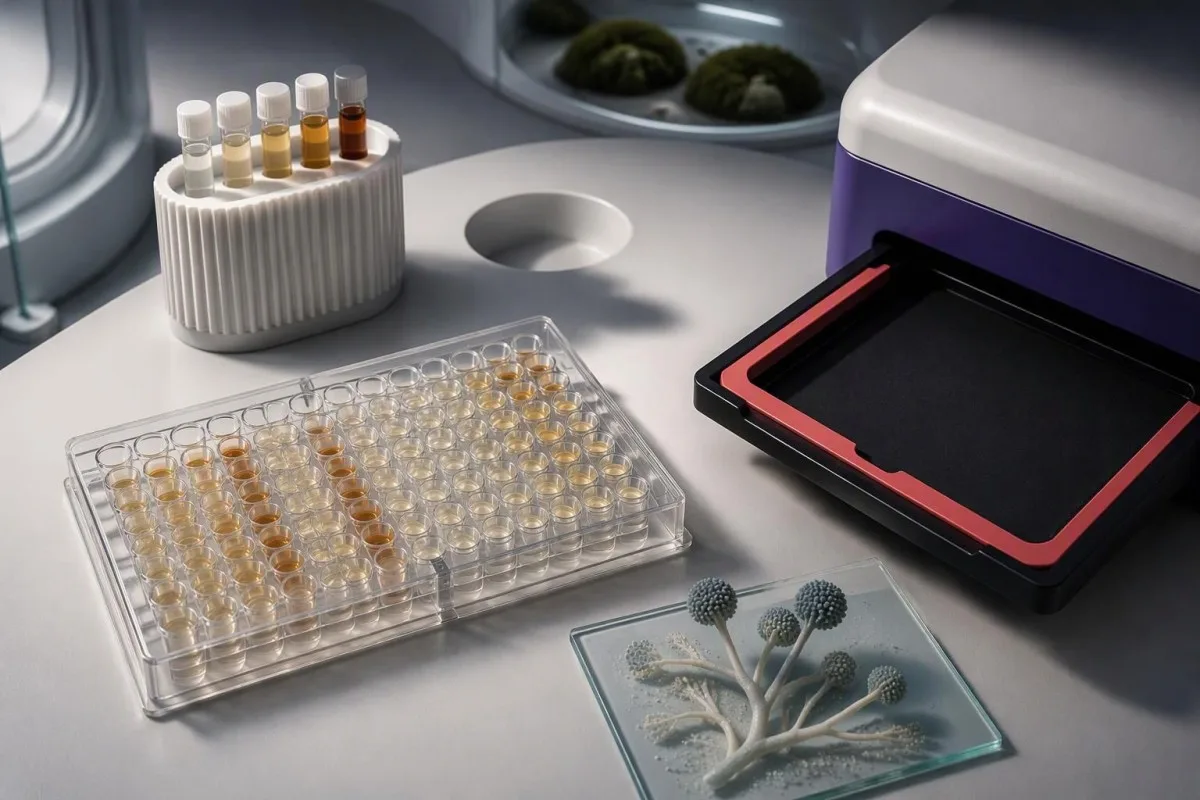
The 2020 EORTC/MSGERC galactomannan thresholds include serum/plasma ≥1.0, BAL ≥1.0, or serum/plasma ≥0.7 together with BAL ≥0.8. These are mycological criteria within research definitions, not stand-alone diagnoses; probable disease also requires the relevant host and clinical criteria (Donnelly et al., 2020).
A serum index of 0.62 may therefore be laboratory-positive without meeting the single-specimen research threshold of 1.0. This is not a contradiction between laboratories and guidelines: lower cutoffs capture more possible cases, while higher cutoffs reduce some false positives; local protocols may also define an equivocal interval or require repeat testing.
There is no universal galactomannan index that automatically means critical illness, and an index of 2.0 does not indicate twice the tissue damage of 1.0. Kantesti keeps the reported cutoff separate from clinical urgency; our guide to आउट-ऑफ-रेंज लैबोरेटरी फ्लैग्स बताती है कि चेतावनी-संकेत निदान नहीं, बल्कि व्याख्या का संकेत क्यों होता है।.
| स्तर | सीमा | इसका क्या अर्थ है |
|---|---|---|
| Common laboratory-negative category | Index <0.5 | Below a frequently used assay cutoff; does not exclude invasive aspergillosis, especially during treatment or in non-neutropenic patients. |
| Positive by many laboratory protocols | Index 0.5–0.99 | Requires specimen-specific and clinical interpretation; may not meet the single-specimen EORTC/MSGERC research threshold. |
| Single-specimen research threshold | Serum/plasma ≥1.0 or BAL ≥1.0 | Meets a 2020 EORTC/MSGERC mycological criterion when the appropriate assay and specimen are used; not sufficient alone for probable disease. |
| Combined-specimen research threshold | Serum/plasma ≥0.7 and BAL ≥0.8 | Both thresholds together meet the combined galactomannan criterion; neither value independently confirms invasion. |
प्रतिरक्षा स्थिति सकारात्मक परिणाम के महत्व को कैसे बदलती है
A positive galactomannan result is more concerning when the patient has a strong risk factor for invasive aspergillosis, such as prolonged severe neutropenia, stem-cell transplantation or substantial immunosuppression. The 2020 research definitions recognize an absolute neutrophil count below 0.5 × 10^9/L for more than 10 days as one host factor.
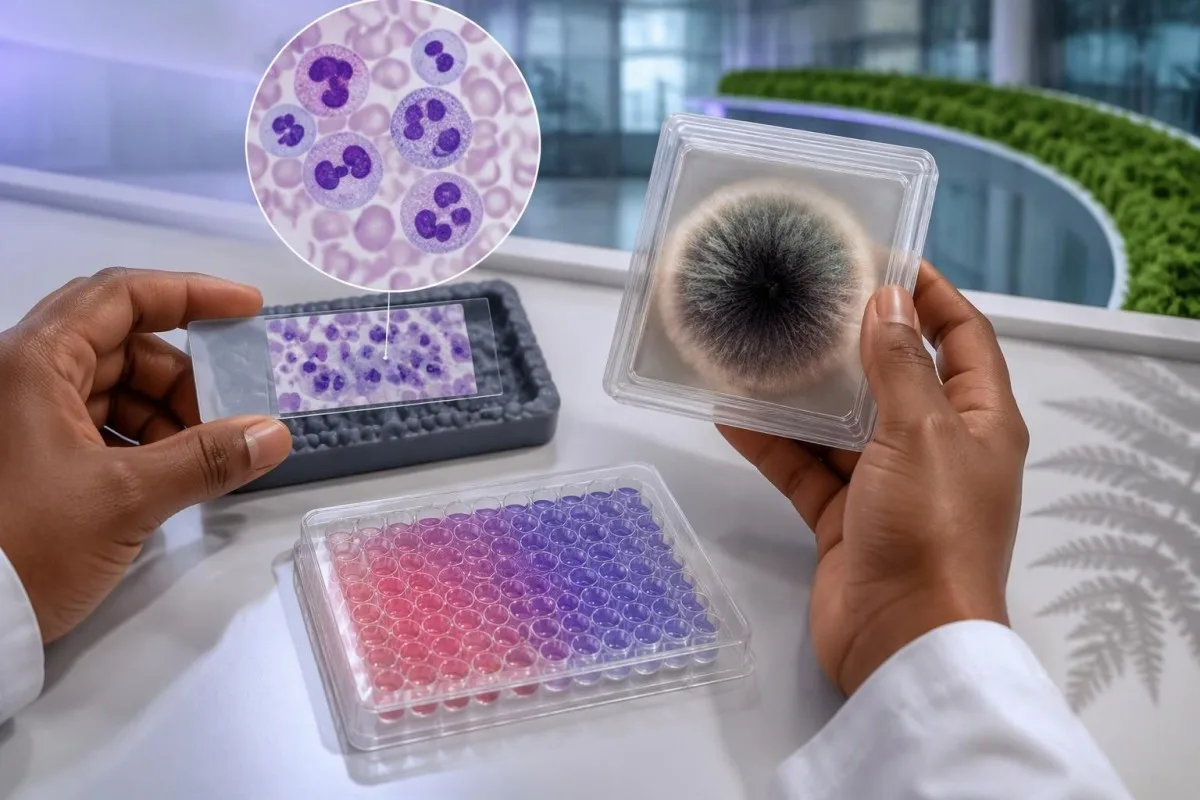
Duration and cause of neutropenia matter alongside the count. An ANC of 0.4 × 10^9/L during prolonged leukemia treatment has a different risk context from a stable, constitutionally lower count without recurrent infections; our 中性粒细胞计数指南 explains why the percentage alone is inadequate.
Corticosteroid exposure is another risk clue, but no single dose separates safe from unsafe for every patient. The EORTC/MSGERC research host criteria include at least 0.3 mg/kg/day for at least 3 weeks in the preceding 60 days—approximately 21 mg/day for a 70 kg adult—while bedside assessment also considers other immunosuppressants and underlying lung disease.
A normal neutrophil count does not guarantee normal fungal defense, because disorders such as chronic granulomatous disease affect cell function rather than simply cell number. Our guide to oxidative burst testing explains this distinction; a single reassuring CBC should not dismiss compatible fungal disease in someone with an established immune disorder.
अलग-अलग रोगियों में एक ही सकारात्मक इंडेक्स के अलग-अलग अर्थ क्यों होते हैं
The probability that a positive galactomannan result represents invasive disease depends on the probability of disease before testing. In a 2019 Cochrane review of BAL testing in immunocompromised patients, an index cutoff of 1.0 had estimated sensitivity of 78% and specificity of 93%, but performance varied across studies.

A hypothetical low-risk calculation illustrates why screening can mislead. If 1,000 tested people had a 1% disease prevalence and the assay performed with 78% sensitivity and 93% specificity, approximately 8 would be true positives and 69 false positives—so only about 10% of positive results would represent disease.
With the same assumed test performance but a 20% disease prevalence, approximately 156 true positives and 56 false positives would occur among 1,000 people. About 74% of positive results would then represent disease; these are teaching calculations, not validated predictions for an individual or evidence that the Cochrane estimates apply to healthy population screening.
Lowering the BAL cutoff from 1.0 to 0.5 trades specificity for sensitivity: the review estimated 88% sensitivity and 81% specificity at 0.5 (de Heer et al., 2019). The broader lesson also appears in our discussion of tests that need confirmation, although the assays and diseases are different.
एंटीफंगल उपचार और प्रोफिलैक्सिस व्याख्या को कैसे प्रभावित करते हैं
Mold-active antifungal treatment can reduce galactomannan detection, making a negative result less reassuring. The 2016 IDSA aspergillosis guideline advises against routine serum galactomannan screening during mold-active prophylaxis or treatment, while recognizing that BAL testing can still help investigate suspected disease (Patterson et al., 2016).
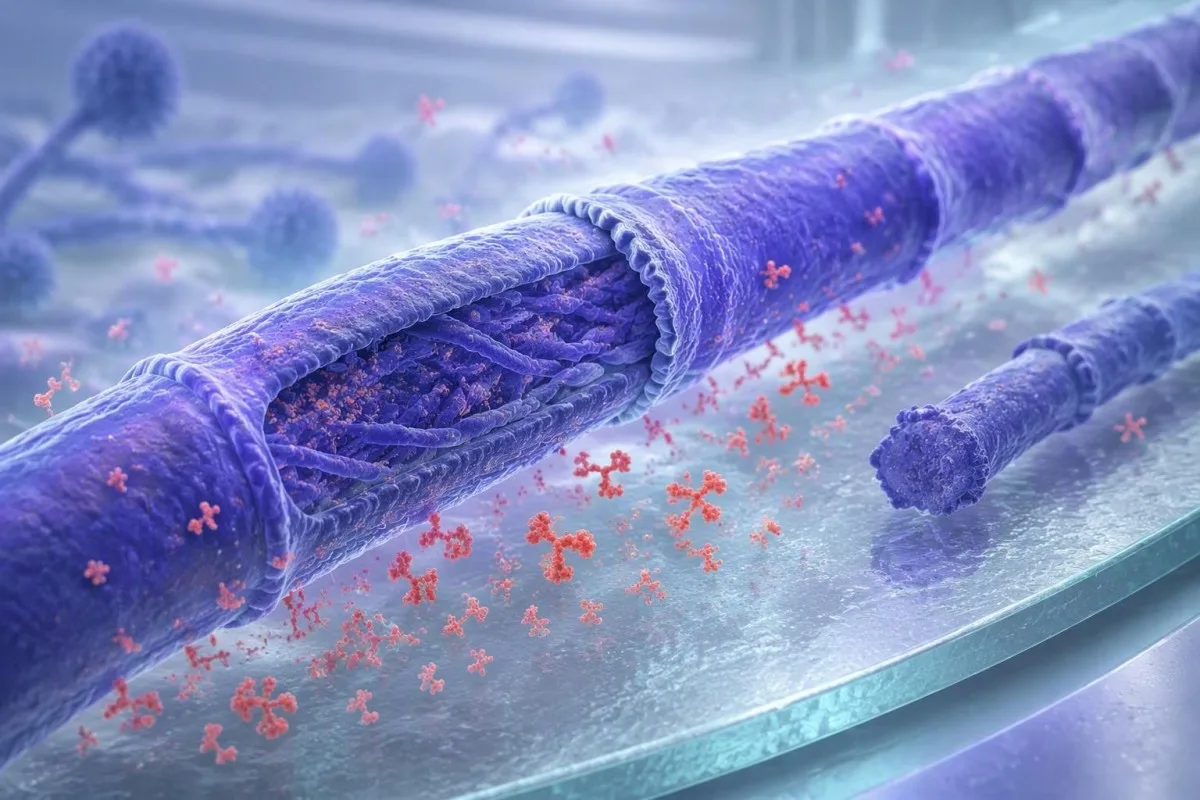
Medication identity and timing must accompany the result, because posaconazole, voriconazole and isavuconazole are mold-active agents, whereas fluconazole does not reliably cover Aspergillus. A serum index of 0.3 after several days of active treatment cannot be interpreted like a pretreatment index of 0.3; do not interrupt prescribed antifungals to obtain a more detectable result.
A positive result despite prophylaxis can suggest breakthrough disease, but it can also reflect inadequate exposure, a false-positive signal or another fungus. For example, a BAL index of 1.6 during posaconazole prophylaxis prompts review of adherence, absorption, drug levels where appropriate, culture and resistance testing—not an automatic conclusion that the fungus is resistant.
Azole antifungals can substantially increase tacrolimus exposure, so transplant teams may need dose adjustments and closer monitoring when treatment starts or stops. Our guide to टैक्रोलिमस ट्रफ के समय-निर्धारण की मार्गदर्शिका explains the sampling issue; a correctly timed drug level answers a different question from a galactomannan index and cannot replace fungal assessment.
कौन-से संपर्क झूठा-सकारात्मक गैलेक्टोमैनन परिणाम दे सकते हैं?
False-positive galactomannan results can arise from cross-reacting fungi, some medication or infusion products, and certain collection-related exposures. An index of 0.9 is not automatically explained by antibiotic use: the exact product, formulation, batch, specimen and timing matter, and a plausible interference does not exclude simultaneous invasive infection.
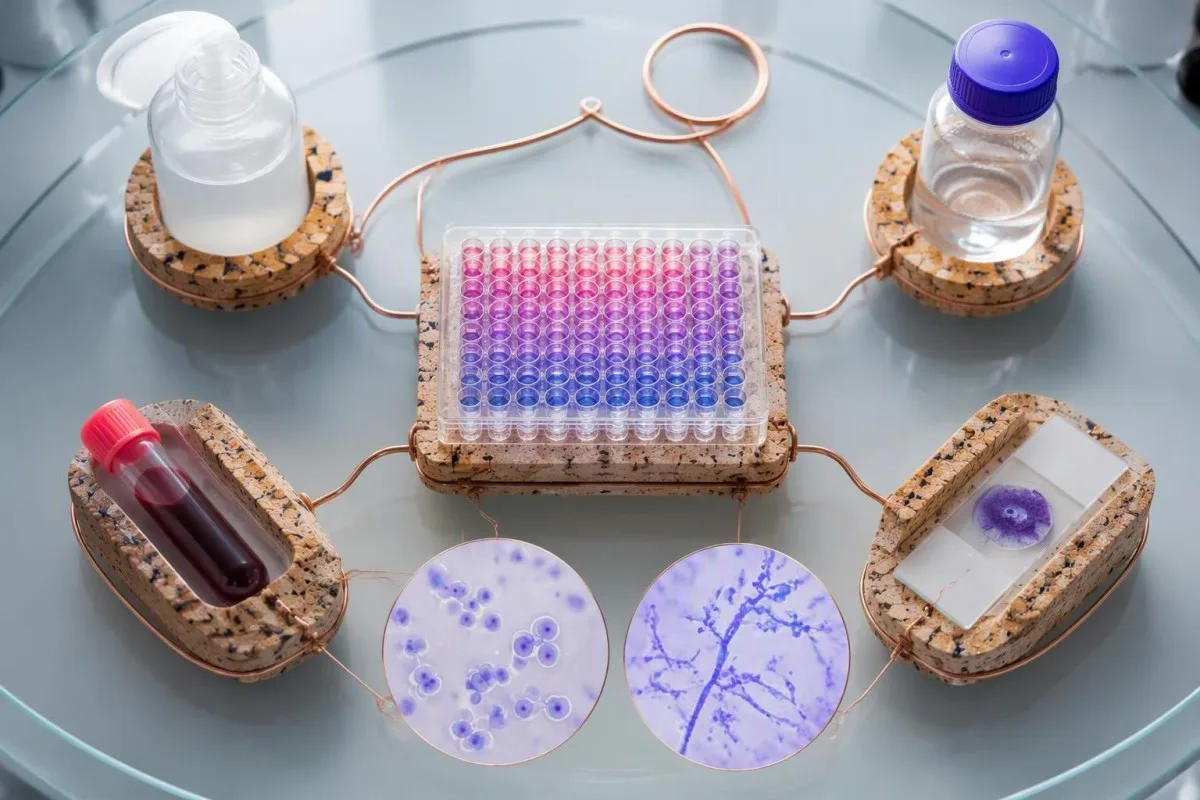
Piperacillin–tazobactam was associated with false-positive galactomannan in older reports, but many contemporary formulations no longer show the same problem. Some amoxicillin–clavulanate formulations and intravenous immunoglobulin products have also been implicated; a single index of 1.2 after an infusion should prompt a product-specific discussion with microbiology rather than a blanket claim that all such medicines invalidate testing.
Other fungi can share antigens recognized by the assay, including Histoplasma and some Fusarium and Talaromyces species. A galactomannan index of 1.5 therefore does not identify an Aspergillus species; our guide to Histoplasma antigen interpretation explains why travel, residence and organism-specific tests can redirect the diagnosis.
Enteral-feed aspiration and antigen translocation through severely damaged intestinal mucosa have been reported as misleading sources, but the evidence is less predictable than for established assay thresholds. Two useful details are the timing of feeding or aspiration and the timing of sample collection; these possibilities are not a reason to restrict ordinary foods or label every positive result a dietary artifact.
क्या BAL का सकारात्मक परिणाम यह दर्शाता है कि एस्परजिलस ने फेफड़े में आक्रमण किया है?
A positive BAL galactomannan result does not prove lung tissue invasion, because antigen may come from Aspergillus colonizing the airways or from collection-related contamination. A BAL index above 1.0 strengthens a compatible investigation but still requires review of the bronchoscopy findings, host risk, imaging and other microbiological evidence.
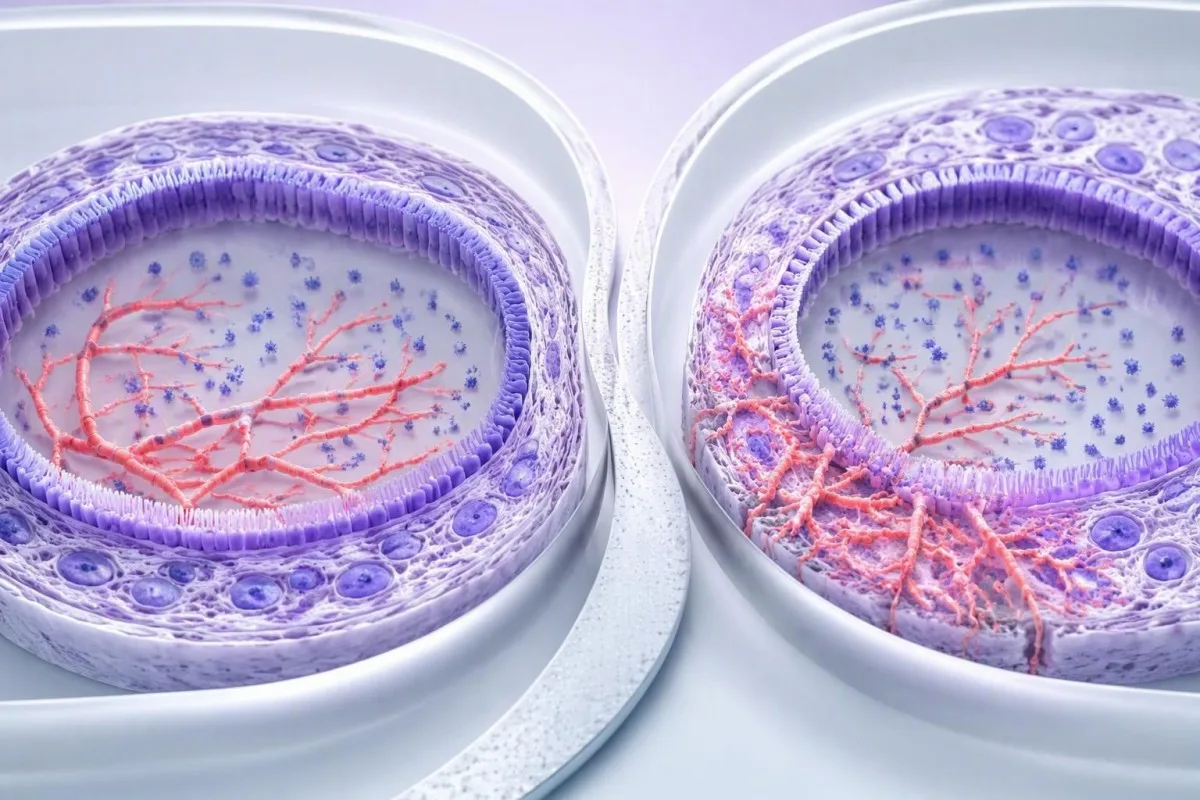
Structural lung disease changes the interpretation of airway fungal findings. Bronchiectasis, previous cavities and lung transplantation can make airway colonization more plausible, while deterioration, compatible CT abnormalities or abnormal airway tissue increase concern; an index of 2.0 cannot determine which process is occurring without those accompanying findings.
Lavage collection deserves scrutiny when the BAL result seems out of proportion to the clinical picture. Some gluconate-containing balanced fluids have caused false-positive galactomannan in published reports, although products vary; if serum is 0.1 and BAL is 1.3, ask which fluid was used and whether the laboratory recognizes interference with that specific formulation.
Regional fungal diseases can resemble pulmonary aspergillosis without sharing an identical diagnostic pathway. For a patient with a BAL index of 0.8 and relevant travel or residence history, our guide to regional fungal antibody testing explains why separate investigations may be appropriate; do not assume every alternative lung fungus will cross-react with galactomannan.
निदान स्थापित करने में कौन-से स्कैन और प्रयोगशाला परीक्षण मदद करते हैं?
Chest CT, respiratory fungal culture, microscopy and Aspergillus PCR can strengthen or challenge a positive galactomannan result. No single combination is appropriate for everyone: a serum index of 1.1 in a neutropenic patient with new pulmonary nodules is a different diagnostic problem from an isolated positive BAL result with stable chronic airway changes.
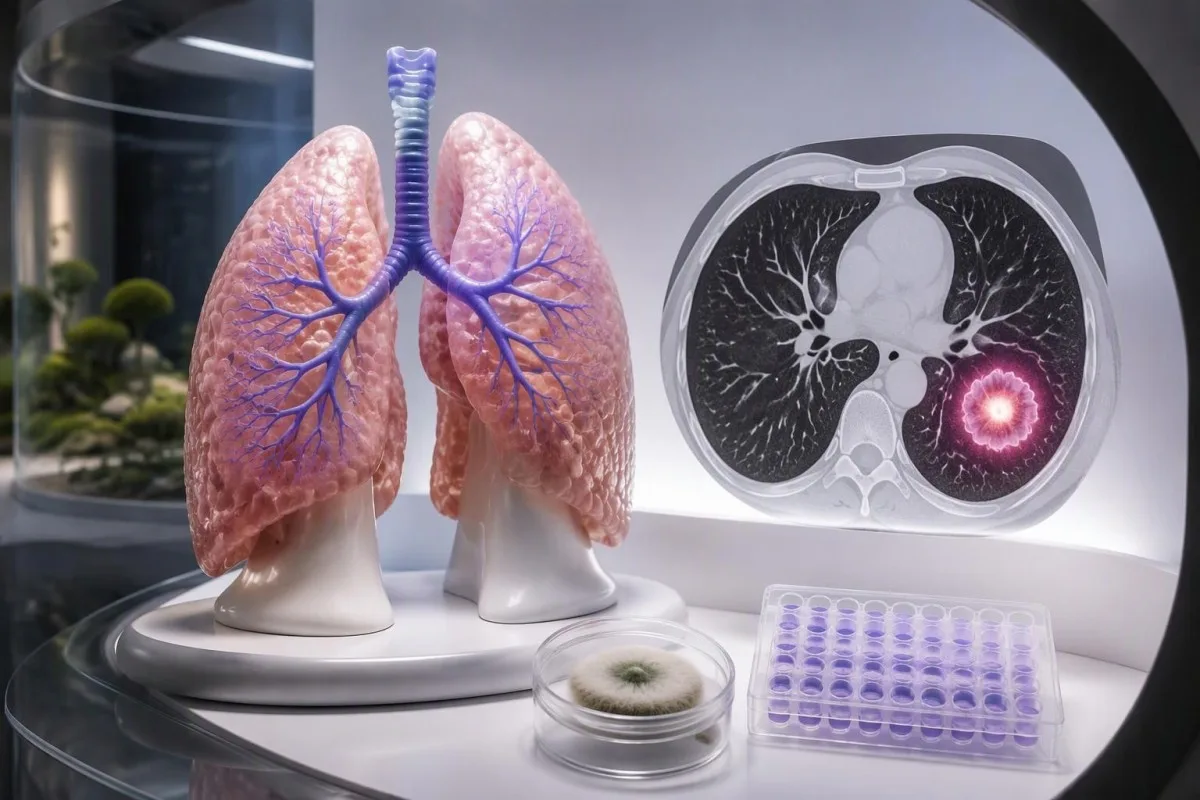
CT findings such as nodules with a surrounding ground-glass halo can support invasive aspergillosis, but they are not specific to Aspergillus. The classic halo is more useful in some neutropenic settings than in many non-neutropenic patients; a positive index of 1.4 and an atypical CT therefore still require a broader assessment rather than exclusion based on absent textbook imaging.
Culture can identify an organism and support susceptibility testing, while PCR detects fungal genetic material; neither a negative culture nor a positive airway PCR alone settles tissue invasion. Bacterial pneumonia can coexist or mimic the presentation, and our Legionella antigen guide explains another specimen-specific test that clinicians may select when the respiratory history fits.
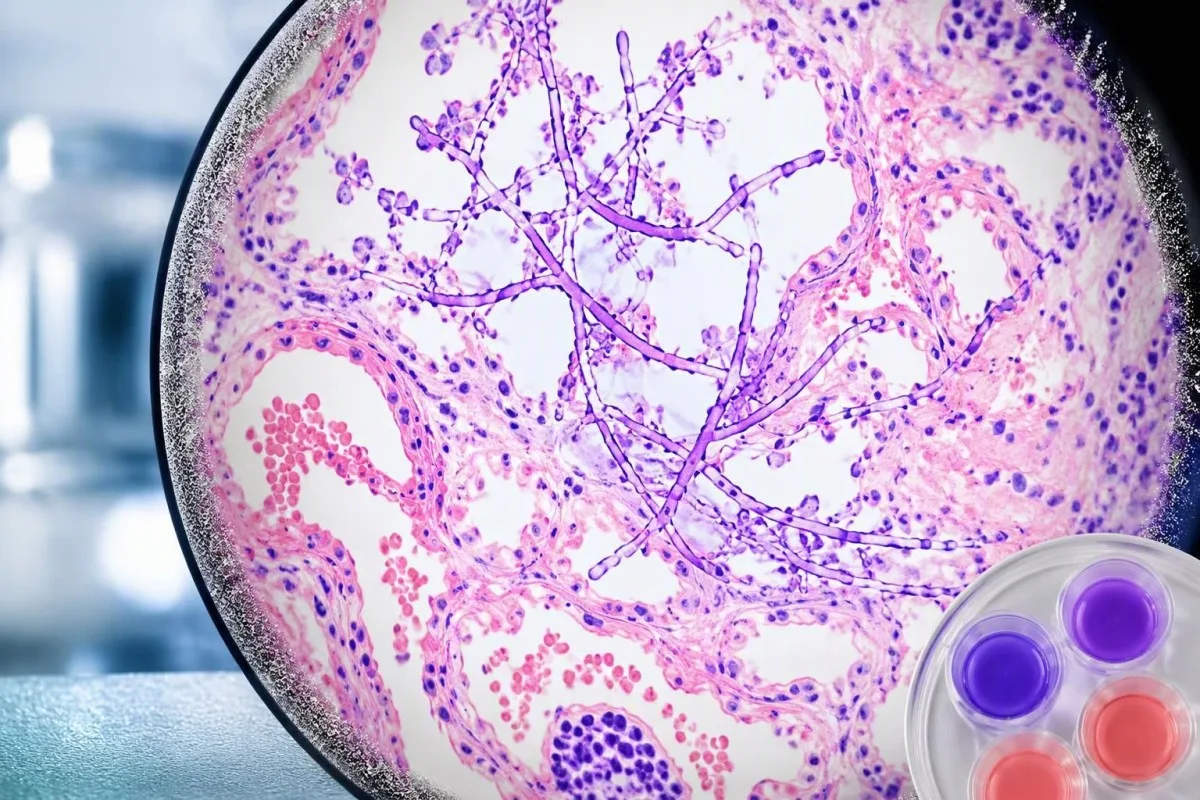
Tissue examination can demonstrate fungal invasion when sampling is feasible, and culture or molecular methods can help identify the fungus because hyphal appearance alone is not species-specific. A CRP of 80 mg/L may show a substantial inflammatory response but cannot identify Aspergillus; our WBC और CRP तुलना explains why general inflammation markers remain supporting evidence.
सकारात्मक परिणाम के लिए तत्काल विशेषज्ञ मूल्यांकन कब आवश्यक होता है?
Contact the treating hematology, transplant, respiratory or infectious-disease team promptly when a positive galactomannan result accompanies high-risk immunosuppression, fever or new respiratory symptoms. An index of 0.6 can warrant urgent action in that setting; the clinical risk matters more than waiting for the number to reach 1.0.
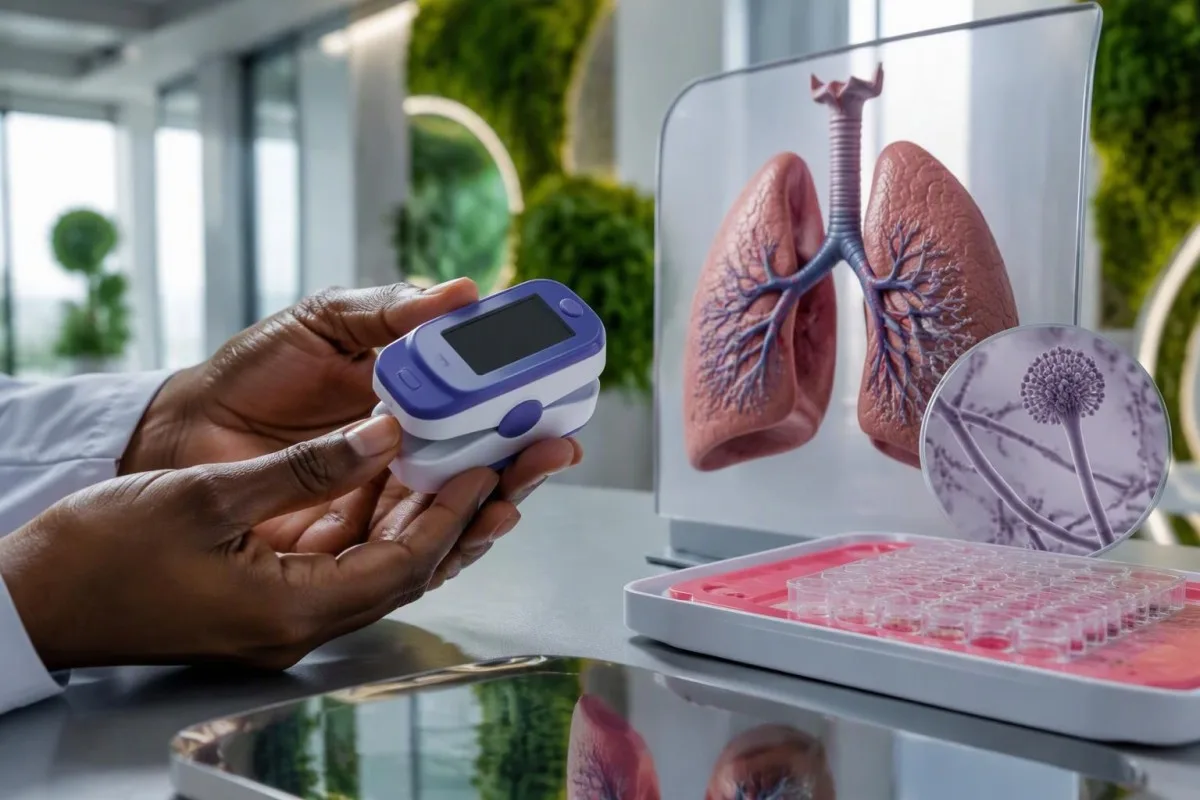
Fever during significant neutropenia requires urgent assessment regardless of the galactomannan result. Common febrile-neutropenia definitions include a single temperature of at least 38.3°C or at least 38.0°C sustained for 1 hour, but oncology services may use stricter instructions; follow the team's emergency plan rather than delaying to meet a published definition.
Severe breathing difficulty, confusion, fainting, significant coughing of blood or rapidly worsening chest symptoms requires emergency care. A room-air oxygen saturation of 92% or below is concerning for many adults without an individualized lower target, but a normal home reading does not rule out serious illness; our सांस फूलने के परीक्षण के लिए मार्गदर्शिका explains why symptoms and direct assessment take priority.
Strongly suspected invasive pulmonary aspergillosis may justify treatment while the diagnostic evaluation continues, as recommended by the 2016 IDSA guideline (Patterson et al., 2016). Conversely, an isolated index of 0.55 in a clinically stable, low-risk person may prompt verification and review first; neither scenario supports starting, stopping or selecting an antifungal without the treating clinician.
क्या गैलेक्टोमैनन की जाँच दोहरानी चाहिए, और क्या घटते मान ठीक होने का संकेत देते हैं?
Repeat galactomannan can help clarify an unexpected result or monitor selected patients, but it must not delay urgent assessment. A change from serum 0.6 to 1.3 can strengthen concern when the clinical picture fits, while a fall from 2.0 to 0.7 may support improvement without proving that infection has cleared.
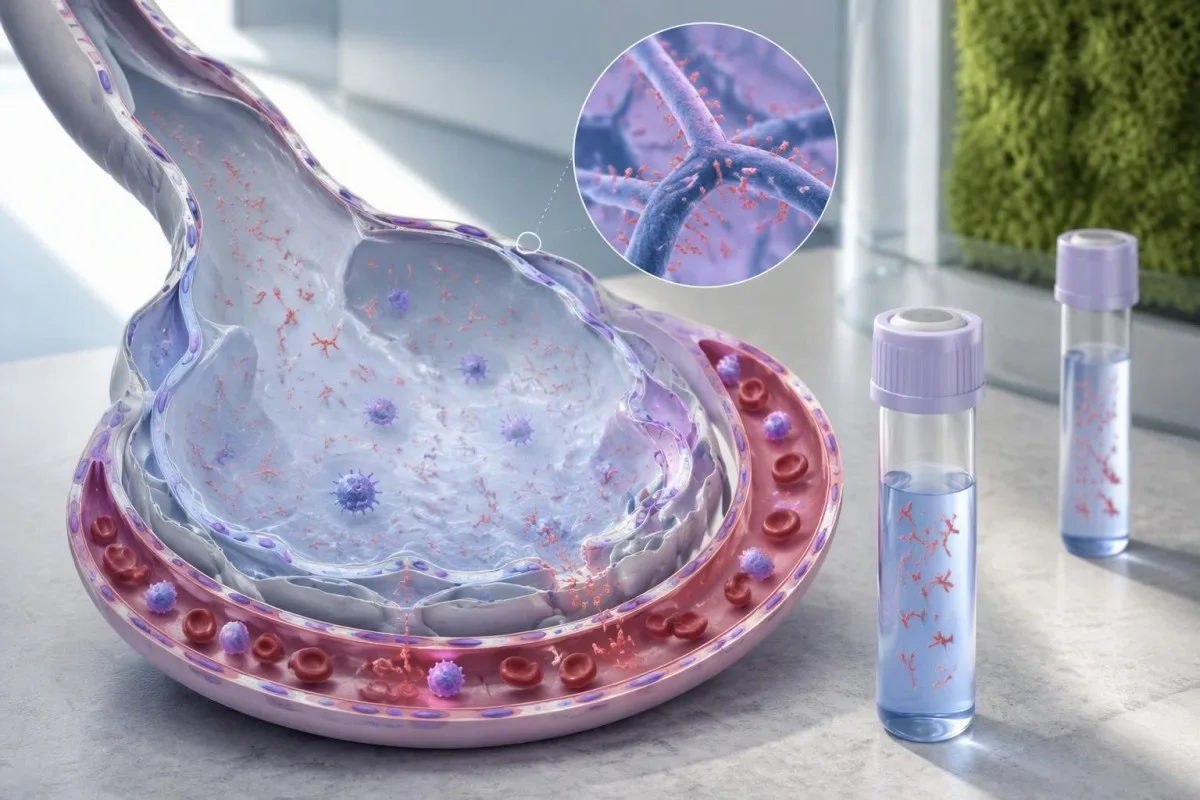
Repeat testing should use the same specimen type and preferably the same assay, because serum and BAL results cannot form a single interchangeable trend. The team may request a fresh sample or laboratory repeat after an unexpected index of 0.58; no universal 24-hour, 48-hour or weekly schedule applies to every patient and every reason for testing.
Serial serum galactomannan is most useful in selected hematological malignancy or stem-cell transplant patients whose antigen was elevated at baseline. A serum result that was always below 0.5 is a weak treatment-response marker, especially for lung-limited disease; our रक्त परीक्षण टाइमलाइन गाइड explains why treatment start dates must travel with laboratory trends.
Kantesti is an AI biomarker interpretation platform that can help organize serial laboratory values, such as an index changing from 1.8 to 0.9, for discussion with the treating team. Recovery still depends on symptoms, imaging, immune recovery and adequate treatment exposure; an antigen decline alone is not a safe rule for stopping antifungals.
गैलेक्टोमैनन परीक्षण की व्याख्या के तीन काल्पनिक उदाहरण
Galactomannan test interpretation changes when the same numerical result is placed in a different clinical setting. The following 3 examples are hypothetical teaching scenarios, not patient encounters; each shows why specimen type, host risk and supporting findings can matter more than whether the report displays a positive flag.
Example 1: a 56-year-old receiving leukemia treatment has an ANC of 0.2 × 10^9/L for 12 days, persistent fever, serum galactomannan 0.62 and new CT nodules. The index is below the single-specimen research threshold, but the overall pattern warrants urgent specialist investigation and possible treatment; our guide to marrow-related blood count changes explains why the underlying hematological condition matters.
Example 2: a 68-year-old with bronchiectasis has BAL galactomannan 1.35, serum 0.12, stable symptoms and no new CT abnormality. Colonization or a collection-related signal becomes more plausible, although neither is proven; the team would review lavage fluid, culture, previous scans and immune status before deciding that antifungal treatment offers more benefit than harm.
Example 3: a 43-year-old transplant recipient taking posaconazole has worsening cough, a new CT abnormality, BAL galactomannan 2.1 and serum 0.18. Treatment exposure may help explain the negative serum result, so breakthrough disease remains a concern; Kantesti can help explain the discordant report, but drug levels, organism identification and treatment decisions belong with the transplant and infection teams.
गैलेक्टोमैनन रिपोर्ट की समीक्षा में Kantesti कैसे सहायता कर सकता है
Kantesti is an AI blood test interpretation platform that can help explain a reported galactomannan index, identify the stated specimen and organize accompanying laboratory results. An index of 0.8 needs different context in serum and BAL, and our explanation is educational support—not a diagnosis, validated fungal triage score or treatment recommendation.

Useful context includes the specimen, laboratory cutoff, collection date, symptoms and antifungal start date. An ANC of 0.3 × 10^9/L or a recent transplant also changes the questions worth asking, but those details must be supplied accurately; our नैदानिक सत्यापन (clinical validation) की पद्धति should not be read as evidence that this particular fungal assay has been independently validated for autonomous diagnosis.
Kantesti cannot inspect a bronchoscopy, verify tissue invasion or determine whether a specific infusion batch contains cross-reacting antigen. Even with a complete report showing an index of 1.7, the platform cannot replace chest imaging, microbiology consultation or drug-interaction management; bring the original laboratory report, not only an AI-generated explanation, to the appointment.
Share only the information needed for the question, and check consent before adding another person's results or immunosuppression history. Two practical privacy steps are removing unnecessary identifiers and checking how uploaded reports are handled; our निजता और डेटा की जानकारी describes the relevant controls, but urgent symptoms should be addressed before any digital review.
शोध स्रोत और विशेषज्ञ से मुलाकात के लिए जाँच-सूची
The most useful follow-up connects 3 kinds of evidence: clinical risk, anatomical findings and microbiological results. The 2016 IDSA guideline, 2020 EORTC/MSGERC definitions and 2019 Cochrane BAL review support that combined approach; none turns a positive galactomannan index into a stand-alone diagnosis.

Prepare 5 questions for the treating team: Was the specimen serum or BAL, which cutoff was used, what makes invasive disease likely, could an exposure explain the signal, and what additional test would change management? For an index of 0.75, these answers are more useful than asking whether the result is simply high or low.
The 2 Zenodo publications listed below are supplementary educational resources about other laboratory panels, not studies validating galactomannan or Aspergillus diagnosis. Our जमावट परीक्षण गाइड और सीरम प्रोटीन गाइड may help explain accompanying results, but neither establishes fungal invasion or determines antifungal treatment.
Keep uncertainty explicit when evidence is incomplete, particularly with a borderline index, negative serum during treatment or a positive BAL in structural lung disease. At Kantesti, our चिकित्सा सामग्री मानक separate educational interpretation from diagnosis; a single index of 1.0 should never outweigh serious symptoms or replace prompt specialist assessment.
अक्सर पूछे जाने वाले प्रश्न
क्या पॉज़िटिव गैलेक्टोमैनन परीक्षण एस्परजिलस संक्रमण की पुष्टि करता है?
0 A positive galactomannan test आक्रामक Aspergillus संक्रमण की पुष्टि नहीं करता, क्योंकि यह परीक्षण ऊतक में संक्रमण के बजाय एंटीजन का पता लगाता है। कई प्रयोगशालाएँ 0.5 का इंडेक्स कटऑफ इस्तेमाल करती हैं, लेकिन सकारात्मक संकेत वायुमार्ग में उपनिवेशन, परस्पर प्रतिक्रिया करने वाले कवक या उत्पाद-विशिष्ट हस्तक्षेप के कारण भी मिल सकता है। चिकित्सक नमूने के परिणाम को प्रतिरक्षा जोखिम, लक्षणों, छाती की इमेजिंग और अतिरिक्त सूक्ष्मजीवविज्ञान संबंधी जाँचों के साथ मिलाकर देखते हैं। बुखार या श्वसन संबंधी लक्षणों वाले उच्च-जोखिम रोगियों का तुरंत आकलन आवश्यक है, भले ही इंडेक्स प्रयोगशाला के कटऑफ से केवल थोड़ा ही ऊपर हो।.
सामान्य गैलेक्टोमैनन सूचकांक क्या है?
कई प्रयोगशालाएँ 0.5 से कम गैलेक्टोमैनन सूचकांक को नकारात्मक बताती हैं, लेकिन रिपोर्ट में दिए गए परीक्षण-विशिष्ट संदर्भ को प्राथमिकता दी जानी चाहिए। यह सूचकांक आम तौर पर इकाई-विहीन ऑप्टिकल घनत्व अनुपात होता है, न कि ng/mL में सांद्रता या संक्रमण के जोखिम का प्रतिशत। 2020 की EORTC/MSGERC अनुसंधान परिभाषाओं में गैलेक्टोमैनन मानदंड के रूप में सीरम/प्लाज़्मा ≥1.0, BAL ≥1.0, या सीरम/प्लाज़्मा ≥0.7 के साथ BAL ≥0.8 का उपयोग किया जाता है। नकारात्मक परिणाम हर आबादी में रोग को विश्वसनीय रूप से खारिज नहीं करता, विशेष रूप से मोल्ड-सक्रिय उपचार के दौरान।.
क्या सीरम नेगेटिव होने पर BAL गैलेक्टोमैनन पॉज़िटिव हो सकता है?
BAL गैलेक्टोमैनन पॉज़िटिव हो सकता है, जबकि सीरम नेगेटिव हो, क्योंकि लैवेज़ फेफड़ों के कंपार्टमेंट का नमूना लेता है, जबकि सीरम में परिसंचारी एंटीजन मापा जाता है। सीरम 0.2 के साथ BAL इंडेक्स 1.4 फेफड़ों तक सीमित रोग में हो सकता है, लेकिन यह वायुमार्ग के उपनिवेशन या नमूना संग्रह से संबंधित हस्तक्षेप को भी दर्शा सकता है। यह असंगति विशेष रूप से गैर-न्यूट्रोपेनिक रोगियों और एंटीफंगल दवाएँ लेने वालों में प्रासंगिक है। CT निष्कर्षों और नैदानिक जोखिम के बिना इन परिणामों का औसत नहीं निकालना चाहिए और न ही उनकी व्याख्या करनी चाहिए।.
क्या एंटीबायोटिक्स या अंतःशिरा इम्युनोग्लोबुलिन के कारण गलत-पॉज़िटिव परिणाम आ सकता है?
कुछ दवाएँ और इन्फ्यूज़न उत्पाद गैलैक्टोमैनन के गलत-सकारात्मक परिणाम दे सकते हैं, लेकिन यह प्रभाव सभी उत्पादों में समान नहीं होता, बल्कि विशिष्ट फॉर्मूलेशन पर निर्भर करता है। पिपेरासिलिन–टैज़ोबैक्टम के पुराने फॉर्मूलेशन इसके लिए ज़िम्मेदार माने गए थे, जबकि कई आधुनिक फॉर्मूलेशन में ऐसा हस्तक्षेप नहीं दिखता; कुछ इंट्रावेनस इम्युनोग्लोबुलिन और अमॉक्सिसिलिन–क्लैवुलैनेट उत्पादों के बारे में भी ऐसी रिपोर्टें हैं। इन्फ्यूज़न के बाद 0.9 का इंडेक्स आने पर प्रयोगशाला के साथ सटीक उत्पाद और नमूना लेने के समय की समीक्षा करनी चाहिए। संभावित हस्तक्षेप से उसी समय मौजूद वास्तविक संक्रमण की संभावना खारिज नहीं होती।.
क्या एंटीफंगल उपचार के दौरान गैलेक्टोमैनन का नकारात्मक परिणाम संक्रमण की संभावना को खारिज करता है?
0 A negative galactomannan result during mold-active antifungal treatment does not rule out invasive aspergillosis. Treatment can reduce antigen detection, so a serum index of 0.3 after therapy starts may be less reassuring than the same pretreatment result. Chest imaging, BAL testing and other microbiology may still be needed when suspicion remains high. Do not stop prescribed antifungals to make the test more likely to become positive.
सकारात्मक गैलेक्टोमैनन परीक्षण के लिए मुझे तत्काल चिकित्सा सहायता कब लेनी चाहिए?
Seek prompt specialist assessment when a positive galactomannan result accompanies substantial immunosuppression, fever or new respiratory symptoms. An index of 0.6 can still be concerning in someone with prolonged severe neutropenia, and fever should trigger the oncology or transplant team's emergency instructions regardless of the antigen value. Severe breathing difficulty, confusion, fainting or significant coughing of blood requires emergency care. There is no universal galactomannan index that must be reached before urgent action is appropriate.
0 क्या गैलैक्टोमैनन सूचकांक में गिरावट का मतलब है कि एंटीफंगल दवाएँ बंद की जा सकती हैं?
गिरता हुआ गैलेक्टोमैनन सूचकांक अपने आप में यह स्थापित नहीं करता कि एंटीफंगल उपचार रोका जा सकता है। सीरम स्तर का 2.0 से घटकर 0.7 होना उन चुनिंदा रोगियों में सुधार का संकेत दे सकता है जिनका एंटीजन शुरू में बढ़ा हुआ था, लेकिन लक्षण, इमेजिंग, प्रतिरक्षा में सुधार और उपचार का संपर्क भी महत्वपूर्ण हैं। सीरम और BAL के मानों को मिलाकर एक ही प्रवृत्ति नहीं मानना चाहिए। उपचार की अवधि इलाज करने वाला विशेषज्ञ तय करता है, न कि किसी एक सूचकांक या प्रतिशत गिरावट के आधार पर।.
अपनी रक्त जांच रिपोर्ट समझें
अपनी लैब रिपोर्ट अपलोड करें और Kantesti का AI कुछ ही सेकंड में प्रत्येक बायोमार्कर को सरल भाषा में समझाएगा। दुनिया भर में 2 मिलियन से अधिक लोगों द्वारा इस्तेमाल किया जाता है।.
संदर्भ
- क्लाइन, टी., मिशेल, एस., & वेबर, एच. (2026)।. aPTT की सामान्य सीमा: D-Dimer, Protein C और रक्त के थक्के बनने की मार्गदर्शिका।. Kantesti AI चिकित्सा अनुसंधान।. डीओआई
- क्लाइन, टी., मिशेल, एस., & वेबर, एच. (2026)।. सीरम प्रोटीन मार्गदर्शिका: ग्लोब्युलिन, एल्ब्यूमिन और A/G अनुपात का ब्लड टेस्ट।. Kantesti AI चिकित्सा अनुसंधान।. डीओआई
- Patterson TF et al. (2016). Practice Guidelines for the Diagnosis and Management of Aspergillosis: 2016 Update by the Infectious Diseases Society of America. Clinical Infectious Diseases।. डीओआई PubMed
- Donnelly JP et al. (2020). Revision and Update of the Consensus Definitions of Invasive Fungal Disease From the European Organization for Research and Treatment of Cancer and the Mycoses Study Group Education and Research Consortium. Clinical Infectious Diseases।. डीओआई PubMed
- de Heer K et al. (2019). Galactomannan detection in broncho-alveolar lavage fluid for invasive aspergillosis in immunocompromised patients. Cochrane Database of Systematic Reviews. डीओआई
- 2एम+विश्लेषित परीक्षण
- 127+देशों
- 100+बोली
चिकित्सा दल के बारे में


E-E-A-T भरोसा संकेत
अनुभव
चिकित्सक-नेतृत्व वाली लैब व्याख्या वर्कफ़्लो की क्लिनिकल समीक्षा।.
विशेषज्ञता
लैबोरेटरी मेडिसिन का फोकस इस पर कि बायोमार्कर क्लिनिकल संदर्भ में कैसे व्यवहार करते हैं।.
अधिकारिता
डॉ. Thomas Klein द्वारा चिकित्सकीय समीक्षा, जिसमें डॉ. Sarah Mitchell और प्रो. डॉ. Hans Weber का योगदान शामिल है।.
विश्वसनीयता
साक्ष्य-आधारित व्याख्या, जिसमें अलार्म कम करने के लिए स्पष्ट फॉलो-अप मार्ग शामिल हैं।.

चिकित्सकीय अस्वीकरण
यह लेख केवल शैक्षिक उद्देश्यों के लिए है और चिकित्सा सलाह का गठन नहीं करता। निदान और उपचार संबंधी निर्णयों के लिए हमेशा किसी योग्य स्वास्थ्य सेवा प्रदाता से परामर्श करें।.
प्रकाशित · संपादकीय दल से संपर्क करें
Kantesti Ltd द्वारा प्रकाशित, इंग्लैंड और वेल्स में पंजीकृत, कंपनी संख्या. 17090423, लंदन, यूनाइटेड किंगडम।.
