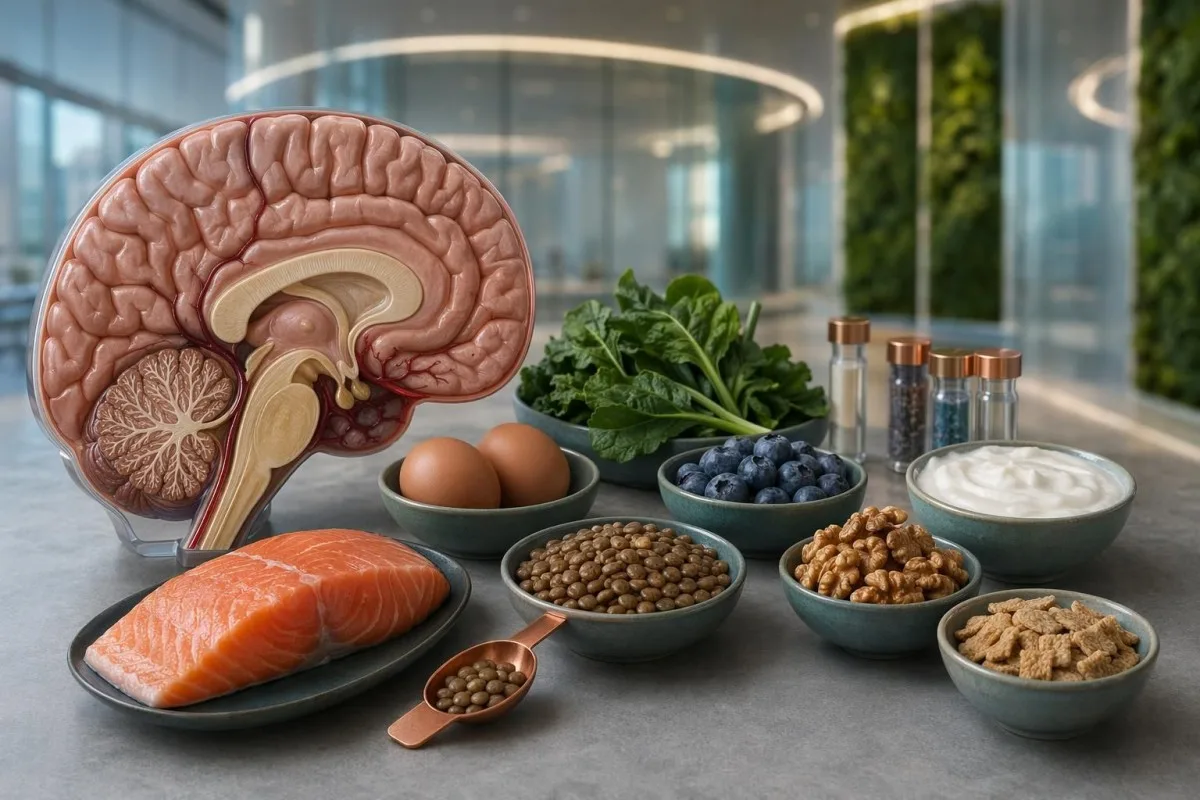
Blueberries and salmon are sensible, but the smarter question is which blood pattern your brain is asking you to fix first. Here is how we connect food choices to measurable labs instead of guessing.


- B12 below 200 pg/mL is usually treated as deficiency; 200-350 pg/mL can still cause neurological symptoms when methylmalonic acid is high.
- Homocysteine above 15 µmol/L often points toward B12, folate, B6, thyroid, kidney or medication-related issues rather than one single missing food.
- Omega-3 Index below 4% suggests low EPA/DHA status; above 8% is often used as a desirable long-term target, though cognition data are mixed.
- HbA1c 5.7-6.4% meets the usual prediabetes range and can affect attention, sleepiness and afternoon mental crashes before diabetes appears.
- hs-CRP above 3 mg/L suggests higher inflammatory burden, while CRP above 10 mg/L usually needs infection, injury or autoimmune context first.
- TSH around 0.4-4.0 mIU/L is typical for many adults, but free T4, antibodies, pregnancy status and symptoms change the meaning.
- Ferritin below 30 ng/mL strongly supports low iron stores in many adults, even when hemoglobin is still normal.
- A personalized nutrition plan should match the lab pattern: B12 foods for B12/MMA changes, oily fish for omega-3 status, and low-glycemic meals for glucose variability.
Which foods for brain health should you choose first?
Foods for brain health work best when they match your blood test pattern. If B12, folate, omega-3 status, glucose control, inflammation, thyroid function or iron stores are off, the right food strategy changes. In our analysis of 2M+ uploaded blood tests, the common mistake is not eating the wrong berry or seed; it is adding random supplements while missing a measurable deficiency. Kantesti AI helps readers connect lab results to food priorities in about 60 seconds, so a salmon habit, lentil bowl or B12 supplement is chosen for a reason.
The first lab pattern I look for is not exotic. It is the ordinary cluster: CBC, ferritin, B12, folate, HbA1c, fasting glucose, TSH, free T4, CRP or hs-CRP, lipid markers and sometimes an Omega-3 Index. A person with B12 of 185 pg/mL and tingling needs a different plan from a person with HbA1c of 6.1% and post-lunch sleepiness.
A 46-year-old teacher once came to clinic convinced she needed nootropics because she forgot names by 3 p.m. Her HbA1c was 5.9%, fasting insulin was 18 µIU/mL and ferritin was 18 ng/mL; blueberries were fine, but breakfast protein, iron repletion and glucose timing were the actual levers. Our longer guide to brain fog blood tests covers that pattern in more detail.
The practical order is simple: correct clear deficiencies, stabilize glucose, reduce inflammatory load, then fine-tune fats and micronutrients. This is where a personalized nutrition plan beats a generic brain-food list, because nutrient deficiencies symptoms can overlap wildly: fatigue, low mood, numbness, headaches and poor concentration can all appear with more than one abnormal marker.
How do B12 results change brain-food choices?
Serum B12 below 200 pg/mL usually suggests deficiency, while 200-350 pg/mL is a borderline zone that may still matter for nerves and cognition. When methylmalonic acid is above about 0.40 µmol/L, I treat that as stronger evidence that tissues are short of active B12.
B12-rich foods are mostly animal-derived: sardines, salmon, trout, eggs, milk, yogurt and fortified foods. A strict vegan with B12 of 260 pg/mL and numb feet is not reassured by the word normal; I would check methylmalonic acid, homocysteine and the CBC before calling it fine.
The CBC can whisper before it shouts. MCV above 100 fL is classic for macrocytosis, but many patients with neurological B12 deficiency have a normal MCV, especially if iron deficiency is pulling cell size downward. I see that mixed pattern often enough that Thomas Klein, MD, no longer uses MCV alone to screen for B12 risk.
If you want the deeper range discussion, our B12 normal range guide explains why laboratory cutoffs differ by country. Some European laboratories flag B12 below 250 pg/mL earlier than many US reports, which is clinically reasonable when symptoms fit.
High-dose oral B12, often 1,000-2,000 mcg daily for deficiency, can work even when absorption is reduced, but pernicious anemia and severe neurological symptoms need clinician oversight. Food is helpful for maintenance; it is usually too slow when gait, numbness or memory symptoms are progressing.
When do folate foods matter for memory and mood?
Folate foods matter most when folate is low, homocysteine is high, or MCV is rising without another clear cause. Serum folate below about 4 ng/mL suggests low recent intake, while red cell folate below 305 nmol/L suggests longer-term deficiency.
Leafy greens, lentils, chickpeas, asparagus, avocado and fortified grains can raise folate intake, but the lab interpretation is not just more greens. Homocysteine above 15 µmol/L can reflect low folate, low B12, low B6, hypothyroidism, kidney impairment or certain medicines.
Smith et al. reported in PLoS One in 2010 that homocysteine-lowering B vitamins slowed brain atrophy in older adults with mild cognitive impairment, particularly when baseline homocysteine was higher. That does not mean everyone should take methylated B vitamins; it means the lab pattern deserves respect.
I am cautious when folate is supplemented without checking B12. Folate can improve anemia while B12-related nerve injury continues, and that is the bad trade-off patients never hear about on supplement labels. Our article on folate and homocysteine clues walks through the combined reading.
A practical food move is one cup of cooked lentils or spinach most days, but the recheck matters. Homocysteine often changes within 6-12 weeks when the cause is nutritional; if it does not, I look harder at thyroid, kidney function, alcohol intake and medications.
Can fish and walnuts fix a low omega-3 pattern?
Oily fish can raise EPA and DHA status, but walnuts and flax mainly provide ALA, which converts poorly to EPA and DHA in many adults. An Omega-3 Index below 4% is commonly read as low, 4-8% as intermediate and above 8% as a desirable long-term range.
The nuance is conversion. Alpha-linolenic acid from chia, flax and walnuts is useful, but conversion to EPA is often below 10% and conversion to DHA may be below 5% in many studies. That is why a vegetarian eating flax daily can still show a low Omega-3 Index.
In clinic, I use the Omega-3 Index less as a magic brain score and more as a long-term membrane-fat marker. The evidence for cognition is honestly mixed, and benefit seems more plausible in people with low baseline status, low fish intake or cardiometabolic risk rather than in already replete adults.
Kantesti AI interprets omega-3 results alongside triglycerides, HDL, hs-CRP and glucose because these markers often move together. For a marker-by-marker walkthrough, see our Omega-3 Index guide.
A typical food prescription is two portions of oily fish weekly, roughly 250-500 mg/day combined EPA and DHA when averaged across the week. If someone uses fish oil, I check platelet count, anticoagulant use, LDL response and gastrointestinal tolerance rather than assuming more is better.
Why do glucose labs matter for concentration?
Glucose variability can affect concentration even before diabetes is diagnosed. HbA1c below 5.7% is usually normal, 5.7-6.4% is the usual prediabetes range, and 6.5% or higher meets the diabetes threshold when confirmed appropriately.
The brain uses glucose constantly, but it dislikes rollercoasters. A fasting glucose of 102 mg/dL, triglycerides of 190 mg/dL and HDL of 38 mg/dL tells me more about brain-energy complaints than a single normal vitamin panel. The pattern often points toward insulin resistance.
Low-glycemic meals are boring advice until the labs prove the point. In one software engineer I reviewed, swapping sweet breakfast cereal for eggs, yogurt and oats dropped fasting glucose from 109 to 96 mg/dL in 10 weeks, while the patient described fewer 4 p.m. blank spells.
Fasting insulin is not standardized as neatly as glucose, but many metabolically healthy adults fall around 2-10 µIU/mL. HOMA-IR above about 2.5 often raises suspicion for insulin resistance, though ethnicity, puberty, pregnancy and assay differences change interpretation; our low-glycemic foods guide gives food examples tied to labs.
If HbA1c and fasting glucose disagree, I ask about anemia, kidney disease, recent bleeding, iron therapy and hemoglobin variants. HbA1c is a useful 2-3 month average, not a perfect brain-energy meter.
What inflammatory markers change brain-food priorities?
hs-CRP below 1 mg/L is usually low inflammatory risk, 1-3 mg/L is intermediate, and above 3 mg/L is higher risk when persistent. A CRP above 10 mg/L often reflects infection, injury or active inflammatory disease rather than a simple diet problem.
A Mediterranean-style pattern is the food approach I reach for most often when hs-CRP, triglycerides and glucose are all nudging upward. Estruch et al. published the PREDIMED reanalysis in The New England Journal of Medicine in 2018, showing fewer major cardiovascular events with Mediterranean diets supplemented with extra-virgin olive oil or nuts.
That trial was not a memory trial, so I do not oversell it as brain insurance. The vascular link matters, though: what protects arteries often protects the small vessels that feed attention, processing speed and long-term cognitive reserve. Our high-CRP diet guide explains what usually moves the marker.
A sneaky pattern is CRP of 6 mg/L with ferritin of 240 ng/mL and low iron saturation. Patients sometimes take iron because they feel tired, but inflammation can trap iron and push ferritin upward. The food plan there is anti-inflammatory first, not automatic iron tablets.
I usually repeat hs-CRP after 2-3 weeks if the result is unexpectedly high and the patient had a cold, dental infection or hard training session. One abnormal inflammatory marker should not become a lifelong identity.
Which thyroid patterns can mimic poor brain nutrition?
Hypothyroidism can look like low motivation, depression, slow thinking and cold intolerance, even when diet seems healthy. Many adult laboratories use a TSH reference range near 0.4-4.0 mIU/L, but free T4, antibodies and timing determine what the number means.
When I review a panel showing TSH of 7.8 mIU/L with low-normal free T4, I do not start with seaweed snacks. I ask about weight change, constipation, menstrual changes, lithium, amiodarone, biotin use and thyroid antibodies. Too much iodine can worsen autoimmune thyroiditis in susceptible people.
Jonklaas et al. published the American Thyroid Association hypothyroidism treatment guideline in Thyroid in 2014, and it remains a useful anchor: levothyroxine is standard treatment for overt hypothyroidism, while supplements do not replace hormone when the gland is underperforming. Selenium foods such as Brazil nuts may help intake, but doses above 400 mcg/day can be toxic.
Food still matters. Adequate protein, iodine within recommended intake, selenium, iron and zinc all support thyroid hormone production and conversion. For age, medication and timing issues, our TSH range guide gives the details patients usually miss.
Biotin deserves its own warning because it can distort immunoassays, sometimes making TSH and thyroid hormone results look misleading. I often ask patients to stop high-dose biotin for 48-72 hours before thyroid testing, but they should follow their clinician's instruction and local lab policy.
How do ferritin and iron stores affect mental stamina?
Ferritin below 30 ng/mL strongly suggests low iron stores in many adults, even when hemoglobin is normal. Low iron can cause fatigue, restless legs, poor exercise tolerance, headaches and concentration problems before classic anemia appears.
Iron is not a brain supplement; it is a lab-guided treatment. A menstruating adult with ferritin of 12 ng/mL, transferrin saturation of 11% and hemoglobin of 12.4 g/dL may be told no anemia, yet they are clearly running on low stores. That is a common pattern in our uploaded reports.
Food options include lentils, beans, spinach, pumpkin seeds, tofu, eggs, fish and lean meats where culturally appropriate. Vitamin C with plant iron helps absorption, while tea, coffee and calcium close to the meal can reduce it. Our low-ferritin food guide gives safer ways to raise stores without overshooting.
Ferritin can rise with inflammation, liver disease or recent infection, so a high ferritin does not always mean iron overload. The reason we pair ferritin with transferrin saturation is that ferritin alone can fool you; TSAT below 20% with high CRP often means iron is unavailable rather than abundant.
For restless legs, many clinicians aim for ferritin above 50-75 ng/mL, though cutoffs vary and the evidence is not tidy. I prefer rechecking ferritin and TSAT after 8-12 weeks of treatment rather than continuing iron indefinitely.
Do vitamin D and magnesium labs add useful brain clues?
Vitamin D and magnesium are not magic cognition markers, but abnormal values can worsen fatigue, muscle tension, sleep and mood symptoms. A 25-OH vitamin D below 20 ng/mL is usually deficient, while 30-50 ng/mL is a common practical target range.
Magnesium is awkward because serum magnesium can look normal while intracellular status is not ideal. Most laboratories use a serum range around 1.7-2.2 mg/dL, and values below 1.7 mg/dL deserve attention, especially with cramps, arrhythmia risk, diuretics or low potassium.
Vitamin D foods include oily fish, egg yolk and fortified dairy or plant drinks, but sun exposure, skin pigmentation, latitude, season and body weight often dominate the blood level. If someone has vitamin D of 11 ng/mL in February and low mood, I correct it, but I do not promise a memory transformation.
The food-and-lab connection is still useful because low vitamin D often travels with low activity, metabolic risk and higher CRP. Our vitamin D level guide explains why 25-OH vitamin D is the test to follow rather than active 1,25-OH vitamin D in routine nutrition checks.
For magnesium supplements, kidney function matters. An eGFR below 60 mL/min/1.73 m² changes the safety conversation, and magnesium oxide is more likely to loosen stools than glycinate or citrate.
What lipid patterns point to vascular brain risk?
Lipid markers matter for brain health because small-vessel and large-vessel disease can reduce cognitive reserve over years. LDL-C below 100 mg/dL is a common general target, while high-risk patients often need lower individualized targets.
A patient can eat avocados daily and still have ApoB of 125 mg/dL. That number suggests a high count of atherogenic particles, which is not fixed by adding one superfood. I look at ApoB, non-HDL cholesterol, triglycerides, HDL, blood pressure, glucose and family history together.
Brain-health food advice often underplays vascular risk. Soluble fiber from oats, beans and psyllium, nuts, olive oil, vegetables and replacing saturated fats with unsaturated fats can move LDL-C and non-HDL cholesterol in measurable ways. For particle-number nuance, read our ApoB blood test guide.
Triglycerides above 150 mg/dL often reflect insulin resistance, alcohol intake, genetics, hypothyroidism or excess refined carbohydrate. When triglycerides are high, calculated LDL can be less reliable, and direct LDL or ApoB may clarify the risk.
I am more impressed by a 6-month trend than a heroic 2-week diet. A 15-25 mg/dL LDL-C drop after sustained fiber, weight change and fat-quality improvement is believable; a one-off change after dehydration or illness may not be.
Which safety labs should you check before brain supplements?
Kidney and liver markers should be checked before high-dose supplements, creatine stacks or aggressive high-protein diets. eGFR below 60 mL/min/1.73 m² for 3 months suggests chronic kidney disease, and persistent ALT or AST elevation needs context before adding pills.
Creatine has interesting brain and muscle data, but it can raise creatinine because creatinine is its breakdown product. A 52-year-old marathon runner with creatinine of 1.32 mg/dL may have muscle mass and supplements driving the number, while cystatin C or urine ACR can clarify kidney risk.
Liver enzymes also matter. Green tea extract, high-dose niacin, some concentrated herbal products and multi-ingredient blends can push ALT, AST or GGT upward. Before adding a brain supplement stack, I want a baseline CMP and medication list.
For people increasing protein or creatine, our high-protein lab guide explains BUN, creatinine and hydration patterns. BUN above 20 mg/dL can reflect dehydration or protein intake, but it can also flag kidney or catabolic stress depending on the rest of the panel.
This is one of those areas where context matters more than the number. A single mildly high AST after heavy training is different from AST and ALT both doubling for 3 months with high GGT and fatigue.
How do you build a personalized nutrition plan from labs?
A personalized nutrition plan starts with the strongest abnormal pattern, not the trendiest food. If ferritin is 9 ng/mL, iron comes first; if HbA1c is 6.2%, glucose strategy comes first; if B12 is 180 pg/mL, neurological safety comes first.
I use a three-bucket method: deficiency correction, metabolic stabilization and long-term vascular support. Deficiency correction is B12, folate, iron, vitamin D or magnesium when clearly low. Metabolic stabilization is glucose, insulin resistance, triglycerides and CRP.
The third bucket is where foods for brain health become a pattern: oily fish, legumes, leafy greens, berries, nuts, olive oil, fermented foods if tolerated, and enough protein. Kantesti AI can help translate a uploaded report into a ranked plan through our personalized blood test approach.
Our AI-powered blood test interpretation platform compares current values with previous uploads, which is often more useful than a single reference range. A ferritin rise from 8 to 28 ng/mL may still be low, but it tells me absorption and adherence are working.
The patient-friendly version is this: choose the food that matches the lab you are trying to move. Randomly adding turmeric, lion's mane and fish oil while ignoring B12 of 165 pg/mL is not personalized medicine; it is expensive guessing.
When should brain-nutrition labs be rechecked?
Most nutrition-related blood markers need 8-12 weeks before a meaningful recheck, but some change faster. Glucose can improve within days, triglycerides within weeks, B12 and folate within 4-8 weeks, and ferritin often needs 8-16 weeks or longer.
Rechecking too early creates noise. If someone starts iron on Monday and checks ferritin on Friday, the result tells us little about tissue rebuilding. Hemoglobin may rise by about 1 g/dL over 2-4 weeks when iron deficiency anemia is treated effectively, but ferritin restoration takes longer.
HbA1c reflects roughly 2-3 months of glucose exposure, so a 3-week diet sprint may not show the full change. Fasting glucose and home readings can move earlier, which is why I pair short-term feedback with the longer A1c cycle.
For practical timelines by marker, our diet retest timeline guide is the one I send to patients who love checking too often. It helps avoid the emotional whiplash of lab variability.
As of May 13, 2026, our platform also tracks trends across uploaded PDFs and photos, which catches quiet drift that a single visit misses. A slow TSH rise from 2.1 to 4.8 mIU/L over 18 months is often more useful than arguing over one cutoff.
How Kantesti validates lab-based nutrition interpretation
Kantesti validates blood-test interpretation by combining clinical rule checks, population-scale benchmarking and physician review rather than treating food recommendations as isolated wellness tips. Our medical team links biomarkers to nutrition only when the lab pattern, symptom context and safety markers support it.
Kantesti AI interprets more than 15,000 biomarkers across uploaded blood test PDFs and photos, and our clinical standards are reviewed with our Medical Advisory Board. Thomas Klein, MD, reviews high-risk medical content so nutrition advice does not drift into diagnosis-by-menu.
Our validation approach is documented on the medical validation page and in the pre-registered clinical benchmark. The point is not to replace a clinician; it is to make lab interpretation faster, safer and more consistent before patients change diet or supplements.
Formal Kantesti research citations: Kantesti LTD. (2026). Clinical Validation Framework v2.0. Zenodo. https://doi.org/10.5281/zenodo.17993721. ResearchGate Academia.edu. Kantesti LTD. (2026). AI Blood Test Analyzer: 2.5M Tests Analyzed | Global Health Report 2026. Zenodo. https://doi.org/10.5281/zenodo.18175532. ResearchGate Academia.edu.
If you already have results, upload them to our free AI blood test analysis tool and look for the strongest modifiable pattern first. If symptoms are severe, sudden, neurological or worsening, use the result as preparation for medical care rather than a reason to delay it.
Frequently Asked Questions
What blood tests should I check before choosing foods for brain health?
The most useful starting blood tests before choosing foods for brain health are CBC, ferritin, B12, folate, homocysteine, HbA1c, fasting glucose, TSH, free T4, CRP or hs-CRP, lipid markers and sometimes an Omega-3 Index. B12 below 200 pg/mL, ferritin below 30 ng/mL, HbA1c 5.7-6.4% and hs-CRP above 3 mg/L each point to different food priorities. This pattern-based approach reduces guessing and makes a personalized nutrition plan safer.
Can nutrient deficiencies cause brain fog even if my CBC is normal?
Yes, nutrient deficiencies symptoms can occur while the CBC still looks normal. B12 deficiency can cause numbness, burning sensations, mood changes and brain fog before MCV rises above 100 fL, and low ferritin below 30 ng/mL can affect stamina before hemoglobin drops. A normal CBC is reassuring, but it does not fully exclude B12, iron, folate, thyroid or glucose-related causes of cognitive symptoms.
Is salmon better than walnuts for omega-3 brain health?
Salmon usually raises EPA and DHA status more reliably than walnuts because walnuts contain ALA, which converts poorly to EPA and DHA in many adults. An Omega-3 Index below 4% suggests low EPA/DHA status, while above 8% is often used as a desirable long-term range. Walnuts are still heart-healthy, but they should not be assumed to correct a low Omega-3 Index.
What foods help if homocysteine is high?
High homocysteine above 15 µmol/L often leads clinicians to check B12, folate, B6, thyroid and kidney function before recommending one food change. Folate-rich foods include lentils, spinach, chickpeas, asparagus and fortified grains, while B12 comes mainly from fish, eggs, dairy, meat and fortified foods. Folate should not be supplemented blindly if B12 deficiency is possible because anemia can improve while nerve symptoms continue.
How long does it take for brain-health foods to change lab results?
Most nutrition-related lab changes need 8-12 weeks for a meaningful recheck, although glucose and triglycerides may shift faster. HbA1c reflects roughly 2-3 months of glucose exposure, B12 and folate may improve within 4-8 weeks, and ferritin often takes 8-16 weeks or longer to rebuild. Rechecking too early can create confusion because normal biological and laboratory variation may be larger than the true change.
Can thyroid problems look like nutrient deficiency?
Yes, thyroid problems can mimic signs of nutrient deficiency, including fatigue, slow thinking, low mood, cold intolerance and weight change. Many adult labs use a TSH range near 0.4-4.0 mIU/L, but free T4, thyroid antibodies, pregnancy status, medication use and symptoms change interpretation. Food can support iodine, selenium, iron and zinc intake, but overt hypothyroidism usually needs clinician-managed treatment rather than diet alone.
Should I take iron for brain fog if ferritin is normal?
Iron should not be taken for brain fog simply because symptoms feel like low iron. Ferritin below 30 ng/mL often supports low iron stores, but ferritin can be normal or high during inflammation, liver disease or infection, so transferrin saturation and CRP add context. Taking iron without a documented need can cause side effects and may be unsafe in iron overload conditions.
When should memory or concentration problems be assessed urgently rather than managed with diet?
Seek urgent medical care for sudden confusion, new trouble speaking, facial drooping, one-sided weakness, severe headache, or loss of balance, as these can signal stroke or another acute illness. Arrange a routine medical review for symptoms that persist, worsen, or interfere with work, driving, or daily life.
Can a high-protein breakfast help concentration if my glucose labs are borderline?
Yes, many people with borderline glucose control feel steadier when breakfast includes protein, fiber, and slower carbohydrates instead of sweet cereal or pastries. Try eggs, Greek yogurt, tofu, beans, or nuts with whole grains, then compare your morning focus for 1 to 2 weeks.
Get AI-Powered Blood Test Analysis Today
Join over 2 million users worldwide who trust Kantesti for instant, accurate lab test analysis. Upload your blood test results and receive comprehensive interpretation of 15,000+ biomarkers in seconds.
📚 Referenced Research Publications
Klein, T., Mitchell, S., & Weber, H. (2026). Clinical Validation Framework v2.0 (Medical Validation Page). Kantesti AI Medical Research.
Klein, T., Mitchell, S., & Weber, H. (2026). AI Blood Test Analyzer: 2.5M Tests Analyzed | Global Health Report 2026. Kantesti AI Medical Research.
📖 External Medical References
⚕️ Medical Disclaimer
This article is for educational purposes only and does not constitute medical advice. Always consult a qualified healthcare provider for diagnosis and treatment decisions.
E-E-A-T Trust Signals
Experience
Physician-led clinical review of lab interpretation workflows.
Expertise
Laboratory medicine focus on how biomarkers behave in clinical context.
Authoritativeness
Written by Dr. Thomas Klein with review by Dr. Sarah Mitchell and Prof. Dr. Hans Weber.
Trustworthiness
Evidence-based interpretation with clear follow-up pathways to reduce alarm.