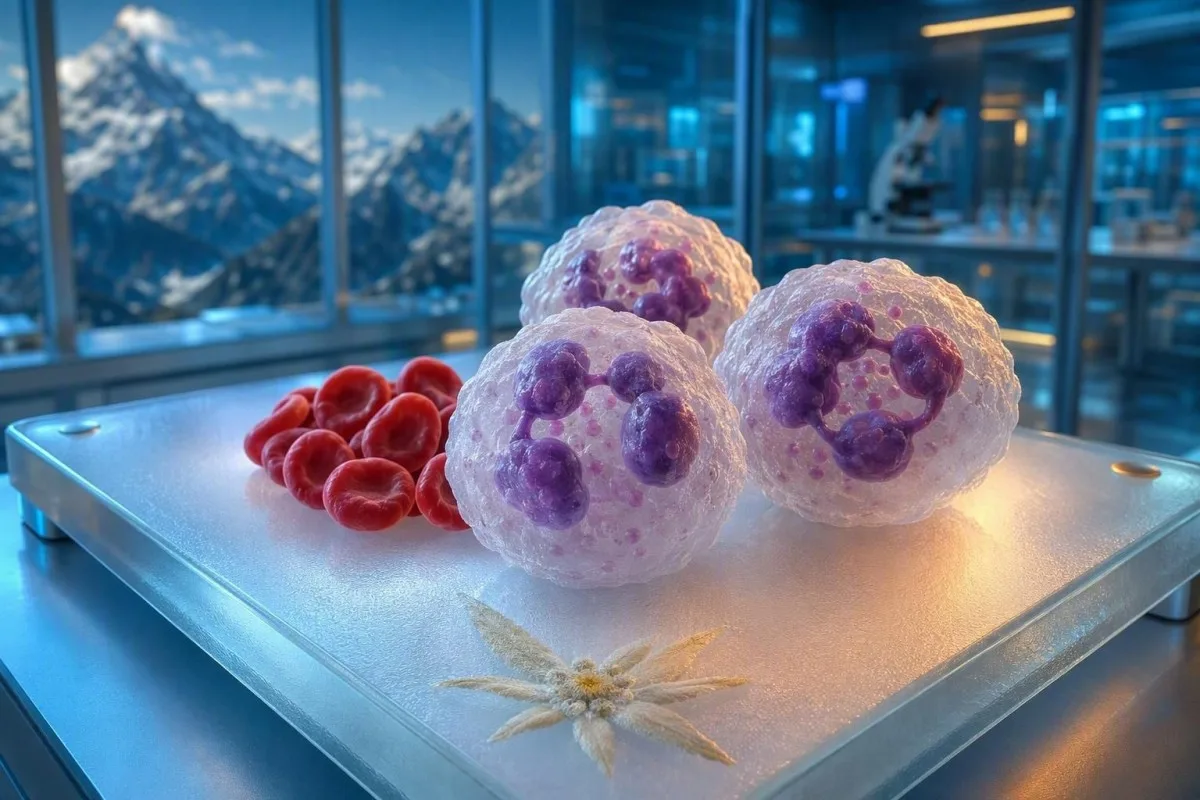
'n Effens hoë neutrofielresultaat is dikwels tydelik, maar die absolute neutrofielgetal, die res van die CBC, simptome en tendens bepaal of dit optrede benodig.


- Grensgeval neutrofiele beteken gewoonlik 'n ANC net bokant die laboratorium se boonste limiet, dikwels ongeveer 7.0-7.5 × 10⁹/L by volwassenes.
- Absoluut neutrofieltelling is meer insiggewend as neutrofielpersentasie; bereken ANC as WBC × neutrofielpersentasie ÷ 100.
- Ligte neutrofielie onder 15 × 10⁹/L sonder ontstellende simptome is algemeen reaktief en kan volg op infeksie, rook, oefening of steroïedbehandeling.
- Herhaaltyd is gewoonlik 2-6 weke na herstel van 'n kort siekte, strawwe oefening, inenting of 'n medikasieverandering.
- Onmiddellike hersiening is toepaslik vir koors met ernstige siekte, kortasem, verwarring, vinnig stygende tellings, blasste, anemie of lae plaatjies.
- Steroïede en adrenalien kan sirkulerende neutrofiele binne ure verhoog deur selle van vaatwande na die gemete bloedpoel te verskuif.
- Volgehoue verhoging vir meer as 3 maande, veral bo 15-20 × 10⁹/L, verdien 'n klinikus-begeleide oorsig en dikwels 'n bloedsmeer.
- Swangerskap kan normaalweg neutrofile tellings verhoog, veral in die derde trimester, so nie-swanger volwasse verwysingsreekse kan mislei.
Wat 'n Grensgeval Neutrofielresultaat Eintlik Beteken
Grensneutrofiele beteken gewoonlik 'n klein toename in die absolute neutrofile telling (ANC), nie 'n diagnose nie. By die meeste gesonde volwassenes, sal 'n ANC net effens bo die laboratoriumreeks normaliseer wanneer die tydelike sneller verbygaan; die eerste taak is om die absolute telling, totale witbloedtelling en simptome na te gaan eerder as om op 'n uitgeligte persentasie te reageer.
Volwasse ANC-verwysingsintervalle strek gewoonlik van ongeveer 1,5 tot 7,5 × 10⁹/L, hoewel die boonste limiet verskil volgens ontleder, afkoms, swangerskapstatus en plaaslike laboratoriummetode. 'n Waarde van 7,8 × 10⁹/L is klinies baie anders as 28 × 10⁹/L, selfs al word albei as hoog gemerk; sien ons gids vir die normale neutrofile reeks.
Die neutrofile persentasie kan hoog lyk bloot omdat limfosiete geval het na stres of kortikosteroïed blootstelling. Byvoorbeeld, 'n WBC van 6,0 × 10⁹/L met 78% neutrofiele gee 'n ANC van 4,68 × 10⁹/L, wat normaal is ondanks die hoë persentasie.
Kantesti is 'n KI-bloedtoetsontleder wat die CBC-differensiaal saam met totale WBC, hemoglobien, plaatjies en vroeëre resultate lees eerder as om een oranje vlag as 'n siekte-etiket te behandel. Vanaf 28 Augustus 2026 bly daardie patroon-eerste benadering die veiligste manier om grense-resultate te interpreteer.
Waarom laboratoriumvlae nie diagnoses is nie
Verwysingsintervalle dek die sentrale 95% van 'n geselekteerde bevolking, so ongeveer 1 uit 20 gesonde metings mag by kans buite 'n gestelde reeks val. 'n Vlag is 'n impuls vir konteks, nie bewys dat iets verkeerd is nie.
Hoekom die Absolute Neutrofielgetal Meer Tel as Persentasie
ANC is die telling wat klinici gebruik om neutrofile verhoging te beoordeel omdat dit die totale WBC met die differensiaal kombineer. 'n Hoë neutrofile persentasie met 'n normale ANC is dikwels 'n proporsionele verskuiwing, terwyl 'n hoë ANC ware neutrofilie bevestig.
Die formule is eenvoudig: ANC = WBC × (% neutrofiele + % stawe) ÷ 100. Met WBC 12.0 × 10⁹/L en neutrofiele 75%, is die ANC 9.0 × 10⁹/L; dit is ligte neutrofilie, nie 'n noodgeval op sigself nie.
Ek sien dikwels vermybare angs wanneer 'n portaal 82% neutrofiele rapporteer maar nie die berekening duidelik vertoon nie. Dr. Thomas Klein se praktiese reël is om die WBC, ANC, hemoglobien, bloedplaatjie-telling en enige onvolwasse granulosiet-vlag neer te skryf voordat besluit word wat die resultaat beteken; ons CBC-komponentgids help met die terme.
’n WBC bo 11 × 10⁹/L word algemeen leukositose genoem by nie-swanger volwassenes, maar die oorsaak kan nie alleen uit daardie getal afgelei word nie. Riley en Rupert (2015) raai klinici aan om die CBC te herhaal en 'n perifere smear te hersien wanneer leukositose onverklaarbaar of aanhoudend is.
Algemene Tydelike Oorsake van Ligte Neutrofilie
Ligte neutrofilie weerspieël meestal 'n tydelike reaktiewe proses: 'n onlangse infeksie, fisiese stres, rook, inflammasie, medikasie-effek of swangerskap. Hierdie oorsake verhoog sirkulerende neutrofiele sonder om noodwendig te beteken dat die beenmurg abnormale selle produseer.
'n Koue, tandheelkundige inflammasie, urienweg simptome, 'n veluitbraak of selfs die eerste paar dae na 'n virussiekte kan ANC verhoog tot in die 8-14 × 10⁹/L reeks. Neutrofiele kan liggies verhoog bly vir dae nadat die koors verdwyn het omdat murgvrystelling en weefselherstel nie op dieselfde oomblik stop nie.
'n Harde interval-sessie, marathon, paniekaanval of akute pyn kan demarginasieveroorsaak —selle wat voorheen langs vaatwande gerus het, tree die sirkulerende monster binne. Hierdie styging kan binne minute tot ure gebeur en is een rede waarom ek atlete vra om ongewoon harde oefening vir 24-48 uur voor 'n beplande CBC te vermy; ons oefening-verwante lab-tydsgids verduidelik die breër patroon.
Rook word geassosieer met hoër WBC en neutrofiel tellings, terwyl vetsug, chroniese tandvleissiekte en inflammatoriese velafwykings 'n beskeie styging kan onderhou. Die effens verhoogde neutrofiele betekenis is dus dikwels oor blootstelling en fisiologie, nie 'n verborge bakteriële infeksie nie.
Medisyne, Entstowwe en Lewenstrap wat Neutrofiele Kan Verhoog
Kortikosteroïede, beta-agonis inhaltore, litium en kolonie-stimulerende medisyne kan neutrofiele verhoog, soms aansienlik. Moenie 'n voorgeskrewe medisyne stop as gevolg van 'n CBC-vlag nie; dokumenteer eerder die middel, dosis en tydsberekening vir die klinikus wat die resultaat hersien.
Prednison en soortgelyke glukokortikoïede mag sirkulerende neutrofiele verhoog binne 4-6 uur deur demarginasie, vertraagde beweging na weefsels en verminderde selklaring. Steroïed-geassosieerde neutrofilie ontbreek dikwels die toksiese granulering of uitgesproke linkerverskuiwing wat met ernstige bakteriële infeksie mag gepaardgaan, hoewel 'n bloedfilm benodig word om dit behoorlik te assesseer.
Litium kan granuloproduksie verhoog, terwyl filgrastim en verwante behandelings opsetlik neutrofiel tellings verhoog; onlangse chirurgie, trauma en geboorte veroorsaak ook 'n stresreaksie. 'n Entstof kan 'n differensiaal tydelik verander, dus 'n roetine toets geneem binne 7-14 dae na inenting mag minder verteenwoordigend van die basislyn wees; lees meer oor post-vaccinasie lab verskuiwings.
Kantesti is 'n AI bloedtoets interpretasie platform wat mense toelaat om medisyne- en siektekonteks met “n resultaat te stoor, wat klinies nuttiger is as om kaal syfers te vergelyk. ”n Medikasie lys moet inhaltore, steroïedrome, inspuitings en "natuurlike" produkte insluit—nie net tablette nie.
Wanneer om 'n CBC te Herhaal vir Grensgeval Neutrofiele
Vir 'n andersins gesonde persoon met ligte geïsoleerde neutrofilie, is dit gewoonlik redelik om 'n CBC met differensiaal oor 2-6 weke te herhaal nadat die waarskynlike sneller opgelos het. Herhaal vroeër – binne dae – as simptome vererger, die telling styg, of die oorspronklike resultaat merkwaardig hoog was.
Kies 'n stabiele dag vir die nuwe bloedtrekking: geen koors, geen strawwe oefening vir 24-48 uur, gewone hidrasie, en geen nuut begin steroid tensy die voorskrywer anders sê nie. Vas is oor die algemeen nie nodig vir 'n CBC nie, maar die bypassende tyd van die dag en toestande maak veranderinge makliker om te interpreteer; ons bloedtoets tydlyn gids verduidelik waarom.
As die ANC 7,6-12 × 10⁹/L is en alle ander sellyne normaal is, verkies ek dikwels een beplande herkontrole eerder as seriewe toetsing elke paar dae. 'n Herhaling na 4 weke kan misleidend wees as die pasiënt nog herstel van longontsteking, prednisoloon begin het, of vir 'n uithouvermoë-geleentheid geoefen het.
Volharding is belangriker as een geïsoleerde nommer. Neutrofilie wat langer as 3 maande, duur, sonder 'n duidelike reaktiewe verduideliking, verdien oor die algemeen primêre sorg-ondersoek, 'n handmatige bloedfilm en geteikende toetsing gebaseer op simptome.
CBC-Patrone wat 'n Neutrofielstyging Meer of Minder Bekommerniswekkend Maak
'n Geïsoleerde ligte ANC-styging met normale hemoglobien en bloedplaatjies is gewoonlik minder kommerwekkend as neutrofilie vergesel van bloedarmoede, trombositopenie, trombositose of onryp selle. Die omliggende CBC-patroon gee die nommer sy kliniese betekenis.
'n Verhoogde ANC plus hoë bloedplaatjies bo 450 × 10⁹/L, onverklaarbare bloedarmoede, basofilie of 'n leuko-erytroblastiese bloedfilm verhoog kommer oor 'n beenmurgproses. Geeneen van hierdie kombinasies diagnoseer kanker nie, maar hulle regverdig vinnige klinikus-ondersoek eerder as 'n toevallige herhaling maande later; sien ons oorsig van die bloedkanker-assesseringspad.
“n ”Linksverskuiwing" beteken bande-, metamyelocyte- of myelocyte-selle is teenwoordig in perifere bloed. Klein getalle kan voorkom in ernstige reaktiewe stres, maar 'n volhardende linksverskuiwing verdien 'n bloedfilm-ondersoek omdat outomatiese tellers nie altyd goedaardige herstel van 'n klonale proses onderskei nie.
Kantesti AI ondersoek witbloedsel-substelle tesame met rooiselindekse en bloedplaatjietendense, en merk dan kombinasies vir mediese opvolging in plaas daarvan om te probeer om leukemie vanaf 'n CBC te diagnoseer. Hierdie benadering is in lyn met ons gepubliseerde kliniese validasie beginsels.
Infeksie, Ontsteking of Stres: Die Kliniese Leidrade Lees
Koors, fokale simptome en 'n stygende CRP kan infeksie ondersteun, maar 'n verhoogde neutrofieltelling alleen kan nie bakteriële infeksie van stres of inflammasie onderskei nie. Klinici diagnoseer die persoon voor hulle, nie 'n differensiële telling in isolasie nie.
Met bakteriële longontsteking, piëlonefrietis of blindedermontsteking, kan ANC bo 15 × 10⁹/L, styg, tog het sommige ernstige infeksies normale of lae WBC-tellings – veral by ouer volwassenes of immuunonderdrukte persone. Simptome, vitale tekens, ondersoek en kulture is dikwels belangriker as of die ANC 11 of 13 is.
CRP styg en daal vinniger as ESR, maar geeneen is spesifiek vir infeksie nie. Indien neutrofilie gepaard gaan met hoë CRP, gewrigswelling, derm simptome of 'n uitslag, brei die differensiaal uit na outo-immuun en inflammatoriese toestande; ons verduideliking van hoë ESR-patrone kan help om daardie bespreking te omraam.
Na my ervaring benodig 'n pasiënt met ANC 10.5 × 10⁹/L, geen koors en 'n normale CRP na 'n slapelose noodkamer besoek gewoonlik kalm opvolg, nie antibiotika nie. Daarteenoor mag 'n siek persoon met kouekoors en 'n ANC van 6.5 × 10⁹/L dringende sorg benodig ondanks 'n tegnies normale telling.
Swangerskap, Ouderdom en Persoonlike Basiese Vlak Verander die Interpretasie
Swangerskap veroorsaak algemeen fisiologiese neutrofilie, veral laat in die swangerskap, en kinders benodig ouderdom-spesifieke reekse. 'n Nie-swanger volwasse verwysingsinterval mag nie gebruik word om 'n swanger persoon se CBC as abnormaal te merk sonder konteks nie.
Gedurende swangerskap kan totale WBC waardes bereik 12-15 × 10⁹/L en mag verder styg gedurende kraam, hoofsaaklik deur neutrofiele. 'n Verhoogde telling sonder koors, baarmoedertenderheid, urinêre simptome of ander siektekente mag fisiologies wees, maar verloskundige spanne gebruik die volledige kliniese beeld.
Pasgeborenes en jong kinders kan neutrofiel tellings hê wat abnormaal sou lyk op 'n volwasse verslag, terwyl ouer volwassenes 'n gedempte witbloedsel reaksie mag toon tydens infeksie. Interpreteer 'n kind se resultaat teen die laboratorium se ouderdomsgroep; ons baba reeks gids verduidelik waarom vergelykings met volwassenes misluk.
Jou eie vorige CBC's is dikwels die beste vergelyking. 'n Stabiele ANC rondom 7.8 × 10⁹/L oor vyf jaar by 'n gesonde persoon het 'n ander waarskynlikheidsprofiel as 'n nuwe styging van 3.2 tot 12.8 × 10⁹/L.
Rook, Metaboliese Faktore en Chroniese Lae-Graad Neutrofilie
Rook, vetsug en chroniese inflammatoriese blootstellings kan laegraadse neutrofilie produseer wat voortduur nadat 'n verkoue gelos het. Hierdie faktore verdien steeds aandag omdat dit gesondheid kan beïnvloed buite die CBC resultaat self.
Rook-verwante leukositose kan neutrofiele, limfosiete en monosite behels, so dit mag nie voorkom as 'n suiwer neutrofiel styging nie. 'n Herhaalde CBC 8-12 weke na rookstaking kan insiggewend wees, hoewel 'n normale resultaat nie vereis word voordat die gesondheidsvoordele van ophou gevier word nie.
Sentrale vetsug, slaapapnee en chroniese periodontale siekte mag bydra tot inflammatoriese signalering en 'n effens hoër WBC telling. Hierdie assosiasies is eg maar onsPesifiek; hulle mag nie gebruik word om nuwe simptome of 'n vinnig toenemende telling te verwerp nie.
Kantesti, ’n KI-aangedrewe bloedtoets-analisehulpmiddel, kan 'n huidige differensiaal met verskeie vorige verslae vergelyk en die stadige veranderinge wat 'n enkele jaarlikse resultaat verberg, aan die lig bring. Vir praktiese dop, teken rookstatus, gewigverandering, onlangse infeksies en steroïed blootstelling langs elke toets in 'n longitudinale lab rekord.
Wanneer om Jou oor Neutrofiele te Bekommer en Vinnige Hulp te Soek
Soek dieselfde-dag mediese assessering vir 'n hoë neutrofiel resultaat met ernstige siekte, koors en verwarring, kortasem, borspyn, 'n stywe nek, of vinnig verslegtende simptome. Die dringendheid kom van moontlike infeksie of sistemiese siekte, nie van 'n grensgrens ANC alleen nie.
'n WBC of ANC bo 25-30 × 10⁹/L verdien onmiddellike kliniese kontak, veral as dit nuut, stygend is, of saam met onryp granulosite gepaardgaan. Tellings bo 50 × 10⁹/L kan 'n leukemoïede reaksie of hematologiese siekte verteenwoordig en moet nie wag vir 'n roetine jaarlikse afspraak nie.
Onverklaarbare nagsweet, gewigsverlies, herhalende infeksies, maklike kneusing, vergrote limfknope of abdominale volheid is redes om 'n tydige klinikus-oorsig te reël. Die kommer neem toe wanneer simptome saamval met anemie, lae plaatjies, basofilie of abnormale selle op die ontleder se waarskuwing.
As jy onwel voel na reis, chemoterapie, oorplantingbehandeling of immuunonderdrukkende medikasie, gebruik 'n laer drempel vir dringende assessering. Ons sepsis-markeer gids verduidelik waarom normaal-lykende laboratoriumwaardes nooit ernstige siekte uitsluit nie.
Wat Klinici Naoog is Wanneer Neutrofilie Voortduur
Aanhoudende onverklaarbare neutrofilie word gewoonlik beoordeel met geskiedenis, ondersoek, herhaal CBC, perifere bloedfilm en geteikende inflammasie- of infeksietoetse. Molekulêre toetse word gereserveer vir patrone wat 'n miëloproliferatiewe neoplasma suggereer, nie vir elke effens hoë resultaat nie.
'n Klinikus kan vra oor rook, slaapapnee, chroniese pyn, inflammatoriese dermsimptome, steroïedgebruik, onlangse splenektomie en familiebloedafwykings. Hulle mag CRP, ESR, lewer- en nier-merkers, kulture of beeldvorming bestel slegs wanneer die geskiedenis daarna wys—breë toetsing sonder 'n kliniese vraag skep dikwels vals alarms.
'n Handmatige film kan toksiese granulering, Döhle-liggaamveranderinge, linkse verskuiwing, basofilie of blaste identifiseer wat outomatiese differensiële tellings onvolledig mag merk. Die 2022 WHO-klassifikasie beskryf chroniese neutrofiliese leukemie as 'n seldsame miëloïde neoplasma wat aanhoudende neutrofilie en spesifieke molekulêre en morfologiese kriteria vereis; dit word nie gediagnoseer van 'n grenslyn-resultaat nie (Khoury et al., 2022).
BCR::ABL1-toetsing, JAK2-toetsing of CSF3R-toetsing mag in geselekteerde gevalle deur hematologie oorweeg word. Daardie toetse is betekenisvol wanneer die CBC-patroon en kliniese bevindinge hulle ondersteun, nie as gerusstelling-skerm vir 'n ANC van 8.1 × 10⁹/L nie.
Wat Bloed-Smeer Opmerkings en Onvolwasse Selle Jou Kan Vertel
'n Bloedfilmkommentaar voeg morfologie by—die voorkoms en rypheid van selle—tot die CBC-telling. “Toksiese veranderinge” kan 'n intense reaktiewe proses ondersteun, terwyl blaste of aanhoudende onverklaarbare onryp vorms vinnige spesialisassesserings vereis.
Bande is minder ryp neutrofiele, en 'n paar kan verskyn tydens infeksie, chirurgie of beenmurgherstel. Laboratoriums verskil in hoe hulle bande rapporteer, so 'n persentasie moet nie direk tussen stelsels vergelyk word sonder om die rapportmetode na te gaan nie.
Toksiese granulering en sitoplasmiese vakuolasie is beskrywende filmbevindinge, nie diagnoses nie. Hulle kan ernstige weefselreaksie vergesel, maar interpretasie hang af van die kliniese omgewing, CRP en of daar 'n linkse verskuiwing is; ons verduideliker oor toksiese neutrofielgranulering dek hierdie terme.
Blaste op “n verslag, ”n laboratoriumoproep wat 'n dringende monster-oorsig aanvra, of 'n nuwe “atipiese selle” kommentaar moet daardie dag met die bestellende klinikus bespreek word. Dit is een situasie waar wag vir 'n roetine-herkontrole die verkeerde skuif is.
Hoe om Voor te Berei vir 'n Nuttige Neutrofiel Herhaaltoets
'n Nuttige herhaal-CBC word geneem wanneer jy klinies stabiel is en sluit genoeg konteks in om enige oorblywende verhoging te verklaar. Jy kan nie veilig neutrofiele “verlaag” vir 'n toets nie, maar jy kan voorkombare geraas vermy.
Vir 'n beplande nie-dringende her-toets, vermy intense oefening vir 24-48 uur, kom normaal gehidreer aan, en lig die bloedtrekspan in oor steroïed dosisse, inhalers, entstowwe en onlangse infeksies. Moenie voorgeskrewe medikasie oorslaan of doelbewus te veel water drink om 'n laboratoriumwaarde te verander nie.
Gebruik dieselfde laboratorium wanneer prakties omdat ontleder-spesifieke verwysingsintervalle en differensiële metodes verskil. 'n Verskil van 0.5-1.0 × 10⁹/L kan gewone biologiese en analitiese variasie weerspieël, veral wanneer resultate naby die boonste limiet is; ons artikel oor werklike teenoor ewekansige laboratoriumveranderinge ondersoek hierdie kwessie.
Bring die vroeëre verslag mee of behou 'n foto daarvan. Die datum van koors, antibiotika-siklus, steroïede-inskrywing of groot oefensessie verklaar dikwels meer as 'n enkele bykomende bloedtrekking.
Hoe om KI-Interpretasie Veilig Langs Kliniese Sorg te Gebruik
KI kan 'n CBC-tendens organiseer en opvolgvrae identifiseer, maar dit kan nie vitale tekens assesseer nie, limfknope ondersoek of 'n dringende infeksie uitsluit nie. 'n Hoë-gehalte interpretasie moet onsekerheid aandui, die ANC-berekening toon en dringende simptome na menslike sorg rig.
Kantesti KI interpreteer neutrofielresultate deur die absolute telling, totale leukosiete, ander sellyne, laboratoriuminterval en longitudinale verandering te analiseer. Dit is ontwerp om gebruikers te help om beter vrae vir hul geneesheer voor te berei, nie om dringende assessering te vervang of behandeling voor te skryf nie.
Privaatheid is belangrik met laboratoriumrekords omdat 'n CBC medikasiegebruik, swangerskap-verwante veranderinge en potensiële chroniese siekte kan openbaar. Kantesti ondersteun veilige resultaatinterpretasie oor meerdere tale, terwyl ons dokters toesig bied deur die Mediese Adviesraad.
Dr. Thomas Klein se kernboodskap is eenvoudig: 'n klein geïsoleerde styging is gewoonlik 'n probleem van herhaal- en konteks-toetsing, terwyl 'n hoë of stygende ANC gekombineer met simptome of ander CBC-afwykings 'n mediese-oorsigprobleem is. Indien die verslag met hoe jy voel, strydig lyk, vra vir 'n geneesheer om die oorspronklike laboratoriumdokument te hersien – nie slegs 'n skermkiekie nie.
'n Praktiese Volgende-Stap Plan vir 'n Grensgeval Resultaat
Die meeste mense met grensoorskrydende neutrofiele kan 'n driestap-plan volg: die ANC bevestig, 'n tydelike sneller identifiseer en 'n gepas geteikende herhaaltoets reël. Eskaleer onmiddellik indien rooi-vlag simptome of groot CBC-afwykings teenwoordig is.
Eerstens, kyk of die gemerkte waarde 'n persentasie of die ANC is, en let op die presiese eenheid. Tweedens, skryf siekte neer in die vorige 2 weke, strawwe oefening in die vorige 48 uur, rook, swangerskapstatus, medikasie en tydsberekening van entstof.
Derdens, as jy goed voel en die ANC is effens hoog met normale hemoglobien en plaatjies, reël 'n herhaalde CBC in 2-6 weke deur jou gewone geneesheer. Indien dit op 3 maande verhoog bly of na 15 × 10⁹/L styg, vra of 'n film-oorsig en gefokusde ondersoek gepas is; ons kontrolelys vir ’n tweede mening kan help om die besoek voor te berei.
Vir meer inligting oor hoe ons metodologie tendense en onsekerheid hanteer, hersien die KI-tegnologiegids. 'n Grensoorskrydende vlag moet sinvolle opvolg, nie 'n middernagtelike diagnose soektog, aanmoedig nie.
Gereelde vrae
Wat beteken effens verhoogde neutrofiele?
Effens verhoogde neutrofiele beteken gewoonlik dat die absolute neutrofielgetal net bo die plaaslike laboratorium se boonste limiet is, dikwels ongeveer 7.5 × 10⁹/L by volwassenes. Onlangse infeksie, oefening, rook, emosionele stres, swangerskap en kortikosteroïede is algemene verklarings. As die ANC onder 15 × 10⁹/L is, hemoglobien en plaatjies normaal is, en jy goed voel, is 'n herhaalde CBC oor 2-6 weke algemeen gepas. Die resultaat moet beoordeel word teen die laboratoriumreeks en jou vorige CBC's.
Wanneer moet ek bekommerd wees oor hoë neutrofiele?
Hoë neutrofiele vereis dringende assessering wanneer dit voorkom met ernstige koors, verwarring, kortasem, borspyn, stywe nek, vinnig verswakkende siekte of 'n merkwaardig hoë telling. 'n ANC bo 25-30 × 10⁹/L, veral as dit styg of geassosieer word met onryp selle, anemie of lae plaatjies, moet dadelik klinikus-kontak veroorsaak. 'n Ligte geïsoleerde ANC van 8-12 × 10⁹/L by 'n gesonde persoon is veel minder ontstellend. Simptome en die res van die CBC bepaal dringendheid meer betroubaar as die persentasie alleen.
Hoe lank bly neutrofiele hoog na 'n infeksie?
Neutrofiele kan vir et paar dae tot 'n paar weke na 'n infeksie verbeter, liggies verhoog bly, afhangende van die erns daarvan en enige behandeling wat gebruik word. 'n Herhalende CBC 2-6 weke na volledige herstel is dikwels meer insiggewend as om die volgende dag weer te toets. Aanhoudende verhoging bo 3 maande sonder 'n ooglopende oorsaak regverdig 'n klinikus se oorsig. Steroïedbehandeling kan die verhoogde resultaat verleng of naboots deur sirkulerende neutrofiele binne ure te verhoog.
Kan stres of oefening hoë neutrofiele veroorsaak?
Ja, akute emosionele stres, pyn en strawwe oefening kan neutrofielgetalle tydelik verhoog deur demarginasie, waar selle van die wande van bloedvate na die sirkulerende monster beweeg. Die verandering kan binne minute tot ure plaasvind en stabiliseer dikwels binne 24-48 uur nadat die stressors opgelos het. Om ongewone strawwe oefening vir 24-48 uur voor 'n beplande herhaalde CBC te vermy, kan hierdie bron van variasie verminder. Hierdie effek beteken nie dat oefening skadelik is of dat 'n infeksie teenwoordig is nie.
Is 'n hoë neutrofiel persentasie dieselfde as 'n hoë ANC?
Nee, 'n hoë neutrofielpersentasie is nie noodwendig 'n hoë neutrofielgetal nie. ANC is gelyk aan totale WBC vermenigvuldig met die neutrofielpersentasie gedeel deur 100, so 'n WBC van 6.0 × 10⁹/L met 78% neutrofiele gee 'n normale ANC van 4.68 × 10⁹/L. 'n Lae limfosietpersentasie kan die neutrofielpersentasie hoog laat lyk selfs wanneer die absolute neutrofielgetal normaal is. Klinici gebruik gewoonlik ANC om ware neutrofilie te bepaal.
Kan kanker neutrofiele verhoog?
Sommige bloedkankers en soliede gewasse kan neutrofilie veroorsaak, maar dit is ongewone verklarings vir 'n enkele grenssluiting. Besorgdheid ontstaan wanneer neutrofilie aanhoudend is en vergesel word van anemie, bloedplaatjie-abnormaliteite, basofilie, abnormale onryp selle, vergrote milt, nagsweet of onbedoelde gewigsverlies. Die 2022 WHO-klassifikasie vereis spesifieke kliniese, bloedfilm- en molekulêre bevindings om myeloiede neoplasmas te diagnoseer. 'n Ligte geïsoleerde ANC-verhoging diagnoseer nie kanker nie.
Kry vandag KI-aangedrewe bloedtoets-analise
Sluit aan by meer as 2 miljoen gebruikers wêreldwyd wat Kantesti vertrou vir onmiddellike, akkurate laboratoriumtoetsanalise. Laai jou bloedtoetsresultate op en ontvang omvattende interpretasie van 15,000+-biomerkers binne sekondes.
📚 Verwysde navorsingspublikasies
Klein, T., Mitchell, S., & Weber, H. (2026). Kantesti LTD. (2026). Serum Proteins Guide: Globulins, Albumin & A/G Ratio Blood Test. Zenodo. Beskikbaar via DOI; verwante outeursprofiele mag deur ResearchGate en Academia.edu deursoek word.. Kantesti KI Mediese Navorsing.
Klein, T., Mitchell, S., & Weber, H. (2026). Kantesti LTD. (2026). C3 C4 Complement Blood Test & ANA Titer Guide. Zenodo. Beskikbaar via DOI; verwante outeursprofiele mag deur ResearchGate en Academia.edu deursoek word.. Kantesti KI Mediese Navorsing.
📖 Eksterne mediese verwysings
Riley LK, Rupert J (2015). Evaluering van Pasiënte met Leukositose. American Family Physician.
⚕️ Mediese Vrywaring
Hierdie artikel is slegs vir opvoedkundige doeleindes en vorm nie mediese advies nie. Raadpleeg altyd ’n gekwalifiseerde gesondheidsorgverskaffer vir besluite oor diagnose en behandeling.
E-E-A-T Vertrouenseine
Ervaring
Kliniese oorsig gelei deur ’n geneesheer van laboratorium-interpretasie-werksvloei.
Kundigheid
Laboratoriumgeneeskunde fokus op hoe biomerkers in ’n kliniese konteks optree.
Gesagsvermoë
Geskryf deur dr. Thomas Klein met hersiening deur dr. Sarah Mitchell en prof. dr. Hans Weber.
Betroubaarheid
Bewysgebaseerde interpretasie met duidelike opvolgpaaie om alarm te verminder.