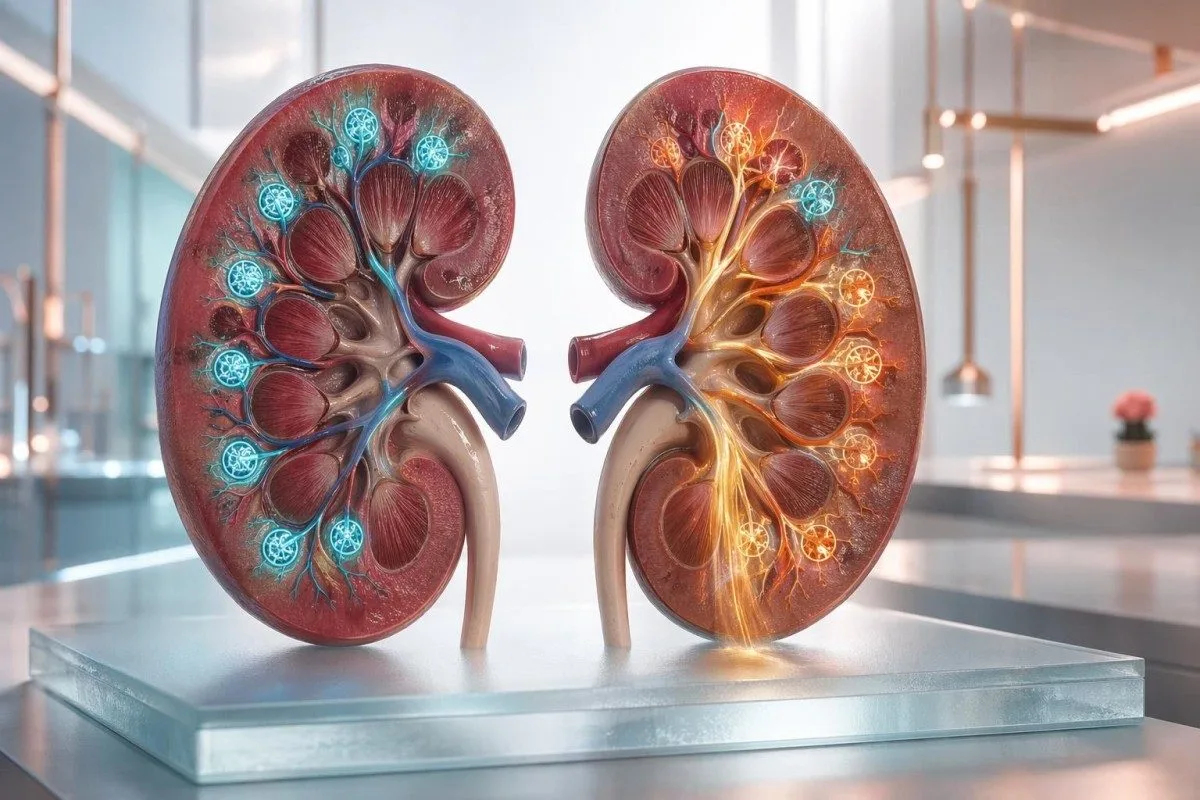
Creatinine-based eGFR is useful, but it can be wrong in predictable people. Cystatin C is often the confirmatory kidney function test when muscle mass, age, training, diet, or a borderline result makes the number hard to trust.


- GFR test results based on creatinine may need cystatin C confirmation when eGFR is 45–75 mL/min/1.73 m² and the clinical picture does not fit.
- eGFR normal range is usually 90 mL/min/1.73 m² or higher in adults, but age, urine albumin, and trend matter more than one isolated number.
- Low GFR below 60 mL/min/1.73 m² for more than 3 months can meet criteria for chronic kidney disease, especially with albuminuria.
- Cystatin C is a 13-kDa protein filtered by the glomerulus and is less dependent on muscle mass than creatinine.
- Older adults with low muscle mass can have a normal creatinine while true kidney filtration is lower than expected.
- Athletes can show mildly high creatinine after heavy training, creatine use, or large meat intake without true kidney damage.
- Urine ACR below 30 mg/g, or below 3 mg/mmol, usually argues against significant albumin leakage when eGFR is borderline.
- Repeat testing is often done within 1–4 weeks for unexpected results, but CKD classification usually requires persistence for at least 3 months.
When creatinine eGFR deserves a cystatin C recheck
A GFR test needs cystatin C recheck when creatinine-based eGFR does not fit the person: older adults with low muscle, athletes with high muscle, people with weight loss or chronic illness, and anyone near a decision cutoff such as 45–59 or 60–75 mL/min/1.73 m². I’m Thomas Klein, MD, and when I review a panel showing a borderline kidney number, I first ask, “Does this creatinine reflect kidney filtration, or just muscle biology?” Our Kantesti AI review can help people see that distinction clearly.
Creatinine eGFR is a useful screening estimate, not a direct measurement of filtration. The practical problem is that creatinine comes partly from muscle turnover, so the same creatinine of 1.1 mg/dL can mean different things in a frail 78-year-old, a 32-year-old powerlifter, and a 52-year-old marathon runner.
A true measured GFR uses clearance methods such as iohexol or iothalamate, but most clinics use estimated GFR because it is cheaper, faster, and available from routine chemistry panels. For a plain-language comparison, our guide to GFR test vs eGFR explains why the estimated number can drift from the real filtration rate.
As of May 2, 2026, most physicians still start with creatinine eGFR, then add cystatin C when the result changes a diagnosis, medication dose, imaging decision, or referral plan. The best recheck is not “more labs forever”; it is the right second marker at the right moment.
How creatinine and cystatin C estimate filtration differently
Creatinine estimates kidney filtration from a muscle-derived waste product, while cystatin C estimates filtration from a small protein made by nearly all nucleated cells. Cystatin C is less affected by muscle mass, which is why it can clarify a kidney function test when creatinine looks suspicious.
Cystatin C is a 13-kDa protein that is freely filtered at the glomerulus and then mostly reabsorbed and broken down in kidney tubules. It is not meaningfully secreted into urine like creatinine can be, so it gives a different view of filtration physiology.
According to the KDIGO 2024 CKD guideline, clinicians should use equations that combine creatinine and cystatin C when more accurate GFR estimation will affect clinical decisions (KDIGO CKD Work Group, 2024). That recommendation is built into our clinical standards because a single marker can be too blunt for dosing, staging, or reassurance.
The eGFR normal range is usually 90 mL/min/1.73 m² or higher in adults, but many healthy older adults sit below that without heavy albumin leakage. Our detailed eGFR by age guide covers why a 68-year-old and a 28-year-old should not be interpreted with identical emotional urgency.
Borderline eGFR results: the 45–59 and 60–75 zones
Borderline eGFR results are the classic reason to order cystatin C, especially when creatinine eGFR falls between 45 and 75 mL/min/1.73 m². This is where one formula can move a person from “watch” to “diagnose,” and that deserves caution.
An eGFR of 58 mL/min/1.73 m² is not the same clinical story in every patient. If urine albumin-to-creatinine ratio is below 30 mg/g, blood pressure is controlled, and prior eGFR values were 56–62 for years, I usually worry less than I would with a fresh drop from 92 to 58.
Borderline kidney results also collide with administrative cutoffs. Some medicines, contrast imaging protocols, and insurance rules still use thresholds such as 30, 45, or 60 mL/min/1.73 m², so a confirmatory cystatin C eGFR can prevent avoidable medication changes.
When a lab value sits right on a cutoff, trend beats panic. Our guide on borderline lab results explains why a 3–5 mL/min/1.73 m² shift can be ordinary biological and analytic variation rather than true kidney decline.
Older adults: sarcopenia can hide low filtration
Older adults with sarcopenia can have deceptively normal creatinine because they produce less creatinine each day. In this group, cystatin C may uncover a low GFR that creatinine eGFR underestimates or misses.
I see this pattern often: an 82-year-old woman has creatinine 0.8 mg/dL, everyone relaxes, but she weighs 48 kg and has lost 6 kg in a year. Her creatinine eGFR may look acceptable while drug clearance is lower than the number suggests.
Sarcopenia is not just “being thin.” It is loss of muscle reserve, and it becomes common after age 70, after hospital admission, and during chronic inflammatory illness. A cystatin C recheck is especially sensible before dosing renally cleared drugs such as gabapentin, metformin, certain antivirals, or some antibiotics.
For older adults, the urine albumin-to-creatinine ratio adds a separate damage signal that filtration alone cannot provide. Our senior blood tests guide lists kidney markers I prefer to trend yearly, including eGFR, potassium, bicarbonate, calcium, albumin, and urine ACR.
Athletes and high muscle mass: creatinine can overcall kidney disease
Athletes and muscular patients can have high creatinine with normal true filtration because creatinine production rises with muscle mass, training load, and sometimes creatine use. Cystatin C can stop a false low GFR label from sticking.
A 41-year-old cyclist once came to clinic frightened by an eGFR of 57 mL/min/1.73 m² after a hard training block. He had normal urine ACR, normal cystatin C eGFR, and creatinine fell after 5 days of rest and hydration; that was muscle physiology, not new kidney disease.
Heavy resistance training can raise serum creatinine by roughly 0.2–0.4 mg/dL in some people, and creatine monohydrate can raise creatinine without reducing glomerular filtration. Large cooked meat meals can also transiently increase creatinine for several hours, which is one reason I ask about dinner, supplements, and training before calling the result abnormal.
The 2012 NEJM paper by Inker et al. found that equations combining creatinine and cystatin C improved GFR estimation compared with either marker alone, particularly around clinical decision thresholds (Inker et al., 2012). For endurance and strength athletes, our athlete lab patterns guide also explains why AST, CK, and creatinine can move together after hard sessions.
Low muscle, weight loss, and chronic illness can make eGFR look falsely normal
Low muscle mass can make creatinine eGFR look better than true kidney function, particularly after weight loss, cancer treatment, chronic liver disease, or prolonged bed rest. Cystatin C is useful when the creatinine number seems too reassuring.
A creatinine of 0.6 mg/dL can be completely normal in a small healthy adult, but it can be misleading in someone who has lost 12 kg during illness. The kidney may filter less well than creatinine eGFR suggests because the body is producing less creatinine to begin with.
This matters for safety. A falsely high eGFR can lead to excessive dosing of medicines cleared by the kidneys, and I have seen confusion, sedation, or nausea appear when doses were chosen from creatinine eGFR alone in frail patients.
If creatinine is normal but symptoms, medication sensitivity, or urine findings suggest kidney strain, cystatin C and urine ACR are reasonable next checks. Our article on low GFR with normal creatinine walks through that exact contradiction in more detail.
Medication, diet, and timing traps before repeating a kidney function test
A repeat kidney function test is most useful when you control the avoidable traps first: hard exercise, dehydration, high meat intake, creatine, and medicines that alter creatinine handling. Otherwise the second result may repeat the same distortion.
Trimethoprim and cimetidine can raise serum creatinine by blocking tubular secretion without reducing true GFR. Fenofibrate can also raise creatinine in some patients, and the effect is often reversible after medication review.
Dehydration can concentrate BUN, creatinine, albumin, and sodium, making kidney results look worse than they are. If a result follows vomiting, diarrhea, sauna use, endurance exercise, or a low-fluid day, I usually want a repeat after 24–72 hours of ordinary intake unless there are urgent features.
Do not stop prescribed medicines just to “fix” a lab number. Instead, bring the exact medication and supplement list; our guide to dehydration false highs shows how fluid status can distort several markers at once.
Reading cystatin C results with urine albumin and electrolytes
Cystatin C should be interpreted beside urine albumin, potassium, bicarbonate, calcium, phosphate, and blood pressure. A filtration estimate without damage markers can miss the reason the kidney number matters.
Urine albumin-to-creatinine ratio below 30 mg/g, or below 3 mg/mmol, is generally considered normal to mildly increased. ACR from 30–300 mg/g suggests moderately increased albuminuria, and above 300 mg/g suggests severely increased albuminuria.
Electrolytes tell me whether a low eGFR is behaving clinically. Potassium above 5.5 mmol/L, bicarbonate below 22 mmol/L, or a rising phosphate level changes the urgency even when the eGFR number looks only moderately reduced.
A full renal function panel is often more useful than a lone creatinine because it frames filtration with minerals, acid-base clues, and albumin. In practice, I trust patterns more than isolated flags.
Albuminuria can appear before creatinine rises, especially in diabetes, hypertension, and some glomerular conditions. That is why a normal cystatin C does not automatically cancel the need to check urine when blood pressure, swelling, or diabetes risk is present.
Why combined eGFRcr-cys often predicts risk better
Combined creatinine-cystatin C eGFR often predicts kidney and cardiovascular risk better than either marker alone. The reason is simple: it averages out different non-kidney biases from muscle, inflammation, age, and body size.
Shlipak et al. reported in NEJM that cystatin C reclassified risk meaningfully compared with creatinine, especially for death and cardiovascular outcomes in people near CKD thresholds (Shlipak et al., 2013). That does not make cystatin C magic; it makes it an independent lens.
Cystatin C can be higher with corticosteroid use, thyroid dysfunction, smoking, obesity, and inflammatory states, so it is not bias-free. I am more confident when creatinine eGFR and cystatin C eGFR agree within about 10–15 mL/min/1.73 m² and the urine ACR supports the story.
Kantesti AI reads kidney results by looking for cross-marker agreement: creatinine, cystatin C when present, BUN, BUN/creatinine ratio, electrolytes, urine ACR, glucose, HbA1c, blood pressure entries, and trend. Our article on early kidney shifts explains why BUN and urine markers sometimes move before creatinine.
When a low GFR is urgent instead of just borderline
A low GFR is more urgent when it appears suddenly, falls below 30 mL/min/1.73 m², or comes with high potassium, low bicarbonate, swelling, breathlessness, confusion, or reduced urination. Borderline chronic results and acute kidney injury are different problems.
Creatinine can lag behind acute kidney injury by 24–48 hours, so a “not too bad” eGFR can still be early in a dangerous process. A rise in creatinine by 0.3 mg/dL within 48 hours is enough to meet common AKI criteria in the right clinical setting.
Potassium is the lab I do not ignore. Potassium above 6.0 mmol/L, especially with kidney impairment or ECG changes, is a same-day medical issue rather than a lifestyle topic.
If your report shows low eGFR plus potassium elevation, severe acidosis, or rapidly rising creatinine, do not wait for a cystatin C appointment. Our guide to high potassium warning signs explains the symptoms and lab thresholds that warrant urgent care.
Repeat testing intervals doctors commonly use
Unexpected eGFR results are often repeated within 1–4 weeks, while chronic kidney disease classification usually requires abnormality for at least 3 months. The timing depends on how abnormal the number is and whether the patient is clinically stable.
If an eGFR drops from 95 to 62 mL/min/1.73 m² after a stomach virus, I usually want a repeat once hydration and intake are normal. If it drops from 95 to 38 with high potassium, that is not a routine repeat; that needs prompt clinical review.
For stable borderline results, many clinicians repeat creatinine, cystatin C, and urine ACR after about 3 months to confirm chronicity. CKD is not usually diagnosed from one isolated low eGFR unless prior records, imaging, albuminuria, or clinical context already support chronic disease.
Lab-to-lab differences can also matter. Our repeat abnormal labs guide gives practical repeat windows for common markers, including when to use the same lab to reduce analytical noise.
What to ask your clinician before changing medicines or supplements
Before changing medicines based on a GFR result, ask whether the dose decision used creatinine eGFR, cystatin C eGFR, or combined eGFRcr-cys. This is especially relevant for drugs with narrow safety margins or kidney clearance.
Metformin, SGLT2 inhibitors, DOAC anticoagulants, lithium, digoxin, gabapentin, pregabalin, certain antibiotics, and many antivirals have kidney-related dosing considerations. The exact cutoff differs by drug, country, and guideline, so patients should not self-adjust from a lab portal number.
Supplements deserve the same caution. Creatine can raise creatinine, high-dose vitamin C may affect stone risk in susceptible people, and potassium-containing salt substitutes can be risky when eGFR is low or ACE inhibitors are used.
Diet advice should be individualized, not copied from a generic kidney handout. Our kidney-protective diet article explains why protein, sodium, potassium, and phosphate targets change by CKD stage, albuminuria, diabetes status, and medications.
How Kantesti AI reads GFR patterns from lab reports
Kantesti AI interprets GFR results by comparing creatinine, cystatin C when available, BUN, electrolytes, urine markers, age, sex, units, reference ranges, and prior trends. Our AI does not diagnose kidney disease; it helps identify when a result deserves confirmation or clinician review.
In our analysis of 2M+ blood test uploads across 127+ countries and 75+ languages, kidney markers are among the most commonly misunderstood results. People often panic over an eGFR of 59 but miss an ACR of 180 mg/g, which is the more actionable risk signal.
Our AI blood test platform can read PDF or photo lab reports in about 60 seconds, then separate urgent patterns from repeatable or borderline ones. Kantesti’s neural network also checks unit differences, because creatinine reported in mg/dL versus µmol/L can make a perfectly normal result look alarming to someone reading quickly.
For deeper marker explanations, our biomarker library covers more than 15,000 lab markers, and our PDF upload workflow explains how reports are processed safely. Kantesti is CE-marked and built under HIPAA, GDPR, and ISO 27001-aligned controls, but your clinician remains the person who can examine you, prescribe, and order follow-up.
Practical checklist before your cystatin C appointment
Before a cystatin C recheck, bring your last 2–3 creatinine/eGFR results, urine ACR if available, medication list, supplement list, recent illness history, and exercise pattern. A clean clinical story makes the confirmatory test more useful.
For 48 hours before repeat testing, avoid unusually hard training unless your doctor wants to assess you under training conditions. Keep hydration ordinary; overhydrating to “pass” a test can dilute the clinical picture and is not helpful.
Do not start or stop creatine, protein powders, NSAIDs, diuretics, or blood pressure medicines without medical advice. If you already changed something, write down the date, dose, and reason because timing often explains the lab movement.
If you want a structured review before your appointment, you can upload your results for free AI blood test analysis. I also like patients to keep a dated record; our blood test variability guide shows why trend, not one flag, usually settles the question.
Research, validation, and careful interpretation at Kantesti
Kantesti publishes validation work because medical AI should be judged against clinical reasoning, not marketing language. For GFR interpretation, that means detecting hyperdiagnosis traps, unit errors, borderline cutoffs, and cases where creatinine does not match the patient.
Our medical content is reviewed by physicians and advisors listed on the Medical Advisory Board. Thomas Klein, MD, reviews kidney articles with the same rule I use in clinic: if a number changes a label, drug dose, or referral, the evidence threshold should be higher.
Kantesti LTD is a UK company building AI-powered blood test interpretation for patients, families, and clinical teams; you can read more about the Kantesti organization. Our validation publication, Clinical Validation of the Kantesti AI Engine, describes 100,000 anonymised blood test cases across 127 countries with hyperdiagnosis trap cases included.
Our broader publication library also includes the Figshare work “Women’s Health Guide: Ovulation, Menopause & Hormonal Symptoms,” DOI 10.6084/m9.figshare.31830721, because hormone timing and kidney interpretation share one practical lesson: context changes the meaning of a normal range. Bottom line — cystatin C is not a prestige add-on; it is a useful recheck when creatinine eGFR may be telling the wrong story.
Frequently Asked Questions
What is a cystatin C GFR test?
A cystatin C GFR test estimates kidney filtration using cystatin C, a 13-kDa protein produced by most nucleated cells and filtered by the kidney glomerulus. It is less dependent on muscle mass than creatinine, so it can be helpful in older adults, athletes, frail patients, and people with major weight changes. Doctors often use cystatin C alone or combined with creatinine to estimate GFR in mL/min/1.73 m².
When should creatinine eGFR be rechecked with cystatin C?
Creatinine eGFR should be rechecked with cystatin C when the result is borderline, unexpected, or likely biased by muscle mass, diet, supplements, or illness. Common triggers include eGFR 45–59 mL/min/1.73 m² without albuminuria, eGFR 60–75 in a muscular or frail person, or a result that would change medication dosing. Cystatin C is also useful when creatinine looks normal but the patient has low muscle mass or medication sensitivity.
What is the normal eGFR range?
The usual adult eGFR normal range is 90 mL/min/1.73 m² or higher, provided urine albumin and clinical history are reassuring. An eGFR of 60–89 may be normal for some older adults but can suggest early kidney disease if albuminuria, diabetes, high blood pressure, or a falling trend is present. An eGFR below 60 for more than 3 months can meet criteria for chronic kidney disease.
Can creatinine be normal when kidney function is low?
Yes, creatinine can be normal even when true kidney filtration is low, especially in people with low muscle mass. A frail older adult or someone who has lost 10–15 kg during illness may produce less creatinine, which can make creatinine eGFR look falsely reassuring. In that situation, cystatin C, urine ACR, and trend over at least 3 months give a safer interpretation.
Is cystatin C better than creatinine for kidney function?
Cystatin C is not always better than creatinine, but it is often better when creatinine is biased by muscle mass or diet. Creatinine can be misleading in athletes, bodybuilders, frail older adults, amputees, and people with chronic illness. The most accurate routine estimate is often combined eGFRcr-cys, which blends creatinine and cystatin C to reduce single-marker error.
Do I need to fast before a cystatin C test?
Most cystatin C tests do not require fasting, but your clinician or laboratory instructions should take priority. For a cleaner kidney function comparison, avoid unusually hard exercise for about 48 hours and keep hydration normal unless your doctor advises otherwise. If creatinine is being repeated at the same time, heavy meat intake and creatine supplements can affect the interpretation.
What if creatinine eGFR and cystatin C eGFR disagree?
If creatinine eGFR and cystatin C eGFR disagree by more than about 10–15 mL/min/1.73 m², doctors usually look for non-kidney explanations before choosing which number to trust. High muscle mass, creatine use, recent exercise, and cooked meat intake can push creatinine upward, while steroid use, thyroid disease, smoking, obesity, and inflammation can raise cystatin C. Urine ACR, potassium, bicarbonate, blood pressure, and the 3-month trend usually decide the next step.
Get AI-Powered Blood Test Analysis Today
Join over 2 million users worldwide who trust Kantesti for instant, accurate lab test analysis. Upload your blood test results and receive comprehensive interpretation of 15,000+ biomarkers in seconds.
📚 Referenced Research Publications
Klein, T., Mitchell, S., & Weber, H. (2026). Women's Health Guide: Ovulation, Menopause & Hormonal Symptoms. Kantesti AI Medical Research.
Klein, T., Mitchell, S., & Weber, H. (2026). Clinical Validation of the Kantesti AI Engine (2.78T) on 100,000 Anonymised Blood Test Cases Across 127 Countries: A Pre-Registered, Rubric-Based, Population-Scale Benchmark Including Hyperdiagnosis Trap Cases — V11 Second Update. Kantesti AI Medical Research.
📖 External Medical References
KDIGO CKD Work Group (2024). KDIGO 2024 Clinical Practice Guideline for the Evaluation and Management of Chronic Kidney Disease. Kidney International.
⚕️ Medical Disclaimer
This article is for educational purposes only and does not constitute medical advice. Always consult a qualified healthcare provider for diagnosis and treatment decisions.
E-E-A-T Trust Signals
Experience
Physician-led clinical review of lab interpretation workflows.
Expertise
Laboratory medicine focus on how biomarkers behave in clinical context.
Authoritativeness
Written by Dr. Thomas Klein with review by Dr. Sarah Mitchell and Prof. Dr. Hans Weber.
Trustworthiness
Evidence-based interpretation with clear follow-up pathways to reduce alarm.