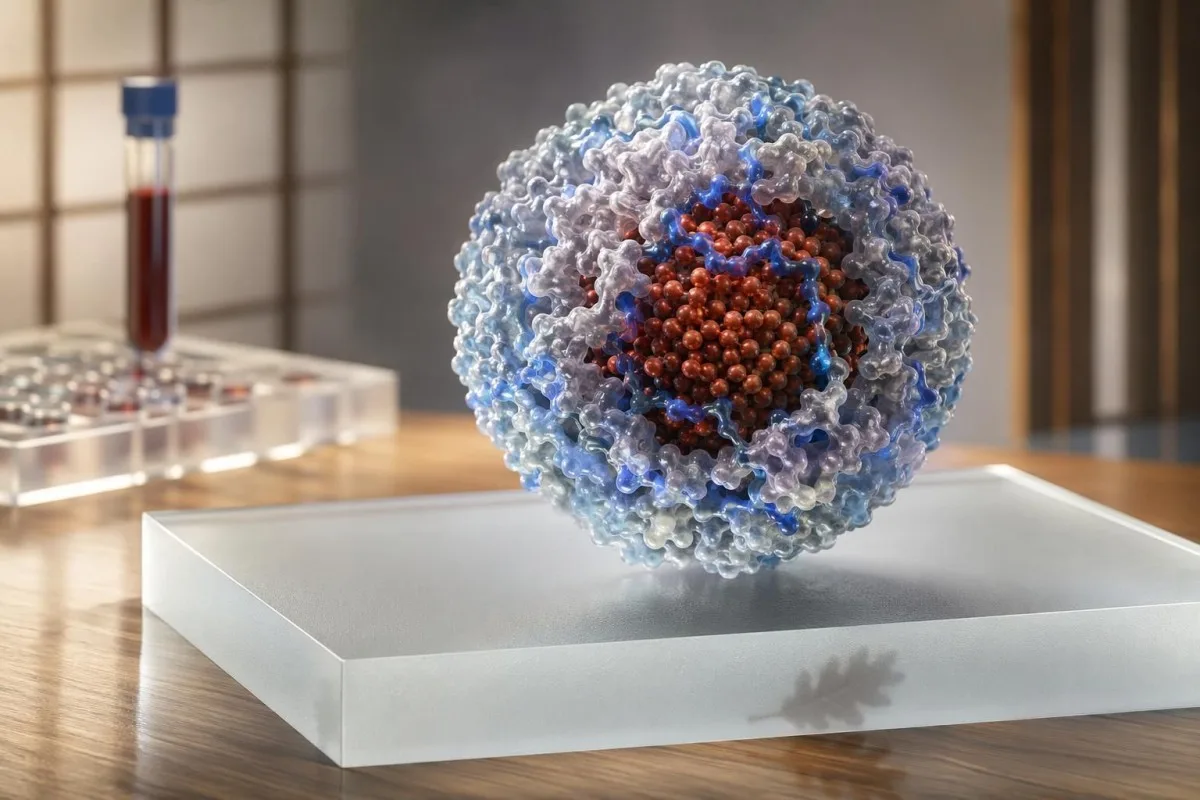
Ferritin is a storage marker, so the story sits between two dates. The useful question is not only whether the number is low, but what changed in your body, diet, cycle, inflammation, or lab method between visits.


- Ferritin drop usually reflects iron use, iron loss, lower inflammation, changed supplementation, or lab-method variation between two blood tests.
- Low ferritin below 15 ng/mL strongly suggests depleted iron stores in otherwise healthy adults; many clinicians treat 15-30 ng/mL as early deficiency.
- Inflammation shift can lower ferritin without new iron loss because ferritin rises during infection or tissue response and falls as CRP or ESR settles.
- Blood loss from heavy periods, frequent donation, gastrointestinal loss, nosebleeds, or recent surgery is the first timeline to reconstruct.
- Iron saturation below 20% with rising TIBC supports iron deficiency even when ferritin is borderline or distorted by inflammation.
- Oral iron often needs 6-8 weeks before ferritin clearly rises; hemoglobin may improve earlier if anemia was present.
- Lab variability of roughly 5-15% can make small ferritin changes look meaningful when they are not, especially across different laboratories.
- Recheck timing is usually 6-8 weeks after diet or oral iron changes, 8-12 weeks after infusion, and 2-4 weeks after an acute infection resolves.
Ferritin drops are timeline clues, not verdicts
Ferritin usually drops because iron stores were used, lost, no longer being artificially raised by inflammation, or measured differently at the second visit. If you are asking why did my ferritin drop, compare the dates: periods, donation, illness, diet, supplements, pregnancy, exercise load, and the exact lab method. A fall from 80 to 45 ng/mL means something different from 22 to 9 ng/mL.
When I review a falling ferritin result, I do not start with panic. I start with a calendar. A 28-year-old runner in our clinic once fell from 54 to 18 ng/mL over 14 weeks; the clue was not the lab printout but two heavy cycles, a half-marathon block, and switching from red meat to a mostly plant-based diet.
Ferritin is an iron-storage protein, and 1 ng/mL is often used clinically as a rough proxy for about 8-10 mg of stored iron, though that shortcut becomes unreliable during inflammation. Our Kantesti AI trend view compares ferritin with CBC, CRP, iron saturation, and previous uploads because one isolated result is a poor detective.
A falling value is more useful when placed on a blood test comparison chart. The same 20 ng/mL drop can be harmless lab noise, early iron loss, or recovery from a recent infection depending on hemoglobin, MCV, RDW, transferrin saturation, and symptoms.
As Thomas Klein, MD, I tell patients this: ferritin is a timeline marker with a medical memory. It remembers blood loss, absorption problems, supplement timing, and inflammatory events weeks before hemoglobin may admit anything is wrong.
How much of a ferritin drop is clinically meaningful?
A ferritin drop becomes clinically meaningful when it is larger than expected assay variation, crosses a decision threshold, or matches symptoms or other iron markers. A fall of 10 ng/mL from 110 to 100 ng/mL is usually less concerning than a fall of 10 ng/mL from 22 to 12 ng/mL.
Ferritin below 15 ng/mL in an otherwise healthy adult strongly suggests absent or near-absent iron stores, according to the WHO ferritin guideline (World Health Organization, 2020). Many clinicians become concerned earlier, around 30 ng/mL, because symptoms and low iron availability often appear before classic anemia.
Adult reference intervals vary widely: many laboratories list about 12-150 ng/mL for women and 30-400 ng/mL for men, but those ranges are not the same as optimal personal baselines. Our normal ferritin range guide explains why a lab flag can miss a meaningful personal decline.
Assay imprecision matters. In real practice, a 5-15% swing can occur from method variation, sample handling, or different analyzers, so I usually trust a repeated downward pattern more than one small dip.
Kantesti AI interprets ferritin changes by pairing the absolute number with the blood test difference between visits. A drop that crosses 30 ng/mL, coincides with rising RDW, and lowers transferrin saturation below 20% has a very different risk profile than an isolated, stable CBC.
Blood loss is the first timeline to reconstruct
Blood loss is the most common reason ferritin falls between visits because each milliliter of lost red cell volume carries iron out of storage. The body can keep hemoglobin normal for weeks or months while ferritin quietly pays the bill.
One standard whole blood donation removes about 200-250 mg of iron, enough to drop ferritin noticeably for several months in people with modest reserves. I have seen ferritin fall from 65 to 24 ng/mL after two donations in 6 months, even when hemoglobin stayed above 13 g/dL.
For menstruating patients, heavy periods are the obvious suspect, but not the only one. Nosebleeds, hemorrhoids, endurance running with gastrointestinal irritation, recent surgery, and frequent phlebotomy can all create the same pattern; our nosebleed lab guide covers the CBC and clotting checks I usually want if bleeding is recurrent.
In adult men and postmenopausal women, unexplained iron deficiency deserves a gastrointestinal review rather than months of blind supplements. The British Society of Gastroenterology guideline recommends investigating confirmed iron deficiency anemia for possible GI sources, especially in these groups (Snook et al., 2021).
The pattern that worries me is falling ferritin plus falling hemoglobin, falling MCH, or rising RDW. That combination points beyond a storage issue and toward developing anemia, which is why I often pair ferritin with the anemia pattern guide.
Menstrual patterns that quietly drain iron stores
Menstrual blood loss can lower ferritin even when a period is considered normal by the patient. A pattern of changing pads or tampons every 1-2 hours, bleeding longer than 7 days, or passing large clots is enough to deplete iron stores over repeated cycles.
In my experience, the biggest miss is not asking whether the pattern changed. A patient may have had manageable 4-day periods for years, then develop 8-day bleeding during perimenopause; ferritin can fall from 48 to 19 ng/mL in 3-4 cycles without hemoglobin flagging yet.
A practical threshold is simple: if menstrual products are saturated in under 2 hours, or nighttime changes are needed, iron loss may exceed dietary replacement. Our women's blood test checklist puts ferritin beside TSH, CBC, B12, vitamin D, and pregnancy-related markers because these patterns often overlap.
Cycle day rarely changes ferritin dramatically in a single morning, but the months before the test matter a lot. Testing 2 days after a heavy period does not instantly erase iron stores; the fall reflects cumulative loss over several cycles.
If periods became heavier after starting anticoagulants, copper-containing contraception, postpartum changes, thyroid shifts, or perimenopause, ferritin deserves a targeted recheck. The practical tip: write the last 3 cycle lengths and heavy days on the same note as your lab date.
Diet and absorption changes can lower ferritin within months
Diet changes can lower ferritin when iron intake drops, heme iron is removed, absorption is blocked, or total calories fall. The effect is usually measured over 8-16 weeks, not after one low-iron meal.
Heme iron from meat and fish is absorbed more efficiently than non-heme iron from plants, often around 15-35% versus 2-20% depending on the meal. That gap explains why ferritin may drop after a well-intentioned diet shift even when total iron on a food app looks adequate.
Tea, coffee, calcium, and high-dose zinc can reduce non-heme iron absorption when taken with iron-rich meals or supplements. Our low ferritin diet guide gives practical timing rules, such as separating iron from calcium by at least 2 hours.
I often see this after GLP-1 medication, bariatric surgery, intense fat-loss plans, or a move to vegan eating. A routine vegan blood test should include ferritin, CBC, B12, folate, and sometimes zinc because fatigue rarely belongs to one marker.
Camaschella's NEJM review on iron-deficiency anemia describes the central clinical issue clearly: iron deficiency can be caused by low intake, impaired absorption, increased needs, or chronic loss (Camaschella, 2015). The trick is matching that mechanism to your personal timeline rather than treating every low ferritin result the same.
Inflammation falling can make ferritin look lower
Ferritin can drop when inflammation improves because ferritin behaves as an acute-phase reactant. A high ferritin during infection, autoimmune activity, liver stress, or recent tissue response may fall later even if iron stores did not truly worsen.
This is one of those areas where context matters more than the number. A ferritin fall from 180 to 70 ng/mL after pneumonia may be reassuring if CRP fell from 80 to 4 mg/L and hemoglobin is stable.
The WHO guideline uses higher ferritin cutoffs when inflammation is present, including about 70 ng/mL in adults with infection or inflammation, because ordinary low-ferritin thresholds can miss deficiency in that setting (World Health Organization, 2020). Pairing ferritin with CRP after infection prevents a common misread.
A classic confusing pattern is low serum iron, normal or high ferritin, low transferrin saturation, and high CRP. That may be iron restriction from inflammation rather than simple iron depletion, and the treatment conversation differs.
Kantesti's neural network flags this by looking for ferritin moving opposite to CRP or ESR. If ferritin falls while CRP normalizes, I am less worried than if ferritin falls while TIBC rises and saturation drops below 20%.
Supplements, infusions, and stopping iron change the curve
Ferritin can fall after stopping iron, missing doses, switching formulations, taking iron with blockers, or moving past the temporary peak after an infusion. The supplement timeline often explains the lab timeline more accurately than the dose printed on the bottle.
Typical oral iron treatment uses about 40-65 mg of elemental iron per dose, often daily or every other day depending on tolerance. Alternate-day dosing can improve absorption for some patients because hepcidin, the iron-regulating hormone, rises after iron intake.
Do not judge oral iron after 10 days unless hemoglobin is dangerously low or symptoms are severe. Ferritin often needs 6-8 weeks to show a clear trend, while reticulocytes and hemoglobin may respond sooner in true iron deficiency.
After intravenous iron, ferritin can jump into the hundreds of ng/mL, then drift down as iron is distributed to marrow and tissues. Our infusion timeline explains why checking ferritin too soon after infusion can exaggerate the apparent store.
The less glamorous causes are common: iron taken with coffee, calcium, proton pump inhibitors, or magnesium; capsules stopped because of constipation; or a prenatal vitamin that contains too little elemental iron. The supplement timing guide is worth reading before increasing dose.
Pregnancy, postpartum, and growth create different baselines
Ferritin often falls during pregnancy, postpartum recovery, adolescence, and rapid training phases because iron demand rises faster than intake. In these states, a ferritin value that looks only mildly low can still matter clinically.
Pregnancy requires roughly 1,000 mg of additional iron across gestation for expanded red cell mass, fetal needs, and delivery-related losses. A ferritin of 25 ng/mL in early pregnancy is not the same story as 25 ng/mL in a nonpregnant adult with no symptoms.
Postpartum ferritin can stay low for months, especially after significant delivery loss, short spacing between pregnancies, or exclusive breastfeeding with poor intake. Our postpartum lab guide includes ferritin because fatigue, mood symptoms, and hair shedding overlap too easily.
Teenagers can drain iron quickly during growth spurts and menstrual onset. Athletes add another twist: foot-strike hemolysis, sweat iron loss, and gastrointestinal irritation can all reduce iron availability despite a high-calorie diet.
For pregnancy-specific interpretation, I prefer ferritin plus CBC, transferrin saturation, and clinician review rather than a single cutoff. The pregnancy iron range article explains why trimester context changes what counts as reassuring.
The rest of the iron panel tells whether the drop matters
A ferritin drop matters more when transferrin saturation falls below 20%, TIBC rises, MCV or MCH declines, or RDW increases. Ferritin alone tells you storage direction; the iron panel tells you whether tissues are receiving enough iron.
Serum iron is noisy because it changes with meals, time of day, and recent supplements. Transferrin saturation, calculated from serum iron and binding capacity, is more useful; below 20% often supports iron-restricted red cell production.
TIBC usually rises when the body is trying to capture more iron, and it often falls or stays normal during inflammation. The TIBC interpretation guide is where I send patients who have a ferritin result that does not match serum iron.
A low ferritin with normal hemoglobin is early iron deficiency until proven otherwise, especially if MCH is sliding toward 27 pg or MCV is drifting below 82 fL. Our early iron loss article covers why waiting for anemia can be a mistake.
Kantesti AI reads more than 15,000 biomarkers and compares iron results against CBC morphology clues, inflammation markers, kidney function, and uploaded history. That is the difference between a lab result tracker and a clinically useful blood test timeline.
Lab variability and unit changes can fake a ferritin drop
A ferritin drop can be partly artificial when tests are done at different labs, with different immunoassays, different reference intervals, or different units. Ferritin in ng/mL is numerically equivalent to µg/L, but not every report displays units clearly.
Some European labs use lower reference intervals for premenopausal women than many North American labs, and both can be technically correct. Reference ranges describe local populations, not your personal iron requirement.
A real lab-method difference of 5-15% is common enough that I hesitate to overinterpret a ferritin change from 52 to 46 ng/mL. A change from 52 to 18 ng/mL, tested twice, is a different animal.
Unit confusion is boring but dangerous. Our guide to different lab units explains how mg/L, µg/L, ng/mL, and local reference flags can mislead when results are copied by hand.
Hydration does not move ferritin as dramatically as albumin or hematocrit, but sample timing still matters. If the second test followed acute illness, heavy exercise, or a supplement dose the night before, I mark the result as interpretable but not final.
Symptoms help rank urgency, but symptoms lag behind ferritin
Symptoms can support a ferritin trend, but they often appear after iron stores have already fallen. Fatigue, reduced exercise tolerance, hair shedding, headaches, restless legs, palpitations, and shortness of breath deserve more attention when ferritin is below 30 ng/mL or falling fast.
Restless legs is the symptom where ferritin thresholds differ from routine anemia screening. Many sleep clinicians aim for ferritin above 75 ng/mL in symptomatic restless legs, though the exact target remains debated and should be individualized.
Hair shedding is similar: ferritin below 30-50 ng/mL may contribute in some patients, but thyroid disease, postpartum shifts, low protein intake, and stress can look identical. Our hair loss blood tests guide keeps ferritin in the right company.
A patient with ferritin 12 ng/mL, hemoglobin 13.1 g/dL, and marathon fatigue is not imagining it. Iron is needed for muscle oxygen handling and mitochondrial enzymes, so performance can decline before the CBC crosses a red line.
The reverse is also true. A tired person with ferritin 70 ng/mL and CRP 25 mg/L needs a broader search, not automatic iron; our restless legs ferritin article shows how symptom-specific thresholds change the conversation.
When to recheck ferritin and iron studies
Most non-urgent ferritin drops should be rechecked with a full iron panel in 6-8 weeks after diet or oral iron changes. Recheck sooner if hemoglobin is falling, symptoms are severe, pregnancy is involved, or there are signs of ongoing blood loss.
A useful repeat panel includes ferritin, serum iron, TIBC or transferrin, transferrin saturation, CBC with indices, and CRP if illness or inflammation is plausible. Reticulocyte count helps when anemia is present and you need to see whether marrow is responding.
After oral iron, 6-8 weeks is usually enough to see direction, but 3 months is often needed to rebuild stores. After an iron infusion, I usually wait 8-12 weeks before using ferritin to judge stable stores unless the clinician has a specific reason.
After infection, vaccination reaction, flare, or surgery, ferritin may stay distorted for 2-4 weeks. Our repeat abnormal labs guide gives marker-specific retesting windows so people do not retest too early and chase noise.
If you are planning a retest, change one thing at a time when possible. The retest timeline guide helps separate real improvement from random variation.
Red flags: when a falling ferritin needs medical review
A falling ferritin needs medical review when it is below 15 ng/mL, paired with anemia, unexplained in a man or postmenopausal woman, associated with black stools or weight loss, or occurring during pregnancy. Do not manage those patterns with supplements alone.
Hemoglobin below the local lower limit plus ferritin below 15-30 ng/mL is not just a nutrition project. It is iron deficiency anemia until the cause is found, and the cause may be gynecologic, gastrointestinal, dietary, medication-related, or mixed.
Snook et al. state in the British Society of Gastroenterology guideline that new iron deficiency anemia in adult men and postmenopausal women warrants evaluation for gastrointestinal causes because malignancy and other treatable conditions can present this way (Snook et al., 2021). That does not mean cancer is likely; it means missing it is costly.
High ESR with low hemoglobin raises a different concern because inflammation, autoimmune disease, kidney disease, and malignancy can all complicate iron interpretation. Our ESR hemoglobin pattern guide explains why ferritin may be normal or high despite true iron-restricted blood production.
Seek urgent care rather than routine retesting if there is chest pain, fainting, severe shortness of breath, rapid heart rate at rest, pregnancy with marked symptoms, or visible gastrointestinal bleeding. Ferritin is slow-moving; unstable symptoms are not.
How a lab result tracker turns ferritin into a blood test timeline
A lab result tracker helps explain ferritin drops by lining up values, units, reference ranges, symptoms, supplements, illness, and menstrual or donation dates. The useful view is not one report; it is the slope across visits.
I like patients to record five dates beside ferritin: last heavy bleeding episode, last donation, start or stop of iron, recent infection, and major diet change. In our analysis of 2M+ blood tests, those five dates explain a surprising number of ferritin surprises.
A good tracker also preserves units and lab source. Our blood test history guide shows why keeping PDFs matters when reference ranges change or older portals disappear.
Kantesti compares uploaded PDFs or photos in about 60 seconds, then highlights whether the blood test difference between visits is likely meaningful. The progress tracking guide is a practical companion if you are following ferritin after treatment.
You can upload your latest report to our platform and compare it with earlier results instead of reading each PDF in isolation. For a no-cost first pass, use the free blood test analysis.
Personal baseline beats the generic reference range
Your personal ferritin baseline is often more informative than the printed reference range. A drop from 95 to 38 ng/mL may be normal on paper, but it can be clinically relevant if your usual ferritin has been stable near 90 ng/mL for years.
Reference intervals usually capture the middle 95% of a tested population, not the level where you feel best or perform best. That is why a lab may mark ferritin 18 ng/mL as normal while a clinician sees a probable cause of fatigue or hair shedding.
Personal baselines are especially useful for endurance athletes, people with heavy periods, inflammatory conditions, bariatric surgery, vegetarian diets, and prior iron deficiency. The personalized blood test approach prevents overreacting to one flag and underreacting to a real trend.
As Thomas Klein, MD, I have become more conservative about ignoring borderline ferritin when RDW is rising. A normal hemoglobin can hide early iron strain for months, particularly in younger adults with good marrow reserve.
Kantesti's medical reviewers and our Medical Advisory Board emphasize this pattern-based approach because patients rarely arrive as textbook averages. They arrive with old labs, medication changes, pregnancies, diets, training blocks, and messy real life.
Research notes and Kantesti clinical publications
The best ferritin interpretation combines guideline thresholds, peer-reviewed hematology evidence, and structured trend analysis. As of May 13, 2026, Kantesti's clinical content is built to connect iron markers with neighboring biomarkers rather than treating ferritin as a stand-alone label.
Our clinical standards are reviewed through medical validation processes that compare AI interpretation with physician reasoning across specialties. The public benchmark is also available as the Kantesti AI Engine validation preprint: population-scale benchmark.
For deeper iron-marker interpretation, see Kantesti Ltd. (2026). Iron Studies Guide: TIBC, Iron Saturation & Binding Capacity. Zenodo. https://doi.org/10.5281/zenodo.18248745. ResearchGate. Academia.edu.
Kantesti Ltd. (2026). Urobilinogen in Urine Test: Complete Urinalysis Guide 2026. Zenodo. https://doi.org/10.5281/zenodo.18226379. ResearchGate. Academia.edu.
If your ferritin fell and you are unsure whether it is blood loss, diet, inflammation, or lab variation, upload both reports to Kantesti. A physician visit is still needed for red flags, but a clean timeline can make that visit far more productive.
Frequently Asked Questions
Why did my ferritin drop if my hemoglobin is normal?
Ferritin can drop while hemoglobin stays normal because iron stores are used before red cell production fails. Ferritin below 15 ng/mL strongly suggests depleted stores, while 15-30 ng/mL often represents early iron deficiency in the right context. Heavy periods, donation, diet changes, and absorption problems commonly lower ferritin months before anemia appears. A full iron panel with transferrin saturation and CBC indices is more useful than repeating ferritin alone.
Can inflammation make ferritin drop between blood tests?
Yes, ferritin can drop when inflammation improves because ferritin rises as an acute-phase reactant during infection, autoimmune activity, liver stress, or tissue response. A fall from 180 to 70 ng/mL may be reassuring if CRP also falls from 80 to 4 mg/L. The WHO guideline uses higher ferritin cutoffs, around 70 ng/mL in adults with inflammation, because ordinary low thresholds can miss deficiency. Always compare ferritin with CRP, ESR, iron saturation, and symptoms.
How fast can ferritin fall after blood donation or heavy periods?
Ferritin can fall within weeks after meaningful blood loss, but the measured pattern often reflects cumulative loss over several months. One whole blood donation removes about 200-250 mg of iron, which can lower ferritin for 2-4 months in people with modest stores. Heavy menstrual bleeding over 3-4 cycles can produce a similar drop even if hemoglobin remains normal. Rechecking ferritin and iron saturation after 6-8 weeks is usually reasonable if symptoms or ongoing loss are present.
What ferritin level is considered low?
Ferritin below 15 ng/mL is widely used as a strong marker of depleted iron stores in otherwise healthy adults. Many clinicians treat 15-30 ng/mL as low or borderline when fatigue, hair shedding, restless legs, heavy periods, pregnancy, or low iron saturation are present. Some symptom-specific situations, such as restless legs, may use targets above 50-75 ng/mL. Laboratory reference ranges vary, so personal trend and clinical context matter.
When should I recheck ferritin after starting iron?
Most people should recheck ferritin with a full iron panel after 6-8 weeks of consistent oral iron or diet changes. Hemoglobin and reticulocytes may improve earlier if anemia was present, but ferritin often takes longer to rebuild. After intravenous iron, ferritin may be artificially high at first, so many clinicians wait 8-12 weeks before judging stable stores. If hemoglobin is falling, pregnancy is involved, or symptoms are severe, recheck timing should be set by a clinician.
Can a ferritin drop be a lab error?
A small ferritin drop can reflect lab variation rather than a true change, especially when tests are done at different laboratories. Ferritin immunoassays can vary by roughly 5-15%, so a change from 52 to 46 ng/mL is often less meaningful than a fall from 52 to 18 ng/mL. Unit confusion also matters because ng/mL and µg/L are numerically equivalent but may be displayed differently. Repeat testing with the same lab and a full iron panel is the safest way to confirm a trend.
Should I take iron if my ferritin dropped?
Do not start high-dose iron solely because ferritin dropped unless the pattern supports iron deficiency or a clinician advised it. Ferritin below 15-30 ng/mL, low transferrin saturation below 20%, rising TIBC, or falling MCV makes iron deficiency more likely. If ferritin dropped because inflammation resolved, extra iron may not be needed and can cause side effects. Adult men, postmenopausal women, pregnant patients, and anyone with anemia or gastrointestinal symptoms should get medical review before self-treating.
Get AI-Powered Blood Test Analysis Today
Join over 2 million users worldwide who trust Kantesti for instant, accurate lab test analysis. Upload your blood test results and receive comprehensive interpretation of 15,000+ biomarkers in seconds.
📚 Referenced Research Publications
Klein, T., Mitchell, S., & Weber, H. (2026). Urobilinogen in Urine Test: Complete Urinalysis Guide 2026. Kantesti AI Medical Research.
Klein, T., Mitchell, S., & Weber, H. (2026). Iron Studies Guide: TIBC, Iron Saturation & Binding Capacity. Kantesti AI Medical Research.
📖 External Medical References
World Health Organization (2020). WHO guideline on use of ferritin concentrations to assess iron status in individuals and populations. World Health Organization.
⚕️ Medical Disclaimer
This article is for educational purposes only and does not constitute medical advice. Always consult a qualified healthcare provider for diagnosis and treatment decisions.
E-E-A-T Trust Signals
Experience
Physician-led clinical review of lab interpretation workflows.
Expertise
Laboratory medicine focus on how biomarkers behave in clinical context.
Authoritativeness
Written by Dr. Thomas Klein with review by Dr. Sarah Mitchell and Prof. Dr. Hans Weber.
Trustworthiness
Evidence-based interpretation with clear follow-up pathways to reduce alarm.